Analysis and reflective essay | Author: Sherafgan Khan | Researched and fact-checked July 30, 2026 | About a 16-minute read
Solarpunk is a literary, artistic, and political movement that asks a practical question: What would a sustainable civilization look like if ordinary people had meaningful power over the systems that shape their lives?
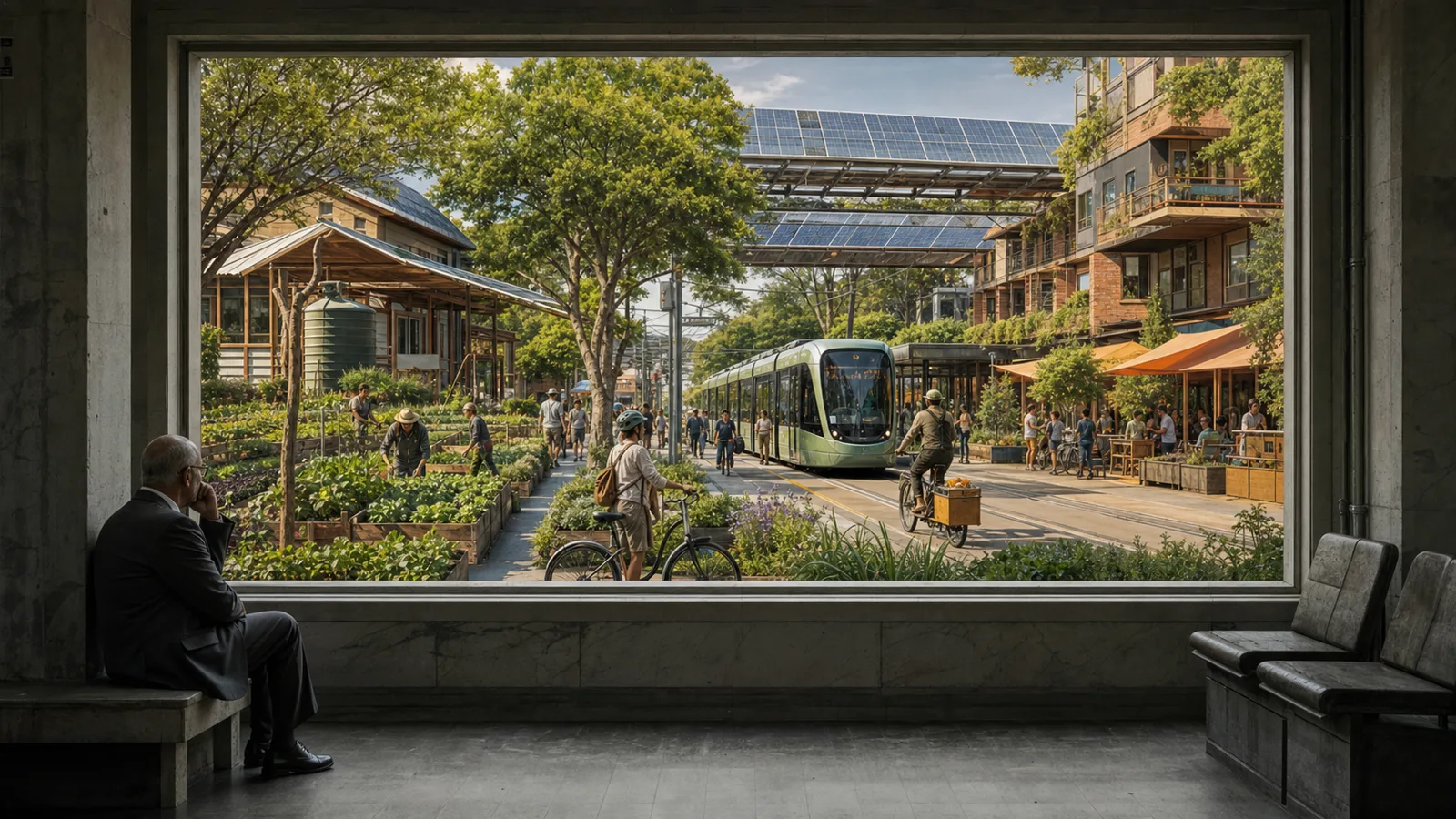
The familiar images—solar roofs, abundant trees, electric rail, community gardens, graceful buildings—are only the surface. Underneath them is a deeper claim. A livable future requires clean energy, but it also requires democratic control, public goods, repairable technology, less extractive consumption, and communities designed around human life rather than permanent crisis.
My argument is that the most defensible version of America’s future is already moving in a solarpunk direction. Not because history guarantees a green utopia, and not because every solarpunk idea is ready for national policy. It is because the material pieces are arriving faster than the political story that would connect them.
The technology is crossing into the present. The public often supports pieces of the transition. Yet the governing system remains organized around money, institutional inertia, fossil dependence, permanent military commitments, and a political imagination trained to treat preventable suffering as realism.
That gap is the Overton window.
The catch is that windows do not move by waiting alone.
Key takeaways
- Solarpunk is more than an aesthetic. It combines speculative fiction, ecological design, renewable energy, community power, repair culture, and social justice.
- Much of the physical future already exists. Solar, battery storage, community energy, electric transit, efficient buildings, urban agriculture, and walkable neighborhoods are deployable technologies and designs.
- The main barrier is political legitimacy and control. A technology can be feasible and popular while the policies needed to scale it remain outside what national institutions treat as serious.
- Money makes the political window sticky. Campaign finance, lobbying, media incentives, incumbency, and concentrated ownership give organized interests more staying power than diffuse public preferences.
- War powers reveal the democratic distance most starkly. Americans can oppose a conflict after it begins while the institutional machinery of war continues with limited direct public consent.
- Solarpunk is not inevitable. A green future can still be unequal, privatized, militarized, and extractive. The “punk” matters because ownership and power determine who benefits.
- Waiting is not a strategy. The Overton window moves when people build credible examples, new institutions, durable coalitions, and language that makes a different future feel governable.
What is solarpunk?
The word solarpunk first appeared in a 2008 blog post titled “From Steampunk to Solarpunk”. The initial idea was a speculative genre centered on technologies that were imaginative but practical under modern economic conditions.
The concept widened. In 2014, Adam Flynn’s “Solarpunk: Notes Toward a Manifesto” helped define it as a culture of craftsmanship, community, renewable technology, and infrastructure as a form of resistance. Writers, artists, architects, gardeners, designers, and activists have since used the term for overlapping things: a science-fiction genre, a visual language, a design philosophy, and a political horizon.
Academic work describes solarpunk as an energy imaginary: a way of thinking not only about new machines, but about the social relationships and institutions a transition would require. Rhys Williams’s peer-reviewed study of solarpunk emphasizes the relationship among imagined infrastructure, community-building, and present-day agency. That is what separates solarpunk from a catalog of green gadgets.
Solarpunk asks who owns the roof, who controls the grid, who can afford the neighborhood, who performs the labor, where the materials came from, and whether the system can be repaired without begging a monopoly for permission.
| Vision | Technology | Social order | Dominant feeling |
|---|---|---|---|
| Cyberpunk | Advanced, concentrated, surveillant | Corporate power and extreme inequality | The future arrived and most people lost |
| Corporate “green” futurism | Efficient but proprietary | Existing hierarchies painted green | Consumption will save us |
| Solarpunk | Advanced where useful, simple where sufficient, repairable | Democratic, local, cooperative, and publicly accountable | The future can be built and contested |
The table is necessarily simplified. Solarpunk is a decentralized movement, not a party platform. Its internal arguments—about markets, government, nuclear power, density, rural life, technology, and scale—are part of the tradition rather than evidence that it has failed to become one doctrine.
What would a solarpunk United States actually look like?
It would not look like every American moving into a vine-covered glass tower.
It might look like a Texas town using solar and batteries to keep critical services running during grid stress. It might be a Midwestern city converting dangerous arterial roads into shaded corridors for buses, bicycles, shops, and housing. It could be a tribal energy project, a rural electric cooperative, an apartment building sharing community-solar savings, a public library lending tools, or a neighborhood where an elderly person can buy groceries without operating two tons of machinery.
At national scale, the pattern would include:
- abundant low-carbon electricity from a diverse and resilient grid;
- buildings that need less energy and remain safe during heat, smoke, cold, and outages;
- fast intercity rail and dependable local transit where density supports them;
- electric vehicles where cars remain necessary;
- housing near jobs, schools, parks, food, and daily services;
- public spaces designed for shade, water management, disability access, and social life;
- durable products, repair rights, reuse systems, and less planned obsolescence;
- community, cooperative, municipal, tribal, and public ownership alongside responsible private enterprise;
- a shorter distance between the people who bear a decision’s costs and the institutions that make it.
This future would still contain markets, disagreement, industry, large infrastructure, and national government. Solarpunk becomes intellectually weak when it pretends complex systems can be replaced by a collection of gardens. A continental grid, semiconductor supply chain, rail network, vaccine plant, or disaster response system cannot be run as a neighborhood hobby.
The better principle is subsidiarity with capacity: decisions should be made as close to affected people as practical, while higher levels of government retain enough competence to coordinate systems that genuinely cross local boundaries.
The material transition is already ahead of the political story
The most important fact about solarpunk is that many of its components are no longer speculative.
The U.S. Energy Information Administration reported that developers planned to add a record 86 gigawatts of utility-scale generating capacity in 2026. Solar accounted for 51% of the planned additions, battery storage 28%, and wind 14%. Those projects may not all arrive on schedule, and capacity is not the same as annual electricity generation. Still, the direction is unmistakable: solar and storage are becoming ordinary infrastructure.
The politics is more complicated. A 2026 Pew Research Center survey found that 65% of Americans favored federal policies encouraging wind and solar production. But support had declined from 72% in 2022, driven largely by a sharp partisan shift. Only 44% of Republicans supported encouragement in 2026, compared with 85% of Democrats.
That is both the case for optimism and the warning against inevitability.
Solar grows because of engineering, capital costs, state policy, electricity demand, private investment, and local conditions. But no technology escapes politics. Transmission lines must be permitted. Benefits and costs must be distributed. Workers and communities dependent on old industries need credible transitions. Mining, land, water, recycling, reliability, and supply chains require governance rather than slogans.
Even access to solar is a political design choice. Community-solar programs can let renters and households without suitable roofs receive electricity-bill credits from shared projects. The Department of Energy has documented both the opportunity and the rules needed to ensure savings reach residents of federally assisted housing. A solar panel does not decide whether its value flows to a tenant, a utility, a landlord, a private equity fund, or a community cooperative. Policy does.
Solarpunk is therefore not the belief that technology will rescue politics. It is the belief that technology and politics must be designed together.
What is the Overton window?
The Overton window is the range of policies that political institutions treat as acceptable or electorally safe at a given time.
Joseph Overton developed the model in the 1990s while working at the Mackinac Center for Public Policy. The center’s own explanation stresses that ideas outside the window are not necessarily impossible or wrong; they require different work—research, communication, coalition-building, and changes in public legitimacy—before officeholders consider them politically viable.
The term is often misused. It does not mean “whatever most people want.” Public opinion is one force among many. A proposal may poll well in the abstract but collapse when attached to taxes, tradeoffs, partisan identities, implementation details, or a particular messenger. Conversely, a policy can remain institutionally secure even when public approval erodes.
The Overton window is better understood as a measure of governability as perceived by power.
That distinction explains a great deal about the United States. Americans may favor clean energy, distrust campaign donors, oppose a particular war, want cheaper housing, and resent monopoly power—yet see little movement that joins those preferences into a durable governing program.
The policy pieces exist inside different partisan boxes. The story connecting them remains outside.
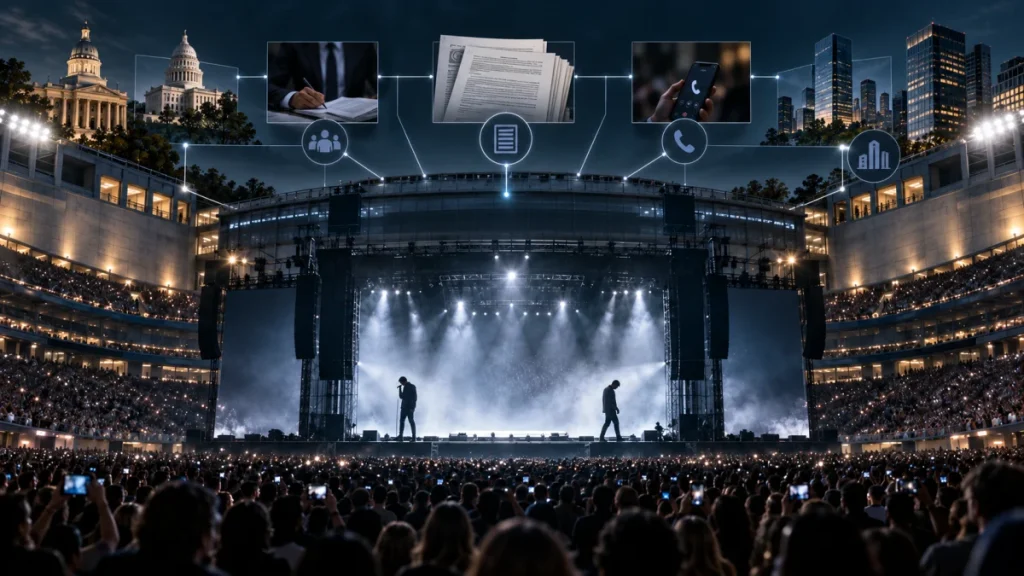
Money in politics makes the window sticky
It is easy to say American politics is corrupt. It is harder, and more useful, to specify what that means.
Bribery is illegal. Lobbying, donations, independent expenditures, fundraising, access, revolving-door employment, and ideological media are largely legal and governed by different rules. Treating them as identical can turn a structural critique into an accusation that cannot be proved.
The stronger claim is that American politics contains a legal influence system that can produce corrupting dependence without requiring a cash-filled envelope.
The scale is not imaginary. The Federal Election Commission reported that during the 2023–2024 cycle, presidential candidates raised $2 billion, congressional candidates raised about $3.8 billion, political parties received $2.7 billion, and PACs reported $15.7 billion in receipts. These categories overlap through transfers and should not be added into a single “cost of the election” figure. Separately, reported independent expenditures reached $4.4 billion.
The public recognizes the distortion. In a large 2023 Pew survey:
- 85% said campaign costs make it hard for good people to run;
- 84% said special interests and lobbyists have too much say;
- 80% said major campaign donors have too much influence over congressional decisions;
- 70% said constituents have too little influence.
Those findings crossed party lines. They do not prove that every policy outcome is purchased. They show a deep bipartisan belief that formal political equality coexists with radically unequal political leverage.
This is how the window becomes sticky. Organized wealth can fund years of litigation, advertising, primary challenges, research, lobbying, and candidate recruitment. A diffuse public preference is usually expressed for a few minutes in a survey or an election. The two forms of power do not meet on equal terms.
Solarpunk sits outside the window partly because it threatens more than a fuel source. Its serious versions question who owns infrastructure, who captures productivity gains, why public abundance is treated as suspicious, and why necessities are often designed as tollbooths.
War is the most violent expression of democratic distance
The United States has not issued a formal declaration of war since World War II. That does not mean every later conflict was simply an unauthorized presidential adventure.
Congress has enacted roughly 50 statutory authorizations for uses of military force, according to the Congressional Research Service, and most historically major uses of force abroad had some congressional authorization. Congress also funds operations, conducts oversight, and can legislate limits. At the same time, presidents of both parties have claimed broad independent power to initiate some military actions, while Congress has often avoided forcing a decisive public vote.
The result is dispersed responsibility. A war can be too presidential for Congress to own, too congressional for the president to own alone, and too distant from ordinary citizens for the public to meaningfully authorize before the machinery is moving.
The current Iran war illustrates the gap. On July 30, 2026, the Associated Press reported that about two-thirds of U.S. adults said the war had not been worth fighting. Only 28% approved of President Donald Trump’s handling of Iran in the July AP-NORC poll. Earlier, a March Pew survey found 59% said the initial decision to use force was wrong.
Public opinion is not a command structure, and polls taken after hostilities begin cannot substitute for constitutional process. But that is precisely the point. The public often receives its clearest opportunity to judge a war after lives, alliances, budgets, and retaliatory dynamics are already committed.
Other conflicts show why generalization must be cautious. Americans have been divided about the appropriate level of support for Ukraine. Views of Israel, Gaza, military aid, civilian protection, and U.S. diplomacy vary by question and party. “Most Americans oppose all U.S. involvement” would be false.
The defensible claim is narrower and more troubling: even when majorities reject a specific military course, the distance between public preference and policy reversal can remain enormous.
Solarpunk is antiwar not because every person in the movement shares one foreign-policy doctrine. It is antiwar because permanent conflict consumes money, materials, attention, legitimacy, and human beings that could have built resilience instead. It treats security as the capacity for people to live—energy, food, housing, health, climate stability, trusted institutions—not merely the capacity to destroy.
That same connection appears in Sherafy’s analysis of how the Iran war exposed the strategic value of electrification and reduced oil dependence. A society less dependent on vulnerable fuel chokepoints is not only cleaner. It is harder to coerce and less tempted to organize foreign policy around controlling combustion.
Solarpunk is not left-wing décor
Some solarpunk values are associated with the political left: ecological limits, public investment, labor power, social equality, and skepticism toward concentrated capital. But reducing the movement to left-wing décor misses its wider American vocabulary.
Solarpunk also speaks to:
- local self-reliance;
- freedom from monopoly utilities and planned obsolescence;
- domestic energy security;
- small-scale enterprise and skilled trades;
- stewardship of land and water;
- voluntary associations, mutual aid, and cooperatives;
- towns designed for children, older adults, and disabled people;
- the conservative principle that a society should maintain what it inherits.
This does not erase genuine ideological conflict. It reveals that the coalition for a livable future may be larger than the vocabulary currently used to describe it.
The Overton window often moves when a previously alien idea is translated into several moral languages at once. Solar panels can represent climate action, household savings, grid resilience, national security, local control, or technological leadership. A walkable town can represent decarbonization, freedom for teenagers, aging in place, stronger small businesses, or simple beauty.
A successful future does not require everyone to share one motive. It requires their motives to become compatible enough to build.
The danger is a future that looks solarpunk but is not
A city can have green roofs, automated transit, vertical gardens, and perfect air quality while remaining brutally unequal.
If ordinary people cannot afford to live there, repair its devices, question its algorithms, own a share of its infrastructure, or participate in its government, it is not solarpunk. It is a luxury enclave with plants.
This is the most important contrary argument. The energy transition can reproduce the same extractive patterns it claims to replace:
- mining communities can bear environmental costs for distant consumers;
- clean neighborhoods can become engines of displacement;
- “smart” infrastructure can become surveillance infrastructure;
- public subsidies can socialize risk while privatizing returns;
- proprietary products can make repair impossible;
- green scarcity can justify austerity for the poor while leaving elite consumption intact.
Solarpunk offers no automatic solution to these problems. It offers a standard by which to expose them.
The “solar” is the energy horizon. The “punk” is the refusal to confuse a cleaner power source with a just society.
We should wait—but not passively
There is one sense in which waiting matters.
Infrastructure changes what people consider normal. A child who grows up riding dependable electric transit, seeing batteries stabilize a local grid, and watching a public building produce its own power will not experience those systems as radical. What one generation calls an experiment, the next may call basic competence.
Time also changes coalitions. Industries mature. Costs fall. Skilled workforces grow. Old systems fail in visible ways. New language becomes available. The window can catch up with conditions that make yesterday’s impossible policy look like tomorrow’s common sense.
But passive waiting leaves the window to the people already paid to hold it in place.
The practical solarpunk strategy is to build evidence:
- Make the future visible. Fiction and art let people desire something more specific than “less catastrophe.”
- Build working examples. A successful bus lane, community-solar project, tool library, cooperative, cooling center, or repair program converts ideology into memory.
- Protect people during transition. No durable climate coalition can be built by treating workers, renters, rural communities, or energy-burdened households as acceptable losses.
- Change ownership, not only equipment. Public and cooperative stakes keep more benefits close to the people who fund and depend on infrastructure.
- Use several political languages. Resilience, freedom, beauty, savings, security, stewardship, and justice can describe overlapping projects.
- Reform the influence system. Campaign-finance transparency, voting access, independent ethics enforcement, antitrust, and stronger public institutions are environmental policy because they determine which environmental choices can survive.
- Recover democratic authority over war. A government that cannot deliberate before destroying will struggle to deliberate before building.
Sherafy’s essay “Ants” makes a related argument in miniature: power does not move only through singular heroes. It moves when enough small actors coordinate around work none could carry alone.
That is how an Overton window really moves. First an idea is mocked. Then it becomes a subculture, a pilot project, a local success, an economic constituency, a coalition demand, a policy option, and finally something politicians insist they supported all along.
Solarpunk is a direction, not a prophecy
America’s future will not be purely solarpunk. It will be a struggle among several futures.
One is a harsher cyberpunk: concentrated wealth, privatized public space, ubiquitous surveillance, climate adaptation for those who can pay, automated precarity, and permanent war managed at a distance.
Another is nostalgic extraction: an attempt to preserve the institutions and consumption patterns of the twentieth century by burning more, policing more, and denying more.
Solarpunk is the third possibility. It accepts technological modernity without surrendering to technological rule. It accepts ecological limits without turning deprivation into virtue. It understands that abundance is possible, but only if abundance means clean energy, time, shade, mobility, health, knowledge, beauty, and democratic power—not an infinite stream of disposable objects.
That future is not waiting in a distant century. Pieces of it are operating now.
What is missing is permission: cultural permission to imagine it, political permission to propose it, and institutional permission to build it at the scale of the problem.
The Overton window will catch up only when enough people stop treating the present arrangement as the outer limit of realism.
The future arrives twice: first as infrastructure, then as common sense.
Solarpunk gives us a name for the interval between them.
References and Further Reading
Solarpunk history and theory
- Republic of the Bees, “From Steampunk to Solarpunk” (2008)
- Adam Flynn, “Solarpunk: Notes Toward a Manifesto,” Project Hieroglyph at Arizona State University (2014)
- Rhys Williams, “‘This Shining Confluence of Magic and Technology’: Solarpunk, Energy Imaginaries, and the Infrastructures of Solarity” (2019)
- Gregory Lynall, “Solarpunk,” in The Cambridge Companion to Literature and Climate (2022)
Energy, infrastructure, and public opinion
- U.S. Energy Information Administration, “New U.S. Electric Generating Capacity Expected to Reach a Record High in 2026”
- U.S. Energy Information Administration, “Solar Power Generation Drives Electricity Generation Growth Over the Next Two Years”
- Pew Research Center, “Americans’ Shifting Views on Energy Sources, Policy in 2026”
- U.S. Department of Energy, “Community Solar and Low-Income Utility Allowances”
The Overton window, money, and democratic power
- Mackinac Center for Public Policy, “What Is the Overton Window?” (2025)
- Federal Election Commission, 2023–2024 Campaign Activity Statistical Summary
- Pew Research Center, “How Americans View Money in Politics”
- U.S. Government Accountability Office, “Campaign Finance: Federal Framework, Agency Roles and Responsibilities, and Perspectives”
War powers and current conflicts
- Congressional Research Service, “Defense Primer: Legal Authorities for the Use of Military Forces” (updated December 2025)
- Congressional Research Service, “Understanding the War Powers Resolution” (2025)
- Pew Research Center, “Americans Broadly Disapprove of U.S. Military Action in Iran” (March 2026)
- Associated Press, “Most Americans Say the Iran War Has Not Been Worth Fighting” (July 30, 2026)