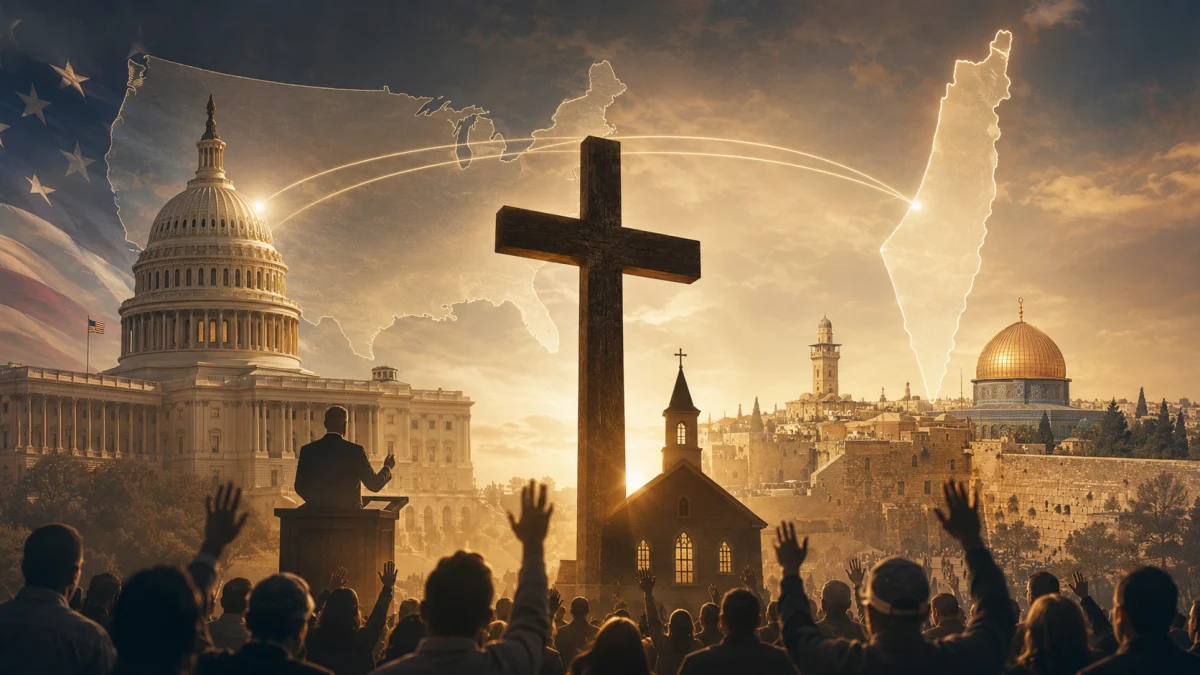
The overlooked force behind American support for Israel
Public discussions of the United States–Israel relationship usually focus on military strategy, Jewish-American political organizations, campaign donors, weapons manufacturers, or the historical memory of the Holocaust.
All of those factors matter. But they leave out one of the largest and most durable sources of support for Israel in the United States: Christian Zionism.
Christian Zionists believe, in varying forms, that the Jewish people retain a divinely established connection to the biblical land of Israel and that Christians therefore have a religious responsibility to support the modern State of Israel. Some regard Israel’s creation in 1948 and its territorial expansion in 1967 as fulfillments of biblical prophecy. Others avoid explicit end-times theology and instead emphasize God’s covenant with the Jewish people, opposition to antisemitism, Israel’s historical legitimacy, or its strategic alliance with the United States.
The movement is not synonymous with Christianity, evangelicalism, Zionism, or ordinary political support for Israel. A Christian may support Israel for secular or humanitarian reasons without being a Christian Zionist. Many Christians oppose Christian Zionism, and many evangelicals hold more complicated or critical views of Israeli policy.
Nevertheless, Christian Zionism has become a major piece of American political infrastructure. It supplies Israel with voters, lobbying networks, charitable donations, tourists, volunteers, media advocates, sympathetic pastors and, perhaps most importantly, a theological narrative that can make political support feel morally nonnegotiable.
That is what makes the movement unusually powerful.
What exactly is Christian Zionism?
Christian Zionism exists on a spectrum.
At its broadest, it means Christian support for the existence and security of a Jewish state in the historic land of Israel.
A more theological version holds that biblical promises concerning the Jewish people and the land remain valid today. According to this view, the Christian church did not replace Israel in God’s plan, and the creation of the modern State of Israel carries religious significance.
The most apocalyptic version is associated with dispensational premillennialism. It sees the gathering of Jewish people in Israel as part of a prophetic sequence leading toward the return of Jesus, a period of tribulation and an ultimate confrontation often associated with Armageddon.
American Christian Zionism became especially consolidated among conservative evangelicals after Israel’s victory in the 1967 Six-Day War. During the 1970s and 1980s, it became closely connected with the emerging Christian Right and increasingly integrated into Republican electoral politics.
The theological differences matter. It is inaccurate to assume that every Christian Zionist is trying to accelerate the apocalypse. Many supporters emphasize covenant, historical justice, national self-determination or opposition to antisemitism rather than a detailed end-times timetable.
But the different versions often produce the same political conclusion: the United States should protect Israel, resist international pressure on it and avoid forcing territorial concessions that Israel’s government does not want to make.
Christian Zionism by the numbers
The available data do not measure Christian Zionism perfectly. Most surveys measure evangelical identity, attitudes toward Israel or particular theological beliefs rather than membership in a clearly defined movement.
Even with those limitations, the scale of the constituency is visible.
| Indicator | Available evidence | What it suggests |
|---|---|---|
| Evangelical Protestants as a share of U.S. adults | 23% | The potential religious constituency is much larger than the American Jewish population, although not all evangelicals are Christian Zionists. |
| Evangelical Protestants identifying with or leaning toward the Republican Party | 70% | The movement is concentrated inside one of the two major political coalitions. |
| White evangelicals with a favorable opinion of the Israeli government in May 2026 | 57% | White evangelicals were the only major religious group in which a majority still viewed the Israeli government favorably. |
| Favorable opinion of the Israeli government among all U.S. adults in May 2026 | 32% | Evangelical opinion has remained substantially more supportive than national opinion. |
| White evangelical favorability toward the Israeli government in 2024 | 71% | Support is declining, but from an exceptionally high starting point. |
| Regular worship attenders who recently heard clergy discuss Israel | 34% | Israel is not merely a foreign-policy issue; it is regularly discussed through religious institutions. |
| Christians United for Israel’s claimed membership | More than 10 million | The movement possesses a major national organizing and communications network, though the figure is self-reported and should not be treated as an audited count of active members. |
| Baseline annual U.S. security assistance under the current memorandum | $3.8 billion | Support for Israel is embedded in a long-term federal commitment. |
| International Fellowship of Christians and Jews revenue in 2024 | $318.2 million | Christian-linked charitable support can generate material assistance on a very large scale. |
Pew’s 2023–2024 Religious Landscape Study found that evangelical Protestants constitute approximately 23% of American adults. Seventy percent identify as Republicans or lean Republican.
The electoral concentration is even more pronounced among white evangelicals. Eighty-one percent of white evangelical Protestant voters backed Donald Trump in the 2024 election, and white evangelicals represented approximately 29% of Trump’s entire voter coalition.
This does not mean that support for Israel determined all of those votes. Abortion, immigration, cultural identity, partisan loyalty and attitudes toward government were also important. It does mean that politicians seeking support from this constituency encounter an electorate in which support for Israel is often part of a larger religious and political identity.
What Christian Zionism does for Israel
1. It gives Israel a mass constituency outside the Jewish community
Jewish Americans make up approximately 2% of the U.S. adult population, while evangelical Protestants make up roughly 23%. Again, evangelicals cannot simply be counted as Christian Zionists, but the comparison explains why Israel has invested heavily in relationships with evangelical pastors, churches, broadcasters and political organizations.
Christian Zionism expands support for Israel far beyond people with a direct ethnic, familial or religious connection to Judaism.
It creates millions of Americans who see Israel’s security as personally and spiritually significant. For some, Israel is not simply another ally. It is part of the biblical story through which they understand history, morality and the future of humanity.
That is a depth of identification that conventional diplomacy rarely produces.
2. It provides political insulation when public opinion shifts
American public opinion toward Israel has deteriorated significantly.
In May 2026, only 32% of Americans reported a favorable opinion of the Israeli government, while 62% reported an unfavorable opinion. Favorability had fallen from 41% in 2024 and 47% in 2022. Yet 57% of white evangelical Protestants still viewed the Israeli government favorably, making them the only major religious group in which a majority retained a positive view.
White evangelical support has also weakened—it stood at 71% in 2024—but it remains far higher than support among the general population.
This gives Israel a form of political insurance. Even when younger Americans, Democrats, religiously unaffiliated people and portions of the Jewish community become more critical of the Israeli government, a large evangelical constituency continues to reward politicians who defend it.
That does not make Israel immune to changing American opinion. It does slow the political consequences of that change.
3. It transforms churches into a communications network
Christian Zionism does not operate only through campaign advertisements and Washington lobbying firms. It operates through churches, conferences, Bible studies, Christian television, radio, podcasts, campus programs, prayer networks and personal relationships with clergy.
In an April 2026 Pew survey, 34% of Americans who attended religious services at least monthly said their clergy had recently spoken about Israel. When clergy addressed the subject, messages supporting Israel were more common than messages criticizing it. White evangelical and Black Protestant attenders were especially likely to report hearing supportive messages.
A political message delivered from a pulpit is qualitatively different from a television advertisement. It arrives through a trusted moral authority and can be presented not as one policy preference among many, but as a religious responsibility.
This decentralized structure is one of the movement’s greatest strengths. It allows political mobilization without requiring every participant to belong to a formal lobbying organization.
4. It creates direct lobbying capacity
Christians United for Israel, or CUFI, describes itself as the largest pro-Israel organization in the United States and claims more than 10 million members. Its programs include church organizing, campus activism, high-school education, congressional advocacy, pastor tours, policy briefings and an annual Washington summit.
CUFI’s stated policy agenda includes:
- Maintaining American military assistance and Israel’s qualitative military advantage
- Opposing international pressure on Israel
- Expanding sanctions against Iran
- Supporting legislation based on the International Holocaust Remembrance Alliance definition of antisemitism
- Opposing the boycott, divestment and sanctions movement
- Restricting assistance to Palestinian institutions
- Strengthening U.S.–Israel military and technological cooperation
These are not hidden objectives. They are openly stated organizational priorities.
CUFI says its members sent more than 135,000 messages supporting the relocation of the U.S. Embassy to Jerusalem, more than one million messages supporting the Taylor Force Act and 65,000 messages to Congress supporting the 2024 Israel aid package. These figures are organizational claims rather than independently verified measures of causation, but they demonstrate the movement’s organizing model: turn religious affinity into constituent pressure.
5. It supplies money, humanitarian aid and physical support
Christian support for Israel is not limited to elections.
The International Fellowship of Christians and Jews reported approximately $318.2 million in revenue in 2024, including more than $307 million in contributions. Its programs fund poverty relief, emergency response, security equipment, immigration to Israel and assistance to Jewish communities around the world. Not every donor should automatically be categorized as a Christian Zionist, but the organization illustrates the scale of financial mobilization made possible by Christian-Jewish advocacy.
Christian travelers also contribute to Israel’s tourism sector. Israel recorded approximately 1.3 million tourists in 2025, including about 400,000 visitors from the United States, the largest national source. Pilgrims accounted for 9% of surveyed visitors during the first half of the year. These figures include many people who are not Christian Zionists, but faith-based tourism remains an important economic and diplomatic channel.
During periods of conflict, Christian organizations have also organized volunteer trips involving agricultural work, food preparation and assistance to displaced Israeli communities. Such visits provide practical labor, tourism revenue and a visible message that Israel is not internationally isolated.
6. It gives territorial politics a sacred narrative
Perhaps Christian Zionism’s greatest contribution to Israel is not money or votes. It is narrative power.
Ordinary territorial disputes can theoretically be negotiated. Sacred promises are much harder to compromise.
When the West Bank is understood primarily as “Judea and Samaria,” Jerusalem as the indivisible capital promised by God and Jewish control of the land as a fulfillment of prophecy, diplomatic concessions can be portrayed as acts of disobedience rather than policy judgments.
This framing benefits Israeli political factions that oppose Palestinian statehood, territorial withdrawal or international restrictions on settlements. Their political program gains a large American audience for whom biblical geography may carry more emotional authority than international law, demographic projections or conflict-resolution research.
It does not follow that every Christian Zionist supports annexation or every Israeli settlement. But the movement supplies a theological vocabulary through which maximal territorial claims can be presented as morally permanent.
Does Christian Zionism explain all American support for Israel?
No.
The United States–Israel relationship cannot be reduced to a single lobby, religion or constituency.
American support also rests on:
- Long-standing military and intelligence cooperation
- Congressional relationships developed over decades
- Arms procurement and defense-industry interests
- Holocaust memory and opposition to antisemitism
- Jewish-American civic and political organizations
- Perceptions of Israel as a democratic and strategic ally
- Concerns about Iran and armed regional organizations
- Institutional momentum across presidential administrations
- Genuine public sympathy following attacks on Israeli civilians
The State Department describes support for Israel’s security as a cornerstone of American policy and says the United States has provided more than $130 billion in bilateral assistance since 1948. Under the current 2019–2028 memorandum, the United States provides $3.3 billion annually in Foreign Military Financing and $500 million for missile-defense programs.
Christian Zionism should therefore be understood as an amplifier, mobilizer and constraint, not as the sole cause of the alliance.
It expands the alliance’s domestic base, rewards politicians who make support unconditional and increases the political cost of applying pressure to an Israeli government.
Its influence is especially strong in Republican politics, presidential primaries and conservative media.
What Christian Zionism does for Americans
The consequences for Americans are more complicated because they include both real benefits and substantial risks.
It supports a relationship many Americans consider strategically valuable
Supporters argue that Israel provides intelligence, military technology, regional knowledge, missile-defense research and cooperation against shared adversaries.
American assistance also supports purchases from U.S. defense companies, joint exercises and interoperability between the two militaries. The U.S. government regards maintaining Israel’s qualitative military advantage as a strategic objective.
Christian Zionism helps maintain public and congressional support for that relationship.
For Americans who regard Israel as a reliable regional partner, this political continuity is a benefit.
It mobilizes opposition to antisemitism
Christian Zionist organizations have invested in Holocaust education, synagogue security, public advocacy and campaigns against antisemitism.
At its best, the movement can encourage Christians to confront the long history of Christian antisemitism and recognize the vulnerability of Jewish communities.
It can also create genuine interfaith friendships and humanitarian partnerships.
Those contributions should not be dismissed merely because they coexist with theological or political disagreements.
It channels private donations into humanitarian assistance
American Christians have financed food, medicine, ambulances, bomb shelters, emergency equipment and services for elderly and impoverished people.
Some programs also assist Holocaust survivors and vulnerable Jewish populations outside Israel.
Whatever one concludes about Christian Zionist foreign policy, humanitarian assistance to civilians is a tangible outcome.
It encourages political participation
Christian Zionist organizations teach members to contact Congress, attend public meetings, follow foreign policy and advocate for legislation.
That is normal democratic participation. Religious citizens do not lose their right to influence foreign policy merely because their motivations are theological.
The concern is not that Christians participate. The concern is whether religious certainty prevents ordinary standards of evidence, accountability and proportionality from being applied.
The costs and risks for Americans
1. It can replace strategic reasoning with non-falsifiable theology
A normal foreign-policy argument can be evaluated against results.
Did a weapons transfer improve American security? Did a military operation reduce threats? Did diplomatic pressure produce concessions? Did a policy increase or reduce civilian harm?
A theological claim such as “God commands America to stand with Israel” cannot be tested in the same way.
If support is treated as a divine instruction, evidence of strategic failure may have little effect. Civilian casualties, regional escalation, settlement growth or violations of U.S. policy can be reframed as reasons to support Israel more strongly rather than reconsider the policy.
This creates a form of policy insulation that democratic governments should treat carefully.
2. It weakens the possibility of conditional support
Allies normally place conditions on one another.
The United States conditions aid, weapons transfers and diplomatic backing according to national interests, legal obligations and recipient conduct. Yet some Christian Zionist organizations explicitly oppose international pressure on Israel and pledge support for decisions made by its elected government.
That approach risks transforming an alliance into an exemption from accountability.
A country can support Israel’s existence and security while still questioning settlements, annexation, civilian-harm practices, indefinite occupation, particular military operations or the conduct of individual Israeli governments.
Christian Zionist politics frequently collapses those distinctions.
3. It creates fiscal and military commitments for the wider public
The current security-assistance memorandum commits the United States to $38 billion over ten years, before emergency appropriations and other forms of cooperation are considered.
Relative to the entire federal budget, the baseline annual amount is not large enough to explain America’s fiscal problems. Claims that eliminating aid to Israel would solve domestic poverty, health care or infrastructure are mathematically unserious.
The larger issue is not simply the dollar amount. It is the combination of financial support, weapons transfers, diplomatic protection, military deployments and the possibility that regional escalation may draw the United States into broader conflict.
The Government Accountability Office has found weaknesses in the State Department’s process for assessing allegations of civilian harm involving U.S.-supplied weapons. The GAO concluded that existing processes did not fully address the risk that transferred weapons could be involved in human-rights abuses.
Religious enthusiasm does not remove the government’s responsibility to conduct that oversight.
4. It can marginalize Palestinian Christians
Christian Zionist messaging frequently presents the conflict as a struggle between the Jewish people and a largely Muslim enemy.
That framework can make Palestinian Christians almost invisible.
Palestinian Christians include Catholics, Orthodox Christians, Anglicans, Lutherans and evangelicals whose families and churches have existed in the region for generations. Many experience military occupation, movement restrictions, settler violence, economic decline and emigration as Palestinian realities, not abstract theological questions.
Recent scholarship on Palestinian evangelicals describes an unequal relationship in which Western evangelicals arrive with powerful assumptions about Israel while giving far less authority to Christians who live under the political system being discussed.
The result is a profound contradiction: American Christians may claim to defend Christianity’s Holy Land while disregarding Christian communities actually living in Bethlehem, Jerusalem, the West Bank and Israel.
5. It can confuse support for Jewish people with support for a government
Opposition to antisemitism is morally necessary. But Jewish identity, Zionism, Israel and the policies of the Israeli government are not interchangeable categories.
Treating them as interchangeable can produce two harms at once.
First, legitimate criticism of state conduct may be mislabeled as hostility toward Jewish people.
Second, Jewish people may be collectively associated with conduct over which they have no control and about which they hold widely differing views.
A responsible movement must be able to defend Jewish people from antisemitism while recognizing that no government represents every person of an ethnic or religious group.
6. It increases domestic polarization
The divide is becoming difficult to ignore.
In 2026, white evangelicals remained disproportionately favorable toward the Israeli government while Democrats, younger Americans, Muslims and religiously unaffiliated Americans were much more critical. The Israeli government’s favorability among white evangelicals also fell from 71% in 2024 to 57% in 2026, suggesting that even this historically durable constituency is changing.
Christian Zionism may therefore preserve support in the near term while contributing to a longer-term partisan backlash.
When Israel becomes identified almost exclusively with one party, one religious bloc or one presidential movement, bipartisan support becomes less stable rather than more stable.
The central American question
The core issue is not whether Christians have the right to support Israel. They clearly do.
Nor is the issue whether Israel has legitimate security needs. It clearly does.
The more difficult question is this:
Should an interpretation of biblical prophecy function as permanent infrastructure for American foreign policy?
Christian Zionism gives Israel an extraordinary advantage. It creates a foreign political constituency that is large, organized, emotionally committed and often willing to support Israel even when the broader American public becomes skeptical.
For Americans, the outcome is mixed.
The movement can produce humanitarian giving, political engagement, opposition to antisemitism and support for a strategically valuable ally. It can also discourage conditionality, marginalize Palestinian voices, sacralize territorial disputes and make it harder to assess foreign policy according to measurable American interests.
The question is not whether Christian Zionism is sincere. Much of it unquestionably is.
The question is whether sincerity is a substitute for scrutiny.
It is not.
A data agenda for researching Christian Zionism
A serious xAIO research project should avoid producing another ideological essay that merely declares Christian Zionism powerful or dangerous. The goal should be to measure its institutions, financial flows, messages and policy effects.
Research question 1: How many Americans are actually Christian Zionists?
Existing studies frequently substitute “white evangelical,” “evangelical Protestant” or “supporter of Israel” for Christian Zionist.
Those categories overlap, but they are not identical.
A useful survey instrument should separately measure:
- Support for Israel’s existence
- Support for current Israeli government policy
- Belief that God gave the land to the Jewish people
- Belief that modern Israel fulfills prophecy
- Belief that Christians are commanded to support Israel
- Support for a Palestinian state
- Support for Israeli settlements or annexation
- Support for conditioning U.S. military assistance
- End-times beliefs involving Israel
- Personal donations, church activity or advocacy involving Israel
Older Pew research found that 82% of white evangelicals believed God gave the land of Israel to the Jewish people, while a 2017 LifeWay survey found that biblical reasoning and prophecy were major motivations among respondents with evangelical beliefs. Those findings are valuable but need contemporary replication.
Research question 2: How much influence comes from theology rather than party identity?
Christian Zionism and Republican identity are highly correlated.
That creates a causal problem.
Do evangelicals support Israeli policy because of theology, because Republican leaders support it, because conservative media supports it, or because all of those forces reinforce one another?
Research should use survey experiments and multivariate models controlling for:
- Party affiliation
- Ideology
- Age
- Race
- Education
- Church attendance
- Biblical literalism
- News consumption
- Attitudes toward Muslims
- Attitudes toward Jewish people
- Views of American military power
- Personal relationships with Jewish, Muslim or Palestinian people
Without those controls, researchers risk attributing every pro-Israel opinion among evangelicals to Christian Zionism.
Research question 3: Does Christian Zionist concentration predict congressional behavior?
A district-level study could compare:
- Estimated evangelical population
- Number and size of evangelical congregations
- CUFI chapters and events
- Pastor endorsements or advocacy
- Constituent email campaigns
- Campaign contributions
- Primary-election competitiveness
- Congressional votes on Israel aid
- Sponsorship of anti-BDS, Iran-sanctions and antisemitism legislation
- Support for Palestinian humanitarian assistance
- Statements concerning settlements, annexation and Palestinian statehood
The model should control for party, district income, Jewish population, defense-industry employment and general ideological orientation.
The key question is whether Christian Zionist organizational strength predicts congressional behavior even after those other factors are considered.
Research question 4: How much money moves through the ecosystem?
The financial analysis should include:
- IRS Form 990 records for Christian Zionist nonprofits
- 501(c)(4) advocacy organizations
- Federal lobbying disclosures
- Federal Election Commission contributions
- Church donations and designated offerings
- Humanitarian organizations
- Israel-focused ministries
- Sponsored travel for pastors and political leaders
- Tourism spending
- Settlement-linked donations
- Security and emergency-response projects
- Christian broadcasting and digital advertising
Researchers must distinguish among humanitarian aid, religious education, political lobbying, tourism, settlement support and direct security assistance.
Lumping every Christian donation connected to Israel into one number would produce a misleading result.
Research question 5: What messages are being distributed through churches?
A sermon and media corpus could measure how Christian Zionist content describes:
- Jewish people
- Palestinians
- Palestinian Christians
- Islam
- Iran
- Jerusalem
- The West Bank
- Settlements
- Civilian casualties
- International law
- The return of Jesus
- American national interests
- Antisemitism
- Criticism of the Israeli government
Researchers could then quantify whose humanity, suffering and political rights receive attention—and whose do not.
Research question 6: Is the movement losing younger evangelicals?
The fall in white evangelical favorability toward the Israeli government from 71% in 2024 to 57% in 2026 deserves close examination.
Potential explanations include:
- Graphic exposure to the destruction in Gaza
- Declining biblical literalism
- Reduced trust in religious institutions
- Greater identification with human-rights language
- Social-media exposure to Palestinian accounts
- Isolationist or “America First” conservatism
- Distrust of foreign aid
- Antisemitic narratives within portions of the online right
- Generational opposition to established evangelical leadership
These explanations are politically and morally very different. They should not be collapsed into a single category of “declining support.”
Proposed xAIO data schema
Each documented action or claim could be recorded with the following fields:
| Field | Description |
|---|---|
| Actor | Individual, church, organization, politician or media outlet |
| Actor type | Clergy, nonprofit, PAC, creator, government official, donor or academic |
| Christian Zionism classification | Explicit, probable, adjacent, opposed or unclear |
| Theological basis | Covenant, prophecy, dispensationalism, historical justice, strategic alliance or other |
| Action type | Donation, lobbying, sermon, vote, travel, advertisement, legislation or media content |
| Policy subject | Aid, Iran, Jerusalem, settlements, Gaza, West Bank, antisemitism, BDS or Palestinian statehood |
| Position | Support, opposition, conditional support or neutral |
| Financial value | Documented dollar amount when available |
| Audience or membership | Claimed, estimated and independently verified values kept separate |
| Geographic scope | Church, district, state, national or international |
| Evidence source | Primary document, financial filing, survey, reporting or self-report |
| Evidence strength | High, moderate, low or unverified |
| Policy result | Passed, failed, pending, symbolic or unknown |
| Date | Exact date or reporting period |
| Notes | Methodological cautions and relevant context |
Methodological rules
Any credible project should follow several basic rules:
- Do not equate all evangelicals with Christian Zionists.
- Do not equate Christian Zionism with all support for Israel.
- Separate opinions of Jewish people, Israeli civilians, the State of Israel, the Israeli government and individual government policies.
- Label organizational membership and impact claims as self-reported unless independently verified.
- Separate correlation from demonstrated causation.
- Distinguish humanitarian donations from political and territorial advocacy.
- Include Palestinian Christian sources rather than treating Christianity in the region as exclusively Western.
- Never use antisemitic assumptions about hidden Jewish control to explain influence that is openly exercised by Christian institutions, voters and politicians.
- Do not label all criticism of Israel as antisemitic or all Christian support for Israel as malicious.
- Track changes over time rather than treating the movement as politically static.
Conclusion
Christian Zionism gives Israel something few nations possess: millions of people in another country who understand its success, territory and security through a sacred narrative.
That support brings money, tourism, lobbying, votes, diplomatic protection and long-term political resilience.
For the State of Israel, it is an enormous strategic asset.
For Americans, the record is more complicated. Christian Zionism may reinforce a useful alliance, mobilize humanitarian generosity and confront antisemitism. It may also commit American power to policies that receive less public support, reduce meaningful oversight and transform negotiable geopolitical questions into tests of religious faith.
The next phase of research should therefore move beyond asking whether Christian Zionism is influential.
It should identify who exercises that influence, how much money and political activity it generates, which policies it changes, who benefits from those changes and which voices are excluded from the process.
That is the data dive the subject now requires.
References and Further Reading
Source and methodology note
The sources below are organized according to their evidentiary function. Survey data and government records support measurable claims about population size, public opinion, voting behavior, military assistance and institutional oversight. Academic sources provide historical and theological context. Organizational websites document how Christian Zionist groups describe their own objectives, membership and accomplishments; claims from those organizations should be identified as self-reported unless independently verified.
Older surveys are included to establish historical baselines, not to represent current opinion. “Evangelical Protestant,” “white evangelical Protestant,” “supporter of Israel” and “Christian Zionist” are overlapping but nonidentical categories and should not be used interchangeably.
Core References
1. Definitions, theology and historical development
Christian Zionism in the United States, 1930–2020
Publisher: Oxford Research Encyclopedia of Religion
Author: Sean Durbin
Published: September 20, 2023
A strong academic starting point for defining Christian Zionism and tracing its development in the United States. The article examines dispensationalism, biblical restorationism, the political consequences of Israel’s establishment in 1948, the importance of the 1967 war and the movement’s eventual integration into conservative evangelical politics.
Best used for: Definitions, history, theology and the development of Christian Zionist political organizations.
Zionism in America
Publisher: Oxford Research Encyclopedia of Religion
Author: Yaakov Ariel
Published: September 26, 2017
A broader history of Zionist thought and organizing in the United States. It examines Christian and Jewish Zionism as distinct but sometimes cooperating movements and provides valuable context for understanding how religious ideas were translated into political advocacy.
Best used for: Distinguishing Christian Zionism from Jewish Zionism and situating both within American history.
Evangelicals and Israel: The Story of American Christian Zionism
Publisher: Oxford University Press
Author: Stephen Spector
Published: 2009
A book-length study based on interviews, evangelical publications, surveys, worship services, news reports and organizational materials. Spector argues that evangelical support for Israel cannot be reduced to a single belief about Armageddon or the Second Coming.
The book examines several overlapping motivations, including:
- Biblical prophecy
- God’s covenant with the Jewish people
- Christian remorse over antisemitism
- Belief that nations will be judged according to their treatment of Israel
- Perceptions of Israel as a democratic ally
- Fear of militant Islamist movements
- Strategic and cultural identification with Israel
Best used for: Avoiding simplistic claims that all Christian Zionism is motivated exclusively by end-times theology.
2. Religious demographics and political identity
Evangelical Protestants: 2023–2024 Religious Landscape Study
Publisher: Pew Research Center
Data collected: July 2023–March 2024
Published: 2025
Pew’s Religious Landscape Study is one of the most comprehensive sources available for estimating the size, geographic distribution, demographic composition and political orientation of American evangelical Protestants.
The interactive database reports that approximately 23% of American adults identify with the evangelical Protestant tradition. It also provides data on political affiliation, ideology, religious attendance, biblical interpretation, age, education, income and geography.
Important limitation: This measures evangelical Protestant identity, not Christian Zionist identity. It establishes the potential population from which Christian Zionist constituencies may emerge but should not be presented as a count of Christian Zionists.
How Voting Patterns Changed in the 2024 Election
Publisher: Pew Research Center
Published: June 26, 2025
This report uses validated voter records to analyze the 2024 presidential election. It found that 81% of white evangelical Protestant voters supported Donald Trump.
Best used for: Demonstrating the concentration of white evangelicals within the Republican electoral coalition.
Important limitation: The result does not establish that Israel policy caused those voting choices. Abortion, immigration, partisan identity, cultural issues and other concerns also influence evangelical voting.
Detailed Demographic Profiles of Trump and Harris Voters in 2024
Publisher: Pew Research Center
Published: June 26, 2025
This companion report examines the religious and demographic composition of each candidate’s voter coalition. It found that white evangelical Protestants constituted approximately 29% of Trump’s 2024 voters.
Best used for: Evaluating the electoral importance of white evangelicals within Republican presidential politics.
3. American attitudes toward Israel
Americans’ Views of Israelis and Palestinians: May 2026 Topline
Publisher: Pew Research Center
Survey conducted: May 4–17, 2026
Sample: 12,574 U.S. adults
Published: July 2026
This is the principal source for the article’s most recent public-opinion figures. It measures American views of:
- The Israeli government
- The Israeli people
- The Palestinian people
- The Palestinian Authority
- Hamas
The survey found that national attitudes toward the Israeli government had become substantially more negative between 2022 and 2026.
Best used for: Current national opinion and comparisons over time.
Detailed Tables: Americans’ Views of Israelis and Palestinians
Publisher: Pew Research Center
Published: July 2026
The detailed tables contain subgroup breakdowns by religious tradition, political affiliation, age and other demographic characteristics.
This is the relevant source for the finding that white evangelical Protestants remained more favorable toward the Israeli government than other major religious groups, even though their favorability had declined from earlier surveys.
Best used for: Comparing white evangelicals with Catholics, mainline Protestants, Black Protestants, Jewish Americans and religiously unaffiliated Americans.
Americans’ Views of Israelis Have Grown Increasingly Negative
Publisher: Pew Research Center
Published: July 9, 2026
A more accessible summary of Pew’s 2026 survey findings. This source is useful for readers who do not need the full questionnaire and detailed tables.
More White Evangelicals Than American Jews Say God Gave Israel to the Jewish People
Publisher: Pew Research Center
Published: October 3, 2013
This older survey found that 82% of white evangelical Protestants believed God gave the land of Israel to the Jewish people, compared with 40% of American Jews.
It also found that white evangelicals were more likely than Jewish Americans to say the United States was not sufficiently supportive of Israel.
Best used for: Establishing the historical relationship between biblical belief and evangelical support for Israel.
Important limitation: The findings are more than a decade old and should not be represented as current estimates. A contemporary replication is needed.
American Evangelicals and Israel
Publisher: Pew Research Center
Published: April 15, 2005
This historical Pew overview compiles early survey results concerning evangelical beliefs about Israel, biblical prophecy, territorial promises and American policy.
It found that white evangelicals were substantially more likely than other Americans to:
- Sympathize with Israel
- Say religion shaped their views of the conflict
- Believe God gave the land to Jewish people
- Believe modern Israel fulfilled prophecy connected to the return of Jesus
- Support an American policy favoring Israel
Best used for: Historical trend analysis rather than contemporary population estimates.
4. Churches as political communication networks
What Political Issues Do Americans Hear About in Church?
Publisher: Pew Research Center
Survey conducted: April 6–12, 2026
Published: May 27, 2026
This report measures the political and social subjects discussed by clergy in American houses of worship.
Among Americans who attended religious services at least monthly, 34% said their clergy had recently discussed Israel. Supportive messages were reported more frequently than critical messages.
Best used for: Demonstrating that views about Israel are transmitted through religious institutions and not only through campaign organizations or secular political media.
Survey Questionnaire and Topline Results
Publisher: Pew Research Center
Published: May 2026
The questionnaire and topline tables provide the precise wording of Pew’s questions, sample sizes and response categories.
Best used for: Methodological review, replication and careful interpretation of the survey.
Primary Organizational Sources
These sources document how prominent Christian Zionist organizations describe their own missions and activities. They are essential primary records, but their claims should not automatically be treated as independent evidence of political causation.
5. Christians United for Israel
Christians United for Israel: Mission
Organization: Christians United for Israel
CUFI describes itself as the largest pro-Israel organization in the United States and reports a membership of more than 10 million people. It says it maintains organizing networks in churches, schools, universities, media and Congress.
The page also describes CUFI’s role in campaigns involving:
- Moving the U.S. Embassy to Jerusalem
- The Taylor Force Act
- Iron Dome funding
- Emergency military assistance
- Iran-related legislation
- Campus advocacy
- Christian fundraising for Israeli emergency programs
Source classification: Primary organizational source.
Important qualification: CUFI’s membership, email-campaign and legislative-impact figures are self-reported. “Membership” may include email subscribers, pledge signatories, donors, activists or other contacts and should not be assumed to represent 10 million active participants.
CUFI Policy Agenda
Organization: Christians United for Israel
This page provides the clearest primary-source description of CUFI’s present policy priorities. These include:
- Continued American military assistance to Israel
- Maintenance of Israel’s qualitative military advantage
- Opposition to international pressure on Israel
- Sanctions and other measures against Iran
- Opposition to boycott, divestment and sanctions campaigns
- Adoption of the International Holocaust Remembrance Alliance definition of antisemitism
- Restrictions on funding connected to Palestinian institutions
- Expanded U.S.–Israel security cooperation
Best used for: Describing the organization’s agenda in its own words rather than relying on characterizations from supporters or critics.
CUFI Policy and Advocacy Resources
Organization: Christians United for Israel
A central directory for CUFI’s policy agenda, issue briefings, advocacy campaigns and organizational claims.
Best used for: Building a longitudinal database of policy priorities, calls to action and changes in organizational messaging.
6. International Fellowship of Christians and Jews
International Fellowship of Christians and Jews: IRS Form 990 Data
Database: ProPublica Nonprofit Explorer
Underlying source: Internal Revenue Service Form 990 filings
For the fiscal year ending December 2024, the International Fellowship of Christians and Jews reported:
- Total revenue: approximately $318.2 million
- Contributions: approximately $307.5 million
- Total expenses: approximately $272 million
- Net assets: approximately $208.2 million
The database also provides prior-year filings, executive compensation, fundraising expenses and downloadable tax documents.
Best used for: Measuring the financial scale of Christian-linked support for Israel and Jewish communities.
Important qualification: The organization’s full budget should not be classified as political lobbying or direct support for the Israeli government. Its programs include humanitarian aid, poverty relief, immigration assistance, emergency services, security projects and support for Jewish communities outside Israel. Program expenditures must be coded separately.
Full 2024 Form 990 Filing
The reconstructed filing contains detailed financial schedules and organizational disclosures.
Best used for: Program-level financial analysis, executive compensation research, vendor analysis and year-over-year comparisons.
Government and Public Records
7. U.S. military assistance and security cooperation
U.S. Security Cooperation With Israel
Publisher: U.S. Department of State
Updated: April 25, 2025
This fact sheet outlines the formal American security relationship with Israel.
It reports that the United States provides, under the 2019–2028 memorandum of understanding:
- $3.3 billion annually in Foreign Military Financing
- $500 million annually for cooperative missile-defense programs
The page also discusses weapons sales, joint military exercises, missile defense, research cooperation and Israel’s qualitative military advantage.
Best used for: Baseline military-assistance figures and the official American rationale for security cooperation.
Important qualification: The annual $3.8 billion baseline does not include every emergency appropriation, weapons sale, loan guarantee, research program, deployment or indirect cost associated with the relationship.
U.S. Relations With Israel
Publisher: U.S. Department of State
Published: January 30, 2023
A broader overview of diplomatic, military, commercial and regional cooperation between the two countries.
Best used for: Placing military aid within the larger bilateral relationship, including trade, diplomacy, regional normalization and technological cooperation.
8. Oversight of American weapons transfers
Human Rights: State Can Improve Response to Allegations of Civilians Harmed by U.S. Arms Transfers
Publisher: U.S. Government Accountability Office
Published: April 24, 2025
The GAO evaluated how the State Department and Department of Defense identify and respond to allegations that U.S.-supplied defense equipment may have contributed to civilian harm or human-rights violations.
The report found weaknesses in staffing, investigation and incident-review processes. It is particularly relevant to questions about whether American weapons transfers are subjected to adequate post-delivery oversight.
Best used for: Assessing accountability mechanisms associated with U.S. arms transfers.
Full GAO Report
The complete report contains the methodology, statutory framework, agency responses, recommendations and detailed discussion of civilian-harm review procedures.
Best used for: Legal and administrative analysis rather than general background reading.
9. Tourism and pilgrimage
Summary of the Israeli Ministry of Tourism’s Activities for 2025
Publisher: Israeli Ministry of Tourism
Published: December 31, 2025
Updated: January 25, 2026
The ministry reported approximately 1.3 million tourist arrivals during 2025, including about 400,000 visitors from the United States. It also reported that pilgrims represented 9% of surveyed visitors during the first half of 2025.
Best used for: Establishing the scale of American tourism and religious pilgrimage to Israel.
Important qualification: The ministry’s data do not identify every American visitor as an evangelical, Christian Zionist or religious pilgrim. Tourism figures should not be used as a direct estimate of Christian Zionist participation.
Independent Reporting and Contemporary Context
10. Christian volunteer travel during wartime
Evangelical Christians Are Fierce Israel Supporters. Now They Are Visiting as Wartime Volunteers
Publisher: Associated Press
Published: March 13, 2024
This report examines Christian “voluntourism” during the Gaza war. It documents evangelical visitors working on farms, preparing food, supporting displaced Israeli communities and participating in trips organized by Christian ministries.
The reporting also discusses:
- The theological motivations of participants
- The effect of volunteer visits on Israeli morale
- Christian fundraising
- The importance of religious tourism during a collapse in ordinary tourism
- The relationship between American evangelical politics and support for Israel
Best used for: Concrete examples of how religious support becomes labor, travel, fundraising and public advocacy.
Why Conservative American Evangelicals Are Among Israel’s Strongest Supporters
Publisher: Associated Press
Published: 2025
A contemporary overview of Christian Zionist theology and its influence on Republican politics and Israeli outreach to American evangelicals.
It also examines the political importance of biblical language, including the preference among some advocates for “Judea and Samaria” rather than “the West Bank.”
Best used for: Contemporary political context and accessible background.
Palestinian Christian and Critical Christian Perspectives
Christian Zionism is a disputed Christian theology. A responsible bibliography should include Christians from the land whose lives and institutions are directly affected by the policies Christian Zionists support.
11. Palestinian evangelical experiences
Palestinian Evangelicals and Global Evangelicalism: An Ethnography of Unequal Encounter
Publisher: Oxford University Press
Author: Lena Rose
Published online: November 14, 2025
Print publication: January 20, 2026
This ethnographic study examines encounters between Palestinian evangelicals and Western evangelical communities. It focuses on the inequality of those relationships and on the pressure Palestinian evangelicals experience when interacting with global Christian institutions that regard the State of Israel as theologically privileged.
Best used for: Understanding Christian Zionism from the perspective of Palestinian evangelicals rather than exclusively through American institutions.
Jerusalem Declaration on Christian Zionism
Issued by: Palestinian Christian church leaders
Original declaration: August 22, 2006
The declaration rejects Christian Zionism as a theological and political movement that, in the signatories’ view, connects Christianity with colonialism, militarism and territorial domination.
It calls for:
- Equal human dignity
- Justice for Israelis and Palestinians
- Reconciliation rather than religiously sanctioned domination
- Recognition of Palestinian Christians
- Opposition to antisemitism
- Resistance to the use of biblical interpretation to deny Palestinian rights
Best used for: A primary theological critique from Christian leaders in Jerusalem.
Important qualification: This is an advocacy and theological declaration, not a neutral academic analysis. Its value lies in documenting the position of Palestinian Christian leaders.
New Presbyterian Resource on Israel, Palestine and Christian Zionism
Publisher: Presbyterian Church (U.S.A.)
Published: December 18, 2024
This resource discusses Christian Zionism from the perspective of a major American Protestant denomination that is critical of the movement.
It emphasizes Palestinian Christian testimony, the political use of biblical narratives and the relationship between theology, occupation and American military assistance.
Best used for: Understanding opposition to Christian Zionism within American Christianity.
Suggested Research Sequence
Readers new to the subject should begin with the following sources:
- Christian Zionism in the United States, 1930–2020 for the movement’s history and definition.
- Pew’s 2023–2024 Religious Landscape Study for the size and characteristics of the evangelical population.
- Pew’s May 2026 Israel-Palestine survey for current public opinion.
- CUFI’s policy agenda for the movement’s stated legislative priorities.
- U.S. Security Cooperation With Israel for official military-assistance figures.
- International Fellowship of Christians and Jews IRS filings for financial scale.
- Palestinian Evangelicals and Global Evangelicalism for perspectives often omitted from American Christian Zionist narratives.
Recommended Data Sources for the xAIO Research Project
A deeper quantitative investigation should draw from the following databases and public-record systems:
- Federal Election Commission campaign-finance data
- U.S. Senate lobbying-disclosure database
- U.S. House lobbying-disclosure resources
- ProPublica Nonprofit Explorer
- IRS Tax Exempt Organization Search
- Pew Research Center datasets
- Association of Religion Data Archives
- Religion Census
- Congress.gov legislation and roll-call records
- U.S. foreign-assistance database
- U.S. Security Assistance Monitor
- OpenSecrets lobbying and campaign-finance databases
- Israeli Ministry of Tourism statistics
- Israeli Central Bureau of Statistics
These databases can be used to investigate financial flows, lobbying disclosures, congressional voting, nonprofit expenditures, church density, religious demographics, sponsored travel and changes in public opinion over time.
Citation guidance
When citing organizational figures, use wording such as:
Christians United for Israel says it has more than 10 million members.
Do not write:
Christians United for Israel has 10 million active members.
When citing evangelical population data, use:
Approximately 23% of U.S. adults identify as evangelical Protestants.
Do not write:
Twenty-three percent of Americans are Christian Zionists.
When discussing influence, distinguish among:
- Documented expenditure
- Lobbying activity
- Constituent mobilization
- Access to policymakers
- Legislative correlation
- Organizational claims of responsibility
- Demonstrated policy causation
Evidence that an organization advocated for legislation does not, by itself, prove that the organization caused the legislation to pass.