Updated: July 27, 2026
Direct answer
Federal prosecutors have charged U.S. citizen Samuel Tunick after he allegedly gave Customs and Border Protection officers a “duress” password that erased his phone during a warrantless border inspection.
The government may be able to construct a technical argument under existing federal law. But that does not make this prosecution just, constitutionally sound, or remotely wise.
Tunick’s case threatens to establish a dangerous principle: that federal agents may demand the contents of a person’s digital life without a warrant, and that using a privacy feature built into one’s own phone can then become a federal felony.
The charges should be dismissed. Congress should require warrants for searches of phone contents at the border. And the conduct of the agencies involved—not merely the conduct of the traveler—deserves serious investigation.
The government demanded his digital life. It received a self-destruct code.
On January 24, 2025, Samuel Tunick returned to the United States from the Dominican Republic through Atlanta’s international airport.
Before he arrived, federal authorities had reportedly flagged him for additional scrutiny. According to his defense, the government’s interest was connected to his association with Defend the Atlanta Forest, the movement opposing Atlanta’s controversial police-training facility commonly called “Cop City.” The government has not publicly established that Tunick committed a terrorism offense or any crime associated with that movement.
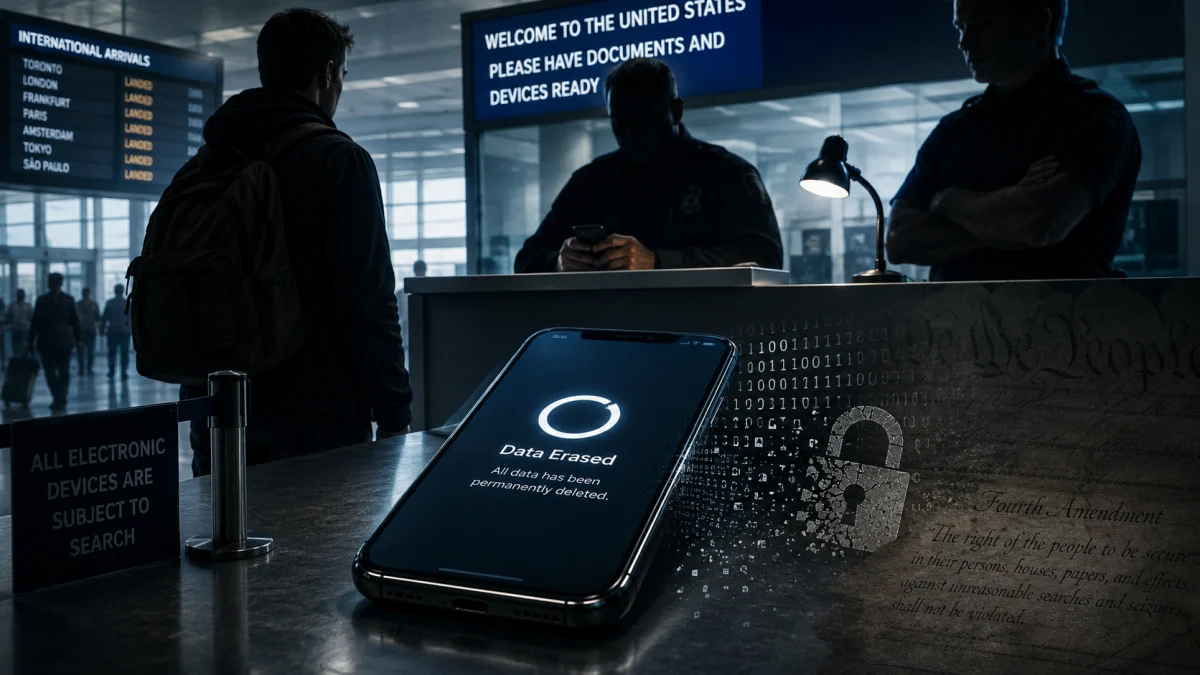
Customs and Border Protection officers placed him in secondary inspection and demanded access to his Google Pixel phone.
According to Tunick’s motion to suppress, he repeatedly requested an attorney. He was allegedly not advised of his Miranda rights. Officers reportedly told him they did not need a warrant and would gain access to the device whether or not he cooperated.
Tunick eventually gave them a password.
It was apparently not the password they expected.
The code allegedly activated a duress feature in GrapheneOS, a privacy- and security-focused Android operating system. Such a feature is designed to erase sensitive data when a person is coerced into unlocking a device. The phone reportedly restarted, and its contents became inaccessible.
The federal government responded by indicting Tunick.
That response should disturb anyone who carries a phone, regardless of political affiliation.
This was CBP—not the TSA
The incident has sometimes been described casually as an airport-security confrontation. But the agency involved was not the Transportation Security Administration.
It was U.S. Customs and Border Protection, reportedly working in coordination with members of the FBI’s Atlanta Joint Terrorism Task Force. Tunick’s defense filing also describes the subsequent seizure of his electronic devices by a Department of Homeland Security agent.
That distinction matters because CBP exercises unusually broad search powers at international borders and their functional equivalents, including international airports.
Under CBP’s policy in force at the time, officers could conduct a “basic” manual device search without suspicion. An “advanced” search involving external equipment was supposed to require reasonable suspicion of a legal violation or a national-security concern, along with supervisory approval. The policy also permitted officers to request passwords and detain devices that could not be accessed.
But an agency policy authorizing an officer to ask for something does not automatically make refusal—or technological resistance—a federal felony.
That is the dangerous leap prosecutors are now attempting.
What prosecutors charged him with
Tunick was charged under 18 U.S.C. §2232(a).
The statute applies when a person knowingly destroys, damages, disposes of, transfers, or takes other action against property for the purpose of preventing or impairing the government’s lawful authority to search for, seize, or retain it.
The maximum sentence is five years in federal prison.
The statute makes sense in ordinary circumstances.
A person should not be free to burn documents after receiving a grand-jury subpoena. A drug trafficker cannot flush contraband while police execute a valid warrant. A corporation cannot shred records after being ordered to preserve evidence.
But those examples involve identifiable evidence, an established legal process, probable cause, a warrant, a subpoena, a preservation obligation, or some combination of them.
Tunick’s case is fundamentally different.
The government was not executing a conventional search warrant based on probable cause. Officers were invoking the border-search exception—a judicial doctrine that developed in an age when border agents searched luggage, cargo and physical containers.
The government now wants to take that exceptional warrantless power and combine it with an evidence-destruction statute to create a new crime:
Give us unrestricted access to your phone, or risk prosecution if the mechanism you provide protects your data instead.
That is not a modest application of existing law. It is a massive expansion of government authority.
The uncomfortable legal reality: Current Eleventh Circuit precedent favors the government
The most intellectually honest defense of Tunick must acknowledge a serious obstacle.
The case is being prosecuted in Georgia, within the Eleventh Circuit. That court has held that border agents may conduct forensic searches of electronic devices without a warrant, probable cause or even individualized suspicion.
In its 2025 decision in United States v. Pulido, the Eleventh Circuit reaffirmed its earlier decision in United States v. Touset. The court concluded that existing border-search precedent permits suspicionless forensic examination of phones and computers. It also rejected an argument that the Supreme Court’s landmark phone-privacy decision in Riley v. California should govern the border context.
That means it would be inaccurate to declare that Tunick indisputably possessed a clearly established right under current Eleventh Circuit law to prevent the search.
But current precedent is not sacred merely because it exists.
Bad precedent does not become good policy. An expansive judicial interpretation does not erase the Fourth Amendment’s purpose. And a rule allowing a search does not automatically answer every question about compelled passwords, custodial interrogation, political targeting, destruction statutes or the criminalization of security software.
The Tunick case should force courts to confront how far they are willing to stretch an already dangerous doctrine.
A smartphone is not a suitcase
The border-search exception rests partly on the government’s legitimate authority to control what physically enters the country.
Agents may inspect luggage for drugs, weapons, undeclared currency, agricultural hazards and other prohibited goods. That power is old, understandable and closely connected to the border itself.
A smartphone is different.
Its physical shell may cross the border, but most of its meaningful contents may be stored remotely or synchronized through cloud services. It can contain years of private communications, medical information, financial records, photographs, political associations, location histories, legal conversations, business documents and access credentials.
Searching a suitcase reveals what a traveler is carrying on that trip.
Searching a phone can reveal the person’s entire life.
The Supreme Court recognized this distinction in Riley v. California, holding that police ordinarily need a warrant to search the digital contents of a phone seized during an arrest. Yet the Eleventh Circuit has declined to apply the same reasoning fully at the border.
That contradiction is becoming impossible to defend.
A person arrested on probable cause in downtown Atlanta generally receives more protection for a phone than a citizen returning home through Atlanta’s airport who has not been charged with any offense.
That is backwards.
The border cannot become a constitutional ambush point
The most alarming allegation in this case is not merely that CBP wanted to inspect a traveler’s phone.
It is that federal authorities may have used the border as a convenient opportunity to pursue a preexisting domestic intelligence interest.
Tunick’s defense says the FBI’s Atlanta Joint Terrorism Task Force coordinated with CBP before his arrival because of his association with Defend the Atlanta Forest. According to reporting on court testimony, an alert describing “suspected terrorism activities” was transmitted only hours before he landed. During the inspection, officers reportedly questioned him under a rationale involving prohibited sexual-abuse material, which the defense characterizes as a pretext.
These allegations have not yet been conclusively resolved. But if the border-search exception was used to obtain information about domestic political associations that investigators could not otherwise search without a warrant, the constitutional problem is profound.
The government should not be allowed to wait for a politically interesting citizen to travel internationally and then use the airport as a warrant-free intelligence checkpoint.
A border exception intended to intercept contraband must not become an all-purpose loophole for domestic investigations.
Providing a password under coercion is not meaningful consent
The government may argue that Tunick voluntarily supplied a password.
That description strips the interaction of its reality.
According to his defense, officers had isolated him in secondary inspection, denied repeated requests for counsel, told him no warrant was necessary, and stated that they would access the phone regardless of his cooperation.
That is not an ordinary request between equals.
It is a demand backed by the authority to detain the traveler, seize the device and escalate the encounter.
When the government communicates that compliance is inevitable, it should not later portray the resulting act as generous voluntary assistance. And when a person under that pressure supplies a code designed for coercive situations, the government should not be shocked that the coercion feature functions as intended.
The word duress is not decorative branding.
It describes the precise circumstance for which the feature exists.
Privacy tools are not evidence of criminal intent
Encrypted messaging, secure operating systems, automatic deletion and duress credentials are often treated in popular discourse as suspicious technologies.
That attitude is both primitive and dangerous.
People use security tools because phones contain valuable and intimate information. Journalists use them to protect sources. Attorneys use them to preserve client confidentiality. Domestic-abuse survivors may use them to protect escape plans. Business owners use them to protect intellectual property. Activists use them because political surveillance is not a hypothetical possibility.
Security features are also useful against ordinary criminals, stalkers, identity thieves and hostile governments.
A privacy tool does not become illegitimate simply because it works against a government agent.
Locks are not evidence of guilt. Encryption is not evidence of guilt. Refusing to volunteer a lifetime of information is not evidence of guilt.
And the use of a security feature should not become retroactive evidence that the government was entitled to see whatever the feature protected.
This prosecution creates an impossible trap
Consider the rule the government appears to be proposing.
A traveler may have no warrant-based right to prevent a phone search. CBP may demand the password. The traveler may face seizure of the device for refusing. But if the traveler supplies a code and that code activates a built-in protection mechanism, the government may prosecute the traveler for interfering with the search.
Under that theory, the only legally safe response is complete submission.
That is not cooperation. It is compelled access disguised as a choice.
The danger extends far beyond one defendant or one operating system.
Manufacturers increasingly include remote-wipe functions, lockdown modes, tamper protections, failed-password deletion settings and emergency security tools. If the activation of such a feature can trigger federal charges during a disputed warrantless search, users may be criminalized for relying on the security architecture of devices they own.
The chilling effect would be enormous.
Technology companies may hesitate to build meaningful anti-coercion protections. Journalists and travelers may disable security features out of fear. Prosecutors could begin treating privacy engineering itself as evidence of obstruction.
A free society should be moving in the opposite direction.
“But he destroyed evidence” assumes the very point in dispute
The government’s most emotionally effective argument will be simple:
Why would an innocent person erase a phone?
The question is misleading.
It assumes that the contents were evidence of a crime. It assumes that the government possessed a lawful and constitutionally sufficient entitlement to inspect all of them. And it assumes that a person protecting private information must have been concealing criminal material.
None of those propositions automatically follows.
People routinely protect information that is sensitive but lawful: intimate photographs, privileged communications, political contacts, financial credentials, personal journals and information about other people who never consented to government inspection.
The government cannot establish probable cause by pointing to the privacy response its own demand provoked.
Nor should “evidence” be defined as every byte of information the government wants to examine.
Evidence is information relevant to an identifiable legal matter. A phone is an indiscriminate repository containing enormous quantities of material unrelated to any legitimate investigation.
Calling the entire device “evidence” is a way of avoiding the particularity that the Fourth Amendment normally requires.
Section 2232 should not be stretched this far
To convict under §2232, prosecutors must do more than establish that data disappeared.
The statute concerns interference with the government’s lawful authority to search, seize or retain property. It also requires purposeful conduct directed at preventing or impairing that authority.
That presents several serious questions.
Was the interrogation functionally custodial? Was demanding a testimonial password constitutionally permissible? Was the inspection truly a border-security search, or an attempt to exploit the border exception for a domestic investigation? Did officers comply with the limits of CBP’s own search policy? Did the government possess lawful authority over the phone’s digital contents, as distinct from the physical device? Does a statute historically associated with destruction of seizable property clearly criminalize activation of a software feature on one’s own device?
Those questions should be resolved before a novel prosecution is allowed to redefine millions of Americans’ legal exposure.
When a criminal statute is genuinely ambiguous, courts traditionally apply the rule of lenity: unclear penal laws should not be creatively expanded after the fact to imprison someone whose conduct was not clearly prohibited.
Federal prosecutors should not be permitted to manufacture a new digital felony through aggressive interpretation and then announce that citizens were expected to anticipate it.
Refusing a digital search is not the same as destroying evidence covered by a warrant
There must be a legally meaningful distinction between these situations:
- Destroying specifically identified evidence after receiving a subpoena.
- Erasing a device after learning that a judge has issued a valid search warrant.
- Violating a court preservation order.
- Destroying records while police are lawfully executing a particularized seizure.
- Protecting the contents of a personal phone during a warrantless and potentially pretextual border interrogation.
The first four circumstances involve recognized legal duties and formal authority.
The fifth involves a disputed expansion of an exception to the warrant requirement.
Treating them as morally and legally interchangeable would eliminate the difference between obstructing justice and refusing to surrender constitutional privacy.
The alleged denial of counsel and warnings deserves scrutiny
Tunick’s defense says he asked for an attorney multiple times and was denied. It also says officers questioned him without providing Miranda warnings and communicated that they would search his phone regardless of whether he cooperated. The defense has asked the court to suppress his statements and resulting evidence.
The government will likely argue that ordinary border questioning is not custodial interrogation requiring Miranda warnings.
But border questioning does not remain “routine” merely because it occurs inside an airport.
An encounter can become custodial when a person is significantly restrained, confronted with accusatory questioning, denied meaningful freedom to leave, and pressured to provide information that may be used criminally.
The airport does not possess a magic constitutional force field.
At minimum, the court should closely examine when this inspection ceased being an ordinary customs encounter and became a targeted criminal interrogation.
The political dimension cannot be ignored
The case also presents an obvious selective-enforcement concern.
A duress password can be used by anyone. Yet the first publicly reported federal prosecution of this kind appears to involve a person whom federal authorities associated with a controversial protest movement.
That does not independently prove unconstitutional retaliation.
But it demands skepticism.
Novel criminal theories are especially dangerous when first tested against politically disfavored defendants. Once accepted, the precedent does not remain confined to activists whom the public may find disruptive or unsympathetic.
It becomes available against journalists, organizers, lawyers, whistleblowers, researchers, business travelers and ordinary citizens.
Rights are often lost at the margins before the majority realizes it needed them.
What the law should be
Congress and the courts should establish several clear rules.
1. Phone-content searches should require a warrant
Border agents should retain authority to inspect the physical device, verify identity, address immediate threats and respond to genuine emergencies.
But accessing the stored or remotely available contents of a phone should ordinarily require a warrant based on probable cause.
2. A border search must actually relate to the border
The government should not use international travel as an opportunity to bypass warrant requirements in unrelated domestic investigations.
If investigators are interested in a person’s political associations or alleged conduct inside the United States, they should present evidence to a judge.
3. Advanced forensic searches must require meaningful suspicion
Even where a warrant is not required, connecting a phone to forensic equipment and extracting large quantities of data should require documented, individualized reasonable suspicion at the absolute minimum.
4. Passcode demands need Fifth Amendment safeguards
A password can be testimonial because it may reveal knowledge, possession and control. Courts should not treat compelled decryption as equivalent to surrendering a physical key without analyzing the constitutional consequences.
5. Privacy features should not be criminalized by surprise
A person should not face an evidence-destruction charge for activating or supplying a device credential unless the government can demonstrate a clearly valid legal process, an established duty to preserve the information and an unambiguous statutory prohibition.
What accountability should look like
It would be irresponsible to demand criminal charges against individual officers without evidence that they committed a specific crime.
But lack of proof for criminal prosecution does not mean the agencies involved deserve no scrutiny.
The court should examine the legality and purpose of the search. The Department of Homeland Security’s inspector general and congressional oversight committees should investigate whether the border-search exception was used as a pretext for domestic political surveillance. The government should disclose the basis of the terrorism-related alert and the communications among CBP, the FBI and other agencies.
Most importantly, the Department of Justice should dismiss the prosecution rather than ask a federal court to transform a privacy feature into a felony trap.
This case is larger than Samuel Tunick
The government’s theory asks the public to accept several propositions at once:
That a citizen’s phone is subject to suspicionless forensic examination merely because the citizen crossed a border.
That authorities may demand the means of access without first persuading a judge.
That resistance to this search can justify detention or seizure.
And that providing a code that protects the phone can itself result in years of imprisonment.
That combination is not a balanced security policy.
It is compelled digital surrender.
A government confident in the legitimacy of its investigation should obtain a warrant. A prosecutor confident that evidence exists should identify it with particularity. An agency confident that its conduct was proper should welcome independent review.
What the government should not do is exploit an extraordinary border doctrine, demand access to a citizen’s entire digital life and then prosecute him because his security system refused to cooperate.
The Constitution is not supposed to work only when citizens make government searches convenient.
The Samuel Tunick prosecution should be dismissed. The underlying search should be subjected to rigorous judicial scrutiny. And Congress should close the border-search loophole before this case becomes the precedent that destroys digital privacy for everyone.
Frequently asked questions
Was Samuel Tunick searched by the TSA?
No. The case involves U.S. Customs and Border Protection at an international port of entry, with reported coordination involving the FBI’s Atlanta Joint Terrorism Task Force and other Department of Homeland Security personnel.
What is a duress password?
A duress password is an alternate credential intended for coercive situations. On a system such as GrapheneOS, entering the configured duress credential can trigger an irreversible deletion of device data rather than ordinarily unlocking the device.
Is wiping your own phone always legal?
No. Destroying information after receiving a valid subpoena, warrant, preservation order or other lawful process can produce serious criminal consequences.
The disputed question in Tunick’s case is whether using a privacy feature during a warrantless border inspection falls within §2232 and whether the government’s underlying search and interrogation were lawful.
Can CBP search a phone without a warrant?
Under current Eleventh Circuit precedent, border agents may conduct even forensic electronic-device searches without a warrant or individualized suspicion. Other courts and civil-liberties advocates have taken more protective approaches, and the constitutional issue remains heavily contested.
What sentence could Tunick face?
The statute under which he was charged, 18 U.S.C. §2232(a), authorizes imprisonment for up to five years. The maximum is not necessarily the sentence that would be imposed following a conviction.
Has the court ruled that the search was unlawful?
Not as of July 27, 2026. Tunick has filed a motion seeking suppression of evidence and statements, but the allegations in that motion remain disputed until the court rules. Reporting indicates that a decision was not expected before approximately the end of October 2026.
References and Further Reading
Source descriptions and case status are current through July 29, 2026. Allegations contained in Samuel Tunick’s defense filings have not necessarily been accepted as fact by the court.
Primary Case Documents
- Samuel Tunick’s Motion to Suppress Evidence and Statements
United States v. Samuel Tunick, No. 1:25-cr-00499, U.S. District Court for the Northern District of Georgia, filed March 17, 2026.This is the most important source for understanding Tunick’s position. His attorneys argue that federal officers subjected him to a custodial interrogation without Miranda warnings, disregarded his repeated requests for an attorney, and used the border-search exception as a pretext to investigate his alleged connections to the Defend the Atlanta Forest movement.The filing also describes the airport encounter, the officers’ demands for device passwords, the alleged activation of the phone’s wipe function, and the defense’s Fourth, Fifth, and Sixth Amendment arguments.Important qualification: This document states the defense’s allegations and legal arguments. It is not itself a judicial finding that the officers acted unlawfully. - Federal Indictment of Samuel Tunick
United States v. Samuel Tunick, No. 1:25-cr-00499, U.S. District Court for the Northern District of Georgia.The indictment contains the government’s formal accusation. Prosecutors allege that Tunick knowingly caused the deletion of the digital contents of a Google Pixel phone to prevent or impair the government’s authority to take the property into custody.An indictment is an accusation, not evidence of guilt. Tunick has pleaded not guilty, and the government must prove every element of the charged offense beyond a reasonable doubt. The indictment is also notably narrow: the reported charge concerns the alleged destruction of phone data, not a separate offense supposedly revealed by that data. (TechCrunch) - 18 U.S.C. § 2232 — Destruction or Removal of Property to Prevent Seizure
U.S. House of Representatives, Office of the Law Revision Counsel.This is the federal statute under which Tunick was charged. Section 2232(a) prohibits knowingly destroying, damaging, disposing of, transferring, or otherwise acting against property for the purpose of preventing or impairing the government’s lawful authority to take it into custody or continue holding it.The statute authorizes a fine, imprisonment for up to five years, or both. The word lawful is central to the dispute: Tunick’s defense argues that the underlying interrogation, password demand, search, and seizure were constitutionally defective. (U.S. Code)
Government Policy and Technical Documentation
- CBP Directive No. 3340-049A: Border Search of Electronic Devices
U.S. Customs and Border Protection, dated January 4, 2018.This directive explains CBP’s published procedures for searching, detaining, reviewing, and copying information from electronic devices at the border.It distinguishes between:- A basic search, in which an officer manually examines information accessible through the device.
- An advanced search, in which external equipment is connected to the device to review, copy, or analyze its contents.
- GrapheneOS Features Overview: Duress PIN and Password
Official GrapheneOS documentation.GrapheneOS describes itself as a privacy- and security-focused mobile operating system based on the Android Open Source Project. Its optional duress feature allows a user to configure alternate credentials that irreversibly wipe the device when entered where device credentials are requested.This source is important because it shows that the feature is a documented part of the operating system—not a vulnerability, secret exploit, or improvised hacking technique allegedly created by Tunick. That fact does not independently determine whether using it during a government search was lawful, but it places the technology itself in the proper context. (GrapheneOS)
Controlling and Foundational Court Decisions
- United States v. Pulido, 133 F.4th 1256 (11th Cir. 2025)
U.S. Court of Appeals for the Eleventh Circuit, decided April 8, 2025.This is the most significant recent appellate precedent for Tunick’s case because Georgia is within the Eleventh Circuit.The court upheld a warrantless forensic border search of electronic devices and rejected the argument that border searches must be limited to locating contraband. It treated the search as permissible under the Eleventh Circuit’s expansive interpretation of the border-search exception.For the article’s argument, Pulido is not supportive authority—it is the legal obstacle that must be confronted. It demonstrates why Tunick cannot simply rely on the claim that all warrantless phone searches at the border are already prohibited under current Eleventh Circuit law. - United States v. Touset, 890 F.3d 1227 (11th Cir. 2018)
U.S. Court of Appeals for the Eleventh Circuit, decided May 23, 2018.In Touset, the Eleventh Circuit held that the Fourth Amendment does not require individualized suspicion for a forensic search of an electronic device at the border. The court reasoned that its precedents did not require suspicion for searches of property, even when that property was a phone, computer, or storage device.A concurring judge questioned the need to resolve the issue so broadly, noting that other federal circuits had required reasonable suspicion for particularly intrusive forensic searches.Touset remains critical because Pulido relied on and reinforced this line of Eleventh Circuit precedent. (Eleventh Circuit Court of Appeals) - Riley v. California, 573 U.S. 373 (2014)
Supreme Court of the United States, decided June 25, 2014.The Supreme Court held that police generally must obtain a warrant before searching the digital contents of a phone seized incident to an arrest.Chief Justice John Roberts’s opinion recognized that modern phones are qualitatively different from ordinary physical containers because they can hold immense amounts of intensely personal information.Riley did not decide the legality of phone searches at the border. Nevertheless, it supplies the strongest Supreme Court reasoning for treating digital searches differently from searches of wallets, suitcases, cigarette packages, or other physical objects. The central unresolved question is how fully that reasoning should apply when the government invokes the border-search exception. (GovInfo)
Decisions Demonstrating the Circuit Split
- United States v. Kolsuz, 890 F.3d 133 (4th Cir. 2018)
U.S. Court of Appeals for the Fourth Circuit.The Fourth Circuit treated an extensive forensic examination of a phone as a nonroutine border search requiring individualized reasonable suspicion. It declined to impose a full warrant requirement, but recognized that a month-long forensic examination generating an almost 900-page report was substantially more intrusive than an ordinary inspection of luggage. (Fourth Circuit Court) - United States v. Cotterman, 709 F.3d 952 (9th Cir. 2013)
U.S. Court of Appeals for the Ninth Circuit, sitting en banc.The Ninth Circuit held that a comprehensive forensic examination of an electronic device at the border requires reasonable suspicion.The court emphasized the volume, sensitivity, and persistence of digital information. It concluded that the intrusive character of the forensic examination—not merely where the examination occurred—triggered the need for heightened justification. (Ninth Circuit Court of Appeals) - United States v. Cano, 934 F.3d 1002 (9th Cir. 2019)
U.S. Court of Appeals for the Ninth Circuit.Cano applied and clarified Cotterman. It held that forensic phone searches require reasonable suspicion and connected the permissible scope of a border search to the government’s interest in locating digital contraband.The opinion is especially relevant to the argument that the border-search exception should not become a general-purpose mechanism for collecting evidence about unrelated domestic activity. (Ninth Circuit Court of Appeals) - Alasaad v. Mayorkas, 988 F.3d 8 (1st Cir. 2021)
U.S. Court of Appeals for the First Circuit.The First Circuit rejected a categorical warrant requirement but held that advanced border searches of electronic devices require reasonable suspicion. It allowed basic searches without suspicion and accepted a broader understanding of the border-search power than the Ninth Circuit adopted in Cano.The case illustrates that courts disagree not only about whether suspicion is required, but also about whether device searches must be restricted to locating contraband rather than evidence of other offenses. (First Circuit Court)
Original and Follow-Up Reporting
- “US Government Targets Cop City Protester Over Phone Operating System”
Timothy Pratt, The Guardian, July 23, 2026.This is the most detailed publicly available account of the suppression hearing and the factual background surrounding the airport interrogation.The report describes testimony concerning the advance federal alert, Tunick’s alleged placement on a terrorism watchlist, coordination involving CBP and the FBI’s Atlanta Joint Terrorism Task Force, repeated requests for counsel, the absence of a warrant, and the moment the phone appeared to wipe itself.It also reports the government’s position that Tunick was undergoing an ordinary international-border inspection. (The Guardian) - “US Accuses American of Allegedly Wiping His Phone Using a ‘Duress’ Password During Border Search”
Zack Whittaker, TechCrunch, July 24, 2026.This report provides links to the indictment and motion to suppress, explains how the GrapheneOS feature functions, and includes observations from digital-security experts who said they were unaware of a previous U.S. prosecution based on comparable use of a duress credential.It also carefully distinguishes between what prosecutors allege, what Tunick’s attorneys claim, and what remains unresolved by the court. (TechCrunch) - “Man Charged for Using Phone’s ‘Duress’ Password to Wipe Data”
SC Media staff, July 24, 2026.This is the brief that prompted the present article. It provides a concise overview of the charge, the alleged phone wipe, the defense’s challenge to the search, and the reported novelty of applying §2232 to a duress-password feature. Because it is a brief based substantially on earlier reporting, it is best used as an introductory source rather than the principal authority for disputed facts. (SC Media) - “Activist Charged With Felony After Giving Border Agent ‘Duress Code’ That Wiped His Phone”
Ryan Whitwam, Ars Technica, July 27, 2026.This article provides additional technical explanation of GrapheneOS, the alleged wipe event, the government’s use of §2232, and the broader concern that a prosecution of this kind could transform ordinary privacy technology into evidence of criminal intent. (Ars Technica)
Broader Digital-Rights Context
- Electronic Frontier Foundation: Border Searches
Electronic Frontier Foundation.EFF’s resource page collects its litigation, policy analysis, traveler guidance, legal briefs, and research concerning government searches of phones, laptops, and other electronic devices at U.S. ports of entry.EFF advocates requiring a warrant supported by probable cause for border device searches. Its position is an advocacy position rather than a neutral statement of settled law, but the page is valuable for understanding the constitutional and technological objections to suspicionless digital searches. (Electronic Frontier Foundation) - “EFF to Fourth Circuit: Electronic Device Searches at the Border Require a Warrant”
Sophia Cope, Electronic Frontier Foundation, May 11, 2026.This analysis presents the modern argument for extending Riley’s warrant requirement to the border. It explains why both manual and forensic searches can expose deeply personal information and argues that the historical justifications for inspecting physical goods do not translate cleanly to cloud-connected digital devices.The article also discusses the practical claim that obtaining a warrant would not prevent officers from temporarily retaining a device when probable cause exists. (Electronic Frontier Foundation)
Editorial Source Note
The primary factual foundation for this article consists of the indictment, Tunick’s suppression motion, the federal statute, the published CBP directive, and the relevant appellate opinions. News reports are used to describe courtroom testimony and developments not yet captured in a published judicial ruling.
Where the defense and government disagree, the article identifies the disputed claim rather than presenting either party’s account as an established judicial fact. The article’s conclusion—that the prosecution should be dismissed and that warrantless border searches of phone contents should be sharply restricted—is an editorial and constitutional argument based on the cited record.