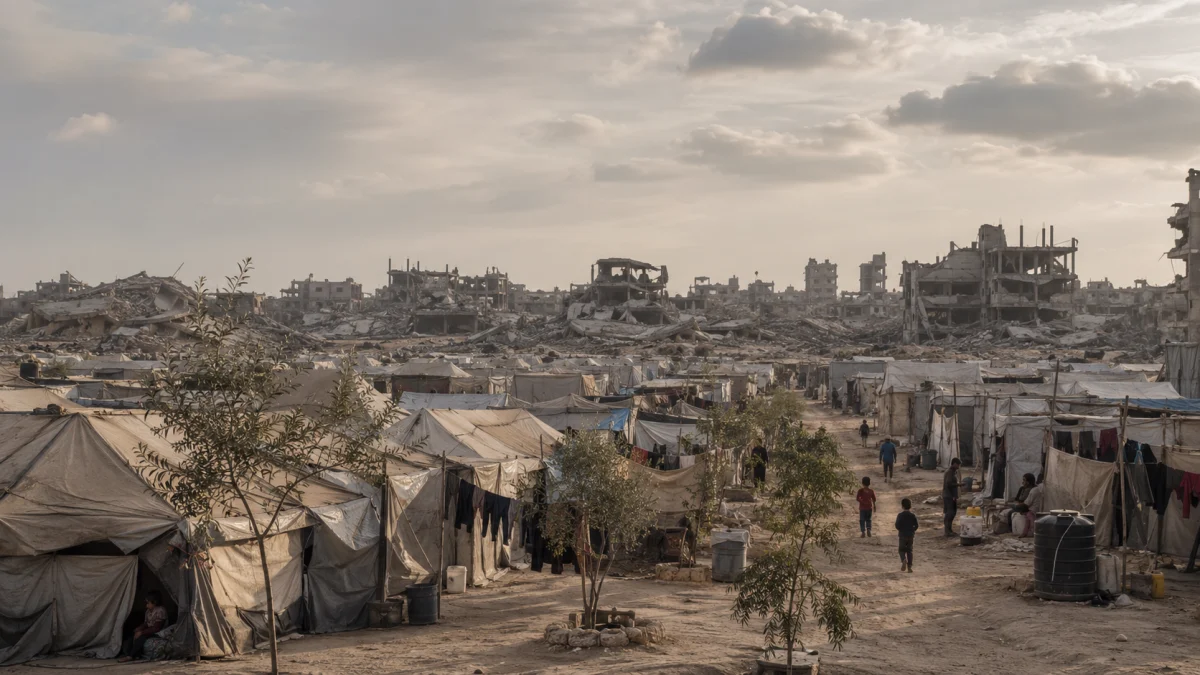
In Khan Younis, trees planted beside temporary shelters have reportedly had time to take root and grow.
That image, described in recent reporting by Bisan Owda, is quietly devastating. A tree is not supposed to mature beside an emergency tent. A tent is supposed to last for days, perhaps weeks or several months in the worst circumstances. It is not supposed to become the address where a child passes through multiple birthdays, where a family builds a toilet in the sand, or where plants begin marking the passage of years.
Yet that is increasingly what displacement looks like in Gaza.
The tents have acquired pathways, improvised kitchens, water barrels, drainage trenches and small patches of cultivated ground. Families have repaired the same tarpaulins repeatedly. Children have learned to recognize particular rows of canvas as neighborhoods. What began as emergency shelter has hardened into a parallel urban system—one without secure housing, adequate sanitation, dependable water, property rights or meaningful protection from military attack.
The central question is no longer whether Gaza has a shelter crisis. It plainly does.
The question is whether the international community intends to let emergency displacement become Gaza’s permanent form of life.
What Bisan Owda saw in Khan Younis
Owda’s reporting matters because it captures something that statistical summaries often miss: time itself has become part of the humanitarian emergency.
Her recent AJ+ reporting described families still living in tents atop the remains of their homes, with large areas inaccessible and daily life continuing under bombing, water shortages and uncertainty despite the formal ceasefire. (YouTube)
The trees around the tents are therefore more than a symbol of Palestinian resilience. They are evidence of political failure.
People plant because they expect to remain alive. They cultivate tiny spaces because ordinary human life continues even under extraordinary deprivation. But the longer those plants grow without a corresponding reconstruction program, the more difficult it becomes to continue describing these settlements as temporary.
The trees are growing because the reconstruction process largely is not.
How large is the displacement crisis?
The best available figures confirm the enormous scale behind Owda’s observations.
In January 2026, the United Nations Satellite Centre identified approximately 283,566 shelters and tents across Gaza, including 148,648 in Khan Younis Governorate alone. The satellite count did not equate every structure with a separate family, but it demonstrated the physical scale of the tent landscape. More than 30,000 shelters in Khan Younis were potentially exposed to flooding, while more than 21,000 sat in coastal areas at high risk from sea surges and strong winds. (United Nations)
By early July, the UN Office for the Coordination of Humanitarian Affairs reported that approximately 1.7 million people were living across more than 1,600 active displacement sites in Gaza. Regular site-management services covered only about one-third of those locations. (OCHA Palestine)
The geographic pressure has grown even worse. By late July, OCHA reported that more than two million Palestinians had been compressed into less than 45 square kilometers, while roughly 88 percent of Gaza had fallen within Israeli-militarized areas or territories covered by displacement orders. (OCHA)
That means Gaza’s population is not simply homeless. Much of it has been concentrated into an increasingly narrow, overcrowded and unstable living area.
Khan Younis and Al-Mawasi have become central to that concentration.
A tent is not a home
The difference between shelter and housing is not cosmetic.
A tent does not provide meaningful insulation from summer heat or winter cold. It cannot reliably resist coastal winds or flooding. It does not provide privacy for children, pregnant women, people with disabilities or survivors of trauma. It cannot safely contain cooking, bathing, sleeping and sanitation functions for an extended family.
In Khan Younis, Associated Press reporters documented families digging latrine pits inside or immediately beside their tents. Some communal toilets are shared by hundreds of people and separated from public view only by thin cloth or sheet metal. Women have described being afraid to use them at night. More than 80 percent of Gaza’s sewage-pumping facilities have reportedly collapsed, leaving sewage, insects and foul water around densely occupied camps. (AP News)
OCHA has reported sewage in streets, stagnant water, accumulated garbage and rodent or parasite infestations in 83 percent of assessed displacement sites. Some families lacked proper containers and were storing water in flour sacks lined with garbage bags. (OCHA Palestine)
These conditions are now producing predictable disease outbreaks. In a two-week period, nearly 9,300 suspected chickenpox cases were recorded across Gaza, with more than half reported in Khan Younis. Humanitarian officials linked the outbreak to extreme overcrowding, inadequate sanitation and the impossibility of isolating infected children inside shared tents. (OCHA Palestine)
This is what humanitarian “limbo” means in practice. It is not merely waiting. It is prolonged exposure to preventable illness, indignity, danger and developmental harm.
Even the tents are not safe
The presence of a ceasefire has not made displacement sites reliably safe.
OCHA documented continuing strikes, shelling and new displacement during June and July 2026. A late-June strike in Al-Mawasi reportedly killed a mother and her infant daughter, destroyed the tents of more than 150 families and damaged those of another 250. (OCHA Palestine)
On July 10, an airstrike reportedly destroyed shelters in Al-Mawasi, newly displacing 78 families and damaging shelters belonging to another 130. Humanitarian access to other camps was disrupted by Israeli military movements, forcing the suspension of water deliveries and other services. (OCHA)
OCHA later reported that 14 Palestinians, including a girl, were killed in strikes on tents in western Khan Younis on July 20. (OCHA)
Families are therefore trapped inside a cruel contradiction. Their homes have been destroyed or made inaccessible, but the temporary places to which they were displaced are themselves exposed to military action, disease, flooding and forced relocation.
The tent is neither a pathway home nor a genuinely protected refuge.
Why people cannot simply return home
“Let them return to their neighborhoods” sounds straightforward until the physical conditions are examined.
The April 2026 Gaza Rapid Damage and Needs Assessment—jointly prepared by the World Bank, European Union and United Nations—estimated that more than 371,000 housing units had been damaged or destroyed. Approximately 1.9 million people had been displaced, and more than 60 percent of Gaza’s population had lost its housing. (United Nations)
Some homes no longer exist. Others are structurally unstable. Many neighborhoods remain inaccessible. Roads, water networks and sewage systems have been destroyed. Unexploded ordnance is embedded in residential areas. Property boundaries are buried under rubble, and remains of missing people may still be present inside collapsed buildings.
UNDP estimates that Gaza contains more than 61 million tons of debris. Clearing that material is not a matter of sending in ordinary bulldozers. It requires explosive-ordnance specialists, hazardous-material controls, forensic procedures, heavy machinery, secure access routes and systems for preserving evidence and identifying human remains. (UNDP)
Nor can families safely rebuild with whatever material they can find. Because cement, steel and heavy equipment have been barred or tightly restricted, Palestinians have resorted to grinding rubble into improvised cement. Engineers say it fails structural testing and cannot safely be used for columns or major load-bearing work. (The Guardian)
The problem is therefore not that Palestinians are unwilling to rebuild. They are improvising construction materials out of the powder of their destroyed cities.
The problem is that the conditions necessary for safe reconstruction have not been permitted or established at anything close to the required scale.
Emergency assistance is not keeping pace
Humanitarian organizations continue to install tents, improve shelters and repair damaged homes, but the scale of their work remains tiny compared with the scale of need.
As of late June, humanitarian partners had upgraded approximately 2,560 makeshift shelters and installed 774 new emergency shelters since the beginning of 2026. About 1,299 damaged homes had received emergency repairs. Those interventions matter enormously to the families receiving them, but they are measured against a displaced population of roughly 1.7 million people and hundreds of thousands of damaged housing units. (OCHA Palestine)
The mismatch is structural, not the result of insufficient effort by field workers.
OCHA says shelter operations are constrained by depleted inventories, restrictions on essential materials, insecurity, supply-chain disruption and major funding shortages. Even ordinary tools—wheelbarrows, shovels, gloves and rakes—have reportedly been rejected or prevented from entering in sufficient quantities. (OCHA Palestine)
A shipment of several hundred tents may save hundreds of families from sleeping under the open sky. It cannot constitute a housing policy for a territory where most of the population has been uprooted.
Israel’s responsibility cannot be separated from the outcome
Israel bears the primary and immediate responsibility for the physical conditions created by its military campaign and for the restrictions that continue to obstruct recovery.
Israeli forces conducted the bombardment and demolition operations that destroyed much of Gaza’s housing and infrastructure. Israel continues to control or restrict key crossings, access routes, coastal areas, reconstruction materials and large sections of Gaza’s territory. UN agencies report that restrictions on cement, steel, machinery, repair equipment and other so-called dual-use goods are severely delaying reconstruction. (The Guardian)
Israel argues that construction materials and equipment may be diverted by Hamas for military purposes. It also argues that Hamas’s refusal to disarm and relinquish coercive control is a central obstacle to implementing the postwar political framework. Those are legitimate security questions that any durable settlement must address. (UN Press)
They do not, however, justify leaving an entire civilian population indefinitely without adequate homes, sanitation or access to reconstruction materials.
Security screening can be conducted through monitored supply chains, tagged shipments, independent engineering inspections, restricted contractor lists and project-level auditing. A security concern can justify regulation. It cannot justify converting emergency tents into a multigenerational housing system.
Hamas also bears responsibility for the October 7 attacks, hostage-taking, its conduct during the war and any interference with aid or civilian governance. Palestinian armed groups have continued to engage Israeli forces and launch rockets during the ceasefire period. (OCHA)
But children living beside sewage pits are not Hamas. Families whose apartment buildings were erased are not legitimate bargaining chips. Civilian shelter cannot be suspended until every political and military dispute has been resolved.
The United States is not a neutral observer
The United States cannot credibly describe Gaza’s devastation as a distant tragedy for which it has no material responsibility.
Israel is historically the largest recipient of American security assistance. The United States has provided more than $130 billion in bilateral assistance since 1948 and normally supplies approximately $3 billion in security assistance each year. As of April 2025, 751 active U.S. Foreign Military Sales cases with Israel were valued at approximately $39.2 billion. (U.S. Department of State)
American support continued during and after the destruction of Gaza. In February 2025, the State Department approved a possible $6.75 billion package containing thousands of bombs, guidance kits and fuzes, followed by another possible $2.04 billion sale of heavy bomb bodies and penetrator warheads. (Defense Security Cooperation Agency)
In March 2026, the administration used an emergency waiver to approve a possible sale of 12,000 one-thousand-pound bomb bodies to Israel. In May, it approved a possible $992.4 million sale of 10,000 Advanced Precision Kill Weapon System rounds and associated equipment. (U.S. Department of State)
The United States has also supplied diplomatic protection. In June 2025, it was the only Security Council member to vote against a resolution demanding a permanent ceasefire, the release of hostages and the removal of restrictions on humanitarian aid. The other 14 members voted in favor. (UN Press)
Whether these actions satisfy the technical legal standard for complicity in particular international crimes would require a competent judicial determination. But in the ordinary political and material sense, the United States is plainly not a bystander. It has supplied weapons, funding and diplomatic support while possessing substantial leverage over the Israeli government.
That produces a corresponding responsibility.
Washington should not merely donate food and tents after helping sustain the military system that created the need for them. It should use its leverage to secure civilian protection, unrestricted humanitarian access and reconstruction at scale.
What would a practical next step actually look like?
Gaza does not need another abstract pledge to rebuild “one day.” It needs a sequenced recovery program beginning immediately.
The World Bank, EU and UN estimate that recovery and reconstruction will require approximately $71.4 billion over the next decade, including $26.3 billion during the first 18 months. That assessment calls for temporary and transitional housing, cash assistance, debris clearance, restoration of services and the beginning of permanent reconstruction to proceed simultaneously. (United Nations)
A realistic plan would operate in three overlapping phases.
Phase one: Make survival dignified—now
During the first weeks and months, every displacement site should receive minimum infrastructure rather than another isolated shipment of canvas.
That means durable transitional shelters with raised floors, insulation and lockable doors; safe communal kitchens; gender-separated toilets and bathing facilities; drainage channels; reliable water storage; waste collection; solar lighting; accessible pathways; primary clinics; temporary classrooms; and protected areas for children.
Cash-for-rent programs should be expanded wherever undamaged housing is available. Partially damaged buildings should receive rapid engineering inspections and repair grants so families can move out of tents without waiting for complete neighborhood reconstruction.
This is still temporary housing, but it is temporary housing designed to preserve life and dignity rather than merely prevent exposure for another night.
Phase two: Open the physical pathway to return
Cement, steel, pipes, electrical equipment, water pumps, construction vehicles and rubble-processing machinery must enter at industrial scale.
These materials can be monitored. Shipments can be inspected at the border, tracked electronically, assigned to verified projects and audited by international and Palestinian engineers. Contractors can be required to document their inventory and construction sites.
The answer to potential diversion is accountable logistics—not a blanket system that makes civilian reconstruction practically impossible.
At the same time, teams must begin clearing major roads, hospitals, schools and residential corridors. Explosive hazards must be mapped and removed. Human remains must be recovered with forensic dignity. Recyclable debris should be separated from hazardous waste, while safe aggregate can be reused under proper engineering standards.
The EU-UNDP debris initiative launched in July is a useful start, but its €15 million budget is tiny beside the 61-million-ton challenge. (UNDP)
Phase three: Rebuild neighborhoods, not permanent camps
Permanent reconstruction should occur neighborhood by neighborhood, with former residents involved in planning and implementation.
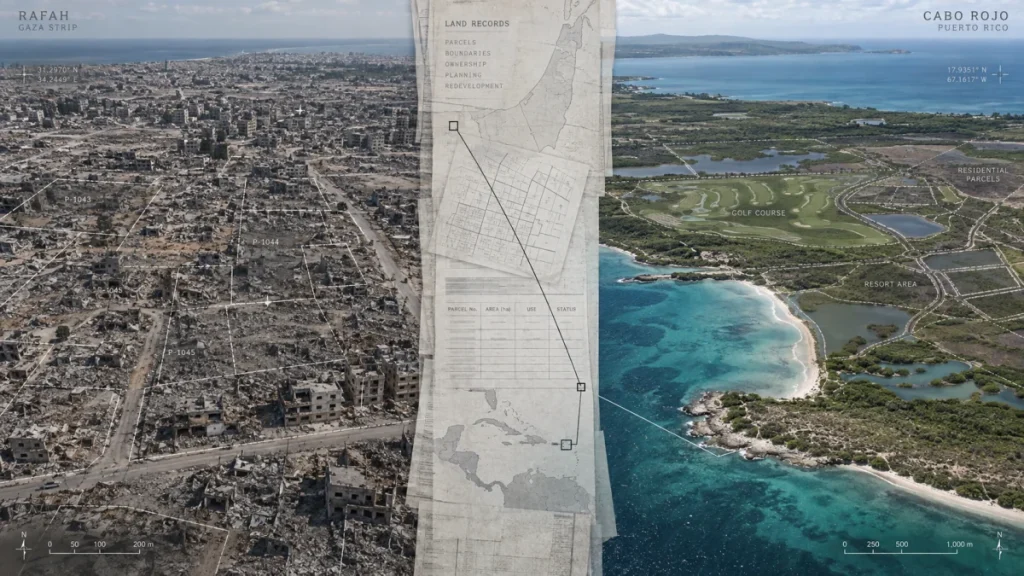
Property records must be protected. Families should not lose ownership because documents were destroyed or because boundaries are no longer physically visible. Women, renters, refugees, informal residents and people whose relatives were killed must have accessible procedures for proving occupancy or ownership.
Palestinian municipalities, engineers, contractors, universities and civil-society organizations should lead the work wherever possible. International agencies should provide finance, technical support and independent auditing—not replace Palestinians as decision-makers over their own cities.
Reconstruction should preserve community networks rather than permanently relocating people into massive centralized camps. The objective is not to produce more efficient displacement. It is to enable voluntary, safe and dignified return.
Who should pay?
The burden cannot simply be handed to international humanitarian charities.
Israel should be expected to make a substantial financial contribution because its military operations caused most of the physical destruction. The United States should also make a major contribution because of its extraordinary military, financial and diplomatic role.
Arab states, European governments, international financial institutions and other donors will almost certainly participate, but their funding should supplement rather than erase the responsibilities of the principal actors.
A Gaza reconstruction trust could pool these contributions under independent financial oversight, publish all contracts and disbursements, prioritize Palestinian companies and workers, and prohibit the use of reconstruction money as leverage for forced displacement or permanent territorial changes.
Money alone, however, will not solve the problem. Billions of dollars pledged into a system that blocks machinery, materials and movement will remain numbers in an account.
Access is as important as funding.
Reconstruction cannot wait for a perfect political settlement
Gaza needs a credible system of civilian governance. Israel needs genuine security. Palestinians need political rights, freedom of movement and self-determination. Hamas’s weapons, Israel’s continued military presence, Palestinian political divisions and the absence of a final peace agreement are all serious issues.
But treating civilian reconstruction as the final reward after every one of those disputes has been resolved guarantees indefinite displacement.
Children cannot wait for a grand bargain before receiving a bathroom. Families cannot postpone housing until the Middle East achieves political harmony. Hospitals cannot operate on promises of a future diplomatic breakthrough.
Humanitarian survival, transitional housing and essential infrastructure must be treated as immediate obligations. Political negotiations should occur alongside reconstruction, not instead of it.
Will Gaza’s families live in tents indefinitely?
They do not have to.
Gaza possesses engineers, tradespeople, municipal workers, business owners, teachers and families eager to rebuild. International agencies already know how to clear rubble, install transitional housing, restore utilities and finance reconstruction. The technical roadmap exists. The estimated costs exist. The labor exists.
What remains absent is sustained political permission.
Without protected access, construction materials, heavy equipment, enforceable civilian safeguards and a serious financing mechanism, the tents will remain. More plants will grow beside them. More children will remember canvas walls as the only home they have known.
When a tree planted beside an emergency shelter begins to mature before the family living there receives a real roof, “temporary” is no longer an honest description.
It is a policy outcome.
Bisan Owda’s reporting should not be remembered merely as another moving portrait of Palestinian resilience. Resilience is not a substitute for justice, housing or political action. The families of Khan Younis do not need the world to admire how resourcefully they survive inside tents.
They need the world to stop making the tents necessary.
Frequently asked questions
How many displaced people are living in Gaza’s tent camps?
OCHA reported approximately 1.7 million people living across more than 1,600 active displacement sites in early July 2026. UN satellite imagery had previously identified about 283,566 shelter and tent structures across Gaza, including 148,648 in Khan Younis Governorate. (OCHA Palestine)
Why has Gaza reconstruction not begun at full scale?
Major barriers include continued military activity, Israeli restrictions on cement, steel and heavy machinery, unexploded ordnance, enormous quantities of rubble, funding shortages, damaged infrastructure and unresolved questions concerning governance and security. (The Guardian)
How much will it cost to rebuild Gaza?
The April 2026 joint World Bank, EU and UN assessment estimated approximately $71.4 billion in recovery and reconstruction needs over the next decade, with $26.3 billion required during the first 18 months. (United Nations)
What should replace the tents first?
The immediate bridge should include durable transitional shelters, repaired apartments, cash-for-rent assistance, toilets, water systems, waste removal, clinics, schools, electricity and protected community spaces. These measures should occur while permanent homes and neighborhoods are being rebuilt.
Is Bisan Owda’s central description accurate?
Her exact observation about growing trees is an eyewitness account that I could not independently retrieve from the original post. However, her central description of prolonged tent life in Khan Younis is supported by current UN satellite counts, humanitarian assessments and independent reporting. (YouTube)
References and further reading
- UN, EU and World Bank — Final Gaza Rapid Damage and Needs Assessment: Reconstruction needs, housing destruction and first-18-month priorities. (The United Nations in Palestine)
- OCHA — Humanitarian Situation Report, July 3, 2026: Displacement-site population, sanitation conditions, disease and shelter operations. (OCHA Palestine)
- OCHA — Late-July Gaza update: Military zones, displacement orders, strikes and population concentration. (OCHA)
- UNOSAT — Khan Younis shelter and flood-exposure analysis: Satellite count of tents and shelters. (UNOSAT)
- UNDP and European Union — Gaza debris-management initiative: Rubble removal, forensics and infrastructure access. (UNDP)
- U.S. State Department and DSCA — Military sales to Israel: Official records of proposed weapons packages. (U.S. Department of State)
- U.S. Government Accountability Office — Arms transfers and civilian harm: Oversight gaps and official assessments concerning U.S.-origin weapons. (Government Accountability Office)
- AJ+ — Bisan Owda reporting after the ceasefire: Continued displacement, bombing and life in tents. (YouTube)