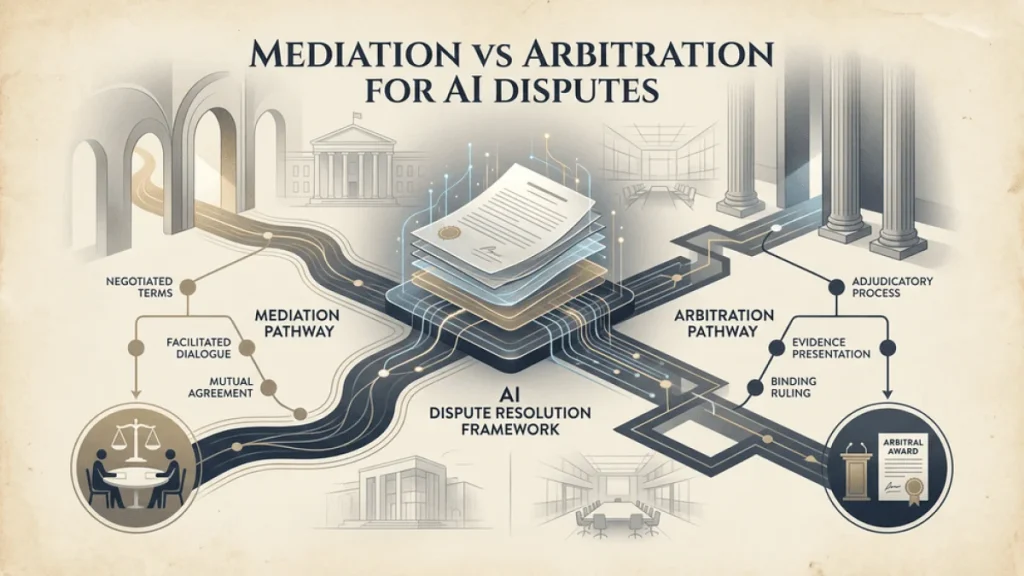

AI-led arbitration used to sound like a speculative future topic.
It is no longer only that.
As of June 1, 2026, the American Arbitration Association is publicly offering an AI Arbitrator process, an AI-led arbitration ruleset, and related materials describing how an AI-enabled dispute-resolution workflow can operate with human oversight.
That does not mean arbitration has become automated justice.
It does mean the conversation has moved from theory to actual institutional design.
What AI-led arbitration means right now
The most concrete public example in the U.S. market right now is the AAA’s AI Arbitrator.
The AAA describes it as a process that combines AI-driven analysis with human arbitrator review and oversight. The public AI Arbitrator page says participation is opt-in and that human legal judgment remains central at every step.
That distinction matters.
AI-led arbitration, at least in this form, is not being presented as a machine that independently issues binding awards with no human role. It is being presented as a structured process in which AI performs analytical and drafting functions inside a framework that still reserves final authority to a human arbitrator.
The current scope matters
As of June 1, 2026, the AAA’s public AI Arbitrator materials describe the offering in connection with two-party, documents-only construction cases.
That is important because it shows the institution is not claiming universal applicability.
The current use case is bounded:
- two parties,
- documents only,
- construction,
- and a highly structured digital process.
That narrow scope is not a weakness. It is a signal that the institution understands the need to start where the factual record and workflow are more constrained.
How the process works at a high level
The AAA’s AI Led Arbitration Rules, amended and effective February 18, 2026, provide the clearest official structure.
Under those rules:
- parties must agree to use the process,
- the dispute runs through the Digital Dispute Resolution Center,
- the AI Arbitrator makes a preliminary decision,
- and the human arbitrator reviews, revises if needed, validates, finalizes, and issues the award.
The rules also expressly include:
- a mediation option,
- confidentiality provisions,
- and a path back to traditional AAA administration if the respondent does not consent to proceed under the AI-led rules.
That is a much more useful description than simply calling it a “robot judge.”
What AI-led arbitration is not
This topic becomes clearer when framed through limits.
AI-led arbitration is not:
- fully autonomous adjudication,
- a general replacement for human legal judgment,
- a universal solution for all arbitration categories,
- or a license to ignore fairness, disclosure, confidentiality, and due process concerns.
The AAA’s own FAQ says exactly that human judgment remains central and that every AI output is validated by an experienced human arbitrator.
So the more accurate label is not “AI replaces arbitration.”
It is “AI is being integrated into a highly managed arbitration workflow.”
Why institutions are exploring it
The attraction is obvious.
Documents-only disputes can be repetitive, time-consuming, and expensive relative to the value at issue. Institutions see an opportunity to reduce cost and time by using AI to:
- parse claims and defenses,
- organize evidence,
- generate structured analyses,
- and draft outputs that a human neutral then reviews.
That can create real efficiency gains if the process is narrow enough and the oversight is meaningful.
In other words, AI-led arbitration is not being pushed mainly as philosophy. It is being pushed as workflow design.
Why this is controversial
The controversy also makes sense.
Even with guardrails, serious questions remain:
- How transparent is the reasoning process?
- What exactly can parties review?
- How are errors detected?
- What data is used and retained?
- How are confidentiality obligations protected?
- Does the process fit only objective document-heavy matters, or will it expand too far too fast?
Those questions are not anti-technology objections. They are ordinary due-process and legitimacy questions applied to a new delivery model.
The real fault line: scope and trust
The biggest issue is not whether AI can assist.
It is whether parties and institutions can draw and maintain credible boundaries around where AI assistance is appropriate.
A narrowly structured, opt-in, documents-only process with human review is one thing.
A broad claim that complex credibility-heavy cases should be resolved the same way would be something very different.
That is why AI-led arbitration should be evaluated case by case and product by product, not as one monolithic category.
What businesses should pay attention to now
Businesses evaluating AI-led arbitration should ask:
- Is the case type actually a good fit for a tightly structured digital process?
- What role does the human arbitrator play in practice, not just in theory?
- What submissions can the parties review and challenge?
- How are confidentiality and data handling managed?
- What happens if one party refuses the AI-led format?
- Is the institution clear about scope limits?
Those are better questions than simply asking whether the process is “innovative.”
What this means for the broader AI dispute field
AI-led arbitration matters even if a party never uses the AAA’s current product.
It matters because it shows that:
- institutions are willing to operationalize AI inside dispute resolution,
- the human-in-the-loop model is becoming a practical governance standard,
- and future fights will likely focus less on whether AI can appear in arbitration at all and more on how much authority it should have, in what case types, under what safeguards.
That is a major shift.
FAQ
Is AI-led arbitration currently fully automated?
No. The current AAA materials emphasize that a human arbitrator reviews, validates, and issues the final award.
Is participation mandatory?
No. The AAA states that the process is opt-in and that both parties must agree.
What kinds of disputes is it currently aimed at?
As of June 1, 2026, the public AI Arbitrator materials describe it for two-party, documents-only construction cases.
Does AI-led arbitration replace legal ethics or due process?
No. If anything, it raises those issues more sharply, which is why the guardrails and scope limitations matter so much.
What is the biggest misconception?
That AI-led arbitration means a machine independently decides the case. The current public model is much more constrained and human-supervised than that.
Conclusion
AI-led arbitration is real enough now that it deserves precise attention rather than abstract speculation.
The right response is neither hype nor panic. It is disciplined analysis. What matters is the scope, the safeguards, the human role, and the kind of case at issue. Those are the questions that will determine whether AI-led arbitration becomes a useful procedural tool, a niche experiment, or a cautionary tale.
Further Reading
- AAA AI Arbitrator page, accessed June 1, 2026: https://www.adr.org/ai-arbitrator/
- AAA AI Led Arbitration Rules, amended and effective February 18, 2026: https://www.adr.org/rules-forms-and-fees/ai-led/ai-led-arbitration-rules/
- AAA AI Arbitrator FAQ: https://www.adr.org/news-and-insights/ai-arbitrator-faq/
- AAA-ICDR AI Arbitrator launch press release, September 17, 2025: https://www.adr.org/press-releases/aaa-icdr-to-launch-ai-native-arbitrator-transforming-dispute-resolution/
- AAA AI Arbitrator now available press release, November 3, 2025: https://www.adr.org/press-releases/aaa-icdr-ai-arbitrator-now-available/
- DDRC Additional Terms of Use, effective November 3, 2025: https://www.adr.org/ddrc-additional-terms-of-use/