
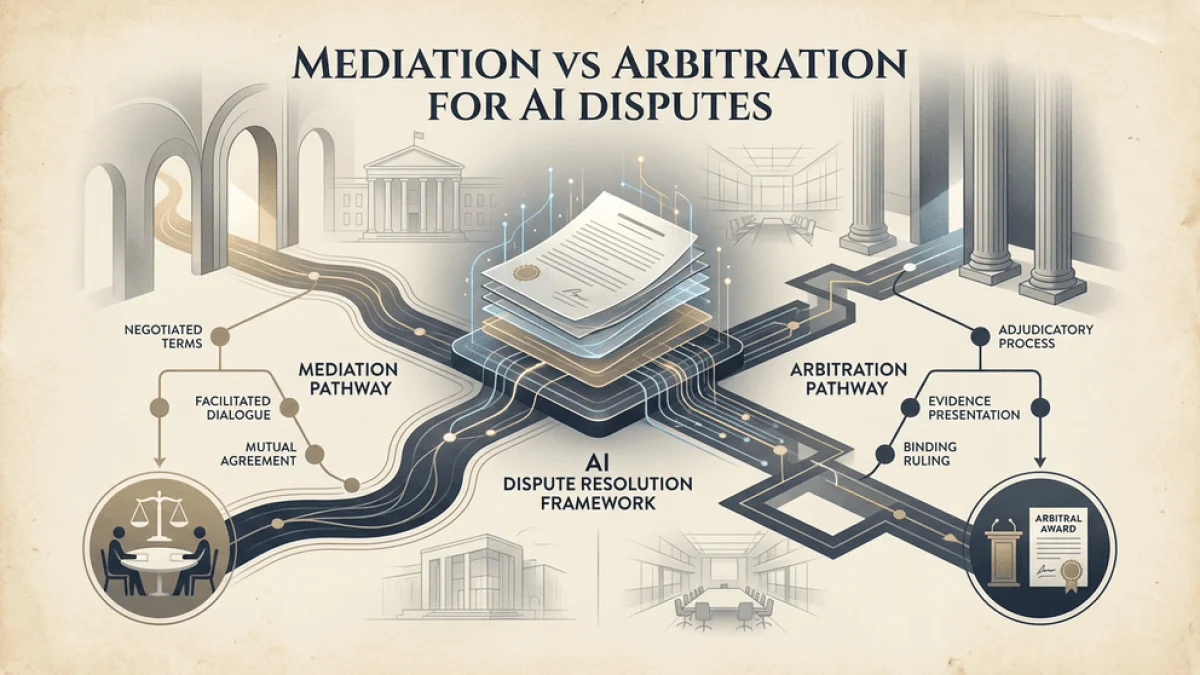
One of the easiest mistakes in AI dispute planning is to ask which forum is “better” in the abstract.
That is the wrong question.
The better question is which process fits the actual dispute:
- a technical contract fight,
- a privacy-sensitive business conflict,
- a relationship worth preserving,
- a dispute with moving facts,
- or a problem that needs a binding answer from a neutral.
That is the real mediation-versus-arbitration choice in AI disputes.
The basic difference
JAMS defines mediation as a process in which the parties meet with a mutually selected impartial neutral who assists them in negotiating their differences. The mediator does not decide the outcome.
JAMS defines arbitration differently: it is an adjudicatory process in which an arbitrator renders a final and binding decision, subject to only limited court review.
That distinction matters more in AI disputes than many people expect.
Why? Because AI disputes often involve both:
- uncertainty about what really happened,
- and strong disagreement about who should bear the risk once the facts are clear.
Mediation helps with the first problem especially well. Arbitration helps with the second.
When mediation fits AI disputes well
Mediation can be especially strong when the dispute is still partly a business problem rather than only a legal one.
1. The relationship still matters
If the parties want to keep working together, mediation is often the better first move.
That is common in:
- vendor-customer AI relationships,
- model licensing arrangements,
- enterprise deployment disputes,
- data-sharing partnerships,
- and internal governance conflicts.
A mediated solution can preserve the contract while changing guardrails, pricing, timelines, data rights, or testing obligations.
Arbitration is much better at deciding who wins. Mediation is often better at keeping the relationship usable.
2. The facts are still developing
AI disputes often begin before the parties understand the system failure completely.
The key questions may still be open:
- Was the output wrong because of the model, the prompt, the data, or the integration?
- Was the issue isolated or systemic?
- Was there a documentation problem, a monitoring problem, or a user-expectation problem?
Mediation gives the parties room to narrow those questions and settle while uncertainty still exists.
3. The best outcome is operational, not adjudicatory
Sometimes the right answer is not a legal ruling. It is:
- a new protocol,
- a revised rollout plan,
- a data-handling fix,
- a pricing adjustment,
- a remediation fund,
- or a staged technical review.
Mediation is often better suited to that kind of customized resolution.
4. Confidential business repair matters more than precedent
Mediation is private and flexible. That can be valuable when the real goal is to contain harm, preserve trust, and avoid hardening positions too early.
When arbitration fits AI disputes well
Arbitration becomes stronger when the parties need a real decision, not only a process for negotiation.
1. The dispute needs a binding outcome
If the parties are too far apart, arbitration can provide closure in a way mediation cannot.
This matters when:
- liability is sharply contested,
- settlement ranges do not overlap,
- a contract allocates risk explicitly,
- or the parties need a final answer to move forward.
2. Technical evidence must be decided, not only discussed
Some AI disputes turn on complex evidence:
- logs,
- prompts,
- version history,
- benchmarks,
- training-data documentation,
- product limitations,
- or expert explanations of system behavior.
In those cases, arbitration may be more useful because it can produce a reasoned, binding outcome after evidence is tested.
3. Neutral expertise matters
Arbitration allows the parties to select a neutral with subject-matter competence, which can be especially valuable in AI-related disputes.
That is one reason JAMS’s AI disputes clause and rules, and the broader Ciarb and AAA-ICDR materials, matter. They support the idea that technical process design is not optional in these cases.
4. Cross-border or multi-jurisdictional enforceability matters
Where parties need a binding result that can travel more cleanly than a negotiated business compromise, arbitration may be the better fit.
The real comparison points
The cleanest way to compare the two forums is by the pressure each one handles best.
| Question | Mediation | Arbitration |
|---|---|---|
| Who controls the outcome? | The parties | The neutral |
| Is the result binding by default? | No | Yes |
| Best for preserving relationships? | Usually yes | Usually less so |
| Best for custom business solutions? | Strong | More limited |
| Best for technical fact-finding with a final answer? | Limited | Strong |
| Best for early-stage uncertainty? | Strong | Sometimes premature |
| Best when one side needs a definitive ruling? | Weak | Strong |
| Best when confidentiality and flexibility both matter? | Strong | Also strong, but more formal |
Why AI disputes often benefit from a staged approach
The best answer is often not mediation or arbitration.
It is mediation then arbitration if needed.
That sequence works well when:
- the relationship has value,
- the facts are technical but not yet fully mapped,
- the parties need room for business creativity,
- yet everyone still wants a binding backstop if settlement fails.
This is especially useful in AI vendor disputes, licensing disputes, and California-facing disputes involving privacy-sensitive material.
When mediation may fail
Mediation is not automatically the more sophisticated choice.
It may be a weak fit when:
- one side needs urgent relief,
- the parties want a definitive liability decision,
- a power imbalance makes voluntary resolution unrealistic,
- or a repeat-player dynamic makes trust too thin for negotiation.
It can also fail if the parties use it as delay rather than as a real resolution effort.
When arbitration may be the wrong first move
Arbitration can also be mishandled.
It may be the wrong first step when:
- the underlying system problem is still unclear,
- the parties could likely redesign the relationship productively,
- the dispute is more commercial than legal,
- or a quick negotiated operational fix would solve the real problem faster.
Going straight to arbitration too often means paying to fight about process before the parties understand the failure well enough to resolve it intelligently.
How to choose in practice
Ask these questions first:
- Does the relationship need to survive?
- Are the facts mature enough for an adjudicated decision?
- Is a custom operational solution more valuable than a formal winner?
- Is the dispute mainly about money, process, access, or future behavior?
- Would a technically informed neutral matter more as a facilitator or as a decision-maker?
- Is a staged mediation-then-arbitration model the smartest design?
Those questions are usually more helpful than general opinions about ADR.
FAQ
Is mediation always cheaper than arbitration?
Often, but not automatically. It depends on how seriously the parties engage and whether mediation actually resolves the dispute.
Is arbitration better for AI disputes because they are technical?
Not always. Technical complexity can support arbitration, but it can also support early mediation if the parties need help structuring a business solution around uncertain facts.
Should AI contracts require mediation first?
Sometimes. A tiered clause can work well, especially where preserving the relationship matters. But it should be designed deliberately rather than copied from boilerplate.
Can mediation handle confidentiality-sensitive AI disputes?
Yes, often very well. Mediation can be a strong setting for privacy-sensitive, trade-secret-heavy, and relationship-centered disputes.
What is the biggest forum-selection mistake?
Treating all AI disputes as if they have the same goal. Some need repair. Some need a ruling. Some need both, in sequence.
Conclusion
Mediation versus arbitration is not really a contest between a soft forum and a hard one.
It is a question of fit. AI disputes often involve technical uncertainty, sensitive evidence, valuable business relationships, and serious allocation-of-risk questions. The best process is the one that matches those realities. Sometimes that is mediation. Sometimes it is arbitration. Very often, the smartest design is to use both in the right order.
Further Reading
- JAMS Mediation Defined: https://www.jamsadr.com/mediation-defined
- JAMS Arbitration Defined: https://www.jamsadr.com/arbitration-defined
- JAMS Artificial Intelligence Disputes Clause and Rules: https://www.jamsadr.com/artificial-intelligence-disputes-clause-and-rules
- AAA Mediation Procedures of the American Arbitration Association: https://www.adr.org/rules-forms-and-fees/commercial/mediation-procedures-of-the-american-arbitration-association-2017/
- Ciarb Guideline on the Use of AI in Arbitration, updated September 2025: https://www.ciarb.org/media/bpndtcgu/guideline-on-the-use-of-ai-in-arbitration_updated-sept-2025.pdf