
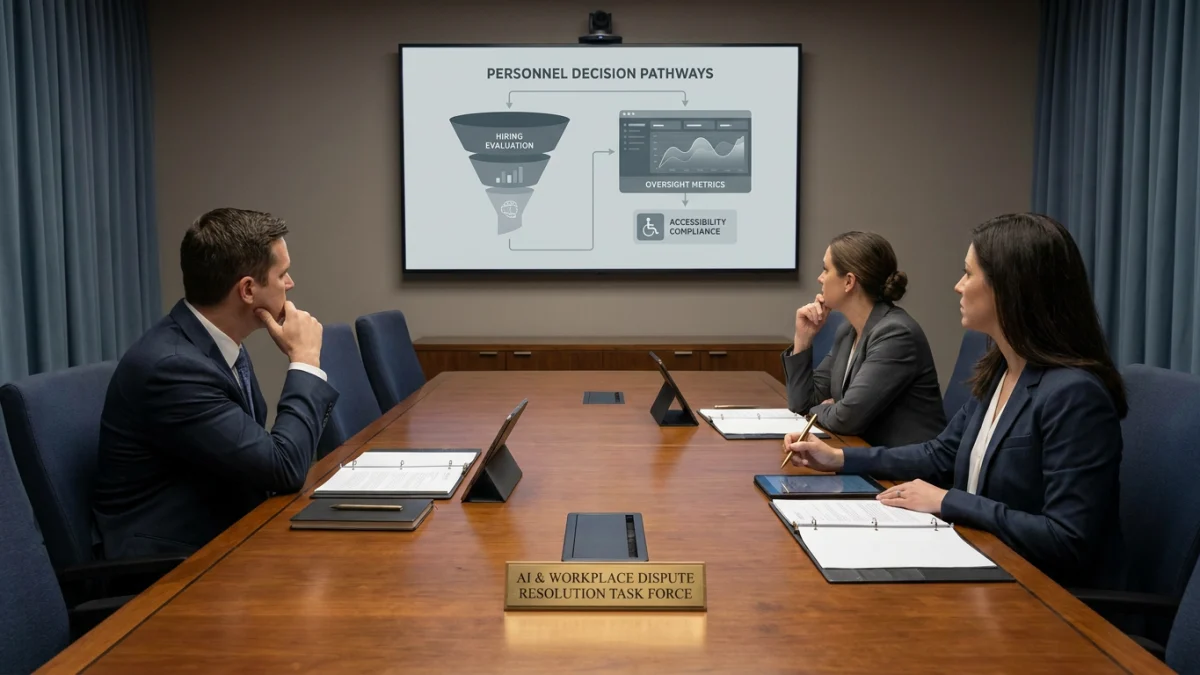
Many AI employment disputes do not begin with a dramatic algorithmic scandal.
They begin with ordinary operational choices that look efficient on the way in: resume filters, video interview scoring, productivity dashboards, attendance models, chatbot recruiting, surveillance software, automated scheduling, or internal tools that quietly influence who gets hired, promoted, disciplined, or let go.
Then something goes wrong.
A qualified applicant is screened out. A disabled worker cannot navigate the process. A monitoring tool misreads behavior. A productivity score becomes a wage or promotion input. A vendor says the model is only advisory, but managers use it as if it were decisive.
That is where AI employment disputes start in the real world.
What counts as an AI employment dispute
An AI employment dispute is any workplace conflict in which automated tools, software models, or AI-assisted systems materially affect employment opportunities or employment conditions.
That can include:
- recruiting and advertising,
- resume screening,
- automated assessments,
- video interview scoring,
- productivity monitoring,
- scheduling or assignment systems,
- pay or promotion recommendations,
- discipline triggers,
- layoffs or termination decisions,
- and workplace surveillance.
The EEOC’s April 29, 2024 worker guidance makes the point directly: federal employment discrimination laws still apply when AI systems are used to discriminate on the basis of race, color, religion, sex, national origin, age, disability, or genetic information.
The technology does not create a legal vacuum.
Where these disputes usually begin
Hiring and screening
This is still the most visible category.
Common risk points include:
- keyword resume filters that eliminate qualified candidates,
- personality or aptitude tools with weak validation,
- recorded interview tools that rate speech, expression, or movement,
- and automated ranking systems that are treated as more objective than they really are.
These disputes often sound like hiring disputes first and AI disputes second. But the AI layer matters because it affects scale, documentation, and the ability to reconstruct how a decision was made.
Disability accommodation failures
One of the clearest current federal guidance areas involves disability.
The EEOC’s ADA-related AI guidance explains that employers may have accommodation obligations when software, algorithms, or AI tools disadvantage applicants or employees with disabilities. That includes situations where a tool cannot accurately assess a person because of the way the person sees, hears, speaks, moves, or interacts with technology.
This is one reason AI employment disputes are not only bias disputes. They are also access and process disputes.
Workplace monitoring and surveillance
The dispute may also start after hiring.
Employers increasingly use software to monitor:
- keystrokes,
- location,
- screen activity,
- response times,
- output volume,
- communications,
- and behavior that a system treats as productivity or risk signals.
The legal issue is not only whether monitoring happened. It is whether the system’s inferences were fair, accurate, properly limited, and lawfully used in employment decisions.
Promotion, pay, discipline, and termination
A tool may not formally make the final decision, yet still drive the outcome.
That matters because many employers assume they can avoid liability by saying the human manager had final authority. In practice, a recommendation engine, scoring tool, or automated flag can shape the manager’s judgment so strongly that the distinction becomes thin.
That is why AI employment disputes often become disputes about influence, not just authorship.
Why these disputes are hard
AI employment disputes are difficult for at least four reasons.
The systems can look neutral while operating unevenly
The EEOC’s AI materials repeatedly emphasize that employment discrimination can still occur even when the tool appears facially neutral. That includes adverse impact problems where a system disproportionately screens out or disadvantages protected groups without adequate justification.
The evidence can be fragmented
The relevant record may live across:
- the employer’s HR systems,
- a vendor platform,
- internal policy documents,
- assessment logs,
- interview data,
- manager notes,
- and accommodation communications.
By the time a claim arrives, the employer may realize it does not actually control the most important part of the record.
Managers often over-trust the tool
Even where a tool is marketed as decision support, teams may use it as a silent gatekeeper.
That creates a familiar dispute pattern:
the vendor minimizes the tool’s role, the employer insists a human made the decision, and the worker experiences the result as automated and unreachable.
The human story still drives the case
AI does not erase the human stakes. These disputes still turn on missed opportunities, discipline, exclusion, humiliation, lost wages, and unequal treatment.
That is why a technically sophisticated defense can still fail if the process feels careless or inaccessible.
What records matter most
When an AI employment issue surfaces, employers should preserve more than the final personnel file.
Key records may include:
- job postings and recruiting criteria,
- configuration settings for screening or scoring tools,
- assessment questions or benchmarks,
- adverse impact analyses,
- accommodation requests and responses,
- monitoring policies,
- training materials for managers,
- vendor statements about tool limits,
- and logs showing what outputs were reviewed and how they were used.
In many cases, the dispute becomes much harder to defend because the employer preserved the employment decision but not the decision pathway.
The vendor problem
Many employers use third-party products and assume that lowers risk.
Sometimes it does the opposite.
Vendor involvement can complicate:
- access to logs,
- explainability,
- testing history,
- validation questions,
- confidentiality restrictions,
- and responsibility for correcting defects.
If the employer cannot explain what the vendor system did, the fact that a vendor supplied it does not solve the dispute. It may simply add another actor to blame.
Arbitration in AI employment disputes
Employment arbitration creates special sensitivity in any case, and AI adds more.
If the dispute involves screening tools, accommodations, workplace monitoring, or automated discipline, the process must be able to handle:
- technical evidence,
- fairness concerns,
- sensitive employee data,
- and questions about how much weight a tool actually carried.
An ordinary arbitration clause may not be enough if it assumes the dispute is a simple one-on-one workplace disagreement rather than a system-shaped conflict with records scattered across software and vendors.
This is an area where process design matters as much as substantive law.
What employers should do before a claim arrives
Employers using AI or automated systems in employment should ask:
- What decisions does the tool influence in practice?
- Could a worker seek an accommodation in connection with the tool?
- Are managers trained not to over-rely on automated outputs?
- Can the organization test for adverse impact and explain the criteria being used?
- Does the employer actually control the needed records?
- Is the dispute process built for technical evidence and confidential employee information?
These are governance questions before they become litigation or arbitration questions.
What workers and counsel will look for
In real disputes, the most important questions are often simple:
- What exactly did the system do?
- What evidence exists?
- Could a human override it?
- Was an accommodation available?
- Was anyone checking for unfair impact?
- Did the employer know the limits and use the tool anyway?
The party that can answer those questions clearly usually has a major advantage.
FAQ
Are AI employment disputes only about hiring tools?
No. They also arise from monitoring, productivity scoring, pay, promotion, scheduling, discipline, and termination systems.
Does a human final decision automatically solve the problem?
No. A human reviewer does not automatically cure unfair or inaccessible automated screening, ranking, or recommendation processes.
Why does disability accommodation matter so much here?
Because some tools may disadvantage workers or applicants with disabilities unless the process is adjusted. The employer’s obligation does not disappear because software is involved.
Is every workplace algorithm an AI dispute?
No. But once an automated system materially affects employment opportunity, treatment, or evidence, the AI dimension becomes important quickly.
What is the biggest practical employer mistake?
Treating the tool as operational infrastructure instead of a potential employment-decision system that must be governed, explained, and preserved.
Conclusion
AI employment disputes are not niche edge cases anymore. They are a foreseeable result of modern hiring, monitoring, and management systems.
The organizations that handle them best are not the ones with the most aggressive automation story. They are the ones that know where the tool sits in the employment process, what the law still requires, what records must be preserved, and where human responsibility never actually disappeared.
Further Reading
- EEOC Artificial Intelligence and Algorithmic Fairness Initiative: https://www.eeoc.gov/ai
- EEOC, What is the EEOC’s role in AI?, April 29, 2024: https://www.eeoc.gov/sites/default/files/2024-04/20240429_What%20is%20the%20EEOCs%20role%20in%20AI.pdf
- EEOC, Employment Discrimination and AI for Workers, April 29, 2024: https://www.eeoc.gov/sites/default/files/2024-04/20240429_Employment%20Discrimination%20and%20AI%20for%20Workers.pdf
- EEOC Artificial Intelligence and the ADA resource page: https://www.eeoc.gov/eeoc-disability-related-resources/artificial-intelligence-and-ada
- EEOC joint statement with DOJ, CFPB, and FTC on AI and automated systems, April 25, 2023: https://www.eeoc.gov/newsroom/eeoc-chair-burrows-joins-doj-cfpb-and-ftc-officials-release-joint-statement-artificial