
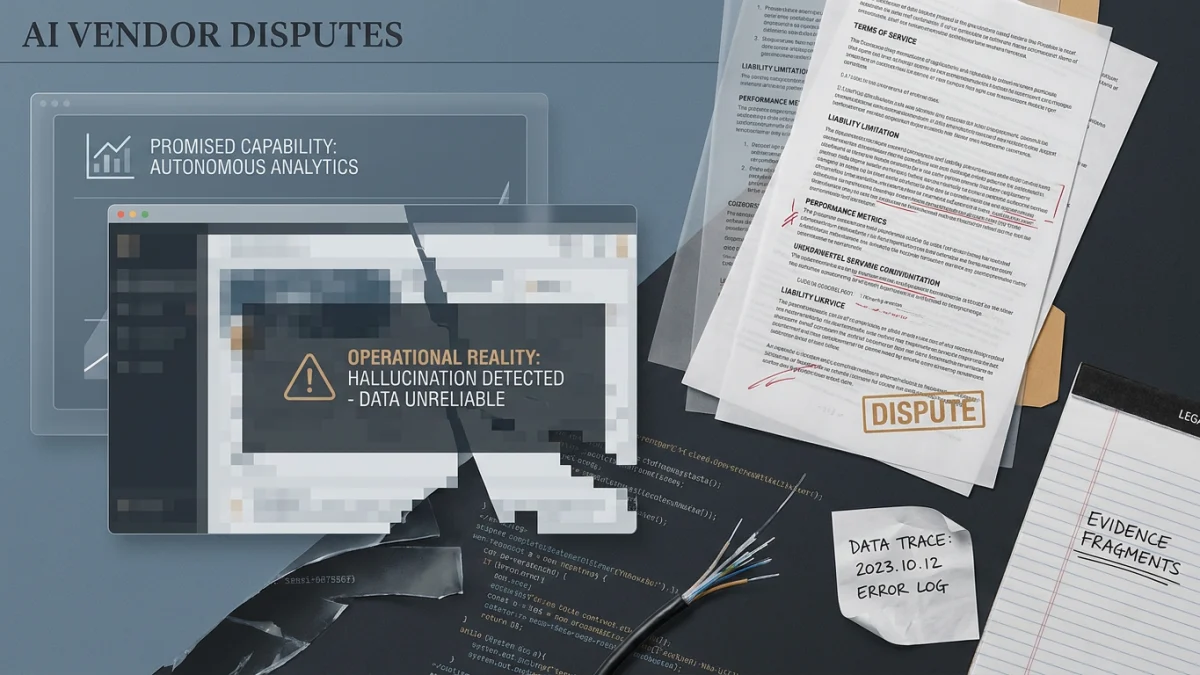
Many AI disputes will not begin as grand arguments about the future of law or technology.
They will begin the way many ordinary business disputes begin: a buyer believed it was getting one thing, the vendor delivered something else, the product changed under pressure, and the contract was not built for the way the system actually worked.
That is why AI vendor disputes are likely to become one of the largest practical categories inside AI dispute resolution.
They are where sales language, product reality, technical evidence, and governance discipline collide.
What an AI vendor dispute is
An AI vendor dispute is a dispute between a provider of an AI-enabled product or service and a customer, enterprise buyer, integration partner, or other commercial counterparty.
Common triggers include:
- disappointing or inconsistent performance,
- hallucinations or unreliable outputs,
- bias or misleading accuracy claims,
- product changes after purchase,
- confidentiality or data-handling problems,
- integration failures,
- policy-based suspensions,
- and disagreements over who was responsible for human oversight.
Some of these are classic warranty and services fights. But AI can make them more complicated because the product may be probabilistic, dynamic, highly configurable, and marketed with language that outruns the contract.
Why these disputes keep happening
Expectations are often inflated
Sales conversations may describe the product as if it were more consistent, reliable, or controllable than it really is in a production environment.
The contract may lag the marketing
The agreement may quietly narrow what was promised, but the customer may have operationalized the broader story.
The product can change after launch
Models update, prompts change, safety layers shift, policies change, retrieval systems are modified, and workflows evolve. The customer may treat those changes as degradation. The vendor may treat them as ordinary product improvement.
Responsibility is often blurred
If the output caused a problem, was the issue:
- the model,
- the integration,
- the prompt design,
- the human reviewer,
- the customer’s data,
- or the deployment environment?
In many disputes, that is the real fight.
The most common AI vendor dispute categories
Performance disputes
The customer says the product failed to meet promised functionality, accuracy, uptime, or workflow utility.
Hallucination and reliance disputes
The system generated false or misleading outputs and the customer claims the risk was inadequately disclosed, inadequately controlled, or inconsistent with the product’s represented use case.
Misrepresentation disputes
The customer says the vendor overstated what the system could do, how accurate it was, how bias-resistant it was, or how safely it could be deployed.
This is where official enforcement signals matter. The FTC’s action against IntelliVision over bias-related claims is an important reminder that AI marketing representations are not immune from ordinary deception principles.
Data-handling and confidentiality disputes
The system may have processed sensitive business or customer information in ways the customer did not expect or adequately approve.
Suspension, restriction, and policy disputes
The vendor relies on acceptable-use or safety policies to suspend or restrict access. The customer says the vendor exercised those powers unpredictably or opportunistically.
Why hallucination disputes are so tricky
The word “hallucination” can obscure more than it reveals.
In a vendor dispute, the more useful questions are:
- What was the system supposed to do?
- What warnings were given?
- What controls were promised?
- What records exist?
- What review process did the customer apply?
- What did the vendor know about foreseeable failure modes?
This is one reason AI vendor disputes are often deeply evidentiary. A bare bad output is usually not enough. The context around the output often matters just as much.
The evidence that usually decides these disputes
Key records may include:
- sales decks and product claims,
- contract language,
- statements of work,
- implementation guides,
- system documentation,
- prompts and outputs,
- logs and timestamps,
- model version changes,
- incident tickets,
- customer complaints,
- internal escalation records,
- and policy updates.
When those records are missing or fragmented, the dispute becomes much harder to resolve fairly.
Why ordinary software thinking can fail
Many buyers and vendors still structure these relationships as if the product were a fairly stable software tool with predictable output logic.
But AI products often behave differently:
- outputs vary,
- prompts matter,
- context matters,
- internal and external data sources matter,
- and model changes can affect downstream performance without always being obvious to the customer.
That does not excuse weak performance or weak disclosure. It does mean the contract and the process need to match the product reality.
Practical contract pressure points
The strongest AI vendor agreements usually think more carefully about:
- product definitions,
- use cases,
- performance commitments,
- disclaimer boundaries,
- human-review expectations,
- change management,
- confidential information handling,
- and dispute resolution design.
Weak contracts often leave those points split across:
- a master agreement,
- online terms,
- product documentation,
- usage policies,
- and sales messaging.
That fragmentation becomes dangerous once the relationship turns adversarial.
Why arbitration often fits AI vendor disputes
Many AI vendor disputes involve confidential technical and commercial information, ongoing business relationships, and fact patterns that benefit from focused handling rather than public spectacle.
That can make arbitration an attractive forum, especially where:
- the evidence is technical,
- the contract is central,
- and the parties want stronger confidentiality controls.
But if the dispute requires broad discovery, public accountability, or precedent-setting litigation, court may still be preferable.
What businesses should do now
Buyers using AI vendors should:
- preserve early sales representations,
- map the real use case carefully,
- document incidents and output failures,
- understand where human review is expected,
- and make sure the contract reflects the operational dependency.
Vendors should:
- avoid inflated claims,
- align sales and legal language,
- document changes,
- and think carefully about how policy-based restrictions are applied and explained.
FAQ
What is an AI vendor dispute?
It is a dispute between a provider of an AI-enabled product or service and a customer or commercial counterparty over performance, outputs, risk allocation, access, or related obligations.
Are hallucinations enough to win a dispute?
Not by themselves. The real question is usually what was promised, what safeguards existed, what the customer did, and what the evidence shows.
Why do these disputes often become evidence fights?
Because the parties usually disagree about what the system did, what changed, what was disclosed, and who was responsible for review or oversight.
What is the biggest mistake buyers make?
Relying on sales confidence without preserving the real product promises and without matching the contract to the operational risk.
Conclusion
AI vendor disputes are where the market stops speaking in abstractions and starts dealing with actual accountability.
That accountability depends on clearer contracts, better records, and more honest alignment between what AI products are sold as and what they can reliably do.
Further Reading
- FTC action against IntelliVision for misleading facial recognition claims: https://www.ftc.gov/node/86829
- FTC report warning about AI-related harms and surveillance incentives: https://www.ftc.gov/news-events/news/press-releases/2022/06/ftc-report-warns-about-using-artificial-intelligence-combat-online-problems
- NIST AI Risk Management Framework 1.0: https://www.nist.gov/publications/artificial-intelligence-risk-management-framework-ai-rmf-10
- JAMS Artificial Intelligence Disputes Clause and Rules: https://www.jamsadr.com/artificial-intelligence-disputes-clause-and-rules