
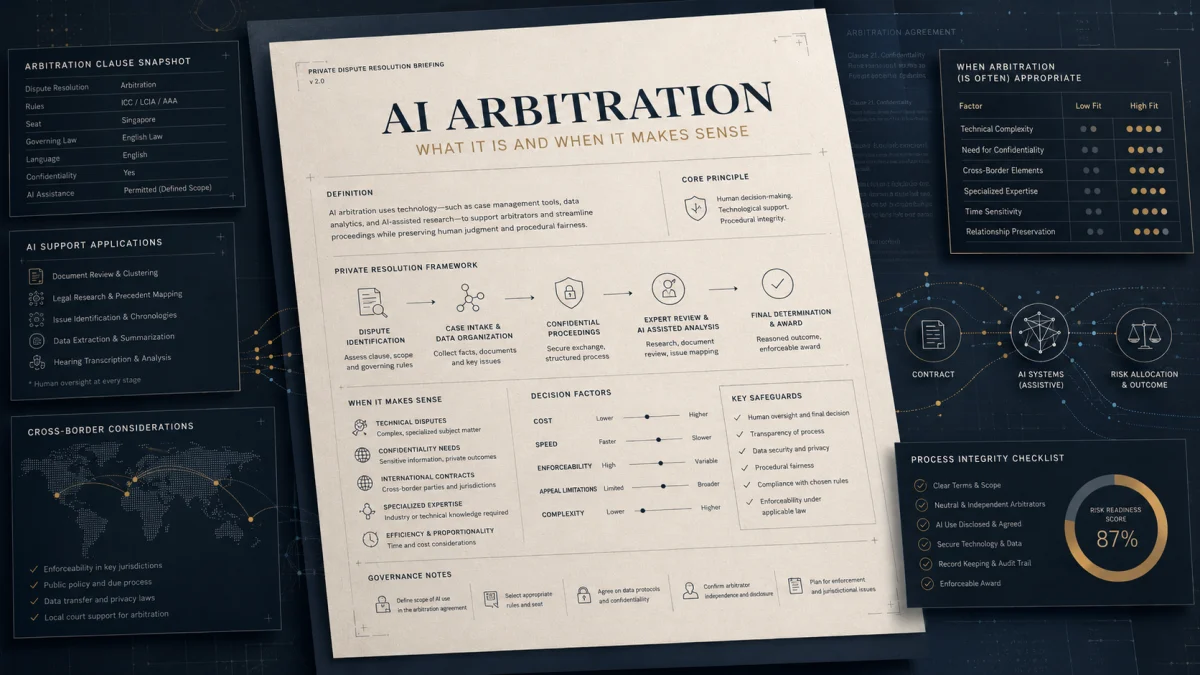
AI arbitration is not just a catchy phrase for tech-heavy disputes. It is becoming a practical label for a real set of conflicts that sit at the intersection of artificial intelligence, contract risk, evidence problems, confidentiality concerns, and procedural design.
The short version is this: AI arbitration usually means arbitration involving disputes about AI systems, disputes that depend on AI-related evidence, or proceedings in which participants are deciding whether and how AI tools may be used without undermining fairness or independent judgment.
That still leaves a deeper question. When does it actually make sense?
The answer depends on the nature of the dispute, the kind of evidence involved, the sensitivity of the information, and whether the parties need a private, expert-friendly forum more than they need the public machinery of court litigation.
What AI arbitration is
AI arbitration is arbitration used to resolve disputes connected to artificial intelligence systems, AI-enabled products, AI-related contractual relationships, or AI-shaped evidence.
That can include:
- disputes between an AI vendor and enterprise customer,
- disputes over model licensing or access rights,
- disputes involving training data or data-use permissions,
- disputes about harmful, unreliable, or noncompliant outputs,
- disputes over confidentiality, trade secrets, or security obligations,
- and disputes about how AI-assisted evidence should be evaluated.
In other words, AI arbitration is not one single claim type. It is a forum category for a growing range of technical and commercial conflicts.
Why the term matters now
For years, people talked about AI dispute resolution as if it were mostly theoretical. That is no longer quite right.
As of May 30, 2026, the procedural ecosystem is clearly developing:
- JAMS offers Artificial Intelligence Disputes Clause and Rules effective June 14, 2024.
- AAA-ICDR issued Guidance on Arbitrators’ Use of AI Tools in March 2025.
- Ciarb launched its Guideline on the Use of AI in Arbitration on September 5, 2025.
Those materials do not mean every AI dispute belongs in arbitration. They do show that institutions and practitioners now treat the subject as serious enough to require distinct guidance.
What kinds of disputes fit AI arbitration
The label is most useful when the dispute has at least one of three features:
- AI is the product or service at the center of the disagreement.
- AI-generated or AI-shaped evidence is central to proving the case.
- The proceeding itself raises questions about whether participants may use AI tools.
AI product and vendor disputes
These are often the most straightforward examples. A company licenses or deploys an AI system, the system underperforms or creates risk, and the parties disagree about representations, warranties, service levels, responsibility, or damages.
Model licensing disputes
These can involve access restrictions, sublicensing, usage caps, fine-tuning rights, retraining limits, exclusivity, or the scope of the licensed output.
Training-data and data-governance disputes
Here the fight may center on permission, provenance, use restrictions, ownership claims, privacy obligations, or whether a party exceeded the agreed scope of data use.
Output and reliance disputes
These disputes often ask whether a party relied on AI-generated outputs in a way the other side should have anticipated, controlled, or warned against.
Evidence disputes
Even when the underlying claim is ordinary, the proof may not be. Prompts, outputs, evaluations, moderation logs, audit records, and version history can become the center of gravity.
When arbitration may be the better forum
Arbitration is not automatically better than litigation. But it often has strong advantages in the AI context.
When confidentiality matters
Many AI disputes involve sensitive technical and commercial information: source materials, internal evaluations, training practices, model behavior analysis, customer records, or deployment strategies. A private forum can be attractive when the parties want tighter control over exposure.
That said, privacy is not self-executing. The agreement and governing rules still matter. So do the actual habits of the participants and the tools they use.
When technical expertise matters
Some disputes become expensive because the decision-maker is forced to learn the system from scratch in public view. Arbitration can make it easier to choose a neutral who is better positioned to understand technical evidence, business context, or specialized procedural needs.
When flexibility matters
AI disputes often require tailored procedures. The parties may need staged discovery, limited inspection rights, expert sequencing, stronger protective arrangements, or a defined protocol for handling sensitive materials. Arbitration can be more adaptable than court on those issues.
When the relationship still matters
If the parties want to preserve a business relationship, a more controlled and private process may be preferable to full public combat.
When arbitration may not be the best fit
There are also times when court is the better path.
When broad discovery is essential
If one party needs expansive third-party discovery or complex public process tools, arbitration may feel too constrained.
When a public precedent matters
Some disputes are not just about private resolution. A party may want a public ruling or a decision with broader signaling value.
When emergency court relief is the real issue
Trade secrets, public injunctive relief, or immediate operational harms may push parties toward court, even if arbitration remains relevant later.
When the clause was drafted poorly
Many AI-related clause problems are not conceptual. They are drafting failures. A vague or mismatched arbitration clause can create more procedural fighting than it prevents.
The special risks in AI arbitration
AI disputes bring recurring risks that should be visible from the beginning.
Evidence can be unstable
A model may change. A policy may change. A system prompt may change. A ranking layer may change. If no one preserved a clear record, the parties may end up arguing about a moving target.
Confidentiality can be overstated
Arbitration can be more private than court, but it does not magically solve data-handling risk. If confidential material is fed into insecure tools, passed around casually, or inadequately segmented, the process can still create major exposure.
Technical misunderstanding is expensive
When the participants use broad labels like “the AI made the decision,” they often hide the real operational chain. A good arbitration process forces precision.
Human judgment still matters
Institutional guidance is increasingly clear on this point. AAA-ICDR’s March 2025 guidance says arbitrators should verify AI outputs, preserve fairness and due process, retain independent decision-making, disclose material generative AI use, and protect confidential information. The direction of travel is support, not substitution.
What the institutional landscape suggests
The institutional materials are useful not because they provide a universal answer, but because they mark out the boundaries of responsible practice.
JAMS now has AI-specific rules that expressly address AI-related disputes and include a dedicated clause and procedural framework. That is a strong signal that the market expects specialized handling.
AAA-ICDR’s 2025 guidance is narrower but very practical. It focuses on what arbitrators should do when using AI tools at all: verify outputs, protect confidentiality, preserve fairness, and never surrender independent judgment.
Ciarb’s 2025 guideline broadens the conversation. It addresses not only arbitrators, but also parties and representatives, and it includes model language and procedural guidance around AI use in arbitration.
Taken together, these materials suggest a mature view:
- AI can complicate disputes.
- AI tools may help some participants work more efficiently.
- But procedural integrity still depends on human responsibility.
What a strong AI arbitration clause should anticipate
If a business expects AI-related disputes to be resolved in arbitration, the clause should be drafted with that reality in mind.
At a minimum, the parties should think about:
- forum selection,
- governing rules,
- the desired level of technical expertise in the neutral,
- confidentiality and protective mechanisms,
- discovery limits,
- treatment of highly sensitive data,
- inspection or audit issues,
- emergency relief,
- and whether AI-tool use during the proceeding should be addressed explicitly.
That is where many companies are still underprepared.
Practical questions to ask before relying on AI arbitration
Before treating arbitration as the answer, ask:
- What exactly could go wrong in this relationship?
- What evidence would matter most if it did?
- Who would need access to sensitive technical information?
- Would a specialized neutral materially improve the process?
- Is the clause matched to the likely dispute, or just copied from another contract?
- Are there issues that should be carved out for court or another process?
Those questions are more useful than a generic pro-arbitration or anti-arbitration posture.
FAQ
What is AI arbitration?
AI arbitration is arbitration used to resolve disputes involving AI systems, AI-enabled products, AI-related contractual relationships, or AI-shaped evidence.
Is AI arbitration only for disputes between AI companies?
No. It can also apply to ordinary businesses using AI vendors, licensing AI tools, integrating models into workflows, or dealing with disputes in which AI-generated materials become evidence.
Does arbitration automatically protect confidentiality?
No. It can help, but real protection still depends on the agreement, governing rules, tool choices, document-handling discipline, and the overall process design.
Can arbitrators use AI tools in an AI arbitration?
Potentially yes, but current guidance points toward careful limits: verify outputs, preserve fairness and confidentiality, disclose material use, and keep judgment in human hands.
Is AI arbitration always better than litigation?
No. It can be better for privacy, flexibility, and expertise, but litigation may still be preferable where public precedent, broad discovery, or urgent judicial relief matter most.
Conclusion
AI arbitration is becoming real not because the buzzword is fashionable, but because the underlying disputes are real and the procedural questions are becoming harder to ignore.
Used well, arbitration can offer privacy, flexibility, and a better fit for technical evidence. Used casually, it can import all the usual drafting mistakes into a new and more complicated field.
The better approach is not to assume AI arbitration is the answer. It is to understand when it is the right answer, and to design for that reality early.
Further Reading
- JAMS Artificial Intelligence Disputes Clause and Rules: https://www.jamsadr.com/artificial-intelligence-disputes-clause-and-rules
- AAA-ICDR Guidance on Arbitrators’ Use of AI Tools, March 2025: https://www.adr.org/media/g1fgccns/2025_aaa-icdr-guidance-on-arbitrators-use-of-ai-tools-2.pdf
- Ciarb Guideline launch note, September 5, 2025: https://www.ciarb.org/news-listing/ciarb-launches-guideline-on-the-use-of-ai-in-arbitration/