Project Esther begins with a real problem. Its proposed solution is a threat to Americans.
Antisemitism is real. Jewish Americans have faced threats, assaults, harassment, vandalism, conspiracy theories, and intimidation. The October 7, 2023, Hamas attacks and the war that followed intensified fear, anger, and polarization inside the United States. Some demonstrations ostensibly organized around Palestinian rights have crossed legitimate boundaries through harassment, explicit support for violence, threats, property destruction, or the targeting of Jewish people as Jews.
Those facts deserve an honest response. They do not justify pretending every pro-Palestinian activist is innocent, every campus encampment is peaceful, or every invocation of “Zionism” is free of antisemitic meaning.
But they also do not justify Project Esther.
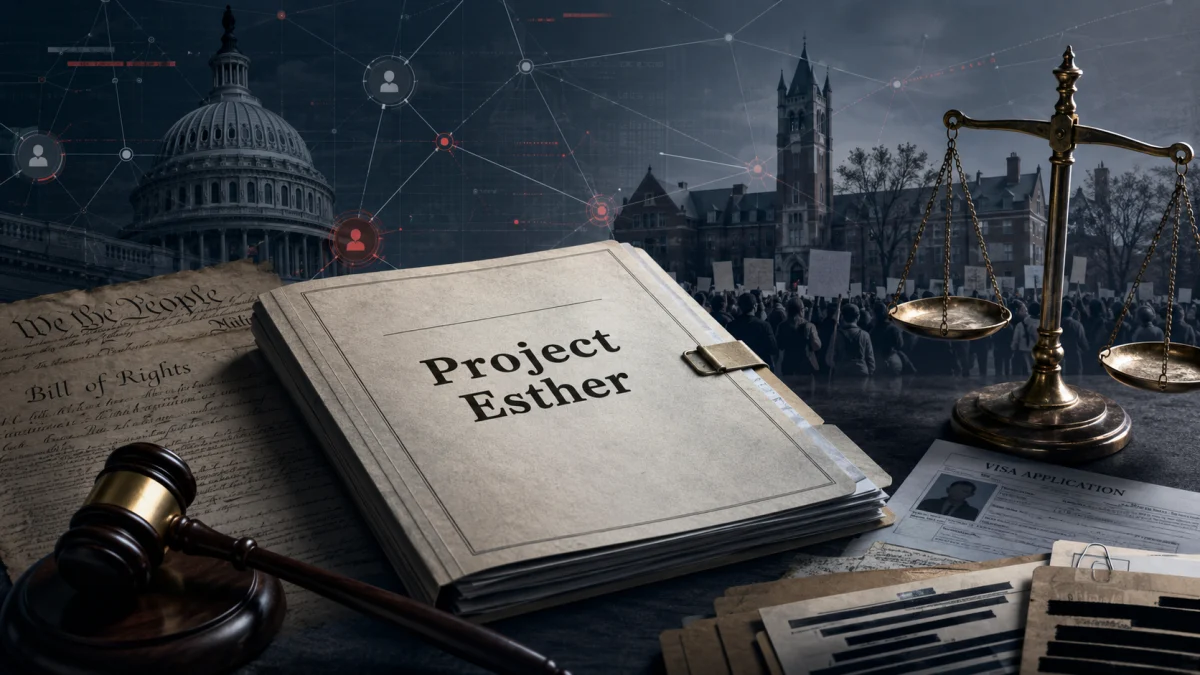
Published by the Heritage Foundation on October 7, 2024, Project Esther presents itself as a “national strategy to combat antisemitism.” In substance, it is a domestic political-warfare plan for dismantling a broad ideological movement inside the United States. It recasts political advocacy, campus organizing, philanthropy, teaching, public protest, online speech, and contact with elected officials as components of what it calls a “Hamas Support Network.” It then proposes using government authority, private donors, universities, employers, social-media platforms, immigration enforcement, lawfare, reputational pressure, and financial disruption to break that alleged network within 12 to 24 months.
The central problem is not that Project Esther takes antisemitism too seriously. It is that it defines the threat so broadly, proves it so weakly, and proposes remedies so coercive that the strategy endangers the constitutional mechanisms Americans use to oppose government policy.
Political pressure on the government to change its foreign policy is not evidence of terrorism. It is one of the constitutional purposes of speech, association, petition, protest, journalism, and academic debate.
Project Esther repeatedly blurs that distinction.
Objectivity AI evidence posture
Before reaching a verdict, the evidence must be separated into different levels of certainty.
Documented with high confidence
Project Esther explicitly seeks to dismantle organizations it associates with pro-Palestinian activism. Its desired outcomes include removing faculty, purging educational content, restricting protest activity, disrupting communications, denying organizations access to financial and social infrastructure, investigating immigration status, deporting foreign participants, and making potential demonstrators afraid to associate with targeted groups. These are not accusations invented by critics; they are contained in the project’s own published strategy.
The Trump administration subsequently employed several closely matching tactics, including immigration investigations of campus activists, efforts to revoke visas or remove noncitizens, federal antisemitism investigations, and the withholding or cancellation of large amounts of university funding.
Strongly supported inference
Project Esther’s measures would predictably chill constitutionally protected speech and association, including among people who have no connection to Hamas and have committed no crime. That conclusion follows not merely from the severity of its proposals but from its stated objective of making people fear affiliation with targeted organizations.
The public document’s analytical structure encourages guilt by association. It identifies an ideological network, treats overlapping beliefs, donors, relationships, protests, and political objectives as evidence of coordination, and then recommends coercive action against the resulting category.
Not established by the available evidence
Project Esther does not publicly prove that the entire collection of organizations, professors, funders, elected officials, students, and protesters it discusses operates under Hamas’s direction or control.
It does not establish that every person advancing a political demand also advanced by Hamas is knowingly providing material support to Hamas.
It has not been proven that Project Esther directly caused every corresponding Trump administration action. The convergence is substantial, but policy similarity is not by itself proof of a direct command chain.
Project Esther has also not demonstrated that its proposed campaign will reduce antisemitic incidents. Its own risk assessment acknowledges the possibility that the strategy could increase antisemitism.
That distinction matters. A rigorous report should neither ignore the convergence nor promote an unproven causal claim as fact.
What is Project Esther?
Project Esther was produced through the Heritage Foundation’s National Task Force to Combat Antisemitism. Heritage announced the task force in November 2023 with participants largely drawn from conservative policy organizations, evangelical Christian groups, academic organizations, and advocacy institutions. Its founding coalition included the America First Policy Institute, Concerned Women for America, the Family Research Council, the National Association of Scholars, Regent University, the Philos Project, the Independent Women’s Forum, and several other groups.
The strategy’s executive summary makes an extraordinary opening claim: that the American pro-Palestinian movement is not merely influenced by extremists or vulnerable to antisemitism but is effectively a terrorist-support network centered on Hamas.
The document gives this purported system a name: the Hamas Support Network, or HSN.
That name sounds like a legal or intelligence designation. It is not. It is a category created by Project Esther itself.
The paper places organizations including Students for Justice in Palestine, National Students for Justice in Palestine, American Muslims for Palestine, Jewish Voice for Peace, Samidoun, WESPAC, the Alliance for Global Justice, and major philanthropic foundations within or around this alleged infrastructure. It also discusses professors, university administrators, progressive activists, financial donors, social-media platforms, protest organizers, and members of Congress.
Some entities named in or associated with this ecosystem may warrant serious scrutiny. Samidoun, for example, was designated by the United States in October 2024 as a sham charity operating as an international fundraiser for the Popular Front for the Liberation of Palestine, a designated terrorist organization. That is precisely why individualized evidence matters: the government already possesses legal mechanisms for acting against an organization when it can establish financial or operational support for a designated terrorist group.
Project Esther does something different. It expands from potentially provable cases to a much broader ideological network whose members may be included because they indirectly “further” Hamas’s cause, participate in related protests, share political objectives, fund organizations in the same ecosystem, or influence public policy against Israel’s military actions.
This is definitional laundering: first describe a political movement as a terrorist-support network, then cite that description as the reason its participants should lose ordinary rights and institutional access.
The real antisemitism crisis should not be minimized
A credible criticism of Project Esther cannot be built on the false premise that antisemitism is imaginary or insignificant.
The FBI recorded 11,679 hate-crime incidents involving 14,243 victims in 2024. Religion accounted for nearly one-quarter of victims in single-bias incidents. Anti-Jewish offenses constituted the large majority of reported religion-based hate crimes.
In the American Jewish Committee’s 2025 survey, 78 percent of Jewish respondents said the October 7 attacks had made them feel less safe as Jews in the United States. The survey used a nationally representative sample of 1,222 Jewish adults.
The Anti-Defamation League reported that antisemitic incidents declined in 2025 from their previous peak but remained historically elevated, including hundreds of assaults and three deaths. Some of the ADL’s classification choices—particularly its treatment of certain anti-Zionist expressions—are contested, but physical assaults, threats, vandalism, and explicit hatred are not methodological abstractions.
Universities have an obligation to protect Jewish students. Protesters do not have a right to assault people, issue true threats, occupy restricted buildings, physically prevent students from attending class, vandalize property, or target someone because of Jewish identity.
None of those propositions require Project Esther’s theory.
Existing criminal law, civil-rights law, university conduct rules, tort law, and immigration law can address actual misconduct. Title VI can require schools receiving federal funds to respond to discriminatory harassment. Prosecutors can pursue violence, threats, vandalism, and material support for terrorism. Universities can impose viewpoint-neutral restrictions on time, place, and manner.
The choice is not between Project Esther and tolerating antisemitism.
The actual choice is between individualized enforcement based on evidence and collective suppression based on political association.
Project Esther’s foundational evidentiary failure
Project Esther does not begin by identifying particular crimes and tracing the responsible actors. It begins with an ideological category and works backward.
The strategy defines its Hamas Support Network broadly enough to include people and institutions that directly or indirectly advance Hamas’s objectives against what the authors describe as American and Western values. That creates an elastic test. Hamas opposes Israeli military action, seeks international pressure on Israel, advocates changes in U.S. policy, and attempts to undermine support for the Israeli government. Millions of people who have no relationship with Hamas also favor one or more of those outcomes for independent moral, legal, humanitarian, religious, or geopolitical reasons.
Sharing a desired policy outcome with a criminal organization does not demonstrate membership in that organization’s network.
The United States and Al-Qaeda both opposed the Soviet occupation of Afghanistan. That fact would not establish a support relationship between every American critic of the Soviet Union and Al-Qaeda.
White supremacists may oppose a particular trade agreement, vaccine mandate, foreign war, or federal agency. Their agreement with an ordinary citizen on one issue does not transform the citizen into part of a white-supremacist network.
An evidentiary system that treats ideological overlap as organizational connection can manufacture almost any conspiracy it wants.
Protest volume is not proof of command and control
Project Esther points to the large number of demonstrations concerning Israel and Palestine, and to the predominance of pro-Palestinian events, as evidence of the network’s reach.
But a large number of demonstrations proves that an issue has mobilized many people. It does not prove that those people are controlled by Hamas, knowingly assist Hamas, endorse attacks on civilians, or hold antisemitic beliefs.
A mass movement may contain coordinated organizations, spontaneous participants, opportunists, extremists, pacifists, students, religious groups, human-rights advocates, ethnic nationalists, socialists, liberals, conservatives, and people motivated primarily by images of civilian suffering. Treating all of them as parts of one terrorist-support system eliminates the distinctions an actual intelligence analysis would be required to establish.
The project substitutes mapping for proof
The strategy maps relationships among advocacy organizations, funders, professors, politicians, media systems, and protest groups. Network mapping can be useful. Money flows, overlapping leadership, shared vendors, coalition work, and organizational coordination are all legitimate subjects of investigation.
But a network diagram is not proof of criminality.
Two organizations receiving money from the same foundation are not necessarily controlled by each other. A professor speaking at a protest is not necessarily an operative of its organizers. A politician meeting with constituents is not necessarily part of their command structure. An organization repeating a slogan is not necessarily taking instructions from whoever first used it.
Project Esther’s method repeatedly crosses the line from connection to coordination, from coordination to support, and from support to terrorism, without publicly supplying the evidence required for each transition.
Canary Mission is treated as an evidentiary resource
Project Esther cites Canary Mission, an anonymous blacklist website that publishes dossiers on students, academics, and organizations accused of supporting hatred of Israel, antisemitism, or terrorism. In one passage, Project Esther relies on Canary Mission’s identification of hundreds of professors, with the underlying citation effectively directing readers to the Canary Mission website itself.
That is not a sufficient evidentiary standard for depriving people of employment, immigration status, financial access, professional credentials, or constitutional protection.
A serious investigation would require source provenance, consistent definitions, the opportunity to challenge accusations, differentiation between lawful and unlawful conduct, and evidence that survives adversarial review. Anonymous dossiers may contain accurate information, inaccurate information, selective quotations, or interpretations stripped of context. Each allegation must be independently tested.
When a government uses a private blacklist to select people for investigation, the blacklist may accomplish indirectly what the government would face constitutional scrutiny for doing directly.
What Project Esther actually proposes
The most important way to evaluate Project Esther is to read what it asks institutions to do.
Its stated end condition is not simply fewer hate crimes or better protection for Jewish students. It seeks the dismantling of the alleged network’s ability to operate within American civil society.
The document describes desired effects that include:
- Removing allegedly supportive material from educational curricula.
- Removing or discrediting faculty and staff viewed as supportive of the targeted movement.
- Preventing organizations from operating on campuses.
- Restricting or denying permits for demonstrations.
- Blocking access to donors, financial systems, and other sources of revenue.
- Pressuring social-media companies and other platforms not to host targeted groups.
- Disrupting internal communications.
- Investigating noncitizens for visa violations.
- Deporting foreign members or leaders.
- Using counterterrorism, racketeering, foreign-agent, immigration, and other laws.
- Applying reputational campaigns, including tactics it calls “name and shame” and “wage lawfare.”
- Creating sufficient social and professional fear that people become reluctant to join demonstrations or associate with the targeted organizations.
The strategy says supporters and influence targets should be subjected to “extreme discomfort” until they capitulate. It anticipates synchronized activity involving federal and state governments alongside private actors.
These are not ordinary recommendations to improve campus security or prosecute hate crimes.
They constitute a coordinated effort to raise the personal, financial, legal, academic, and immigration costs of political participation until a movement can no longer sustain itself.
The objective is deterrence through fear.
Political advocacy is not material support for terrorism
Federal law prohibits knowingly providing material support or resources to a designated foreign terrorist organization. That includes money, property, services, training, expert assistance, personnel, transportation, and other tangible forms of support. This is a legitimate national-security law, although its boundaries have produced difficult constitutional disputes.
In Holder v. Humanitarian Law Project, the Supreme Court upheld restrictions on certain forms of coordinated assistance to foreign terrorist organizations, even when the assistance was described as peaceful conflict-resolution or legal advocacy. The decisive element was coordination with or service to the designated organization. The Court did not hold that independent speech supporting similar political goals could be criminalized.
The statute itself distinguishes people operating under a terrorist organization’s direction or control from people acting independently.
That distinction is essential.
A person may independently argue that Israel should accept a ceasefire, that the United States should suspend military assistance, that Palestinians should have a state, that Israel is committing war crimes, or even that Zionism should be rejected. Those positions may be correct, incorrect, offensive, one-sided, inflammatory, or historically uninformed. They are not, without additional evidence, material support for Hamas.
Speech can lose constitutional protection when it constitutes a true threat, direct participation in criminal activity, or incitement intended and likely to produce imminent lawless action. Mere advocacy of an unpopular or even morally repellent doctrine is not enough under Brandenburg v. Ohio.
Project Esther repeatedly treats the political effect of speech as evidence that the speech belongs to a terrorist network. That is precisely the conceptual leap constitutional law does not permit the government to make automatically.
The First Amendment protects movements, not just isolated sentences
The First Amendment does not merely protect the act of privately holding an opinion. It protects the infrastructure through which political ideas acquire influence: assembly, association, demonstrations, boycotts, fundraising, publishing, coalition building, teaching, and petitioning elected officials.
In NAACP v. Claiborne Hardware, the Supreme Court protected a politically motivated boycott involving speeches, meetings, picketing, and economic pressure. The Court refused to impose blanket organizational liability merely because some participants had engaged in unlawful behavior. Liability required evidence connecting the organization or individual to the unlawful act.
That case is particularly relevant because Project Esther is not focused only on criminal conduct. It seeks to disrupt the surrounding movement’s capacity to organize, raise money, communicate, gain legitimacy, and influence officials.
In NAACP v. Alabama, the Supreme Court recognized that exposing an organization’s membership could deter association through fear of economic retaliation, hostility, and social pressure. The Court understood that compelled disclosure could destroy a movement without formally banning it.
Project Esther openly identifies deterrence from association as one of its desired conditions.
That makes the chilling effect not an accidental consequence but part of the mechanism.
The Constitution also does not allow the government to suppress an idea merely because officials regard it as offensive. As the Supreme Court reaffirmed in Matal v. Tam, the government may not prohibit expression simply because it disparages or offends.
Antisemitic harassment can be punishable in appropriate circumstances. Criticism of Israel—even severe, unfair, or emotionally brutal criticism—is not automatically antisemitic harassment. A constitutional system must preserve the distinction.
The collective-guilt logic appears in Project Esther’s own footnotes
One of Project Esther’s most revealing claims appears in an endnote. The document argues that Gaza’s population bears responsibility for Hamas because Hamas won the 2006 Palestinian legislative election and the population did not remove it. It extends that responsibility to Americans who support the Palestinian cause, comparing them to supporters of overtly fascist movements.
This is not serious individual threat assessment. It is collective-guilt reasoning.
Hamas won a plurality in the 2006 legislative election and secured 74 of 132 parliamentary seats. Gaza has not held another open national election since. Hamas subsequently established authoritarian control, suppressed rivals, restricted political freedom, and governed without a renewed electoral mandate.
By 2024, approximately 47 percent of Gaza’s population was under 18. A vast share of the population was either not alive or not old enough to vote in 2006.
It is possible to condemn Hamas unequivocally while recognizing that children, political opponents, dissidents, civilians living under authoritarian rule, and people born years after an election are not equally responsible for the organization’s crimes.
A framework that erases those distinctions will predictably erase similar distinctions among Americans. Once a population is assigned collective culpability, advocacy for its rights can be reframed as advocacy for its rulers. Humanitarian concern becomes ideological support. Ideological support becomes organizational association. Association becomes terrorism.
That reasoning is not merely harsh. It is analytically defective.
Project Esther treats democratic influence as part of the threat
Project Esther identifies the alleged network’s strategic purpose as generating political pressure that could weaken or change U.S. support for Israel.
But that is exactly what political movements are supposed to do.
Environmental organizations organize to change energy policy. Gun-rights organizations organize to change firearms policy. Labor unions organize to change labor policy. Antiwar groups organize to change military policy. Cuban, Armenian, Ukrainian, Iranian, Israeli, Palestinian, evangelical Christian, Muslim, and other communities all attempt to influence U.S. foreign policy.
Americans have the right to argue that the United States should support Israel more, support it less, condition military assistance, recognize Palestinian statehood, reject Palestinian statehood, impose sanctions, veto international resolutions, or end a military alliance.
Project Esther transforms one side’s attempt to influence policy into evidence of a hostile network.
It even uses the term “Hamas Caucus” to describe progressive members of Congress associated with criticism of Israel.
That is not an evidentiary classification. It is political branding.
Members of Congress may express irresponsible, inaccurate, or prejudiced views. They should be criticized on the merits. But labeling lawmakers as a terrorist caucus without demonstrating operational support for Hamas normalizes the idea that dissent from a preferred foreign policy is presumptively disloyal.
The most dangerous proposition in Project Esther is that full access to American democracy should depend on conformity with one position concerning a foreign government.
Public-private suppression evades normal accountability
Project Esther envisions a partnership between a sympathetic administration and private institutions.
This architecture is strategically important. Direct government censorship is conspicuous and subject to constitutional challenge. A distributed pressure campaign is harder to identify and remedy.
A government may investigate someone. A private blacklist may identify the target. Donors may pressure the university. Employers may review the person’s statements. Platforms may restrict their reach. Financial services may become unavailable. Immigration officials may examine their visa. Professional organizations may question their credentials.
Each actor can portray its decision as independent.
Together, the system can impose severe punishment without a criminal conviction, a trial, or even a clearly stated charge.
Private organizations generally possess their own rights to criticize, boycott, investigate, and advocate. But constitutional concerns become more serious when government officials encourage, coordinate, or materially participate in private retaliation against protected speech.
This is why Project Esther’s call for synchronized government and private action deserves scrutiny. The issue is not whether civil society may oppose antisemitism. It should. The issue is whether private institutions become an informal enforcement layer for viewpoint-based government policy.
A blacklist does not become due process merely because a private organization compiled it.
Universities become financial hostages
Universities can fail Jewish students. Administrators can hide cowardice behind vague language, selectively enforce rules, or tolerate conduct they would condemn in another context. Federal civil-rights enforcement is therefore legitimate when supported by evidence and conducted through lawful procedures.
Project Esther, however, treats universities as strategic nodes to be coerced.
In 2025, federal agencies began reviews involving billions of dollars in grants and contracts at Columbia and Harvard. The government canceled approximately $400 million in grants and contracts to Columbia and examined billions in Harvard commitments. These actions were publicly justified in the name of combating antisemitism and institutional noncompliance.
The government has a right to enforce grant conditions and civil-rights laws. It does not have unlimited authority to use unrelated scientific and medical funding as leverage to obtain ideological or governance concessions.
In September 2025, a federal district court ruled that the administration’s termination of Harvard research grants violated the First Amendment, failed to follow Title VI procedures, and was arbitrary and capricious under administrative law. The court found an inadequate relationship between the canceled research and the government’s stated antisemitism concerns and described the funding pressure as ideologically motivated.
That was a district-court judgment, not a final Supreme Court resolution. Nevertheless, it demonstrates the constitutional danger of replacing individualized enforcement with institution-wide financial punishment.
Canceling medical, scientific, technological, or public-health research does not narrowly punish an antisemitic harasser. It can punish laboratory workers, patients, graduate students, researchers, and the public.
A government that can threaten cancer research to control campus speech has acquired leverage far beyond the original dispute.
Immigration status becomes a political vulnerability
Project Esther explicitly identifies visa review and deportation as tools for dismantling the alleged network.
In January 2025, President Donald Trump issued an executive order directing federal agencies to identify authorities that could be used against antisemitism and to recommend mechanisms involving foreign students and staff who might be inadmissible or removable. A White House fact sheet promised the cancellation of student visas and deportation of what it called “Hamas sympathizers.”
The administration subsequently detained or sought to remove several noncitizen students and scholars connected to pro-Palestinian activism. The cases involved different facts and immigration circumstances, and their outcomes have varied. Some courts protected activists from immediate detention; appellate courts in other jurisdictions required immigration proceedings to run their course before constitutional claims could be fully litigated.
The constitutional issue is not whether noncitizens can ever be deported. They can. Visa fraud, status violations, criminal activity, security grounds, and statutory inadmissibility may all have consequences.
The issue is whether lawful political expression is being used as the practical basis for selecting people for immigration punishment.
When the government uses immigration status to suppress a viewpoint it could not constitutionally silence in citizens, it creates two levels of political freedom: robust speech for those secure enough to risk retaliation and conditional speech for everyone else.
That does not remain confined to Palestine activism. Foreign students and scholars may begin avoiding debate about China, Saudi Arabia, India, Russia, Iran, climate policy, race, religion, war, or the actions of the United States itself.
The predictable result is intellectual conformity produced through administrative fear.
Policy convergence is real, but direct causation remains unproven
Project Esther called for a public-private partnership under a “willing Administration.” It recommended immigration enforcement, federal investigations, financial pressure on universities, platform and donor pressure, legal campaigns, and the targeting of alleged network nodes.
The Trump administration then pursued:
- A government-wide antisemitism initiative.
- Multi-agency investigations of university campuses.
- Reviews and cancellations of university funding.
- Visa cancellation and deportation initiatives involving pro-Palestinian activists.
- Public rhetoric connecting campus protest to Hamas sympathy.
- Pressure on universities to change policies, discipline participants, and restructure governance.
This is strong evidence of policy convergence.
It is not, standing alone, proof that Project Esther secretly directed each government decision. The administration had its own political objectives, personnel, campaign promises, legal theories, and relationships with other advocacy organizations.
As of July 2026, Mahmoud Khalil has filed a federal civil-rights lawsuit alleging a coordinated public-private conspiracy involving administration officials, the Heritage Foundation, Canary Mission, and Betar. The complaint points directly to Project Esther’s proposed partnership and alleges that private organizations supplied targets for government immigration action. Heritage has denied being silenced by the litigation and has defended its role as a policy organization. These allegations are consequential but have not yet been adjudicated as facts.
The most defensible conclusion is therefore precise:
Project Esther publicly advocated a set of tactics that the federal government later used in substantial part. Direct responsibility for individual actions remains a matter requiring documentary evidence, testimony, discovery, and judicial findings.
That conclusion neither dismisses the resemblance nor outruns the evidence.
Project Esther’s selective treatment of antisemitism
Project Esther presents the pro-Palestinian movement as the preeminent organized threat to American Jews and Western civilization. It does not provide a comparable analysis of white-nationalist, neo-Nazi, Christian nationalist, conspiratorial, or far-right antisemitism.
This omission matters because antisemitism does not belong to one political faction.
It can appear in Islamist movements, white nationalism, Christian theology, racial conspiracy theories, anti-capitalist rhetoric, anti-communism, nationalist populism, elite conspiracy narratives, and forms of anti-Zionism that assign collective guilt to Jews. It can also appear in supposedly pro-Israel political spaces that value Jews primarily as instruments in an apocalyptic or nationalist agenda.
A credible national strategy would analyze all major threat streams according to evidence, capability, intent, incident history, and potential for violence.
Project Esther instead concentrates its coercive machinery on a political coalition associated predominantly with the left, Muslims, Palestinians, students, academics, and Israel’s critics.
That selective posture became harder to ignore in late 2025, when several participants or affiliated figures left Heritage’s antisemitism initiative after Heritage president Kevin Roberts defended Tucker Carlson following Carlson’s friendly interview with Nick Fuentes, a white-nationalist figure known for antisemitism. At least eight people or organizations reportedly resigned or threatened to leave.
That controversy does not automatically disprove every claim in Project Esther. Institutions can produce valid findings while behaving inconsistently elsewhere.
But it does expose the governance problem: an organization asking for extraordinary power to define and dismantle antisemitic networks showed far greater institutional strain when antisemitism appeared within its own political neighborhood.
A threat framework that is aggressive toward opponents and hesitant toward allies is not objective threat assessment. It is partisan threat selection.
Project Esther may undermine the fight against antisemitism
Conflating antisemitism with opposition to Israel produces several damaging effects.
First, it weakens the meaning of antisemitism. When the term is applied to everything from physical attacks on Jews to criticism of Israeli military policy, people begin treating the entire category as political manipulation.
Second, it makes Jewish safety dependent on suppressing other people’s rights. That encourages resentment and allows genuine antisemites to portray Jews collectively as responsible for censorship or government coercion.
Third, it obscures actual threats. Investigators have limited attention and credibility. A system focused on professors, slogans, donors, and peaceful demonstrators may fail to distinguish them from people planning violence.
Fourth, it divides Jewish communities. Many Jewish Americans strongly support Israel, while others oppose occupation, settlements, military actions, Zionism, or the Israeli government. Project Esther places Jewish Voice for Peace within its hostile network, demonstrating that Jewish identity does not protect a person from being classified as part of the problem when their politics diverge from the preferred line.
Fifth, the strategy itself acknowledges the risk that its campaign could provoke greater antisemitism. Rather than treating that danger as a reason to reconsider the model, it discusses communications and public-relations methods for managing accusations and backlash.
A program ostensibly designed to protect Jews should be evaluated partly on whether it makes Jews safer.
Project Esther supplies no credible causal model demonstrating that firing professors, deporting students, bankrupting organizations, pressuring platforms, restricting demonstrations, and canceling unrelated research grants will reduce anti-Jewish violence.
The plan has a theory of suppression. It does not have a demonstrated theory of safety.
The strongest defense of Project Esther—and why it fails
The strongest defense is not frivolous.
Hamas is a terrorist organization that murdered civilians and took hostages on October 7. Some American activists have praised the attack, celebrated Hamas, endorsed violent “resistance,” harassed Jewish students, or adopted rhetoric that appears to justify killing civilians. Some organizations may have undisclosed relationships, financial ties, or coordination that deserve investigation. Universities have sometimes failed to enforce rules or protect students consistently. Foreign actors do attempt to exploit American political movements.
A responsible government should investigate credible evidence of those things.
But that defense supports targeted enforcement, not Project Esther’s full framework.
When evidence shows that a person knowingly transferred money, services, personnel, or coordinated assistance to a terrorist organization, prosecute the person under material-support law.
When a protester commits assault, prosecute the assault.
When someone issues a true threat, investigate the threat.
When an organization acts as an undeclared agent of a foreign principal, apply the Foreign Agents Registration Act based on evidence.
When a university permits severe discriminatory harassment, enforce Title VI through established procedures.
When a noncitizen violates a valid immigration law, provide notice, evidence, counsel where required, and an opportunity for review.
What Project Esther cannot legitimately do is use the existence of some unlawful conduct to assign presumptive guilt to an entire political ecosystem.
Movements are not collectively stripped of constitutional protection because some participants commit crimes. That principle protects civil-rights organizations, religious groups, labor movements, gun-rights advocates, anti-abortion activists, environmental protesters, and conservative organizations as much as it protects pro-Palestinian activists.
The precedent cannot be confined to the intended target.
Why Project Esther is bad for Americans who have nothing to do with Palestine
Some Americans may support Project Esther because they dislike the organizations it targets. That is shortsighted.
The machinery described in the plan is politically reusable.
A future administration could define a “Christian Nationalist Support Network” and pressure banks, employers, churches, platforms, and universities to isolate conservative activists.
It could define a “Russian Support Network” that includes critics of NATO expansion or military assistance to Ukraine.
It could define a “Chinese Influence Network” encompassing scholars who oppose tariffs, defend Chinese students, or criticize U.S. policy in Taiwan.
It could define a “Domestic Extremism Network” that includes gun-rights organizations, abortion opponents, racial-justice protesters, climate activists, antiwar groups, or journalists who publish leaked information.
In every case, the government could argue that the movement contains dangerous actors, spreads propaganda, pressures elected officials, receives opaque funding, uses coordinated messaging, and weakens national policy.
Those observations may be partly true of almost every effective political movement.
The constitutional question is whether the government can use those features to dismantle the surrounding lawful movement.
Project Esther says, in practical terms, yes.
That is why it is dangerous even to Americans who believe its immediate targets are wrong, obnoxious, radical, or morally compromised.
Civil liberties are not rewards distributed to movements after the government approves their message. They are restraints imposed on the government precisely when officials consider a movement dangerous.
What a legitimate national strategy against antisemitism would look like
Rejecting Project Esther does not require passivity.
A legitimate strategy would begin with conduct and evidence rather than ideological identity.
It would:
- Improve reporting and prosecution of violence, threats, vandalism, stalking, and discriminatory harassment.
- Protect Jewish institutions through grants, security coordination, threat intelligence, and rapid law-enforcement response.
- Enforce Title VI consistently, using clear standards that protect Jewish students without treating political criticism of Israel as inherently discriminatory.
- Differentiate protected speech from unprotected conduct, even when the protected speech is offensive, historically distorted, or hostile to Zionism.
- Investigate material support and foreign coordination using individualized evidence, warrants, financial records, testimony, and adversarial legal processes.
- Protect Muslim, Palestinian, Arab, Israeli, and Jewish students simultaneously, recognizing that collective retaliation can move in multiple directions.
- Address antisemitism across ideological factions, including Islamist extremism, white nationalism, conspiracy movements, and political spaces friendly to the investigators themselves.
- Reject anonymous blacklists as substitutes for due process.
- Preserve academic and scientific funding from unrelated political retaliation.
- Measure outcomes, including whether interventions reduce assaults, threats, fear, and discriminatory exclusion rather than merely reducing visible protest.
The Nexus Project’s Shofar Report offers one competing model centered on democracy, civil-rights enforcement, education, security, coalition building, and the protection of political expression. Its recommendations are themselves open to debate, but they demonstrate that confronting antisemitism does not require dismantling constitutional dissent.
Final verdict
Project Esther identifies a real and serious problem: antisemitism has increased, Jewish Americans feel unsafe, and some conduct carried out under the banner of Palestinian solidarity has been hateful, threatening, or unlawful.
But Project Esther does not remain anchored to that problem.
It enlarges a collection of political organizations, donors, professors, students, protesters, and elected officials into an alleged Hamas Support Network without publicly proving the direction, control, knowledge, or operational coordination that such a label implies.
It treats the normal work of a political movement—persuasion, protest, fundraising, teaching, coalition building, and pressure on elected officials—as infrastructure to be dismantled.
It proposes to make Americans and noncitizens fear association with targeted causes.
It encourages public-private coercion capable of imposing punishment without trial.
It turns universities, research funding, immigration status, professional reputation, and access to digital platforms into weapons of ideological enforcement.
And it asks Americans to trust that this machinery will be used only against people who deserve it.
History provides no reason for that trust.
The United States can prosecute Hamas supporters who knowingly provide material assistance. It can punish violence, threats, vandalism, and discriminatory harassment. It can protect Jewish students and institutions without apology.
What it cannot safely do is erase the distinction between terrorism and dissent.
Project Esther’s defining flaw is not excessive concern about antisemitism. It is the substitution of ideological classification for individualized proof.
That is bad analysis, bad civil-liberties policy, and ultimately bad for Jewish safety.
Most importantly, it is bad for Americans because it establishes a model in which the government and aligned private institutions can declare a political movement a national-security threat, disable the institutions that sustain it, and call the resulting silence public safety.
That is not how a free country defeats extremism.
It is how a free country teaches future governments to suppress opposition.
References and Further Reading
Primary Project Esther and Heritage documents
- Heritage Foundation, Project Esther: A National Strategy to Combat Antisemitism, October 7, 2024.
- Heritage Foundation, Heritage Announces Formation of National Task Force to Combat Antisemitism, November 22, 2023.
Federal policy and government actions
- The White House, Additional Measures to Combat Anti-Semitism, January 29, 2025.
- The White House, Fact Sheet: President Donald J. Trump Takes Forceful and Unprecedented Steps to Combat Anti-Semitism, January 2025.
- U.S. Department of Justice, Federal Task Force to Combat Antisemitism Announces Visits to 10 College Campuses, February 28, 2025.
- U.S. Department of Education, ED, HHS, and GSA Announce Additional Measures to End Anti-Semitic Harassment on College Campuses, March 3, 2025.
- U.S. Department of Education, Federal Agencies Announce Initial Cancellation of Approximately $400 Million in Columbia University Grants and Contracts, March 7, 2025.
- U.S. Department of Education, Federal Contract and Grant Review of Harvard University, March 31, 2025.
Constitutional law and material-support law
- 18 U.S.C. § 2339B, Providing Material Support or Resources to Designated Foreign Terrorist Organizations.
- Holder v. Humanitarian Law Project, 561 U.S. 1 (2010).
- Brandenburg v. Ohio, 395 U.S. 444 (1969).
- NAACP v. Claiborne Hardware Co., 458 U.S. 886 (1982).
- NAACP v. Alabama, 357 U.S. 449 (1958).
- Matal v. Tam, 582 U.S. 218 (2017).
Court challenges and implementation
- U.S. District Court for the District of Massachusetts, Harvard University Federal Funding Decision, September 2025.
- Associated Press, reporting on Mahmoud Khalil’s July 2026 civil-rights lawsuit alleging a public-private deportation campaign.
- Associated Press, Update on immigrants detained in the campus-activism crackdown, March 2026.
- JURIST, Mahmoud Khalil Sues Trump Officials and Private Groups Over Alleged Deportation Conspiracy, July 15, 2026.
Antisemitism data
- U.S. Department of Justice, Hate Crime Statistics.
- American Jewish Committee, The State of Antisemitism in America 2025.
- Anti-Defamation League, Audit of Antisemitic Incidents 2025.
Independent reporting and institutional scrutiny
- Jewish Telegraphic Agency, Jewish Exodus From Heritage Foundation Antisemitism Initiative, November 3, 2025.
- J. The Jewish News of Northern California and The Forward, Internal Project Esther Documents and the Strategy’s “Mastermind” Framing, December 9, 2024.
Gaza governance and demographic context
- Freedom House, Freedom in the World 2024: Gaza Strip.
- Palestinian Central Bureau of Statistics, Palestinian Children’s Day 2024 Demographic Report.