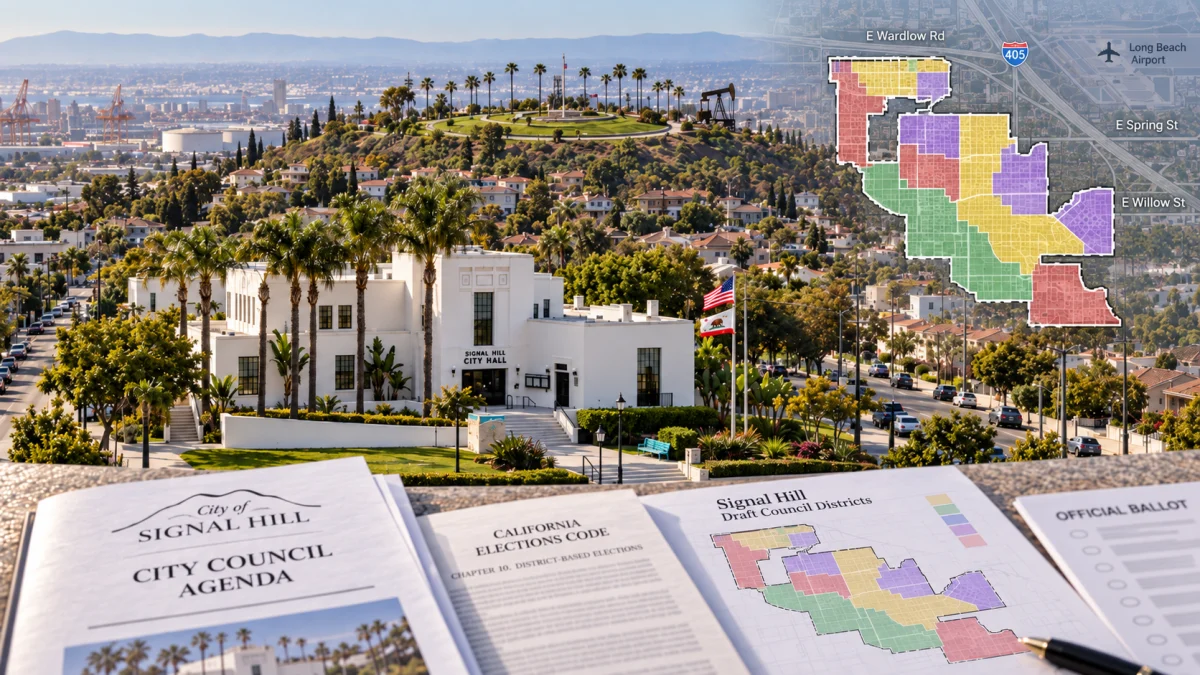
Signal Hill is changing the way residents elect their City Council after receiving a California Voting Rights Act challenge, but no court has found that the city’s existing at-large election system violates voting-rights law.
The demand letter is public. It is included in the City of Signal Hill’s July 8, 2026 special City Council meeting packet, beginning on PDF page 4.
That matters because the letter should be evaluated directly, rather than only through later descriptions of it.
Shenkman & Hughes, writing on behalf of the Southwest Voter Registration Education Project, or SVREP, argues that Signal Hill’s at-large system dilutes Latino voting power in violation of the California Voting Rights Act, or CVRA. The letter points to the city’s substantial Latino population and what SVREP describes as the absence of a Latino elected to the City Council over Signal Hill’s 102-year history. It characterizes that contrast as “outwardly disturbing and fundamentally hostile” to participation by the protected class.
That is a serious allegation.
It is not a court finding.
Signal Hill denies that its election system violates the CVRA. Yet on August 11, the City Council began the process of abandoning at-large elections and moving to a district system anyway.
The public record shows why those two positions are not necessarily contradictory.
Under California law, Signal Hill faced a choice between entering a statutory safe-harbor process with relatively predictable costs or contesting a CVRA claim with potentially much larger and less predictable litigation exposure. City staff estimated roughly $30,000 for a demographer and up to about $34,000 in reimbursable prospective-plaintiff costs if the city completed the voluntary transition process.
So the clearest supported conclusion is narrower than either side’s strongest rhetoric:
Signal Hill is changing its election system because the CVRA challenge created significant legal and financial risk. The city’s decision to transition does not itself prove that Latino votes were being diluted, and the city’s denial does not prove that they were not.
The question of whether the existing system actually caused legally significant vote dilution requires evidence about how Signal Hill voters behave, who different groups prefer, and whether a lawful alternative election system would materially improve Latino voters’ electoral opportunity.
That evidence is the unresolved part of the story.
What the demand letter actually says
The June demand letter should not be described as missing. It is part of the city’s own July 8 meeting packet.
Its basic theory is straightforward: Signal Hill elects all five City Council members at large; Latinos make up a substantial share of the city; SVREP says no Latino has been elected to the council in the city’s history; and the organization alleges that racially polarized voting combined with the at-large structure prevents Latino voters from electing candidates of choice or otherwise exercising equivalent electoral influence.
Local reporting also identified several Latino candidates who have run unsuccessfully for Signal Hill City Council, including Edward Villanueva, Salvador Hernandez and Robert Mendoza. Signal Tribune reported the allegation and linked directly to the July 8 city packet containing the letter.
The letter therefore does contain factual predicates and legal argument. It would be too broad to characterize it simply as containing “no evidence.”
That phrase comes from the city.
In its August 11 staff report, Signal Hill said the letter “did not include any evidence to support a claim of a CVRA violation,” said the city was unaware of such evidence at the time, and denied that its system violates the CVRA.
The more precise distinction is this:
The letter provides reasons to investigate the allegation, but the public materials do not establish the local voting-behavior analysis needed to resolve it.
A demographic disparity and a history of unsuccessful candidates can be relevant evidence. They do not, standing alone, tell us whether Latino and non-Latino voters consistently prefer different candidates, whether Latino-preferred candidates are usually defeated because of majority bloc voting, or whether a lawful alternative system would produce a meaningful improvement.
Those are the questions on which the legal merits ultimately turn.
There is a date discrepancy in the public record
Signal Hill’s official staff reports state that the city received the Shenkman & Hughes letter on June 29, 2026, and the city uses June 29 to calculate the statutory CVRA response period.
Signal Tribune reported on July 9 that City Clerk Daritza Perez received the letter on June 20.
Because the city’s formal August and September records use June 29 for the statutory timeline, this article uses June 29 as the operative receipt date. The discrepancy is worth noting rather than silently choosing one account.
The city’s August staff report also says the letter requested a response by August 10, while Signal Tribune reported an August 20 deadline to begin voluntarily discussing a transition. The legally important deadlines, however, come from California Elections Code §10010 rather than either characterization of a requested response date.
Why would Signal Hill switch systems without litigating first?
Because California law changes the economics of the decision.
Under California Elections Code §10010, a prospective plaintiff must first send written notice asserting that a jurisdiction’s election method may violate the CVRA.
The prospective plaintiff cannot file the CVRA enforcement action for 45 days after the jurisdiction receives that notice.
During that window, the jurisdiction may adopt a resolution stating its intent to move from at-large to district-based elections. If it does, another 90-day period follows during which the prospective plaintiff cannot bring the action while the transition process proceeds.
Section 10010 also limits reimbursement for qualifying work supporting the notice to $30,000, adjusted annually for inflation.
Signal Hill’s August 11 staff report estimated that adjusted reimbursement exposure at approximately $34,000 and estimated another $30,000 for an expert demographer.
That is roughly $64,000 in identified outside transition costs before other city expenses.
The alternative was not cost-free. If Signal Hill declined the transition and litigation followed, the city could incur its own defense costs and potentially face a much larger attorneys’-fee award if a plaintiff prevailed.
By September, Signal Hill was stating explicitly in its second districting hearing report that it was voluntarily transitioning “to avoid costly litigation which could undermine the community’s fiscal stability,” while emphasizing that the transition did not constitute an admission of a CVRA violation.
That is the most direct documented explanation for why the city is moving forward.
Compliance is not an admission, but it is not a merits victory either
It would be a mistake to reason backward from Signal Hill’s decision and conclude that the allegation must therefore be true.
A defendant can rationally avoid litigation because the expected cost of fighting exceeds the expected cost of compliance even when the defendant believes it has a defensible case.
The opposite inference is equally weak.
Signal Hill’s denial does not establish that the allegation is false. The city is an interested party facing threatened litigation, and its staff report should be treated as the city’s legal and fiscal assessment, not as an independent adjudication.
The sensible reading is that two questions remain separate:
Why did Signal Hill decide to transition?
The public record strongly supports litigation risk and cost exposure as a central reason.
Would Signal Hill have been found to violate the CVRA if the dispute were litigated?
The available public evidence does not establish that answer.
What does the CVRA actually require?
California Elections Code §14027 prohibits an at-large election system when it impairs the ability of a protected class to elect candidates of its choice or influence an election because of vote dilution or abridgment.
Section 14028 addresses racially polarized voting and specifically directs attention to voting behavior. It also makes clear that discriminatory intent by voters or elected officials is not required.
That means a CVRA case is not necessarily an accusation that Signal Hill officials intentionally designed an election system to discriminate.
The legal question concerns the effect of the system.
But the California Supreme Court has also made clear that the analysis cannot stop at racial polarization.
In its 2023 decision in Pico Neighborhood Association v. City of Santa Monica, the court held that a plaintiff alleging dilution of the ability to elect candidates of choice must identify a lawful alternative election system that provides the benchmark for comparison.
The protected class must have a real electoral opportunity under that lawful alternative, either alone or with crossover voters, and the alternative must improve the group’s overall ability to elect its preferred candidates.
The court called for an intensely local examination of electoral history, voting patterns and the likely effects of the proposed alternative.
That standard matters enormously for Signal Hill.
A 37.4% Latino population does not answer the legal question
The U.S. Census Bureau’s current QuickFacts profile reports that 37.4% of Signal Hill residents are Hispanic or Latino. The Census Bureau estimates the city’s population at 11,153 as of July 1, 2025.
Those numbers make Latino representation an obvious subject for examination.
But 37.4% of the total population is not the same thing as 37.4% of the electorate.
For voting-rights analysis, relevant denominators can include citizen voting-age population, registered voters and actual voters. Those populations may differ materially from total population.
There is another important distinction.
The CVRA concerns candidates of choice. A candidate of choice does not have to share the ethnicity of the voters supporting that candidate.
Latino voters may prefer a non-Latino candidate. A Latino candidate is not automatically the preferred candidate of Latino voters.
So even if SVREP’s historical claim about council representation is correct, comparing the city’s Latino population share with the ethnicity of elected councilmembers cannot by itself establish vote dilution.
The central missing evidence is still local voting behavior
The most useful evidence would be a racially polarized voting analysis using Signal Hill election results.
That analysis would help answer whether Latino and non-Latino voters consistently prefer different candidates; whether Latino-preferred candidates receive cohesive Latino support but are defeated by a different majority preference; whether crossover voting is substantial; and whether a lawful alternative system produces a net improvement in Latino voters’ ability to elect candidates of choice.
A complete merits analysis would also examine the Latino citizen voting-age population and its geographic distribution.
As of September 28, 2026, the public materials reviewed for this article do not provide a published Signal Hill-specific analysis resolving those questions.
That is not evidence that no violation exists.
It is a limit on what can responsibly be concluded from the currently public record.
Signal Hill’s description of CVRA litigation also deserves qualification
The city’s August staff report states that “no public entity has successfully defended itself against a CVRA challenge.”
The broader point is clear: CVRA litigation can be extremely expensive, and many jurisdictions have chosen to transition rather than test the claim in court.
But the categorical wording obscures a more complicated procedural history.
Santa Monica, for example, obtained a Court of Appeal judgment in its favor in 2020. The California Supreme Court later reversed that judgment in 2023 because the Court of Appeal had applied the wrong legal standard for dilution, and the Supreme Court expressly declined to decide whether Santa Monica’s at-large system ultimately violated the CVRA.
The case was remanded for further proceedings.
That does not weaken Signal Hill’s underlying concern about litigation expense. If anything, years of appeals illustrate why a small city might view even a potentially defensible case as a major financial risk.
But the distinction matters: litigation history should be described accurately rather than reduced to a slogan that nobody has ever won anything.
What actually changes for Signal Hill voters?
Signal Hill currently elects its five-member City Council at large.
Under that system, council candidates may live anywhere in the city, and voters citywide participate in the council races that are on the ballot.
Under a by-district system, council candidates must live in the district they seek to represent, and only voters in that district participate in that particular council race.
The two systems therefore distribute electoral influence differently.
| At-large elections | District elections |
|---|---|
| Voters participate in council contests citywide | Voters choose the representative for their own district |
| Candidates can live anywhere in Signal Hill | Candidates must reside in the district they seek to represent |
| Each councilmember has a citywide electoral constituency | Each district representative has a geographically defined constituency |
| The candidate pool for a seat is citywide | The candidate pool for a district seat is limited geographically |
| A geographically concentrated group can still be outvoted citywide | A geographically concentrated group may exercise more influence within a district |
| No council district boundaries determine representation | Map boundaries and election sequencing become consequential |
Neither structure simply gives voters “more democracy.”
Under at-large elections, residents have a direct vote in more council contests.
Under districts, residents receive a representative whose electoral constituency is much more geographically specific.
Those are different forms of accountability.
What does the research say about who gets elected?
California provides unusually useful evidence because many local governments have moved from at-large to district elections under the CVRA.
A study published in the American Journal of Political Science found a strong positive effect on Latino officeholding where Latinos constituted a sufficiently large share of the voting population, particularly in larger and more residentially segregated jurisdictions.
The same study found essentially null estimated effects when those conditions were absent.
That is an important limitation.
Districts do not mechanically produce representation for a particular group. Their effect depends on local demographics, residential patterns and voting behavior.
A 2026 study in Political Science Research and Methods examined 118 California cities that switched systems between 2008 and 2020.
It found that district-based elections were associated with candidates and winners coming from neighborhoods with renter shares about three percentage points higher. Winning candidates came from block groups with per-capita income roughly 6% lower, on average. The study also found increases in Latino candidates and winners.
Those results suggest that districting can change socioeconomic as well as racial representation.
They are statewide findings, not a prediction about Signal Hill.
District elections also have a documented competition tradeoff
A separate 2025 Urban Affairs Review study found that switching from at-large to single-member district elections increased the expected number of uncontested City Council seats by approximately half a seat per election.
The study attributes much of that increase to fewer candidates entering individual district races.
The mechanism is easy to understand in a small city.
Under an at-large system, any otherwise eligible Signal Hill resident can potentially compete for a citywide council seat.
Under districts, only residents of one geographic district can compete for that district’s seat. Several politically active residents may live in one district while another district produces only one candidate.
That tradeoff is particularly relevant in Signal Hill, a city of roughly 2.2 square miles.
But the current at-large system is not producing strong candidate competition either.
The final 2026 at-large council election has two candidates for two seats
Signal Hill’s official November 2026 election page lists two at-large City Council seats on the November 3 ballot.
It lists exactly two qualified council candidates:
Tina L. Hansen and Keir Jones, both incumbents.
So the city’s final scheduled at-large council election already has two ballot-qualified candidates for two available seats.
That does not tell us whether future district elections will be competitive.
It does show that uncontested or minimally contested elections are not a problem unique to district systems.
The research indicates that districting can increase the frequency of uncontested seats on average. Signal Hill’s current experience shows that retaining at-large elections would not guarantee competition.
The November 2026 election is still at large
The districting process does not change how Signal Hill residents vote for council this November.
The city’s official election information expressly identifies the November 3, 2026 council election as two at-large seats and states that the districting process does not affect the current incumbents’ eligibility to run for those offices.
Existing at-large terms also will not simply disappear when a district map is adopted.
Signal Hill’s staff reports explain that the transition will be phased. After the first district election, the council can temporarily contain members elected from districts alongside members still completing terms won under the old at-large system.
The City Council will also have to decide the sequence of district elections: which districts vote first and which wait until the following cycle.
That sequencing can determine how quickly different parts of Signal Hill receive district-based representation.
The maps will make the debate much more concrete
The city held its second pre-map public hearing on September 22.
The September 22 staff report schedules the first hearing involving proposed draft maps for October 13, followed by another map hearing on October 27.
Signal Tribune reports that resident map submissions are due October 2, draft maps are expected to be released October 6, and the city plans to consider final adoption on November 10.
Once draft maps are public, the key questions become measurable.
The most useful comparison will be whether proposed boundaries preserve recognizable communities, how population is distributed, what Latino citizen voting-age population looks like within each configuration, how renter and income patterns differ across districts, where current officeholders reside, and which districts would vote first.
Most importantly for the original CVRA allegation, the maps can be tested against the underlying electoral question:
Would any lawful alternative materially improve Latino voters’ ability to elect their candidates of choice compared with the existing at-large system?
That is much closer to the question the California Supreme Court says matters.
What the public record supports right now
The public record supports several conclusions without requiring anyone to accept either side’s entire narrative.
Signal Hill received a real CVRA demand letter. The letter is publicly available in the city’s July 8 meeting packet and makes a substantive allegation based on the city’s election structure, demographics and representation history.
No court has ruled that Signal Hill violated the CVRA.
Signal Hill denies that a violation has been established.
The city nevertheless has a clear economic reason to transition without litigating. California’s safe-harbor process places comparatively predictable limits on the immediate transition and reimbursement costs, while contested CVRA litigation can become far more expensive.
The demand letter raises legitimate questions, but demographic representation alone cannot resolve them.
Determining whether Latino votes are actually diluted requires a more specific analysis of voting behavior, candidates of choice and the effect of a lawful alternative system.
District elections can materially change representation. California research finds changes in Latino officeholding and in the socioeconomic backgrounds of candidates and winners under some conditions.
District elections can also change political competition. California research finds more uncontested seats after transitions to single-member districts.
And Signal Hill already has a candidate-competition problem under its at-large system, with two qualified council candidates for two seats in November 2026.
The most accurate way to understand the transition, then, is not as proof that Signal Hill was caught violating voting-rights law and not as proof that the demand was baseless.
It is a legal-risk decision occurring alongside a major redesign of political representation.
The next evidence that matters will be the maps, the demographic data attached to them, the election sequencing, and eventually the voting patterns and candidates those districts produce.
References and Further Reading
Primary Signal Hill Records
City of Signal Hill — July 8, 2026 Special City Council Meeting Packet — The June Shenkman & Hughes/SVREP demand letter is included beginning on PDF page 4. This is the primary document underlying the threatened CVRA action.
Signal Hill — August 11 Staff Report and Resolution of Intention — Explains the city’s response to the demand letter, denial of a CVRA violation, projected demographer and reimbursement costs, safe-harbor process and transition mechanics.
Signal Hill — September 22 Second Districting Public Hearing Staff Report — Provides the current districting schedule and states the city’s litigation-risk rationale for voluntarily transitioning.
Signal Hill — 2026 Election Information — Confirms that the November 3, 2026 election still contains two at-large City Council seats and lists Tina L. Hansen and Keir Jones as the qualified council candidates.
California Law and Court Decisions
California Elections Code §10010 — Governs pre-litigation CVRA notice, the 45-day waiting period, the resolution-of-intention safe harbor, public hearings, map publication and the inflation-adjusted reimbursement cap.
California Elections Code §14027 — Prohibits at-large methods that impair a protected class’s ability to elect candidates of choice or influence elections through vote dilution or abridgment.
California Elections Code §14028 — Sets out the statutory treatment of racially polarized voting and related evidence.
Pico Neighborhood Association v. City of Santa Monica — California Supreme Court, 2023. Clarifies that dilution requires comparison with a lawful alternative electoral system and an intensely local analysis of electoral conditions.
Demographic Data
U.S. Census Bureau QuickFacts — Signal Hill, California — Current population and demographic estimates, including the 37.4% Hispanic or Latino figure.
Research on At-Large and District Elections
“At-Large Elections and Minority Representation in Local Government” — American Journal of Political Science. Finds that conversion to district elections can substantially increase Latino officeholding under specific demographic and geographic conditions, while estimated effects are null where those conditions are absent.
“District-Based Elections and Class-Based Representation: Evidence From the California Voting Rights Act” — Political Science Research and Methods, 2026. Finds shifts toward candidates and winners from higher-renter and lower-income neighborhoods after districting across 118 California cities.
“The California Voting Rights Act and Uncontested City Council Seats” — Urban Affairs Review, first published online in 2025. Finds that conversion to single-member districts increases the expected number of uncontested council seats by about half a seat per election.
Independent Local Reporting
“Signal Hill Faces Possible Lawsuit Unless It Establishes Voting Districts” — Signal Tribune, July 9, 2026. Reports the original SVREP challenge, statements from Kevin Shenkman, the city’s representation history and the June-date discrepancy.
“Signal Hill Is Getting Voting Districts. Here’s How to Shape the Process.” — Signal Tribune, Sept. 18, 2026. Covers public participation, mapping criteria and the anticipated October and November districting schedule.
Editorial currency note: Signal Hill’s district boundaries, election sequencing and final implementation schedule remain under development as of September 28, 2026. This article should be updated when draft maps are released.