
Updated July 10, 2026
The central argument
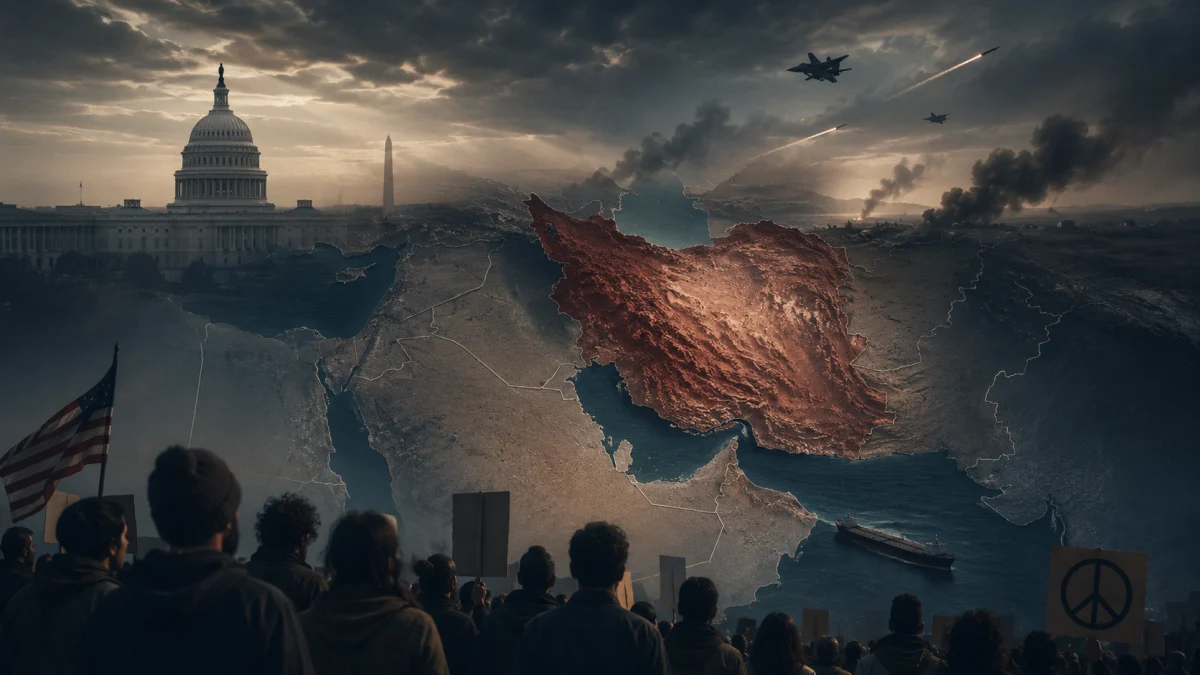
The war with Iran is not continuing because the American public demanded it. It is continuing because the institutions capable of sustaining a war are better organized than the people who oppose it.
Those institutions include an executive branch accustomed to initiating military action without a declaration of war, a national-security establishment built to expand rather than surrender missions, an Israeli government pursuing objectives broader than those necessary for American security, organized pro-Israel campaign money, partisan loyalty, defense-industry incentives, and the political fear of appearing “weak” once a war has begun.
Lobbying and donor influence are an important part of this system, but they are not the entire explanation. Saying that one lobby alone caused the war would be emotionally satisfying and analytically incomplete. The stronger conclusion is that pro-Israel political organizations helped create the environment in which adopting Israel’s threat perception became politically safe, while questioning an expanding war became politically expensive.
This distinction matters. A serious antiwar argument should not depend on exaggeration. It should be strong enough to survive scrutiny.
The United States does have legitimate interests involving Iran: preventing nuclear proliferation, protecting American personnel, preventing attacks on commercial shipping and limiting regional warfare. But the existence of legitimate interests does not prove that this broad, open-ended military campaign serves them. The relevant question is whether this war is necessary, proportional, achievable, legally authorized and more effective than diplomacy.
The evidence increasingly suggests that it fails those tests.
American public opinion
It is fair to say that a clear majority of Americans oppose the war or believe it was not worth the cost.
In March, Pew found that 59% of Americans believed the initial decision to use force was wrong, while 61% disapproved of President Donald Trump’s handling of the conflict. By late June, a Quinnipiac poll found that 60% of registered voters believed the military action was not worth it, while 62% disapproved of Trump’s handling of Iran. Among independents, 66% said the war was not worth it. (Pew Research Center)
That is not universal opposition. Republican voters remain much more supportive than Democrats and independents. But it is a stable national majority—and more than enough to establish that the war is not an expression of popular consent.
The honest formulation is therefore:
Most Americans do not believe this war was worth it, yet the war continues anyway.
That gap between public preference and government action is one of the most important facts about the conflict.
What exactly is the Iran war?
On February 28, 2026, the United States and Israel launched coordinated strikes against Iran. Their stated objectives included destroying Iran’s nuclear and ballistic-missile capabilities, damaging its naval forces, weakening its regional partners and creating conditions for political change inside Iran. Iran retaliated against Israel, U.S. bases and locations in neighboring states, while severely restricting passage through the Strait of Hormuz. Fighting also expanded into Lebanon through exchanges between Israel and Hezbollah. (House of Commons Library)
A two-week pause began on April 8. On June 17, the United States and Iran signed a memorandum of understanding intended to stop the fighting and create a 60-day negotiating period. Yet the major disputes—uranium enrichment, ballistic missiles, sanctions, the Strait of Hormuz, reparations, Iran’s regional alliances and Israel’s freedom to strike—were deferred rather than resolved. (House of Commons Library)
By July, the ceasefire was again collapsing. U.S. forces resumed major strikes after attacks on commercial vessels, and Iran retaliated against U.S.-allied states. Trump publicly said he believed the ceasefire was over and suggested the United States should “finish the job,” even while insisting that renewed attacks did not necessarily mean a return to full-scale war. CENTCOM records show continuing rounds of strikes in late June and early July. (AP News)
That contradiction—bombing while denying that bombing represents a return to war—is not merely rhetorical confusion. It reveals the absence of a stable definition of victory.
The war’s mission has repeatedly changed
The White House initially described Iran as an “imminent nuclear threat” and listed nuclear facilities, missiles, proxy forces and naval capabilities among the targets. At the beginning of the campaign, Trump also called for Iranians to overthrow their government and demanded unconditional surrender. (The White House)
On April 8, however, the White House announced that the operation’s stated objectives had been met after 38 days. Yet strikes subsequently resumed, the blockade continued, new targets were added and the administration’s immediate priority shifted toward commercial shipping and the Strait of Hormuz. (The White House)
This is mission creep: a war begins with one stated objective, then acquires new objectives whenever the original mission no longer justifies continued fighting.
A nuclear mission became a missile mission. The missile mission became a naval mission. The naval mission became a blockade. The blockade became a fight over Hormuz. The fight over Hormuz became retaliation for tanker attacks. Meanwhile, regime change remained present as either an explicit aspiration or an implied possible outcome.
A war with that many purposes has no natural ending point.
Does the Iran war serve a real American interest?
An intellectually honest answer must begin by rejecting two oversimplifications.
The first is that Iran presents no threat. Iran’s government has enriched large quantities of uranium, restricted international inspections, supported armed groups across the region, attacked shipping and struck American forces and neighboring countries. Those are real security concerns.
The second oversimplification is that any real security concern automatically justifies a major war.
A government should have to satisfy five basic tests before placing its citizens, armed forces and economy into a conflict:
- The threat must be concrete and sufficiently serious.
- Military force must be necessary, not merely available.
- The objective must be specific and achievable.
- The likely benefits must outweigh the human, economic and strategic costs.
- The action must have democratic and legal authorization.
The Iran war performs poorly on at least four of these five tests.
Preventing an Iranian nuclear weapon is a legitimate American interest. Preventing attacks on American troops and commercial ships is also legitimate. But destroying a government, attempting to dictate its entire defense policy, maintaining an indefinite blockade and adopting another country’s maximal war aims are not automatically American interests.
The correct conclusion is not that America has no interests involving Iran. It is that no demonstrated American interest justifies this particular open-ended war in its current form.
The nuclear danger was real—but “imminent” was not publicly established
Before the war, Iran’s nuclear program had become genuinely dangerous.
The International Atomic Energy Agency estimated that, as of June 2025, Iran possessed approximately 440.9 kilograms of uranium enriched to 60%. The agency had verified most of that quantity, but by early 2026 Iran was refusing access to its four declared enrichment facilities. The IAEA therefore could not determine the current size, composition or location of the stockpile. (IAEA)
That is serious. Sixty-percent enrichment is far beyond what is ordinarily required for civilian power generation and substantially shortens the technical distance to weapons-grade material.
But a dangerous nuclear capability is not the same thing as an active decision to build a bomb.
A Congressional Research Service assessment reported that official U.S. intelligence had continued to judge that Iran had not resumed the structured nuclear-weapons program halted in 2003. The IAEA likewise said it lacked tangible proof of a current program or plan to manufacture a nuclear weapon. Iran had created the capability to move more quickly if its leaders chose to do so, but capability, intent and imminence are different questions. (CRS Reports)
That distinction does not excuse Iran’s conduct. Refusing inspectors and accumulating highly enriched uranium was reckless, provocative and destabilizing. But it does weaken the claim that a large-scale war was the only remaining option.
The diplomatic road had already been damaged by Washington
When the 2015 nuclear agreement was functioning, the IAEA repeatedly confirmed that Iran was implementing its nuclear commitments and described the arrangement as an exceptionally strong verification regime. The United States withdrew from that agreement in May 2018. Iran began exceeding its limits in 2019 and later reduced monitoring. (IAEA)
Iran is responsible for its later violations. But the historical sequence still matters: the United States abandoned an agreement that was restraining the program, imposed maximum-pressure sanctions and then cited the resulting nuclear expansion as proof that diplomacy had failed.
That does not mean the old agreement could simply have been restored without changes. It means the claim that military action became unavoidable leaves out the role American policy played in destroying the previous inspection-based solution.
War may now make proliferation more likely. Bombing facilities can destroy equipment, but it can also scatter expertise, drive programs deeper underground, remove inspectors and convince Iranian leaders that only an actual nuclear deterrent can protect them from future attacks. That is an inference, not a confirmed outcome—but it is a foreseeable one supported by the loss of IAEA visibility.
Why did the ceasefires keep failing?
The ceasefires failed because they attempted to pause military activity without reconciling the purposes for which the parties were fighting.
1. The agreements postponed the hardest questions
The June memorandum did not settle the nuclear issue, missile restrictions, sanctions, reconstruction, reparations or the long-term governance of Hormuz. It created a 60-day period in which those matters were supposed to be negotiated.
It was therefore not a comprehensive peace agreement. It was a promise to discuss a possible future peace agreement.
Even the complete official text was not publicly released. Journalists and governments instead worked from versions briefed by U.S. officials or released by Iran. That secrecy weakened public accountability and made it easier for every party to describe the agreement differently to its own audience. (House of Commons Library)
2. The participants did not agree on what the war was about
The United States initially discussed nuclear weapons, missiles, naval forces, regional armed groups and political change. Israel emphasized eliminating what it considered a long-term existential threat. Iran demanded security guarantees, recognition of its rights, reparations and protection for its regional allies.
Iran also said its ballistic-missile program was not negotiable. It linked progress in the U.S.-Iran talks to the fighting in Lebanon and proposed a new system—including possible fees—for passage through the Strait of Hormuz. The United States and Gulf governments rejected Iranian tolls. (House of Commons Library)
A ceasefire cannot remain stable when one side thinks it is negotiating nuclear limits, another thinks it is negotiating the survival of its government, and a third believes it is preserving the right to restart a regional war.
3. Israel was not a party to the agreement that supposedly bound it
This may be the most obvious structural flaw.
The June agreement purported to end military operations by the signatories “and their allies,” including fighting involving Israel and Hezbollah. But Israel, Hezbollah and Lebanon were not parties to the U.S.-Iran negotiations. Israel openly emphasized that it had not signed the agreement and retained its own security interests and military options. (House of Commons Library)
In April, Netanyahu had already said the temporary ceasefire was not the end of Israel’s campaign, that Israel still had objectives to complete and that it was prepared to return to combat. (The New Indian Express)
The United States cannot create a credible peace by negotiating terms for a military partner that reserves the right to disregard them. That is not a minor technical problem. It leaves a hole in the center of the agreement.
4. Every retaliation created a justification for the next retaliation
The war developed a self-sustaining logic:
- U.S. and Israeli strikes produced Iranian retaliation.
- Iranian attacks on bases, neighboring states and ships produced additional U.S. strikes.
- Those strikes produced further Iranian retaliation.
- Every government then described its own action as defensive and the other side’s action as aggression.
Once this cycle begins, the original reason for the war becomes less important than the latest attack. A campaign supposedly launched to stop a nuclear threat can continue indefinitely as retaliation for events the campaign itself helped produce.
Iran bears responsibility for attacks on civilians, bases and commercial vessels. But those attacks do not erase the sequence in which the United States and Israel launched the February 28 campaign.
5. The parties lacked a credible enforcement mechanism
A serious ceasefire requires clear definitions, independent monitoring, procedures for disputed incidents and penalties short of renewed war.
The Iran agreements were far weaker. What counted as an Iranian violation? What counted as a defensive Israeli strike? Could the United States attack a missile launcher preparing to fire? Could Iran stop or inspect vessels? Were Iranian-aligned groups covered? Who would determine responsibility after an ambiguous tanker attack?
Without a trusted mechanism for answering those questions, each incident could be interpreted by the aggrieved party as permission to resume bombing.
6. Domestic politics rewarded maximalism
Compromise creates political vulnerability.
Iranian leaders risk appearing to surrender after their country was attacked. Israeli leaders risk being accused of leaving an existential threat intact. American leaders risk being labeled weak, especially after declaring that victory, regime change or unconditional surrender was within reach.
War also creates sunk costs. Once lives and billions of dollars have been spent, officials argue that stopping would mean those sacrifices were “for nothing.” That is emotionally powerful but logically backward. Past losses cannot be recovered. The relevant question is whether additional losses will produce a better result.
A government that continues a failing policy solely to justify earlier costs is not honoring the dead. It is creating more of them.
Israel’s role: a partner, not a passenger
Israel did not merely support an American operation. It jointly launched the campaign and pursued its own strategic objectives.
At the beginning of the war, Netanyahu said the campaign would continue for as long as necessary. He described the goal as ending the threat posed by Iran’s governing system and said the strikes would create conditions that could enable Iranians to overthrow it. While he presented regime collapse as a possible result rather than the formal objective, the distinction becomes thin when military operations deliberately create the conditions for that result. (The Times of Israel)
Israel’s security concerns are not fictional. Iranian officials and aligned organizations have threatened Israel, Iran has supported armed groups fighting it, and Iran’s missiles and nuclear capabilities create serious risks.
But Israel’s national interests and America’s national interests are not identical.
Israel may rationally prefer the permanent destruction of Iranian missile, nuclear and regional capabilities. The United States must consider additional costs: American deaths, attacks on bases, global energy disruption, lost diplomatic credibility, broader regional instability and the possibility that Washington becomes responsible for another state’s collapse and reconstruction.
An alliance does not require one country to adopt every threat perception, timeline or military objective of the other.
The failure to maintain that distinction is one of the reasons the United States entered a war whose boundaries it cannot now clearly define.
The lobbying and donor system: what the evidence actually proves
The claim that donor influence helped enable the war is well supported. The claim that one organization secretly purchased a specific bombing order is not.
Understanding the difference makes the argument stronger.
What AIPAC openly says it does
AIPAC describes its mission as persuading the U.S. government to enact policies strengthening the U.S.-Israel relationship. It identifies United Democracy Project as its backed super PAC and says the organization works to defeat political candidates it considers detractors of that relationship. (AIPAC)
These are not accusations from critics. They are descriptions from AIPAC itself.
Federal Election Commission records show the scale of the operation. From January 2025 through May 2026, AIPAC’s PAC reported approximately $43.95 million in receipts and more than $40 million in contributions to other political committees. United Democracy Project reported approximately $98.63 million in receipts, $12.65 million in independent expenditures and more than $7 million in contributions to other committees. (FEC.gov)
After the June ceasefire framework, AIPAC publicly demanded a final agreement requiring the removal of all enriched uranium, dismantlement of all Iranian enrichment sites, restrictions on missiles and drones, and an end to support for regional armed groups. Those terms were considerably broader than a basic nuclear nonproliferation agreement. (AIPAC)
AIPAC also states that its members and donors are Americans and that it is neither directed nor funded by the Israeli government. There is no basis for casually describing its campaign spending as secret Israeli-government money. (AIPAC)
That fact does not make its influence unimportant. It means the relevant problem is American campaign finance and American political organizations promoting another state’s preferred policies, not a simplistic story about foreign cash secretly purchasing Congress.
How political money works without an explicit bribe
Political influence rarely looks like a donor handing a legislator money in exchange for one recorded vote.
It works upstream.
Money determines which candidates can survive expensive primaries. It helps define which positions are politically safe. It buys advertising, opposition research, staff access and the capacity to punish dissent. It teaches legislators that certain votes may bring well-funded challengers while other votes will bring campaign support.
A randomized field experiment involving 191 congressional offices found that offices made senior policymakers available three to four times more often when they were informed that the people requesting meetings were political donors rather than merely constituents. (eScholarship)
A broader study of 1,779 policy outcomes found that economic elites and organized interests had substantial independent effects on policy, while the preferences of average citizens had little or no independent effect after those other forces were considered. That research does not prove the cause of the Iran war, but it demonstrates the larger system in which concentrated interests routinely outperform unorganized public opinion. (Cambridge University Press & Assessment)
The most defensible conclusion is therefore:
AIPAC did not need to write the bombing order. Its political value is earlier in the process: helping determine which politicians survive, what positions remain acceptable and how costly opposition to Israeli government policy becomes.
That is not a conspiracy theory. It is the visible operation of legal political influence.
Lobbying is an enabling cause, not the only cause
The Iran war cannot be reduced to AIPAC.
Other forces include:
- A president willing to use expansive interpretations of executive war powers.
- Republican legislators reluctant to oppose their party’s president.
- Democratic politicians fearful of being portrayed as weak on Israel or national security.
- A defense bureaucracy institutionally prepared to plan and execute escalation.
- Contractors that benefit when missiles, aircraft, interceptors and munitions must be replaced.
- Ideological hawks who have supported regime change in Iran for decades.
- Christian Zionist organizations and donors.
- Gulf governments concerned about Iranian power.
- Iranian actions that provide genuine material for pro-war arguments.
- The political difficulty of ending a conflict after leaders have publicly promised victory.
Lobbying did not create all these forces. It connected with them, reinforced them and helped discipline Congress around a pro-Israel consensus.
Criticism must remain precise
AIPAC is a political organization. Israel is a state. Neither is synonymous with Jewish people.
Jewish Americans hold diverse political views, including strong opposition to Netanyahu, the war and AIPAC. Blaming Jews collectively for the conduct of a government or lobby is factually false, morally wrong and strategically destructive.
The target of criticism should be identifiable institutions, officials, donors, policies and votes—not a religion or ethnicity.
Is the United States still functioning as a democracy?
The United States still has elections, competing parties, courts, civil liberties and opportunities for public organizing. It would therefore be imprecise to say that the country has no democratic features.
But this war exposes a severe democratic deficit.
A democratic deficit exists when formal democratic institutions remain in place but public preferences are repeatedly filtered, delayed or overridden by concentrated power.
Consider the sequence:
- National polling showed majority opposition.
- On June 3, the House passed H.Con.Res. 86 by 215–208, directing the president to remove U.S. forces from hostilities with Iran.
- On June 23, the Senate agreed to the same concurrent resolution by 50–48.
- Military operations nevertheless continued. (Clerk of the House)
That is extraordinary. A majority of the public opposed the war. Majorities in both chambers formally voted against continued hostilities. Yet the executive branch continued striking Iran.
The reason is partly legal architecture. H.Con.Res. 86 was a concurrent resolution rather than a binding statute. It did not require presidential signature, but it also lacked the ordinary force of law. The War Powers Resolution says a president should withdraw forces when Congress directs withdrawal through such a measure, but that provision has faced serious constitutional doubts since the Supreme Court’s decision in INS v. Chadha. (Default)
In practical terms, Congress expressed opposition without using its strongest weapon: the power of the purse.
Congress can place a binding prohibition on spending for unauthorized offensive operations. It can attach that prohibition to defense or appropriations legislation. It can pass a joint resolution with statutory force and attempt to override a veto. It can refuse to replenish weapons consumed by an unauthorized campaign. (Default)
Most legislators have not yet been willing to impose those consequences.
The accurate democratic conclusion
The United States is not simply a dictatorship, nor is every election meaningless.
But on matters of war, it increasingly operates as an electoral system with an imperial presidency and oligarchic channels of influence. Public opinion matters weakly and intermittently. Presidents, major donors, organized lobbies, party leadership and national-security institutions matter constantly.
The public has the theoretical right to change policy, but it must organize at an intensity far beyond what concentrated interests need to maintain it.
That is not meaningful majority rule. It is a system in which the majority may speak while a smaller, better-organized network continues governing.
The human and economic costs
The war’s costs are not abstract.
United Nations humanitarian reporting described intensive strikes across Iran, high civilian casualties and extensive damage to homes, schools, health facilities, electricity, water and communications infrastructure. A UN emergency-funding summary estimated that more than 2,200 civilians were killed between February 28 and April 8, including hundreds of women and children. Figures from an active war remain difficult to verify independently, but the scale of civilian harm is beyond serious dispute. (UN Iran)
Brown University’s Costs of War project estimated that military operations had cost upward of $29 billion by May 18. It separately estimated that Americans had paid more than $40 billion in additional gasoline and diesel costs since the war began—more than $300 per household on average. Those estimates involve a modeled comparison with expected prices in a no-war scenario, but they illustrate how war costs appear not only in federal budgets but at gas pumps and throughout supply chains. (Costs of War)
Commercial passage through the Strait of Hormuz also collapsed. Preliminary data showed at least 576 transits in June 2026, compared with 3,131 during June 2025. Oil prices again rose when renewed strikes threatened the ceasefire. (AP News)
This matters to the national-interest argument. One of the war’s current stated objectives is restoring secure commercial passage. Yet the war itself helped turn the strait into a battlefield and bargaining weapon.
A policy cannot be declared successful merely because it is now attempting to repair a crisis that its own escalation helped intensify.
Answering the strongest pro-war arguments
A rigorous antiwar position should answer the strongest arguments for continuing the conflict rather than pretending they do not exist.
“Iran is dangerous.”
Correct. Iran’s government is authoritarian, represses its people, supports armed groups, has attacked civilians and neighbors, accumulated highly enriched uranium and obstructed inspections.
But “dangerous” is not a sufficient standard for war. Numerous governments are dangerous. The case for military force must establish necessity, proportionality, achievable objectives and superiority to diplomatic alternatives.
The war has weakened parts of Iran’s military infrastructure. It has not produced a stable nuclear settlement, lasting access for inspectors or a durable regional security arrangement.
“Iran cannot be allowed to control the Strait of Hormuz.”
Correct. No state should be permitted to extract unilateral tolls through intimidation or attack commercial vessels.
But the practical question is which policy most reliably keeps the strait open. A permanent air war and blockade invite Iran to use shipping as retaliation. A monitored maritime agreement involving Oman, Gulf states and international guarantors would better protect navigation than an endless exchange of attacks.
“America must support Israel.”
The United States can help defend Israeli civilians from missiles without granting the Israeli government authority to define American war aims.
Defensive cooperation and unlimited strategic alignment are not the same thing. An ally may deserve protection without receiving a blank check to pull the United States into regime change or perpetual preventive war.
“Stopping now would reward Iranian aggression.”
Iran should not be rewarded for attacking ships, bases or neighboring states. A settlement should require those attacks to stop and should contain automatic consequences for verified violations.
But continuing an unsuccessful war simply because stopping feels like defeat is a sunk-cost error. The goal is American security, not emotional satisfaction.
A verified agreement that removes or dilutes highly enriched uranium, restores inspectors and protects shipping would accomplish more than indefinite bombing—even if Iranian leaders also claim victory.
What a realistic exit from the Iran war would require
“Stop the war” is a moral demand, but it is not yet a security plan. A durable exit must address the dangers that will otherwise be used to restart the conflict.
1. An immediate reciprocal halt to offensive operations
The United States, Iran and Israel should begin with a monitored halt to offensive strikes. The United States would retain the right to intercept incoming missiles and defend its personnel, but it would stop attacks intended to punish, coerce or produce regime change.
Every party should provide the mediator with a confidential list of forces and activities covered by the halt. Alleged violations should go through an emergency hotline and a third-party investigation before retaliation.
2. A formal end to regime-change objectives
Washington should publicly state that it will not seek to overthrow Iran’s government through military force.
This is not an endorsement of the Iranian regime. It is recognition that governments rarely disarm when the negotiating party simultaneously threatens their survival.
Security guarantees would be conditional: Iran would have to cease attacks on American forces, neighboring countries and commercial vessels.
3. Immediate restoration of IAEA access
Iran should provide the IAEA with immediate access to every declared enrichment facility, the enriched-uranium stockpile and relevant centrifuge production sites.
The 60%-enriched material should be inventoried, sealed and then removed, diluted or converted under international supervision. Enrichment should be capped at a level consistent with an agreed civilian program, with continuous monitoring and rapid access to suspected undeclared locations.
This addresses the nuclear danger through verified control rather than optimistic trust.
4. Phased and reversible sanctions relief
Sanctions relief should occur in stages tied to verified actions.
When inspectors receive access, specific sanctions are suspended. When highly enriched material is removed or diluted, additional restrictions are lifted. If Iran expels inspectors or resumes prohibited activity, sanctions return through a predefined mechanism.
This gives Iran a reason to comply without requiring the United States to surrender all leverage at the beginning.
5. A separate agreement for the Strait of Hormuz
The strait should not be governed by unilateral Iranian tolls or an indefinite American blockade.
Oman, Gulf states and international maritime authorities should establish monitored navigation lanes, inspection procedures, emergency communications and penalties for attacks on commercial vessels. The agreement should prohibit arbitrary fees and offensive military use of commercial traffic.
6. Separate negotiations for Israel and Lebanon
A U.S.-Iran agreement should not pretend to bind Israel, Hezbollah or Lebanon when they are absent from the negotiations.
The Israel-Lebanon conflict requires its own agreement, guarantors and monitoring system. American military support for offensive operations should be conditioned on compliance with that settlement.
7. Congressional authorization for any future offensive action
Congress should prohibit offensive operations against Iran unless it passes a specific authorization for the use of military force, or AUMF.
Any authorization should identify:
- The precise mission.
- The countries and territory covered.
- The forces permitted.
- Civilian-harm reporting requirements.
- A short expiration date.
- A prohibition on regime change.
- A requirement for renewed congressional approval before expansion.
No president should receive a permanent blank check.
8. International endorsement and enforcement
A final settlement should be endorsed by the United Nations Security Council and supported by regional governments. It should include a dispute-resolution body, inspection authority and consequences that begin with diplomatic and economic measures rather than immediate bombing.
A durable agreement is not one that assumes everyone will behave well. It is one that remains functional when they do not.
What Americans can do right now
The antiwar public does not primarily suffer from a lack of opinion. It suffers from a lack of organization.
Millions of people individually disapproving of the war are politically weaker than a few organized groups that can provide money, endorsements, staff access, advertising and primary challenges.
The solution is not simply to express greater anger. It is to convert public opposition into consequences.
Make three specific demands
Every member of Congress should be pressed to answer three questions:
- Will you vote for a binding statute ending unauthorized offensive hostilities with Iran?
- Will you support an appropriations provision prohibiting federal funds from being used for offensive operations not specifically authorized by Congress?
- Will you oppose any broad or permanent Iran AUMF that lacks strict mission limits and an expiration date?
Do not allow an office to substitute a statement about “supporting diplomacy” for an answer about votes and funding.
Use a question that requires a yes-or-no answer
A constituent can say:
I am a constituent, and I want a written answer. Will the representative or senator vote to prohibit federal funds from being used for offensive military operations against Iran unless Congress passes a specific, time-limited authorization? Please record my position and tell me whether the answer is yes or no.
This is more effective than a long general message because it creates a measurable commitment.
Build district-level delegations
One caller can be ignored. A coordinated district delegation is harder to dismiss.
Bring together veterans, military families, Iranian Americans, Muslim and Jewish antiwar organizations, faith leaders, labor representatives, small-business owners, students and ordinary constituents. Ask for an in-person meeting at the district office.
Before leaving, request:
- The member’s position in writing.
- A commitment regarding the funding cutoff.
- A date by which the office will respond.
- A follow-up meeting with senior staff if the member is unavailable.
Publish the response—or the refusal to respond.
Create public vote scorecards
Every representative and senator should have a simple public record:
- How they voted on the withdrawal resolution.
- Whether they support a binding funding cutoff.
- Whether they accept money from major pro-war or defense interests.
- Whether they support a new AUMF.
- Whether they will condition military assistance on ceasefire compliance.
The goal is to turn an issue many politicians expect voters to forget into a permanent electoral record.
Escalate peacefully and visibly
A productive escalation ladder can include town halls, vigils, demonstrations, office visits, public letters, union or organizational resolutions and lawful sit-ins.
Some people may choose nonviolent civil disobedience while accepting the possible legal consequences. That is a personal decision that should be approached carefully and peacefully.
Threats, harassment, vandalism, weapons or targeting people because of religion or ethnicity are both wrong and strategically disastrous. They give war supporters an excuse to change the subject from government policy to the conduct of protesters.
Discipline is power.
Impose electoral consequences
Officials continue supporting unpopular wars when they believe voters will complain but ultimately vote for them anyway.
That calculation must change.
Candidates should be asked to sign a public antiwar pledge covering funding, authorization and campaign contributions. Politicians who refuse should face primary challenges, general-election opposition, loss of endorsements and organized small-dollar fundraising for alternatives.
A movement does not need to defeat every incumbent. Defeating a few carefully selected officials can change the behavior of dozens more.
AIPAC’s influence is not based only on money spent. It is based on the belief that it can make examples of dissenters. An antiwar movement must create the opposite expectation: supporting an unauthorized war can also end a political career.
A 30-day antiwar pressure plan
During the first three days
Identify how your House member and senators voted. Call their district and Washington offices. Ask the exact funding question and request a written response.
Recruit at least five other constituents to do the same. Record the date, office and response.
During the first week
Form a local coalition and request a district meeting. Keep the coalition focused on three demands: end unauthorized hostilities, cut off offensive funding and reject a blank-check AUMF.
Avoid forcing every participant to agree on every issue involving Iran, Israel or the Middle East. A broad coalition can agree that presidents should not wage open-ended wars without authorization.
During the second week
Deliver a public letter signed by local organizations, veterans, clergy, business owners and community leaders.
Send it to local newspapers and political reporters. Ask one question in the headline: Will our representative vote to stop funding the Iran war?
During the third week
Hold a peaceful public event outside the district office or at a town hall. Invite the member to answer in person.
Use signs and speeches centered on votes, costs, authorization and concrete demands—not generalized hostility toward entire populations.
During the fourth week
Publish the member’s scorecard. Announce whether the coalition considers the official supportive, undecided or pro-war.
Where the official remains pro-war, begin candidate recruitment, small-dollar fundraising and outreach to organizations capable of withdrawing endorsements.
Repeat the cycle. One demonstration is an event. Repeated political pressure is a movement.
What “revolutionary change” should mean
Revolutionary change does not have to mean violence. In this context, violence would be counterproductive, immoral and likely to strengthen the institutions responsible for the war.
The meaningful revolution is organizational.
It means citizens no longer functioning as isolated spectators who become angry for several days and then return to normal. It means building institutions capable of imposing political, financial and reputational costs.
That can include:
- Primary challenges against members who fund unauthorized wars.
- Mass small-dollar financing for antiwar candidates.
- Public disclosure of lobby meetings and campaign bundling.
- Local and statewide antiwar coalitions that survive beyond one conflict.
- Peaceful mass demonstrations tied to specific legislative votes.
- Candidate pledges rejecting money from organizations promoting open-ended war.
- Small-donor public financing to reduce dependence on wealthy interests.
- Automatic funding termination when a president exceeds the War Powers deadline.
- Short sunsets and geographic limits on every future military authorization.
- A legal definition of “hostilities” that includes airstrikes, missile attacks, drone warfare and blockades.
The objective is to change what officials fear.
At present, many legislators fear donors, party leaders and organized lobbies more than they fear antiwar voters. Revolutionary democratic change occurs when that hierarchy is reversed.
Frequently asked questions
Why does the Iran war continue?
It continues because the major disputes were deferred rather than resolved, Israel was not a party to an agreement that supposedly constrained it, Iran continued using missiles and Hormuz as leverage, and the United States retained an expansive right to retaliate. Domestic politics, executive war powers and organized pro-war interests make continuation easier than compromise. (House of Commons Library)
Do most Americans support the war?
No. Multiple national polls have found that approximately six in ten Americans believe the initial action was wrong or not worth the cost and disapprove of the administration’s handling of Iran. That is a clear majority, although not an overwhelming majority across every party or question. (Pew Research Center)
Did Congress authorize the war?
Congress did not enact a new, Iran-specific authorization for this broad campaign. Both chambers passed a concurrent resolution directing withdrawal, but that measure lacks the ordinary force of a statute and did not itself terminate funding. (Clerk of the House)
Did AIPAC cause the Iran war?
AIPAC should not be described as the sole cause, and public evidence does not establish a direct quid pro quo. But AIPAC and its affiliated political operation openly work to elect pro-Israel candidates, defeat opponents and promote hardline policies toward Iran. Their financial scale and electoral activity make them an important enabling force in the political environment surrounding the war. (AIPAC)
Was Iran about to build a nuclear weapon?
Iran possessed a dangerously large stockpile of 60%-enriched uranium and blocked adequate inspection access. However, public U.S. intelligence and IAEA assessments had not established that Iran had resumed a structured nuclear-weapons program or made a final decision to build a weapon. (IAEA)
What is the fastest realistic way to end the war?
The quickest viable route is a reciprocal halt to offensive operations, restored IAEA inspections, supervised removal or dilution of Iran’s 60%-enriched uranium, staged sanctions relief, a separate maritime agreement for Hormuz and distinct negotiations covering Israel and Lebanon. Congress must simultaneously prohibit funding for unauthorized offensive action.
The bottom line
The Iran war is not continuing because ordinary Americans carefully weighed the alternatives and chose an indefinite regional conflict.
It is continuing because concentrated power is organized and public opposition is diffuse.
Presidential war powers allow military action to begin before the country has a genuine debate. Israeli leaders can push objectives that exceed America’s narrower security needs. Campaign money and organized lobbying make opposition costly. National-security institutions create new missions as old ones lose credibility. Partisan loyalty discourages legislators from confronting their own president. Once the war begins, retaliation, sunk costs and fear of humiliation keep it moving.
Lobbying is not the entire root of the war, but it is part of the root system. It helps turn a foreign government’s preferred strategy into a domestic political test and helps make unconditional support safer than independent judgment.
The most accurate conclusion is not that America has ceased to possess every feature of democracy. It is that war policy is not presently functioning according to majority rule.
The public has spoken. Both chambers of Congress have spoken. The bombing continues.
That will change only when opposition becomes more than an opinion—when it becomes an organized force capable of affecting funding, elections, access and political survival.
The war will not end merely because most Americans dislike it. It will end when continuing it becomes more politically costly than stopping it.
Sources, Methodology, and Further Reading
Sources last reviewed July 10, 2026.
Source and methodology note
This article combines several kinds of evidence:
- Primary government records, including congressional votes, official military-policy statements and nuclear-inspection reports.
- Independent polling, used to measure American public opinion.
- Academic research, used to examine campaign finance, political access and unequal influence.
- Humanitarian and economic assessments, used to document civilian and financial costs.
- News reporting, used for rapidly developing events that had not yet been incorporated into longer government or academic reports.
- Advocacy materials, including statements from AIPAC, the White House and the Israeli government, used primarily to document those organizations’ own positions, objectives and descriptions of their activities.
Official government and advocacy sources should not automatically be treated as neutral accounts. They are included because they provide direct evidence of what the relevant institutions publicly claimed, demanded or acknowledged. Where possible, those claims are compared with independent polling, international inspections, congressional records, academic research and outside reporting.
Casualty counts, military-cost estimates and shipping figures from an active conflict remain provisional and may be revised. The broader conclusions of the article—including its analysis of lobbying, democratic accountability and American national interests—represent the author’s synthesis of the evidence rather than the stated conclusion of any single source.
The war, ceasefires and current developments
- House of Commons Library — Israel/US-Iran Conflict 2026: Background and UK Response
A detailed overview of the February 2026 U.S.-Israeli strikes, Iranian counterattacks, stated military objectives, regional expansion of the conflict and international response. - House of Commons Library — U.S.-Iran Ceasefire and Nuclear Talks in 2026
The principal source for the April ceasefire, the June memorandum of understanding, the proposed 60-day negotiating period and unresolved disputes involving uranium enrichment, missiles, sanctions, Lebanon and the Strait of Hormuz. - House of Commons Library — Iran in 2026: Research Collection
A collection of parliamentary research covering the war, Iranian domestic politics, the nuclear dispute, ceasefire negotiations, regional conflict and the Strait of Hormuz. - Associated Press — New Attacks Raise Questions About What Comes Next in the Iran War
Reporting on the renewed U.S.-Iran escalation in July 2026, conflicting descriptions of the ceasefire and diplomatic attempts to prevent another full-scale phase of the war. - Associated Press — The Latest: Trump Spoke With Netanyahu About U.S. “Moves” in the Persian Gulf
A live report covering renewed strikes, Iranian retaliation, diplomatic developments and preliminary commercial-shipping figures for the Strait of Hormuz. - Associated Press — The Tenuous State of the U.S.-Iran Ceasefire Renews Anxiety Over High Fuel Prices
Reporting on the connection between the ceasefire, oil markets, commercial shipping and American gasoline prices. - Associated Press — Trump Administration Says Its War in Iran Has Been “Terminated” Before 60-Day Deadline
Examines the administration’s argument that the April ceasefire ended the relevant hostilities for purposes of the War Powers Resolution and the legal objections raised against that position.
Official American statements and stated war objectives
- The White House — President Trump Launches Operation Epic Fury
The administration’s original public justification for the campaign, including its claims concerning an imminent nuclear threat, ballistic missiles, Iranian naval power and regional armed groups. - The White House — Operation Epic Fury: Decisive American Power to Crush Iran’s Terror Regime
A subsequent White House description of the campaign’s military objectives, including the destruction of missile capacity, weakening of Iran’s allied groups and permanent denial of a nuclear weapon. - The White House — Operation Epic Fury “Crushes Iranian Threat” as Ceasefire Takes Hold
The April 8 statement declaring that the campaign’s stated objectives had been achieved after 38 days. - The White House — President Trump’s April 2026 Address on Operation Epic Fury
A direct record of the president’s public description of the operation, its purported accomplishments and the administration’s negotiating posture.
These White House releases are cited as primary evidence of the administration’s arguments and stated objectives. Their characterizations of military success, legality, necessity and threat imminence should be understood as administration claims rather than independent assessments.
Israel’s objectives and relationship to the ceasefires
- Government of Israel — Statement by Prime Minister Benjamin Netanyahu, February 28, 2026
Netanyahu’s official statement announcing the joint operation and describing its purpose as removing what Israel considered an existential threat from Iran. - Government of Israel — Additional Statement by Prime Minister Netanyahu, February 28, 2026
States that the joint U.S.-Israeli operation would continue for as long as necessary and describes the campaign as targeting the Iranian governing system and its military capabilities. - Government of Israel — Statement by Prime Minister Netanyahu, April 8, 2026
The clearest primary source for Israel’s position on the temporary ceasefire. Netanyahu stated that it was not the end of the campaign, that Israeli objectives remained unfinished and that Israel was prepared to resume combat. - Government of Israel — Statement by Prime Minister Netanyahu, April 12, 2026
Further discussion of Israel’s accomplishments, continuing objectives and view of the wider regional campaign. - The Times of Israel — Full Text of Netanyahu’s Message as Israel and the United States Strike Iran
A transcript and English-language presentation of Netanyahu’s February 28 message, including his appeal to the Iranian public and discussion of creating conditions for political change.
Official Israeli statements are used to document Israel’s own objectives and its declared willingness to resume fighting. They are not presented as neutral assessments of Iranian capabilities or the war’s legality.
American public opinion
- Pew Research Center — Americans Broadly Disapprove of U.S. Military Action in Iran
Pew’s March 2026 survey found that 59% of American adults considered the initial decision to use military force wrong and 61% disapproved of President Trump’s handling of the conflict. - Pew Research Center — Americans Remain Critical of the Trump Administration’s Approach to Iran
Follow-up polling showing that national opinion remained substantially negative rather than shifting decisively in favor of the campaign. - Pew Research Center — Israelis, Palestinians and Americans See the War in Iran Differently
Comparative polling that places American opposition within the broader regional divide over the conflict. - Quinnipiac University Poll — 60% of Voters Say U.S. Military Action Against Iran Was Not Worth It
The June 24, 2026 national poll finding that 60% of registered voters believed the military action was not worth its costs, compared with 34% who believed it was. - Quinnipiac University — Complete Poll Report and Methodology
The full questionnaire, demographic breakdowns, methodology and detailed results behind the June survey.
These surveys support the narrower, defensible conclusion that a clear national majority opposed or negatively evaluated the war. They do not establish that every military action against Iran was opposed by an overwhelming majority across every possible question.
Iran’s nuclear program and the evidence behind the threat claims
- International Atomic Energy Agency — NPT Safeguards Agreement With Iran, GOV/2026/8
The principal safeguards report describing Iran’s unresolved reporting obligations, the loss of adequate inspection access and the IAEA’s inability to fully account for affected facilities and nuclear material. - International Atomic Energy Agency — NPT Safeguards Report, GOV/2025/65
Documents the estimated Iranian enriched-uranium inventory, including approximately 440.9 kilograms enriched to 60% uranium-235 as of June 13, 2025. - International Atomic Energy Agency — IAEA Monitoring and Verification in Iran
The agency’s central portal for safeguards reports, official statements and updates concerning Iran’s nuclear facilities. - International Atomic Energy Agency — IAEA Board Reports on Iran
An archive of formal IAEA reports that allows readers to trace the nuclear dispute and the deterioration of monitoring over time. - Congressional Research Service — Iran and Nuclear Weapons Production
Reviews Iran’s enrichment capabilities, potential breakout timeline and public U.S. intelligence assessments. It distinguishes the ability to produce weapons-grade material from a confirmed decision to manufacture a nuclear weapon. - IAEA — Iran Was Implementing Its Nuclear-Related JCPOA Commitments
A March 2018 statement confirming that Iran was implementing its nuclear commitments under the 2015 agreement at that time. - IAEA — Statement on the JCPOA Verification System, May 9, 2018
Describes Iran as being subject to what the IAEA called the world’s most robust nuclear-verification regime and confirms implementation of the nuclear commitments as of the date of the U.S. withdrawal. - U.S. Department of State Archive — U.S. Withdrawal From the JCPOA
The official May 8, 2018 announcement explaining the first Trump administration’s decision to leave the nuclear agreement. - Arms Control Association — The Status of Iran’s Nuclear Program
An accessible technical overview of Iran’s enrichment expansion, reduced monitoring and the consequences of the U.S. withdrawal and subsequent Iranian violations. - Arms Control Association — Timeline of Nuclear Diplomacy With Iran
Historical background on Iran’s nuclear activities, negotiations, sanctions, the JCPOA and the breakdown of the agreement.
Congress, the Constitution and presidential war powers
- U.S. House of Representatives — House Vote on H.Con.Res. 86
The official June 3, 2026 roll call. The House voted 215–208 to direct the president to remove U.S. forces from hostilities with Iran, subject to the resolution’s defensive exceptions. - U.S. Senate — Senate Vote on H.Con.Res. 86
The official June 23, 2026 Senate roll call. The concurrent resolution was agreed to by a vote of 50–48. - U.S. Code — War Powers Resolution, 50 U.S.C. Chapter 33
The statutory text governing consultation, reporting, the 60-day withdrawal period and congressional action concerning unauthorized hostilities. - Congressional Constitution Annotated — Overview of Congressional War Powers
A nonpartisan legal overview of Congress’s authority to declare war and authorize military force. - Congressional Constitution Annotated — Declarations of War and Authorizations for Use of Military Force
Explains how Congress may authorize limited military operations through an AUMF without issuing a formal declaration of war. - Lawfare — What Congressional Resolutions Mean for the War in Iran
A detailed legal analysis of H.Con.Res. 86, the weakness of a concurrent resolution without statutory force, the effect of INS v. Chadha and the additional mechanisms Congress could use to restrict or defund the war. - Lawfare — Law and the Iran War After the First 60 Days
Further analysis of the administration’s War Powers Resolution arguments and the legal controversy surrounding the claim that the ceasefire paused or ended the statutory deadline.
The article’s conclusion that Congress could take stronger action through appropriations is grounded in Congress’s constitutional spending authority and the distinction between a concurrent resolution and binding legislation.
AIPAC, campaign spending and political influence
- AIPAC — Politics and Electoral Activity
AIPAC’s own description of its political program. It states that its members support pro-Israel candidates and that the AIPAC-backed United Democracy Project works to defeat candidates it considers detractors of the U.S.-Israel relationship. - Federal Election Commission — AIPAC Political Action Committee
Official financial records for AIPAC’s PAC, including receipts, expenditures, contributions and reporting periods. - Federal Election Commission — United Democracy Project
Official records for the AIPAC-backed independent-expenditure super PAC, including total receipts and reported political spending. - AIPAC — Statement on the U.S.-Iran Memorandum of Understanding
AIPAC’s response to the June 2026 framework. It calls for the removal of all enriched uranium, dismantlement of enrichment sites, restrictions on missiles and drones, and an end to Iranian financing of allied armed organizations. - AIPAC — Policy Memo: Prevent a Nuclear Iran
Further details regarding the conditions AIPAC argues should be included in a final agreement with Iran. - AIPAC — What Is “AIPAC Money”?
AIPAC’s explanation of its funding structure and its statement that its members and donors are Americans and that it is not funded or directed by the Israeli government. - AIPAC — About AIPAC
Its official mission statement, organizational description and answers concerning funding and governance.
AIPAC’s own materials are included to avoid attributing to the organization objectives it does not publicly claim. They document its acknowledged electoral activities and policy demands, but they do not independently establish the effect those activities had on any particular decision to begin or continue the war.
Academic research on donors, access and unequal political influence
- Joshua Kalla and David Broockman — Campaign Contributions Facilitate Access to Congressional Officials: A Randomized Field Experiment
A randomized study involving 191 congressional offices. It found that identifying meeting participants as campaign donors substantially increased access to senior policymakers. - Martin Gilens and Benjamin Page — Testing Theories of American Politics: Elites, Interest Groups and Average Citizens
A widely cited study of 1,779 policy outcomes examining the relative influence of average citizens, economic elites and organized interest groups. - Congressional Research Service — Candidates, Groups and the Campaign-Finance Environment
A neutral overview of traditional PACs, super PACs, independent expenditures and the development of the modern campaign-finance system.
These studies illuminate the broader political environment in which organized donors and interest groups operate. Neither study, by itself, proves that campaign contributions caused the Iran war or purchased a particular vote.
Civilian harm and humanitarian consequences
- United Nations OCHA — Iran Humanitarian Update No. 1, March 17, 2026
An early assessment of civilian casualties, displacement, attacks on infrastructure and disruption of essential services. - United Nations OCHA — Iran Humanitarian Update No. 2, April 3, 2026
Reports more than 2,100 civilians killed as of March 30, more than 27,900 injured, millions affected and extensive damage to homes, schools, health facilities and other civilian infrastructure. - World Health Organization and United Nations in Iran — Emergency Intervention to Sustain Health Services
Details reported damage to hospitals, healthcare centers, pharmaceutical facilities, emergency bases, ambulances and medical-supply systems.
The UN reports identify the Iranian government and Iranian Red Crescent as sources for some casualty and damage figures. Those numbers are important but should be treated as provisional rather than as independently audited final totals.
Financial, energy and shipping costs
- Brown University Costs of War Project — The U.S. Energy Cost of the Iran War
Estimates the direct military campaign at more than $29 billion by May 18, 2026 and models more than $40 billion in additional American gasoline and diesel costs. - Brown University — Full Iran War Energy Cost Research Brief
Provides the methodology behind the fuel-cost estimate, including its comparison of actual prices with a modeled no-war counterfactual. Because it uses an economic model, its results should be understood as estimates rather than direct budget totals. - House of Commons Library — Reopening the Strait of Hormuz
Reviews the importance of the strait, the collapse in oil and LNG shipping, Iranian restrictions, the American counter-blockade and international proposals for restoring navigation. - United Nations Conference on Trade and Development — Strait of Hormuz Disruptions: Implications for Global Trade and Development
An assessment of the conflict’s effects on oil, gas, fertilizer, freight, insurance and international supply chains. - Congressional Research Service — Iran Conflict and the Strait of Hormuz: Impacts on Oil, Gas and Other Energy Markets
A detailed review of the strait’s role in global energy markets and the consequences of military disruption.
Recommended further reading
Readers seeking a deeper understanding of the conflict and the political system surrounding it may begin with the following:
- For the clearest overall conflict chronology: House of Commons Library’s Iran in 2026 collection.
- For nuclear facts and inspection records: IAEA Monitoring and Verification in Iran.
- For the full legal framework governing U.S. hostilities: The War Powers Resolution.
- For analysis of Congress’s remaining options: What Congressional Resolutions Mean for the War in Iran.
- For public-opinion data: Pew Research Center’s March report and Quinnipiac University’s June poll.
- For campaign-finance records: The FEC profiles for the AIPAC PAC and United Democracy Project.
- For civilian consequences: UN OCHA’s April humanitarian update.
- For economic costs: Brown University’s Iran War Energy Cost report.
- For shipping and energy-market consequences: The House of Commons Library briefing on the Strait of Hormuz.
- For the strongest version of the administration’s case: The White House announcement launching Operation Epic Fury.
- For AIPAC’s position in its own words: AIPAC’s U.S.-Iran MOU statement.
- For Israel’s position in its own words: Netanyahu’s February 28 statement and April 8 ceasefire statement.
Corrections and updates
Because this article covers an active conflict, readers are encouraged to examine the publication date attached to every source. Later military, diplomatic, polling or humanitarian developments may supersede individual figures reported here.
Substantive corrections, revised official statistics or credible contradictory evidence should be incorporated transparently, with the article’s update date changed accordingly. Updating a factual claim should not require concealing the previous version; where the change is significant, the correction should identify what changed and why.