
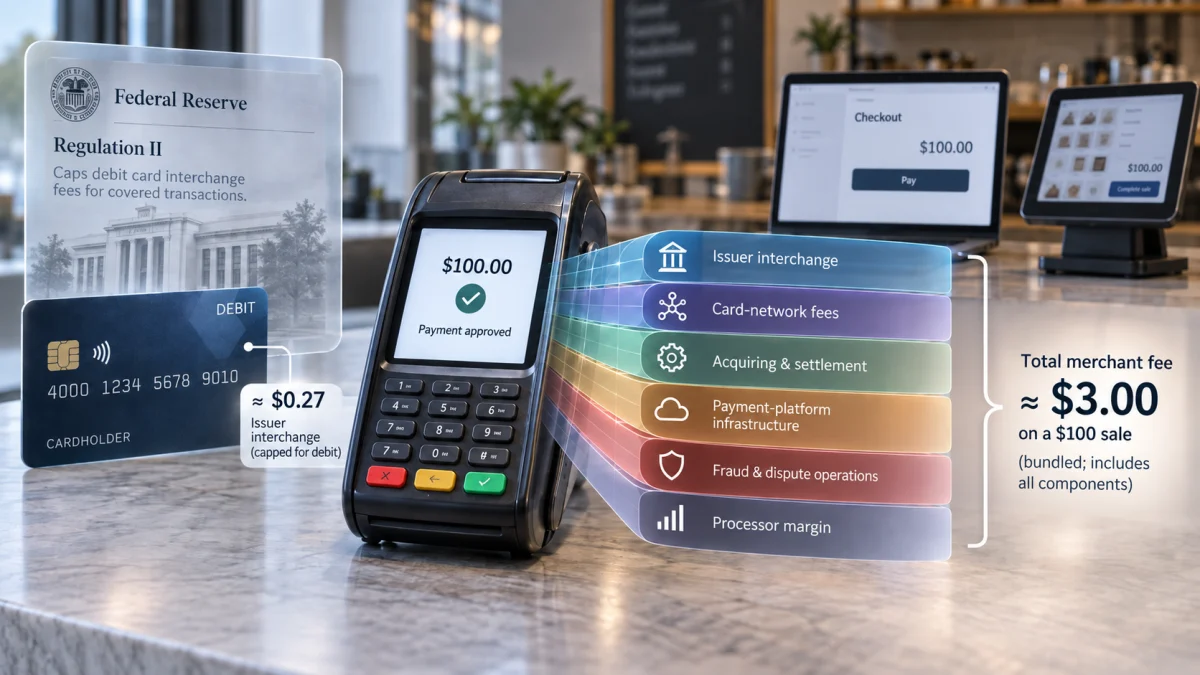
Stripe and Square can charge the same published processing rate for an ordinary U.S. debit card and an ordinary credit card because their standard rates are blended retail prices for payment acceptance, not a direct pass-through of what that individual card costs them underneath.
That distinction matters.
On a $100 debit-card purchase from a large bank covered by federal Regulation II, the issuing bank’s interchange fee generally cannot exceed about 27 cents, assuming the issuer qualifies for the additional fraud-prevention adjustment.
Yet the same $100 transaction can cost a merchant $2.75 through Square Free in person, $2.75 through Stripe Terminal or $3.20 through Stripe’s standard online pricing under their currently published U.S. rates.
So where did the other several dollars go?
The first thing to understand is that the question contains an easy trap:
27 cents of debit interchange and a $2.75 merchant processing fee are not the same category of fee.
Interchange is only one component inside the payment system. The merchant’s total price can also have to cover card-network fees, acquiring and settlement costs, gateway and platform infrastructure, security and compliance, fraud and dispute operations, support, and the payment provider’s own margin.
That does not mean the enormous difference between cheap regulated debit and expensive credit is irrelevant. It means the difference has to be analyzed correctly.
For a business with a lot of debit-card volume, the more useful question is:
At what point does the simplicity of flat-rate processing cost more than it is worth?
That answer depends heavily on the business’s actual card mix.
The $100 Debit-Card Paradox
Start with one $100 purchase.
As of September 2026, Stripe’s standard online price for domestic cards is 2.9% + 30 cents, or $3.20 on a $100 transaction. Stripe Terminal charges 2.7% + 5 cents, or $2.75.
Square Free currently charges 2.6% + 15 cents for a tapped, dipped or swiped payment, also $2.75 on $100. Square’s Free-plan online rate is 3.3% + 30 cents.
Now compare that with the federal debit-interchange rule.
The Federal Reserve’s Regulation II generally limits what a covered debit-card issuer may receive to:
21 cents + 0.05% of the transaction + up to 1 cent for eligible fraud-prevention costs.
On $100:
- Base amount: $0.21
- 0.05% of $100: $0.05
- Possible fraud adjustment: $0.01
- Maximum: about $0.27
That produces a striking comparison:
| $100 transaction | Merchant-facing or issuer amount |
|---|---|
| Stripe standard online | $3.20 |
| Stripe Terminal | $2.75 |
| Square Free in person | $2.75 |
| Regulation II covered-debit issuer interchange ceiling | About $0.27 |
But those numbers should not be interpreted as:
Square charges $2.75, pays the bank 27 cents and pockets $2.48.
That would be wrong.
The $2.75 is a bundled merchant-facing price. The 27 cents represents only one regulated upstream component.
Understanding everything between those numbers is the entire story.
Interchange Is Only One Layer of the Payment Fee
Visa itself makes the distinction unusually clear.
Visa describes interchange as a transfer fee between the acquiring side of the transaction and the issuing bank. The merchant instead pays what Visa calls a merchant discount, which can include a variety of payment-processing services.
Mastercard similarly says interchange is only one component of the merchant discount rate paid for card-acceptance services.
A useful way to think about the merchant’s payment bill is therefore as several economic layers:
| Layer | What it pays for | Regulation II cap? |
|---|---|---|
| Issuer interchange | Compensation associated with the card-issuing bank’s side of the transaction | Yes, for covered debit transactions |
| Card-network fees | Visa, Mastercard and other network assessments and transaction charges | No |
| Acquiring and settlement | Merchant access to the card system, authorization, clearing and settlement infrastructure | No |
| Gateway/platform services | Checkout, APIs, tokenization, encryption, POS functions, reporting and related technology | No |
| Fraud, disputes and risk operations | Fraud detection, chargeback infrastructure, account monitoring, reserves and other risk functions | No |
| Processor/provider margin | The provider’s economic return after its relevant costs | No |
The corporate boundaries are not always this clean.
A modern payment company can combine several of these functions itself or contract with banks, networks and other infrastructure providers behind the scenes. A merchant using Square or Stripe usually does not receive six separate bills.
That is the point of the product.
The merchant sees one relatively simple price.
For a broader explanation of the entire card-payment stack, including why U.S. credit-card acceptance often ends up near 3%, see sherafy.com‘s “Why Are Credit Card Processing Fees So High? Where the 3% Goes.” Why Are Credit Card Processing Fees So High? Where the 3% Goes
What Regulation II Actually Caps
Regulation II is commonly summarized as the federal rule that capped debit-card fees.
That is directionally useful but imprecise.
The regulation does not cap the merchant’s total debit-card processing bill.
It limits the interchange fee that certain debit-card issuers may receive.
The Federal Reserve currently states that a covered issuer generally may not receive more than 21 cents plus 0.05% of the transaction value, plus the possible 1-cent fraud-prevention adjustment. Certain prepaid and government-program cards can also qualify for separate exemptions.
That is why a business can simultaneously encounter both of these true statements:
The issuing bank received only a few dimes of regulated debit interchange.
and:
The merchant paid its payment provider several dollars.
There is no federal requirement that a flat-rate processor take a cheap debit transaction and reduce its retail merchant fee dollar-for-dollar.
The $10 Billion Exemption: Not Every Debit Card Is Capped
There is another complication that many simplified explanations miss.
Regulation II’s interchange standard does not apply the same way to every bank.
The Federal Reserve’s current 2026 small-issuer lists classify institutions with less than $10 billion in assets, including applicable affiliates, as exempt from the interchange-fee standard. The current lists use institution data from December 31, 2025.
That distinction has a measurable effect.
The Fed’s latest published network data cover 2024:
| Debit network type | Covered transactions | Exempt transactions |
|---|---|---|
| Dual-message | $0.22 average interchange | $0.61 |
| Single-message | $0.24 | $0.26 |
| All networks | $0.23 | $0.51 |
“Dual-message” and “single-message” refer to different network processing architectures. They should not be reduced to the old shorthand that one simply means “credit” and the other “PIN debit.”
The larger point is simpler:
There is no single underlying wholesale price called “the debit-card fee.”
A regulated debit transaction from a large covered issuer can have very different economics from debit issued by an exempt institution.
And both can still arrive at the merchant through the same flat-rate payment plan.
Why Ticket Size Makes Regulated Debit Especially Interesting
The structure of the Regulation II cap produces another consequence that is easy to overlook.
Most of the regulated issuer fee is fixed.
That means its effective percentage falls sharply as the transaction gets larger.
Assuming the issuer qualifies for the 1-cent fraud adjustment:
| Purchase | Maximum covered issuer interchange | As percentage of purchase |
|---|---|---|
| $10 | 22.5¢ | 2.25% |
| $100 | 27¢ | 0.27% |
| $500 | 47¢ | 0.094% |
| $1,000 | 72¢ | 0.072% |
These figures are issuer interchange only, not the merchant’s total cost.
But they illustrate why average ticket size can matter so much to a debit-heavy merchant.
A percentage-based flat fee continues growing with the transaction value.
The regulated issuer-interchange component barely does.
On a $10 purchase, the difference may not look spectacular.
On a $500 regulated debit transaction, it can become enormous.
That does not automatically mean interchange-plus will be cheaper after every other fee is included. It means a high-ticket, debit-heavy business has a particularly good reason to examine the numbers.
Why Stripe and Square Do Not Simply Charge Less for Cheap Debit
Because that is not how their standard pricing product is designed.
Stripe’s own pricing policy describes the distinction directly.
Under its blended-rate model, the merchant pays the agreed transaction fee regardless of underlying differences in network costs, including interchange and card-scheme fees.
Under interchange-plus, Stripe instead attributes the underlying network costs to the merchant and adds its own markup.
That is essentially the whole mystery.
Imagine five customers each spend $100:
- one uses regulated debit;
- one uses debit from an exempt smaller bank;
- one uses an ordinary credit card;
- one uses a rewards card;
- one uses a more expensive premium or commercial card.
The underlying economics can be different for all five.
A flat-rate processor can nevertheless sell the merchant one predictable price within that payment channel.
Some transactions will be relatively cheap underneath.
Others will be expensive.
The provider absorbs that variability into the blended price.
This is why “flat rate” is a much better description than “interchange pass-through.”
The Difference Is Not Pure Processor Profit
This is where explanations of debit fees often go off the rails.
Suppose a merchant pays $2.75 to accept a $100 regulated debit purchase and the issuer receives 27 cents or less.
It may be tempting to conclude:
$2.75 – $0.27 = $2.48 of processor profit.
No.
That subtraction only tells us that $2.48 remains after removing one component of the payment chain.
It does not tell us how the remaining amount is divided.
Other costs can include network assessments and transaction fees, acquiring and bank relationships, payment infrastructure, encryption and tokenization, fraud systems, dispute administration, PCI-related compliance, customer support, engineering, reporting, merchant underwriting and loss exposure.
Square, for example, says its processing price includes services such as dispute management, PCI-compliance support, account-takeover protection, end-to-end encryption, fraud prevention, reporting and support.
That does not mean every penny of those costs can be assigned neatly to one transaction either.
Many are platform-wide operating costs.
There is also an important fraud nuance.
Merchants frequently remain financially responsible for valid chargebacks. The processor therefore is not simply buying every merchant’s fraud losses out of its own pocket.
But payment providers still operate fraud-detection systems, investigate disputes, manage reserves and merchant risk, handle account takeovers and can face losses when a merchant cannot cover reversals or other obligations.
The correct statement is therefore:
Cheap debit can create a much larger spread between the merchant’s flat price and the underlying card-system costs, but that spread is not the same thing as net processor profit.
Without internal transaction-level cost and accounting data from the provider, outsiders cannot responsibly calculate the profit on that one transaction.
Cheap Debit Still Matters
Avoiding the “pure profit” mistake should not obscure the important economic consequence.
Under flat-rate pricing, the merchant does not necessarily receive the benefit when an individual transaction is unusually cheap to process underneath.
That is real.
A debit-heavy merchant can therefore pay a blended rate designed to accommodate a broader portfolio that includes more expensive credit-card transactions.
In an economic sense, cheaper transactions help support the average price of the pool.
The reverse can also happen.
A merchant with an unusually expensive mix of premium credit cards may sometimes receive a comparatively attractive deal from the same flat rate because the processor continues charging the published price instead of passing every high-cost card category directly through.
That is why the business’s own payment mix matters more than slogans such as:
Flat rate is expensive.
or:
Interchange-plus is always cheaper.
Neither is universally true.
Why Square Can Charge Its Normal Rate but Refuse to Surcharge Debit
There is another version of this question showing up among Square merchants.
Square currently has an automatic credit-card surcharge feature in U.S. open beta. Square says those surcharges apply to credit-card transactions only and not to debit cards.
That can seem bizarre from the merchant’s perspective:
If Square charges me the same ordinary processing rate on debit, why can’t I pass that same surcharge to the debit customer?
Because the rules governing what Square charges the merchant and what the merchant may surcharge the customer are different rules.
Visa’s U.S. rules state that debit transactions cannot receive a credit-card surcharge, including when the point-of-sale terminal gives the debit-card holder a choice labeled “credit” rather than “debit.”
Mastercard likewise says its surcharge rules allow qualifying surcharges on credit cards but prohibit them on Debit Mastercard and prepaid cards.
Selecting “credit” at a terminal does not magically convert the customer’s checking-account debit card into a credit card.
The funding instrument remains debit.
This is therefore not evidence that Square secretly regards debit as a credit transaction.
It is the intersection of two separate pricing systems:
- Square’s flat merchant-processing price.
- Card-network and applicable legal restrictions governing merchant surcharges.
Flat Rate vs. Interchange-Plus: What Actually Changes?
The easiest way to understand the alternative is to compare pricing models.
| Flat-rate pricing | Interchange-plus | |
|---|---|---|
| Actual interchange | Bundled into merchant rate | Passed through |
| Network costs | Generally bundled | Often separately passed through |
| Processor markup | Embedded in overall rate | More visible |
| Cost predictability | High | Lower |
| Statement simplicity | High | Lower |
| Merchant benefits when card cost is low | Not necessarily | More directly |
| Merchant exposure when card cost is high | Processor absorbs some variation within its pricing model | Merchant sees more of it |
| Best for | Simplicity and predictable pricing | Businesses whose actual mix makes pass-through economics attractive |
Stripe publicly offers IC+ pricing as part of its custom pricing options.
PayPal provides an unusually transparent public example of the two structures living side by side.
Its September 2026 U.S. fee schedule lists Standard Credit and Debit Card Payments together at 2.99% plus a fixed fee, while eligible Advanced Credit and Debit Card Payments can instead use an Interchange Plus Plus structure consisting of interchange pass-through costs plus 0.49% and a fixed charge.
Same payment ecosystem.
Different retail pricing model.
When Can a Debit-Heavy Business Materially Overpay?
There is no responsible universal rule such as:
Switch to interchange-plus once you process $10,000 a month.
Monthly volume matters because it magnifies savings or losses, but it does not by itself determine which model is cheaper.
The important variables include:
- percentage of transactions funded by debit;
- how much of that debit comes from covered versus exempt issuers;
- average transaction size;
- total transaction count;
- card-present versus online or keyed-in volume;
- ordinary versus premium/commercial credit-card mix;
- actual interchange-plus markup;
- processor per-transaction fees;
- network pass-through fees;
- monthly, gateway or PCI charges;
- software or POS services bundled with the flat-rate provider;
- chargeback and refund patterns;
- switching and integration costs.
A $100,000-a-month restaurant with thousands of small transactions can have very different payment economics from a contractor processing $30,000 a month through 60 large transactions.
Both businesses may be “debit heavy.”
That alone does not answer the question.
Businesses most worth examining
Flat pricing deserves especially close scrutiny when a business has several of these characteristics:
High debit share.
More low-cost debit means more opportunity for a pass-through model to expose those lower costs.
Large average tickets.
Because regulated debit interchange grows very slowly with transaction size while a 2.6% or 2.9% merchant rate grows proportionally.
Mostly card-present transactions.
These are generally less risky than remote card-not-present payments and can have more favorable payment economics.
Meaningful monthly volume.
A difference of even 0.30 percentage points is $300 a month on $100,000 of processing and $3,600 per year.
Low need for bundled extras.
A supposedly cheaper processor may not actually be cheaper if replacing the current POS, fraud tools, reporting, subscription billing or other integrated services creates new costs elsewhere.
The correct test is therefore not:
Is interchange-plus cheaper in general?
It is:
What would this business have paid under both models for the same actual transaction mix?
How to Check Your Own Merchant Statement
Start with the simplest useful number:
Effective processing rate = total relevant processing cost ÷ card sales
If your business processed $50,000 in card sales and paid $1,400 in payment-processing costs, the observed effective rate was:
$1,400 ÷ $50,000 = 2.8%
Do not stop there.
For a meaningful comparison, collect at least:
- total card sales;
- transaction count;
- processing fees actually charged;
- debit versus credit volume;
- average transaction value;
- card-present versus online/keyed volume;
- recurring monthly or gateway charges;
- applicable dispute or miscellaneous payment fees.
Square’s current reporting can break payment methods down by debit versus credit, domestic versus international card origin, card brand and associated fees.
Stripe’s payment data can likewise identify a card’s funding type as credit, debit, prepaid or unknown.
That means many merchants do not actually need to guess their debit percentage.
They may already have the data.
The Best Flat-Rate vs. Interchange-Plus Calculator Should Use Real Statement Data
Most comparison calculators begin by asking the merchant to estimate monthly volume, average ticket and debit percentage.
That can provide a rough estimate.
A better tool would start with what the business actually paid.
The ideal inputs are:
Current processor
- monthly card volume;
- number of transactions;
- actual total processing fees;
- debit volume;
- credit volume;
- card-present versus card-not-present volume;
- monthly and gateway charges.
Proposed interchange-plus provider
- actual interchange/network pass-through from a quote or representative statement;
- processor percentage markup;
- processor per-transaction markup;
- monthly fee;
- gateway or platform charges;
- any other recurring acceptance costs.
The output should then show:
- current effective processing rate;
- current cost per $100 of sales;
- estimated or actual interchange-plus effective rate;
- monthly difference;
- annual difference;
- break-even alternative rate.
Most importantly, it should not tell the merchant:
Your processor is making $X of profit from you.
The available data generally do not support that conclusion.
The defensible result is:
Your current payment model costs approximately $X more or less than the alternative under these assumptions.
That is the number the business owner actually needs.
Flat Rate Can Still Be the Better Choice
None of this means small businesses should rush away from Stripe or Square.
Flat pricing solves real problems.
The merchant gets easy onboarding, predictable rates and a payment platform without having to understand hundreds of interchange categories.
Stripe’s standard plan, for example, advertises no setup or monthly fees and includes a broader payments platform with built-in fraud prevention.
Square’s standard processing infrastructure includes encryption, dispute management, fraud detection, reporting, PCI support and other operational services.
For a small or sporadic merchant, that simplicity can easily be worth more than squeezing the last few basis points out of processing.
Flat rate can also be surprisingly competitive for a merchant whose customers disproportionately use expensive credit-card products.
Interchange-plus becomes most interesting when the business has grown large enough, or developed a favorable enough transaction mix, that the wholesale-cost advantage consistently exceeds the value of the bundled simplicity.
That is a calculation, not an ideology.
The Bottom Line
Stripe and Square generally charge the same published rate for ordinary debit and credit cards within a given flat-rate payment channel because they are selling a bundled payment-acceptance service, not reselling each card’s interchange cost at cost.
Regulation II can limit the issuing bank to roughly a quarter on a $100 covered debit transaction while the merchant still pays its processor several dollars.
Those figures are not contradictory because interchange is only one layer of the merchant’s total payment cost.
But the enormous difference between regulated debit and many credit-card transactions still matters.
For businesses with high debit volume, large average tickets or otherwise inexpensive card mixes, flat-rate processing can leave substantial savings unrealized compared with a competitive interchange-plus arrangement.
The only reliable way to know is to compare the actual all-in cost of both models using the business’s real transaction data.
And one calculation should be avoided entirely:
Flat processing fee minus debit interchange does not equal processor profit.
References and Further Reading
Federal Regulation and Debit Data
Federal Reserve Board — Regulation II: Average Debit Card Interchange Fee by Payment Card Network
The primary source for the federal debit-interchange ceiling and the latest published 2024 data comparing covered and exempt transactions. Federal Reserve Regulation II interchange data
Federal Reserve Board — Regulation II Small Issuer Exemption
Explains the $10 billion asset threshold and provides the current 2026 lists of institutions classified as exempt or non-exempt. Federal Reserve small-issuer exemption data
Processor Pricing and Services
Stripe — Pricing
Current standard U.S. pricing, including 2.9% + 30 cents for domestic online card transactions and availability of IC+ custom pricing. Stripe pricing
Stripe — Pricing Policy
Directly explains the difference between Stripe’s blended pricing and interchange-plus models and how underlying network costs are treated. Stripe pricing policy
Square — Processing Fees
Current Square plan pricing, including published rates for card-present, online and other payment channels. Square processing fees
Square — What Square Fees Include
Details the security, dispute-management, reporting, fraud-prevention and other services bundled into Square’s merchant offering. Square fee explanation
PayPal — U.S. Merchant Fees
Useful primary-source example of a payment provider offering both standard blended credit/debit pricing and an interchange-plus-plus option. PayPal U.S. merchant fee schedule
Card-Network Rules and Economics
Visa — Interchange Reimbursement Fees and Merchant Discount Rates
Visa’s explanation of the distinction between interchange paid within the card system and the broader merchant discount paid for acceptance services. Visa processing fees and interchange
Mastercard — Interchange Rates and Fees
Mastercard’s explanation that interchange is only one component of the merchant discount rate established for card-acceptance services. Mastercard interchange rates and fees
Visa — U.S. Merchant Surcharge Rules
Explains the prohibition on applying credit-card surcharges to debit transactions, including transactions where a debit-card holder chooses a terminal option labeled “credit.” Visa U.S. surcharge rules
Square — Credit Card Surcharges
Current documentation for Square’s U.S. surcharge feature, which applies to credit-card transactions and excludes debit cards. Square credit-card surcharge documentation
Merchant Data and Further Analysis
Square — Payment Methods Reports
Explains how merchants can view payment data broken down by debit versus credit, card brand, origin and associated fees. Square payment-method reporting
Stripe API — Card Funding Type
Documents Stripe’s credit, debit, prepaid and unknown card-funding classifications, useful when analyzing actual transaction mix. Stripe card funding documentation
sherafy.com — Why Are Credit Card Processing Fees So High? Where the 3% Goes
Companion explainer covering the broader economics of U.S. card-processing fees, interchange, networks, rewards and merchant acceptance. Why Are Credit Card Processing Fees So High? Where the 3% Goes
Editorial currency note: Payment-processor prices, card-network rules and merchant surcharge programs can change. Rates and program details in this article were checked against published sources on September 21, 2026. Federal Reserve interchange figures refer to its latest published 2024 network data.