
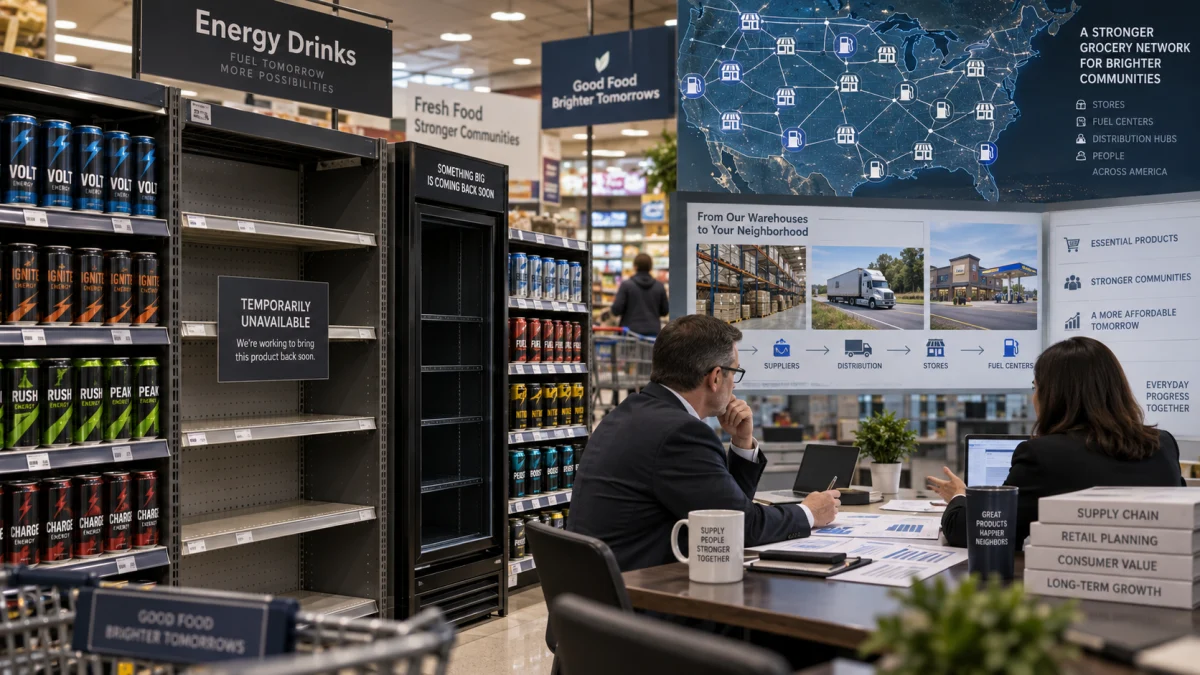
Red Bull is gone from Kroger because of what appears to be a supplier-pricing standoff, not a recall or an ordinary inventory shortage.
Kroger confirmed that it stopped selling Red Bull at its stores and fuel centers nationwide. The last inventory was sold during August, and Red Bull-branded coolers and displays had been removed by August 31, according to reporting by the Cincinnati Enquirer.
Kroger has declined to publicly disclose the reason for the break with Red Bull. But there is an important piece of evidence that makes pricing much more than speculation: Kroger’s own beverage page currently tells customers:
"Red Bull is currently out of stock while we work with our suppliers to keep prices affordable for you."
That message, combined with Kroger CEO Greg Foran’s unusually explicit comments about resisting supplier price increases, makes a pricing disagreement the strongest explanation supported by the public evidence.
What we still do not know is exactly what Red Bull proposed, how much its wholesale prices may have changed, or whether other commercial terms are part of the dispute. Neither company has disclosed the underlying contract negotiations.
Kroger did not simply run out of Red Bull
Calling this an "out of stock" situation understates what happened.
Kroger told the Cincinnati Enquirer that the last Red Bull inventory sold during August and that the company’s branded coolers and displays were removed from stores by August 31. The removal applies across Kroger stores and fuel centers nationally.
Kroger continues selling competing energy drinks including Monster, Alani Nu, Bloom, Rockstar and NOS.
That matters because it largely rules out a Kroger-wide decision to leave the energy-drink business.
It also makes an ordinary supply hiccup difficult to square with the evidence. Retailers do not normally remove branded equipment nationwide because a truck is late.
The better description is that Kroger has stopped carrying Red Bull while the companies work through a commercial disagreement.
Why does this look like a pricing dispute?
There are two unusually strong pieces of evidence.
The first comes directly from Kroger.
As of September 17, Kroger’s website says Red Bull is unavailable while the retailer works with suppliers to "keep prices affordable." The same message has appeared on other Kroger-owned banners, including Ralphs and Mariano’s.
That does not reveal the details of the negotiations. But Kroger itself is explicitly connecting Red Bull’s absence to supplier pricing and affordability.
The second piece of evidence is Kroger’s broader purchasing strategy.
During Kroger’s September 11 earnings call, analyst Scott Marks asked Foran specifically about large suppliers seeking price increases to cover higher input costs and what Kroger could do during those negotiations.
Foran said Kroger would work through increases when suppliers could justify them. What Kroger did not want, he said, was a situation in which suppliers could simply raise prices without "full justification."
He also described Kroger’s role as acting as the customer’s representative on value and pointed to Kroger’s private-label portfolio as one of the company’s bargaining tools.
Those comments were not explicitly about Red Bull. That distinction is important.
But when Kroger simultaneously removes Red Bull nationwide, tells shoppers it is working with suppliers to keep prices affordable, and publicly explains that it is challenging supplier price increases, a pricing disagreement becomes a strong inference rather than a rumor.
What Kroger has not told us
The public evidence does not establish several claims now circulating online.
Kroger has not disclosed how much Red Bull may have wanted to charge it.
There is no public Red Bull-Kroger contract showing a proposed percentage increase.
We also do not know whether the disagreement concerns only the wholesale price of the drinks. Large retailer-supplier relationships can involve promotional funding, display space, distribution, rebates, marketing commitments and other commercial terms.
Red Bull had not provided a public explanation as of September 17 despite multiple requests for comment from the Cincinnati Enquirer and USA Today.
For that reason, claims that Red Bull demanded a particular percentage increase should be treated as unverified unless either company releases documentation or independently verifiable records emerge.
Is Red Bull recalled?
There is no evidence that Kroger’s Red Bull removal was caused by a recall or safety problem.
That point is worth making because a nationwide disappearance of a food or beverage product can understandably make shoppers suspect a recall.
The FDA’s current recall materials do not show a recall of the familiar Red Bull Energy Drink corresponding with Kroger’s removal. An FDA notice from March involving a product called "Red Bull Extreme" is unrelated. That product was a sexual-enhancement supplement containing undeclared sildenafil, not Red Bull GmbH’s mainstream energy drink.
There is another straightforward indication that Red Bull itself has not been discontinued: Red Bull North America announced a new permanent Apple Edition for U.S. retailers on August 31, the same date Kroger says its Red Bull displays had been removed.
Red Bull remains a major national consumer brand sold through other retailers.
Why would Kroger drop a brand as large as Red Bull?
Because shelf space is leverage.
The basic economics of a supplier dispute depend on which side believes consumers are more willing to switch.
Red Bull benefits from strong brand loyalty. If a shopper who wants Red Bull leaves Kroger and buys it somewhere else, Kroger risks losing not only the drink sale but potentially the rest of that shopping trip.
Kroger has the opposite bet available to it. If enough shoppers simply buy Monster, Alani Nu, Celsius, Rockstar or another energy drink instead, Red Bull loses sales while Kroger keeps the customer.
That gives a retailer of Kroger’s size substantial bargaining power.
As of January 31, 2026, Kroger reported operating 2,697 supermarkets in 35 states and the District of Columbia, along with 1,731 fuel centers.
The scale of the Red Bull withdrawal therefore matters. This is not one regional supermarket deciding it dislikes a vendor’s price. It removes Red Bull from access to a large national retail network.
And Red Bull is not a minor brand. Circana data cited in a 2026 SEC filing put Red Bull at roughly 34.7% of U.S. ready-to-drink energy-drink dollar share in the first quarter of 2026, making the decision to go without it commercially significant for Kroger as well.
Both companies have something to lose.
That is precisely what gives each side negotiating leverage.
Kroger is becoming more willing to use its own brands as leverage
The Red Bull situation also fits a larger strategy under Foran.
Kroger reported more than $39 billion in sales from its own brands in 2025, against total company sales of about $147.6 billion. That means Kroger-controlled brands accounted for more than one-quarter of company sales.
During the September 11 call, Foran said Kroger plans to expand its low-price Smart Way range from roughly 130 products to about 1,000 over the next year and a bit.
Private label does not solve the Red Bull problem directly. Kroger does not have a straightforward house-brand equivalent with Red Bull’s brand recognition.
But it changes the balance of power across Kroger’s supplier relationships.
A retailer that can replace more national brands with products it controls is less dependent on accepting every supplier’s proposed terms.
Foran’s message to investors was essentially that Kroger wants suppliers to justify increases rather than treating inflation as an automatic reason to push through higher prices.
The disappearance of Red Bull is what that negotiating philosophy looks like when an agreement apparently cannot be reached.
Does this mean Kroger is protecting shoppers rather than its profit margin?
That conclusion would go beyond the evidence.
Kroger says its strategy is designed to improve customer value, and lower procurement costs can certainly make lower shelf prices easier to sustain.
But Kroger is also a for-profit retailer managing its own gross margins.
Its September earnings materials explicitly describe a model in which Kroger intends to generate savings, reinvest some of them into customer value and improve margins over time.
Those goals are not mutually exclusive.
Rejecting a supplier increase can benefit Kroger’s margins, give Kroger room to lower retail prices, or do some combination of both. Without the Red Bull contract terms and the prices each company proposed, there is no reliable way to calculate who would have captured the difference.
So the evidence supports saying Kroger is resisting supplier costs.
It does not yet tell us exactly how much of any resulting savings would reach shoppers.
Is Red Bull also gone from Ralphs, Fry’s, Fred Meyer and other Kroger chains?
Kroger said the removal is nationwide across its stores and fuel centers, not merely supermarkets carrying the Kroger name.
The Kroger family operates under numerous regional banners, including Ralphs, Fry’s, Fred Meyer, King Soopers, Dillons, QFC, Mariano’s, Harris Teeter and others. Kroger’s own January 2026 delivery announcement specifically identifies Ralphs, Fred Meyer, King Soopers, Smith’s, Fry’s, Harris Teeter and Mariano’s among its national family of banners.
The Red Bull affordability notice is already visible on multiple banner websites.
So a shopper looking for Red Bull at a Ralphs in California or Fry’s in Arizona may be encountering the same Kroger-level decision even though the storefront does not say "Kroger."
Will Red Bull come back to Kroger?
Possibly.
Nothing currently available establishes that the split is permanent.
In fact, Kroger’s own wording suggests an unresolved negotiation rather than a final ban. The company says Red Bull is "currently" unavailable while it works with suppliers on pricing.
At the same time, removing inventory, branded coolers and displays across the country is more substantial than a routine temporary shortage.
The safest conclusion is therefore:
Kroger and Red Bull appear to be in a commercial pricing standoff, Red Bull is not currently being sold across Kroger’s national retail network, and there is no publicly announced date for its return.
If the two companies reach acceptable terms, there is nothing apparent preventing Kroger from putting Red Bull back on the shelf.
Until then, shoppers looking specifically for Red Bull will have to buy it from another retailer.
The bottom line
Kroger has confirmed the unusual part of this story: Red Bull was deliberately removed from its stores and fuel centers nationwide, with remaining inventory sold off and branded equipment removed by August 31.
Kroger has not publicly released the contract dispute behind that decision.
But its own websites now say Red Bull is unavailable while Kroger works with suppliers to keep prices affordable. Just days later, Kroger’s CEO publicly explained that the company is scrutinizing supplier price increases and is willing to push back when it believes those increases are not sufficiently justified.
Taken together, the evidence makes a supplier-pricing dispute the most credible explanation for Red Bull’s disappearance.
What remains unknown is just as important: how much Red Bull wanted, what Kroger was willing to pay, whether other contractual terms are involved and which company ultimately has more leverage.
That is where the story stands as of September 17, 2026.
References and Further Reading
Primary and Corporate Sources
-
Kroger Beverage Department: Red Bull Supplier-Affordability Notice — Kroger’s own retail site currently states that Red Bull is unavailable while the company works with suppliers to keep prices affordable.
-
Kroger Second-Quarter 2026 Results — Kroger’s September 11 earnings release provides current financial results and context for its value and cost-management strategy.
-
Kroger 2025 Form 10-K — Establishes Kroger’s total sales, more than $39 billion in Our Brands sales and other company financial information.
-
Kroger Store and Fuel-Center Footprint — Kroger’s SEC filing reports 2,697 supermarkets and 1,731 fuel centers as of January 31, 2026.
-
Red Bull North America: Apple Edition U.S. Launch — Confirms Red Bull continued introducing products nationally while the Kroger removal occurred.
Earnings Call and Supplier-Pricing Context
- Kroger Q2 2026 Earnings Call Transcript — Includes Greg Foran’s detailed response on supplier price increases, private-label leverage and Kroger’s approach to negotiations.
Independent Reporting
-
Cincinnati Enquirer: Kroger Stopped Selling Red Bull Nationwide — Original reporting confirming the nationwide removal, August inventory sell-through and removal of coolers and displays.
-
USA Today: What We Know About Red Bull’s Removal From Kroger — Confirms Kroger’s online supplier-affordability notice and repeated attempts to obtain comment from Red Bull.
-
WCPO: Red Bull Disappears From Kroger Stores Amid Supplier Dispute — Documents the same affordability language on in-store signage and provides local reporting on the disagreement.
Market Context
- Circana Energy-Drink Market Data Cited in SEC Filing — Provides 2026 U.S. ready-to-drink energy-drink market-share data showing the commercial scale of Red Bull.
Recall Verification
- FDA Red Bull Extreme Safety Notice — Useful for distinguishing an unrelated supplement called Red Bull Extreme from Red Bull Energy Drink.
Editorial currency note: This is an active commercial dispute. Product availability, Kroger’s website messaging and the positions of Kroger or Red Bull may change quickly if the companies reach an agreement. Facts above are current as of September 17, 2026.