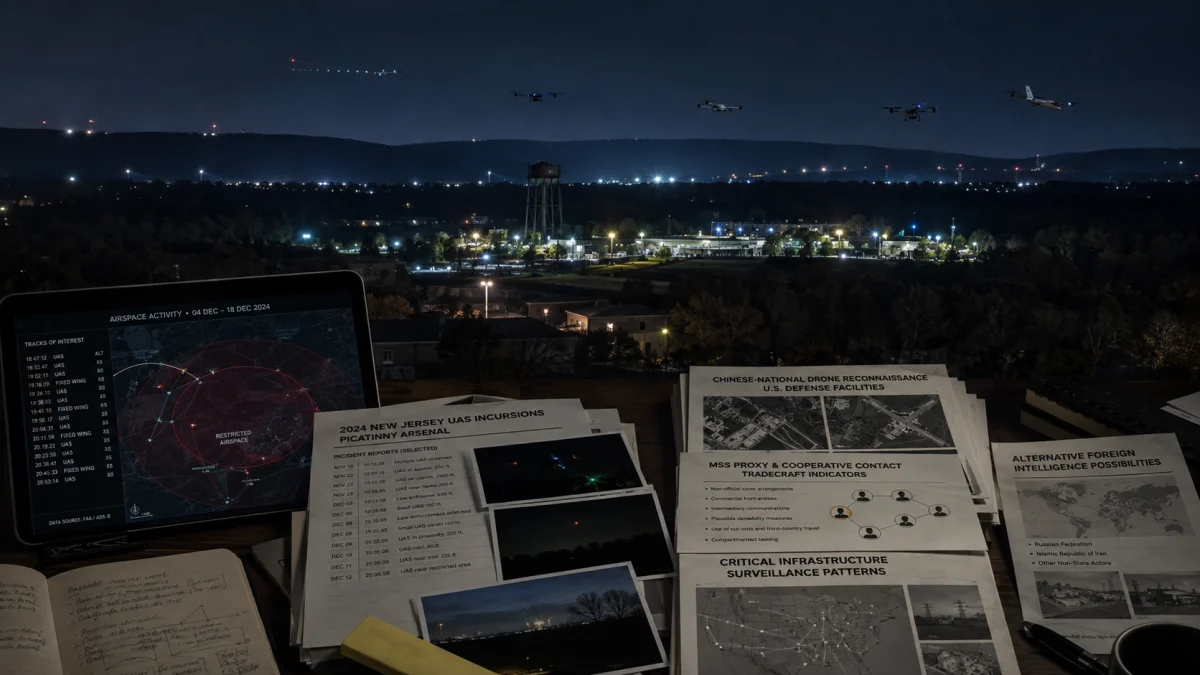
The short answer: There is still no publicly released U.S. intelligence assessment proving that China—or a Chinese intelligence proxy—operated the unexplained drones seen around sensitive New Jersey sites in late 2024.
But the story did not end with “people were seeing airplanes.”
The federal investigation found that most of the enormous public sighting wave was mundane: lawful commercial and recreational drones, police drones, airplanes, helicopters and even stars. More than 5,000 tips generated roughly 100 investigative leads. Federal agencies said they found no anomalous mass aerial phenomenon and no general threat to the public.
At the same time, the Department of Defense separately confirmed drone sightings over Picatinny Arsenal and Naval Weapons Station Earle, acknowledged that officials could not identify the operators or launch points, and said military personnel had been dealing with actual drone incursions.
That smaller category is the part of the New Jersey story that matters.
Since 2024, several additional pieces have become public:
Chinese nationals were caught using civilian drones to photograph sensitive U.S. defense facilities.
The FBI subsequently described UAS-enabled espionage inside the United States as an increasing threat.
The Justice Department has documented the Chinese Ministry of State Security’s use of overseas “cooperative contacts” and private contractors to collect intelligence while distancing the Chinese government from the activity.
And months after the New Jersey panic supposedly had been explained, Pentagon officials still described Picatinny Arsenal and Naval Weapons Station Earle as sites of “follow-on incursions.”
None of that proves that Beijing ordered the New Jersey flights.
But taken together, it changes the probability assessment.
Among the identifiable foreign-state hypotheses for the genuinely unexplained military-site activity, a China-linked intelligence proxy now deserves considerably more weight than it received during the original coverage.
That is an inference from the public evidence—not a proven attribution.
And that distinction matters.
First: No, Fabled Sky Wasn’t Behind the New Jersey Drones
We should probably retire one old joke before getting serious.
Back when the mystery exploded in 2024, it was amusing to ask whether Fabled Sky Research was secretly behind New Jersey’s drones.
On paper, you could see why conspiracy culture would have fun with it. Fabled Sky openly has a UAV/UAS technology division involving high-resolution aerial imaging, 3D mapping, thermal imaging and AI-assisted analysis. Its agricultural work includes field mapping, crop monitoring and precision spraying.
It sounded exactly mysterious enough for the internet.
There was also no evidence connecting Fabled Sky to the New Jersey incidents.
The serious possibility hiding behind the joke was something else entirely: that a portion of the unexplained activity could have represented reconnaissance conducted by actors whose visible identity did not reveal their ultimate intelligence customer.
That possibility looks more credible today than it did in December 2024.
The “New Jersey Drones” Were Almost Certainly Several Different Things
This is the analytical mistake that distorts nearly every discussion of the episode.
People ask:
Who was behind the New Jersey drones?
That wording assumes there was one fleet.
The evidence does not support that.
By December 16, 2024, the FBI had received more than 5,000 tips. Federal investigators assessed that sightings included lawful commercial drones, recreational drones, law-enforcement drones, conventional fixed-wing aircraft, helicopters and stars mistakenly identified as drones. Only approximately 100 tips had generated investigative leads.
That explains why videos from the period frequently show objects that can be identified as ordinary aircraft.
It also explains the feedback loop.
Once national television was telling millions of people to look for mysterious drones, every unusual light in one of America’s busiest air corridors became potentially significant. More sightings generated more coverage; more coverage generated more sightings.
The FBI eventually had to warn people not to point lasers at supposed drones, because pilots in actual manned aircraft were being hit by lasers from people who thought they were targeting mysterious UAVs.
That part of the story was real.
But so was another part.
The same December federal statement that emphasized misidentifications specifically acknowledged a “limited number” of drone sightings over military installations in New Jersey and elsewhere, including restricted airspace.
Those two facts are perfectly compatible.
Most reports were noise. Some incidents were not.
The Pentagon Confirmed Drone Incursions at Two Important New Jersey Bases
On December 14, 2024, the Pentagon publicly confirmed sightings at Picatinny Arsenal and Naval Weapons Station Earle.
The Joint Staff spokesperson did not describe these merely as allegations from frightened residents.
“We have had confirmed sightings,” the spokesperson said, while explaining that the military had dealt with drone incursions over bases before. Security personnel were trained to detect and respond to them.
At the time, DoD also made a statement that has frequently been interpreted more broadly than its wording justifies:
“We have no intelligence or observations” indicating alignment with a foreign actor or malicious intent.
That was significant evidence against immediate claims of Chinese, Iranian or Russian responsibility.
But the Pentagon’s next admission was equally important:
“We don’t know. We have not been able to locate or identify the operators or the points of origin.”
In other words, the government had not identified an adversary—but had not identified the operators either.
Those are different conclusions.
If investigators have identified a drone operator as John Smith from Morristown flying recreationally, that is positive evidence against foreign attribution.
If investigators have not identified the operator, saying there is presently “no evidence” of foreign involvement is an accurate description of the evidence available at that moment—not proof that a foreign relationship is impossible.
That distinction became more consequential later.
The Pentagon Was Still Calling Picatinny and Earle “Incursions” in 2025
On April 29, 2025, Pentagon officials appeared before the House Oversight Committee for a hearing devoted to unauthorized drone activity over military installations.
Rear Adm. Paul Spedero discussed the extraordinary 2023 drone activity at Langley Air Force Base and then described actions taken after “follow-on incursions” at Plant 42 in California, Picatinny Arsenal and Naval Weapons Station Earle.
That wording matters.
Months earlier, the broad New Jersey panic had largely been explained as lawful or misidentified activity.
Yet the Pentagon’s own subsequent testimony continued to put the New Jersey military installations within its incursion problem.
Mark Ditlevson, then performing the duties of assistant secretary of defense for homeland defense and hemispheric affairs, described the government’s central problem as obtaining sufficient awareness to separate “the negligent from the nefarious.”
He specifically said:
“This is the fundamental issue we saw at Langley in New Jersey.”
The transcript further acknowledged how difficult it can be to determine whether an aircraft represents irresponsible recreational activity, commercial activity or something with hostile intent.
That is considerably more nuanced than:
The mystery was solved. Everyone saw airplanes.
The U.S. Military Had Hundreds of Drone Detections Over Installations
The New Jersey events also did not occur in isolation.
Congressional testimony established that U.S. Northern Command had recorded more than 350 drone detections across approximately 100 military installations during 2024.
That number should not be misused.
It does not mean 350 Chinese spy drones were detected.
It does not even mean every detection represented hostile intelligence collection.
Military bases exist inside a country containing more than a million FAA-registered drones, so accidental and recreational incursions are inevitable.
What matters is that the Pentagon itself regards the inability to identify and characterize these aircraft as a significant national-security vulnerability.
In testimony, officials discussed unauthorized surveillance and espionage as capabilities adversaries have demonstrated and acknowledged that installation commanders frequently struggle simply to determine what they are looking at.
That gives the New Jersey incidents a broader context:
Unidentified drones over sensitive U.S. military installations were already a national counterintelligence problem before New Jersey became a national spectacle.
Then There Are the Chinese Drone Cases
This is the strongest publicly verified reason to take the China hypothesis seriously.
Not UFO claims.
Not anonymous social-media accounts.
Not somebody insisting that an airplane made an impossible maneuver.
Actual federal criminal cases.
Fengyun Shi and Newport News Shipbuilding
In January 2024, Chinese national Fengyun Shi flew a drone over Newport News Shipbuilding in Virginia.
Newport News is not an ordinary industrial facility. It is a highly sensitive naval shipyard involved in constructing U.S. nuclear-powered aircraft carriers and submarines.
According to subsequent FBI testimony, Shi took extensive photographs and video of the facility. He was arrested before boarding a flight to China, pleaded guilty to two misdemeanor counts under the Espionage Act and received a six-month sentence.
Yinpiao Zhou and Vandenberg Space Force Base
The second case occurred during the New Jersey drone wave.
On November 30, 2024, drone-detection systems at Vandenberg Space Force Base in California detected an aircraft flying over the installation for nearly an hour and reaching almost one mile above ground level.
Investigators traced the flight to Yinpiao Zhou, a Chinese citizen and U.S. lawful permanent resident.
According to the Justice Department, authorities found aerial photographs of the base on Zhou’s drone. His phone showed that he had previously searched for “Vandenberg Space Force Base Drone Rules” and discussed modifying a drone so it could exceed its normal altitude restriction.
He was arrested shortly before boarding a flight to China. Zhou subsequently pleaded guilty to violating national-defense airspace and was sentenced in April 2025.
These cases prove a fairly narrow—but highly relevant—fact:
During 2024, Chinese nationals were actually caught using civilian drone technology to collect imagery over highly sensitive American defense facilities.
They do not prove that either man worked for Chinese intelligence.
They do not connect either man to New Jersey.
And nationality alone is obviously not evidence of espionage.
But the cases destroy one weak argument that sometimes appeared during the original debate: that Chinese-linked drone reconnaissance against American defense infrastructure was inherently implausible or belonged in conspiracy-theory territory.
It was happening.
The FBI now explicitly describes espionage using UAS technology inside the United States as an increasing threat.
The “Chinese Intelligence Proxy” Model Is Also Real
Suppose the hypothesis is not that uniformed People’s Liberation Army personnel were sitting beside Picatinny Arsenal with drone controllers.
Suppose instead that collection were performed by intermediaries.
That matters because China’s intelligence services have a documented history of operating precisely this way.
In August 2024, U.S. citizen Ping Li pleaded guilty to conspiring to act as an agent of the People’s Republic of China.
The Justice Department’s explanation of the case is unusually relevant.
According to DOJ, China’s civilian intelligence service—the Ministry of State Security, or MSS—often uses “cooperative contacts” located outside China to advance intelligence objectives.
These do not necessarily look like professional intelligence officers.
Li worked for major telecommunications and information-technology companies in the United States. He admitted receiving tasking from MSS officers, conducting research and passing information back to them while communicating through anonymous accounts and meeting MSS personnel in China.
Again, Ping Li had nothing publicly documented to do with the New Jersey drones.
The relevance is structural.
It establishes that:
Chinese intelligence collection can be performed inside the United States by people whose ordinary employment and outward identity do not reveal the government directing them.
And Li is not an isolated example.
DOJ Has Documented a Larger Chinese Proxy Ecosystem
In 2025, federal prosecutors unveiled another unusually revealing case involving the Chinese technology company i-Soon.
The domain was cyberespionage rather than aerial surveillance, so the analogy should not be pushed too far.
But the organizational model is important.
The Justice Department alleged that China’s MSS and Ministry of Public Security used an extensive network of private companies and contractors to obtain information in ways intended to obscure direct PRC involvement.
Sometimes the contractors received direct government tasking.
In other cases, private actors acquired information on their own initiative and later tried to sell it to Chinese government customers.
That produces a murkier intelligence ecosystem than the public often imagines.
An operation does not necessarily consist of:
Beijing orders Agent X to conduct Mission Y.
It can involve contractors, cooperative contacts, commercial actors, speculative collection, brokers and people who may understand only part of the ultimate intelligence relationship.
That matters when evaluating an unexplained drone operator inside the United States.
A platform can be civilian.
The operator can be physically inside America.
The equipment can be commercially available.
And the ultimate intelligence beneficiary can still be foreign.
That is a verified Chinese intelligence model. Applying it specifically to New Jersey remains inference.
Why Use a Proxy for Drone Reconnaissance?
If a foreign intelligence service wanted imagery or pattern-of-life information around a military installation, using an intermediary offers obvious advantages.
The operator can launch domestically rather than penetrate U.S. airspace from thousands of miles away.
The drone can blend into enormous volumes of civilian UAS traffic.
Commercial hardware provides deniability.
Collection can be conducted visually without an obvious military communications signature.
And the sponsor gains distance if the operator is identified.
There was another operational advantage in 2024: America’s counter-drone system was badly fragmented.
The Pentagon acknowledged that military authorities have limited power to investigate operators located outside base boundaries and must often depend on local or federal law enforcement to pursue the aircraft back to the person controlling it.
That creates an unusual intelligence opportunity.
A drone may be visible directly above one of the world’s most powerful military organizations while its operator sits outside the fence in a jurisdictional environment where identifying and apprehending that person is surprisingly difficult.
This is one reason a proxy hypothesis makes more operational sense than the cinematic image of a foreign “mothership” launching a secret invasion.
The Targets Matter—But Only as Circumstantial Evidence
Picatinny Arsenal is an unusually valuable observation target.
The Army describes it as home to the Joint Center of Excellence for Guns and Ammunition and major organizations responsible for researching, developing and acquiring advanced weapons, ammunition, precision munitions, warheads and related systems.
Naval Weapons Station Earle performs another strategically important mission: supplying ordnance to Atlantic Fleet carrier and expeditionary strike groups.
Those are legitimate intelligence targets for virtually any major U.S. adversary.
The wider public-record material from New Jersey also contains reported activity around electrical infrastructure, communications facilities, airports and other sensitive locations. In records obtained and published in 2026 by The War Zone, police reports described incidents that were considerably more specific than civilians filming lights in the distance.
One particularly notable December 3 report involved Trenton-Mercer Airport.
According to a Mercer County Sheriff’s Office report reproduced by The War Zone, air traffic control personnel observed several unidentified primary radar targets around the airport at roughly 600 feet, visually observed suspected drones and recorded speeds reaching approximately 150 knots. Training flights were grounded and a Notice to Airmen was issued.
Another police report described an apparent large quadcopter moving toward a Jersey Central Power & Light substation and Army National Guard armory. The officer reported finding no corresponding registered aircraft on FlightRadar24 and no Remote ID return on a drone scanner.
Other reports described suspected drones around reservoirs, power stations, airports and medical facilities.
These records still need restraint.
A police officer sincerely reporting a drone does not establish its manufacturer, operator or purpose. Some apparently extraordinary reports from the same period were ultimately conventional aircraft.
But the records make it harder to flatten the entire event into one giant case of mass misidentification.
There appears to be a residual set of incidents that remain difficult to explain from publicly available information.
China’s Interest in Critical Infrastructure Is Independently Documented
The target question becomes more interesting when compared with China’s documented intelligence priorities.
In 2024, U.S. agencies disclosed extensive activity by the PRC-linked Volt Typhoon group against American communications, energy, transportation, water and other critical infrastructure.
The joint government assessment described extensive reconnaissance of target systems, including security arrangements, operational behavior and network architecture. U.S. agencies assessed with high confidence that the campaign was designed to establish access that could be useful during a future crisis or conflict.
This is cyber activity, not drone activity.
It therefore cannot be used as evidence that a drone over a New Jersey electrical facility belonged to China.
Its relevance is narrower:
Systematic reconnaissance of American military and critical infrastructure is already an established PRC strategic priority.
If unidentified aircraft were deliberately collecting information around those kinds of targets, the target selection would be consistent with that broader priority.
Consistent does not mean proven.
What Former National-Security Officials Have Said Since 2024
Later public discussion also became less dismissive of a foreign-intelligence explanation.
Retired Gen. Glen VanHerck, who commanded NORAD and U.S. Northern Command during the extraordinary 2023 Langley Air Force Base incursions, told 60 Minutes that he did not believe those aircraft were hobbyists based on their numbers, sizes and persistence.
Asked what they could have been doing, VanHerck said a foreign or threat nexus was possible and specifically identified surveillance of critical infrastructure as one possibility.
That was Langley, not New Jersey.
But the Pentagon later grouped Picatinny and Earle into the same broader sequence of subsequent UAS incursions.
Former FAA, National Security Council, Joint Chiefs and Defense Intelligence Agency official Brett Feddersen went further in a 2025 interview with The War Zone, identifying China as the most significant adversary to consider when discussing this type of UAS intelligence problem and describing the possibility of people physically inside the United States being compensated to collect information for foreign actors.
Feddersen now works in the counter-UAS industry, giving him a commercial interest in the issue, and he did not publicly prove a Chinese role in New Jersey.
His comments therefore belong in the context column, not the proof column.
The pattern, however, is notable: people familiar with the broader military drone problem increasingly discuss foreign collection and domestic intermediaries as ordinary counterintelligence possibilities, not fringe scenarios.
What About the Whistleblower Claims That Specifically Said China?
There have also been much more dramatic public claims.
They deserve less weight, not more.
After the January 2025 Cybertruck explosion in Las Vegas, police confirmed that investigators recovered an email sent by Army Master Sgt. Matthew Livelsberger to a podcast host.
That communication became famous because Livelsberger reportedly attributed East Coast drone activity to China.
But the same claim was wrapped in extraordinary allegations involving supposed “gravitic propulsion” technology and submarine-launched aircraft.
There is no publicly demonstrated evidence for those technological claims.
Therefore, the intellectually responsible treatment is simple:
Livelsberger’s China allegation exists. It is not reliable corroboration of Chinese responsibility.
Other media personalities have subsequently made source-based claims pointing toward China, sometimes connecting the story to alleged reverse-engineered or exotic technology.
The same evidentiary problem applies.
Anonymous sourcing can eventually prove correct.
But extraordinary propulsion claims without independently verifiable technical evidence should not be used to strengthen an otherwise conventional counterintelligence case.
Ironically, focusing on the exotic claims can obscure the more compelling evidence.
China does not need antigravity technology to fly a commercially available drone over a military base.
We already know Chinese nationals did that in 2024.
The Strongest Evidence Against the China Theory
A serious analysis has to confront the evidence pointing the other way.
There is quite a lot of it.
First, federal agencies said repeatedly in December 2024 that they had found no evidence of a foreign nexus or malicious activity.
Second, their investigation convincingly showed that much of the public phenomenon consisted of normal aircraft and lawful drones.
Third, the Pentagon specifically rejected the sensational claim that an Iranian vessel offshore was launching drones toward New Jersey.
And then came perhaps the strongest counterargument.
On January 29, 2025, White House Press Secretary Karoline Leavitt said President Trump had received an update concluding that drones flying over New Jersey “in large numbers” were authorized by the FAA for research and various other reasons.
She added that many others were hobbyist or private recreational drones and relayed Trump’s conclusion:
“This was not the enemy.”
That is not trivial.
It is a direct presidential-administration explanation and deserves substantial evidentiary weight.
But it has a limitation.
The White House statement did not publicly provide the underlying flight records, research programs, operators or aircraft necessary to map that explanation onto each previously confirmed military-site incursion.
And three months later, Pentagon officials still publicly described Picatinny and Earle as locations of “follow-on incursions.”
The cleanest reconciliation is probably that both descriptions capture different parts of the same event.
Large numbers of public sightings were FAA-authorized, recreational or misidentified aircraft. A smaller military-site subset remained an incursion problem.
That interpretation requires neither a government conspiracy nor blind acceptance of an incomplete explanation.
It simply stops treating thousands of unrelated observations as one fleet.
Could the China Cases Simply Be Coincidence?
Absolutely.
This is the strongest logical objection to the circumstantial case.
The United States contains millions of Chinese and Chinese-American residents. A Chinese citizen violating drone restrictions does not establish a Chinese intelligence operation.
Likewise:
China uses intelligence proxies.
China conducts reconnaissance against U.S. infrastructure.
Chinese nationals have flown drones over defense facilities.
New Jersey experienced unexplained military-site drone incursions.
Those facts do not automatically combine into:
China operated the New Jersey drones.
That would be affirming the consequent.
A valid attribution would require something connecting the incidents directly: operator identification, communications, payment, tasking, forensic evidence, an intelligence assessment, recovered hardware, surveillance of a launch team, intercepted communications or a criminal case.
No such public bridge has yet emerged.
This is why the China-proxy theory should be called credible and increasingly well-supported as a hypothesis, not established fact.
Why the China Hypothesis Has Nevertheless Become Stronger
The probability changes because several independent observations now line up.
In 2024, the public argument was largely:
There are weird lights over New Jersey. Maybe China?
That is weak.
The argument available in 2026 is different:
Verified: genuine UAS sightings occurred at Picatinny Arsenal and Naval Weapons Station Earle.
Verified: investigators had not identified the operators or launch locations when they publicly rejected evidence of a foreign nexus.
Verified: Pentagon officials later continued calling the New Jersey military-site events “incursions.”
Verified: Chinese nationals were caught in separate 2024 incidents using drones for unauthorized imagery collection over sensitive American defense facilities.
Verified: the FBI subsequently described UAS espionage inside the United States as an increasing threat.
Verified: DOJ has documented the MSS using “cooperative contacts” inside other countries and the broader PRC security apparatus using private contractors to obscure direct government involvement.
Verified: reconnaissance of U.S. military and critical infrastructure is a demonstrated Chinese intelligence priority.
Unverified: any direct operational connection between those facts and the New Jersey operators.
Reasonable inference: a China-linked proxy is now one of the more credible foreign-intelligence explanations for whatever portion of the New Jersey military-site activity remains genuinely unidentified.
That’s a much more serious argument.
Why a Chinese Proxy May Fit Better Than a Direct Chinese Operation
If China were involved, the proxy component may explain one of the central mysteries:
Why did nothing obviously Chinese ever appear?
Because an intelligence service trying to avoid attribution would prefer that nothing did.
A contractor, cooperative contact or financially motivated operator inside the United States could potentially use commercially available equipment and domestic launch sites while providing imagery or other collected information to an intermediary.
The aircraft would not need Chinese military markings.
The operator would not necessarily be a Chinese citizen.
The drone would not necessarily even be Chinese-made.
That distinction is important because another weak argument often conflates Chinese-manufactured drones with Chinese intelligence operations.
A DJI drone owned by an American wedding photographer is not a Chinese spy operation.
Conversely, a person collecting information for Chinese intelligence could theoretically use hardware manufactured anywhere.
Attribution follows tasking, control and intelligence relationships—not the manufacturer’s label.
So Who Was Actually Behind the New Jersey Drones?
The most defensible answer in August 2026 is:
There probably was no single actor behind “the New Jersey drones.”
The enormous public wave was mostly a mixture of ordinary aviation, lawful drone activity, government and law-enforcement aircraft, hobbyists and misidentification amplified by intense media attention.
That part is strongly supported.
But underneath it was a smaller category involving real UAS activity over or around sensitive military installations and other infrastructure.
The government publicly confirmed that category.
Its operators were not publicly identified.
And later Pentagon testimony continued treating Picatinny Arsenal and Naval Weapons Station Earle as drone-incursion sites.
For that narrower unresolved component, a China-linked intelligence proxy is now a credible hypothesis and, among the specific foreign-state explanations publicly available, arguably the one with the strongest surrounding evidentiary pattern.
That does not mean China has been proved responsible.
It means the hypothesis now fits several independently verified facts that were not fully appreciated when the story first broke:
China was already conducting aggressive intelligence collection against American infrastructure.
Chinese nationals were caught using civilian drones to photograph sensitive U.S. defense facilities during the same year.
The FBI considers UAS espionage an increasing domestic threat.
And China’s intelligence apparatus demonstrably uses civilian contacts and private intermediaries when it wants information without placing an obvious Chinese government officer at the scene.
The missing piece remains direct attribution.
Until that bridge becomes public, the responsible conclusion is not:
“China definitely did it.”
But neither is it:
“We solved the drones. Everyone was looking at airplanes.”
The evidence supports something considerably more interesting.
The great New Jersey drone panic appears to have buried a smaller, genuine national-security problem beneath thousands of false positives.
The airplanes may have been the distraction.
The handful that weren’t airplanes are the story.
References and Further Reading
Primary Federal Records on the New Jersey Drone Events
-
DHS, FBI, FAA and DoD Joint Statement on the Reported Drone Sightings — The most important federal summary of the mass-sighting phenomenon. It documents more than 5,000 tips, extensive misidentification and the separate existence of limited military-facility sightings.
-
Department of Defense — Joint Staff Addresses Drones Over New Jersey Military Installations — Confirms sightings at Picatinny Arsenal and Naval Weapons Station Earle and records DoD’s admission that operators and points of origin had not been identified.
-
FBI and DHS — December 12, 2024 Joint Statement on New Jersey Drone Reports — Primary source for the early federal assessment finding no evidence at that stage of a foreign nexus or malicious activity.
-
White House — January 2025 Explanation of the New Jersey Drones — Primary source for President Trump’s statement that large numbers of the drones were FAA-authorized for research and other purposes, with additional hobbyist and private activity.
Pentagon and Congressional Records
-
House Oversight Hearing — Securing the Skies: Addressing Unauthorized Drone Activity Over U.S. Military Installations — April 2025 Pentagon testimony referring to Picatinny Arsenal and Naval Weapons Station Earle as locations of “follow-on incursions.”
-
Congressional Hearing Transcript — DoD on Separating “the Negligent From the Nefarious” — Particularly useful for understanding why identifying intent and operators remains difficult even when a drone itself is observed.
Documented UAS Espionage Cases
-
FBI — Senate Judiciary Testimony on Criminal and Espionage Uses of UAS — FBI testimony explicitly calling UAS-enabled espionage an increasing domestic threat and describing the Fengyun Shi and Yinpiao Zhou cases.
-
Justice Department — Drone Flight and Photography Over Vandenberg Space Force Base — Primary federal record detailing Zhou’s November 2024 flight, photographs, prior searches concerning Vandenberg drone restrictions and attempted departure for China.
Chinese Intelligence Proxy Tradecraft
-
Justice Department — Ping Li Sentenced for Acting as an Agent of the PRC Government — Explains the MSS practice of using overseas “cooperative contacts” and documents Li’s admitted intelligence relationship with MSS officers.
-
Justice Department — i-Soon and the PRC Private-Contractor Intelligence Ecosystem — Describes Chinese security services using private companies and contractors to acquire intelligence while obscuring government involvement.
-
Justice Department — Chinese Hacker-for-Hire Networks and PRC Intelligence Services — Additional primary documentation showing how commercial and freelance actors can operate alongside or on behalf of Chinese security agencies.
Critical-Infrastructure Reconnaissance
- CISA Joint Advisory — PRC State-Sponsored Actors Compromise U.S. Critical Infrastructure — Documents extensive Chinese reconnaissance and pre-positioning against U.S. communications, energy, transportation and water infrastructure. Relevant to target priorities, not direct evidence of New Jersey drone attribution.
Later Investigative Records and Context
-
The War Zone — What Police Actually Saw During the New Jersey Drone Scare — 2026 review of thousands of pages of police and government records. Particularly valuable because it documents both extensive misidentification and a smaller group of more difficult-to-explain observations.
-
60 Minutes — The Unresolved Drone Threat Over Sensitive U.S. Military Sites — Interviews former NORAD/NORTHCOM commander Glen VanHerck and other officials about the broader military-installation drone problem and possible surveillance missions.
Context for the Old Fabled Sky Joke
-
Fabled Sky Research — UAV/UAS Technology Capabilities — Documents the company’s legitimate commercial UAV work in imaging, mapping and thermal analysis. Included for contextual transparency only; no evidence reviewed for this article connects Fabled Sky to the New Jersey drone events.
-
Fabled Sky Research — Agricultural UAV Technologies — Describes agricultural field mapping, monitoring and precision-spraying applications that helped inspire the original tongue-in-cheek speculation.
Editorial currency note: This analysis reflects publicly available information reviewed through August 20, 2026. Attribution could change materially if the FBI, Department of Defense or U.S. intelligence community identifies operators, releases forensic evidence, declassifies an intelligence assessment, or if a related prosecution establishes tasking by a foreign government or intermediary.