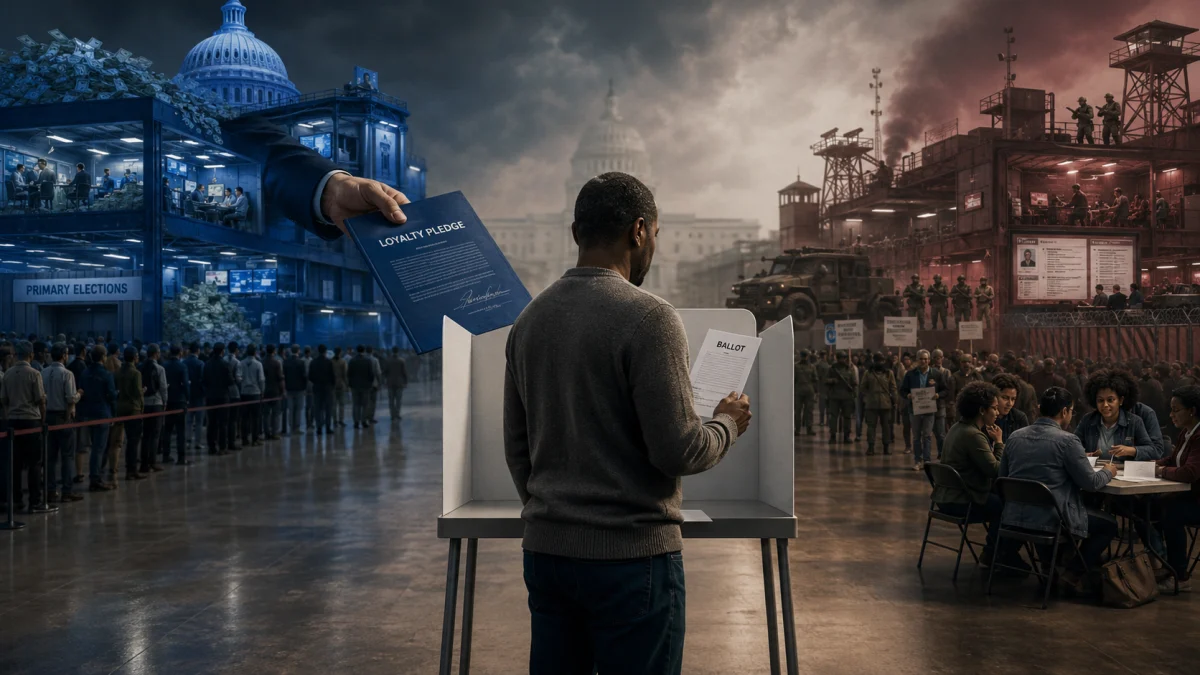
“Vote blue no matter who” starts with a reasonable point.
It ends with a much more dangerous one.
The reasonable point is simple: sometimes two candidates really are not equally bad. One may threaten rights, institutions or vulnerable people more than the other. In a U.S. election system where third-party candidates rarely win, voting for the less harmful major-party candidate can be a rational choice.
The dangerous point comes next:
Because one candidate is worse, you must support the Democrat. No matter who.
Those are not the same argument.
A person can decide that a Democrat is the better choice in one election without promising the Democratic Party their vote forever.
A strategic vote is not an unconditional vote.
A vote is not a loyalty oath.
And no political party should be able to turn fear of the other party into permanent immunity from accountability.
The Slogan Starts With a Real Point
It is important to admit where the “blue no matter who” argument is strongest.
The United States mostly uses winner-take-all elections. Political scientists have understood for a long time that this system pushes voters toward two major parties. Voting for a smaller party can sometimes help the major candidate a voter likes least by taking support away from the stronger alternative.
That is not imaginary. Strategic voting and spoiler effects are real features of plurality elections.
So if someone says:
“I dislike both candidates, but I think one would cause much more harm, so I am voting for the other one.”
That can be completely logical.
The problem begins when that decision gets turned into a rule:
“Because the Republican is worse, the Democrat is automatically entitled to your vote.”
That does not follow.
Three different questions are being mixed together:
- Is Candidate A worse than Candidate B?
- Should I sometimes vote strategically because of the election system?
- Does that mean Party B deserves my vote no matter whom it nominates or what it does?
You can answer yes to the first two questions and still answer no to the third.
That distinction matters.
“Different” does not mean “entitled to my vote.”
“People Will Get Hurt” Does Not End the Argument
The most powerful defense of unconditional Democratic voting is not really about party loyalty. It is about harm.
People say that reproductive rights are at stake. Immigrant families are at stake. LGBT protections are at stake. Healthcare is at stake. Democracy itself may be at stake.
Those concerns should not be mocked.
Political decisions can hurt real people.
But there is a strange jump in responsibility that often happens next.
If the Democratic Party loses, ordinary voters are asked:
Why didn’t you stop this?
Far less attention may be given to another question:
Why didn’t the party persuade enough people to vote for it?
A candidate controls a campaign, a platform, advisers, messaging and many policy choices.
A political party controls huge fundraising networks, campaign infrastructure, primary rules, candidate support and national strategy.
A normal voter controls one ballot.
Yet after an election loss, the voter can somehow become the person who is blamed for failing the institution.
That relationship is backwards if taken too far.
Parties are supposed to earn votes too.
Calling Dissatisfied Nonvoters “Privileged” Does Not Fit the Data
One common argument says that refusing to vote for the lesser evil is a form of privilege.
The idea is that only comfortable people can afford to sit out an election because they will not personally suffer from the result.
That may describe some individuals.
It does not describe American nonvoters as a group very well.
Pew Research Center’s study of validated voters and nonvoters in the 2024 election found that nonvoters were younger, had lower family incomes, were less likely to be White and were less likely to have gone to college than people who voted.
Almost half of 2024 nonvoters had no education beyond high school. Among voters, that figure was 28%.
This does not prove that every person who stays home is making a principled political protest.
People miss elections for many reasons.
Some do not care. Some face barriers. Some dislike the candidates. Some think politics does not matter. Some simply fail to vote.
But the data make one thing clear:
You cannot safely assume that people who do not vote are simply rich, comfortable people who have nothing to lose.
Many nonvoters are exactly the kinds of people political campaigns say they are fighting for.
Calling them privileged may feel morally satisfying.
It does not explain why they are not voting.
And if your goal is to win elections, understanding them matters more than insulting them.
The Civil Rights Movement Was Not Built on Passive Loyalty
The civil rights movement is sometimes used to defend slow political change.
The story goes something like this:
Civil-rights activists understood that progress takes time. They accepted small victories. Therefore, voters today should support the better major party even when progress feels painfully slow.
There is a piece of truth inside that argument.
Civil-rights leaders did pursue legislation. They registered voters. They worked within the political system. Major victories came through laws, elections and court decisions.
But that is only half the history.
They also organized boycotts.
They held sit-ins.
They marched.
They deliberately disrupted normal life.
They challenged politicians in their own coalition.
They put institutions under pressure.
Martin Luther King Jr.’s Letter from Birmingham Jail defended direct action because negotiation had failed. The point of direct action was to create pressure strong enough that people in power could no longer comfortably ignore the issue.
King later published Why We Can’t Wait, explicitly pushing back against the idea that Black Americans should quietly accept gradual progress on somebody else’s timeline.
That history does not teach us that elections are useless.
It teaches almost the opposite:
Political participation works alongside political pressure.
Voting was one form of power.
Boycotts were another.
Protests were another.
Organizing was another.
The lesson was not, “Support the friendlier powerful people no matter what.”
The lesson was that power usually moves when people give it a reason to move.
A Close Election Can Have Many “Causes”
Another common argument appears after Democrats lose a close election:
“If these progressives had just voted properly, Democrats would have won.”
Sometimes the math behind that statement is technically true.
The conclusion usually is not.
Imagine an election decided by 10,000 votes.
You find 20,000 progressive voters who stayed home.
You can say:
“If those progressives had voted for our candidate, we would have won.”
True.
But perhaps 50,000 previous Democratic voters switched parties.
If they had stayed, the candidate also would have won.
Perhaps turnout fell among young voters.
If more had voted, the candidate might have won.
Perhaps suburban voters moved right.
Perhaps Black turnout dropped.
Perhaps Latino voters shifted.
Perhaps the campaign wasted money.
Perhaps the candidate performed badly.
Perhaps the party chose the wrong message.
In a close election, many different things can be mathematically necessary to the final outcome at the same time.
Choosing one disliked group and assigning it all the moral blame is not the same as explaining why the election was lost.
Consider 2016.
Research using validated voter records found that about 11.8% of Bernie Sanders primary voters later voted for Donald Trump. That happened and should not be hidden.
But about 76.6% voted for Hillary Clinton.
Another major voter study found that about 9.2% of people who voted for Barack Obama in 2012 voted for Trump in 2016.
Those are different groups, so the percentages should not be treated as directly comparable estimates.
The larger lesson is simpler.
Major elections involve millions of people making different choices for different reasons.
“Progressives did it” is not an analysis.
It is a decision about whom to blame.
Primaries Matter if Voters Are Told to “Fight It Out in the Primary”
There is a common compromise offered to unhappy Democratic voters:
Fight for whoever you want during the primary.
Then, when the primary is over, support the winner.
That system can make sense.
But there is an obvious condition:
The primary has to matter.
Party institutions cannot tell voters that the primary is the proper place to challenge establishment candidates while also treating meaningful primary competition as a threat.
The 2016 Democratic primary remains a useful example because both sides often overstate what happened.
Leaked Democratic National Committee emails showed party officials discussing Bernie Sanders in ways that contradicted the organization’s public promise of neutrality. The controversy helped force DNC Chair Debbie Wasserman Schultz to resign.
That is documented.
What those emails do not prove is that millions of primary votes were secretly changed or that Sanders definitely would have won without DNC favoritism.
There is no need to claim that.
The narrower fact is serious enough:
An organization that promised neutrality showed evidence of internal favoritism.
The problem did not disappear after 2016.
In Florida in 2024, there was no Democratic presidential preference primary because the Florida Democratic Party submitted only Joe Biden’s name for the ballot. The Florida Department of State explicitly documented the reason.
Again, that was not secret ballot fraud.
It was party power.
And that distinction matters.
If voters are told that their proper time to demand something different is during the primary, then meaningful competition inside the primary cannot be treated as an inconvenience.
A Blue Label Does Not Erase What Government Actually Does
This is where the argument often becomes sloppy.
Critics of Democrats sometimes say:
“The two parties are exactly the same.”
They are not.
There are major differences on abortion, taxation, judges, environmental regulation, labor law, LGBT policy, voting rules and many other issues.
But the opposite mistake is just as bad:
A Democratic administration does not automatically produce progressive policy.
Party labels tell us something.
They do not tell us everything.
Immigration
Barack Obama was a Democratic president.
His administration still deported enormous numbers of people.
Pew Research Center, using Department of Homeland Security figures, counted about 2.4 million deportations from fiscal years 2009 through 2014.
Under Joe Biden, ICE reported 271,484 removals in fiscal year 2024.
There were important differences between Obama, Trump and Biden immigration policies. Enforcement priorities changed. Asylum policy changed. Humanitarian programs changed. Treatment of some undocumented groups changed.
Those differences matter.
But so does the basic fact:
Electing a Democrat has never meant deportation disappears.
That is why policy should be judged by what the government actually does, not only by the letter beside the president’s name.
Defense and Surveillance
The same pattern appears in national security.
The fiscal year 2026 National Defense Authorization Act passed the House in December 2025 by 312–112. That included 115 Democratic yes votes and 197 Republican yes votes. The Senate later approved the measure 77–20, and it became law.
That is not a theory about a secret “uniparty.”
It is a public voting record showing broad bipartisan support for a major defense bill.
Surveillance offers another example.
In 2024, the House passed legislation reauthorizing Section 702 of the Foreign Intelligence Surveillance Act by 273–147. The yes votes included 147 Democrats and 126 Republicans. The Senate passed the legislation 60–34.
Again, the parties were not identical.
Members of both parties also fought against parts of the surveillance system.
But major parts of the national-security state have clearly maintained bipartisan support.
A voter can care about that even if one party is better on other issues.
Foreign Policy
Foreign policy can show the same kind of continuity.
During the Gaza war, the Biden administration continued major military support for Israel.
In December 2023, the administration invoked emergency authority twice to move specific arms sales to Israel without the ordinary period of congressional review: one involving tank ammunition and another involving artillery components. The Congressional Research Service documents both actions.
A voter who strongly opposed those policies did not become unreasonable simply because the president carrying them out was a Democrat.
That is what accountability means.
A party does not get to say:
“You must judge Republicans by what they do, but judge us by what Republicans might have done instead.”
Both questions can matter.
Money Matters Because Leverage Matters
This may be the most important part of the whole argument.
Critics often tell dissatisfied voters:
“You have to be realistic. Change takes time.”
Sometimes that is true.
American government has many barriers to fast change. Congress is divided. Courts matter. Senate rules matter. States have power. Public opinion matters. Even a president cannot simply order every desired policy into existence.
But another force matters too:
money.
The scale is enormous.
The Federal Election Commission reported that during the 2023–2024 election cycle, federal party committees took in about $2.7 billion. PACs reported roughly $15.7 billion in receipts.
Money existing in politics does not automatically prove corruption.
A donation is not proof of a bribe.
But researchers have spent years asking a harder question:
Whose preferences receive the most attention once politicians are in office?
One famous study by Martin Gilens and Benjamin Page examined 1,779 policy issues. It found much stronger independent relationships between policy outcomes and the preferences of economic elites and business interest groups than between outcomes and the preferences of average citizens.
That finding has been challenged. Political scientist Omar Bashir argued that the original model understated the influence of middle-income Americans and that some sweeping claims about American “oligarchy” went beyond what the evidence could firmly prove.
That disagreement matters.
But it does not make the broader money question disappear.
Other research has found that U.S. senators respond in measurable ways to their parties’ national donor classes even after researchers account for the views of constituents and other political factors.
So we should avoid two bad extremes.
The first is:
“Donors secretly control everything.”
That is too simple.
The second is:
“Money doesn’t matter because voters still get ballots.”
That is also too simple.
Money buys access, organization, advertising, staff, research, lobbying and the ability to keep applying pressure long after Election Day.
Which raises an uncomfortable question.
If a wealthy donor can say:
“Change this policy or I stop writing checks,”
why is an ordinary voter told:
“Threatening to withhold your vote is selfish and irresponsible”?
Both are forms of political leverage.
One is simply much more expensive.
Incremental Change Is Not the Problem
This is where critics of “blue no matter who” sometimes weaken their own case.
They say:
“Incremental change never works.”
That is not true.
Major reforms often happen in steps.
Social Security expanded over time.
Civil-rights protections developed through many laws, court rulings and political fights.
Medicare changed.
Labor protections changed.
Environmental rules changed.
Incremental progress is normal in a large democracy.
The real problem is different.
There are two kinds of incrementalism.
The first says:
“We won part of what we wanted. Now we organize for the next part.”
The second says:
“We won part of what we wanted. Stop demanding more, because the other party might win.”
Those are not the same thing.
The first uses compromise as a step.
The second can turn compromise into a ceiling.
Incremental change only keeps moving if somebody pushes for the next increment.
That requires leverage.
And political science gives us at least some reason to believe electoral pressure matters. Research has found that elected officials in more competitive districts can be more responsive to what their constituents want.
Politicians are supposed to worry about losing votes.
That fear is not a flaw in democracy.
It is part of how democracy is supposed to work.
“But What if Trump Really Is Worse?”
Then vote based on that judgment.
That still does not answer the larger question.
Suppose a voter concludes:
- Donald Trump would cause more harm than the Democratic nominee.
- The Democratic nominee is therefore the better strategic choice.
- The Democratic Party is still failing badly on issues that matter to that voter.
There is no contradiction there.
That voter can support the Democrat in November and protest the Democrat in December.
They can vote strategically and still support a primary challenger later.
They can believe the Republican is worse and still demand that Democrats stop deporting certain immigrants, change foreign policy, reduce surveillance, reject donor influence or deliver stronger economic reforms.
They can even decide that a future Democratic candidate has crossed a line they will no longer accept.
The slogan becomes a problem when it tries to erase that final possibility.
Because once a party knows the answer will always be:
“I will vote for you because the other side is worse,”
the voter’s leverage becomes weaker.
This does not mean politicians will instantly stop caring about that voter.
Coalitions are complicated.
But the basic incentive problem is real.
A threat that everyone knows you will never carry out is not much of a threat.
When Every Election Is Too Important for Accountability
There will always be an argument that the next election is uniquely dangerous.
Sometimes it will even be true.
But think about what happens when the same message lasts for decades:
Not this election.
This one is too important.
Not the next election either.
That Republican is even worse.
And definitely not the election after that.
Democracy itself is on the line.
Eventually, a temporary emergency rule becomes a permanent political relationship.
Voters are told they can demand major change someday.
Just never now.
That creates a very simple question:
If voters may only use their leverage during an election that is not important, when exactly is that election supposed to happen?
Every election has consequences.
That is precisely why parties should take the people whose votes they need seriously.
Political Loyalty Can Hide Bad Behavior
There is a deeper problem here that goes far beyond Democrats.
Humans are tribal.
Once politics becomes part of identity, people start judging their own side differently from the other side.
Research on polarization has found that partisan loyalty can weaken the public’s willingness to punish behavior that threatens democratic rules, although other research also shows voters are not completely blind to misconduct by their own side.
That should worry Republicans.
It should worry Democrats.
It should worry everyone.
If your standard becomes:
“My side must win,”
then almost anything your side does can eventually be explained as necessary to stop the enemy.
That is how political standards collapse.
The solution is not to stop caring who wins.
It is to refuse to make winning the only standard.
Losing Voters Is Information
When a restaurant loses customers, the owner does not get to order them back.
When a company loses users, it has to figure out why.
Political parties are different because elections affect everyone, including people who do not participate.
But one basic rule still applies:
Losing support is information.
If millions of people who once voted for a party stop doing so, the first question should not automatically be:
“What is wrong with these people?”
It should also be:
“Why did we lose them?”
Did their economic conditions improve?
Did they trust the candidate?
Did they believe the party’s promises?
Did they dislike its foreign policy?
Did they believe donors had more influence than voters?
Did they think the primary was fair?
Did they feel heard?
Were they misinformed?
Were they persuaded by the opposition?
Were they simply disengaged?
Those are political questions.
“Shut up and vote blue” is not an answer to them.
It is an attempt to avoid them.
The Real Question Is: Who Is Accountable to Whom?
None of this means people should never vote Democrat.
It does not mean people should always vote third party.
It does not mean Republicans and Democrats are identical.
It does not mean voting is pointless.
And it does not mean refusing to vote automatically creates political leverage. A party can simply replace lost voters with different ones. Strategic pressure only works when it is organized, understood and tied to clear demands.
The argument is simpler.
No party owns your vote.
A voter may choose harm reduction.
A voter may compromise.
A voter may decide that one candidate is clearly better than the other.
But none of those choices require unconditional loyalty.
There is a difference between saying:
“You earned my vote this time.”
and saying:
“You will have my vote no matter what you do.”
The first is democracy.
The second starts to look a lot more like fandom.
Political parties should want your vote.
They should work for your vote.
They should worry about losing your vote.
And when they do lose it, they should have to ask why.
Because the moment a party no longer has to earn the support of its own coalition, accountability starts flowing in the wrong direction.
The voters become responsible for protecting the party.
The party stops being responsible for satisfying the voters.
That is the real problem with “vote blue no matter who.”
The mistake is not voting for the lesser evil.
Sometimes that may be the most rational choice available.
The mistake is turning a tactical choice made under bad circumstances into a permanent moral duty.
A strategic vote is not a surrender of your standards.
Harm reduction is not a loyalty oath.
And democracy works better when politicians remember that your vote still has to be earned.
References and Further Reading
Elections, Voters and Strategic Voting
Pew Research Center — Voter Turnout in the 2020 and 2024 Elections: A Detailed Analysis — Validated-voter research comparing people who voted with people who did not. Especially useful for age, income, race and education differences among 2024 nonvoters.
American Political Science Review — The Two-Party System and Duverger’s Law — Classic political-science discussion of why plurality electoral systems tend to produce two major parties and encourage strategic voting.
Political Science Research and Methods — Strategic Voting in Plurality Elections — Research examining how candidate viability and plurality rules can encourage voters to abandon less competitive choices.
Brian Schaffner — How Sanders Supporters Behaved in the 2016 General Election — Analysis using validated primary and general-election participation to estimate how Bernie Sanders primary voters voted in November 2016.
Voter Study Group — Race, Religion, and Immigration in 2016 — Longitudinal voter research documenting movement between the 2012 and 2016 presidential coalitions, including Obama-to-Trump voters.
Civil Rights, Pressure and Incremental Change
The Martin Luther King, Jr. Research and Education Institute — Letter from Birmingham Jail — King’s defense of direct action and political pressure when ordinary negotiation repeatedly failed.
The Martin Luther King, Jr. Research and Education Institute — Why We Can’t Wait — Historical context for King’s rejection of demands that the civil-rights movement accept an indefinitely gradual timetable.
Democratic Primaries and Party Institutions
Associated Press via PBS — Debbie Wasserman Schultz to Step Down After DNC Email Controversy — Contemporary reporting on leaked DNC emails suggesting favoritism toward Hillary Clinton despite the committee’s stated neutrality during the 2016 primary.
Florida Department of State — 2024 Presidential Election Year Information — Primary state source explaining that no Democratic presidential preference primary was held in Florida in 2024 because the state Democratic Party submitted only Joe Biden’s name.
Immigration, Defense, Surveillance and Foreign Policy
Pew Research Center — U.S. Immigrant Deportations Declined in 2014 but Remained Near Record Highs — Analysis of Department of Homeland Security data on deportations during the Obama administration.
U.S. Immigration and Customs Enforcement — Fiscal Year 2024 Annual Report — Primary federal source reporting ICE enforcement activity, including 271,484 removals during FY2024.
U.S. House of Representatives Clerk — Roll Call Vote on the FY2026 National Defense Authorization Act — Official House vote showing substantial Democratic and Republican support for the defense bill.
Congress.gov — National Defense Authorization Act for Fiscal Year 2026 Legislative History — Official congressional record documenting House and Senate passage and enactment of the FY2026 NDAA.
U.S. House of Representatives Clerk — 2024 FISA Reauthorization Roll Call Vote — Official House record documenting the bipartisan vote on reauthorization legislation affecting Section 702 surveillance.
U.S. Senate — 2024 FISA Reauthorization Vote — Official Senate vote on the same surveillance legislation.
Congressional Research Service — U.S. Foreign Aid to Israel: Overview and Developments Since October 7, 2023 — Nonpartisan congressional research documenting U.S. military support to Israel and the Biden administration’s December 2023 emergency arms-sale determinations.
Money, Donors and Political Accountability
Federal Election Commission — Statistical Summary of 2023–2024 Federal Campaign Activity — Primary federal campaign-finance data showing the scale of money flowing through presidential campaigns, congressional races, party committees and PACs.
Perspectives on Politics — Testing Theories of American Politics: Elites, Interest Groups, and Average Citizens — Martin Gilens and Benjamin Page’s influential analysis of 1,779 policy outcomes and the relationship between public preferences, elite preferences and organized interests.
Research & Politics — Testing Inferences About American Politics: A Review of the “Oligarchy” Result — Omar Bashir’s important methodological criticism of stronger interpretations of the Gilens-Page findings.
Congress & the Presidency — Does Money Buy Congressional Love? Individual Donors and Legislative Voting — Research examining relationships between senators’ voting behavior, constituents and national donor classes.
The Journal of Politics — Electoral Competition and Democratic Responsiveness — Research finding greater responsiveness to constituent preferences among representatives facing stronger electoral competition.
Yale Institution for Social and Policy Studies — Partisanship, Polarization, and Support for Democracy — Research on how strong partisan and ideological commitments can weaken voters’ willingness to punish threats to democratic norms.
Editorial currency note: Election procedures, immigration enforcement, surveillance law, defense policy, campaign-finance totals and other government policies can change. Political and policy facts in this article were checked against the cited records available through August 20, 2026. Historical examples are identified by year so they are not confused with current policy.