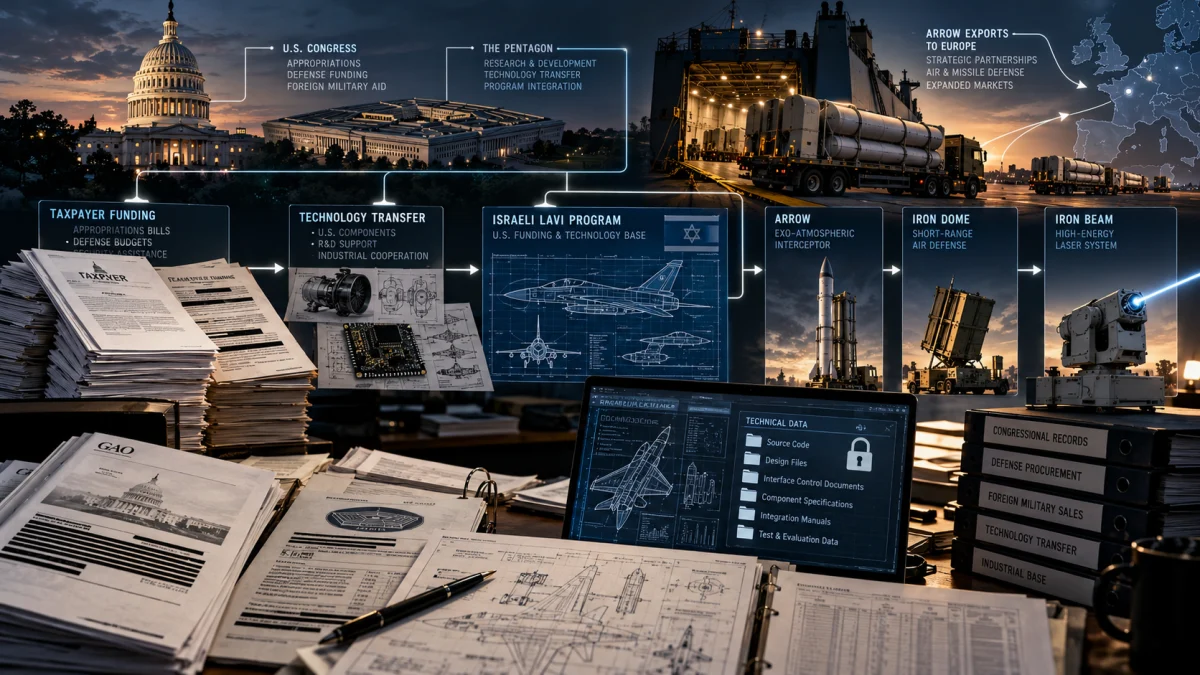
The United States did considerably more than buy weapons for Israel. American taxpayers helped finance Israel’s domestic defense-industrial capacity, supplied technology and components, paid large portions of major development programs, and funded joint weapons that were later promoted internationally as Israeli technological achievements.
The Congressional Research Service’s detailed review of U.S. aid to Israel states this unusually plainly: U.S. military assistance helped Israel build its domestic defense industry, which has since become one of the world’s major arms exporters. CRS says Israel Aerospace Industries, Rafael and Elbit export nearly 70% of their products.
That does not mean every Israeli weapon is actually an American invention. Iron Dome, for example, really was originally developed in Israel. Modern Iron Beam also cannot responsibly be described as an old American laser simply repackaged under an Israeli name.
But those facts do not make the larger history symmetrical.
Government records show a recurring pattern in which American money assumed a substantial part of the financial risk, American technology entered the development chain, and Israeli contractors accumulated the resulting expertise and industrial capacity. In some cases, U.S. officials later encountered disputes over technology provenance, oversight or access to technical information.
The Lavi fighter is one of the clearest examples. More than 90% of the spending during the period examined by the U.S. Government Accountability Office came from American assistance. Israel Aerospace Industries later said Lavi technology became a foundation for many of its subsequent technologies.
Then some of that technological lineage appeared in Arrow, another program whose early contracts were overwhelmingly financed by the United States.
GAO subsequently found that Arrow technology presented as Israeli background technology included U.S. parts and technology derived from the U.S.-funded Lavi.
Today, Arrow 3 is officially described by Israel’s own Defense Ministry as jointly developed and produced with the U.S. Missile Defense Agency. Yet when Israel delivered Arrow 3 to Germany as part of what has become a roughly $6.7 billion export program, the same ministry described it as "Israeli technology at its best."
Both descriptions can technically be true.
But they tell very different histories.
"Israeli Technology" Often Starts the Story Too Late
There are at least five separate questions buried inside the phrase Israeli military technology:
Who conceived the system? Who supplied important underlying technology? Who paid to develop it? Who engineered the finished weapon? And who eventually controlled, manufactured and exported it?
Those answers are not always the same country.
A weapon can be engineered principally by an Israeli contractor while American taxpayers finance much of its development.
A system can be genuinely Israeli-origin while subsequent American funding pays for enormous production expansion.
A weapon can be jointly developed by U.S. and Israeli agencies but sold internationally under an Israeli national identity.
And paying for development does not necessarily mean the United States automatically receives every source-code, intellectual-property or technical-data right associated with the resulting product.
That is why simply counting the nationality of the prime contractor can produce an incomplete picture.
The more useful question is provenance.
And on provenance, the public record is unusually revealing.
The United States Did Not Just Buy Weapons for Israel. It Helped Finance Israel’s Defense Industry
For decades, Israel received an exception unavailable in ordinary Foreign Military Financing arrangements.
Normally, U.S. military aid provided through Foreign Military Financing is spent on American products. Israel, however, was permitted to spend part of its American military assistance inside Israel on Israeli-manufactured equipment, a privilege known as Off-Shore Procurement, or OSP.
Under the 2009-2018 aid arrangement, as much as 26.3% of U.S. military assistance could be spent on Israeli-manufactured equipment. The current 2019-2028 arrangement phases the privilege out, reaching zero by FY2028. The CRS aid report shows the phaseout and the broader role of U.S. military financing in Israel’s defense sector.
The history is even more revealing.
A 1991 GAO investigation of U.S. military aid spent inside Israel found that the offshore procurement program was established in fiscal year 1984 specifically to finance development of Israel’s Lavi fighter aircraft. Congress earmarked almost $2.8 billion for Israeli offshore procurement between FY1984 and FY1991.
GAO became sufficiently concerned about how broadly the program was being used that it questioned whether some of the arrangement had become closer to economic support than conventional military procurement.
This was not something Israel secretly imposed on Washington. Congress and successive U.S. administrations authorized the arrangement.
But its effect matters.
American military assistance did not merely increase what Israel could buy. It allowed U.S. grant money to support Israeli research, development, manufacturing and industrial capacity.
That is the structural background for the individual weapons programs.
Lavi: The Israeli Fighter That Was More Than 90% U.S.-Financed
The Lavi is usually remembered as Israel’s ambitious attempt to build an indigenous advanced fighter during the 1980s.
That description is incomplete.
In its 1987 examination of the Lavi program, GAO reported that the aircraft had been financed predominantly by U.S. assistance funds.
For the expenditures tabulated from 1980 through 1986, GAO reported approximately:
| Funding source | Lavi expenditures |
|---|---|
| United States | $1.330 billion |
| Israel | $132.5 million |
| Total | $1.4625 billion |
That means roughly 91% of the spending in GAO’s table came from the United States.
American industry also participated heavily. GAO identified hundreds of millions of dollars in Lavi contracts and purchase orders to U.S. companies, including Grumman, Pratt & Whitney and Lear Siegler.
So this was not simply $1.3 billion deposited into Israeli companies. American contractors received substantial work as well.
But the technological accumulation did not disappear when Israel cancelled the Lavi in 1987.
Years later, Israel Aerospace Industries itself described what happened next.
In its 2017 sustainability report, IAI wrote that "the legacy of the LAVI laid the foundation for many of IAI’s current technologies." The company said a Lavi technology demonstrator continued flying for another 162 flights while IAI shifted toward aircraft modernization, UAVs, mission aircraft, electronics and phased-array radar.
That produces an important distinction.
The United States did not simply finance an airplane that was subsequently cancelled.
It overwhelmingly financed a major advanced-aircraft development program whose Israeli prime contractor says left behind technological capabilities that became a foundation for later work.
And then the paper trail leads directly into Arrow.
Arrow: Where U.S.-Funded Lavi Technology Reappeared
The early Arrow missile-defense program provides some of the strongest evidence in the record.
A 1993 GAO investigation of the U.S.-Israel Arrow/ACES program examined contracts worth a combined $487.6 million.
The funding looked like this:
| Funding source | Arrow/ACES funding |
|---|---|
| Direct U.S. funding | $363.6 million |
| U.S. Foreign Military Financing grants | $97.9 million |
| Direct Israeli funding | $26.1 million |
| Total | $487.6 million |
In other words, $461.5 million of the $487.6 million, about 94.6%, came from U.S. funding sources in the Arrow and ACES contracts examined by GAO.
Direct Israeli funding was approximately 5.4%.
This does not mean the United States has paid 94.6% of every Arrow version over the program’s entire history.
The balance changed substantially as the system matured. The current CRS accounting says the United States has funded just under half of annual Arrow development costs over the longer term, with cumulative U.S. contributions to the Arrow family exceeding $4.7 billion through FY2025.
But during the formative Arrow/ACES contracts investigated by GAO, the American financial role was overwhelming.
And money was not the only American contribution.
GAO Challenged Claims That Arrow’s Background Technology Was Indigenous
The most striking part of the 1993 GAO report is not the funding table.
It is what auditors discovered when they tried to determine where Arrow’s underlying technology came from.
Israel Aerospace Industries provided lists of technologies it claimed as existing "background" technology rather than technology newly supplied or financed through the joint program.
According to GAO’s Arrow investigation, an Israeli Defense Ministry official initially characterized IAI’s claimed background technology as Israeli-origin, then revised that characterization to "mostly indigenous."
GAO found that certain items being claimed as Israeli background technology contained U.S. parts, and that some might contain U.S. technology controlled under other licensing arrangements.
Then GAO gave a concrete example:
Israeli officials acknowledged that Arrow’s central data computer was based on technology from the U.S.-funded Lavi fighter.
The technological genealogy therefore looks like this:
U.S. taxpayers finance more than 90% of the Lavi spending reviewed by GAO → Lavi leaves behind technology and expertise → Israeli officials acknowledge that Lavi-derived technology forms the basis of Arrow’s central computer → Arrow background technology is presented to U.S. investigators as indigenous or mostly indigenous.
That is not speculation.
It is contained in U.S. government audit records.
GAO also concluded at the time that U.S. oversight of technology and funds supplied to Arrow was inadequate and that American officials lacked comprehensive knowledge of some U.S.-origin technology incorporated into the program.
That does not make every later Arrow component American property.
It does show that the line between "Israeli technology" and American-funded or American-origin technology was already difficult enough that U.S. auditors challenged the attribution.
Arrow Is Now a $6.7 Billion Israeli Export
Move the clock forward three decades.
Arrow 3 is now part of the largest defense-export agreement in Israel’s history.
The ministry is also explicit about the system’s provenance:
Arrow 3 is jointly developed and produced by Israel’s Directorate of Defense Research and Development and the U.S. Missile Defense Agency.
The current production network includes American participation as well. IAI is the prime developer, and its U.S. subsidiary STARK Aerospace participates in production.
Yet national branding tells a much simpler story.
During the December 2025 delivery ceremony in Germany, the Israeli Ministry of Defense described Arrow 3 as jointly developed and produced with the U.S. Missile Defense Agency while also quoting the system as "Israeli technology at its best."
That juxtaposition is revealing.
Calling Arrow Israeli technology is not literally false. Israeli scientists, engineers, defense officials and companies have spent decades developing, manufacturing, testing and operating it.
But that national label removes a great deal of history:
- its origins in U.S.-Israeli Strategic Defense Initiative cooperation;
- the exceptionally large American share of the early Arrow/ACES contracts;
- Lavi-derived technology financed overwhelmingly by the United States;
- decades of U.S. Missile Defense Agency participation;
- more than $4.7 billion in cumulative American Arrow funding through FY2025;
- and continuing U.S. co-production.
Calling the finished export simply "Israeli technology" therefore tells readers who is leading and selling the present system. It does not tell them who financed and technologically enabled important parts of the path that produced it.
The China Technology-Transfer Concern Was Real and Consequential
This history intersects with another longstanding U.S. concern: whether American-origin or American-financed military technology provided to Israel could subsequently reach third countries.
The public evidence here needs careful wording because intelligence assessments are not judicial findings.
But the concern was specific enough to influence U.S. policy.
A declassified Defense Intelligence Agency assessment on China-Israel relations described Israeli transfers of weapons, equipment and technology to China and assessed that Israeli assistance contributed to Chinese military development.
Most importantly for this story, U.S. intelligence reporting associated Israeli assistance with a Chinese fighter program based in part on Lavi technology.
That allegation becomes significant once the Lavi funding history is restored.
The Lavi was not a purely Israeli-funded research project whose technology Washington merely disliked seeing transferred elsewhere. American assistance had paid more than 90% of the spending reviewed by GAO.
Historical Congressional Research Service reporting on U.S.-Israel relations also documents serious disputes over Israeli military sales to China, including the Phalcon airborne early-warning system and Harpy unmanned weapons.
Israeli and Chinese officials disputed important allegations concerning the transfer of Lavi-related American technology.
That disagreement should be included.
So should what happened next.
Washington Restricted Defense Cooperation Over Israeli Transfers to China
The dispute became serious enough to affect U.S.-Israel defense cooperation.
U.S. pressure led Israel to cancel the planned Phalcon sale to China in 2000.
A later dispute over Israel’s proposed servicing or upgrading of Harpy systems sold to China produced another major confrontation. CRS reported that the Pentagon restricted aspects of cooperation with Israel, including F-35-related technological cooperation, while Washington pushed for tighter Israeli export controls.
The two governments ultimately established new technology-security arrangements, and Israeli military exports to China later fell sharply.
So it would be wrong to imply that Israel is presently transferring U.S.-origin missile-defense technology to China on the scale feared during the earlier period.
But it would also be wrong to describe the historical concern as hypothetical.
U.S. intelligence agencies raised it. Congress investigated it. The Pentagon changed cooperation over it. Israel subsequently tightened its defense-export controls.
Iron Dome Is Different: It Really Was an Israeli-Origin System
Iron Dome is an important test of the broader argument because the evidence points in a different direction.
Unlike Arrow, Iron Dome was originally developed by Israel.
The CRS aid report identifies Rafael Advanced Defense Systems as the developer and states that because Israel developed Iron Dome alone, Israel initially retained the proprietary technology rights.
That deserves to be stated plainly.
Then the financing relationship changed dramatically.
According to CRS, the United States had provided more than $6 billion for Iron Dome batteries, interceptors, co-production costs and maintenance through the period covered by the report.
Congress also pushed for American production and access to the technology.
In 2014, the two governments signed a co-production agreement that CRS says gave the U.S. Missile Defense Agency full access to what had previously been proprietary Iron Dome technology. By 2023, the U.S. production workshare was approximately 30%.
One might reasonably assume that billions of dollars in support plus a formal technology-access agreement meant the U.S. military could thereafter integrate Iron Dome however it wished.
The Army’s own records show that the reality was more complicated.
After Billions in U.S. Support, the Army Still Hit a Source-Code Problem
When the U.S. Army evaluated incorporating Iron Dome components into its Integrated Air and Missile Defense Battle Command System, or IBCS, it needed detailed technical data.
The Army’s explanation is preserved in a 2020 House Armed Services Committee hearing record.
During one integration effort, the Army reported that Raytheon/Rafael was unable to provide the necessary source code and high-fidelity models and simulations needed to continue the effort in April 2019.
The Israeli Missile Defense Organization subsequently transmitted technical information to the Army in October 2019.
But the Army said the package still did not contain mission-command and interceptor component-level source code, algorithms or mathematical models necessary to break Iron Dome into components and integrate its launcher and interceptor into the Army’s IBCS architecture.
Army specialists also concluded that some component-level models they wanted apparently were not then possessed by the Israeli organization itself, while Iron Dome’s tightly coupled architecture created additional integration problems.
That distinction matters.
This record does not establish that Israel permanently prohibited the United States from using Iron Dome.
It does establish something narrower and still significant:
After billions of dollars in American support, co-production and a formal technology-access agreement, a U.S. Army integration program reached a point where the Army did not have the source code, algorithms and technical models it said it needed for the integration it wanted to perform.
American financial participation and American practical technical control were not the same thing.
David’s Sling Shows How a Joint Weapon Acquires a National Identity
David’s Sling presents another version of the provenance problem.
There is little ambiguity over its formal status.
The United States and Israel signed a project agreement to co-develop David’s Sling, and the system was developed jointly by Rafael and RTX/Raytheon. The CRS report says the United States had contributed more than $3.8 billion to David’s Sling development since FY2006. A 2018 agreement established joint production of the Stunner interceptor, with some components manufactured in Arizona.
When Finland moved to buy David’s Sling, the Israeli Ministry of Defense described it as an Israeli weapon system.
But the same announcement explains that:
- the United States had to approve the transaction;
- the system was co-developed and co-produced with the U.S. Missile Defense Agency;
- Finland would receive Israeli-U.S. co-produced interceptors;
- and the Finnish version would be jointly developed by American and Israeli industries led by Rafael and Raytheon.
There is nothing inherently improper about Israel being the seller or describing a system fielded by its military as Israeli.
The point is that national branding is a poor substitute for a development ledger.
David’s Sling is not simply an Israeli weapon that happened to receive a little American help.
It is a genuinely joint system into which the United States has invested billions of dollars.
THEL and Iron Beam: A Real American Lineage, but Not the Same Weapon
Iron Beam is where criticism can easily outrun the evidence.
The United States and Israel unquestionably had a major directed-energy partnership decades before modern Iron Beam.
In 1995, the two countries began the Nautilus laser-defense program. A 1999 GAO review of U.S. laser-weapons programs described Nautilus as a joint U.S.-Israel effort and said the U.S. Army Space and Missile Defense Command provided its primary management functions.
The system was tested at White Sands Missile Range using American high-energy-laser infrastructure.
After Nautilus, U.S. contractor TRW received an $89 million contract to develop the Tactical High Energy Laser, or THEL, using a deuterium-fluoride chemical laser. GAO reported that Israel contributed $24.7 million toward that contract.
That establishes an important U.S.-Israeli directed-energy history.
But modern Iron Beam is not the same machine as THEL.
The old THEL system was a chemical laser.
Modern Iron Beam uses an electrically powered high-energy-laser architecture and much newer electro-optical technology. The Israeli Ministry of Defense identifies Israel’s DDR&D as leading the program, Rafael as the primary developer, and Elbit Systems as responsible for the laser source.
The United States has nevertheless returned to the financing chain in a major way.
The 2024 Israel security supplemental, as summarized by CRS, appropriated $1.2 billion specifically for Iron Beam.
So the supportable conclusion is not that America invented Iron Beam and Israel renamed it.
It is this:
Modern Iron Beam is an Israeli-led development built inside a much older U.S.-Israeli directed-energy ecosystem, and American taxpayers are now financing it on a very large scale as well.
Making a stronger allegation than the records support would only weaken the much stronger documentation elsewhere.
The U.S.-Israel Defense Technology Provenance Ledger
The historical pattern becomes clearer when the systems are compared by provenance rather than national branding.
| Program | Original development | Documented U.S. role | Control / provenance issue | Best-supported description |
|---|---|---|---|---|
| Lavi | Israeli fighter program led by IAI | More than 90% of expenditures in GAO’s 1980-86 accounting; major U.S. components and contractors | IAI says Lavi became a foundation for later company technologies | Israeli-designed program overwhelmingly financed by U.S. assistance during the period reviewed |
| Arrow / ACES | U.S.-Israel program emerging from SDI-era cooperation | 94.6% of early contract funding examined by GAO came from U.S. sources | GAO found supposedly indigenous background items containing U.S. parts; central computer based on U.S.-funded Lavi technology | Joint program with exceptionally deep early U.S. financial and technological roots |
| Arrow 2 / Arrow 3 | Continuing joint development | More than $4.7 billion cumulative U.S. contributions through FY2025; U.S. MDA co-development and co-production | Exported under strong Israeli national branding despite formal joint-development status | U.S.-Israeli co-developed system with IAI as prime |
| Iron Dome | Originally Israeli-developed by Rafael | More than $6 billion U.S. support; U.S. co-production and technology-access agreement | U.S. Army encountered missing source code and models during a 2019 integration effort | Israeli-origin system subsequently heavily U.S.-financed and co-produced |
| David’s Sling | Joint Rafael-Raytheon development | More than $3.8 billion U.S. contribution; U.S. co-production | Third-country sale required U.S. approval | Clearly joint U.S.-Israeli system |
| Nautilus / THEL | Joint U.S.-Israeli directed-energy effort | U.S. Army primary management; U.S. test infrastructure; TRW prime contractor | Important predecessor ecosystem, but technically different from modern Iron Beam | Joint historical laser-defense program |
| Iron Beam | Modern Israeli DDR&D/Rafael/Elbit development | $1.2 billion dedicated U.S. appropriation in 2024; newer U.S. industrial cooperation | Historical connection to joint laser work does not establish identity with THEL | Israeli-led modern system now receiving major U.S. financing |
The overall pattern is not that Israel contributed nothing.
It is that American participation is often much larger than the shorthand "Israeli technology" suggests.
The Commercial Result Matters Too
This is no longer simply a question of military aid.
Israel has built one of the world’s major defense-export industries.
CRS says IAI, Rafael and Elbit export nearly 70% of their products.
Arrow 3’s German program has grown to approximately $6.7 billion.
David’s Sling has been sold to Finland.
Iron Dome and Israeli-derived components are entering American procurement and co-production chains.
That makes the provenance question economically important.
The U.S. public financed not merely Israeli consumption of military hardware but, over decades, part of the research, engineering and manufacturing ecosystem from which an export-oriented industry emerged.
That does not mean every dollar of an Israeli weapons export is profit derived from American taxpayers. U.S. companies participate in several programs, and co-production sends substantial work back to American factories.
But neither is it accurate to treat American assistance as merely money spent on U.S.-made weapons that leaves Israel technologically unchanged.
The government’s own records describe a much deeper relationship.
Congress Is Considering a Deeper Technology-Cooperation Framework
This history is especially relevant because Congress is considering additional institutionalized U.S.-Israel defense-technology cooperation.
The House-passed FY2027 National Defense Authorization Act contains a proposed United States-Israel Defense Technology Cooperation Initiative.
The House text directs the Pentagon to designate an executive agent to synchronize bilateral defense technology research, development, testing, evaluation and industrial cooperation. It also calls for identifying jointly developed or Israeli-origin technologies with operational utility for potential incorporation into U.S. programs, facilitating procurement pathways, and establishing frameworks for joint ventures, licensing and U.S.-based co-production.
The Senate Armed Services Committee has proposed a parallel initiative. Its FY2027 NDAA executive summary describes an initiative to expand and accelerate bilateral defense technology research, development, testing, evaluation, coordination and industrial cooperation.
This is not a legal merger of the U.S. military and the Israel Defense Forces. It does not create a common military command.
It would, however, deepen and institutionalize defense-technology cooperation.
As of September 23, 2026, the FY2027 NDAA had not been enacted. The House passed H.R. 8800 on July 22. The Senate had not passed S. 4784; the latest public congressional action remained procedural consideration of the bill. The Congressional Research Service’s September 1 status report likewise showed no enacted FY2027 NDAA.
That makes the historical record directly relevant to the design of any new cooperation framework.
The practical questions are straightforward:
When U.S. taxpayers finance joint technology, what data rights does the Pentagon receive? Who owns background and newly developed intellectual property? What source-code rights exist? What information can be withheld from U.S. integrators? What controls prevent U.S.-origin technology from reaching third countries? What production rights does the United States retain? And how are industrial benefits distributed when jointly financed technology becomes a foreign sale?
Those questions are not hypothetical.
Versions of them already surfaced in Lavi, Arrow, Iron Dome and the technology-security disputes involving China.
What the Evidence Establishes
There is enough documentation to draw strong conclusions without pretending the record says more than it does.
Verified fact: U.S. military assistance helped build Israel’s domestic defense industry. The Congressional Research Service says so explicitly.
Verified fact: More than 90% of the Lavi expenditures reviewed by GAO were financed with U.S. assistance. IAI later said Lavi became a technological foundation for later company capabilities.
Verified fact: Approximately 94.6% of the early Arrow/ACES contract value reviewed by GAO came from direct U.S. funding or U.S. Foreign Military Financing grants.
Verified fact: GAO found that technology claimed as Israeli Arrow background included U.S. parts, and Israeli officials acknowledged that Arrow’s central data computer was based on technology from the U.S.-funded Lavi.
Verified fact: The United States had contributed more than $4.7 billion to the Arrow family, more than $6 billion to Iron Dome and more than $3.8 billion to David’s Sling through the periods covered by the current CRS accounting.
Verified fact: During a 2019 Iron Dome integration effort, the U.S. Army reported that it lacked source code, algorithms and mathematical models it considered necessary for the desired component-level integration with IBCS.
Verified fact: U.S. intelligence agencies historically raised serious concerns about Israeli military-technology transfers to China, and later U.S.-Israel disputes over Chinese defense sales produced real restrictions and changes in bilateral technology-security arrangements.
Reasonable inference
Taken together, those records support a broader conclusion:
The label "Israeli military technology" frequently starts the history at the point where an Israeli company fields, manufactures or exports the finished product, rather than at earlier stages where American taxpayers financed development, American technology entered the program, and U.S. institutions helped create the underlying industrial capability.
That does not make the Israeli contribution fictional.
It makes the usual national-credit story incomplete.
What the Evidence Does Not Establish
The documents reviewed here do not establish that Israel simply stole every major military technology from the United States.
They do not establish that modern Iron Beam is merely the American THEL program under another name.
They do not establish that Israel receives every dollar of revenue from jointly developed exports. American suppliers participate in several of these production chains.
They also do not establish that the United States is permanently barred from accessing or operating Iron Dome technology. The 2019 Army records document a specific technical-access and integration problem at a particular point in time.
And although historical U.S. intelligence reporting raised serious allegations concerning military technology transfers to China, present-day Israeli defense exports to China are far more restricted than they were before the U.S.-Israel technology-security disputes of the 1990s and 2000s.
Those limitations do not erase the larger finding.
They define it accurately.
The Bottom Line
The strongest version of this story does not require claiming that Israeli engineers invented nothing.
They plainly did.
It requires starting the history earlier.
The United States spent decades doing more than supplying an ally with American weapons. American taxpayers financed Israeli research and development, funded domestic procurement inside Israel, supplied components and technical assistance, financed most of important early programs, and helped create the industrial capacity from which today’s Israeli defense-export sector emerged.
Lavi makes that structural relationship unusually visible: more than 90% American-funded in the period examined by GAO, yet remembered as an Israeli fighter-development program whose technological legacy IAI itself says seeded later capabilities.
Arrow carries the chain forward. Early Arrow contracts were approximately 94.6% U.S.-financed, and GAO found that supposedly indigenous Israeli background technology included U.S. content and a central computer derived from the U.S.-funded Lavi. The modern Arrow system is formally acknowledged as jointly developed with the U.S. Missile Defense Agency, while simultaneously being celebrated in export messaging as Israeli technological achievement.
Iron Dome shows a different form of asymmetry. It genuinely began as an Israeli system, but after more than $6 billion in U.S. support and formal technology-sharing arrangements, an American Army integration effort still encountered source-code and technical-model limitations.
David’s Sling is explicitly joint.
Iron Beam is genuinely Israeli-led in its modern form, while sitting inside a much longer U.S.-Israeli laser-development history and now benefiting from another $1.2 billion in American funding.
The factual conclusion is therefore neither "Israel invented everything" nor "America invented everything."
The record is more specific, and more consequential:
American taxpayers helped finance not merely Israel’s weapons purchases but the technological and industrial ecosystem that produces them. Yet the public credit, commercial identity and technical control associated with the resulting systems have not always followed the American contribution in proportion to the money, technology or risk the United States supplied.
That is the part of the history the phrase "Israeli technology" usually leaves out.
References and Further Reading
U.S. Government Audits and Primary Records
Foreign Assistance: Analysis of Cost Estimates for Israel’s Lavi Aircraft — U.S. Government Accountability Office, 1987
The primary GAO examination documenting the overwhelming U.S. share of the Lavi expenditures reviewed and identifying major American contractors and components.
Israel: U.S. Military Aid Spent In-Country — U.S. Government Accountability Office, 1991
Documents the creation of Israel’s Off-Shore Procurement program for Lavi and GAO’s review of how U.S. military aid supported Israeli domestic procurement.
U.S.-Israel Arrow/ACES Program: Cost, Technical, Proliferation, and Management Concerns — U.S. Government Accountability Office, 1993
The central primary source for early Arrow financing, U.S. oversight problems, background-technology claims and the acknowledgment that Arrow’s central computer drew on U.S.-funded Lavi technology.
FY2021 Army and Marine Corps Ground Systems Modernization Hearing — House Armed Services Committee
Contains the Army’s detailed explanation of its Iron Dome integration effort, including the missing source code, algorithms and mathematical models.
Defense Acquisitions: DOD Efforts to Develop Laser Weapons for Theater Defense — U.S. Government Accountability Office, 1999
Documents the joint Nautilus/THEL program, U.S. Army management, American testing infrastructure and TRW’s central role in the earlier U.S.-Israeli laser-defense effort.
Declassified China-Israel Relations Assessment — Defense Intelligence Agency FOIA Reading Room
Primary declassified intelligence material relevant to historical U.S. concerns about Israeli military-technology transfers to China.
Congressional Research Service
U.S. Foreign Aid to Israel: Overview and Developments Since October 7, 2023 — Congressional Research Service
The principal consolidated source for Off-Shore Procurement and U.S. financing of Iron Dome, David’s Sling, Arrow and Iron Beam.
FY2027 NDAA: Status of Legislative Activity — Congressional Research Service
Tracks House and Senate action on the FY2027 NDAA and its enactment status.
Israel: Background and Relations with the United States — Congressional Research Service
Historical CRS record covering the Phalcon and Harpy disputes and U.S. technology-security tensions involving Israeli defense trade with China.
Israeli Government and Industry Records
IAI 2017 Sustainability Report — Israel Aerospace Industries
IAI’s own retrospective states that the Lavi legacy laid the foundation for many of the company’s later technologies.
Historic Milestone: Arrow 3 System Handover to Germany — Israel Ministry of Defense
A useful source because the same official announcement acknowledges U.S.-Israeli joint development while presenting Arrow as an Israeli technological achievement.
Germany Salutes Arrow Weapon System Project — Israel Ministry of Defense
Confirms the approximately $6.7 billion German Arrow program and the present U.S.-Israeli development and production structure.
United States Approves David’s Sling Sale to Finland — Israel Ministry of Defense
Shows the joint U.S.-Israeli development and co-production structure behind the Finnish export.
Current Legislative Context
FY2027 NDAA Executive Summary — Senate Armed Services Committee
Describes the proposed U.S.-Israel Defense Technology Cooperation Initiative and its intended expansion of bilateral R&D, testing, evaluation and industrial cooperation.
Congressional Record, July 22, 2026 — U.S. Government Publishing Office
Records House passage of H.R. 8800 and amendments considered during debate on the FY2027 NDAA.
Editorial currency note: Funding totals refer to the periods covered by the cited sources. FY2027 NDAA status was checked through September 23, 2026. The House has passed its bill, but the FY2027 NDAA has not yet been enacted.