
Updated on April 27th, 2026: See what’s changed.
When most people think about rice, potatoes, or pasta, they think “carbs” — foods that spike blood sugar and digest quickly. But here’s a fascinating twist: under the right conditions, the starch in these foods can transform into something that behaves more like dietary fiber. This is called resistant starch (RS), and learning how to increase it in your everyday meals is one of the simplest, most scientifically supported nutrition strategies you can use.
What Is Resistant Starch?
Starch is a polysaccharide made up of two types of glucose polymer: amylose (long, linear chains) and amylopectin (highly branched chains). When heated in water, starch granules swell and gelatinize, making them easy for your digestive enzymes to break down. That’s why hot, freshly cooked rice or potatoes are rapidly digested and raise blood sugar relatively quickly.
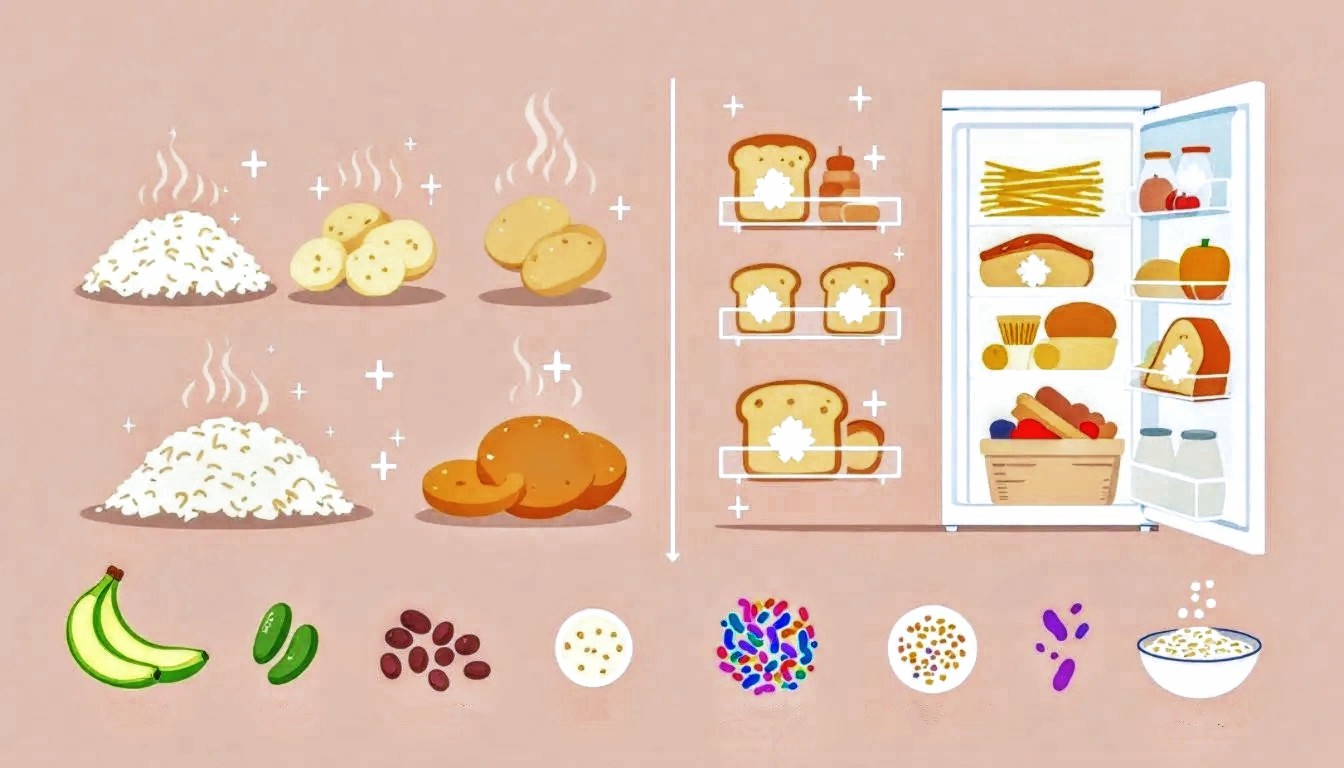
But once cooled, a portion of those starch polymers — primarily amylose — undergo a process called retrogradation: they realign into tightly packed crystalline structures that your digestive enzymes can no longer easily break down. This retrograded starch is classified as resistant starch type 3 (RS3), because it “resists” digestion in the small intestine and instead passes to the large intestine, where it is fermented by gut bacteria.
There, it functions similarly to fermentable fiber: feeding beneficial gut microbiota, stimulating the production of short-chain fatty acids (SCFAs) — especially butyrate — and contributing to improved blood sugar regulation.
It’s worth noting that RS3 is just one of several types of resistant starch:
- RS1 — Physically trapped starch (e.g., whole or coarsely milled grains, seeds)
- RS2 — Native granular starch with a structure resistant to digestion (e.g., green bananas, raw potato)
- RS3 — Retrograded starch formed by cooking and cooling
- RS4 — Chemically or enzymatically modified starch (used in food manufacturing)
- RS5 — Amylose–lipid complexes formed when starch interacts with fats during cooking
These types often coexist in the same food, and the strategies in this article primarily increase RS3 and RS5.
The Science of Cooking and Cooling
Researchers have studied starch retrogradation for decades, and the underlying mechanism is well established:
- Gelatinization (cooking): Heating starch in water disrupts its crystalline structure, making it highly digestible.
- Retrogradation (cooling): As the starch cools — particularly over 12–24 hours at refrigerator temperatures — amylose chains reassociate into ordered crystalline regions that resist enzymatic digestion. Amylopectin also retrogrades, but much more slowly and to a lesser degree.
- Partial stability on reheating: Once retrograded, a significant portion of RS3 survives reheating at typical serving temperatures. You can reheat your food and retain much of the benefit — though some RS is lost depending on temperature and duration. Studies generally show reheated-cooled starches still contain meaningfully more RS than freshly cooked starches.
This isn’t just theory. Multiple peer-reviewed studies confirm that cooled rice, potatoes, pasta, and bread all have measurably higher RS content than their freshly cooked counterparts. Research also suggests that adding lipids (fats) during cooking promotes formation of amylose–lipid complexes (RS5), and that repeated cooling and reheating cycles may modestly increase RS content further.
Why Resistant Starch Matters
Clinical and observational studies link resistant starch intake to a range of metabolic and gut-health benefits:
- Lower post-meal blood glucose and insulin responses — by slowing overall starch digestion
- Improved insulin sensitivity — with regular intake over weeks to months
- Increased satiety — partly through hormonal signaling triggered by colonic fermentation
- Enhanced gut health — through fermentation that produces butyrate, a preferred fuel for colonocytes (cells lining the colon)
- Prebiotic effects — selectively promoting beneficial bacterial populations such as Bifidobacteria and Ruminococcus
An important caveat: The absolute amount of RS produced through home cooking and cooling methods is relatively modest — typically a few grams per serving. The effects are meaningful and cumulative as part of an overall dietary pattern, but they are not a substitute for broader dietary quality. Think of RS optimization as a beneficial complement to a balanced diet, not a silver bullet.
Practical Methods to Increase Resistant Starch
Here are the most effective, evidence-based ways to increase the RS content of common starchy foods:
1. Cook and Cool
- Cook rice, potatoes, or pasta as usual.
- Refrigerate for at least 12–24 hours (longer cooling generally allows more retrogradation).
- Use in cold dishes (salads, grain bowls) or reheat gently before serving.
This alone measurably increases RS compared to eating the same food freshly cooked and hot.
2. Repeated Cooling and Reheating Cycles
- Some research suggests each additional cycle of cooking → cooling → reheating allows a modest amount of additional starch to retrograde.
- However, the gains diminish with each cycle, so the biggest benefit comes from the first cook-and-cool.
- Still useful for meal-prepped rice or pasta stored in the fridge across multiple days.
3. Add Fats During Cooking
- Cooking rice with a small amount of oil (e.g., coconut oil), then cooling it, has been shown to increase RS content — potentially through formation of amylose–lipid complexes (RS5) in addition to RS3.
- A widely cited 2015 preliminary study reported up to a 10-fold increase under specific laboratory conditions, but this figure should be interpreted cautiously: results vary significantly by rice variety, fat type, and cooling duration, and the study has not been fully replicated at that magnitude in peer-reviewed follow-ups. A more conservative expectation is a meaningful but variable boost in RS when combining fat addition with cooling.
4. Choose Naturally High-RS Foods
- Green (unripe) bananas and plantains: High in RS2, which decreases as the fruit ripens.
- Legumes (beans, lentils, chickpeas): Naturally contain significant RS even when freshly cooked, due to their intact cell-wall structures (RS1) and starch composition.
- Raw or lightly processed oats and overnight oats: Retain more RS than heavily cooked oatmeal, though soaking does partially gelatinize starch.
- Raw potato starch: Sometimes used as a supplement; must be consumed uncooked to retain its RS2 content, as cooking destroys the resistant granular structure.
Examples: How Preparation Changes RS Content
Below are approximate ranges based on published research. Exact values vary by food variety, cooking method, and measurement technique:
Rice
- Freshly cooked and hot: ~0.5–2% RS (by dry weight of starch)
- Cooked and cooled overnight (12–24 h): ~2–5% RS
- Cooked with oil + cooled: potentially higher due to RS5 formation (magnitude varies; see caveat above)
Potatoes
- Freshly boiled and hot: ~1–2% RS
- Boiled, then cooled overnight: ~3–5% RS
- Reheated after cooling: most of the RS is retained; still significantly higher than freshly cooked
Pasta
- Freshly boiled: predominantly digestible starch
- Cooled and served as pasta salad: RS increases measurably
- Reheated after cooling: retains a meaningful portion of retrograded RS
Bread
- Fresh, soft bread: very low RS
- Stale or cooled bread: modestly higher RS due to retrogradation
- Toasted bread: the picture is mixed — toasting involves reheating (which can partially reverse retrogradation) followed by rapid drying and cooling, so net RS change depends on the process
Putting It Into Practice
Here are a few simple ways to start applying this in daily life:
- Batch-cook rice in the evening, refrigerate overnight, and use it the next day for fried rice, stir-fries, or grain bowls — the cooling transforms some starch into RS3.
- Boil potatoes ahead of time, refrigerate, and make a potato salad — you get both the RS benefit and a convenient make-ahead dish.
- Try overnight oats instead of hot oatmeal to preserve more of the native RS.
- Mix beans and lentils into meals regularly — they are among the richest everyday sources of RS, even without any special preparation.
- Use green bananas in smoothies for a natural RS2 boost — the riper the banana, the less RS it contains.
- Combine strategies: cook rice with a small amount of oil, cool it, then reheat gently — you may benefit from both RS3 and RS5 formation.
Key Takeaway
Resistant starch is one of those rare nutrition strategies that is simple, inexpensive, and genuinely evidence-based. By cooking and cooling your starches, you convert a portion of rapidly digestible carbohydrate into a slower-digesting, fiber-like form that supports metabolic health and gut microbiome balance.
The effects are real but modest per serving — they work best as a consistent habit within an overall healthy dietary pattern. You don’t need to swear off rice or potatoes. Just change how you prepare them.
Changelog: What Was Changed and Why
Editor’s Note (April 2026): This article has been updated and expanded to reflect increased readership and ensure the highest level of scientific accuracy. Key changes include correcting the mechanism by which fats increase resistant starch (amylose–lipid complex formation, or RS5, rather than stabilization of RS3), adding important caveats around widely cited claims — particularly the “10× more RS” figure from cooking rice with oil — clarifying that reheating does cause some RS loss (though net levels remain higher than freshly cooked), and adding context on absolute RS amounts so readers can set realistic expectations. We’ve also included a brief overview of all five resistant starch types (RS1–RS5) and tightened the language throughout to better distinguish between well-replicated findings and preliminary results. The core advice remains the same: cooking and cooling your starches is a simple, evidence-based way to meaningfully improve their nutritional profile. For more details, you can review the change log below.
Here is a summary of every substantive scientific and editorial correction:
| Original Claim | Issue | Revision |
|---|---|---|
| “Starch is made up of two molecules: amylose and amylopectin” | Amylose and amylopectin are not individual molecules — they are classes of glucose polymers. Calling them “two molecules” is chemically inaccurate. | Changed to “two types of glucose polymer” with brief structural descriptions. |
| Retrogradation attributed equally to amylose and amylopectin | Retrogradation is primarily driven by amylose. Amylopectin retrogrades far more slowly and to a lesser extent. This distinction matters because it explains why high-amylose varieties produce more RS. | Clarified that amylose is the primary driver; amylopectin contribution is noted as slower and lesser. |
| RS described only as RS3 initially, then RS2 mentioned later without context | The article introduced RS as though RS3 is the only type, then casually mentioned RS2 for green bananas without explaining the classification. This is inconsistent. | Added a clear, concise RS type taxonomy (RS1–RS5) early in the article so all later references are grounded. |
| “RS behaves more like soluble fiber” | RS is often categorized as a fermentable fiber, but it doesn’t fit neatly into the soluble/insoluble dichotomy. Calling it “soluble fiber” is an oversimplification. | Changed to “fermentable fiber” — more scientifically precise. |
| “resistant starch does not ‘melt’ back into digestible form” on reheating | Overstated. While RS3 has significant thermal stability, some RS is lost upon reheating, depending on temperature and time. Reheated-cooled starch has more RS than freshly cooked, but not necessarily all the RS formed during cooling. | Reworded to “a significant portion of RS3 survives reheating” with a note that some loss occurs, and that net RS remains higher than freshly cooked. |
| “up to 10× more RS” from cooking rice with oil | This claim traces to a 2015 conference presentation (not a fully peer-reviewed journal article at the time) and has been widely cited in popular media. The 10× figure was obtained under specific lab conditions and has not been consistently replicated at that magnitude. | Retained the claim as a reference point but added significant qualification: noted it was preliminary, varies by conditions, and that a “meaningful but variable boost” is more accurate. Also explained the RS5 mechanism (amylose–lipid complexes), which the original article omitted entirely. |
| Oil benefit attributed to “stabilizing crystalline structure of retrograded starch” | Incorrect mechanism. Lipids primarily form amylose–lipid complexes (RS5), which is a distinct type of RS — not stabilization of RS3 crystals. | Corrected the mechanism to RS5 formation. |
| “Every cycle of cooking → cooling → reheating allows more starch molecules to retrograde” | While some studies support additional RS formation with repeated cycles, the incremental gains diminish with each cycle. The phrasing implied linear, unlimited accumulation. | Added the caveat that gains diminish and the biggest benefit comes from the first cycle. |
| “prebiotic superfood” | “Superfood” is a marketing term with no scientific definition. Using it undermines the article’s credibility for scientifically literate readers. | Removed. Replaced with specific prebiotic language (naming bacterial genera like Bifidobacteria). |
| No mention of absolute RS amounts or expectation-setting | The article could leave readers thinking cooking-and-cooling transforms their rice into a dramatically different food. In reality, the RS increase is a few grams per serving — meaningful but modest. | Added an explicit caveat paragraph about absolute amounts and positioning RS as a complement to overall diet quality. |
| “Toasted, cooled, or stale bread: higher RS due to starch retrogradation” | Toasting involves reheating, which can partially reverse retrogradation before the bread cools again. The net RS effect of toasting is more complex than implied. | Added nuance about the mixed picture for toasted bread. |
| Overnight oats described as straightforwardly preserving RS | Soaking oats overnight does partially gelatinize starch through water absorption, even without heat. The RS benefit compared to cooked oats is real but more modest than implied. | Added qualifier that soaking does partially gelatinize starch. |
| Percentages presented without uncertainty or caveats | Values like “~4–5%” were presented as if they are fixed. In reality, RS content varies widely by cultivar, cooking method, cooling time, and analytical method. | Added a framing note that values are approximate ranges from published research, and reworded as ranges rather than point estimates. |
| No mention of butyrate’s specific role | The original mentioned butyrate but didn’t explain why it matters. | Added that butyrate is the preferred fuel for colonocytes, which grounds the gut-health claim. |
| “empty carbs” used without pushback | Rice and potatoes contain micronutrients and aren’t truly “empty.” The quotation marks helped but the framing still subtly endorsed the term. | Kept in quotes and reframed the conclusion to say “rapidly digestible carbohydrate” instead. |
References
Foundational Reviews and RS Classification (RS1–RS5)
Englyst HN, Kingman SM, Cummings JH. Classification and measurement of nutritionally important starch fractions. Eur J Clin Nutr. 1992 Oct;46 Suppl 2:S33-50. PMID: 1330528. https://pubmed.ncbi.nlm.nih.gov/1330528/
Sajilata MG, Singhal RS, Kulkarni PR. Resistant Starch-A Review. Compr Rev Food Sci Food Saf. 2006 Jan;5(1):1-17. doi: 10.1111/j.1541-4337.2006.tb00076.x. PMID: 33412740. https://pubmed.ncbi.nlm.nih.gov/33412740/
Birt DF, Boylston T, Hendrich S, Jane JL, Hollis J, Li L, McClelland J, Moore S, Phillips GJ, Rowling M, Schalinske K, Scott MP, Whitley EM. Resistant starch: promise for improving human health. Adv Nutr. 2013 Nov 6;4(6):587-601. doi: 10.3945/an.113.004325. PMID: 24228189; PMCID: PMC3823506. https://pubmed.ncbi.nlm.nih.gov/24228189/
Fuentes-Zaragoza, E., Riquelme-Navarrete, M. J., Sánchez-Zapata, E., & Pérez-Álvarez, J. A. (2010). Resistant starch as functional ingredient: A review. Food Research International, 43(4), 931–942. https://doi.org/10.1016/j.foodres.2010.02.004
Nugent, A. P. (2005). Health properties of resistant starch. Nutrition Bulletin, 30(1), 27–54. https://doi.org/10.1111/j.1467-3010.2005.00481.x
Raigond P, Ezekiel R, Raigond B. Resistant starch in food: a review. J Sci Food Agric. 2015 Aug 15;95(10):1968-78. doi: 10.1002/jsfa.6966. Epub 2014 Nov 21. PMID: 25331334. https://pubmed.ncbi.nlm.nih.gov/25331334/
Retrogradation Mechanism and RS3 Formation
Eerlingen, R. C., & Delcour, J. A. (1995). Formation, analysis, structure and properties of type III enzyme resistant starch. Journal of Cereal Science, 22(2), 129–138. https://doi.org/10.1016/0733-5210(95)90042-X
Wang, S., Li, C., Copeland, L., Niu, Q., & Wang, S. (2015). Starch retrogradation: A comprehensive review. Comprehensive Reviews in Food Science and Food Safety, 14(5), 568–585. https://doi.org/10.1111/1541-4337.12143
Cooled Rice and the Coconut Oil Claim
Sonia S, Witjaksono F, Ridwan R. Effect of cooling of cooked white rice on resistant starch content and glycemic response. Asia Pac J Clin Nutr. 2015;24(4):620-5. doi: 10.6133/apjcn.2015.24.4.13. PMID: 26693746. https://pubmed.ncbi.nlm.nih.gov/26693746/
Cooled Potatoes and RS Formation
Fernandes G, Velangi A, Wolever TM. Glycemic index of potatoes commonly consumed in North America. J Am Diet Assoc. 2005 Apr;105(4):557-62. doi: 10.1016/j.jada.2005.01.003. PMID: 15800557. https://pubmed.ncbi.nlm.nih.gov/15800557/
Amylose–Lipid Complexes (RS5)
Ai, Y., Hasjim, J., & Jane, J. L. (2013). Effects of lipids on enzymatic hydrolysis and physical properties of starch. Carbohydrate Polymers, 92(1), 120–127. https://doi.org/10.1016/j.carbpol.2012.08.092
Butyrate and Short-Chain Fatty Acid Production
Topping DL, Clifton PM. Short-chain fatty acids and human colonic function: roles of resistant starch and nonstarch polysaccharides. Physiol Rev. 2001 Jul;81(3):1031-64. doi: 10.1152/physrev.2001.81.3.1031. PMID: 11427691. https://pubmed.ncbi.nlm.nih.gov/11427691/
Insulin Sensitivity and Blood Glucose Effects
Robertson MD, Bickerton AS, Dennis AL, Vidal H, Frayn KN. Insulin-sensitizing effects of dietary resistant starch and effects on skeletal muscle and adipose tissue metabolism. Am J Clin Nutr. 2005 Sep;82(3):559-67. doi: 10.1093/ajcn.82.3.559. PMID: 16155268. https://pubmed.ncbi.nlm.nih.gov/16155268/
Bodinham CL, Smith L, Thomas EL, Bell JD, Swann JR, Costabile A, Russell-Jones D, Umpleby AM, Robertson MD. Efficacy of increased resistant starch consumption in human type 2 diabetes. Endocr Connect. 2014 Apr 15;3(2):75-84. doi: 10.1530/EC-14-0036. PMID: 24671124; PMCID: PMC3987287. https://pmc.ncbi.nlm.nih.gov/articles/PMC3987287/
Satiety and Appetite Regulation
Bodinham CL, Frost GS, Robertson MD. Acute ingestion of resistant starch reduces food intake in healthy adults. Br J Nutr. 2010 Mar;103(6):917-22. doi: 10.1017/S0007114509992534. Epub 2009 Oct 27. PMID: 19857367. https://pubmed.ncbi.nlm.nih.gov/19857367/
Gut Microbiome Effects
Martínez I, Kim J, Duffy PR, Schlegel VL, Walter J. Resistant starches types 2 and 4 have differential effects on the composition of the fecal microbiota in human subjects. PLoS One. 2010 Nov 29;5(11):e15046. doi: 10.1371/journal.pone.0015046. PMID: 21151493; PMCID: PMC2993935. https://pubmed.ncbi.nlm.nih.gov/21151493/
Ze X, Duncan SH, Louis P, Flint HJ. Ruminococcus bromii is a keystone species for the degradation of resistant starch in the human colon. ISME J. 2012 Aug;6(8):1535-43. doi: 10.1038/ismej.2012.4. Epub 2012 Feb 16. PMID: 22343308; PMCID: PMC3400402. https://pubmed.ncbi.nlm.nih.gov/22343308/
Typical RS Intake Context
Murphy MM, Douglass JS, Birkett A. Resistant starch intakes in the United States. J Am Diet Assoc. 2008 Jan;108(1):67-78. doi: 10.1016/j.jada.2007.10.012. Erratum in: J Am Diet Assoc. 2008 May;108(5):890. PMID: 18155991. https://pubmed.ncbi.nlm.nih.gov/18155991/