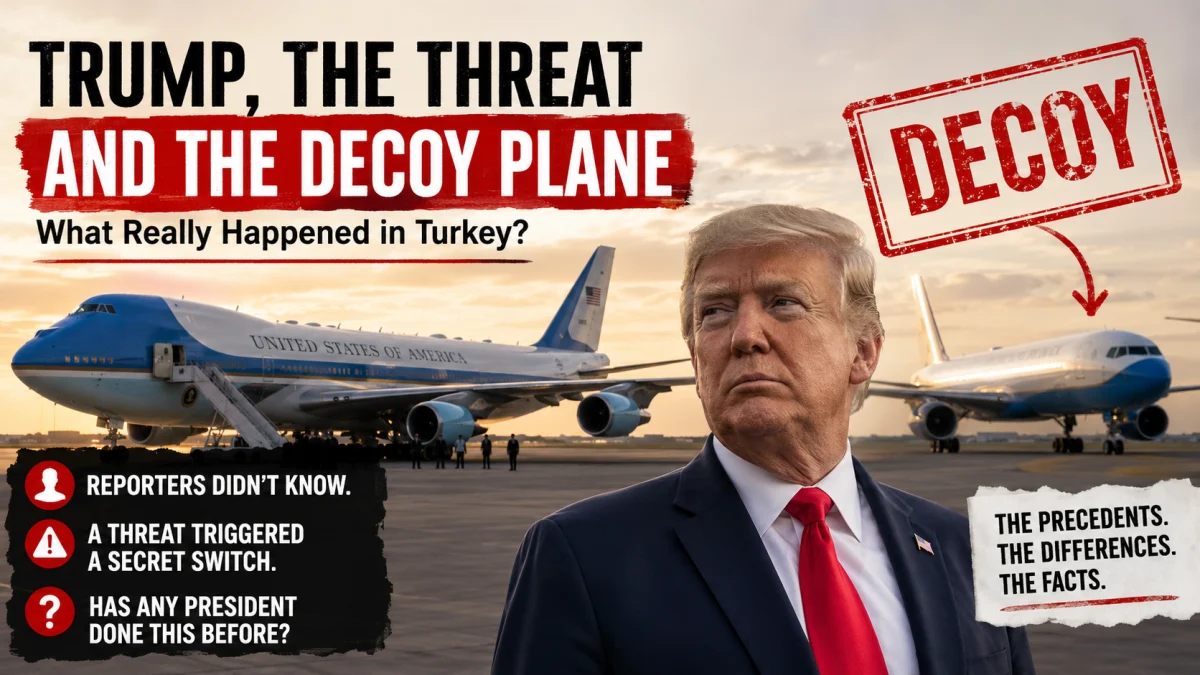
Presidents have used decoy planes, secret routes and false travel plans before. What appears different about Donald Trump’s 2026 flight from Turkey is that reporters and staff remained aboard the apparent presidential aircraft without knowing Trump had been removed because of a reported threat. The closest known precedent happened under Bill Clinton — and a proposal to use journalists similarly was reportedly rejected.
Updated: August 11, 2026
The short answer
Yes, U.S. presidents have used decoy aircraft and deliberately misleading travel arrangements before. But there is an important difference.
In the publicly documented modern cases we reviewed, we could not find another example that cleanly matches what happened after President Donald Trump left Turkey on July 8, 2026: a president being secretly removed from the apparent presidential aircraft because of a specific reported threat while journalists and other personnel who did not know he had left continued flying aboard that aircraft.
The closest precedent is President Bill Clinton’s 2000 trip to Pakistan.
That comparison is particularly important because Clinton’s security planners reportedly considered a plan under which journalists would have believed Clinton was aboard their aircraft while he secretly flew on another. A senior White House official objected specifically to using the media as decoys. The plan was altered, the journalists could see that Clinton had not boarded their aircraft, and at least one senior member of the traveling press corps was privately briefed about the danger and security arrangements.
That does not prove Trump’s operation was designed to sacrifice journalists, nor does the public evidence establish that anyone expected the decoy aircraft to be attacked.
It does mean that simply saying “presidents have always used decoys” leaves out the most important part of the comparison.
What actually happened to Trump’s plane in Turkey?
On July 8, 2026, Trump was preparing to leave Ankara after a NATO summit.
He publicly boarded the familiar presidential 747 in view of cameras. According to reporting subsequently corroborated across multiple outlets, he then secretly exited on the opposite side of the aircraft with the assistance of an airport catering vehicle and was moved to an Air Force C-32A, a modified Boeing 757.
Trump flew separately to Britain.
Meanwhile, journalists and members of his staff flew the same route aboard the large presidential aircraft while believing Trump was still aboard with them. Reporters had also been instructed to keep their window shades closed.
The Associated Press later described the aircraft as being sent into the air essentially as a decoy.
There is a technical distinction worth making. “Air Force One” is not permanently the name of a particular airplane. It is the radio call sign used when the president is aboard an Air Force aircraft. Once Trump left the large presidential aircraft, it was therefore no longer technically Air Force One in the ordinary meaning of the call sign, even though it remained the highly recognizable aircraft the public associates with Air Force One.
That distinction matters technically. It does not change the security question: an observer on the ground was apparently meant to believe the president remained aboard the recognizable presidential aircraft.
How certain are we that Iran actually threatened the plane?
This requires separating several different claims.
Strongly established: Trump was secretly moved to another aircraft
The physical plane switch is supported by photographs, video, contemporaneous press observations, subsequent reporting and Trump’s own acknowledgment that he changed aircraft at the request of his security team.
Strongly established: journalists did not know Trump had left
Contemporaneous pool reports recorded the unusual instruction to close the press cabin’s shades. Multiple reporters later confirmed they believed Trump was still traveling with them.
Strongly supported: some security threat prompted the switch
Trump himself said on August 11 that the military and Secret Service wanted him on another aircraft and acknowledged that there had been a threat. That is independent evidence that the switch was not merely an invention of anonymous intelligence sources.
Reported but not independently inspectable: the exact Iranian missile plot
CBS News reported, citing a U.S. official with direct knowledge, that intelligence indicated a credible Iranian or Iranian-proxy plan involving a missile attack against the aircraft carrying Trump. Other outlets have reported similar threat information.
But the underlying intelligence has not been publicly declassified.
That distinction is critical.
A government official saying intelligence exists is evidence. It is not the same thing as the public being able to examine the intelligence and independently verify its accuracy, specificity or confidence level.
We therefore should not jump from:
Officials reported an Iranian threat.
to:
We independently know precisely what Iran planned and how likely an attack was.
Those are different claims.
Did Trump knowingly put journalists in danger?
The most defensible answer is:
Potentially — but the amount of additional danger cannot currently be measured from public evidence.
If a threat concerning Trump’s aircraft was considered serious enough to remove the president from that aircraft, then it is reasonable to ask what risk remained for the people who continued aboard it.
But several possibilities have to be considered simultaneously.
The decoy itself may have reduced the effectiveness of any attack by creating uncertainty about which aircraft actually carried Trump. The recognizable presidential aircraft also had extensive defensive capabilities and security support. Meanwhile, Trump’s smaller and less obvious aircraft may have carried its own risks.
Trump himself has suggested that the aircraft carrying him could actually have been the more dangerous position. That claim cannot presently be independently quantified either.
So the evidence does not justify saying:
“Trump knew Iran would shoot at the plane and intentionally sent journalists up to die instead.”
There is no public evidence establishing that intent.
But the opposite extreme is also unsupported:
“Nobody aboard the other aircraft was placed at any additional risk, so there is nothing unusual here.”
We do not have enough information to establish that either.
What we can establish is narrower:
A threat was considered serious enough to change how the president traveled, while civilians who were part of the deception were not told that the president had left or why.
Were the journalists actually “decoys”?
There are two different meanings hiding inside that word.
The aircraft was clearly functioning as a decoy
The point of the operation was apparently to preserve the appearance that Trump was aboard the recognizable presidential aircraft while he traveled elsewhere. AP explicitly characterized the plane as essentially a decoy.
Calling the passengers “bait” goes further than the evidence
The journalists, staff and officials aboard the aircraft were necessarily part of the visual deception because an empty aircraft could have raised questions.
But “bait” implies that planners wanted an attacker to strike that aircraft.
That has not been established.
Likewise, “human shield” is an imperfect description. Human shielding normally means civilians are positioned to deter an attack against something protected by their presence. Here, the apparent purpose was misdirection: make it difficult to determine where the president actually was.
The most evidence-based description is therefore:
The aircraft was used as a decoy, and its uninformed passengers became part of that deception.
Whether security planners themselves regarded those passengers as “decoys” is unknown.
Has another U.S. president used a decoy plane?
Absolutely.
Presidential security has long relied on deception.
Motorcades can contain similar vehicles. Presidential helicopters can fly in formations that make it harder to identify which aircraft carries the president. Presidential trips to war zones have routinely involved false schedules, communication blackouts and aircraft switches.
The unusual issue in the Trump case is therefore not the existence of a decoy.
It is who knew about the deception, where the apparent target went afterward, and how long the deception continued.
| Presidential operation | Deception used? | Journalists aware of danger or operation? | President separated from their aircraft? | Closely comparable to 2026? |
|---|---|---|---|---|
| Trump — Turkey, 2026 | Yes | No, according to current reporting | Yes | The case being examined |
| Clinton — Pakistan, 2000 | Yes | At least one press representative was briefed; reporters knew Clinton was not on their plane | Yes | Closest known comparison |
| Bush — Iraq, 2003 | Yes | Traveling reporters were participating under secrecy | No comparable uninformed decoy arrangement documented | No |
| Obama — Afghanistan, 2010 | Yes | Reporters traveled under security restrictions | Press accompanied presidential trip | No |
| Trump — Afghanistan, 2019 | Yes | A separate press group accompanied Trump; another pool and decoy remained in Florida | Yes, but not aboard the apparent threatened target | No |
| Biden — Ukraine, 2023 | Yes | Two journalists accompanied the secret journey | Journalists traveling with Biden knew the nature of the trip | No |
The historical pattern is therefore clear: presidential deception is ordinary; uninformed civilian participation in this particular form of airborne deception is not.
Bill Clinton’s 2000 Pakistan flight is the most important comparison
Clinton’s March 2000 trip to Pakistan involved serious security concerns.
His visit to Islamabad was deliberately concealed. Multiple aircraft were used, including a recognizable presidential decoy, while Clinton traveled aboard another aircraft. The archived Clinton presidential record confirms that he arrived in Islamabad on March 25, 2000, although the archive itself does not document the classified security mechanics.
Recent interviews with people involved in that operation provide the crucial additional detail.
According to Joseph Hagin, who helped organize presidential travel, an initial security proposal would have led journalists aboard a C-17 to believe Clinton was traveling with them while Clinton secretly boarded another aircraft.
Hagin says he objected specifically because the arrangement would effectively use the media as decoys.
The plan was changed. Reporters could see that Clinton did not enter their aircraft, although they still did not know which of several other aircraft carried him.
There is another significant difference.
Susan Page, then president of the White House Correspondents’ Association, says she was privately briefed in advance. Security officials explained the unusual danger, the decoy operation and measures intended to protect the journalists.
Once Clinton arrived, the basic deception also became apparent.
That makes the Clinton operation unusually valuable as a historical comparison because it answers a hypothetical question with an actual case:
What happened when presidential security planners previously considered keeping journalists unaware that they were traveling separately from a threatened president?
According to the people involved, someone objected, and the plan was modified.
That does not prove that the Clinton decision was legally or ethically mandatory. It does establish that the problem had been recognized before.
George W. Bush’s secret 2003 Iraq trip was dangerous — but materially different
President George W. Bush secretly flew to Baghdad for Thanksgiving in November 2003, at a time when Iraq presented obvious dangers to the president and everyone traveling with him.
The operation involved extensive secrecy.
But Bush’s own remarks afterward establish something important: members of the traveling press pool knew they were participating in a confidential operation. Bush explicitly thanked the reporters for maintaining the secrecy needed to make the trip possible.
Bush also said planners had considered whether his presence could cause an enemy reaction that endangered other people and that he was prepared to cancel the mission if security conditions deteriorated.
People unquestionably accepted danger during that trip.
The key difference is knowledge and participation.
They were not apparently allowed to fly away believing Bush was sitting elsewhere on their aircraft after he had secretly been removed because that aircraft itself had become the focus of a specific threat.
Trump’s own 2019 Afghanistan trip provides another useful comparison
During Trump’s first term, he secretly visited Afghanistan for Thanksgiving in 2019.
A decoy aircraft and press pool remained in Florida to preserve the appearance that Trump was still at Mar-a-Lago. Meanwhile, another group of journalists traveled with Trump to Afghanistan and documented his visit.
Again, deception was part of presidential protection.
But it was a different kind of deception.
The people maintaining the false appearance in Florida were not being flown aboard an aircraft that potential attackers were apparently supposed to believe contained the president.
Biden’s 2023 Ukraine trip followed the traditional covert-trip model
President Joe Biden’s surprise trip to Kyiv in February 2023 was extraordinarily sensitive.
The publicly announced schedule helped preserve the impression that Biden remained in Washington. He traveled aboard a smaller Air Force C-32 to Poland and then secretly entered Ukraine by train.
But two journalists traveled with him and documented the trip under strict secrecy.
That illustrates the conventional tradeoff:
Limit the number of people who know, bind those who do know to secrecy, and reveal the operation once the immediate security requirement has passed.
That is meaningfully different from allowing the traveling press pool to believe it remained physically with the president when it did not.
Why secrecy itself is not the strongest criticism
There is an obvious security argument for what happened in Turkey.
A covert evacuation works only if very few people know about it. Informing every journalist and staff member before takeoff could increase the risk of an accidental disclosure that reveals where the president actually is.
Joseph Hagin, who has worked on presidential security operations under both Republican administrations, argues essentially this point: presidential travel inherently carries risk, compartmentalization can be necessary, and protecting the president may require keeping almost everyone else uninformed.
That argument should not be dismissed merely because it comes from someone defending the operation.
It is logically sound.
But it does not answer every question.
There are actually two separate periods to examine:
- While Trump was still in danger, when secrecy could plausibly have been operationally necessary.
- After Trump was safely away from the danger, when the reason for continuing to conceal what happened becomes less obvious.
The second issue may be historically more unusual than the first.
AP found that past secret presidential trips were generally disclosed after the immediate danger had passed. The 2026 operation remained undisclosed for weeks and became public through reporting rather than a post-operation announcement.
That transformed a protective-security question into a transparency question as well.
The recursive evidence test
One way to avoid political bias is to test the major explanations against themselves.
Scenario 1: The Iranian threat was exactly as serious as reported
Then secretly moving Trump becomes understandable.
But the unanswered question becomes stronger: what risk did the remaining passengers face, and why were uninformed civilians used in the deception?
Scenario 2: The threat existed but was uncertain or low-probability
Then moving the president may still make sense because presidential security operates at an unusually low tolerance for risk.
In that case, however, we should be careful about describing the passengers as having been placed in an imminent death trap. The public evidence does not establish that.
Scenario 3: The decoy operation actually lowered everyone’s risk
This is plausible.
Forcing a potential attacker to distinguish between several possible presidential aircraft can make a successful attack more difficult.
But even if the tactic reduced overall risk, the transparency question remains: the journalists did not know that their circumstances had materially changed.
Scenario 4: The intelligence about Iran was wrong
That would undermine claims about the actual physical danger.
It would not erase the plane switch, the deception or the decision to leave the press uninformed. Those events are independently documented.
This is why the article does not require blind confidence in either government intelligence or criticism of the government.
Different conclusions rest on different layers of evidence.
So was Trump’s operation unprecedented?
The safest answer is:
Possibly in its specific form, but “unprecedented” cannot be proved absolutely.
There may be classified presidential protection operations that have never become public.
What can be said is that neither this review nor the historians and journalists examining the episode have identified a documented modern precedent matching all of the important elements:
- a specific threat serious enough to cause the president to abandon his apparent aircraft;
- the president secretly moving to another plane;
- the apparent presidential aircraft nevertheless departing;
- journalists and staff remaining aboard while believing the president was with them;
- those journalists not being briefed about the relevant danger;
- and the operation remaining undisclosed after the immediate security situation ended.
AP described Trump’s extended concealment as believed to be unprecedented, while presidential historian Garrett Graff has said he was unaware of another modern example involving this combination of circumstances.
That is different from declaring categorically that nothing similar has ever happened.
History involving presidential security contains secrets by definition.
The bottom line
Donald Trump was not the first president to use a decoy plane. He was not the first president to hide his location, mislead potential attackers, travel secretly or expose staff, military personnel and journalists to some degree of danger.
Those practices have extensive precedent.
What makes the July 2026 operation different is more specific.
Trump was secretly removed from the recognizable presidential aircraft after a reported threat serious enough to alter his transportation. That aircraft then departed with officials, staff and journalists aboard. The journalists apparently believed Trump was still traveling with them and were not told otherwise.
The closest known comparison, Clinton’s 2000 Pakistan trip, actually sharpens rather than weakens that distinction: a plan that reportedly would have used uninformed journalists in a similar deception was objected to and changed, and at least one representative of the press was briefed about the danger.
There is currently no evidence that Trump or his security team wanted the other aircraft attacked, expected its passengers to die or intentionally used journalists as sacrificial bait.
There is also no basis for pretending nothing unusual happened.
The evidence supports a narrower but still consequential conclusion:
Uninformed civilians were incorporated into a presidential security deception triggered by a threat serious enough to remove the president from the aircraft they believed he was still aboard. In the publicly documented modern history of presidential travel, that combination appears highly unusual and may be without a known precedent.
Frequently Asked Questions
Did Trump use Air Force One as a decoy?
The recognizable presidential aircraft functioned as a decoy after Trump secretly moved to another Air Force aircraft. Technically, however, an aircraft is called “Air Force One” only while the president is aboard.
Did journalists know Trump had switched planes?
Current reporting indicates they did not. Reporters aboard the presidential aircraft believed Trump was traveling with them and had been told to keep their shades closed.
Was there really an Iranian threat to Air Force One?
There is strong evidence that some threat prompted Trump’s security team to change his aircraft because Trump himself has acknowledged that fact. The more specific allegation of an Iranian or Iranian-proxy missile plot comes from intelligence reporting attributed to officials. The underlying intelligence has not been publicly released, so its details cannot currently be independently verified.
Has a president used a decoy plane before?
Yes. Bill Clinton’s 2000 Pakistan trip is a particularly clear example, and other presidents have used misleading schedules, alternate aircraft, decoy motorcades and secret travel arrangements.
Did Clinton use journalists as decoys?
An initial plan reportedly would have misled journalists about which aircraft Clinton was aboard. A senior official says he objected to using the media that way, and the plan was modified. At least one senior press representative was also briefed before the flight.
Does this prove Trump intentionally endangered journalists?
No. It establishes that journalists unknowingly participated in the deception. The classified information needed to determine the actual probability of an attack, relative risk of each aircraft and full reasoning of the security planners is not publicly available.
References and Further Reading
Primary and Official Historical Records
U.S. Air Force — VC-25 / Air Force One Fact Sheet
The Air Force’s technical description of the presidential VC-25 fleet. Most useful here for clarifying that “Air Force One” is a call sign used when the president is actually aboard an Air Force aircraft, rather than the permanent name of one particular plane.
George W. Bush White House Archive — President Discusses Trip to Iraq With Reporters, November 27, 2003
Primary-source transcript following Bush’s secret Thanksgiving trip to Baghdad. Bush discusses the security concerns surrounding the trip and thanks the traveling press for maintaining confidentiality, making it useful for comparing informed participation in a secret mission with the 2026 Turkey operation.
Clinton White House Archive — Islamabad Itinerary, March 25, 2000
Archived official itinerary confirming Clinton’s highly sensitive March 2000 visit to Pakistan. The archive establishes the underlying trip; later reporting supplies details of the decoy-aircraft operation.
Clinton White House Archive — Remarks by President Clinton in Islamabad
Contemporaneous presidential record confirming Clinton’s presence in Islamabad on March 25, 2000 and providing historical context for the visit.
Reporting on the July 2026 Trump Flight
Associated Press — Why Trump’s Elaborate Ruse in Turkey Isn’t Like Other Secret Presidential Trips
The strongest single comparative overview. AP examines Trump’s 2026 flight alongside Biden’s Ukraine trip, Trump’s 2019 Afghanistan visit, Bush’s Iraq travel and Clinton’s Pakistan operation, and describes the presidential aircraft as being sent into the air essentially as a decoy.
CBS News — Trump Secretly Switched Planes in Turkey Amid Iran Missile Threat
Important independent reporting on the alleged Iran-related missile threat, the catering-truck transfer and Trump’s August 11 acknowledgment that his military and Secret Service protection teams wanted him to change aircraft because of a threat. The exact intelligence remains classified.
The Washington Post — Reporter Breaks 26-Year Silence on Briefing That Preceded Clinton’s Plane Swap
A particularly valuable source because USA Today’s Susan Page describes for the first time how she was privately briefed before Clinton’s 2000 Pakistan flight about the danger, the president’s location and security measures for journalists. It provides one of the clearest historical controls for evaluating the 2026 operation.
The Washington Post — Trump’s Secret Turkey Flight and Air Force One Decoy Operation
The original major investigation that revealed the extent of the July 8 plane switch, including the catering-truck transfer, the separate C-32A flight and the fact that reporters and some staff believed Trump remained aboard the presidential aircraft.
Peter Baker / The New York Times via Business Standard — With Trump Secretly Evacuated, Imperiled Air Force One Becomes Flying Decoy
Useful because it reconstructs the ethical and operational dispute rather than presenting only one interpretation. It includes both criticism of leaving civilians uninformed and the counterargument from experienced presidential-security officials that compartmentalization may be necessary to keep the president alive. It also contains the detailed account of the rejected Clinton-era proposal to mislead accompanying journalists.
Editorial Note
This is a developing story involving classified presidential-protection procedures and intelligence concerning an alleged Iranian threat. The physical plane switch and the lack of knowledge among the traveling press are now strongly corroborated. The precise nature, reliability and severity of the underlying threat remain partly dependent on nonpublic intelligence.
If additional records are declassified, congressional investigations produce evidence, or participants provide firsthand accounts, those facts could materially change the assessment of how much danger the passengers actually faced and how the operation was authorized.