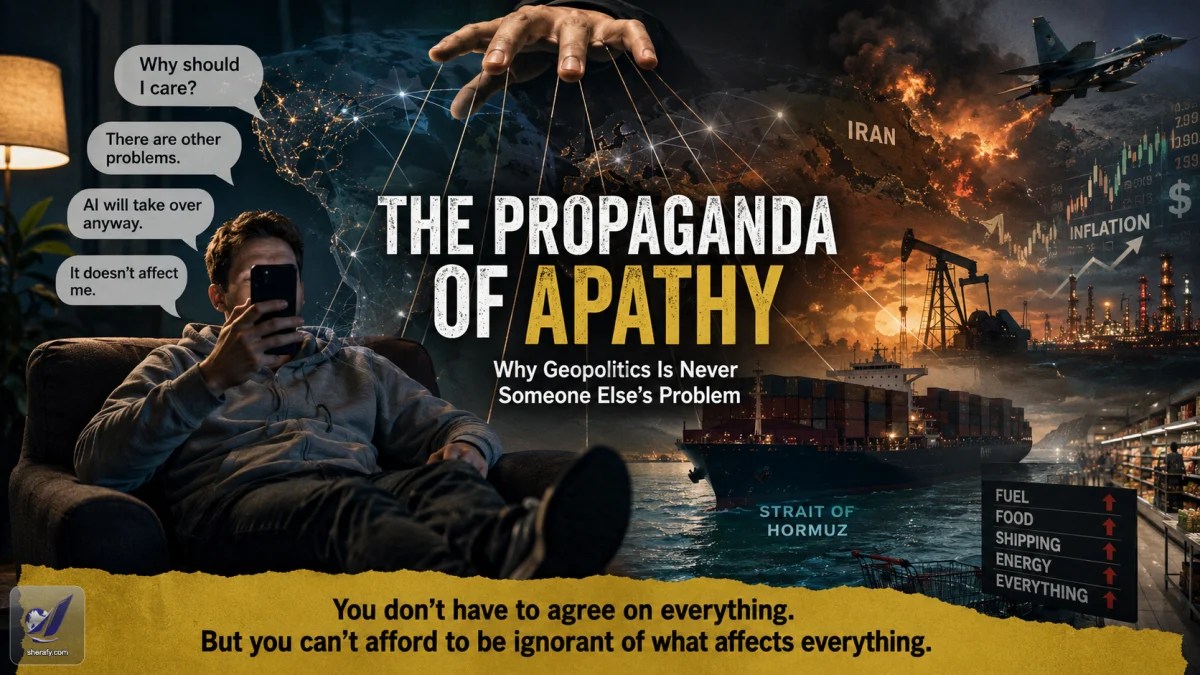
When people discuss Iran, the Strait of Hormuz, global shipping, military alliances, sanctions, or international trade, a familiar response often appears:
Why do you care so much?
What does any of this have to do with your life?
There are problems here at home.
Politics is all corrupt anyway.
AI is going to replace everyone, so none of this will matter.
These statements can sound practical. Some even resemble wisdom: concentrate on your family, protect your peace, and avoid becoming consumed by events you cannot personally control.
There is a reasonable version of that advice. No one can study every conflict, follow every election, or spend every waking hour absorbing disturbing news. Constant outrage is not civic responsibility. Doomscrolling is not political education.
But there is also a far more dangerous version of the argument. It does not merely encourage balance. It teaches people that understanding power is pointless, that geopolitical events are irrelevant, and that anyone who takes them seriously is pretentious, paranoid, or wasting their life.
That message functions as a kind of meta-propaganda.
Traditional propaganda tells people what to believe. Meta-propaganda teaches them that belief, investigation, and participation are themselves foolish. Its objective is not necessarily to persuade the public that a government, corporation, war, or economic policy is good. It is enough to convince people that nothing can be understood, nothing can be changed, and caring is embarrassing.
Once that happens, power no longer needs widespread public agreement. It needs only public withdrawal.
The Most Effective Propaganda Does Not Always Ask for Belief
When people imagine propaganda, they often picture posters, patriotic slogans, fabricated news reports, or a government directly instructing citizens whom to support.
Modern propaganda is frequently more subtle. It can operate by producing confusion rather than conviction.
A population does not have to believe every official claim. It may be politically useful for people to conclude that all claims are probably dishonest, that every institution is equally corrupt, and that discovering the truth is impossible. Research on contemporary authoritarian propaganda describes how cynical audiences can be exploited precisely because they already distrust nearly every source of information. Blatantly false or contradictory messages can weaken the effect of accurate reporting by making the entire information environment seem contaminated.
The RAND Corporation has described Russia’s high-volume propaganda system as a “firehose of falsehood”: rapid, repetitive, multichannel messaging that does not require internal consistency. Its power lies partly in overwhelming the audience. When every event produces hundreds of claims, counterclaims, clips, conspiracies, corrections, and accusations, many people do not become informed. They become exhausted.
Exhaustion then becomes cynicism:
- Everyone lies.
- Both sides are the same.
- Nothing can be verified.
- Politics is only entertainment.
- Normal people should stay out of it.
This is an extraordinarily useful conclusion for anyone already holding power.
A citizen who strongly disagrees can organize, vote, investigate, protest, donate, publish, expose wrongdoing, or persuade others. A citizen who believes that everything is meaningless is far less threatening.
The ideal outcome is not always obedience. Sometimes it is resignation.
Political Apathy Can Be Produced
Political apathy is often treated as an individual personality trait. Some people care about politics; others supposedly do not.
Research suggests that apathy can also be socially cultivated.
A study of young Russians described an “apathy syndrome” in which repeated frustration developed into cynicism, mistrust, and disbelief in collective action. Families and institutions reinforced the idea that private life should take priority over public affairs. Political involvement became associated with risk, futility, and inappropriate emotional intensity.
Research examining democratic backsliding in Hungary similarly treats apathy as a potential strategy of autocratization. The political objective is not always to make everyone enthusiastically support the emerging authoritarian system. Discouraging opponents from acting may be sufficient.
Research on Chinese internet censorship offers another important lesson. Contrary to the assumption that authoritarian censorship simply removes all criticism of the government, researchers found that criticism could sometimes remain online while material with the potential to facilitate collective action was more likely to be suppressed. The central concern was not merely what an individual thought. It was whether people might connect, coordinate, and act together.
This distinction is crucial.
Power can often tolerate private anger. It becomes more concerned when private anger becomes shared knowledge, organized pressure, or coordinated resistance.
That is why the message “just focus on yourself” can have political consequences even when it does not originate from an official government campaign. It isolates people inside their private frustrations. Everyone may be struggling with the same economic or political conditions, but each perso experiences the struggle as an individual failure rather than a collective problem.
The citizen becomes a consumer managing symptoms instead of a participant questioning causes.
Ridicule Is a Form of Social Enforcement
Political disengagement is not enforced only through censorship. It can also be enforced socially.
People who discuss foreign policy seriously are often mocked for believing they are experts. Those who follow trade routes, military policy, international law, or sanctions may be accused of caring about distant abstractions while ignoring “real life.”
Humor itself is not the problem. Political satire can expose hypocrisy, translate difficult subjects, and give people the emotional strength to confront powerful institutions. However, research also warns that certain forms of satire can increase cynicism and reduce political efficacy—the belief that people understand politics and can affect it.
The difference is between humor directed at power and humor directed at the very idea of caring.
The first can be democratic. The second can be demobilizing.
When seriousness becomes socially embarrassing, fewer people speak. When fewer people speak, others may incorrectly conclude that almost nobody cares. Social scientists call one version of this problem pluralistic ignorance: people privately hold concerns but mistakenly believe those concerns are not widely shared.
Silence can therefore manufacture the appearance of consent.
A person may privately oppose a war, a corrupt policy, corporate capture, or an abuse of state power. But if public concern is treated as cringeworthy, irrational, or socially dangerous, that person may remain quiet. Others see the silence and assume there is no meaningful opposition. Each individual’s caution reinforces everyone else’s belief that resistance is marginal.
No police officer has to enter the room. Social ridicule performs part of the censorship.
“Why Should I Care About the Strait of Hormuz?”
The most direct answer is that geopolitics is not separate from everyday life. It is one of the systems that determines the cost and availability of everyday life.
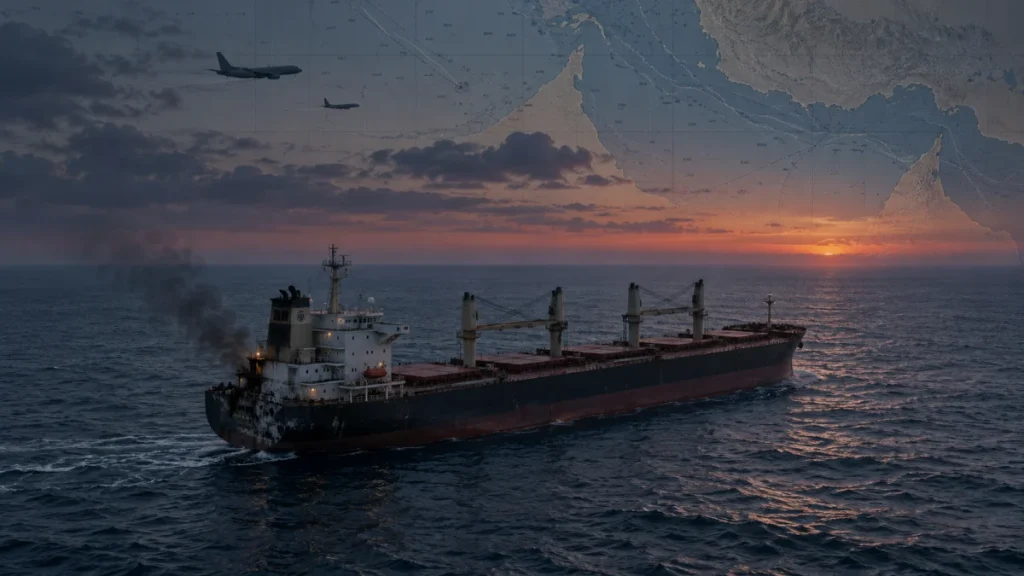
Consider the Strait of Hormuz, the narrow waterway connecting the Persian Gulf to the Gulf of Oman and the Arabian Sea.
In 2024 and early 2025, oil moving through Hormuz represented more than one-quarter of global seaborne oil trade and roughly one-fifth of total global petroleum consumption. Around one-fifth of global liquefied natural gas trade also passed through it, much of it originating in Qatar.
Hormuz is not important because people enjoy memorizing maps. It is important because a disruption in one narrow maritime corridor can affect:
- Crude-oil prices
- Gasoline and diesel prices
- Electricity and heating costs
- Airline and trucking expenses
- Shipping rates
- War-risk insurance premiums
- Fertilizer production and transportation
- Food production
- Consumer prices
- Interest-rate decisions
- Government budgets
- Employment and investment
Approximately one-third of global seaborne fertilizer trade passes through the strait. During the 2026 disruption, UN Trade and Development warned that higher tanker rates, marine-fuel costs, insurance premiums, and fertilizer risks could spread through supply chains, with especially severe consequences for poorer countries.
This is how an event that appears thousands of miles away reaches a household.
A tanker route becomes dangerous. Insurers charge more to cover ships. Some vessels are delayed, rerouted, or removed from service. Oil, natural gas, and shipping costs rise. Diesel becomes more expensive. Trucking, aviation, construction, plastics, manufacturing, and agriculture absorb higher expenses. Businesses then raise prices, reduce investment, cut hours, freeze hiring, or pressure governments for relief.
Fertilizer prices can increase the cost of growing food months before the consumer sees the final grocery bill. Shipping disruptions can increase the price of imported machinery, electronics, medicines, clothing, replacement parts, and industrial materials. Energy shocks can weaken currencies and increase government borrowing costs, particularly in countries already carrying high levels of debt.
The average shopper will never see a line on a receipt labeled Strait of Hormuz surcharge. The effect appears indirectly, distributed across dozens of prices and economic decisions.
That invisibility makes the system easy to dismiss. It also makes the public easier to manipulate.
Global Trade Is the Hidden Infrastructure of Ordinary Life
Modern life depends on systems most people rarely see.
A product may be designed in one country, financed in another, assembled in a third, built from materials originating in several more, shipped through multiple maritime chokepoints, insured by an international company, processed at a domestic port, transported by diesel truck, and sold by a local retailer.
The final purchase feels local. The production system is global.
This does not mean globalization is automatically good or that every trade agreement benefits every worker. Trade can produce displaced industries, dangerous dependencies, labor exploitation, environmental damage, and concentrated corporate power. Those are reasons to understand the system, not reasons to ignore it.
A population that does not understand trade cannot meaningfully debate:
- Which industries should be produced domestically
- Which imports are strategically dangerous to depend upon
- Whether tariffs will protect workers or merely raise prices
- How sanctions affect civilians and political elites
- Which supply chains require redundancy
- Whether corporations are using geopolitical events to justify excessive price increases
- How military commitments protect—or endanger—commercial routes
- Who ultimately receives the benefits of public subsidies and emergency relief
The alternative to global literacy is not independence from the world. It is dependence without understanding.
Iran Is Not Merely a “Foreign” Issue
The conflict involving Iran illustrates the false separation between foreign policy and domestic life.
Iran sits beside one of the world’s most important energy corridors. It is connected to regional military alliances, oil production, shipping security, nuclear policy, sanctions, Gulf-state infrastructure, and broader competition among the United States, China, Russia, Israel, and other regional powers.
By mid-July 2026, renewed American-Iranian hostilities and attacks involving shipping around Hormuz again destabilized a route that had only recently begun reopening. The rapid movement between disruption, partial stabilization, and renewed conflict demonstrates why geopolitical conditions cannot be treated as distant background noise.
One does not have to support the Iranian government, the American government, Israel, Gulf monarchies, or any particular military campaign to understand the stakes.
In fact, serious geopolitical attention should reduce simplistic loyalty. An informed person can ask several questions at once:
- What triggered the escalation?
- Which claims have been independently verified?
- Who benefits from prolonging the conflict?
- Who bears the human and economic costs?
- What diplomatic alternatives existed?
- What legal authority is being claimed?
- How could retaliation expand beyond the original combatants?
- How will energy, fertilizer, shipping, and financial markets react?
- Are officials accurately describing the risks to the public?
- Are businesses using the crisis to pass on costs beyond what the disruption justifies?
These are not questions for people pretending to be generals. They are questions for citizens whose money, security, relatives, taxes, employment, and political rights may be affected.
War is financed by the public, fought by members of the public, justified to the public, and followed by economic consequences absorbed by the public. Calling it “foreign” does not make those consequences foreign.
History Repeatedly Punishes the Illusion of Distance
The economic shocks of the 1970s provide a clear historical example.
The 1973–1974 oil crisis contributed to major price, balance-of-payments, and economic pressures around the world. Later oil disruptions connected to Iran in 1979 helped contribute to the recessionary and inflationary difficulties of the early 1980s.
The details of today’s energy system are different. Economies generally use less oil per unit of economic output than they did in the 1970s, and production is more geographically diversified. But reduced vulnerability is not the same as immunity.
The larger historical lesson is not that every overseas crisis produces catastrophe. It is that physical distance does not guarantee economic or political isolation.
Events involving shipping lanes, commodity producers, industrial centers, financial institutions, or military alliances can rapidly cross borders. The transmission mechanism may be oil, grain, fertilizer, semiconductors, credit markets, migration, insurance, cyberattacks, military obligations, or political instability.
People often begin paying attention only after the consequence reaches them personally. By then, the important decisions may already have been made.
“AI Will Take Over Anyway” Is Fatalism Disguised as Foresight
Artificial intelligence introduces a newer version of the same argument.
The reasoning usually sounds like this:
AI will replace millions of jobs. Corporations will become more powerful. Governments will use automated systems. The technology cannot be stopped. Therefore, studying geopolitics, voting, organizing, or demanding accountability is pointless.
That conclusion does not follow.
If AI is likely to transform employment, surveillance, weapons, media, education, public benefits, policing, and government decision-making, then political engagement becomes more important, not less.
Technology does not determine by itself:
- Who owns the systems
- Who receives the productivity gains
- Whether workers share in those gains
- What data may be collected
- Whether automated decisions can be appealed
- Whether AI companies can form monopolies
- Whether autonomous weapons are permitted
- Whether displaced workers receive income, training, ownership, or nothing
- Whether public agencies must disclose how algorithms make decisions
- Whether corporations or citizens set the rules
Those are political choices.
Recent research on AI in government emphasizes concerns about transparency, dependency, contestability, and the public’s ability to retain control over delegated decisions. Research also shows that public beliefs about AI’s economic effects are already connected to preferences over how governments should respond to possible job displacement.
Saying that AI is inevitable does not tell us what kind of AI economy is inevitable.
Fatalism collapses a range of possible futures into one supposedly predetermined outcome. That is politically convenient for those already positioned to own the infrastructure.
If the public believes the future cannot be influenced, then the companies building that future face less resistance over ownership, labor rights, privacy, safety, taxation, competition, and democratic oversight.
“I cannot personally stop technological progress” may be true.
“Therefore, society has no choices to make” is false.
A Passive Population Does Not Become Free. It Becomes Governable.
The language of slavery should be used carefully. Political disengagement does not automatically make someone a slave in the literal or legal sense.
But it can move a person from citizenship toward subjecthood.
A citizen is not merely someone who lives under a government. A citizen is someone who understands that public systems can be questioned, challenged, influenced, and redesigned.
A subject experiences those same systems as weather.
Prices rise. Wars begin. surveillance expands. Employment disappears. Public money moves upward. Rights narrow. Algorithms make decisions. Corporations consolidate. The subject may complain, joke, or privately rage, but does not imagine that organized action is legitimate or useful.
This is why apathy is so valuable to concentrated power.
It turns political choices into natural events.
Austerity becomes “economic reality.”
War becomes “what had to happen.”
Monopoly becomes “innovation.”
Job insecurity becomes “the future.”
Mass surveillance becomes “convenience.”
Corruption becomes “how the world works.”
None of these explanations must be completely false to be manipulative. The deception often lies in presenting a contested decision as though no alternative ever existed.
Caring Does Not Mean Obsessing
The answer to political apathy is not permanent emotional emergency.
People have jobs, families, health concerns, financial pressures, and limited time. Expecting every person to become an expert in energy markets, maritime law, Iranian politics, international finance, artificial intelligence, and military strategy would be unreasonable.
Healthy civic attention requires selection and structure.
A person does not need to know everything. But every citizen should develop enough political and economic literacy to recognize when a supposedly distant event can affect personal life.
A useful minimum framework is to ask:
- What system is involved?
Energy, food, shipping, finance, technology, military security, law, or another essential structure? - What is the transmission mechanism?
How could this event reach prices, employment, taxes, rights, safety, or public services? - Who benefits from my confusion or disengagement?
Which governments, industries, political factions, or institutions face less scrutiny when the issue appears too complicated to understand? - What is verified, and what remains uncertain?
Serious engagement requires distinguishing evidence from propaganda, not choosing a preferred propaganda source. - What form of action is realistic?
Voting, contacting representatives, supporting investigative journalism, joining an organization, discussing the issue accurately, changing purchasing behavior, attending a local meeting, or simply refusing to repeat an unverified claim.
Not every issue requires personal activism. But dismissing an issue should be the result of informed prioritization, not trained helplessness.
The Real Meaning of “Why Should I Care?”
The question “Why should I care?” can be sincere. People deserve a clear explanation of why a distant waterway, foreign election, military alliance, sanction, or trade dispute matters.
But the question can also contain a deeper assumption: that a person should care only about consequences that are immediate, visible, and personal.
That is an impossible standard in a complex society.
By the time a geopolitical event becomes visibly personal, it may already have shaped fuel prices, grocery costs, employment conditions, tax policy, migration patterns, military deployments, interest rates, public spending, or the balance of political power.
Understanding these connections is not a hobby for elites. It is a form of self-defense.
The public does not need to agree on every conflict. It does not need one approved ideology. It does not need permanent outrage.
It needs the confidence to believe that reality can be investigated, that power can be understood, and that collective decisions are not forces of nature.
The most dangerous propaganda may not be the message telling you to support the system.
It may be the message telling you that the system is too distant, too complicated, too inevitable, or too absurd to be worth understanding.
Because once a population stops asking how power works, it does not escape politics.
It simply gives up its role in deciding what politics will do to it.
References and Further Reading
Geopolitics, Energy and Global Trade
- U.S. Energy Information Administration — “Amid Regional Conflict, the Strait of Hormuz Remains Critical Oil Chokepoint”
Official data explaining how much oil and liquefied natural gas moves through the Strait of Hormuz, the limited availability of alternative routes, and how disruptions can increase shipping and energy costs. - UN Trade and Development — “Strait of Hormuz Disruptions: Implications for Global Trade and Development”
A broader analysis of how disruption around Hormuz can affect energy markets, shipping, fertilizers, food prices, insurance costs, supply chains and financially vulnerable countries. - World Bank — “How Do Current Oil Market Conditions Differ from Those During the Price Shocks of the 1970s?”
Explains the historical importance of the 1970s oil shocks while examining why today’s global economy is more diversified—but still vulnerable to major energy disruptions.
Propaganda, Cynicism and Political Apathy
- Christopher Paul and Miriam Matthews, RAND Corporation — “The Russian ‘Firehose of Falsehood’ Propaganda Model”
A foundational explanation of high-volume propaganda that operates through repetition, contradiction, confusion and information overload rather than through one consistently believable narrative. - Alexei Zakharov — “Propaganda to a Cynical Audience”
Research examining how propaganda can remain effective among people who already distrust official information by deepening cynicism and weakening the credibility of competing sources. - Anna Zhelnina — “The Apathy Syndrome: How We Are Trained Not to Care About Politics”
A study of how frustrating political experiences, family attitudes, educational institutions and cultural expectations can produce cynicism, political avoidance and disbelief in collective action. - Laura Jákli — “Political Apathy as Autocratization Strategy: Evidence from Hungary”
An overview of research treating political apathy as a demobilizing force that can help emerging authoritarian systems consolidate power without obtaining enthusiastic public support.
Censorship, Collective Action and Social Silence
- Gary King, Jennifer Pan and Margaret E. Roberts — “How Censorship in China Allows Government Criticism but Silences Collective Expression”
An influential study finding that censorship may focus less on eliminating every criticism than on suppressing communication with the potential to facilitate collective organization and action. - Dale T. Miller — “A Century of Pluralistic Ignorance: What We Have Learned About Its Origins, Forms and Consequences”
A review of how people can systematically misjudge the private beliefs of others, causing widely shared concerns to appear socially marginal and discouraging people from speaking or acting. - Amy Bree Becker and colleagues — “Satire and Efficacy in the Political Science Classroom”
Research relevant to the complicated relationship between political humor, cynicism, public understanding and people’s belief that political participation can make a difference.
Artificial Intelligence, Employment and Democratic Choice
- Organisation for Economic Co-operation and Development — Artificial Intelligence Policy and Research
An extensive collection of policy research concerning trustworthy AI, democratic values, privacy, safety, accountability, employment and governmental oversight. - International Labour Organization — “Generative AI and Jobs: A Refined Global Index of Occupational Exposure”
A detailed assessment of how generative AI may transform occupations across countries and industries, emphasizing that exposure to automation does not automatically determine how governments, employers and workers respond.
Links and source attributions verified July 21, 2026.