
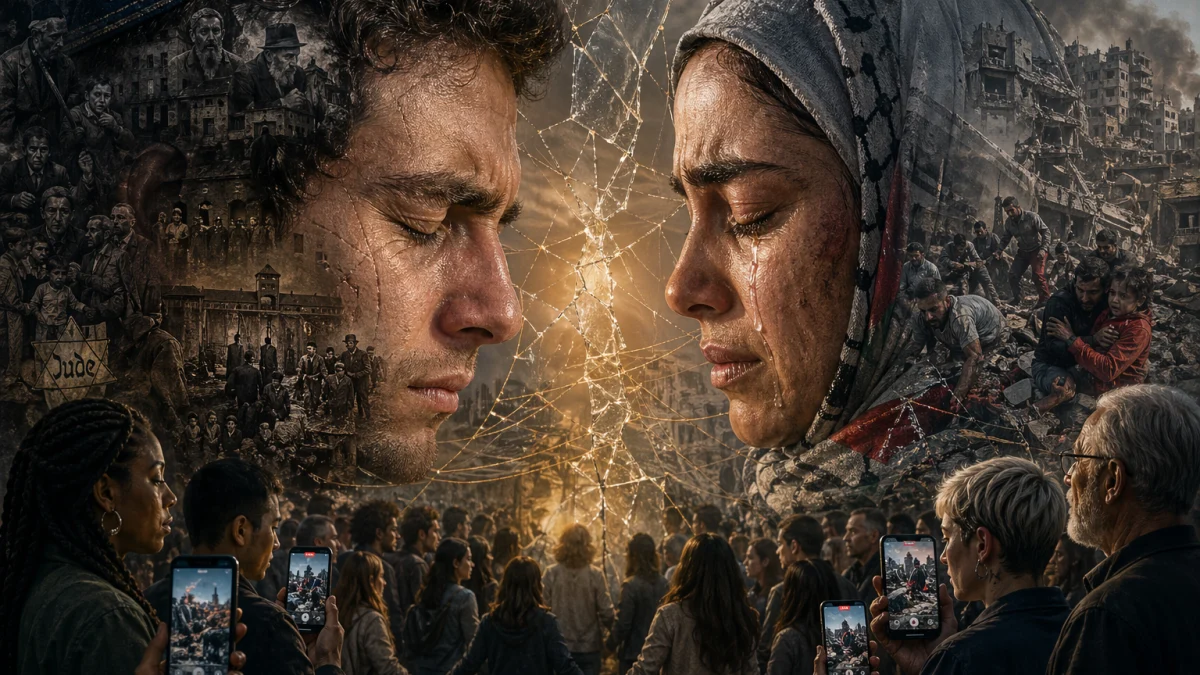
Much of the oral history and lived internal tensions explored in this piece were informed by engagement with the work and voice of David Spevak — someone who occupies a genuinely rare position in this conversation. Having grown up inside the very community and cultural environment this essay attempts to understand, his public messaging offers something that outside analysis simply cannot: the texture of lived experience from within. His willingness to speak openly about these tensions on social media has been a quiet but meaningful thread running through the thinking behind this piece. If these questions stay with you, following him is one of the most direct ways to keep learning from a voice that has earned its perspective. Find him at @davidsaysstuff.
There is a feeling that precedes thought. It lives in the body before the mind can name it—a tightening in the chest, a quickening of breath, the ancient animal certainty that something dangerous is approaching. For many Jewish people alive today, criticism of Israel activates that feeling. Not as metaphor. Not as performance. As something inherited, cellular, carried forward through generations that learned, again and again, that when the world turns its attention toward Jewish people, what follows is rarely kind.
That feeling is not imaginary. It did not appear from nowhere. It was built, brick by brick, across centuries of expulsion, pogrom, ghetto, and genocide. It was reinforced by a twentieth century that confirmed the worst possible version of Jewish historical memory—that the world will, when given the opportunity, look away. Or worse, participate. To dismiss that psychological inheritance as mere sensitivity is to misunderstand what history does to a people. It does not simply pass. It sediments. It becomes architecture.
And so when millions of people around the world raise their voices against the Israeli state, something happens inside many Jewish communities that outsiders often fail to recognize: the criticism does not land as politics. It lands as threat. It registers not in the part of the brain that evaluates policy, but in the part that scans for danger. The part that remembers.
This must be understood before anything else can be said honestly.
Two Conversations That Cannot Hear Each Other
But understanding is not the same as agreement, and empathy is not the same as immunity. And here is where the present crisis lives—not in the streets of any single city, but in the space between two simultaneous conversations that have lost the ability to hear each other.
One conversation is about material reality. It is about what is happening on the ground, in real time, to real human bodies. It is about neighborhoods reduced to rubble. About children pulled from wreckage. About displacement measured not in metaphor but in miles walked, in homes lost, in generations uprooted. The people having this conversation are responding to what they see, and what they see is suffering at a scale that demands response. They are not, in the main, parsing ancient theological disputes or litigating the nuances of twentieth-century diplomacy. They are watching people die and asking why the world is allowing it.
The other conversation is about identity under siege. It is about what it feels like to hear your people’s homeland called illegitimate. To hear the word “genocide” applied to a state that was born, in part, as a response to genocide. To watch protest signs blur the line between a government and a people, and to feel, with that old and terrible certainty, that the blur is not accidental. The people having this conversation are not indifferent to suffering. Many of them are anguished by it. But their anguish is competing with something equally powerful—the fear that this moment is not really about policy at all, but about them. About who they are. About whether there is room for them in the moral universe being constructed.
These two conversations are not having a disagreement. They are having entirely different experiences of the same events. And because neither can fully see the other, they collide instead of converging—producing not understanding, but noise. Escalation. Entrenchment. The slow, corrosive certainty on both sides that the other is acting in bad faith.
This collision is not inevitable. But it is, at present, nearly total.
The Fusion That Is Breaking Everything
At the center of this wreckage sits a single conflation, deceptively simple and enormously destructive: the fusion of Jewish identity with the Israeli state.
This fusion did not happen by accident. It was constructed deliberately over decades, by political leaders who understood its power. If Israel is not merely a country but an expression of Jewish peoplehood—if its flag is not a national banner but a communal one, if its wars are not strategic but existential, if its critics are not political opponents but enemies of a people—then the state becomes unassailable. Not because its actions are beyond reproach, but because reproach itself becomes an act of aggression against an identity. Criticism is transmuted, through this alchemy, into bigotry. And the conversation ends before it can begin.
This is a profoundly seductive framework. It offers, to those inside it, the comfort of moral clarity: we are not defending a government, we are defending ourselves. And for a people whose history provides ample evidence that self-defense is not paranoia but survival, the appeal is almost gravitational.
But the cost is catastrophic, and it is paid by everyone—including, and perhaps especially, by Jewish people themselves.
Because when identity and state are made synonymous, two things happen simultaneously, each feeding the other in a cycle that benefits no one except those who prefer silence to accountability.
First, every critique of Israeli policy, no matter how specific, no matter how grounded in evidence, no matter how carefully it distinguishes between a government and a people, is absorbed into the category of antisemitism. A student protesting military operations becomes an antisemite. A human rights organization documenting civilian casualties becomes an antisemitic institution. A Jewish person who dissents from Israeli policy becomes a self-hating traitor. The word loses its precision. It becomes not a scalpel but a bludgeon, deployed so frequently and so indiscriminately that it begins to mean everything and therefore nothing.
Second—and this is the part that should terrify anyone who actually cares about Jewish safety—actual antisemitism becomes harder to name, harder to see, harder to fight. When the same word is used to describe someone spray-painting a swastika on a synagogue and someone calling for a ceasefire, the public loses its ability to distinguish between genuine hatred and political disagreement. The boy who cried wolf is not a children’s story. It is a warning about what happens when a legitimate alarm is sounded so often, and so carelessly, that the world stops listening. And when the world stops listening, the people who face real, violent, specific antisemitism—the kind that results in bullets and broken glass—are left more exposed, not less.
The fusion was supposed to be a shield. It is becoming a trap.
The Engine of Visibility
There is another dimension to this moment that must be named, because without it, the intensity of global response appears inexplicable—and in that inexplicability, prejudice becomes the only available explanation.
We are living through an unprecedented revolution in the visibility of war.
For most of human history, the suffering caused by military operations was experienced only by those on the ground and narrated, after the fact, by those with the power to narrate. Governments controlled the frame. Distance provided insulation. The gap between an event and its telling could be days, weeks, years—long enough for context to be curated, for language to be softened, for attention to move elsewhere.
That world is gone.
Today, a person in Lagos or São Paulo or Stockholm can watch, in real time, footage filmed by the people experiencing bombardment. They can see the dust. They can hear the screaming. They can watch a parent carry a child’s body through streets that were, hours earlier, a neighborhood. This is not filtered through a press conference or a diplomatic statement. It arrives raw, unmediated, and at a volume and frequency that the human nervous system was not designed to absorb.
When people see this—when they see it not once but hundreds of times, not from one source but from thousands—they react. They react with outrage, with grief, with the urgent conviction that what they are witnessing must stop. This is not a sophisticated geopolitical analysis. It is a human response to human suffering, and it operates on a moral logic that is as old as empathy itself: this is wrong, and it must end.
Does this mean every reaction is perfectly informed? No. Does it mean that no bad actors exploit the moment to advance genuine bigotry? Of course not. Antisemitism is real, it is persistent, and it does spike in moments of heightened conflict. People who hate Jewish people will always find permission in moments of crisis, and they must be identified, confronted, and opposed.
But to interpret the entirety of global outcry as antisemitism—to look at millions of people on every continent, from every background, representing every faith and no faith, and conclude that what unites them is hatred of Jews—is to make an error so profound that it forecloses the possibility of understanding what is actually happening.
What is actually happening is that people are watching other people suffer, and they are saying so. Loudly. Imperfectly. Sometimes clumsily. But overwhelmingly, they are responding to what is being done, not to who is doing it.
The failure to recognize this distinction is not just intellectually dishonest. It is strategically disastrous. Because it transforms potential allies into perceived enemies, and it ensures that the conversation never reaches the only place where it might actually matter: the material reality of what is happening, and what can be done to stop it.
The Necessary Separation
So where does this leave us?
It leaves us at a threshold that must be crossed, however uncomfortable the crossing. And the threshold is this: Jewish identity and the Israeli state must be understood as separate things.
This is not a denial of connection. Many Jewish people feel a genuine, deep, historically rooted bond with Israel. That bond is real, and no one is required to sever it. But a bond is not an equivalence. A feeling of connection to a place is not the same as moral responsibility for every action taken by its government. And the insistence that these are the same—that to criticize Israel is to attack Jewish people—does not protect Jewish identity. It conscripts it. It places an entire people in front of a government’s record and says: defend this, or be disloyal.
That is not solidarity. It is a hostage situation dressed in the language of belonging.
The separation must be made, and it must be made clearly, for reasons that serve everyone:
It serves Palestinian people, who deserve to have their suffering addressed on its own terms, without every conversation about their lives being rerouted through someone else’s identity crisis.
It serves Jewish people, who deserve the freedom to engage with Israeli policy critically, to dissent, to grieve, to demand better—without being told that their conscience makes them traitors.
It serves the global public, who deserve the ability to respond to visible human suffering without being accused of bigotry for doing so.
And it serves the fight against antisemitism itself, which can only be waged effectively when the word refers to what it actually means: hatred of Jewish people for being Jewish. Not disagreement with a government. Not protest against a military campaign. Not the anguished, imperfect, sometimes clumsy attempt by human beings to say that what they are seeing is unconscionable.
What It Sounds Like When It’s Said Right
None of this means that the conversation is easy, or that tone does not matter. It does. Profoundly.
There is a version of this argument that opens doors, and a version that slams them shut. “This isn’t about you” is the version that slams. It may be technically accurate. It is also functionally useless, because it tells a person whose nervous system is in threat-response mode that their experience is irrelevant. And a person who feels dismissed does not reconsider. They fortify.
The version that opens doors sounds different. It sounds like:
I understand that this feels personal. I understand that your history gives you every reason to hear criticism of Israel as something aimed at you. That history is real, and I am not asking you to forget it. But I am asking you to hold two things at the same time: the reality of your fear, and the reality of someone else’s suffering. Because right now, the conversation is about what is happening to real people—about actions and consequences that exist in the world regardless of how they make any of us feel. And we have to be able to talk about that. Not instead of your experience, but alongside it. Because if we can’t, then the only people who benefit are the ones who prefer silence.
That framework does not erase identity. It does not mock fear. It does not pretend that history is irrelevant. What it does is insist, firmly and with care, that identity cannot function as a veto on moral inquiry. That the question “Is this causing harm?” must be answerable, regardless of who is asking it and who it is asked about.
The Space That Is Collapsing
There is a space—narrow, fragile, essential—where it is possible to hold all of the following as simultaneously true:
That Jewish history is marked by real and repeated persecution, and that this history shapes how Jewish people experience the present.
That antisemitism is a living force, not a historical relic, and that it must be fought with precision and seriousness.
That the Israeli government is a political entity whose actions are subject to the same moral scrutiny as those of any other government on earth.
That Palestinian people are full human beings whose lives, dignity, and suffering are not secondary to anyone else’s narrative.
That it is possible—indeed, necessary—to care about Jewish safety and Palestinian safety at the same time, because these are not competing commitments but complementary ones.
This space is where dialogue lives. It is where understanding becomes possible. It is where the false choice between empathy and accountability dissolves, because both are held, both are honored, and neither is weaponized against the other.
Right now, that space is collapsing. It is collapsing under the weight of pain, of history, of algorithms that reward outrage over nuance, of political actors on every side who benefit from polarization, of a media environment that has no room for complexity and no patience for grief that does not fit a clean narrative.
But the space is not gone. It is compressed, under pressure, barely breathing—but it is there. And every person who refuses the false binary, who insists on holding complexity even when it is uncomfortable, who speaks with both honesty and care, is doing the quiet, essential work of keeping it open.
What You Walk Away Knowing
If you have read this far, here is what I hope you carry with you:
That empathy is not a finite resource, and extending it to one group does not require withdrawing it from another. That identity is real but not sovereign—it can explain a reaction without justifying it. That governments are not peoples, and peoples are not governments, and the deliberate blurring of that line serves power, not truth. That the ability to distinguish between hatred of who someone is and opposition to what someone’s government does is not a rhetorical trick but a moral necessity. And that the hardest, most important conversations are not the ones where you are certain you are right, but the ones where you are willing to hold your certainty in one hand and someone else’s pain in the other, and let them both be real at the same time.
The world is not turning against Jewish people. The world is turning toward a suffering it can no longer unsee. And the difference between those two sentences is not subtle. It is everything.