
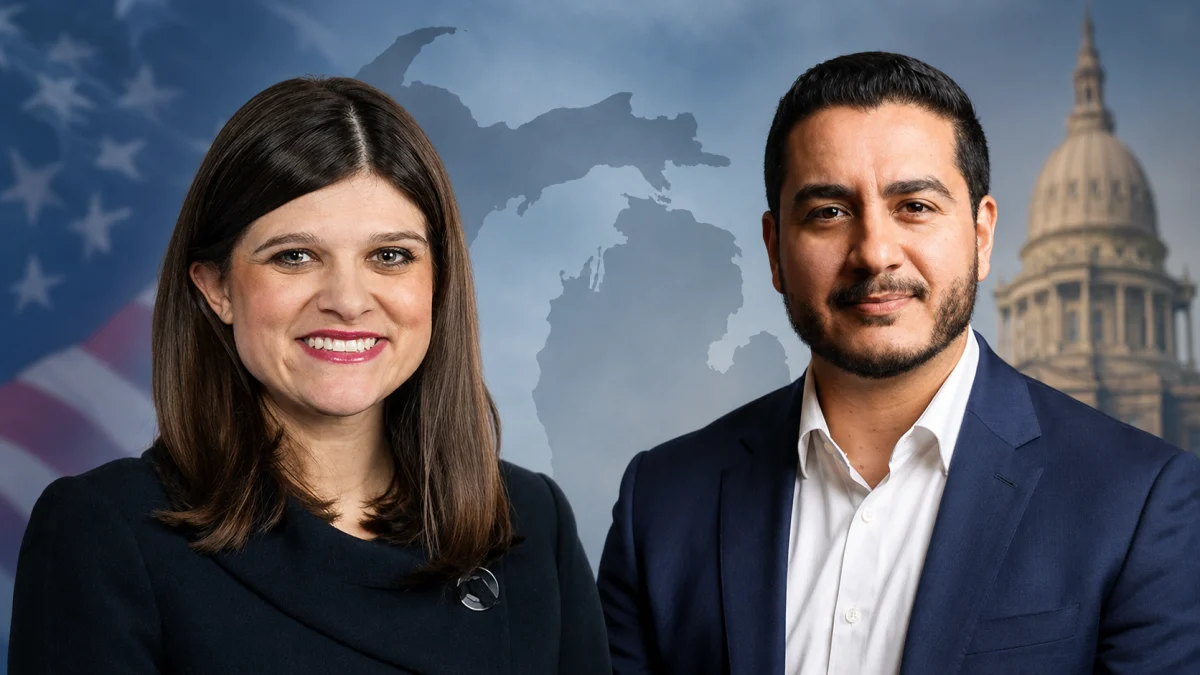
Yes. Haley Stevens endorsed Abdul El-Sayed after he defeated her in Michigan’s Democratic primary for U.S. Senate.
She did not merely acknowledge the result and disappear.
Stevens said she had spoken directly with El-Sayed, offered him her “full support” and urged Democrats to unite behind him against Republican Mike Rogers in November. She later reinforced that position publicly, describing the primary as over and saying the two sides had effectively reached their “unity deal.”
Considering how bitter, expensive and ideologically divided the primary had been, that is worth acknowledging.
And speaking personally, I think Stevens deserves some credit for it.
Not because I suddenly believe in “vote blue no matter who.”
I still don’t.
“Vote Blue No Matter Who” Is Still a Bad Political Principle
I have never believed that voters should support candidates simply because they belong to the correct political party.
Candidates should be judged individually.
Their policies matter. Their donors matter. Their judgment matters. Their integrity matters. Their willingness to stand up to powerful interests matters.
A party label should never substitute for that evaluation.
So this is not an argument that Democrats should automatically support every Democratic nominee. Nor is it an endorsement of the broader “vote blue no matter who” mentality that has often been used to shut down legitimate criticism of establishment Democratic candidates.
What makes the Stevens situation interesting is almost the reverse.
The political faction most associated with demanding party unity just lost to the progressive faction — and Stevens is actually honoring the standard her side has so often asked everyone else to follow.
That deserves some respect.
Haley Stevens and Abdul El-Sayed Represented Very Different Democratic Coalitions
Stevens and El-Sayed were not interchangeable candidates.
Stevens represented a more traditional establishment-oriented wing of the Democratic Party. Her campaign attracted enormous outside financial support, including tens of millions of dollars from groups aligned with AIPAC.
El-Sayed ran explicitly to her left.
He campaigned on Medicare for All, restrictions on money in politics, progressive economic policies and a substantially different approach to U.S. policy toward Israel.
Those differences were real.
So were the criticisms directed at Stevens during the campaign.
I was among the people deeply uncomfortable with the extraordinary outside spending supporting her candidacy. Nothing about her endorsement of El-Sayed retroactively erases those concerns.
But political criticism should not require pretending that someone is incapable of doing something commendable afterward.
El-Sayed won.
Stevens accepted that.
And rather than undermining him after the primary, she publicly backed him.
That is the part worth recognizing.
Yes, I Obviously Want Haley Stevens Supporting El-Sayed
There is also no reason to pretend I am neutral about the outcome.
I preferred El-Sayed.
I am glad he won.
And of course I would rather have Haley Stevens encouraging her supporters to vote for him than spending the next three months attacking him.
That is hardly a hidden motive.
But there is still a meaningful principle underneath it.
For years, progressive voters have frequently been told that once a Democratic primary ends, internal disagreements should be put aside because defeating the Republican candidate is more important.
That argument has overwhelmingly been directed at progressives after establishment Democrats win primaries.
This time, the direction is reversed.
The progressive won.
The establishment candidate lost.
And Stevens did not suddenly discover that party unity only applies when her side wins.
She conceded, offered El-Sayed her support and told her voters where she stood.
Whatever someone thinks about the underlying “vote blue no matter who” philosophy, consistency is better than hypocrisy.
Stevens Did Not Pretend Their Disagreements Disappeared
Another important part of the story is that Stevens has not suddenly adopted El-Sayed’s entire political platform.
She continues to disagree with him on major issues.
She has maintained her own views on Israel and other policy questions, and she has not portrayed her endorsement as some sweeping ideological conversion.
That actually makes her response more credible.
Supporting someone after a primary does not require pretending the primary never happened.
Stevens can believe El-Sayed was wrong about certain issues while also recognizing that Democratic voters chose him.
Those positions are not contradictory.
There is a difference between ideological surrender and accepting an election result.
Political Accountability Should Work Both Ways
There is a broader reason I think this matters.
If we are willing to criticize politicians when they deserve criticism, we should also be willing to acknowledge when they behave better than expected.
Otherwise, criticism becomes tribal rather than analytical.
Stevens received substantial criticism during the primary, including over the enormous amounts of outside money supporting her campaign.
Some of that criticism was justified.
But if the standard becomes “Haley Stevens is bad, therefore everything Haley Stevens does must also be bad,” then we are no longer evaluating behavior.
We are merely defending teams.
That is precisely the kind of politics I dislike.
You can oppose someone politically without needing them to become a cartoon villain.
And in this particular instance, Stevens handled losing better than many politicians do.
This Is What Respecting a Primary Result Looks Like
Primaries are supposed to resolve disagreements inside political parties.
Candidates compete.
Voters decide.
Someone wins.
Someone loses.
What happens next says something about the people involved.
Haley Stevens could have offered a sterile congratulations and quietly disappeared.
She could have blamed El-Sayed’s supporters.
She could have spent the general election emphasizing why she believed he was too progressive, too controversial or too difficult to elect.
Instead, she publicly offered him her support.
That does not make every criticism of Stevens disappear.
It does not make “vote blue no matter who” a good philosophy.
And it certainly does not mean voters should stop evaluating candidates on their individual merits.
It means something much narrower.
Haley Stevens lost to a progressive candidate, accepted the result and followed through on the party-unity principle that establishment Democrats have spent years asking progressive voters to honor.
I am glad she did.
Partly because I want Abdul El-Sayed to win.
But also because if you demand a standard from other people, you should be willing to live by that standard when the election does not go your way.
On that point, Haley Stevens deserves credit.
References and Further Reading
CBS News — Haley Stevens discusses supporting Abdul El-Sayed after Michigan primary
Stevens discusses the end of the primary, her remaining disagreements with El-Sayed and the decision to unite behind the Democratic nominee.
The Times of Israel — Haley Stevens endorses Abdul El-Sayed after conceding Michigan Senate race
Coverage of Stevens’ concession and her statement offering El-Sayed her full support in the general election.
Associated Press — AIPAC spending in Michigan’s Democratic Senate primary
Detailed reporting on the extraordinary outside spending supporting Stevens during the Democratic primary.
Associated Press — Abdul El-Sayed wins Michigan Democratic Senate primary
Overview of El-Sayed’s victory, the ideological divide in the race and the broader significance for the Democratic Party.