
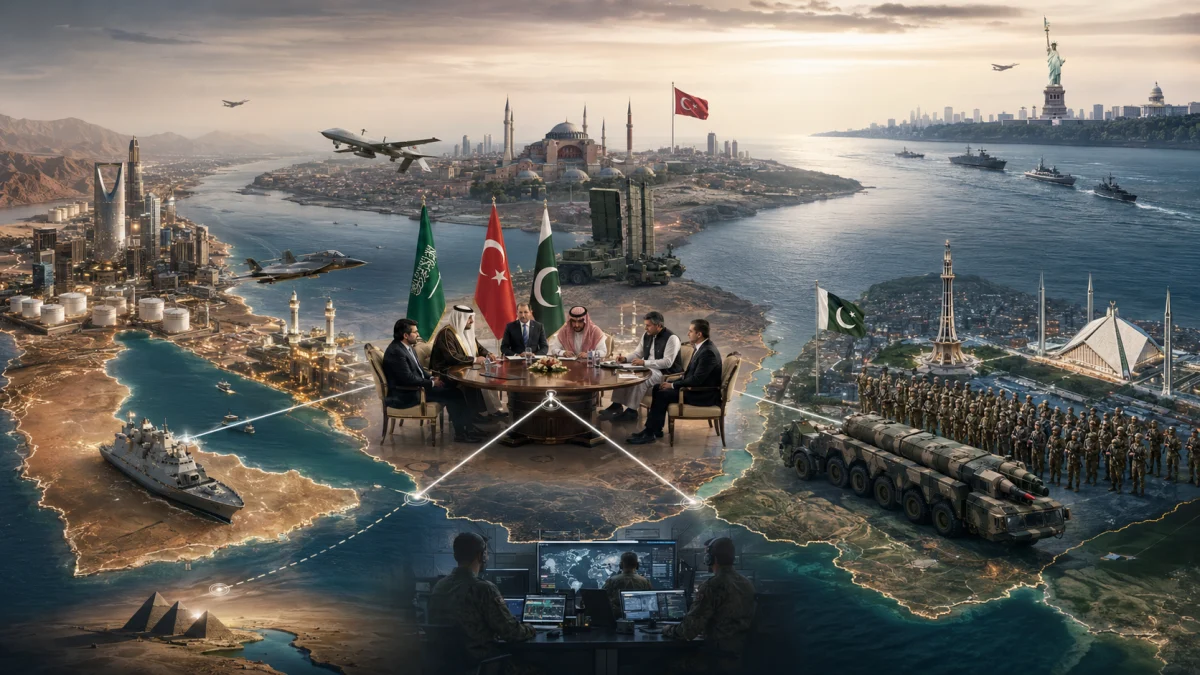
Saudi Arabia, Turkey and Pakistan have created a real mutual-defense alliance with an unusually strong commitment: an armed attack against one of the three countries will be considered an attack against all three.
That part is not speculation.
On August 7, 2026, Saudi Crown Prince Mohammed bin Salman, Turkish President Recep Tayyip Erdoğan and Pakistani Prime Minister Shehbaz Sharif signed the Makkah Joint Defence Agreement, also widely called the Mecca Joint Defense Agreement, at Al-Safa Palace in Mecca.
The official joint statement says the agreement is designed to strengthen collective deterrence and expressly provides that an armed attack against any one of the three states will be regarded as an attack against all of them. It also commits the countries to expand defense cooperation.
That is why the agreement is already being described as a possible “Muslim NATO.”
That description is not completely ridiculous. Turkish Foreign Minister Hakan Fidan himself said the agreement’s collective-defense provision is technically comparable to NATO’s Article 5. Turkey has also disclosed plans for joint exercises, recurring meetings involving foreign ministers, defense ministers and military chiefs, and a permanent coordinating secretariat in Saudi Arabia.
But calling it a finished Islamic version of NATO goes too far.
The more accurate answer is this:
Saudi Arabia, Turkey and Pakistan have created the foundation of a new regional collective-defense alliance. It has a NATO-like mutual-defense clause and is beginning to develop permanent institutions, but it does not yet possess anything approaching NATO’s integrated military structure, decades of joint planning or established operational machinery.
Whether it eventually develops those things is now one of the most important questions in the region.
What Did Saudi Arabia, Turkey and Pakistan Actually Agree To?
The core language is remarkably straightforward.
The official Saudi and Pakistani statements say that an “armed attack against any one of the three States shall be regarded as an attack against them all.”
The agreement also calls for broader defense cooperation among the three states.
Subsequent explanations from Turkish officials have provided considerably more detail.
Foreign Minister Hakan Fidan said a country facing an attack would formally request assistance. The response from the other members could then range from intelligence sharing and logistical support to ammunition or deployment of military units, depending on the nature and scale of the threat.
The countries are also expected to conduct exercises and training, create political and military coordination mechanisms and hold regular meetings between their senior defense and foreign-policy officials.
That makes this more substantial than a ceremonial promise of friendship.
It is an emerging collective-security system.
Does the Pact Mean All Three Countries Automatically Go to War?
No.
This is one of the most important distinctions being lost in simplified coverage.
The agreement says an attack against one member is considered an attack against all, but that does not necessarily mean Saudi, Turkish and Pakistani forces automatically enter the war the moment an attack occurs.
Fidan’s explanation indicates that the attacked country would request assistance and that the form of assistance could vary.
Interestingly, NATO’s Article 5 does not literally require automatic war either.
Article 5 obligates NATO members to assist an attacked ally, but each state takes whatever action it considers necessary. NATO explicitly says that assistance “may or may not involve the use of armed force.”
So describing the Mecca agreement as having an Article 5-style clause is justified.
Describing it as an automatic three-country declaration of war is not.
Is This Really a “Muslim NATO”?
The comparison is useful—as long as it is not taken literally.
The two systems now share an important principle: collective defense.
But NATO is much more than Article 5.
It has 32 members, a permanent political and military bureaucracy, integrated command arrangements, established defense planning, standardized military procedures and more than seven decades of operational cooperation.
NATO itself notes that the extraordinary depth of military coordination among its members is part of what makes Article 5 unusually powerful.
The Mecca pact is only beginning to build its institutions.
A quick reality check therefore looks like this:
| Claim | What the evidence supports |
|---|---|
| Saudi Arabia, Turkey and Pakistan formed a mutual-defense pact | Verified |
| An armed attack on one is considered an attack on all | Verified |
| The provision resembles NATO Article 5 | Verified; Turkey’s foreign minister explicitly says so |
| Military assistance is automatically required in every case | No; the response depends on a request and circumstances |
| The three countries have created a fully developed NATO equivalent | No |
| Pakistan’s nuclear weapons automatically protect Saudi Arabia and Turkey | Not established |
| The alliance can expand | Yes; officials are openly discussing additional members |
| Egypt has already joined | No; Egypt is considering the agreement but is not currently a signatory |
“Muslim NATO” is therefore best understood as shorthand for what this alliance could become, rather than a precise description of what currently exists.
Why These Three Countries?
The alliance becomes easier to understand when you look at what each country brings.
Saudi Arabia brings economic power, energy leverage and strategic geography. It sits at the center of the Gulf and Red Sea security systems and has enormous resources available for military procurement and defense investment.
Turkey brings one of the region’s largest and most sophisticated militaries, NATO experience and a rapidly expanding domestic defense industry. Turkish drones, missiles, warships and other defense systems have increasingly become important exports.
Pakistan brings a large, experienced military—and something neither Saudi Arabia nor Turkey independently possesses: a national nuclear arsenal.
SIPRI estimated that Pakistan possessed approximately 170 nuclear warheads at the beginning of 2026, alongside continuing development of new delivery systems and additional fissile material.
Put those capabilities together and the strategic logic becomes obvious.
The alliance connects Saudi financial resources, Turkish defense-industrial capacity and Pakistani military and nuclear weight across a geographic arc stretching from the Mediterranean through the Gulf to South Asia.
That does not automatically make the three countries a military superpower.
But it creates a combination of capabilities that potential adversaries cannot simply ignore.
Did This Alliance Come Out of Nowhere?
No.
The August 2026 agreement is better understood as the next stage of a process that had already begun.
On September 17, 2025, Saudi Arabia and Pakistan signed their own Strategic Mutual Defense Agreement. That agreement similarly declared that aggression against either country would be considered aggression against both.
By January 2026, Pakistani officials were openly discussing the possibility of Turkey or other countries eventually joining an expanded arrangement.
Turkey’s foreign minister has since said work on the Mecca agreement had been underway for approximately two years.
So the pact should not be understood as a panicked response to a single attack or crisis.
The architecture was already being constructed.
What changed is the environment in which that architecture became politically valuable.
Why Did the Agreement Happen Now?
The Middle East of 2026 is considerably less stable than the Middle East in which the United States could plausibly be treated as the unquestioned security guarantor for its regional partners.
The continuing regional war involving the United States, Israel and Iran, attacks affecting Gulf security and shipping, renewed Houthi attacks connected to the Yemen conflict and growing doubts about the predictability of outside security guarantees have all created pressure for regional governments to build additional forms of deterrence.
That does not prove the Mecca pact was secretly designed as an anti-American project.
Turkey remains a NATO member. Saudi Arabia retains extensive security ties with Washington. Pakistan continues to maintain important relationships with the United States and other major powers.
The more defensible interpretation is strategic diversification.
These governments are not necessarily abandoning their existing partners.
They are making themselves less dependent on any one of them.
And that may ultimately be the most consequential part of the agreement.
Is the Mecca Pact Directed Against Iran?
Officially, no.
Turkish, Saudi and Pakistani officials have repeatedly said the agreement does not identify a common enemy and is defensive rather than offensive.
Fidan put the principle plainly: countries that do not attack the members are not targets of the agreement.
That official position should not simply be dismissed as meaningless diplomacy.
Pakistan has attempted to play a mediating role involving Iran, Turkey maintains its own complicated but extensive relationship with Tehran, and Saudi-Iranian relations cannot be reduced to the old Sunni-versus-Shia framework.
At the same time, pretending Iran has nothing to do with the security environment would also be artificial.
Saudi Arabia faces missile, drone and proxy threats connected to Iran and Iranian-aligned groups, and the wider Iran conflict has placed enormous pressure on Gulf security.
The evidence therefore supports a narrower conclusion: Iran is clearly part of the threat environment that makes the agreement strategically useful, but there is no public evidence that the treaty designates Iran as its enemy.
Is the Alliance Directed Against Israel?
Again, not formally.
Israel is not named in the publicly released material.
But Israel is also impossible to remove entirely from the strategic context.
Recent Israeli military operations around the region, including earlier attacks beyond Israel’s immediate borders, contributed to broader anxiety among governments that had previously relied heavily on U.S.-centered security arrangements. The Financial Times has placed the Mecca pact within a wider Middle Eastern realignment driven partly by uncertainty about Washington and concern over increasingly unilateral regional military behavior.
That still does not make the agreement an anti-Israel treaty.
It means Israel is one of several actors whose military power now forms part of the strategic calculation.
There is an important practical distinction.
If Israel attacked Saudi Arabia, Pakistan or Turkey in circumstances covered by the agreement, nothing in the publicly announced collective-defense clause appears to contain an Israeli exemption.
But that does not tell us what the other two countries would actually do.
They could provide intelligence.
They could provide weapons.
They could provide logistical assistance.
They could deploy forces.
The specific response would depend on the circumstances and the political decisions made at the time.
What About India?
The same logic applies to Pakistan’s longstanding rivalry with India.
The public language states that an armed attack against any member is considered an attack against all.
There is no publicly announced exception saying the provision ceases to apply if the attacking country is India.
That means a future Indian attack on Pakistan could, at least in principle, bring the Mecca agreement into consideration.
But this does not mean Saudi Arabia and Turkey have precommitted themselves to immediately fight India in a future India-Pakistan conflict.
The distinction between aggression and self-defense would matter. The circumstances in which fighting began would matter. Pakistan would have to request assistance, and the other members would still have choices about what form that assistance took.
That ambiguity may itself be intentional.
Deterrence sometimes works precisely because an adversary cannot know in advance how far other countries will go.
Does Pakistan’s Nuclear Arsenal Now Protect Saudi Arabia and Turkey?
This is the most consequential unresolved question.
The public Mecca agreement does not establish a Pakistani nuclear umbrella over Saudi Arabia and Turkey.
Saudi officials have gone further, explicitly saying that the 2026 agreement is not linked to nuclear ambitions or an arms race.
So claims that Saudi Arabia and Turkey simply became Pakistani nuclear-protected states on August 7 are not supported by the publicly available evidence.
But the nuclear question cannot be dismissed entirely either.
After the 2025 Saudi-Pakistan bilateral defense agreement, Pakistani Defense Minister Khawaja Asif made comments indicating that Pakistan’s nuclear capabilities could be available in Saudi Arabia’s defense under that arrangement. He later declined to disclose specifics and stressed that Pakistan was not selling nuclear weapons to the kingdom.
That history creates genuine strategic ambiguity.
Pakistan does not need to physically station a nuclear weapon in Saudi Arabia for its nuclear status to affect the calculations of someone considering a major attack on Saudi territory.
The unresolved question is whether that ambiguity represents:
a formal extended-deterrence commitment,
an intentionally vague political signal,
or merely the unavoidable strategic consequence of having a nuclear-armed state inside a collective-defense pact.
The public evidence is currently insufficient to choose confidently among those possibilities.
That is exactly why claims of an established three-country nuclear umbrella should be treated cautiously.
How Does This Work With Turkey’s NATO Membership?
Turkey’s participation makes the alliance particularly unusual because Turkey is already a member of NATO.
The Turkish government says there is no contradiction.
Its Communications Directorate has explicitly described the Mecca agreement as complementary to, rather than a replacement for, Turkey’s NATO obligations.
That position is plausible.
NATO membership does not prohibit Turkey from having other defense relationships. Nor would an attack on Saudi Arabia or Pakistan automatically trigger NATO Article 5, because neither country is a NATO member.
Turkey could therefore assist Saudi Arabia or Pakistan under the Mecca pact without automatically dragging the entire NATO alliance into the conflict.
If Turkey itself were attacked under circumstances covered by both systems, however, things would become much more interesting.
Turkey could potentially seek assistance through both NATO and the Mecca framework.
In other words, Turkey now sits at the intersection of two collective-defense systems.
That makes Ankara a strategically important bridge between European, Middle Eastern and South Asian security structures.
Could More Countries Join?
This may be where the story becomes much bigger.
The three founding countries are openly discussing expansion.
Pakistan has said the agreement is open to additional states willing to accept its principles, while Erdoğan and Fidan have both spoken favorably about broadening the framework.
The most obvious candidate is Egypt.
Egypt was already participating with Saudi Arabia, Turkey and Pakistan in a four-country diplomatic consultation framework before the Mecca agreement was signed. Egypt’s Foreign Ministry documented the four governments meeting together in Cairo in June 2026 to coordinate on regional stability.
Fidan has publicly described Egypt as a natural future member.
More importantly, Egypt itself has now confirmed that the proposal is being seriously examined. Egyptian Foreign Minister Badr Abdelatty said on August 13 that the relevant Egyptian institutions were studying the agreement and its potential legal obligations.
As of August 20, 2026, Egypt has not joined.
But if it does, the “Muslim NATO” comparison becomes harder to dismiss casually.
Egypt would add another enormous military, control of the Suez Canal and a strategically crucial bridge between North Africa, the Mediterranean, Red Sea and Middle East.
And once one additional country joins, expansion stops being theoretical.
It becomes precedent.
Could This Eventually Become a Genuine Alternative to NATO or the U.S. Security System?
Possibly—but there is a large distance between possible and inevitable.
The alliance currently has several characteristics that make further development plausible:
It has an explicit collective-defense commitment.
It is creating permanent coordinating institutions.
It plans joint military training and exercises.
Its members possess complementary military and economic capabilities.
Its leaders openly favor expansion.
And it is emerging during a period in which governments throughout the region have strong incentives to reduce their dependence on outside powers.
Those are not trivial ingredients.
But alliances are tested by crises, not signing ceremonies.
The real measure of the Mecca pact will come when helping one member becomes expensive for the others.
Would Pakistan confront India on Saudi Arabia’s behalf?
Would Saudi Arabia risk its relationships with India to defend Pakistan?
Would Turkey deploy forces against a powerful state attacking Saudi Arabia?
Would Pakistan enter a conflict involving Israel?
What happens if one member believes another provoked the conflict?
What happens when economic interests and defense commitments point in opposite directions?
NATO’s significance comes not merely from words written in 1949 but from the political, military and institutional infrastructure built around those words over the following decades.
The Mecca pact has written the words.
Now comes the harder part.
So, Did Saudi Arabia, Turkey and Pakistan Just Create a “Muslim NATO”?
Not yet—but they created something important enough that the comparison cannot simply be laughed away.
Saudi Arabia, Turkey and Pakistan now have a formal mutual-defense arrangement under which an armed attack on one is considered an attack on all.
They are creating mechanisms for political and military coordination.
They plan exercises and training.
They have established a process for requesting and supplying assistance.
They are discussing additional members.
And one of the founding countries possesses nuclear weapons.
That is far more than an ordinary defense-cooperation memorandum.
At the same time, there is no public evidence of an integrated NATO-scale command structure, automatic troop commitments or a formal three-country nuclear umbrella.
The most accurate description today is therefore:
The Mecca Joint Defense Agreement is an emerging regional collective-defense alliance with a NATO-style mutual-defense principle—but it is still at the beginning of the institutional process that would be required to turn it into anything resembling a full “Muslim NATO.”
The larger significance may be even more important than the label.
For most of the modern era, the Middle East’s major security structures have either been created, guaranteed or heavily shaped by powers outside the region.
Saudi Arabia, Turkey and Pakistan are now attempting something different:
a security architecture built around major regional powers themselves.
Whether it succeeds is unknown.
But the attempt is real.
And if Egypt joins—or other countries follow—the agreement signed in Mecca on August 7, 2026 may eventually be remembered as much more than another defense treaty.
It may be remembered as the moment a new regional security system began taking shape.
References and Further Reading
Primary and Official Sources
Saudi Arabia, Türkiye, and Pakistan Issue Joint Statement of the Makkah Al-Mukarramah Summit for Joint Defence — Saudi Press Agency, August 7, 2026. The official Saudi statement announcing the agreement and its attack-on-one, attack-on-all provision.
Makkah Al-Mukarramah Summit for Joint Defence — Ministry of Foreign Affairs of Pakistan, August 7, 2026. Pakistan’s official publication of the agreement’s core collective-defense language.
Message to the Nation on the Signing of the Makkah Joint Defence Agreement — Ministry of Foreign Affairs of Pakistan, August 2026. Pakistan’s explanation of the pact as a collective self-defense arrangement grounded in Article 51 of the UN Charter.
Türkiye, Saudi Arabia and Pakistan Sign Joint Defence Agreement — Republic of Türkiye Directorate of Communications, August 7, 2026. Turkey’s official account of the agreement and collective-defense commitment.
Türkiye’s Statement on the Makkah Agreement and NATO Article 5 — Republic of Türkiye Directorate of Communications, August 7, 2026. Turkey’s official position that the Mecca agreement complements rather than replaces its NATO commitments.
Joint Statement on the Saudi Arabia–Pakistan Strategic Mutual Defense Agreement — Ministry of Foreign Affairs of Pakistan, September 17, 2025. The bilateral agreement that preceded and helped establish the model for the 2026 trilateral pact.
Collective Defence and Article 5 — NATO. Official explanation of NATO’s own collective-defense obligation and the fact that Article 5 assistance does not necessarily require military force.
Implementation, Expansion and Regional Context
Turkey Says Defense Pact With Saudi Arabia and Pakistan Is Not Aimed at Iran or Any Other Country — Associated Press, August 8, 2026. Important reporting on Hakan Fidan’s explanation of how assistance requests would work, possible military responses, recurring committees and the planned secretariat.
Mecca Joint Defense Agreement Technically Same as NATO’s Article 5, Turkish Foreign Minister Says — Anadolu Agency, August 8, 2026. Fidan’s direct characterization of the collective-defense mechanism and discussion of expansion.
Egypt Considers Joining Mecca Defence Pact — MENA/The New Arab, August 14, 2026. Reports Egyptian Foreign Minister Badr Abdelatty’s confirmation that Cairo is formally studying possible participation.
Fourth Consultative Meeting of Egypt, Pakistan, Saudi Arabia and Türkiye — Egyptian Ministry of Foreign Affairs, June 21, 2026. Primary documentation showing that the four-country political framework involving Egypt existed before the Mecca defense agreement.
The Realignment of the Middle East — Financial Times, August 17, 2026. Broader analysis placing the pact within changing regional security calculations and declining reliance on traditional outside guarantees.
Nuclear Deterrence
Increasing Focus on Nuclear Weapons Amid Heightened Escalation Risks — SIPRI Yearbook 2026 — Stockholm International Peace Research Institute, June 8, 2026. Current authoritative assessment of global nuclear forces and Pakistan’s nuclear modernization.
SIPRI Yearbook 2026 Summary: World Nuclear Forces — SIPRI. Estimates Pakistan’s nuclear inventory at approximately 170 warheads as of January 2026.
Pakistan Says Its Nuclear Program Can Be Made Available to Saudi Arabia Under Defense Pact — Associated Press, September 2025. Documents the unusually consequential comments by Pakistani Defense Minister Khawaja Asif following the earlier Saudi-Pakistan mutual-defense agreement.
Makkah Joint Defense Agreement Not a Military Axis or Sectarian Bloc, Saudi Official Says — Saudi Gazette, August 7, 2026. Reports Saudi Deputy Foreign Minister Rayed Krimly’s explicit statement that the trilateral pact is not tied to nuclear ambitions or an arms race.
Editorial currency note: This is a rapidly developing security arrangement. Membership, command structures, joint exercises, defense-industry integration and the interpretation of the collective-defense commitment may change. This article reflects publicly available information through August 20, 2026.