Update — September 2026: This article has been substantially revised to incorporate new reporting and ongoing European investigations into the alleged “Sarajevo Safari,” including sworn ICTY testimony about apparent foreign “tourist shooters” and the current evidentiary limits of claims that wealthy foreigners paid to shoot civilians. We also strengthened the sourcing throughout, clarified how Sarajevo siege casualty estimates differ, and tightened the distinction between crimes established by international courts and allegations that remain under investigation.
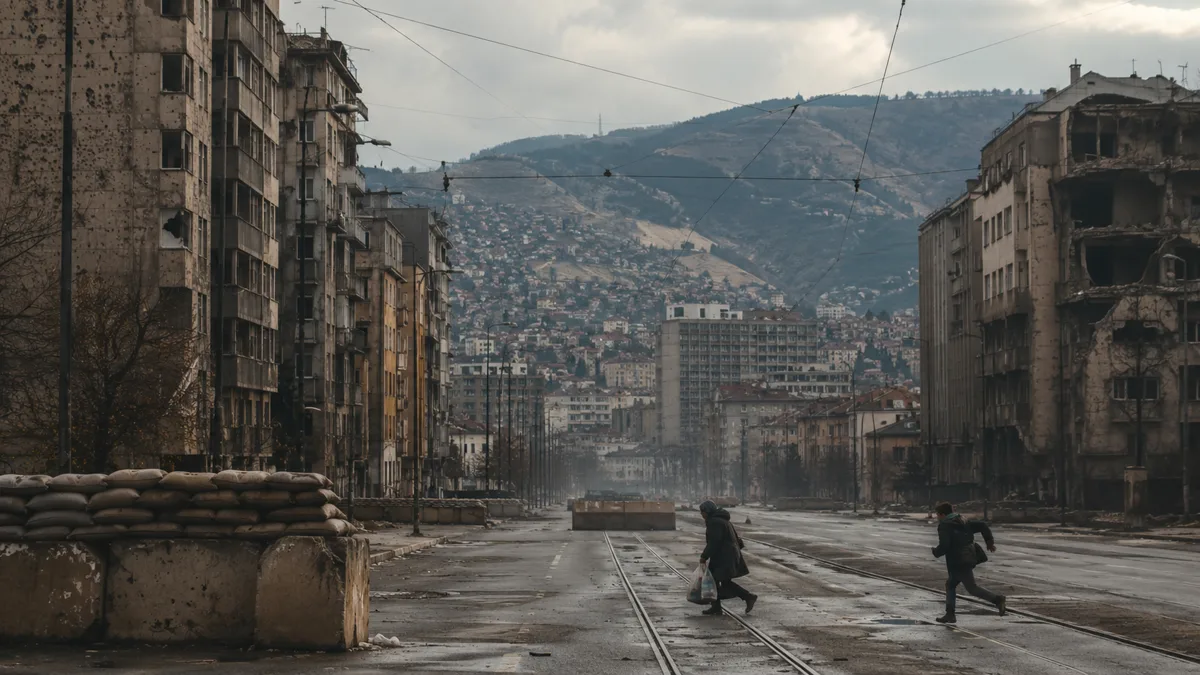
During the Siege of Sarajevo, ordinary people could be shot while crossing a street, riding a tram, collecting water, tending a garden or walking a child home.
“Sniper Alley” became the best-known name for the exposed roads where that danger was especially visible. But the name can also obscure the larger reality: sniper fire was not confined to one boulevard. International criminal courts ultimately found that forces of the Army of Republika Srpska, or VRS, conducted a prolonged campaign of sniping and shelling against Sarajevo’s civilian population with the purpose of spreading terror.
A separate controversy has received renewed attention more than three decades later. Prosecutors in several European countries are investigating allegations that wealthy foreign visitors paid for access to Bosnian Serb positions around Sarajevo and were allowed to shoot at civilians for sport.
There is real evidence behind that allegation—including sworn testimony from a former U.S. Marine who saw apparent outsiders being escorted around known sniper positions. But there is also a large gap between that evidence and the most sensational version of the story. No court has established that hundreds of wealthy foreigners participated in an organized “human safari,” and some of the claims about numbers, prices and target categories have significant evidentiary problems.
Understanding Sniper Alley therefore requires separating two things:
The deliberate campaign against Sarajevo civilians is established historical and judicial fact.
The alleged participation of paying foreign “tourist shooters” is a serious, actively investigated claim with corroborating evidence, but it is not yet a proven historical finding.
Article type: Historical explainer and evidence review
Last updated: September 3, 2026
What was Sarajevo’s Sniper Alley?
Sniper Alley was the informal wartime name given to exposed sections of Sarajevo’s main east-west transportation corridor, particularly Zmaja od Bosne Street and Meša Selimovića Boulevard.
It was not an official street name, nor was it a single precisely bounded location.
Sarajevo lies along the Miljacka River in a long valley surrounded by hills and mountains. During the war, Bosnian Serb forces controlled much of the elevated terrain around the city as well as neighborhoods and buildings close to confrontation lines.
That geography created long fields of observation over roads, intersections, apartment buildings and public transportation.
The main boulevard was particularly dangerous because it was broad, difficult to cross quickly and essential to civilian life. People could not simply abandon it. The corridor connected residential districts with workplaces, hospitals, government buildings and supply routes.
Residents learned which intersections were exposed and where walls, wrecked vehicles, containers or other barriers offered cover.
Signs warning “Pazi — Snajper!” — “Watch out — sniper” became one of the visual symbols of wartime Sarajevo.
People sometimes waited for armored vehicles to pass so they could move behind them. Others sprinted across open ground or waited for darkness, fog or bad weather in the hope that visibility would be reduced.
The important point is that Sniper Alley did not have to produce constant casualties to control behavior.
If civilians believed that a shooter might be watching an intersection, one rifle could stop hundreds of people from crossing it.
Fear itself became part of the weapon.
How did the Siege of Sarajevo begin?
Sarajevo was the capital of Bosnia and Herzegovina, one of six constituent republics of socialist Yugoslavia.
As Yugoslavia disintegrated during the early 1990s, Bosnia contained three major national communities: Bosniaks, Bosnian Serbs and Bosnian Croats, along with people who identified in other or mixed ways.
Bosnia and Herzegovina declared independence in March 1992 following a referendum that was overwhelmingly supported by participating voters but largely boycotted by Bosnian Serbs.
Bosnian Serb political leaders opposed an independent Bosnian state and pursued territorial control over areas they claimed for a separate Bosnian Serb polity. During the wider Bosnian War, Bosnian Serb forces carried out campaigns of persecution, killing, deportation and forcible removal of non-Serb populations from numerous areas. Bosniak and Bosnian Croat forces also committed crimes against civilians during the conflict.
Sarajevo had enormous strategic and symbolic importance. It was the capital of the internationally recognized Bosnian government and had been one of Yugoslavia’s most visible multiethnic cities.
Bosnian Serb forces failed to capture the whole city.
Instead, troops and heavy weapons surrounded much of it.
The Sarajevo-Romanija Corps of the Army of Republika Srpska occupied commanding terrain around the valley and maintained positions from which artillery crews, machine gunners and snipers could fire into government-held Sarajevo.
The siege is commonly dated from April 5, 1992, through February 29, 1996—about 1,425 days, making it the longest siege of a national capital in modern warfare.
The principal wartime campaign ended following the 1995 Dayton peace agreement, although the physical reintegration of surrounding areas continued into 1996.
Why was Sarajevo especially vulnerable to snipers?
Sarajevo’s physical geography gave surrounding forces a major observational advantage.
The city stretches along relatively low ground between mountain slopes. A person positioned at elevation could look down onto streets, tram lines, courtyards and buildings below.
Sniper Alley combined several particularly dangerous features:
- broad roads with little cover;
- long and predictable sightlines;
- tall buildings that could be used as firing positions;
- heavy civilian traffic;
- predictable tram routes;
- open intersections;
- and close proximity in some areas to Bosnian Serb-held Grbavica and other positions.
The danger extended well beyond the boulevard.
The International Criminal Tribunal for the former Yugoslavia, or ICTY, examined sniper incidents across residential neighborhoods and other parts of the city.
Its judgments documented civilians being attacked while carrying out activities that were visibly civilian rather than military.
How did the sniper campaign operate?
Sniping formed part of a much broader military campaign.
Sarajevo was subjected to artillery, mortar fire, machine guns and other weapons as well as individual rifle fire.
The ICTY examined military records, United Nations reports, witness testimony, medical documentation, photographs, expert analysis and individual shooting incidents in determining whether attacks on civilians represented random battlefield events or a broader pattern.
The conclusion was unequivocal.
In the case against Sarajevo-Romanija Corps commander Stanislav Galić, judges found beyond a reasonable doubt that Sarajevo civilians were deliberately attacked by SRK forces.
Victims were shot while:
- attending funerals;
- riding in ambulances;
- traveling in trams and buses;
- cycling;
- tending gardens;
- shopping;
- collecting water;
- clearing rubbish;
- walking through residential areas;
- and playing outside.
Children were shot while playing, walking with parents or returning from school.
The Appeals Chamber later said the evidence demonstrated that terrorizing the civilian population was the primary purpose of the campaign of sniping and shelling.
That distinction is important.
Sarajevo was a battlefield. Armed forces operated inside the city, legitimate military targets existed and not every civilian casualty automatically constituted a war crime.
But the tribunal did not infer deliberate targeting merely because civilians died.
It examined the circumstances of individual attacks and the wider pattern and concluded that civilians themselves were repeatedly made the objects of attack.
Why were trams and intersections so dangerous?
Public transportation combined two characteristics a sniper could exploit: visibility and predictability.
A tram followed a fixed route.
It could not suddenly choose another street when sniper fire began. At bends or stops, it slowed down.
Tribunal evidence documented repeated attacks on public transportation and passengers, including firing in the Sniper Alley area.
A United Nations situation report cited in the Galić judgment described a sniper firing against a tramway and wounding three civilians in August 1994.
Crossing a street could create the same problem.
A civilian approaching an exposed intersection might be invisible behind a wall one second and completely exposed the next.
People adapted accordingly.
Some ran individually. Others crossed in groups. Some learned to zigzag, although at sufficient distance a trained shooter could still predict movement. People waited behind walls for armored vehicles, clouds, darkness or periods of reduced gunfire.
Every trip became a calculation about probability.
What was everyday life like during the siege?
The sniper threat existed alongside the destruction of normal urban infrastructure.
Electricity, heating and telephone service became unreliable or disappeared for extended periods. Water systems failed. Food and medicine became scarce.
People collected water from wells, pumps and improvised sources.
Furniture and books were sometimes burned for heat. Parks, athletic fields and other open areas were converted into vegetable gardens or burial grounds.
Getting necessities meant leaving whatever protection a building provided.
That created a brutal contradiction.
A civilian might understand perfectly that a water point or food line could be observed from hostile positions, but remaining inside indefinitely could mean dehydration or starvation.
The siege converted ordinary routines into exposure events.
Walking.
Shopping.
Waiting.
Boarding a tram.
Carrying water.
Taking a child outside.
International courts later emphasized that people living in Sarajevo never knew when ordinary movement might place them in someone’s sights.
Were Sarajevo civilians deliberately targeted?
Yes.
This is one of the most firmly established aspects of the history.
The finding does not rest solely on survivor testimony, later journalism or the political interpretation of one party to the war.
The ICTY spent years examining the Sarajevo campaign in multiple cases.
In the Galić proceedings, judges found that civilians were deliberately attacked over a prolonged period and that those attacks formed a widespread or systematic campaign. The Appeals Chamber upheld the central findings and increased Galić’s sentence to life imprisonment.
The Karadžić Trial Chamber similarly found that the VRS deliberately sniped and shelled Sarajevo civilians on an almost daily basis during the relevant period. The Chamber concluded that Radovan Karadžić participated in a joint criminal enterprise to establish and carry out that campaign with the purpose of spreading terror.
Those conclusions survived appellate review.
What does “terror” mean in the Sarajevo judgments?
The word is important because it was not being used merely as an emotional description.
International humanitarian law prohibits making civilians the object of attack. It also prohibits acts or threats of violence whose primary purpose is spreading terror among the civilian population.
The legal question is therefore not simply whether warfare frightened people.
War almost inevitably creates fear.
The relevant question is whether violence was intentionally used in a way designed primarily to terrorize civilians.
The Sarajevo judgments found that it was.
A sniper campaign is especially effective at producing this effect because uncertainty magnifies the weapon.
A shooter does not have to fire at every pedestrian.
The population needs only to know that any pedestrian could be selected.
The victim might be the first person crossing an intersection.
Or the fifth.
Or no one at all.
That unpredictability forces everyone to behave as though the rifle is pointed at them.
Who was convicted for the campaign against Sarajevo?
Four senior Bosnian Serb political or military leaders received international convictions involving the campaign.
Stanislav Galić commanded the Sarajevo-Romanija Corps from 1992 until 1994. He was convicted of terror, murder and inhumane acts. His original 20-year sentence was increased to life imprisonment on appeal.
Dragomir Milošević succeeded Galić. His convictions included crimes resulting from the continued campaign of sniping and shelling. On appeal, some findings concerning particular incidents and modes of responsibility were changed, while his command responsibility for sniper crimes and major portions of his convictions remained. His sentence was reduced from 33 to 29 years.
Radovan Karadžić, president of Republika Srpska and supreme commander of its armed forces, was convicted in connection with the joint criminal enterprise to spread terror among Sarajevo civilians through sniping and shelling. His final sentence was life imprisonment.
Ratko Mladić, commander of the VRS Main Staff, was also convicted of crimes connected with the Sarajevo terror campaign, in addition to genocide and other crimes elsewhere in Bosnia. His life sentence was upheld.
Responsibility should be described precisely.
These judgments establish the criminal responsibility of particular commanders, political leaders and military organizations.
They do not establish collective criminal responsibility for Serbs as an ethnic population.
Sarajevo itself contained a substantial Serb population. Sarajevo Serbs were among the civilians who endured the siege and were killed by fire entering the city.
Did forces defending Sarajevo also commit crimes?
Yes.
Acknowledging that fact does not weaken the evidence concerning the siege.
Members of forces belonging to the Army of the Republic of Bosnia and Herzegovina committed crimes against civilians, including Sarajevo Serbs.
The most notorious Sarajevo example is Kazani, a pit on Mount Trebević where civilians—most of those identified as victims being Serbs—were abducted and killed by members of the 10th Mountain Brigade commanded by Mušan Topalović, known as Caco.
Multiple members of the brigade were prosecuted and convicted for killings associated with Kazani, although the exact number of victims remains disputed and some later proceedings involving individual defendants became legally complicated.
Those crimes should be documented on their own evidence.
But they do not create an evidentiary equivalence with the military campaign surrounding Sarajevo.
The existence of crimes committed by members of the defending side does not negate the separately established tribunal finding that the Sarajevo-Romanija Corps conducted a prolonged campaign of sniping and shelling with the purpose of terrorizing the city’s civilian population.
War crimes are not arithmetic.
One crime does not cancel another.
Was every sniper attack blamed on Bosnian Serb forces actually proven?
No.
This is one reason the tribunal record is so valuable.
International judges did not simply accept every wartime allegation.
Different incidents were examined separately. Witness credibility, trajectories, firing positions, visibility, military activity and documentary evidence were disputed in court.
In the Dragomir Milošević case, appellate judges altered findings involving certain incidents and forms of responsibility. The Appeals Chamber overturned or modified portions of the trial judgment while leaving the core finding of a campaign against civilians intact.
The Karadžić Trial Chamber similarly did not attribute every scheduled incident to the Sarajevo-Romanija Corps.
That makes the broader conclusion stronger rather than weaker.
The existence of the campaign did not depend on accepting every accusation.
It survived a process in which individual allegations could—and sometimes did—fail.
How many people were killed on Sniper Alley?
There is no reliable death toll specifically for Sniper Alley.
The term did not define an official geographical crime scene. Sniper attacks occurred elsewhere in Sarajevo, while people on or near the boulevard were also exposed to artillery, mortars and other weapons.
It is therefore misleading to take the overall death toll from the Siege of Sarajevo and describe those people as “Sniper Alley victims.”
Even the total siege death toll depends on what geography, period and category a researcher uses.
An expert demographic analysis prepared for the ICTY estimated 9,502 direct war-related deaths in parts of six Sarajevo municipalities between April 1992 and December 1995: approximately 4,954 civilians and 4,548 members of armed forces.
The researchers emphasized that their count was incomplete.
Other Sarajevo and Bosnian databases cover different municipal boundaries and populations and produce higher totals. One frequently cited Sarajevo memorial figure is 11,541 people killed during the siege, while other datasets covering a broader Sarajevo area have produced still different numbers.
These figures are not necessarily competing answers to precisely the same question.
They use different boundaries, definitions and source databases.
The safest conclusion is therefore not that one number has finally settled the issue.
It is that thousands of civilians and combatants died during the siege, but no defensible number exists for people killed specifically on “Sniper Alley.”
Did wealthy foreigners really pay to shoot Sarajevo civilians?
This is the most disturbing unresolved question connected to the sniper story.
The allegation is that wealthy foreigners—often described as hunters, businessmen or thrill seekers—paid intermediaries or Bosnian Serb personnel for access to positions overlooking Sarajevo, where they could fire rifles at civilians.
Later versions of the story describe organized trips, large payments and even different prices depending on the type of civilian target.
Those claims should not currently be presented as established fact.
But they also cannot fairly be dismissed as something invented by social media in the 2020s.
The underlying story is much older.
The “Sarajevo Safari” allegation existed during the war
BIRN/Detektor traced the first known press report about foreigners paying to shoot Sarajevo civilians to March 30, 1995, while the siege was still taking place.
The allegation appeared in the Italian newspaper Corriere della Sera following statements associated with Sarajevo refugees and proceedings before the Permanent Peoples’ Tribunal.
Critically, however, the tribunal did not incorporate the allegation into its final conclusions because it could not adequately verify it.
The story then largely disappeared from public attention.
That chronology matters.
It means “Sarajevo Safari” is not simply a retrospective story invented decades later.
But a contemporaneous rumor is still a rumor unless evidence can establish what actually happened.
John Jordan’s ICTY testimony is the strongest early corroboration
One of the most significant pieces of evidence surfaced in an unexpected place: sworn testimony before the ICTY.
John Jordan was a former U.S. Marine whose military background included serving as a chief scout sniper. He later worked in Sarajevo as a volunteer firefighter and emergency responder during much of the siege.
Because his firefighting work operated across confrontation lines, Jordan had unusual access to both government-controlled Sarajevo and Bosnian Serb-held areas.
During his 2007 testimony in the trial of Dragomir Milošević, defense counsel questioned Jordan about portions of an earlier statement referring to “tourist shooters” and people who would pay money to come to Sarajevo and shoot from the Serb side.
Jordan confirmed the statement.
He testified that on several occasions he had seen people who did not appear to be locals because of their clothing, weapons and the way local personnel were guiding them around.
He said some carried unusual hunting-style rifles rather than weapons normally seen among local forces.
Jordan specifically recalled seeing people fitting that profile while visiting Serb firefighters in Grbavica and in other areas of Bosnian Serb-controlled territory.
This is significant eyewitness evidence.
But Jordan also placed an important limit on it himself.
He told the court:
“I never saw one of these tourist shooters take a shot.”
What he personally witnessed was apparent outsiders with weapons being escorted around areas containing known sniper positions. His conclusion that they were “tourist shooters” was an inference from their appearance, equipment, behavior and movement.
Jordan therefore provides meaningful corroboration for the presence of suspicious armed outsiders at Bosnian Serb positions.
His testimony does not, by itself, prove that they paid for access or that any particular outsider killed a civilian.
That distinction is essential.
What does the 2022 documentary claim?
The allegation returned to public attention through Slovenian director Miran Zupanič’s documentary Sarajevo Safari.
The film relied heavily on witness testimony, including accounts from people connected with Bosnian wartime intelligence.
One of the central public witnesses was former Bosnian intelligence officer Edin Subašić, who said he learned in 1993 about foreigners present on the Sarajevo battlefield who were not ordinary military volunteers.
Subašić has said a captured Serb fighter described Italians who came to shoot and that Bosnian intelligence passed information to Italian intelligence.
The documentary did not itself result in a criminal conviction, and several important witnesses remained anonymous.
But it led former Sarajevo mayor Benjamina Karić to file a criminal complaint in Bosnia and helped move a largely forgotten allegation back into formal investigative channels.
Why did the story explode again in 2025 and 2026?
Italian writer Ezio Gavazzeni pursued the allegation further and submitted material to prosecutors in Milan.
He later published I cecchini del weekend—The Weekend Snipers—arguing that the operation was significantly larger than previously believed.
The most dramatic versions of Gavazzeni’s reconstruction allege that hundreds of foreigners participated, including roughly 230 Italians, and that customers paid large sums for opportunities to shoot people.
Other reports derived from his investigation have described an alleged “price list” in which killing children or particular categories of victims supposedly cost more.
Those details have driven much of the worldwide attention.
They are also among the least securely established parts of the story.
What are prosecutors actually investigating?
The allegations have moved beyond documentaries and books into genuine criminal investigations.
The Prosecutor’s Office of Bosnia and Herzegovina confirmed in February 2026 that its Special Department for War Crimes was working on a Sarajevo Safari case.
Bosnian prosecutors said they had contacted Italian authorities and the International Residual Mechanism for Criminal Tribunals in The Hague as part of efforts to verify the allegations.
In Italy, Milan prosecutors opened a criminal investigation and identified multiple suspects.
By June 2026, Reuters reported that five people had been placed under investigation.
Italian police also searched the home of one suspect in June and seized material including a photograph, technical equipment and a suppressor. Investigators were reportedly acting in part on testimony from a former partner who said the man had spoken about wartime trips to Bosnia and shootings.
Those developments make the case more serious than an internet legend.
But they are not equivalent to proof.
A photograph suggesting that somebody was present in Bosnia, possession of weapons equipment decades later or a former partner’s account of what somebody said may generate investigative leads without establishing that the person paid for a civilian-hunting trip.
And only days after the June search, a source directly familiar with the Milan investigation told Reuters that prosecutors did not at that point have sufficient evidence to seek a trial against any suspect.
Austria has also opened an investigation involving an Austrian citizen and another suspect over alleged participation in the same phenomenon.
The Parliamentary Assembly of the Council of Europe has meanwhile received a motion calling for greater international cooperation concerning the allegations. That political action demonstrates the seriousness with which the matter is now being treated; it is not evidence that the underlying allegations have been proven.
What problems have investigators found with the Sarajevo Safari story?
A major BIRN/Detektor investigation published in July 2026 examined the origins of the allegation and interviewed several people connected to it.
Its findings are important because they complicate the strongest public version of the story.
The investigation found that accounts from important sources did not always align and that much of the alleged documentary trail remains unavailable to independent scrutiny.
Former Italian diplomat Michael Giffoni and former Bosnian intelligence officer Edin Subašić, both connected in different ways to the intelligence story, expressed doubt about some of the most expansive claims.
In particular, they questioned the plausibility of hundreds of foreign participants and expressed skepticism about the supposed standardized “price list.”
BIRN also found little publicly available ICTY material directly corroborating a large organized paid-safari system beyond evidence such as Jordan’s testimony concerning apparent tourist shooters.
That does not establish that no foreigners ever paid to shoot civilians.
It means the public evidence is currently much better at supporting the possibility of some foreign shooters than at proving an industrial-scale network involving hundreds of wealthy clients.
Gavazzeni disputes the criticism
Gavazzeni has argued that the public record understates the evidence because many of his witnesses were protected by pseudonyms in his book but were identified to prosecutors.
In a July response to the BIRN investigation, he said approximately 70 percent of his sources subsequently provided testimony to prosecutors and claimed that additional institutional witnesses could corroborate disputed intelligence information.
Those claims deserve to be reported.
But there is an unavoidable limitation.
If evidence has been given confidentially to prosecutors but has not been released publicly or tested in court, independent observers cannot yet assess its reliability in the same way they can assess Jordan’s ICTY testimony.
The correct conclusion is therefore provisional.
What about the newest witnesses?
The allegation continues to generate new testimony.
In late August 2026, The Times reported on another witness from the Trieste area who said she had encountered affluent hunters traveling toward the Balkans during the war and later came to believe their references to hunting “deer” were coded references to human targets.
The account could prove important if investigators can corroborate it with records, travel information or other witnesses.
At present, however, it remains another witness allegation rather than independent documentary proof.
This distinction should be maintained even when a witness account sounds exceptionally specific.
Specificity makes a claim testable.
It does not automatically make it true.
So did the Sarajevo “human safaris” actually happen?
The most defensible answer in September 2026 is:
There is credible evidence that apparent foreign “tourist shooters” were present around Bosnian Serb sniper positions during the Siege of Sarajevo, and there are multiple witness accounts alleging that some foreigners paid for the opportunity to shoot civilians. Criminal authorities in several countries consider the allegations serious enough to investigate.
But:
It has not yet been judicially established that a structured commercial operation existed, how many people participated, whether the largest numerical estimates are accurate, or whether claims about standardized prices for particular victims are true.
The evidence is not binary.
Calling the entire story “proven” goes beyond what the available evidence establishes.
Calling the entire story “made up” also goes beyond what the evidence establishes.
A useful way to think about the present record is:
| Question | Current evidence |
|---|---|
| Did Bosnian Serb forces deliberately snipe Sarajevo civilians? | Established by international court judgments. |
| Were apparent foreign outsiders seen with unusual weapons around Bosnian Serb sniper positions? | Yes. Supported by sworn ICTY testimony. |
| Did Jordan personally see those outsiders shoot civilians? | No. He explicitly said he did not. |
| Did witnesses during and after the war allege that foreigners paid to shoot? | Yes. |
| Are prosecutors investigating identifiable people? | Yes. |
| Has anyone been convicted for participating in a paid Sarajevo sniper safari? | No. |
| Has a commercial system involving hundreds of participants been proven? | No. |
| Has the alleged victim “price list” been proven? | No. |
| Could further evidence materially change this assessment? | Absolutely. The investigations remain active. |
That is where the evidence currently stands.
What did Sniper Alley represent?
The reason Sniper Alley became internationally recognizable was not that it was the only dangerous road in Sarajevo.
It compressed the logic of the siege into a single scene.
An ordinary person stands behind a wall.
Across the street is food, water, work, family or home.
The distance might be twenty meters.
The person waits.
Then runs.
Somewhere far enough away to remain unseen, another person may be watching through a rifle sight.
Geography became a weapon
Sarajevo demonstrated how terrain and urban design can be exploited against a population.
Mountains, hills, apartment towers and broad roads created observation and firing positions over civilian movement.
Fear became a method of control
The campaign did not need to kill every person who entered an exposed street.
It needed to convince everyone that they might be next.
That was enough to affect where people went, when they left home and whether they allowed their children outside.
Ordinary civilian life became dangerous
Food lines, water collection, trams, gardens, funerals and playgrounds all appear in the tribunal record.
The distinction between “front line” and “ordinary life” became increasingly meaningless to civilians who could be targeted during ordinary activities.
Continuing to live became its own form of resistance
Sarajevo nevertheless remained a functioning city.
People organized schools, newspapers, medical care, theater, music and community services.
They constructed barriers, improvised utilities, planted food and developed routes through buildings and protected spaces.
People did not stop being teachers, doctors, parents, musicians or children merely because somebody had placed them within rifle range.
What does Sniper Alley look like today?
The roads once associated with Sniper Alley are now heavily traveled urban boulevards.
Trams move through the city. Offices, museums, hotels, apartment buildings and shops line the streets.
Grbavica is a residential neighborhood rather than a military confrontation line.
The Holiday Inn—famous during the war as a base for foreign journalists—still stands.
Some buildings retain bullet or shrapnel damage. Elsewhere, the physical evidence has disappeared beneath reconstruction.
Other marks of the siege remain deliberately visible.
Sarajevo Roses preserve the shapes of mortar impacts filled with red resin.
Museums, memorials, photographs and survivor accounts document how different the same streets looked when moving across them required calculating whether an unseen shooter might fire.
That contrast may be the most difficult part of Sniper Alley to understand today.
The road itself was never inherently extraordinary.
It was an ordinary road placed inside an extraordinary system of violence.
Frequently asked questions
Was Sniper Alley an official street name?
No. It was an informal wartime nickname associated primarily with exposed sections of Zmaja od Bosne Street, Meša Selimovića Boulevard and nearby roads.
Who controlled the sniper positions?
The best-documented organized campaign was carried out by the Sarajevo-Romanija Corps of the Army of Republika Srpska from positions surrounding and overlooking government-held Sarajevo.
Individual firing positions changed during the war, and courts did not attribute every reported sniper incident to VRS forces.
Were only Bosniaks targeted?
No.
The terror campaign was directed against the civilian population of Sarajevo. Bosniaks formed the largest population group in the besieged city, but Sarajevo also contained Serbs, Croats, Jews and people of mixed or other backgrounds.
Sarajevo Serbs were among the civilians killed.
How long did the siege last?
The commonly commemorated siege runs from April 5, 1992, through February 29, 1996—approximately 1,425 days.
International criminal cases often use somewhat narrower periods when examining particular commanders or charged criminal campaigns.
How many civilians were killed by snipers?
There is no authoritative total separating every sniper death from casualties caused by shelling, mortars and other forms of violence.
The ICTY established numerous individual sniper attacks and found that hundreds of civilians were killed and thousands injured by sniping and shelling during periods examined in its cases, but it did not produce a definitive “Sniper Alley death toll.”
Was Sniper Alley the entire Siege of Sarajevo?
No.
It was one highly visible component of a much larger siege involving shelling, territorial combat, blockade, infrastructure destruction, shortages and attacks throughout Sarajevo.
Is the Sarajevo Safari story proven?
Not in its full form.
There is significant evidence worth investigating, including contemporaneous allegations, witness accounts and John Jordan’s sworn ICTY testimony concerning apparent foreign “tourist shooters” around known sniper positions.
But no court has established the existence or scale of an organized system in which hundreds of rich foreigners paid to kill civilians, and some of the strongest public claims remain disputed or uncorroborated.
Are there still criminal investigations?
Yes.
As of September 2026, investigations and international cooperation concerning the allegations have continued in Bosnia and Herzegovina, Italy and other European jurisdictions.
No final conviction establishing the alleged paid-sniper system has been issued.
Conclusion
Sarajevo’s Sniper Alley was not infamous because it was the only street where people could be killed.
It became infamous because it exposed the logic of the siege with unusual clarity.
International courts found that Sarajevo civilians were deliberately subjected to a campaign of sniping and shelling designed to spread terror.
A person carrying water did not control territory.
A child walking home was not a military position.
A passenger sitting inside a tram was not an artillery battery.
Yet all could become targets.
The allegations now known as the “Sarajevo Safari” add another possible layer to that history.
There is enough evidence that the story deserves serious investigation. Armed foreigners who appeared out of place were observed around Bosnian Serb sniper positions. The allegation that outsiders paid for the privilege of shooting people existed while the siege was still underway. Decades later, prosecutors are examining named suspects and new witnesses.
But the same evidentiary discipline used to establish the crimes of the siege should also be applied to this allegation.
The documented terror campaign does not need embellishment.
If wealthy foreigners paid to turn Sarajevo civilians into human targets, the surviving evidence should be pursued until investigators can identify who participated, who facilitated it and whom they killed.
If parts of the modern story have been exaggerated, those parts should be discarded.
The historical record is strongest when the line between what is known and what is suspected remains visible.
And what is already known about Sniper Alley is horrifying enough:
For years, simply crossing an ordinary city street could mean entering someone else’s field of fire.
References and Further Reading
International court records and primary evidence
IRMCT — The Siege of Sarajevo — Overview of Sarajevo-related prosecutions and archival material from the ICTY and its successor institution.
ICTY — Prosecutor v. Stanislav Galić, Trial Judgment — Detailed judicial findings concerning sniper incidents, shelling and the campaign against civilians.
ICTY — Galić Appeals Chamber sentencing decision and summary — Explains why the Appeals Chamber upheld findings that terrorizing Sarajevo civilians was the campaign’s primary purpose.
ICTY — Dragomir Milošević Appeals Judgment summary — Important for understanding which trial findings survived appeal and which were modified.
IRMCT — Radovan Karadžić case record — Final appellate record concerning the Sarajevo terror campaign and other crimes.
ICTY transcript containing John Jordan’s 2007 testimony — Includes Jordan’s sworn testimony concerning people he described as “tourist shooters,” as well as his explicit statement that he never personally saw one of them fire.
Historical context and casualty research
United States Holocaust Memorial Museum — Bosnia, 1992–1995 — Concise historical background on Yugoslavia’s breakup, the Bosnian War, ethnic cleansing and crimes committed by multiple forces.
ICTY — War Demographics research overview — Explains the tribunal prosecution office’s demographic research methodology and the role of expert casualty analysis.
Sarajevo Safari investigations and evidence
Detektor/BIRN — Decades-Old Story of Sarajevo “Sniper Safari” Still in the Realm of Rumour — The most important independent critical investigation currently available. Traces the allegation to 1995 and examines contradictions and weaknesses in key modern accounts.
FENA — Bosnia and Herzegovina Prosecutor’s Office working on the Sarajevo Safari case — Confirms activity by Bosnia’s Special Department for War Crimes.
Reuters report on the June 2026 status of the Milan investigation, republished by Euronews Serbia — Reports that five people were under investigation but prosecutors did not then have sufficient evidence to request a trial.
Council of Europe Parliamentary Assembly — “Sarajevo safari”: the need to combat impunity for transnational war crimes — Documents the international political push for cooperation while appropriately treating the underlying conduct as allegations under investigation.
Ezio Gavazzeni’s response to the BIRN investigation — Useful for understanding the investigative author’s response to criticism and his claims concerning confidential witnesses provided to prosecutors.
Editorial currency note: The Sarajevo siege judgments are historical and final, but the Sarajevo Safari investigations remain active. Allegations concerning individual suspects, the number of alleged participants, payment arrangements and supposed target “price lists” should be rechecked if prosecutors announce charges, dismiss cases or release additional evidence.