
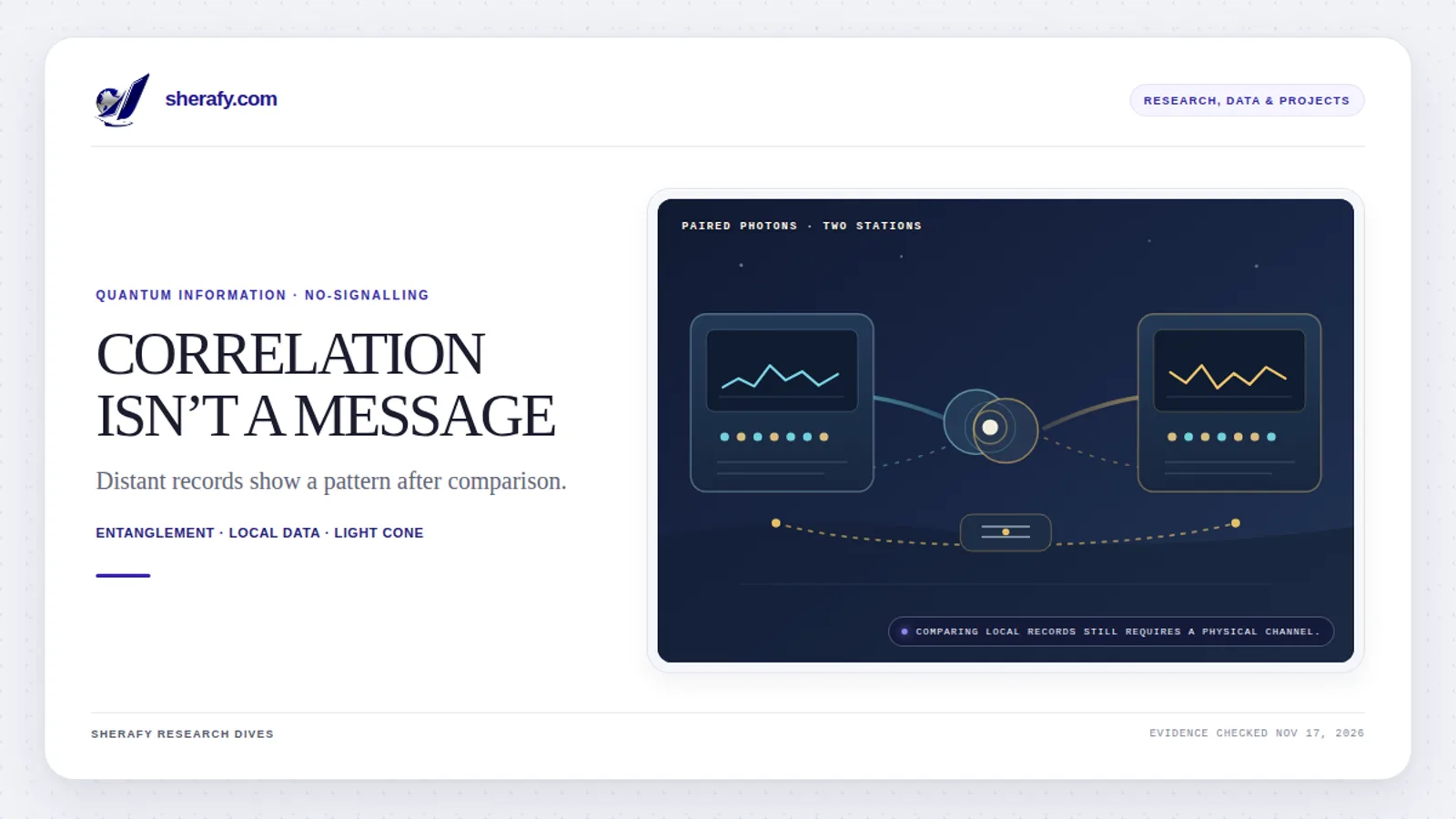
No. Not according to established quantum mechanics, and not in any verified experiment. Entangled particles can produce correlations across great distances that cannot be explained by conventional local hidden-variable models. But neither observer can use those correlations alone to transmit a chosen message faster than light.
That distinction is more surprising than it sounds. In August 2023, researchers from the University of Ottawa and Sapienza University of Rome published a striking yin-yang-like reconstruction of a two-photon quantum state. In September 2026, another team demonstrated a remote quantum-holography system that recovered different images through measurements on entangled photons. Meanwhile, real-world quantum networks have carried entanglement through tens of kilometers of commercial fiber.
The science is real. So is the limitation. None of those experiments demonstrated instantaneous communication. The reason lies in what a distant observer can actually measure without first receiving information through an ordinary physical channel.
This article follows the experimental evidence, shows the mathematics, and examines what would have to change for faster-than-light communication to become possible.
| The question | The evidence-based answer |
|---|---|
| Can entangled particles display correlations at large distances? | Yes. Bell-test experiments have established nonclassical correlations. |
| Can Alice decide what Bob's distant detector will report? | No. In standard quantum mechanics, her local actions cannot change his locally accessible statistics. |
| Can entanglement help transmit quantum information? | Yes, through protocols such as teleportation and quantum networking, which require physical or classical communication. |
| Have scientists demonstrated a controllable faster-than-light message? | No. |
What the Famous Yin-Yang Quantum Image Actually Shows
The image that keeps circulating online is genuine experimental work. The simplified caption often attached to it, however, leaves out the essential part of the experiment.
In Interferometric Imaging of Amplitude and Phase of Spatial Biphoton States, published in Nature Photonics on August 14, 2023, Danilo Zia, Nazanin Dehghan, Alessio D'Errico, Fabio Sciarrino, and Ebrahim Karimi introduced a method called biphoton digital holography.
The team was not photographing two microscopic particles that spontaneously arranged themselves into a yin-yang symbol. The yin-yang pattern was deliberately prepared in the light entering their apparatus. Their achievement was recovering information about the resulting two-photon quantum state from experimental measurements.
Examine Figure 6 in the original Nature Photonics paper. Its inset shows the prepared pattern; the rest of the figure shows a coincidence-interference image and the reconstructed amplitude and phase of the encoded structure.
How the researchers produced the reconstruction
The experimental chain matters because it distinguishes an actual quantum measurement from a spectacular-looking illustration:
- A 405-nanometer laser beam entered an interferometer. A spatial light modulator shaped an optical field into selected patterns, including the yin-yang design, alongside a reference field.
- The prepared light passed through a 0.5-millimeter beta-barium borate crystal. A process called spontaneous parametric down-conversion generated pairs of photons whose spatial properties were correlated quantum mechanically.
- The photons were routed to different regions of one time-stamping camera, not two separate cameras. Its sensor had 256 × 256 pixels and approximately one-nanosecond time resolution.
- The researchers identified photon-pair detection events using their spatial coordinates and timestamps. They collected data for one minute per spatial mode studied, then analyzed the coincidence patterns.
- By comparing the unknown biphoton state with a reference state, the team reconstructed information about both its amplitude and phase.
Amplitude describes the magnitude of the quantum wavefunction's components. Phase describes their relative relationship, information that ordinary intensity images cannot fully reveal. Recovering both gives researchers a far richer description of the state than a conventional photograph.
The authors reported an approximately three-orders-of-magnitude improvement in reconstruction time compared with certain previously used projective characterization methods, with 87% average fidelity across the reconstructions they evaluated. That does not mean a universal 1,000-fold improvement over every imaging technique or an 87% probability that a pair of photons was entangled. Fidelity is a measure of agreement between reconstructed and target quantum states.
The method also had limitations, including assumptions about the reference state and spatial correlations, camera resolution, and the optical arrangement. The research is a powerful quantum-state characterization technique, not a complete imaging solution for every possible quantum system.
For precision, the paper received an author correction in October 2023 fixing a scale in Figure 2d. The correction did not concern the yin-yang Figure 6 or invalidate the experiment.
Was this the first image of quantum entanglement?
No. The phrase first photograph of entanglement depends heavily on what someone means by a photograph or an image.
In 2008, researchers reported quantum-entangled images involving light beams. In 2019, another group demonstrated a Bell-inequality violation within recorded images, reporting a Bell parameter of 2.44 ± 0.04, above the relevant classical bound of 2.
Those were different experiments with different measurements. The 2023 paper's distinctive contribution was the efficient reconstruction of complex spatial biphoton states, including the famous designed pattern. It did not directly test whether information could outrun light.
What Quantum Entanglement Actually Means
Two particles are entangled when their quantum state cannot be fully described as two separate individual states. Their joint system contains information that is not captured by describing each particle independently.
Consider a carefully prepared pair of photons. Alice measures one photon; Bob measures the other. Under appropriate measurement settings, their outcomes can be strongly correlated even when the photons are far apart.
A familiar analogy is two gloves placed in separate boxes. Open one box, see a left glove, and you know the other contains the right glove. There is no mystery: the properties were fixed when the gloves were packed.
Quantum entanglement goes beyond that analogy. With different choices of measurement settings, experiments can produce correlations that cannot all be accounted for by a model in which local outcomes were predetermined in the ordinary way and no relevant influences cross the separation. That distinction is the point of Bell's theorem and the experiments that followed it.
But quantum correlation is not the same as a communication channel.
If Alice and Bob each record a long sequence of detector results, their separately recorded lists can look random. The unusual pattern appears when they later compare the right pairs of observations and the settings under which those observations were made.
The word later is doing important work here.
Why Entanglement Cannot Send a Message Faster Than Light
Imagine Alice stays on Earth while Bob travels to a distant space station. Before separating, they share many identically prepared entangled particle pairs. Alice keeps one particle from each pair; Bob takes the partners.
Alice wants to send one bit of information without radio, laser, spacecraft, or any other physical messenger. She invents a code:
- To send 0, she measures her particles in one basis, called Z.
- To send 1, she measures them in another basis, called X.
Bob measures all his particles in the Z basis. He knows the proposed code and has perfect equipment. He wants to identify which basis Alice selected using his data alone.
It fails, even in the ideal experiment.
The crucial result: Bob sees the same thing either way
Take an ideal, maximally entangled pair in the Bell state usually written as |Φ+⟩. If Alice measures Z and Bob measures Z, their individual results match perfectly. If Alice measures X while Bob continues measuring Z, the results have a different joint pattern.
But Bob's local distribution is identical in both cases.
| Alice's choice | What Alice and Bob find when their records are eventually compared | What Bob sees before comparison |
|---|---|---|
| Z (message 0) | Matching 0/0 and 1/1 pairs, each with 50% probability | 50% 0, 50% 1 |
| X (message 1) | Four X/Z outcome combinations, each with 25% probability | 50% 0, 50% 1 |
These are exact theoretical probabilities, not promises that a finite experiment will yield precisely equal counts. With 100 trials, Bob might observe 46 zeros and 54 ones. With another 100, he might see 53 and 47. Those random fluctuations do not tell him whether Alice selected X or Z.
Even if Alice repeats the same choice a million times, Bob's results have the same predicted local distribution under either message. More samples make a genuine difference easier to detect, but there is no message-dependent difference to uncover.
Only after Alice tells Bob which basis she used and which outcomes she obtained can they sort the data into the appropriate groups and recognize the correlations.
Alice's measurement choice changes what the two observers can establish together. It does not change what Bob can establish alone.
This is the central reason entanglement, by itself, cannot function as a faster-than-light telephone.
Why this is different from ordinary randomness
It is tempting to say that quantum measurements simply produce random results. That is true for Bob's local outcomes in this example, but it misses the deeper point.
The randomness is not hiding a readable message that better equipment might extract. Under standard quantum mechanics, every measurement Bob can perform on his subsystem alone gives statistics consistent with the same local quantum state, regardless of Alice's choice among allowed local operations.
The restriction is structural, not a problem of detector sensitivity, distance, or insufficient computing power.
The No-Communication Theorem, Explained With Mathematics
The no-communication theorem, also called the no-signalling theorem in this setting, formalizes that result.
Start with the entangled two-qubit Bell state:
|Φ+⟩ = (|00⟩ + |11⟩) / √2
This describes the joint state of Alice's and Bob's particles. To describe only the information available to Bob, physicists perform an operation called the partial trace: mathematically, they ignore Alice's subsystem.
The result is:
ρ_B = Tr_A(|Φ+⟩⟨Φ+|) = I / 2
Here, ρ_B is Bob's reduced density matrix, Tr_A means taking the partial trace over Alice's system, and I / 2 is the maximally mixed state of a qubit. It predicts a 50/50 result for Bob in any two-outcome projective measurement basis.
Now let Alice apply an ordinary local quantum operation. The relevant mathematical statement is:
ρ'_B = Tr_A[(𝓔_A ⊗ I_B)(ρ_AB)] = ρ_B
This equality holds when 𝓔_A is a local trace-preserving quantum operation and Bob is not given any selected information about Alice's outcome. It includes ordinary local unitary operations and measurements when all possible outcomes are counted.
In plain English: Alice can change her local system, but she cannot change Bob's unconditional local measurement statistics by doing so.
There is an essential qualification. If Alice measures her particle and then selects only runs with a particular outcome, the corresponding conditional state of Bob's particle may differ. That does not rescue instant communication, because Bob cannot know which of his results belong to Alice's selected subset until she communicates the selection information.
This distinction between joint statistics, conditional statistics, and Bob's local statistics is where many otherwise persuasive-sounding faster-than-light proposals fail. IBM Quantum's detailed treatment of reduced quantum states provides the formal mathematical foundation.
Notice one further distinction: this two-qubit example is a teaching model. The 2023 yin-yang experiment reconstructed high-dimensional spatial biphoton states. The same general information-theoretic restriction applies, but we should not confuse its exact optical setup with Alice and Bob's hypothetical Bell-pair messaging test.
Did Einstein's “Spooky Action” Violate Relativity?
In 1935, Albert Einstein, Boris Podolsky, and Nathan Rosen published Can Quantum-Mechanical Description of Physical Reality Be Considered Complete?. Their argument raised a troubling question: how could the quantum description of one system be connected so tightly to measurements performed on another, distant system?
In 1964, John Bell made the debate experimentally testable. His theorem on the Einstein-Podolsky-Rosen paradox showed that theories obeying certain local-causality conditions, together with relevant auxiliary assumptions, must satisfy statistical inequalities that quantum mechanics can violate.
Subsequent experiments found those violations. Among the major advances was a 2015 loophole-free Bell test involving electron spins separated by approximately 1.3 kilometers. In 2022, the Nobel Prize in Physics recognized Alain Aspect, John F. Clauser, and Anton Zeilinger for experiments with entangled photons and Bell-inequality violations, along with their foundational work in quantum information science. The Nobel committee's account documents that achievement.
What did these experiments establish?
They gave strong empirical support to quantum correlations that cannot be reproduced by the relevant class of local-causal models. They did not show that an observer can set the value of a distant detector by choosing a local measurement. They also did not place a stopwatch on a controllable signal traveling between the particles.
Bell's theorem involves assumptions that matter, including how measurement settings are chosen. Its implications for the ultimate interpretation of quantum mechanics remain debated, as explained in the Stanford Encyclopedia of Philosophy's review of Bell's theorem. The experimental violations themselves are not reasonably dismissed, but neither should they be inflated into proof of an instant messaging technology.
Special relativity limits how causal signals propagate through spacetime. Standard quantum theory permits the observed Bell correlations while maintaining the operational rule that one observer cannot control the other's distant outcomes to send a message outside the light cone.
There is no contradiction in saying both that quantum nonlocality is real in the Bell-test sense and that faster-than-light communication has not been demonstrated.
Scientists Actually Tested a Proposed Faster-Than-Light Communicator
This is not merely a philosophical thought experiment. Physicists have tested proposals intended to turn entanglement into superluminal communication.
In 1981, physicist Nick Herbert proposed the First Laser-Amplified Superluminal Hookup, or FLASH. The basic hope was that amplifying the quantum state associated with one member of an entangled pair might make a distant observer's choice of measurement detectably visible, turning correlations into a message.
In November 2007, Tiziano De Angelis, Eleonora Nagali, Fabio Sciarrino, and Francesco De Martini published Experimental Test of the No-Signaling Theorem in Physical Review Letters.
Their experiment used optical parametric amplification to turn one photon belonging to an entangled pair into an amplified output involving roughly 5,000 photons. They then analyzed why the FLASH approach still failed to deliver a faster-than-light signal. Amplification did not supply a way to extract a chosen remote measurement setting from the local output.
There is a particularly interesting historical connection: Fabio Sciarrino is also a coauthor of the 2023 yin-yang photon-reconstruction paper. The same researcher appears on a published experimental test of a proposed superluminal communicator and, sixteen years later, on an influential quantum-imaging study.
Those publications were not one continuous experiment, and the 2023 holography work should not be portrayed as a follow-up attempt at faster-than-light messaging. The connection is valuable for a different reason: it shows the distance between making entanglement measurable and useful and making entanglement transmit a controllable message instantaneously.
The 2007 test examined a particular proposed physical scheme. It did not experimentally disprove every conceivable future theory of nature. But within ordinary quantum mechanics, the no-communication theorem supplies the broader reason such schemes cannot work merely by combining shared entanglement with local operations.
What If Alice Tries a Different Trick?
The strongest challenge to the usual explanation is not simply asking whether particles are connected. It is asking whether Alice can do something deliberate that Bob can detect before a conventional message arrives.
Here are the main possibilities and why they fail under established quantum mechanics.
| Proposed trick | What actually changes | Can Bob read Alice's choice locally? |
|---|---|---|
| Measure in a different basis | Correlations between Alice's and Bob's later-compared records | No. Bob's local statistics remain unchanged. |
| Measure now instead of later | The way the joint experiment is described or conditionally sorted | No. Bob cannot identify her measurement time from his data alone. |
| Apply a phase shift or other local gate | The joint quantum state and potentially its later correlations | No. A local unitary does not change Bob's reduced state. |
| Destroy or discard Alice's photon | Alice loses access to her half of the shared state and its correlations | No. Destroying her separated photon does not create a controlled change in Bob's marginal statistics. |
| Use millions of entangled pairs | Greater precision in measuring whatever local statistics exist | No. Repetition cannot reveal a difference that the theory says is absent. |
| Keep only favorable measurements | The selected subset can have different correlations | No. Bob needs Alice's selection labels. |
| Amplify or try to clone the state | The amplifier produces its own quantum noise and obeys quantum constraints | No. The FLASH-type approach does not bypass no-signalling. |
| Use a delayed-choice quantum eraser | Different interference patterns appear in properly sorted coincidence subsets | No. The complete local dataset does not encode a message from the later choice. |
| Change the source before distribution | The photons physically sent toward Bob may change | Not superluminally. Any resulting change arrives through an ordinary physical channel. |
A 2013 experiment on quantum erasure with causally disconnected choices is especially useful here. It explored a striking separation between measurement choices and observations. But a quantum eraser does not let someone rewrite a photograph already recorded in another laboratory, transmit a bit into the past, or display a remotely chosen interference pattern in unsorted local data.
A pattern that becomes visible after two datasets are compared is not a message received before the comparison.
That is also why entanglement swapping, heralded measurements, and elaborate arrangements of multiple detectors do not automatically provide an exception. If the result depends on learning which events succeeded or which pairs correspond, the selection or timing information must reach the observer through a real communication channel.
Quantum Teleportation Is Real. Instant Teleportation Is Not.
The name makes it sound like science fiction, but quantum teleportation is an established information protocol with a precise mathematical meaning.
In the original 1993 teleportation proposal by Charles Bennett and colleagues, Alice and Bob share an entangled pair in advance. Alice performs a joint measurement involving the quantum state she wants to transfer and her half of that pair. She obtains one of four possible results, which she communicates to Bob using two ordinary classical bits. Bob then applies the appropriate correction to reconstruct the intended quantum state.
Until those two classical bits reach him, Bob cannot identify or recover the transferred state as a usable message. Quantum teleportation is not the transportation of a physical person or object, and the original unknown quantum state is not simply copied and left behind.
An equally important protocol is superdense coding. By sharing entanglement beforehand, Alice can convey two classical bits by physically sending Bob one qubit. That is a genuine communication advantage, but it still requires a transmitted quantum system. IBM Quantum's discussion of superdense coding makes that requirement explicit.
Quantum key distribution, meanwhile, uses quantum properties to help establish secret keys and detect certain kinds of interference. Some protocols use entangled particles; others do not. Real implementations also require authenticated classical communication and careful device security. Quantum physics does not automatically make every deployed network invulnerable.
| Technique | What entanglement contributes | What must still be communicated? | Faster-than-light message? |
|---|---|---|---|
| Bell correlation experiment | Nonclassical joint statistics | Measurement settings and results for comparison | No |
| Biphoton digital holography | Characterization of joint spatial photon states | Detection records and processing data | No |
| Quantum teleportation | A resource for transferring a quantum state | Classical measurement results | No |
| Superdense coding | More classical bits per transmitted qubit | A qubit physically sent to the receiver | No |
| Entanglement-based key distribution | Quantum correlations useful for establishing a key | Quantum distribution plus authenticated classical discussion | No |
| Quantum network | Shared quantum resources between distant nodes | Photons, timing, control and other required classical signals | No |
These are not failures of quantum technology. They are examples of what quantum technology actually does well.
What Quantum Networks Achieved in 2026
The practical excitement around entanglement is justified, provided the breakthroughs are described accurately. Three 2026 experiments make the distinction particularly clear.
NIST distributed entanglement through 62 kilometers of real fiber
Researchers from the National Institute of Standards and Technology and collaborators demonstrated distribution of polarization-entangled photons between NIST in Gaithersburg, Maryland, and the University of Maryland in College Park using a 62-kilometer, partially aerial fiber link.
According to their July 2026 peer-reviewed paper in the Journal of Optical Communications and Networking, they recorded approximately 1,500 coincident photon pairs per second after transmission, and their active stabilization system supported 92.8% entanglement-distribution uptime during a 24-hour run. Their time-averaged Bell-test parameter was 2.34 ± 0.37 across the reported continuous test.
This was a hard engineering problem. Fiber movement, environmental conditions, optical loss, polarization drift, and detector timing can all damage the usable correlations. The paper describes active polarization correction and a parallel fiber carrying timing information used to identify coincident detections at the receiving laboratory.
Those details matter. Researchers were distributing quantum resources and communicating synchronization information through physical infrastructure. They were not using the entanglement to send 1,500 faster-than-light messages each second. The experiment itself took place in early 2025 and was reported in a 2026 publication, according to NIST's account of the work.
Northwestern carried entanglement alongside conventional internet traffic
In a second 2026 study, a Northwestern University-led team sent entangled photons through 24.4 kilometers of installed fiber between Evanston and downtown Chicago. The same fiber also carried high-capacity classical optical traffic, including two 800-gigabit-per-second channels.
The researchers reported Bell-state fidelity above 94% and used wavelength separation, filtering, and precise synchronization to protect the quantum signals from noise. The experiment was published in Optica Quantum in July 2026, with an accessible Northwestern research summary.
The practical implication is important: future quantum networks may be able to share portions of the optical-fiber infrastructure already used for ordinary telecommunications. That is not the same as making the internet instantaneous. The photons and classical signals still travel through the fiber, subject to propagation time and engineering losses.
A September 2026 remote quantum hologram exposed the same limitation
The most revealing recent comparison may be Quantum Remote Multichannel Meta-Holography With Entangled Photons, published in Physical Review A on September 23, 2026.
Li-Chao Peng and colleagues used polarization-entangled photon pairs and a specially engineered optical metasurface to retrieve different holographic content from joint measurements. The paper reported a 4.74-decibel improvement in signal-to-noise ratio for the coincidence-based reconstruction over the comparison single-channel approach.
But the key qualification appears in the published abstract: the selected holographic content was identified through polarization-resolved coincidence measurements, while local single-channel detection alone did not provide access to the corresponding conditional channel information.
That is a contemporary demonstration of the exact distinction behind the faster-than-light question. A quantum experiment can produce meaningful information in correlations that a lone distant observer cannot independently read.
The September 2026 holography study and the 2023 yin-yang study involve different methods and research teams. Neither should be described as a practical instant-messaging service.
How Long Does Entanglement Take, and Has Anyone Measured the Speed of Collapse?
People often ask whether entanglement is instantaneous. The question bundles together several different ideas.
Creating and distributing entanglement takes time. Photons must be generated, routed, and, in a networking experiment, physically transmitted to the locations where they will be used. Their propagation is not instantaneous.
Correlations do not come with a directly measured message-travel time. The joint outcomes predicted by quantum mechanics can violate Bell inequalities when measurements are spacelike separated. That does not establish a detectable signal moving from one particle to the other.
Wavefunction collapse is not a universally agreed physical traveling event with a measured speed. Different interpretations of quantum mechanics describe state updating differently. The experimental predictions can agree even when the interpretations differ.
This is why headlines claiming that scientists measured quantum communication at 10,000 times the speed of light are misleading. In a 2008 experiment by Daniel Salart and colleagues, the researchers placed bounds on the speed of certain hypothetical influences under assumptions involving a preferred reference frame. A lower bound within such a model is not an observed data signal, nor is it a measured physical velocity of wavefunction collapse.
A useful question is therefore not simply How fast did something move? It is: What measurable change can a distant observer detect, and could that change have been deliberately controlled by someone else?
So far, the answer to the faster-than-light messaging part remains no.
Could Future Physics Make Faster-Than-Light Communication Possible?
Science should not confuse what has failed experimentally with what could never be contemplated under any possible future theory. But an open question is not evidence for a working technology.
Under standard quantum mechanics, the no-communication result is mathematically robust. A confirmed faster-than-light communication channel would therefore require more than a clever repackaging of entanglement. It would challenge important assumptions about quantum operations, measurement, or causality.
There is a clear experimental target.
Suppose Alice and Bob are separated far enough that no light-speed message from Alice's choice can reach Bob during the measurement interval. Alice randomly selects one of two local operations. Bob measures only his own particles. The claimed breakthrough would be a repeatable difference in Bob's local measurement statistics that tracks Alice's freely selected setting before any conventional signal could arrive.
Such a result would have to survive rigorous checks for timing leaks, common causes, source drift, detector artifacts, selection effects, incomplete isolation, and statistical mistakes. Other laboratories would need to reproduce it independently. A difference found only after the two experimenters exchange or sort their records would not qualify.
What about nonlinear quantum mechanics?
Some proposed modifications to ordinary quantum theory are relevant precisely because they expose how tightly standard theory constrains communication. In a 1990 paper, Nicolas Gisin showed that a particular nonlinear extension of quantum mechanics could permit arbitrarily fast communication.
That is an interesting theoretical warning, not evidence that nature implements the proposed extension. It demonstrates how a seemingly small change to quantum dynamics may create serious problems for relativistic causality. A viable theory would need both experimental support and a coherent explanation of its consequences.
What about wormholes, ER=EPR, and shortcuts through spacetime?
The ER=EPR conjecture associated with Juan Maldacena and Leonard Susskind explores a possible deep relationship between entanglement and Einstein-Rosen bridges, often called wormholes. That is a serious theoretical research program, not a claim that ordinary entangled photons create a human-usable tunnel through space.
In a 2017 theoretical study of traversable wormholes, Ping Gao, Daniel Jafferis, and Aron Wall described a special gravitational construction involving an interaction between two boundaries. The authors explicitly stated that their construction could not be used to violate causality.
These ideas may reshape how physics connects quantum information and spacetime. They do not establish that a pair of photons can carry a freely chosen message instantly across the universe.
A real discovery that enabled controllable communication outside the light cone would be enormous. It could also force physicists to revisit how cause and effect are ordered between observers in relative motion. That possibility deserves careful research, not premature dismissal or promotional certainty.
A Short History of the Evidence
| Year | Milestone | What it established or explored |
|---|---|---|
| 1935 | Einstein, Podolsky and Rosen | The conceptual challenge posed by correlated distant quantum systems |
| 1964 | Bell's theorem | Testable constraints on local-causal explanations of quantum correlations |
| 1993 | Quantum teleportation proposal | Transfer of quantum state information using entanglement plus classical bits |
| 2007 | Experimental FLASH test | Why one proposed amplified-entanglement messaging scheme failed |
| 2015 | Loophole-free Bell experiment | Stronger tests of Bell correlations with spatially separated systems |
| 2023 | Yin-yang biphoton holography | Efficient reconstruction of complex spatial two-photon states |
| 2026 | Deployed-fiber entanglement distribution and remote quantum holography | Practical quantum networking progress and conditional information retrieval |
These milestones address related but distinct scientific questions. They are not steps toward an already demonstrated superluminal communication device.
Frequently Asked Questions
Does measuring one entangled particle instantly change the other?
A measurement changes which conditional quantum-state description applies once its result is known. In some interpretations this is described using collapse; others explain the formalism differently. What experiments do not establish is a controllable physical signal whose arrival changes the distant observer's unconditional local data.
Can entangled photons carry binary information?
Yes, quantum communication systems can encode and transmit information using photons and entanglement-assisted protocols. But entanglement alone, with Alice restricted to local operations and Bob observing only his subsystem, cannot carry a selected bit faster than light. Superdense coding works because Alice actually sends a qubit.
What if the particles are a billion light-years apart?
The mathematical prediction of entanglement correlations does not acquire a conventional signal-transmission mechanism just because the separation grows. In practice, however, distributing, preserving, and measuring entanglement over long distances is an extraordinary technical challenge. Distance does not turn correlations into instant messages.
Are quantum measurement outcomes genuinely random?
In the ideal Bell-pair example, each local measurement has probabilistic outcomes, even though the appropriately compared joint results have precise correlations. Different interpretations debate the underlying meaning of randomness. The no-signalling conclusion does not require Bob to discover a hidden code in his random-looking results.
Can a quantum eraser change the past?
No evidence shows that it can. Quantum-eraser experiments can reveal different correlation patterns after data are sorted using additional measurement information. They do not let a later observer edit an already available local record or send a message backward in time.
Does quantum teleportation move an object instantly?
No. Quantum teleportation transfers a quantum state using previously shared entanglement, measurements, and classical communication. It does not move a person or piece of matter across space, and the receiving end cannot finish the protocol before the necessary classical information arrives.
Will the quantum internet replace the ordinary internet?
Not as an instant, drop-in substitute. Quantum networks aim to connect quantum devices and support tasks such as entanglement distribution, cryptographic protocols, sensing, and distributed quantum computation. They will still require ordinary communication channels for synchronization, control, and many information-processing steps.
What the Evidence Establishes
The yin-yang photon image was real. Bell-inequality violations are real. Quantum teleportation is real. And by 2026, researchers were distributing entangled photons through deployed communications infrastructure while extracting sophisticated images from jointly measured quantum data.
None of that establishes faster-than-light messaging. The decisive obstacle is not the distance between particles or the quality of the equipment. It is the difference between a correlation that two observers can verify together and a message that one observer can choose for the other to receive alone.
Entanglement changes what distant observers can discover together. It does not let either one decide what the other learns first.
References and Further Reading
Original Imaging and Communication Experiments
- Zia et al. (2023), Interferometric Imaging of Amplitude and Phase of Spatial Biphoton States, Nature Photonics. The original, open-access yin-yang experiment. Establishes the imaging apparatus, reconstructed spatial states, comparison methodology, average fidelity, experimental limitations, and Figure 6.
- Zia et al. (2023), Author Correction, Nature Photonics. Clarifies that the subsequent correction concerned the scale in Figure 2d, not the yin-yang reconstruction.
- De Angelis et al. (2007), Experimental Test of the No-Signaling Theorem, Physical Review Letters. Experimental examination of the FLASH amplification proposal and the failure of the proposed faster-than-light scheme. Fabio Sciarrino is also an author of the 2023 imaging paper.
- Moreau et al. (2019), Imaging Bell-Type Nonlocal Behavior, Science Advances. An earlier experimental imaging approach reporting violation of a Bell inequality within recorded images.
- NIST (2008), Physicists Produce Quantum-Entangled Images. Historical record demonstrating that entanglement-related imaging predates the viral 2023 reconstruction.
Quantum Foundations and the No-Signalling Principle
- Einstein, Podolsky and Rosen (1935), Can Quantum-Mechanical Description of Physical Reality Be Considered Complete?, Physical Review. Original statement of the problem of quantum completeness and distant correlations.
- Bell (1964), On the Einstein Podolsky Rosen Paradox. The foundational theorem making particular local-causal accounts experimentally testable.
- Hensen et al. (2015), Loophole-Free Bell Inequality Violation Using Electron Spins Separated by 1.3 Kilometres, Nature. A landmark test constraining local-realist explanations.
- Royal Swedish Academy of Sciences (2022), Physics Nobel Prize Press Release. Official account of recognition for entangled-photon experiments, Bell inequalities, and quantum information.
- IBM Quantum Learning, Multiple Systems and Reduced States. Technical treatment of Bell states, density matrices, and the partial trace underlying the local-statistics explanation.
- Stanford Encyclopedia of Philosophy, Bell's Theorem. Careful treatment of the theorem's assumptions, experimental significance, and interpretive limits.
- Salart et al. (2008), Testing the Speed of “Spooky Action at a Distance”, Nature. The original conditional bound on hypothetical nonlocal influences, often misrepresented as a measured speed of information transfer.
Actual Quantum Information Protocols
- Bennett et al. (1993), Teleporting an Unknown Quantum State via Dual Classical and Einstein-Podolsky-Rosen Channels, Physical Review Letters. Original teleportation protocol establishing the need for entanglement and classical information.
- IBM Quantum Learning, Teleportation and Superdense Coding. Worked technical comparison of quantum teleportation and dense coding, including the necessity of transmitted classical bits or a physical qubit.
- Ma et al. (2013), Quantum Erasure With Causally Disconnected Choice, PNAS. Relevant experiment for understanding quantum erasers, selection of coincidence data, and why retrocausal-message claims do not follow.
Verified 2026 Applications
- Shi et al. (2026), Entanglement Distribution Over a Polarization-Stabilized Aerial Fiber, Journal of Optical Communications and Networking. Original 62-kilometer field experiment and detailed measurements of coincidence rates, active stabilization, Bell-test parameters, and uptime.
- Talcott et al. (2026), Quantum Entanglement Distribution Coexisting With High-Rate, Broadband Classical Optical Communications, Optica Quantum. Original 24.4-kilometer installed-fiber experiment demonstrating entanglement alongside high-capacity classical optical traffic.
- Peng et al. (2026), Quantum Remote Multichannel Meta-Holography With Entangled Photons, Physical Review A. Reports remotely conditioned holographic retrieval using joint photon-coincidence measurements, while specifying the limitation of local single-channel detection.
- NIST (2026), “Spooky” Particles Transit DC Suburbs, a Step Toward a Quantum Network. Institutional explanation of why aerial fiber and polarization drift complicate deployed quantum links.
Theoretical Possibilities Beyond Standard Protocols
- Gisin (1990), Weinberg's Non-Linear Quantum Mechanics and Supraluminal Communications, Physics Letters A. Illustrates how a proposed nonlinear modification of quantum theory can permit superluminal signaling in that model; it is not experimental evidence for such signaling.
- Maldacena and Susskind (2013), Cool Horizons for Entangled Black Holes, Fortschritte der Physik. Introduces the ER=EPR conjectural connection between entanglement and Einstein-Rosen bridges.
- Gao, Jafferis and Wall (2017), Traversable Wormholes via a Double Trace Deformation, Journal of High Energy Physics. A theoretical traversable-wormhole construction whose authors explicitly state that it does not violate causality.
Editorial currency note: Research and experimental results were checked through November 17, 2026. Further quantum-network advances may change the technology landscape, but claims of faster-than-light information transfer require independent experimental evidence that meets the communication test described above.