
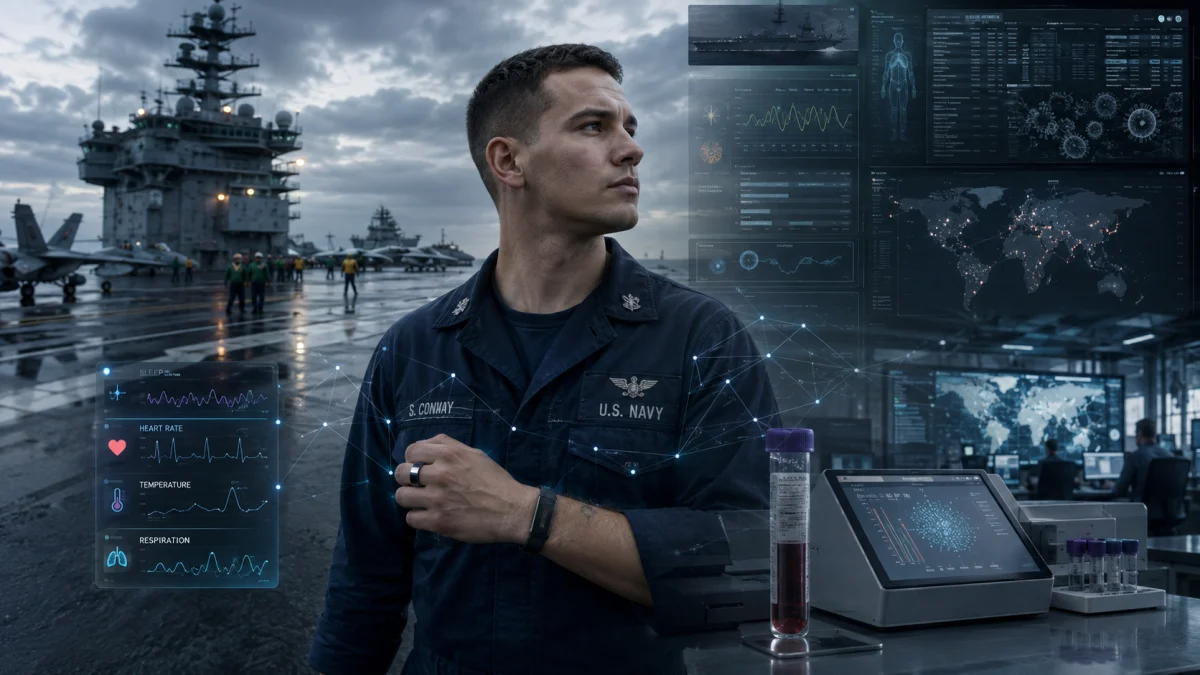
The U.S. Navy is not simply experimenting with Oura rings to help tired sailors sleep.
Public Navy documents, congressional testimony, military research records and Defense Department budget materials show something much larger taking shape: an expanding infrastructure for measuring the biological condition of sailors and turning that information into data that can inform military decisions.
The pieces already include wearable devices measuring sleep and physiology; software connecting fatigue to watch schedules; medical records; shipboard wastewater surveillance; blood testing for occupational exposures; longitudinal biobanks; automated blood collection during toxic exposures; and artificial-intelligence systems designed to analyze complex biological and operational datasets.
There is no public evidence that all of those datasets have been merged into a single master profile of every sailor. There is also no evidence that the Navy is currently using Oura-ring scores to punish sailors, deny promotions or remove security clearances.
Those distinctions matter.
But so does the direction of travel.
A Department of the Navy Science and Technology Board discussion in 2024 described the broader future as “biological diaries” and discussed the value of integrating and aggregating data from many individual devices. In 2025, a senior Navy officer described the fatigue-monitoring system at the center of this expansion as a potential “shipboard tactical warfighting solution.” In 2026, Navy researchers said the same secure biometric infrastructure could support readiness analytics beyond sleep and fatigue management.
That changes the question.
The important question is no longer simply whether Oura rings can help prevent exhausted sailors from making deadly mistakes.
It is:
What happens when the military develops the ability to continuously measure its personnel biologically—and that capability moves from voluntary research into normal military operations?
Because the same system capable of protecting a sailor can also acquire the power to classify one.
And history suggests that those rules should be written before the infrastructure becomes indispensable.
It Started With a Real Problem: Exhausted Sailors Were Dying
There is an entirely legitimate reason the Navy began taking fatigue more seriously.
On June 17, 2017, the destroyer USS Fitzgerald collided with the merchant vessel ACX Crystal near Japan. Seven sailors died.
Two months later, USS John S. McCain collided with the tanker Alnic MC near Singapore. Ten sailors died.
Seventeen sailors were dead within roughly nine weeks. Federal and Navy investigations found major failures involving training, watchstanding, operational oversight and crew readiness. The National Transportation Safety Board specifically identified fatigue among the safety issues aboard Fitzgerald, while subsequent Government Accountability Office work described fatigue as a contributing factor in the fatal 2017 collisions.
The problem went far beyond two ships.
A GAO investigation published in 2021 estimated that just 14 percent of surface-warfare officers received at least seven hours of sleep per day during their most recent deployment, while approximately 67 percent reported five hours or less.
The Navy itself recognizes that prolonged sleep deprivation can degrade human performance to levels comparable with intoxication.
So the basic proposition behind biometric fatigue monitoring is not absurd or sinister.
If a commanding officer can know that the person about to perform a safety-critical task has been awake far too long, that information could prevent another catastrophe.
The problem begins when a technology designed to answer that narrow question becomes infrastructure capable of answering many others.
That is exactly what appears to be happening.
CREW Turned a Sleep Study Into an Operational Readiness System
Beginning around 2020, the Navy started developing what became the Command Readiness, Endurance and Watchstanding system, or CREW.
Commercial wearable devices could collect information such as sleep duration, heart rate, heart-rate variability, respiratory rate, blood-oxygen measurements, skin temperature and physical activity. CREW could then combine physiological information with watchstanding requirements so leaders could better understand fatigue across a crew.
Its companion system, Optimized Watchbill Logistics, or OWL, goes further.
A 2024 Department of the Navy Science and Technology Board report described CREW and OWL as systems capable of combining changing fatigue levels with qualifications, personnel availability and projected operational requirements. That allows leadership to adjust operations according to the crew’s measured capacity. The board recommended extending the systems across the surface fleet and developing increasingly individualized fatigue management.
Notice what has happened.
The wearable is no longer merely telling you whether you slept well.
Your body is becoming another input into an organizational decision system.
That distinction is fundamental.
Then the Navy Started Talking About “Biological Diaries”
During a September 2024 Department of the Navy Science and Technology Board meeting, the discussion became considerably broader.
According to the official meeting notes, board member Dr. Jesse Ausubel described the broader context of “biological diaries” as the future and said the combined information from many people could be highly valuable.
The discussion immediately turned to the need for additional research into integrating and aggregating data from many individual devices. Another member responded that research on integration and aggregation was already underway.
This was not an obscure outside futurist speculating about what the Pentagon might someday do.
It was an official Navy advisory-board meeting discussing Navy health and readiness technologies.
The same meeting notes said the Navy had “enthusiastically embraced” recommendations to extend CREW and OWL, expand individualized fatigue management and explore a broader range of wearable devices and other mechanisms for assessing sailor health.
That phrase—biological diaries—deserves attention because it captures what individual measurements become when they are accumulated over time.
One night’s sleep is a measurement.
Months of sleep, heart rate, temperature, respiratory patterns, activity, illness and duty schedules become a history.
Add occupational exposures and blood biomarkers and it becomes something else again.
A diary.
By 2025, CREW Was Being Described as a “Tactical Warfighting Solution”
The transition became even clearer in congressional testimony.
In March 2025, Vice Adm. James Kilby told lawmakers that CREW was being evaluated not merely as a wellness program but as a “shipboard tactical warfighting solution.”
The Navy was considering transitioning CREW into a formal Program of Record, which would move it much closer to becoming established military capability rather than a temporary research project.
Kilby’s written testimony also said the system was designed to be device-agnostic and that the Surface Force was evaluating wearable technology to collect biometric health information at scale for additional use cases.
That last phrase matters enormously.
Additional use cases.
Mission expansion is therefore not merely something privacy advocates are imagining might happen someday.
Expansion is part of the stated development path.
The Gerald R. Ford Deployment Was a Scale Test, Not the Beginning
That context changes how the much-publicized Oura-ring deployment aboard USS Gerald R. Ford should be understood.
During its 2025 deployment, approximately 1,600 sailors volunteered to wear Oura rings in what was described as the Navy’s largest crew-fatigue study of its kind.
The rings collected sleep information and numerous physiological measurements. According to reporting on the project, participants could keep their ring if they wore it sufficiently during the deployment, participation was voluntary, and commanders were supposed to receive fatigue-related information while researchers analyzed broader trends.
The Navy’s ultimate objective was described as the ability to monitor fatigue among sailors underway in real time.
There is no evidence in the public record I reviewed that Ford sailors were secretly forced to participate.
That is important.
It is also not the end of the inquiry.
The more consequential question is what happens if the technology succeeds.
A voluntary experiment involving 1,600 sailors operates under one set of assumptions.
A formally funded fleet capability intended to support tactical decisions operates under another.
In 2026, the Navy Explicitly Looked Beyond Sleep and Fatigue
By May 2026, Navy Medicine was discussing the next generation of CREW.
Researchers said smartwatches would expand the range and accuracy of biometric information being collected. Future systems could incorporate applied artificial intelligence.
Most importantly, Navy Medicine said the secure biometric infrastructure being built through CREW could support integration with other shipboard systems and future readiness analytics “including and beyond sleep and fatigue management.”
This is one of the clearest statements in the public record.
The system created because exhausted sailors died in 2017 is being developed as infrastructure for purposes extending beyond exhaustion.
And another 2026 Navy experiment shows what “beyond” can mean.
USS Essex Connected Wearables, Medical Records and Wastewater Surveillance
During RIMPAC 2026, approximately 200 sailors aboard USS Essex voluntarily wore Oura rings as part of a broader experiment in detecting infectious disease and biological threats.
But the Oura rings were only one sensor.
The Navy simultaneously collected wastewater information and incorporated medical-record information.
According to Navy Medicine, data from wearables, wastewater and medical records each provide only a partial picture. The objective was to integrate those streams into broader biosurveillance.
Wearable physiological information could be fed into illness-prediction algorithms. Wastewater could provide advance warning that pathogens were circulating on the ship. The resulting information was integrated into a broader biosurveillance portal and a centralized cloud-based dashboard intended to generate medical-readiness projections and support tactical and strategic decision-making.
The CREW team said it hopes this more holistic dashboard can eventually be used throughout the Navy.
That does not establish that every sailor’s medical record, wastewater contribution and wearable reading are being fused into an individually identifiable profile. Wastewater surveillance is inherently capable of operating at a group level, and the Navy’s public description does not explain precisely how identity is handled across every layer.
But that uncertainty is itself part of the transparency problem.
The Navy has publicly described the integration.
It has not publicly provided enough detail to understand the complete data architecture.
Then There Is the Blood
A separate Navy research effort aboard USS Abraham Lincoln reveals another side of the emerging biological-data ecosystem.
During fall 2025 carrier qualifications, Naval Health Research Center researchers enrolled 50 sailors in a project called Monitoring Analysis and Research in Nautical Environmental Risks, or MARINER.
The objective was highly defensible: determine what sailors working around fuels, solvents and other potentially toxic substances are actually absorbing.
Researchers collected more than 195 blood samples and survey datasets.
The Navy subsequently announced that those samples and data had been transferred to the Windber Research Institute biobank and were also subject to secondary-use protocols with research collaborators. The repository was described as de-identified and intended to compare lower- and higher-exposure groups.
There is enormous potential public benefit here.
For decades, veterans exposed to toxic substances have sometimes had to prove years later that an illness was connected to something encountered during military service. Prospective biological sampling could produce evidence that never existed for earlier generations.
But “this research may help sailors” does not answer the governance questions.
It makes answering them more important.
What exactly are the secondary uses?
Which collaborators receive what?
How long are samples retained?
Can new questions be asked of a stored sample years later?
Can a sailor withdraw future access?
What happens to analyses or models already derived from that sample?
What identifiers remain available to the institution capable of reconnecting a de-identified sample with occupational or medical history?
“De-identified” answers one important question.
It does not answer all of them.
The Navy Planned to Go Back for More Blood
The January 21, 2026 Navy Medicine announcement did not describe MARINER as finished.
Researchers said they planned a longitudinal follow-up later in 2026 to examine biomarkers and exposure patterns over time.
As of August 21, 2026, I could not find a subsequent public Navy Medicine announcement confirming whether that follow-up collection has occurred.
That does not establish that it did not happen.
It means the public record I found does not answer the question.
And that is why sailors aboard Abraham Lincoln could resolve an important factual gap simply by answering whether researchers returned for another collection and whether crew members were offered any wearable monitoring as part of this or another research effort.
No operational details are necessary to answer either question.
MARINER Leads to Something Much Larger: PROMETHEUS
The Lincoln study is supported by the Project for Military Exposures and Toxin History Evaluation in U.S. Service Members, or PROMETHEUS.
The Navy itself called MARINER a cornerstone of that initiative.
PROMETHEUS reaches well beyond one carrier.
Department of Defense FY2027 budget materials say 21 multi-agency PROMETHEUS research protocols were underway.
One protocol uses longitudinal serum specimens and exposure records to search for biomarkers associated with exposure-related cancer risk, with complex datasets subjected to advanced computational and artificial-intelligence analysis.
Another, PROMETHEUS 31, is particularly revealing.
It is designed to allow active-duty personnel aboard ships and Special Forces personnel to obtain automated blood samples in real time during significant environmental toxic exposures while deployed or conducting operations. Those samples can then be tested for hundreds of toxins and analyzed alongside other data using advanced computational methods and AI.
Viewed narrowly, this is occupational medicine.
Viewed functionally, the servicemember’s body is becoming a sensor.
The environment leaves a chemical signal in the body. The body is sampled. That sample is time-linked to an operational exposure. Software analyzes the resulting biological information.
Again, that could save lives.
It is also an extraordinarily powerful capability.
The Military Already Has One of the World’s Largest Longitudinal Biological Repositories
These new programs are not emerging into an empty data environment.
The Department of Defense Serum Repository already contains more than 74 million serial serum specimens from more than 12 million active-duty and reserve service members.
Its history stretches back decades, initially through military HIV testing and later through broader operational health-surveillance collections.
Those specimens can be connected through the Defense Medical Surveillance System with demographic, occupational and medical information for authorized military research and surveillance purposes.
There is no evidence in the material reviewed for this article that CREW wearable records, MARINER samples, the Essex dashboard and the entire Defense Department Serum Repository have all been connected into one person-level database.
It would be irresponsible to imply otherwise.
But it would be equally irresponsible to pretend these projects exist in institutional isolation.
The Department of Defense already possesses decades of biological specimens and military-health information. New systems are being developed specifically around aggregation, integration, longitudinal analysis, AI and operational decision support.
That combination is precisely why strong boundaries matter now.
The Most Important Line May Be the One Between “Research” and “Operations”
Military human-subject research does have meaningful protections.
Current Department of Defense rules prohibit commanders and supervisors from influencing subordinates to participate in research. The chain of command generally cannot be present during recruitment and consent.
The rules even anticipate that research involving military personnel can create fitness-for-duty risks, including risks resulting from a breach of personal information, and require relevant risks to be addressed during informed consent.
Those are not trivial protections.
But there is another section of the same regulatory framework that makes CREW’s movement toward operational status especially important.
The Defense Department’s human-subject research instruction distinguishes research from certain authorized operational activities conducted in support of defense and national-security missions. It also excludes qualifying public-health surveillance activities from the definition of research.
That does not mean the military can suddenly do anything it wants with a sailor’s body once somebody writes “operational” on a form.
Other laws, regulations, medical-privacy rules and constitutional protections continue to exist.
But the governing framework changes.
And that means the transition from:
“Would you volunteer for this research study?”
to:
“This is an operational readiness system.”
is not merely a bureaucratic distinction.
It can change which protections apply, what consent means and how realistic refusal remains.
That is why congressional testimony describing CREW as a potential Program of Record and a tactical warfighting system deserves much more scrutiny than it has received.
A System Does Not Have to Be Abused to Take Something Away From Someone
The easiest response to concerns like these is to imagine an obviously malicious commander scrolling through sailors’ private health information looking for people to punish.
That is probably not how the most consequential harms would occur.
Institutional power usually becomes consequential through ordinary decisions.
A biological measurement becomes a readiness score.
A readiness score becomes a recommendation.
A recommendation becomes a restriction.
A restriction affects who can stand watch, fly, deploy, receive an assignment or perform a particular duty.
At every step, the institution may plausibly say it is protecting the sailor and the mission.
Sometimes it genuinely will be.
But something can still be taken away.
That is particularly important in the military because medical privacy is already structurally different from the privacy most Americans experience with an ordinary employer.
Defense Department medical-privacy rules permit covered military health entities, under specified circumstances, to disclose protected health information to appropriate military command authorities for purposes including fitness for duty, fitness for a particular mission or assignment, and other activities necessary to properly execute the military mission.
This does not establish that raw CREW wearable data automatically falls under that rule.
It does establish something much more important for the policy debate:
The pathway from health information to personnel decisions is not imaginary. It is already contemplated by military law.
Therefore, when the Navy builds new categories of physiological information specifically to measure operational readiness, asking how those measurements could eventually affect an individual’s career is not paranoia.
It is basic due diligence.
Algorithms Can Be Wrong Even When Everyone Involved Means Well
The risk does not require misconduct.
Suppose a future system determines that a sailor is physiologically “not ready” for a particular assignment.
Perhaps the system is correct.
Perhaps it identifies exhaustion before the sailor realizes how impaired they are.
That is the promise.
But what happens when it is wrong?
One Navy-related wearable study presented through the Office of Naval Research found that Oura readiness scores did not cleanly predict operational performance in the small teams studied. One group had better readiness measurements while producing substantially more errors.
The study was small and does not establish that Oura measurements are useless.
It demonstrates why biometric measurement and operational competence are not interchangeable concepts.
Human physiology is noisy.
Sleep disruption, infection, stress, medication, unusual duty schedules and individual biological variation can change measurements without necessarily answering the question a commander actually cares about.
Once an imperfect proxy begins determining opportunities, the statistical error stops being abstract.
Someone pays for it.
That is why any future system capable of affecting assignments, deployability or other personnel outcomes needs more than an accuracy percentage.
It needs transparency, independent validation and a meaningful way for the person being classified to challenge the classification.
“Secondary Use” Is Not a Hypothetical Concern Either
There is another common response to privacy concerns: the data was collected for a good reason, therefore concern about other uses is speculative.
But MARINER’s own public description explicitly mentions secondary-use protocols with research collaborators.
CREW provides another documented example of expanding use.
It grew from fatigue monitoring.
The Navy then discussed aggregating “biological diaries.”
Congress heard about biometric collection at scale for additional uses.
The Essex project incorporated wearable physiology into illness prediction and broader biosurveillance.
And Navy Medicine now describes the CREW infrastructure as potentially useful beyond sleep and fatigue.
That does not prove improper use.
It proves purpose expansion.
The rational response is therefore not to demand evidence of abuse before establishing safeguards.
The rational response is to recognize that the institution itself expects new uses and define acceptable and prohibited uses before those uses become routine.
“Voluntary” Matters. It Also Does Not End the Conversation.
The Ford study was reported as voluntary.
The Essex wearable experiment was described by Navy Medicine as voluntary.
Military research rules contain explicit protections against command coercion.
Those facts should not be minimized simply because they complicate a surveillance narrative.
But voluntary research is exactly why the next phase matters so much.
If CREW becomes issued operational equipment, the question will no longer be whether researchers improperly pressured sailors into a study.
The question will be whether wearing a physiological sensor has become a condition of doing the job.
I found no evidence that the Navy has reached that point fleetwide.
But the Navy is openly considering institutionalizing CREW, expanding its sensor capabilities and using the resulting infrastructure for additional readiness purposes.
Waiting until mandatory biometric monitoring exists before debating the rules would be backwards.
The Navy Should Answer These Questions Before It Scales This System
The burden should not be on an individual sailor to prove that a future misuse will occur before the institution explains how it intends to prevent one.
The Navy can resolve much of this uncertainty by publishing straightforward answers:
- Exactly which biometric fields are collected by each system, and which are retained rather than analyzed temporarily?
- Who can see individual-level data: the sailor, researchers, medical personnel, commanding officers, contractors or all of the above?
- What information reaches commanders, and at what level of identification?
- How long are raw wearable records, blood specimens, derived biomarkers and operational-readiness outputs retained?
- Which contractors, universities, laboratories and other collaborators receive data or specimens, and what secondary uses are authorized?
- What happens to previously collected data if a research participant later withdraws?
- When CREW transitions from human-subject research into an operational capability, which consent and anti-coercion protections remain?
- Can biometric or biomarker information ever be used in promotion, assignment, deployment, disciplinary, disability, separation, clearance or other personnel decisions? If not, where is that prohibition written?
- If an algorithm labels a sailor fatigued, ill, impaired or otherwise not ready, does that sailor have access to the underlying information and a way to challenge an erroneous determination?
- Who independently audits the algorithms for false positives, false negatives and systematic bias before they influence operational decisions?
- What are the breach-notification and accountability rules when extremely sensitive longitudinal biological information is exposed?
- Did MARINER conduct the planned 2026 longitudinal follow-up aboard USS Abraham Lincoln, and if so, what additional samples or measurements were collected?
None of those questions interferes with an operational mission.
None requires publishing ship locations, tactical capabilities or classified information.
They are governance questions about Americans whose bodies are supplying the data.
The Case for This Technology Is Also the Case for Stronger Oversight
There is a temptation in stories involving military surveillance to force readers into one of two camps.
Either the technology is protecting troops, so privacy concerns are treated as obstruction.
Or the technology is surveillance, so its potential health and safety benefits are dismissed as a pretext.
The evidence supports neither simplification.
Fatigue kills.
Toxic occupational exposures can cause devastating diseases years after military service.
Earlier detection of infectious disease aboard a ship could prevent an outbreak from disabling an entire crew.
Researchers capable of proving what a sailor absorbed during service could give future veterans evidence that previous generations desperately lacked.
Those are serious benefits.
They are also precisely why these systems are likely to become attractive, permanent and increasingly interconnected.
Technology that does not work can be abandoned.
Technology that saves lives becomes infrastructure.
And infrastructure outlasts the researchers who originally built it, the commanders who originally promised restraint and the policies under which the first volunteers consented.
That is the point at which good intentions stop being an adequate safeguard.
This Is Already Bigger Than Oura Rings
The documented record now shows a progression.
Seventeen sailors died in two catastrophic collisions.
The Navy responded in part by treating fatigue as something that should be measured rather than guessed.
Wearables created individualized physiological data.
CREW connected those measurements to operational readiness.
OWL connected fatigue to watch scheduling.
Navy advisers discussed aggregating people’s “biological diaries.”
Congress was told the system could become a tactical warfighting capability and collect biometric information at scale for additional uses.
The Essex experiment connected wearable physiology with medical and wastewater information for broader biosurveillance.
MARINER began collecting sailors’ blood to build longitudinal exposure datasets and biobanks with secondary-use protocols.
PROMETHEUS is developing systems capable of collecting blood during real-world toxic exposures and applying advanced computational analysis to biological data.
And all of this is developing inside a Defense Department that already possesses tens of millions of biological specimens from millions of service members.
Again, there is no evidence that every one of those systems has already been fused into one giant database.
That claim would outrun the facts.
But the larger architecture no longer requires imagination.
Integration is documented. Expansion is documented. Secondary use is documented. Fleetwide ambitions are documented. Operational decision-making is documented. AI-assisted analysis is documented.
What remains inadequately documented for the public is the governance.
Who ultimately controls these biological diaries?
What cannot be done with them?
What remains voluntary?
What happens when a sailor says no?
What happens when an algorithm is wrong?
And who protects the sailor when the institution’s interest in readiness conflicts with the individual’s interest in privacy, autonomy or career?
Those are not reasons to stop research that could protect service members.
They are reasons to establish enforceable boundaries while sailors still have the leverage to demand them.
The appropriate standard for a system this powerful is not:
Trust us. We are using it for something good.
It is:
Show us the rules.
References and Further Reading
2017 Collisions and the Fatigue Problem
NTSB: Collision Between USS Fitzgerald and ACX Crystal — The federal investigation into the June 2017 collision that killed seven Fitzgerald sailors, including findings involving Navy oversight and fatigue-related safety issues.
NTSB: Collision Between USS John S. McCain and Alnic MC — Official investigation into the August 2017 collision that killed ten sailors and documented major deficiencies in training, procedures and operational oversight.
GAO: Navy Readiness — Actions Needed to Evaluate and Improve Surface Warfare Officer Career Paths and Fatigue Management — Key federal review documenting severe sleep deprivation in the surface fleet and the Navy’s development of biometric fatigue-monitoring pilots.
CREW, Wearables and “Biological Diaries”
Department of the Navy Science and Technology Board: Improving Sailor Physical and Mental Health — Official board report describing CREW, OWL and recommendations to expand individualized fatigue management across the fleet.
Department of the Navy Science and Technology Board: September 12, 2024 Open Session Notes — Important primary record containing the discussion of “biological diaries,” aggregation of wearable data and the Navy’s response to fleetwide CREW recommendations.
Congressional Testimony on Navy Surface Force Readiness and CREW — Vice Adm. James Kilby’s 2025 testimony describing CREW as a potential tactical warfighting solution and discussing biometric collection at scale for additional use cases.
Navy Medicine: CREW Fatigue-Risk Monitoring System at Pentagon Lab Day — May 2026 Navy description of smartwatches, AI and future readiness analytics extending beyond sleep and fatigue.
Navy Times: USS Gerald R. Ford Oura Ring Fatigue Study — Independent reporting on the approximately 1,600-person voluntary Ford deployment study and the Navy’s broader fatigue-monitoring ambitions.
Biosurveillance
Navy Medicine: NHRC Tests Novel Biothreat Early-Warning System Aboard USS Essex at RIMPAC — Primary Navy account describing the integration of Oura wearable measurements, wastewater surveillance and medical information into a broader cloud-based biosurveillance platform.
Blood Sampling, MARINER and PROMETHEUS
Navy Medicine: Naval Health Research Center Leads MARINER Study Aboard USS Abraham Lincoln — Primary January 2026 disclosure of more than 195 blood samples and survey datasets from 50 sailors, biobank storage, secondary-use protocols and the planned longitudinal follow-up.
FY2027 Defense Health Agency Research and Development Budget Materials — Primary budget documentation describing 21 PROMETHEUS protocols, longitudinal biospecimen research, real-time exposure blood collection and AI-assisted analysis.
Uniformed Services University: PROMETHEUS Military Exposure Research Initiative — Official overview of the multi-agency military exposure initiative and its use of biospecimens, exposure information and health datasets.
Defense Health Agency: Department of Defense Serum Repository — Official description of the repository containing more than 74 million serial serum specimens from more than 12 million service members.
Consent, Command Access and Personnel Consequences
Department of Defense Instruction 3216.02: Protection of Human Subjects and Adherence to Ethical Standards in DoD-Conducted and -Supported Research — Current human-subject rules addressing informed consent, command influence and risks involving military personnel.
DoD Human-Subject Research Rules on Operational Activities and Public-Health Surveillance — Relevant provisions defining certain authorized operational and public-health-surveillance activities outside the human-subject research framework.
DoD Manual 6025.18: Implementation of the HIPAA Privacy Rule in DoD Health Care Programs — Military medical-privacy rules describing circumstances in which health information may be disclosed to command authorities for fitness, assignment and mission purposes.
Validating Biometric Readiness
Office of Naval Research Research on Wearable Readiness Measurements and Operational Performance — Navy-related research illustrating why consumer wearable readiness metrics should not automatically be treated as equivalent to actual operational performance.
Editorial currency note: This article reflects publicly available records reviewed through August 21, 2026. CREW, PROMETHEUS, MARINER and related Navy biosurveillance programs are active or evolving. No publicly posted Navy Medicine update located during this review confirmed whether the planned 2026 USS Abraham Lincoln MARINER longitudinal collection had occurred.