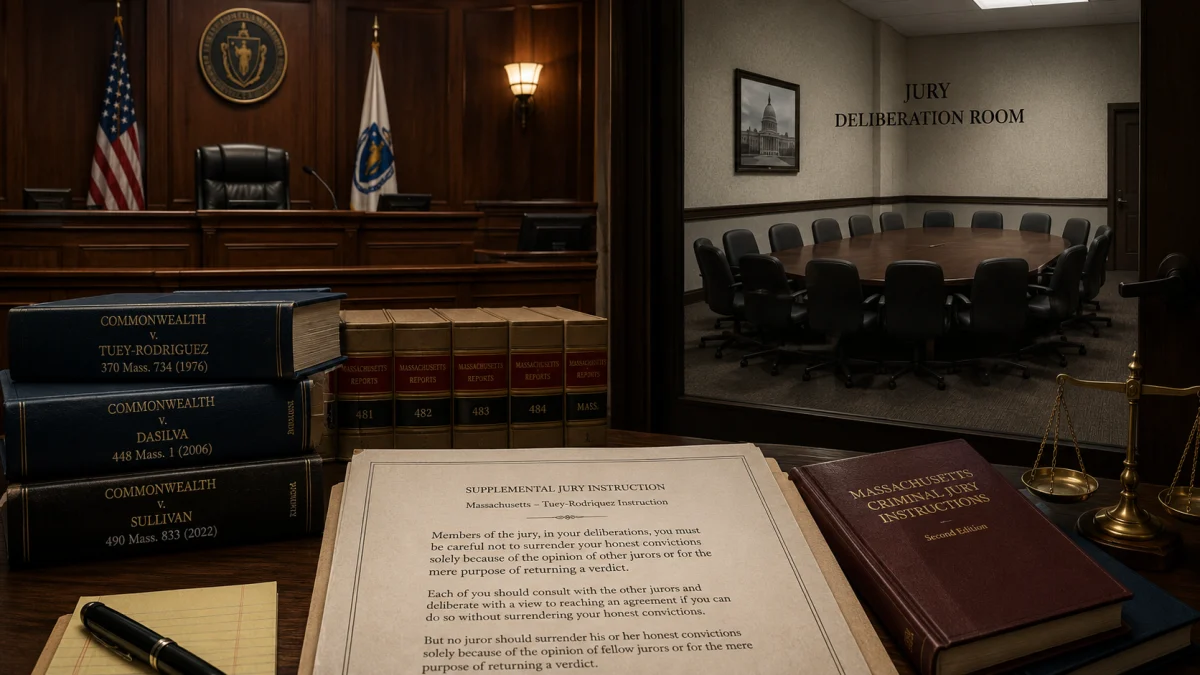
Judge William Sullivan’s Wednesday instruction to the deadlocked Lindsay Clancy jury was a Tuey-Rodriquez charge, a Massachusetts jury instruction commonly nicknamed a “dynamite charge.”
Despite the dramatic name, it is not an order to reach a verdict.
The instruction is supposed to do something much narrower: encourage jurors who appear genuinely stuck to reconsider opposing arguments while protecting a crucial limit — each juror’s verdict must remain that juror’s own, and nobody should surrender an honestly held conviction simply to make the vote unanimous.
That distinction is particularly important in the Clancy trial.
Based on the public record through Thursday evening, September 3, there is no obvious reason to conclude that Sullivan’s decision to give the instruction Wednesday was itself improper. The jury had deliberated for days and repeatedly reported difficulty reaching unanimity.
The more legally delicate issue developed afterward.
On Thursday, the jury foreperson sent another note that, according to what was disclosed in court, identified one particular juror as refusing to follow Sullivan’s instructions concerning reasonable doubt. Defense attorney Kevin Reddington asked Sullivan to remove that juror. Sullivan declined, questioned the jurors, explained reasonable doubt again and allowed deliberations to continue. The sixth day of deliberations eventually ended without a verdict.
That creates a different problem from an ordinary deadlock.
Massachusetts appellate courts have repeatedly warned judges to be extraordinarily careful when a supposedly problematic juror may actually be nothing more than a persistent minority juror — particularly once the judge knows which juror is standing apart from the others.
And there is an important fact we still do not know:
The public does not know how the disputed juror is voting.
We do not know whether that juror favors conviction, manslaughter, acquittal based on lack of criminal responsibility, or some other permissible resolution of the charges.
That uncertainty matters.
What happened with the Clancy jury?
Clancy does not dispute that she killed her three children, Cora, Dawson and Callan, in their Duxbury home in January 2023. The central trial dispute is whether she was criminally responsible when she did so.
Her defense argues that severe mental illness, including postpartum psychosis, rendered her not criminally responsible. Prosecutors argue that she understood what she was doing and understood that it was wrong.
The jury began deliberating on August 27.
On Tuesday, September 1, jurors reported that they could not reach a unanimous decision.
Sullivan sent them back to continue deliberating.
On Wednesday, the jury again reported an inability to agree. Sullivan then gave the Tuey-Rodriquez instruction, telling jurors not to abandon their own convictions merely to obtain a verdict but to listen seriously to opposing viewpoints and reconsider their positions where appropriate.
Then came Thursday.
According to the open-court discussion and subsequent reporting, the foreperson complained that one juror was not following Sullivan’s instructions concerning reasonable doubt.
Sullivan brought jurors up individually for questioning. Afterward, he again instructed the entire panel on reasonable doubt and returned them to deliberations. Reddington argued that the singled-out juror should instead be removed.
Sullivan rejected that request at that stage, explaining that discharging a deliberating juror is a sensitive undertaking and that it would be improper for him effectively to choose between the disputed juror and the other eleven.
The jurors deliberated a little longer before being sent home. They are due back Friday. Reddington told reporters that he expected Sullivan to conduct a further inquiry concerning the identified juror Friday morning.
One point deserves emphasis because it is easy to overread what happened:
This does not establish a confirmed 11-1 vote on Clancy’s guilt or criminal responsibility.
One juror has apparently been singled out as the source of the dispute. Sullivan himself referred in court to not siding with “one juror or the 11.” But the actual substance of the jury’s deliberations has not been publicly revealed, and neither has the direction of the disputed juror’s vote.
What is a Tuey-Rodriquez “dynamite charge”?
A Tuey-Rodriquez charge is a supplemental instruction a Massachusetts judge may give after concluding that a jury has deliberated sufficiently and appears unable to agree.
Its essential message is balanced.
Jurors should listen seriously to one another.
Those leaning toward acquittal should consider why equally conscientious jurors remain persuaded by the prosecution’s evidence.
Those leaning toward conviction should consider why equally conscientious jurors remain unconvinced.
But neither side should change its position simply because it is outnumbered.
Massachusetts’ published criminal model instruction expressly says that each juror’s verdict must represent that juror’s own convictions rather than mere acquiescence in the conclusion of others. It also reiterates that the Commonwealth carries the burden of proving every essential element beyond a reasonable doubt.
The model currently appears among the District Court criminal instructions, but Massachusetts Superior Court judges may use those models, adapt other model instructions or formulate legally appropriate language of their own.
The purpose is therefore not:
Reach a verdict.
It is:
Keep genuinely deliberating if you can do so without abandoning your own conscientious judgment.
That distinction is what separates legitimate encouragement from coercion.
Massachusetts actually invented the instruction that became the Allen charge
The history is unusually relevant here.
Outside Massachusetts, this kind of instruction is commonly called an Allen charge, after the U.S. Supreme Court’s 1896 decision in Allen v. United States.
But the federal Allen charge had Massachusetts roots.
It derived from Commonwealth v. Tuey, an 1851 Massachusetts case. The Massachusetts Supreme Judicial Court later explicitly observed that the Allen charge “was taken from the Tuey charge.”
The historical sequence is therefore:
Commonwealth v. Tuey (1851) → Allen v. United States (1896) → Commonwealth v. Rodriquez (1973).
The last case is important because Massachusetts eventually concluded that its original instruction itself needed fixing.
A spelling note: the controlling 1973 Massachusetts decision is Commonwealth v. Rodriquez, which is why Massachusetts courts generally call the instruction Tuey-Rodriquez. “Tuey-Rodriguez” is common in contemporary news coverage, but it is not the spelling of the reported case.
Massachusetts rewrote the charge because the original version could pressure holdouts
In Commonwealth v. Rodriquez, the Supreme Judicial Court identified two significant problems with the old Tuey instruction.
The first involved a seemingly innocuous statement telling jurors that the case “must at some time be decided.”
The SJC said that was simply not true.
A criminal jury can remain deadlocked. A mistrial can be declared. And even after a mistrial, another trial is not inevitable.
More importantly, the court recognized that telling exhausted jurors that the case must eventually be decided has a coercive tendency. It can make a juror believe that refusing to compromise amounts to a failure to perform the job.
The second problem was even more fundamental.
The traditional instruction told jurors in the minority to reconsider their judgment in light of the majority’s views.
It did not place the same responsibility on the majority.
The SJC rejected that imbalance. A criminal jury is not a public-opinion poll. Numerical superiority does not establish that one side is correct.
Eleven jurors can be wrong.
One juror can be right.
Massachusetts therefore revised the instruction so that reconsideration runs in both directions.
Even after those changes, however, the Supreme Judicial Court warned that the instruction still “has a sting” and should not be used prematurely or without evident cause.
That warning explains the nickname.
The SJC noted that versions of the old instruction had been called “dynamite,” “nitroglycerin,” “third degree” and “shotgun” charges because of their potential to extract a verdict from a jury that otherwise could not agree.
Was Sullivan wrong to give the instruction on Wednesday?
Nothing publicly reported so far establishes that.
That does not mean an appellate court has already blessed everything that occurred. We do not have the complete trial record, and jury-coercion claims are intensely dependent on context.
But the circumstances publicly known Wednesday are not obviously outside the normal use of a Tuey-Rodriquez instruction.
The jury had spent several days deliberating a lengthy case. It had reported an inability to agree on Tuesday and again on Wednesday. Sullivan then gave a balanced supplemental instruction and specifically reminded jurors not to abandon their own convictions simply to produce a verdict.
Massachusetts courts give trial judges considerable discretion in deciding whether deliberations have become sufficiently thorough and whether an apparent impasse warrants the charge.
A 2026 Massachusetts Appeals Court decision, Commonwealth v. Bamford, provides a useful recent example. The court explained that not every jury note suggesting difficulty automatically counts as a statutory deadlock. What matters includes the content of the communication, the amount of deliberation and whether the trial judge has concluded that “due and thorough deliberation” has occurred. The decision was issued under Rule 23.0 and therefore carries persuasive rather than binding precedential weight, but its analysis is directly relevant to the common misconception that judges simply count deadlock notes.
For that reason, the stronger legal question in Clancy’s case is no longer merely:
Should Sullivan have given the dynamite charge?
It is:
What can the court properly do after learning that one identifiable juror may be the source of the continuing disagreement?
An identified holdout changes the coercion problem
The Massachusetts case that comes closest to explaining the danger is Commonwealth v. Chalue, decided by the Supreme Judicial Court in 2021.
The facts were different from Clancy’s case.
In Chalue, a jury returned what appeared to be guilty verdicts, but when the jury was polled, one juror said she did not agree. The judge then spoke separately with that known dissenting juror and encouraged her to keep an open mind and see whether the jury could reach unanimity.
The SJC held that the individual instruction was erroneous.
The problem was not merely that the judge encouraged deliberation.
It was that the juror knew the judge knew she was the holdout.
The SJC explained that the coercive effect of a dynamite-style instruction increases when a juror reasonably understands that judicial pressure is being directed specifically at that person.
The court ultimately concluded that the error in Chalue did not require reversal under the particular circumstances of that case.
But the warning is important.
Consider the difference between these two situations.
A judge tells twelve jurors:
Everyone should keep an open mind and seriously consider the views of everyone else.
Now imagine that one juror knows the judge has been told:
You are the person preventing a verdict.
Even identical words can carry a very different weight in the second situation.
That is why the Clancy case became legally more delicate on Thursday.
Can Sullivan remove the disputed juror?
Potentially — but the threshold is deliberately high.
Massachusetts General Laws Chapter 234A, Section 39 provides that a judge may discharge a juror who is already participating in deliberations only after a hearing and upon finding an “emergency or other compelling reason.”
Massachusetts appellate decisions impose additional safeguards because removing a deliberating juror can alter the jury itself at precisely the moment when the juror’s vote matters most.
In Commonwealth v. Connor, the SJC reversed convictions after a deliberating juror was improperly removed.
The court explained that, in the ordinary holdout context, a valid reason for removal cannot simply be the juror’s views on the case or difficulties arising from disagreement with fellow jurors.
It also recognized the unavoidable reality of unanimous juries: occasionally an unusually stubborn or eccentric person will become a juror.
That alone does not authorize a judge to replace the person.
The court called that possibility “an unavoidable risk of the jury system.”
The alternative would be much worse.
If eleven jurors could effectively report the twelfth as “unreasonable” and have that juror replaced, unanimity would cease to mean unanimity.
Massachusetts overturned convictions over juror removal in 2021
The Supreme Judicial Court reinforced the rule in Commonwealth v. Williams.
A deliberating juror there was discharged after saying that he could not begin deliberations anew following the replacement of another juror.
The problem was that his difficulty appeared intertwined with his interactions and disagreements with the other jurors rather than an independent personal circumstance preventing him from serving.
The SJC found the removal erroneous and prejudicial and vacated the convictions.
The current Massachusetts Guide to Evidence summarizes the governing principle this way: during deliberations, judges must distinguish genuine reasons that prevent a juror from serving from reasons involving the issues in the case, the juror’s views or the juror’s relationship with fellow jurors.
It also warns judges conducting such inquiries not to invite the juror to reveal the substance of deliberations.
There can, of course, be genuine juror misconduct or independent circumstances warranting removal. Bias, outside influence, illness or another legally sufficient inability to perform the role can present different questions.
But “the other jurors think this person is wrong” is not itself a sufficient reason.
What if the juror really is refusing to follow the reasonable-doubt instruction?
This is the hardest part of Thursday’s dispute.
Jurors do not have a legal entitlement to replace the judge’s instructions with whatever law they prefer.
They are supposed to apply the law given by the court.
So if a juror actually announces, for example, that he or she simply refuses to use the legally required burden of proof, that can raise a genuine problem.
But the foreperson’s characterization of another juror’s reasoning does not, by itself, prove that this is what happened.
There is an enormous difference between:
“I refuse to apply the reasonable-doubt standard.”
and:
“I am applying reasonable doubt, and I remain unconvinced.”
The first suggests refusal to perform the juror’s legal duty.
The second is the juror doing exactly what a juror is supposed to do, even if every other person in the room thinks the conclusion is irrational.
That difference cannot safely be resolved by asking:
Why are you voting that way?
Massachusetts has already confronted the danger.
In Commonwealth v. Hebert, a jury poll revealed one unconvinced juror. The judge then questioned that juror about whether particular facts had been proved beyond a reasonable doubt.
The SJC held that the questioning crossed the line from clarification into likely coercion because it intruded into the jury’s function.
The court acknowledged that jurors are supposed to follow the law, but it nevertheless held that the judge could not effectively interrogate the dissenter into a unanimous verdict.
That principle is highly relevant to what Sullivan must navigate now.
Chalue gives judges a roadmap for questioning a disputed juror
The Chalue decision went beyond identifying the problem. The Supreme Judicial Court gave trial judges practical guidance for situations involving a potentially problematic juror.
The suggested first step is to tell the juror not to disclose the substance of deliberations or the jury’s numerical division.
The judge can then ask whether the juror remains willing to honor the oath, decide the case from the evidence, review that evidence impartially and discuss the case with fellow jurors.
If the juror says yes, the suggested course is generally to return the juror to deliberations.
If the juror says no, the judge can proceed cautiously to determine whether there is an independent reason preventing continued service — without turning the inquiry into an investigation of the juror’s vote or the merits of the case.
That distinction explains why Sullivan’s handling of any further inquiry could ultimately be more legally consequential than the dynamite charge itself.
The public record currently shows that Sullivan individually questioned jurors Thursday and then reminded the whole jury of the reasonable-doubt standard.
It does not establish that he privately pressured an identified holdout to change a vote.
That distinction is important. Chalue explains a risk; it does not prove that Sullivan has committed the same error.
What happens if Sullivan does remove a juror?
Massachusetts law provides a specific procedure.
If a juror is properly discharged after deliberations have begun, an alternate can be selected.
But the newly constituted jury cannot simply continue where the original twelve stopped.
Under Chapter 234A, Section 68, the jury must begin its deliberations anew.
That requirement is crucial.
Suppose eleven original jurors had already spent six days reaching a conclusion and an alternate were simply dropped into the room for the final hour.
That would not give the replacement juror meaningful participation in deliberations.
Starting over is intended to make the new twelve-person jury an actual deliberative body rather than eleven settled votes plus a replacement.
Given how long the Clancy jury has already been deliberating, such a reset would be significant.
Does Massachusetts have a “two deadlocks and you’re done” rule?
Not exactly.
This is one of the easiest parts of the story to oversimplify.
Massachusetts General Laws Chapter 234A, Section 68C says that when a jury returns without a verdict after due and thorough deliberation, the court may explain the evidence or law again and send the jurors back.
If they then return a second qualifying time without a verdict, the statute says they cannot simply be sent back again without their consent unless they are asking the court for further explanation of the law.
That creates a real statutory limit on repeatedly ordering an exhausted jury to keep trying.
But it does not mean:
First note + second note = automatic mistrial.
The phrase “after due and thorough deliberation” matters.
So does the content of the communication.
Massachusetts courts have repeatedly treated the determination that a jury has reached that point as a contextual judgment rather than a stopwatch or note-counting exercise.
The 2026 Bamford decision illustrates the distinction particularly well. The jury had previously asked questions suggesting concern about unanimity, but the trial judge did not treat those questions as statutory returns following due and thorough deliberation. The Appeals Court found no abuse of discretion in that assessment.
Again, Bamford is a Rule 23.0 summary decision and therefore persuasive rather than binding precedent. But its reasoning is useful because it addresses almost exactly the popular misconception now surrounding the Clancy jury.
The Karen Read case is the stronger binding comparison
The Massachusetts Supreme Judicial Court addressed Section 68C in Read v. Commonwealth, arising from the mistrial in Karen Read’s first trial.
There, the jury initially reported difficulty reaching agreement. The judge determined that further deliberation was appropriate.
After a later and stronger declaration of impasse, the jury received the Tuey-Rodriquez charge.
The jurors eventually returned again with an emphatic message explaining that further deliberation would be futile and would force them to compromise deeply held beliefs.
The judge declared a mistrial.
The Supreme Judicial Court upheld that decision and emphasized two related principles:
Judges must avoid coercing a deadlocked jury into compromising sincerely held views.
And Massachusetts law restricts a judge from repeatedly ordering further deliberation once the statutory conditions in Section 68C have been satisfied.
The SJC did not create a mechanical rule based simply on the number of notes.
That is the important lesson for Clancy.
Has Sullivan already violated the two-deadlock rule?
The public record is not sufficient to say that.
Tuesday and Wednesday both involved reports that jurors could not agree.
But determining when Section 68C was triggered requires more than counting those communications. It matters when Sullivan determined that “due and thorough deliberation” had occurred and precisely what the jury communicated at each stage.
Thursday’s note also appears materially different from a simple third announcement that further deliberation was hopeless.
According to the information disclosed publicly, it raised a dispute involving one juror and the court’s reasonable-doubt instruction. Sullivan responded by explaining that law again.
Without the complete notes, transcript and Sullivan’s findings, it would be too aggressive to declare that Section 68C has already been violated.
That could change quickly.
If the jury returns Friday and unequivocally reports that it remains unable to agree after due and thorough deliberation, Section 68C becomes central to what Sullivan can require next.
Could Sullivan give another dynamite charge?
This also requires more nuance than simply saying yes or no.
There is no good basis for stating that any second supplemental instruction is automatically unlawful.
But Massachusetts courts repeatedly emphasize that these instructions must be evaluated for coercion in context.
And the context has now changed.
The jury has deliberated for six days.
It has already received a Tuey-Rodriquez charge.
A particular juror has apparently been identified as the source of a dispute.
The court is aware of that fact.
And the juror may now understand that the court knows it as well.
Under Chalue, that last fact matters enormously because even language that is ordinarily permissible can become substantially more coercive when a known holdout reasonably understands that the instruction is being directed specifically at him or her.
So the question would not simply be:
Did Sullivan repeat the magic words?
It would be:
Considering everything that had already occurred, could a reasonable juror understand the court’s intervention as pressure directed at the person preventing unanimity?
What should we watch on Friday?
The first issue is how Sullivan questions the disputed juror, assuming the further inquiry described by Reddington occurs.
Questions about whether the juror can follow the court’s instructions, honor the oath, fairly consider the evidence and continue discussing the case are much safer under Chalue.
Questions probing why the juror remains unconvinced, what evidence the juror accepts or rejects, or why the juror disagrees with everyone else would present a substantially different problem.
The second issue is whether Sullivan finds a legally sufficient reason to remove anyone.
If a juror is removed and an alternate substituted, the jury should be instructed to begin deliberations anew.
The third is what the jury itself says next.
Another unequivocal declaration that deliberations are futile would put Section 68C and the possibility of a mistrial squarely at the center of the case.
And the fourth is whether the apparent juror conflict resolves itself.
A holdout can change his or her mind after genuine reconsideration.
So can the other eleven.
The law permits both outcomes.
What it is designed to prevent is a vote changing merely because judicial or group pressure became impossible to withstand.
Could this become an issue on appeal?
Yes, if Clancy is convicted, the entire sequence could receive appellate scrutiny.
But it is important to distinguish a possible appellate issue from an established trial error.
Based on what is publicly known now, Sullivan’s Wednesday Tuey-Rodriquez instruction by itself does not look like an obvious reversible error.
A future appellate argument could be considerably stronger if the record ultimately showed that an identifiable dissenting juror was individually pressured to reconsider the merits, improperly removed because of a minority position, or subjected to escalating instructions after Massachusetts law no longer permitted the court to order further deliberations.
Cases such as Chalue, Williams, Connor and Hebert demonstrate that Massachusetts appellate courts take those boundaries seriously.
They do not establish that Sullivan has crossed them here.
The exact transcript, the jury notes, Sullivan’s findings, the lawyers’ objections and whatever happens next would all matter.
The real meaning of the Clancy jury deadlock
The phrase “dynamite charge” makes Wednesday’s event sound like the judge deployed an extraordinary weapon to blast a verdict out of the jury room.
The law is more interesting than that.
Massachusetts has spent more than 170 years wrestling with the tension built into unanimous criminal juries.
Society wants verdicts.
Trials consume extraordinary amounts of money, time and emotional energy. A mistrial can require witnesses and families to endure the entire process again.
But unanimity means very little if the legal system can manufacture the twelfth vote by placing enough pressure on whoever refuses to join the other eleven.
That is why Massachusetts rewrote the original Tuey instruction.
It is why the Supreme Judicial Court warned that even the revised instruction still “has a sting.”
It is why removing a deliberating juror requires extraordinary caution.
And it is why knowing the identity of an apparent holdout changes the legal calculus.
The judge can require jurors to follow the law.
He can tell them to listen to one another.
He can clarify reasonable doubt.
He can encourage honest reconsideration.
What he cannot legitimately do is decide that eleven jurors must be right because there are eleven of them and use judicial authority to make the remaining vote fall into line.
Sometimes a lone juror eventually changes position.
Sometimes the other eleven do.
And sometimes twelve conscientious people simply cannot agree.
The fact that the legal system permits that final outcome is not a failure of the unanimity requirement.
It is part of what makes the requirement meaningful.
References and Further Reading
Massachusetts statutes and official court guidance
Massachusetts General Laws Chapter 234A, Section 68C — Failure of a Jury to Agree The controlling Massachusetts statute governing further deliberations after a jury has returned without a verdict following due and thorough deliberation.
Massachusetts General Laws Chapter 234A, Section 39 — Discharge of a Deliberating Juror Provides that a juror already participating in deliberations may be discharged after a hearing only upon a finding of an emergency or other compelling reason.
Massachusetts General Laws Chapter 234A, Section 68 — Alternate Jurors and Renewed Deliberations Requires a reconstituted jury to begin deliberations anew when an alternate replaces a discharged juror.
Massachusetts Trial Court Criminal Model Jury Instruction 2.460 — When Jurors Cannot Agree The published Massachusetts model language illustrating the balanced Tuey-Rodriquez instruction, including the requirement that each juror reach an independent judgment.
Massachusetts Superior Court Model Jury Instructions — Judicial Discretion and Use of Models Explains that Superior Court judges may use Superior Court models, adapt other models such as the District Court instructions, or formulate their own legally appropriate language.
Massachusetts Guide to Evidence, Section 606 — Juror Competency and Juror Inquiries Current Massachusetts court guidance on inquiries involving deliberating jurors, secrecy of deliberations and the safeguards surrounding removal of a juror.
Key Massachusetts cases
Commonwealth v. Rodriquez, 364 Mass. 87 (1973) The foundational modern Massachusetts decision modifying the original Tuey charge because of coercion concerns. The court eliminated the assertion that a case “must” eventually be decided, addressed the imbalance between majority and minority jurors, and warned that the revised instruction still “has a sting.”
Commonwealth v. Chalue, 486 Mass. 847 (2021) Particularly important to the Clancy situation because it addresses judicial interaction with a known holdout juror and explains why an instruction can become more coercive when the juror knows the judge is aware of the juror’s dissenting position.
Commonwealth v. Williams, 486 Mass. 646 (2021) The SJC vacated convictions after finding that a deliberating juror was improperly removed where the stated difficulty was intertwined with disagreement and relationships inside the jury room.
Commonwealth v. Connor, 392 Mass. 838 (1984) A major Massachusetts decision limiting removal of a deliberating juror and warning that complaints about a supposedly difficult juror may conceal nothing more than the assertion of a minority position.
Commonwealth v. Hebert, 379 Mass. 752 (1980) Shows the line between permissible clarification and coercive questioning after a particular juror is revealed to be unconvinced.
Read v. Commonwealth, 495 Mass. 312 (2025) The Massachusetts Supreme Judicial Court’s decision arising from Karen Read’s first mistrial. It is especially useful for understanding repeated deadlock communications, Section 68C and the danger of coercing an exhausted jury.
Commonwealth v. Bamford, Massachusetts Appeals Court (April 2, 2026) A recent application of Section 68C explaining why every jury note suggesting difficulty does not automatically count as a statutory deadlock. This was a Rule 23.0 summary decision and is therefore useful for its persuasive reasoning rather than as binding precedent.
Current reporting on the Clancy deliberations
Associated Press — Lindsay Clancy Trial Ends Without a Verdict for a Sixth Day After Courtroom Dispute The most comprehensive current account of Thursday’s juror dispute, Sullivan’s response, the defense request for removal and the procedural status entering Friday.
WCVB — Lindsay Clancy Defense Seeks Removal of Juror During Deliberations Detailed local courtroom reporting on the argument over the disputed juror and Sullivan’s decision not to remove the juror Thursday.
Editorial currency note: This article reflects the publicly available record through the evening of September 3, 2026. The jury is scheduled to return Friday, and a further juror inquiry, juror substitution, verdict or mistrial could materially change the procedural analysis. Massachusetts statutes and case authorities were rechecked against current sources before publication.