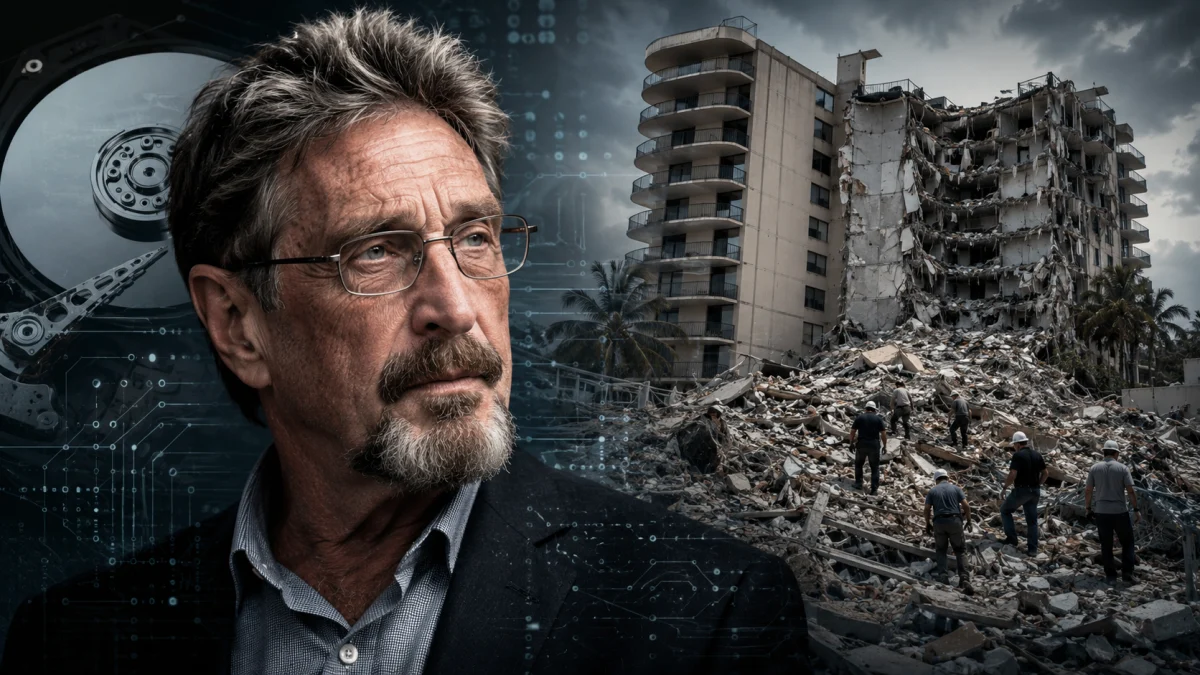
John McAfee died in a Spanish prison on June 23, 2021. Hours later, in the early morning of June 24, part of Champlain Towers South in Surfside, Florida, collapsed, ultimately killing 98 people. McAfee had previously claimed to possess more than 31 terabytes of incriminating information about government corruption. An Israeli military search-and-rescue delegation subsequently worked directly on the rubble. An Israeli military intelligence unit helped map the building. Mexican rescue specialists also arrived. Families were not allowed to freely search the debris. And investigators later disclosed that 25 damaged hard drives were recovered from the site. (AP News)
Those facts are real enough that asking whether they are connected is not irrational.
But the strongest version of the McAfee-Surfside theory has a serious problem: no verified evidence currently places McAfee, his alleged data cache or one of his hard drives inside Champlain Towers South before it collapsed. The viral tweet that supposedly provided that missing connection appears to have been fabricated after the disaster. Meanwhile, evidence created before the collapse—and a separate forensic engineering investigation conducted during civil litigation—provides a substantial structural explanation for why the building failed. (Lead Stories)
That does not require trusting every institution involved. It requires separating the evidence that can be independently corroborated from claims that depend on assumptions.
The short answer
Was John McAfee connected to the Surfside condo collapse?
There is currently no verified evidence that he was.
What is verified is considerably stranger than that simple answer makes it sound:
- McAfee died on June 23, 2021.
- Champlain Towers South collapsed on June 24.
- McAfee really had claimed to possess “31+” terabytes of incriminating government information.
- An IDF Home Front Command delegation worked at Surfside.
- The IDF Intelligence Directorate’s Unit 9900 produced a three-dimensional model used in the operation.
- Mexico-based rescue specialists participated or sought permission to participate.
- Families and other unauthorized people could not freely enter the rubble field.
- Investigators ultimately recovered 25 hard drives from the debris.
What has not been established is the crucial bridge connecting those facts: that McAfee had property, data or equipment inside Champlain Towers South. (Lead Stories)
How this investigation evaluates evidence
Government agencies can be wrong. Companies can protect themselves. News organizations can repeat errors. Witnesses can misremember events. Anonymous social-media accounts can fabricate evidence. Even records bearing dates should not automatically be accepted merely because a date appears on them.
For that reason, the strongest evidence in a case like Surfside is not necessarily the evidence carrying the most prestigious logo. It is evidence with good provenance: records demonstrably circulating before the event, contemporaneous correspondence, physical evidence, independent analyses that converge despite different incentives, and claims that can be checked against other records.
There is also an important distinction between:
“There is no evidence that X happened”
and
“There is evidence that X did not happen.”
Those are not the same conclusion, and this article will not treat them as interchangeable.
Why the McAfee-Surfside story looks so suspicious
Strip away all interpretation and consider the sequence.
McAfee was awaiting extradition from Spain to the United States when he was found dead in his prison cell on June 23, 2021. Spanish authorities determined that he died by suicide. His widow questioned that conclusion and sought further investigation. In 2023, a Barcelona court rejected the family’s appeal to reopen the case, finding no evidence implicating another person. That ruling establishes the official judicial conclusion; it does not require readers to regard every unanswered question surrounding McAfee’s death as illegitimate. (AP News)
Then Champlain Towers South collapsed at roughly 1:22 a.m. on June 24.
McAfee had previously made provocative claims about what would happen if he were arrested or disappeared. Most importantly for the Surfside story, on June 9, 2019, he publicly claimed that he had collected files concerning government corruption and possessed more than 31 terabytes of incriminating information that would be released if he were arrested or disappeared. The existence and contents of that supposed cache were never independently established, but the statement itself was real. (Lead Stories)
Then foreign rescue personnel arrived at Surfside.
Among them were members of the Israel Defense Forces Home Front Command. The IDF subsequently disclosed that the Intelligence Directorate’s Unit 9900, which specializes in visual intelligence, produced a three-dimensional model of the collapsed building to help rescuers navigate the debris and locate missing residents. (IDF)
And years later, NIST disclosed that 25 physical hard drives had been recovered.
Put those facts into a 30-second social-media video and the implication practically writes itself.
The problem is that implications are not evidence.
McAfee really did make the 31-terabyte claim
This portion of the story should not be dismissed as internet mythology.
McAfee publicly claimed in 2019 that he possessed “31+” terabytes of material concerning government corruption and threatened its release if he disappeared or was arrested. (Lead Stories)
What we cannot independently verify is whether:
- 31 terabytes of material actually existed;
- the information contained what McAfee claimed;
- copies remained intact in June 2021;
- McAfee controlled those copies from prison;
- or anyone else knew precisely where they were stored.
That distinction matters. McAfee making the claim is established. The physical existence, significance and location of the alleged archive are not.
Did McAfee say his hard drives were at Surfside?
This is the pivotal piece of the entire theory.
After the collapse, a screenshot circulated purporting to show a June 8, 2021 tweet from McAfee saying that his 31 TB of files were stored on hard drives in his condominium near 88th Street and Collins Avenue—almost exactly where Champlain Towers South stood.
If authentic and demonstrably published before June 24, that would be extraordinary evidence.
The available provenance points in the opposite direction.
Researchers examining McAfee’s actual June 8 activity found two other tweets from him that day, neither mentioning Surfside, Miami or hard drives. More importantly, an archived copy of McAfee’s Twitter timeline made on June 20, four days before the building collapsed, does not contain the alleged message. AFP independently reviewed McAfee’s timeline and public property records and reached the same conclusion. (Lead Stories)
That pre-collapse archive matters.
A screenshot produced after an event is weak evidence because virtually anyone can manufacture one and assign it an earlier timestamp. An archive already captured before the event provides a much stronger test.
Could a sophisticated operation theoretically alter or manipulate archives? In the abstract, almost any digital evidence can be challenged. But an investigation cannot stop at “fabrication is theoretically possible.” It asks how much additional evidence would have to be falsified for an alternative explanation to work.
At present, the evidence strongly supports the conclusion that the Surfside-specific McAfee tweet was fabricated, while McAfee’s earlier 31-terabyte claim was authentic. (Lead Stories)
That distinction appears to be where the conspiracy acquired its missing bridge.
Did John McAfee own a condo at Champlain Towers South?
Public property-record searches conducted immediately after the disaster found neither John McAfee nor his wife Janice among the recorded owners of units at Champlain Towers South. Researchers also reported finding no publicly identifiable connection between McAfee and the LLCs holding units they reviewed. (Lead Stories)
That substantially weakens claims that this was “McAfee’s condo.”
It does not prove he could never have had any connection to the building.
Ownership records cannot exclude the possibility that someone rented an apartment, stayed with another resident, stored property with an associate or used an intermediary.
Accordingly, the defensible conclusion is narrower:
No evidence reviewed for this article establishes that McAfee owned, rented, occupied or stored data at Champlain Towers South.
If someone produces a lease, contemporaneous message, storage agreement, visitor record, testimony from a resident or other authenticated pre-collapse evidence connecting McAfee to a specific unit, the analysis should change.
That evidence has not surfaced.
Why was the IDF involved in a condo collapse in Florida?
This is a reasonable question, and reducing the answer to “Israel helps with disasters” does not adequately address it.
An actual foreign military unit was operating at an American disaster site.
Contemporary reporting provides important context. Florida Gov. Ron DeSantis said that families with missing loved ones wanted Israeli specialists involved. Reuters reported that more than two dozen people initially missing had Jewish or Israeli connections and that relatives had expressed hope that the Israeli rescue team would participate. The Israeli National Rescue Unit had extensive experience operating inside collapsed structures, including disasters overseas and buildings damaged during warfare. (Jerusalem Post)
The IDF says its delegation consisted of engineering, rescue and population-assistance specialists and worked with American responders rather than establishing an independent operation. (IDF)
There is therefore a coherent operational explanation for why the team was invited.
That does not mean the appropriate investigative response is to stop asking questions.
Relevant questions include who authorized each participant, which sectors they entered, who supervised them, what objects they encountered and what evidence-handling rules governed their work.
Those are legitimate chain-of-custody questions regardless of whether the rescuers were Israeli, Mexican or American.
Was Israeli military intelligence involved?
Yes, in a specific and documented sense.
The IDF disclosed that an operational analysis team from Unit 9900 of the Intelligence Directorate built a three-dimensional model of Champlain Towers South. Unit 9900 specializes in visual intelligence. According to the IDF, the model helped rescuers reconstruct the location of apartments and navigate the collapsed structure. Contemporary reporting based on military briefings described the Unit 9900 team’s commander as being in Florida. (IDF)
That detail should not be disguised with vague language about “Israeli technical assistance.”
Military intelligence capability was involved.
But that fact does not establish that an intelligence-collection operation was underway.
There is an obvious rescue application for precisely this skill. If a 12-story building pancakes into a debris field and rescuers need to determine where a particular bedroom has moved, three-dimensional reconstruction and imagery analysis are extremely useful. The Israeli team was interviewing families about where missing residents slept and using building information to guide excavation. Reuters separately reported that rescuers were attempting to locate bedrooms and likely voids inside the rubble. (The Straits Times)
The legitimate use of intelligence technology does not prove that no improper activity occurred. It simply means the mere presence of Unit 9900 technology is not, by itself, evidence of one.
Why were Mexican rescuers there?
This portion of the story is often oversimplified.
There was not simply a mysterious Mexican government force operating alongside the IDF.
A Mexico-based humanitarian organization called Cadena International had a specialized Go Team assisting the response. Another group, Topos Azteca, grew out of the 1985 Mexico City earthquake and specializes in entering collapsed structures. (News Channel 3-12)
And the treatment of Topos Azteca is revealing.
Its rescuers did not receive automatic access simply because they had traveled to Florida. Contemporary reporting shows members waiting for authorization and saying they had to respect U.S. protocols and wait until they were permitted to enter. Miami-Dade Fire Rescue officials said responders had to establish that people entering the site were properly trained. (News Channel 3-12)
That complicates one popular version of the Surfside story:
Americans were prohibited from searching while foreign teams were secretly given unrestricted control of the rubble.
The documented situation was more controlled and less unusual: authorized specialists worked within a managed rescue operation while unauthorized civilians—and at least some foreign volunteers—could not simply enter.
Were families prevented from searching the rubble?
Yes.
Relatives were brought close enough to see the disaster site, but they were not allowed to independently climb onto the rubble and conduct searches. Some families were deeply frustrated and pushed officials to bring in additional international experts. (WUSF)
There was also an obvious safety reason for restricting access.
Miami-Dade Fire Rescue described an extremely compact debris field that had to be stabilized as crews moved through it. Moving one slab without understanding what supported it could destroy a survivable void or trigger a secondary collapse onto rescuers or trapped residents. Search operations were themselves interrupted at various points because of structural danger. (WUSF)
The restriction is therefore real, but the inference that families were excluded specifically so somebody else could secretly search for evidence is not established.
Contemporary officials also stated that documents, photographs, money and other personal “artifacts” discovered in the debris were to be turned over to police. (WUSF)
Whether that procedure was followed perfectly for every object is a separate question.
The 25 hard drives are real
This may be the most remarkable verified detail associated with the theory.
NIST disclosed in 2024 that Miami-Dade Police and investigators identified 25 hard drives among the fine debris recovered from Champlain Towers South. Investigators were especially interested in electronic storage because approximately 24 functioning security cameras had reportedly been recording to a digital video recorder inside the building. (NIST)
NIST says specialists examined the 25 drives but found the magnetic media too badly damaged to recover their contents. Investigators could not obtain usable security footage from them. (NIST)
NIST’s published chain-of-custody account states that Miami-Dade Police’s Homicide Bureau maintained custody of evidence immediately following the collapse, that evidence was cataloged and moved to secure facilities, and that control later transferred to NIST while police retained access. (NIST)
That is meaningful documentation.
It is also fair to distinguish an agency’s summary of evidence handling from the underlying records. In the public materials reviewed for this article, we did not locate a complete item-by-item initial intake and chain-of-custody log for every electronic device recovered from the rubble.
Publishing those records would answer more skeptical questions than simply repeating that custody was secure.
Most importantly, though:
No evidence reviewed here identifies any of the 25 drives as belonging to John McAfee.
The fact that hard drives existed inside a 136-unit residential building is not surprising by itself. What makes them feel significant is McAfee’s genuine earlier statement about hard drives and data. Without evidence connecting him to this building, however, that is correlation rather than a chain of proof.
The structural evidence does not depend entirely on NIST
This is where the intentional-collapse theory encounters its strongest problem.
If the entire case for structural failure rested on the federal government saying “trust us,” skepticism would be more justified.
It does not.
Engineers documented serious problems in 2018
Morabito Consultants inspected Champlain Towers South in 2018, almost three years before McAfee died.
Its report warned that failed waterproofing beneath the pool deck and entrance drive was causing major structural damage to the concrete slab and stated that deterioration would continue to expand if the waterproofing was not replaced. Engineers also found abundant cracking and spalling in garage columns, beams and walls, including areas containing exposed deteriorating reinforcement.
And we do not have to rely solely on the date printed at the top of that PDF.
A separate Town of Surfside public record contains an email dated November 13, 2018, from condo board member Mara Chouela to Surfside building official Rosendo Prieto, with the Morabito reports attached.
Could someone theoretically fabricate one old PDF? Yes.
But the evidentiary burden becomes considerably larger when the report also appears inside a separate contemporaneous email trail involving different people and an administrative process. That does not make manipulation metaphysically impossible; it makes a post-collapse fabrication explanation require substantially more unsupported assumptions.
A separate forensic engineering investigation found a failure mechanism
Wiss, Janney, Elstner Associates—WJE—conducted a forensic investigation for insurers and the court-appointed receivership during the civil litigation surrounding the collapse.
Its engineers reviewed original plans, maintenance records and photographs; inspected physical evidence; performed laboratory testing; and developed finite-element structural models. (Structure Magazine)
Their conclusions were severe.
WJE found that the original pool-deck design had inadequate punching-shear capacity at nearly all columns supporting the slab. A 1996 renovation added additional weight from pavers and sand. When as-built conditions and long-term loading effects were considered, WJE concluded that the pool deck had been near its collapse capacity since at least 1996. (Structure Magazine)
More important than the model itself were the photographs.
WJE identified November 2020 photographs showing evidence it interpreted as punching-shear-related distress. Photographs dated June 2, 2021—22 days before the collapse—showed significant vertical movement of the slab near one of the most heavily loaded pool-deck columns. An April 2020 photograph did not show the same condition. (Structure Magazine)
That is difficult evidence for an intentional-demolition theory to explain away.
The building appears to have begun failing before the tower came down
WJE reconstructed the pool deck as failing first, around 1:10 to 1:15 a.m., based on physical evidence, witness accounts and video. It placed the catastrophic eastern-tower collapse at approximately 1:22 a.m.—roughly seven to twelve minutes later. (Structure Magazine)
That does not resemble the simplest popular image of a healthy building suddenly being destroyed in one instantaneous event.
A separate academic team subsequently applied computer-vision feature tracking to publicly available collapse footage to quantify structural movement during the failure, providing another evidence stream independent of the federal investigation. (arXiv)
None of this establishes that deliberate interference is physically impossible.
It does establish that there was a real, independently documented structural failure process requiring no sabotage to explain why the building could collapse.
What has NIST actually concluded?
As of August 10, 2026, NIST has released its major technical findings, but its full final investigative report is still being prepared. That distinction matters because some reporting has loosely called the June release a final report. NIST itself says the full report will contain the supporting evidence analysis, computational modeling and recommendations. (NIST)
NIST’s current conclusion is that two garage-column/pool-deck connections failed in early June 2021. Over approximately three weeks, cracking and load redistribution progressively overloaded surrounding connections until the pool deck failed and the damage propagated into the tower. NIST attributes the dangerously small structural margins primarily to deficiencies in the original design and deviations during construction, aggravated by later added loads and long-term degradation. (NIST)
NIST also says it evaluated and ruled out several alternative contributors, including foundation failure, sinkholes, nearby-construction vibration, storm effects and impulsive loading such as an explosion. (NIST)
That conclusion deserves scrutiny like any other institutional conclusion.
But its persuasive force does not come merely from NIST’s authority. It comes from the fact that it broadly converges with engineering records transmitted in 2018 and a separate civil forensic investigation that identified pre-collapse distress and a plausible progressive-failure mechanism.
Could someone have intentionally triggered an already failing building?
Yes—in theory.
This is an important logical distinction.
Evidence that Champlain Towers South was badly deficient does not automatically prove that nobody intentionally accelerated its failure. A vulnerable structure could theoretically be easier to sabotage than a healthy one.
Therefore, “the building was structurally unsound” is not by itself a complete rebuttal to every intentional-trigger hypothesis.
But once that hypothesis is proposed, it needs affirmative evidence.
One would reasonably look for things such as unusual structural tampering, cutting or drilling, explosive residue, blast damage, unauthorized access to critical locations, suspicious work shortly before the collapse, communications demonstrating planning, anomalous physical signatures or evidence that someone knew exactly which vulnerable structural connection to compromise.
No credible evidence establishing such a sequence was identified in the sources reviewed for this investigation.
Meanwhile, there is affirmative evidence of progressive structural distress before June 24.
That makes an ordinary structural failure substantially better supported by the available evidence than a deliberate trigger—even without assuming that NIST or any other institution is automatically trustworthy.
The theory’s missing link is still McAfee → Surfside
This is ultimately the simplest way to evaluate the entire claim.
We can build several documented chains:
John McAfee
↓
claimed to possess 31+ TB of incriminating information ✅
And:
Champlain Towers South
↓
IDF rescue delegation participated ✅
↓
Unit 9900 visual-intelligence modeling assisted ✅
And:
Champlain Towers South
↓
25 hard drives recovered ✅
But the theory requires another connection:
John McAfee
↓
Champlain Towers South ❌
That bridge remains unsupported.
Worse for the theory, the viral piece of evidence that supposedly supplied the bridge—the tweet locating his hard drives near 88th and Collins—strongly appears to have been fabricated after the building collapsed. (Lead Stories)
Until that gap is filled with authenticated evidence, the remaining facts cannot simply be curve-fitted together.
What remains legitimately unanswered?
There are still records that would make the public record stronger.
A genuinely transparent investigation would benefit from publication or easier access to:
- the complete Surfside site-access logs showing personnel, times and assigned sectors;
- the IDF delegation’s detailed operational assignments;
- additional documentation concerning precisely how Unit 9900 personnel and products were integrated into the search;
- original Miami-Dade evidence-intake and chain-of-custody records for electronic devices;
- recovery locations and identifiers for the 25 hard drives;
- any surviving documentation concerning the building’s security DVR;
- a broader check of tenants, visitors and beneficial ownership against McAfee’s known associates;
- and a forensic reconstruction identifying the earliest creator and distributor of the fake McAfee-Surfside tweet.
That final question may be particularly interesting.
Someone took a real McAfee claim—the 31 TB statement—and apparently created a false piece of evidence placing that data at the exact location of a catastrophic building collapse that occurred one day after McAfee died.
Determining where that fabrication originated would tell us more about the development of the Surfside theory than another round of arguing about whether people should “trust the government.”
Evidence-weighted verdict
McAfee claimed to possess 31+ TB of incriminating government information
Verified as a claim made by McAfee.
The existence and contents of the alleged archive were not independently established. (Lead Stories)
McAfee owned a unit at Champlain Towers South
No supporting evidence found.
Public property-record reviews found no ownership by John or Janice McAfee. This does not independently rule out every possible rental, guest or third-party-storage arrangement. (AFP Fact Check)
McAfee said his hard drives were stored near 88th Street and Collins Avenue
Strong evidence indicates the viral tweet was fabricated.
Its alleged June 8 message is absent from McAfee’s documented activity and from a June 20 pre-collapse archive. (Lead Stories)
The IDF searched Champlain Towers South
Verified. (IDF)
An Israeli military intelligence unit assisted
Verified.
Unit 9900 created a 3-D visual-intelligence model used during rescue operations. (IDF)
Mexican specialists were involved
Verified.
Different Mexico-based groups responded; Topos Azteca initially had to wait for authorization rather than receiving unrestricted access. (News Channel 3-12)
Families were restricted from searching the rubble
Verified.
The debris field was controlled because of rescue procedures and secondary-collapse risk. (WUSF)
Investigators recovered 25 hard drives
Verified. (NIST)
Those drives belonged to McAfee
No evidence found.
Champlain Towers South was intentionally destroyed to eliminate or retrieve McAfee’s data
Not supported by the available evidence.
The structural-failure explanation is supported not merely by a federal investigation but by records demonstrably circulating years before the collapse, pre-collapse photographs, physical testing, engineering analysis performed in separate civil litigation and the observable sequence of the failure itself.
Conclusion: the suspicious facts are real; the connection is not
The McAfee-Surfside story is unusually compelling because many of the details people repeat as evidence of a conspiracy are actually true.
McAfee really died one day before the disaster. He really claimed to possess an enormous cache of incriminating data. The IDF really searched the rubble. Israeli military intelligence really contributed technology. Mexican rescue specialists really came to Surfside. Families really were restricted from the debris field. And investigators really did recover 25 hard drives.
Those facts deserve to be stated plainly rather than minimized.
But investigation requires more than accumulating unusual facts. It requires proving the connections between them.
At present, the indispensable connection—John McAfee to Champlain Towers South before June 24, 2021—has not been established. The supposed tweet that appeared to prove that connection instead shows strong signs of post-collapse fabrication.
At the same time, the case for structural failure is considerably stronger than “the government says so.” Engineers had documented serious structural problems years beforehand; a surviving 2018 email trail helps authenticate that history; photographs show developing distress before the catastrophe; and an independent forensic engineering investigation reconstructed a credible progressive failure that broadly converges with the later federal findings.
That leaves room for skepticism without requiring speculation to masquerade as evidence.
The evidence does not justify calling the McAfee-Surfside theory proven. It also does not justify pretending that every question about foreign access, electronic evidence or chain of custody is unreasonable.
The intellectually defensible position is narrower: follow every suspicious fact as far as the evidence permits—and stop where the evidence stops.
References and Further Reading
Because this subject mixes engineering evidence, government records, contemporary rescue reporting and later conspiracy claims, the sources below are organized by what they actually establish rather than by publisher.
Primary structural records and pre-collapse documentation
- Morabito Consultants — Champlain Towers South Structural Field Survey Report, October 8, 2018 — The pre-collapse engineering survey documenting failed waterproofing, concrete deterioration, cracking, spalling and structural repairs considered necessary at Champlain Towers South. (Town of Surfside)
- Town of Surfside — November 13, 2018 Email Transmitting the Morabito Reports — Particularly important for provenance because the municipal email record shows the Morabito material being transmitted years before the collapse, rather than relying solely on the date printed on the engineering report.
- Town of Surfside — Champlain Towers South Structural Recertification Inspection Material — Additional inspection material concerning the condition of the structure and repairs identified during the recertification process. (Town of Surfside)
Independent and forensic structural analysis
- STRUCTURE Magazine / WJE — The Champlain Towers South Collapse: A Forensic Engineering Analysis — Detailed account by Wiss, Janney, Elstner engineers who investigated the collapse for insurers and the court-appointed receivership, including structural modeling, laboratory testing, pre-collapse photographs and their proposed failure sequence. (Structure Magazine)
- Kong & Smyl — Investigation of Condominium Building Collapse in Surfside, Florida: A Video Feature Tracking Approach — Independent academic analysis applying computer-vision techniques to publicly available collapse footage. (arXiv)
- University of Washington RAPID Facility — Investigating the Champlain Towers Collapse — Describes independent post-disaster lidar, seismic and other field-data collection used to preserve the physical condition and geometry of the site. (RAPID)
NIST investigation and physical evidence
- NIST — Technical Findings on What Caused the 2021 Partial Collapse of Champlain Towers South, June 2026 — NIST’s current technical conclusions on the collapse mechanism, design and construction deficiencies, load redistribution and alternative hypotheses including explosion. The complete final report was still forthcoming as of this article’s publication. (NIST)
- NIST — Champlain Towers South Investigation Hub — Central repository for technical presentations, investigation updates, personnel and future final-report material. (NIST)
- NIST — Evidence Transfer From Champlain Towers South to Miami-Dade Police Department — Details physical-evidence custody and storage and, critically, the recovery and forensic examination of 25 hard drives. (NIST)
Israeli rescue operation and Unit 9900
- IDF — Using IDF Intelligence Methods and Technology: Home Front Command Delegation in Miami — Primary IDF account explicitly identifying Intelligence Directorate Unit 9900 and describing its 3-D visual-intelligence model of Champlain Towers South. (IDF)
- IDF — “Helping Hand” Joint IDF and Ministry of Foreign Affairs Aid Delegation — Primary description of the Israeli delegation’s composition, mission and cooperation with American responders. (IDF)
- Reuters — Israeli and Mexican Rescuers Bring Experience to Miami Building Collapse, republished by The Jerusalem Post — Contemporary independent reporting on why Israeli and Mexican specialists were present, family requests for Israeli involvement and the international search effort. (Jerusalem Post)
- Reuters — Israeli Commander Describes Surfside Rescue Operation, via The Straits Times — Contemporary interview with Israeli National Rescue Unit commander Golan Vach detailing how the team reconstructed apartments and searched for bedrooms and void spaces. (The Straits Times)
Mexican rescuers and access restrictions
- CNN — The Mexican Rescuers Joining the Search for Survivors in Surfside — Details the roles of Cadena International and Topos Azteca and records Topos personnel acknowledging that they had to wait for authorization before entering the operation. (News Channel 3-12)
- Azteca Noticias — Mexican Rescuers at the Collapsed Surfside Building — Contemporary Spanish-language account separately documenting Topos Azteca’s wait for official access and the participation of Cadena personnel. (TV Azteca)
Families, rubble access and evidence handling
- Associated Press / WUSF — Families of the Missing Visit Site of Condo Collapse — Contemporary reporting on families’ frustration, the inability to freely search the pile, structural dangers faced by rescuers and officials’ statement that recovered personal artifacts were handed to police. (WUSF)
John McAfee’s death, 31 TB claim and the alleged Surfside connection
- Associated Press — Spanish Court Rejects Appeal to Reopen Investigation Into John McAfee’s Death — Independent reporting on the Spanish judicial determination of suicide and the family’s unsuccessful effort to reopen the death investigation. (AP News)
- Lead Stories — No Evidence John McAfee Owned Property in the Collapsed Miami Building — Useful because it documents both McAfee’s genuine 2019 31+ TB statement and the problems with the later Surfside-specific screenshot, including the June 20 pre-collapse archive. (Lead Stories)
- AFP Fact Check — Fabricated McAfee Tweet Misleadingly Linked to U.S. Condo Collapse — Independent review of the alleged June 8 tweet, McAfee’s archived timeline and Miami-Dade/Surfside property records. (AFP Fact Check)
- PolitiFact — Image Suggesting John McAfee Stored Files at Collapsed Florida Condo Tower Is Fake — Separate examination of the viral screenshot and McAfee’s documented June 8 Twitter activity. (Politifact API)
Current independent reporting on the 2026 engineering findings
- Associated Press — A Deadly Florida Condo Collapse Happened Slowly Over Several Weeks, Probe Finds — Independent reporting on the June 2026 technical findings and the evidence of a progressive failure beginning weeks before the visible tower collapse. (AP News)