
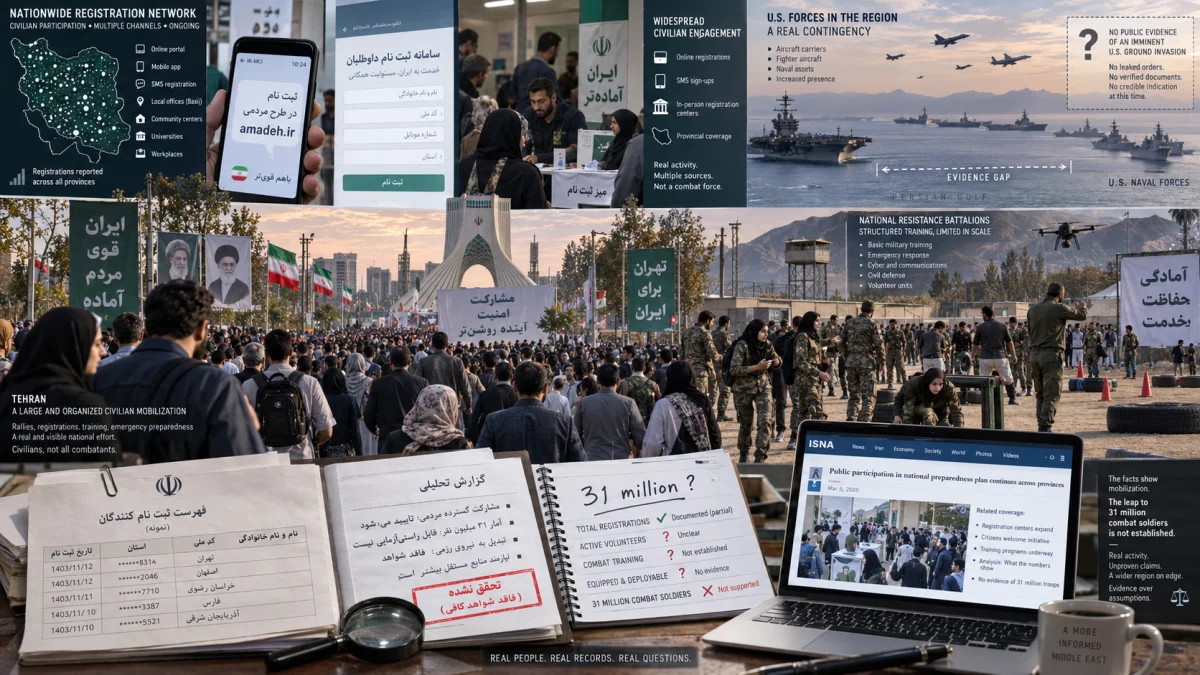
Iran really is organizing a large civilian-defense mobilization, including military training and 1,000 planned "National Resistance" battalions. But the viral claim that 31 million Iranian men just signed up to fight the United States, will all receive military training, and that one million have been selected to repel an imminent American ground invasion is not what the available evidence shows.
The 31 million figure is not a new count of combat volunteers. It is a months-old Iranian government claim about participation in the much broader Jan-Fada campaign, whose participants were asked about military service, emergency relief, social work, media activity and financial support.
Iran’s own current figures also contradict the claim that these were "31 million men." Campaign spokesperson Sasan Zare said 32 percent of the claimed participants were women and 68 percent were men. He said 26 percent had expressed willingness to participate in military or security activities.
More importantly, the underlying 31 million figure has never been independently verified. The Associated Press reported on September 18 that Iranian officials had previously claimed more than 30 million volunteers, but AP could not independently confirm the number. Independent technical analysis of the campaign website has also raised substantial questions about how the total was generated.
At the same time, dismissing the entire story because the 31 million figure is questionable would be a mistake.
Something significant is happening.
Iran has begun converting Jan-Fada from a broad national mobilization campaign into actual organized military and emergency training. The campaign has announced 1,000 resistance battalions. Iranian officials say hundreds of thousands registered for the current Tehran mobilization, and Tehran’s Revolutionary Guard commander told state television that more than one million people could eventually receive training. AP independently documented hundreds of thousands of people participating in Friday’s government-organized rally.
The important story is therefore not that "31 million fighters are waiting for America."
It is that Iran is building a large civilian-defense structure during an active war, while the numbers being used online to describe that structure have become badly scrambled.
The viral claim combines at least three different numbers
The easiest way to understand the story is to separate the figures.
| Claim circulating online | What the evidence actually shows |
|---|---|
| 31 million Iranian men signed up to fight | Iran claims roughly 31 million people participated in Jan-Fada. Its own figures say 32% were women. The 31 million total remains independently unverified. |
| 31 million people volunteered for combat | No. Iran’s latest campaign breakdown says 26% expressed interest in military/security activity. Other participants selected relief, social, cultural, media or financial-support roles. |
| All 31 million will receive military training | No public evidence supports this. The current military-training program concerns a subset of Jan-Fada participants. |
| Iran is creating 1,000 resistance battalions | Yes. This has been publicly announced by the Jan-Fada organization and reported across Iranian media. |
| One million people were selected from the 31 million to fight Americans | That is not what the available reporting says. A Tehran IRGC commander said more than 600,000 had registered for the current mobilization and more than one million were expected to participate in training. |
| Iran is preparing civilians for modern warfare | Yes. Iranian officials have described military and relief instruction and have discussed training relevant to contemporary drone and weapons warfare. |
| This proves Iran has intelligence that a U.S. invasion is imminent | No public evidence establishes that. A possible U.S. ground operation has been openly discussed for months. |
That distinction changes the story considerably.
Where did the 31 million figure actually come from?
Jan-Fada did not suddenly appear this week.
The campaign began in late March 2026, after the U.S.-Israeli war with Iran had already started. A text message distributed inside Iran described the campaign as a response to American and Israeli threats against Iranian "islands and borders" and invited people to declare their readiness to defend Iranian territory. The Wall Street Journal reported the recruitment effort on March 29 while the possibility of an American ground operation was already being publicly discussed.
Iranian media then began reporting rapidly rising participation totals.
By April 7, Tasnim was reporting more than 14 million participants. By early May, Jan-Fada spokesperson Sasan Zare was claiming 31.3 million registrations. A May 2 report gave the campaign’s own demographic breakdown and said participants included men and women, with the original registration campaign open to people as young as 12.
So the claim circulating now that Iran "just mobilized 31 million men" collapses months of events into a single development.
The 31 million number is old.
What is new in September is the effort to take a portion of the broader Jan-Fada network and organize it into structured military and emergency-response units.
Iran’s own numbers do not describe 31 million soldiers
This is perhaps the simplest factual problem with the viral version.
At a September 16 press conference, Zare said the claimed 31 million participants were approximately 68 percent male and 32 percent female. If that overall total were accurate, it would correspond to roughly 21 million men, not 31 million men.
But even that does not make those 21 million men soldiers.
According to the latest breakdown attributed to Zare:
26 percent selected military and security activities, 20 percent relief and rescue work, 20 percent social services, 17 percent cultural and media work, and 13 percent ongoing financial support, with a smaller category covering other activities.
Earlier Iranian reporting had put the military-interest figure at 40 percent. Zare’s September comments said the campaign had initially relied on survey information and now possessed more detailed data, after which he gave the lower 26 percent figure.
That may explain another number circulating online.
Forty percent of roughly 31 million is around 12.4 million. That appears to be a plausible origin for claims that more than 12 million Iranians had volunteered for military roles.
But even if that is where the number came from, it would still represent a percentage applied to an unverified overall registration count, not 12.4 million trained fighters.
Using the campaign’s newer 26 percent figure would produce a very different number anyway.
The larger lesson is that none of these percentages should be mistaken for a military order of battle.
How reliable is the 31 million figure?
This is where the evidence gets more complicated.
Iranian authorities continue to stand behind the figure. It has been repeated by senior officials and state-aligned media and was repeated again this week.
But they have not published an anonymized registration database or other independently auditable evidence establishing that 31 million unique people participated.
That matters because an extraordinary headline number is not independently verified simply because multiple government outlets repeat it.
The Associated Press specifically noted that it could not independently confirm the earlier claim of more than 30 million volunteers.
There is also a technical challenge to the number.
Former Sharif University academic Ali Sharifi-Zarchi examined publicly accessible data exposed by the Jan-Fada website. His analysis found ascending record identifiers that had reached only about 3.9 million while the site’s public counter was claiming more than 30 million participants.
He subsequently published his methodology, code and samples on GitHub. His argument is that the site’s structure indicates these identifiers correspond to registration records rather than an entirely separate comment database.
Fact-checking outlet FactNameh examined the evidence and concluded that the 30 million figure was false. It also documented that critics of Sharifi-Zarchi’s analysis argued the exposed numbers could instead be comment identifiers. FactNameh rejected that explanation based on its examination of the site’s design.
There are additional problems. The campaign accepted registrations through multiple channels, and its registration architecture did not provide the kind of publicly auditable unique-person dataset needed to determine how many separate human beings participated. FactNameh also found that a person could potentially create multiple registrations using different phone numbers or email addresses.
What can we responsibly conclude?
The evidence does not justify treating 31 million as an independently established headcount.
But it would also be too strong to say that the public website data independently proves the true nationwide total was exactly 3.9 million or lower. Jan-Fada used web, SMS, telephone and in-person registration mechanisms, while outsiders do not possess the campaign’s complete database.
The strongest evidence-based conclusion is narrower:
Iran says approximately 31 million people participated in Jan-Fada, but it has not released enough auditable data to independently establish that number, and publicly available technical evidence gives substantial reason to question it.
That is more defensible than either blindly accepting the government’s total or pretending outsiders possess a complete census that they do not.
What changed in September: the 1,000 battalions
This part is real and much more important than the inflated social-media version needs it to be.
On September 14, the Jan-Fada organization announced preparations to train and organize 1,000 "National Resistance" battalions, coordinated with Iran’s armed forces.
People were instructed to register through the Jan-Fada website or by SMS for military and relief courses.
Zare subsequently claimed that the initial capacity for the 1,000 battalions was filled in less than 100 minutes, with additional applicants being placed into reserve or waiting pools. That figure, like the organization’s larger registration statistics, comes from the campaign itself and is not independently auditable from the outside.
Iranian reporting has also quoted Zare saying the instruction would be designed around contemporary warfare, including training involving FPV drones and shoulder-fired systems, with the armed forces responsible for the training.
That is a considerably more concrete development than an online pledge.
Iran is not merely collecting names anymore. It is openly describing an effort to train, organize and integrate civilians into defense formations.
What has not been publicly established is the final size, readiness, equipment level or combat role of those formations.
The phrase "1,000 battalions" should also not be converted automatically into one million troops. Iran has not published a definitive roster showing that each Jan-Fada unit contains 1,000 people, and military units called battalions can vary substantially in size and organization.
So where does the "one million" figure come from?
This number is real in a much narrower sense.
During the September 18 Tehran mobilization, Greater Tehran Revolutionary Guard commander Gen. Hassan Hassanzadeh told Iranian state television that more than 600,000 people had registered to participate and that more than one million were expected to take part in training.
The state broadcaster estimated more than 300,000 people were on Tehran’s streets Friday. AP described the event as the largest government-organized demonstration in Iran since the war began.
Iranian state reporting gave somewhat different numbers, including approximately 500,000 registered for the Tehran exercise and a planned 313,000-person parade. That variation is another reason to distinguish government estimates from independently verified attendance.
None of these reports says that Iran examined 31 million recruits and selected exactly one million soldiers to defeat an American invasion.
The million figure is an expectation for participation in training, attributed to a Tehran IRGC commander.
That is not the same claim.
Does Jan-Fada mean Iran knows a U.S. ground invasion is coming?
There is no public evidence of that.
But there is an important nuance: Iran does not need secret intelligence to regard a U.S. ground operation as a real contingency.
The possibility has been public for months.
On March 2, shortly after the war began, U.S. Defense Secretary Pete Hegseth declined to rule out deploying American ground troops into Iran.
When Jan-Fada launched later that month, its recruitment message explicitly referred to threats against Iranian territory. The Wall Street Journal reported the campaign in the context of fears that the United States could conduct a ground operation.
The possibility has remained part of U.S. military planning.
The Washington Post reported in late August that more than 50,000 U.S. troops had remained on alert in the region and that elements of the 82nd Airborne Division deployed after the war began. The Post noted that those troops would be important in the event of a ground invasion. The same reporting also described serious warnings from senior U.S. military leaders about the strain caused by extending the Iran operation.
CNN reported on September 9 that a ground option had been presented in discussions about deeply buried Iranian nuclear facilities but had not been selected.
So two things can simultaneously be true:
A U.S. ground operation is a real military contingency that Iran has obvious reasons to prepare for.
And:
There is no publicly available evidence showing that this week’s mobilization was triggered by new Iranian intelligence proving that Washington has decided to invade.
Preparation for a known contingency is not evidence that the contingency has become an approved operation.
Why the mobilization still matters
Correcting the numbers should not obscure the underlying development.
Iran has gone from soliciting declarations of national support to publicly organizing at least some volunteers into structured formations, coordinating their training with the armed forces and describing instruction for the kinds of weapons and drones relevant to modern warfare.
Friday’s event was also not merely an online campaign.
AP reporters documented hundreds of thousands of participants, military-style formations, armed Revolutionary Guard members, drones and other military equipment displayed in Tehran.
Iran’s stated purpose is deterrence and national defense.
There is another possible function as well. The Revolutionary Guard and Basij are not solely external-defense organizations; both have historically played major domestic-security roles. AP noted that expanding a trained volunteer layer could also strengthen the state’s ability to respond to future internal unrest. That is an implication, not proof that internal repression is the program’s primary purpose.
The most accurate description is therefore broader than either side’s preferred narrative.
Jan-Fada is simultaneously a political mobilization campaign, a demonstration of national resilience, a recruitment network and, increasingly, a mechanism for actual civilian defense training.
Exactly how effective it becomes is a separate question.
Would a huge volunteer force determine the outcome of a ground war?
No responsible military analysis can answer that from a signup number.
Registration is not the same as training. Training is not the same as unit cohesion. Unit cohesion is not the same as combat capability.
A ground campaign would depend on logistics, intelligence, command structures, air and missile power, terrain, supply lines, force protection, local support, morale and the ability of each side to sustain losses.
Iran’s size, population, mountainous terrain and potential for decentralized resistance would create very different problems from those involved in an air campaign. A recent CSIS analysis of a hypothetical post-invasion insurgency argued that a U.S. occupation could confront challenges exceeding those experienced in Iraq or Afghanistan. That is an analytical scenario, not a prediction that any particular side would win.
The United States also retains capabilities that cannot be captured by comparing raw troop counts.
Conversely, technological superiority does not make manpower, drones, dispersed forces, geography or prolonged logistics irrelevant.
That is precisely why reducing the question to "31 million versus the U.S. military" is not serious analysis.
The bottom line
Iran is carrying out a genuine and increasingly militarized civilian mobilization.
It has announced 1,000 National Resistance battalions. Iranian officials say hundreds of thousands have registered for the current Tehran mobilization, and more than one million could ultimately receive some form of training. The government is openly discussing military, emergency and modern-warfare instruction.
But the viral version substantially changes what the evidence says.
There is no verified evidence that 31 million Iranian men just enlisted for war.
There is no evidence that all 31 million will receive military training.
There is no evidence that one million were selected from those 31 million specifically to repel an American invasion.
And there is no public evidence that the latest mobilization proves Iran has obtained secret intelligence showing that a U.S. ground invasion has been ordered.
The 31 million figure is a months-old, unaudited Iranian government claim about a broad national campaign. Iran’s own demographic and activity breakdowns show that the participants were neither all men nor all military volunteers.
But the correction should not become its own form of minimization.
Iran really is preparing a potentially large pool of civilians for organized defense during an active war.
That documented development is significant enough without turning 31 million campaign registrations into 31 million soldiers.
References and Further Reading
Current Mobilization and Jan-Fada
Associated Press: Hundreds of thousands attend Iran’s biggest government-organized rally since the war began
The strongest independent reporting on the September 18 mobilization, including the 600,000-plus registration claim, the expectation of more than one million trainees and AP’s inability to independently verify the earlier 30 million figure.
Iranian announcement of training and organization for 1,000 National Resistance battalions
Reproduces the Jan-Fada headquarters announcement establishing the new military and relief-training phase.
Current Iranian reporting on Jan-Fada participant categories and the 26 percent military/security figure
Reports Sasan Zare’s latest breakdown of campaign participants and his statement that newer data were more detailed than the campaign’s initial survey figures.
Tasnim coverage of the September Tehran Jan-Fada exercise
Provides Iranian state-aligned reporting on the 313,000-person event and the claim that roughly 500,000 people had registered in Tehran.
Origins of the Campaign
Wall Street Journal: Iran recruits volunteers amid ground-invasion fears
Documents the March 29 recruitment message sent to Iranian mobile users and its reference to threats against Iranian territory.
WANA: Iran’s May claim that more than 31 million people joined Jan-Fada
Useful as a record of what campaign officials themselves were claiming months before the current training phase, including the earlier demographic and military-interest figures.
Verification of the 31 Million Figure
Ali Sharifi-Zarchi’s published technical analysis and Jan-Fada website evidence
Contains the source-code analysis, exposed record identifiers, methodology and supporting files used to challenge the campaign’s public registration counter.
FactNameh investigation of the Jan-Fada 30 million registration claim
Examines the technical dispute over the website identifiers, duplicate-registration issue and lack of independently auditable campaign data.
U.S. Ground-War Context
Washington Post: U.S. would not rule out sending ground troops into Iran
Establishes that possible U.S. ground operations were publicly discussed before Jan-Fada was launched.
Washington Post: Military leaders warn against extending Iran war operations
Reports the current U.S. force posture, the deployment of 82nd Airborne personnel and internal military concerns about sustaining the conflict.
CSIS: Imagining an insurgency in post-revolutionary Iran
Provides a useful analytical discussion of the military and political difficulties that could accompany a hypothetical large-scale ground campaign and occupation.
Editorial currency note: This article reflects publicly available information through September 19, 2026. The U.S.-Iran conflict and Iran’s Jan-Fada mobilization are developing rapidly. Registration figures, training plans and U.S. force posture may change as additional information becomes available.