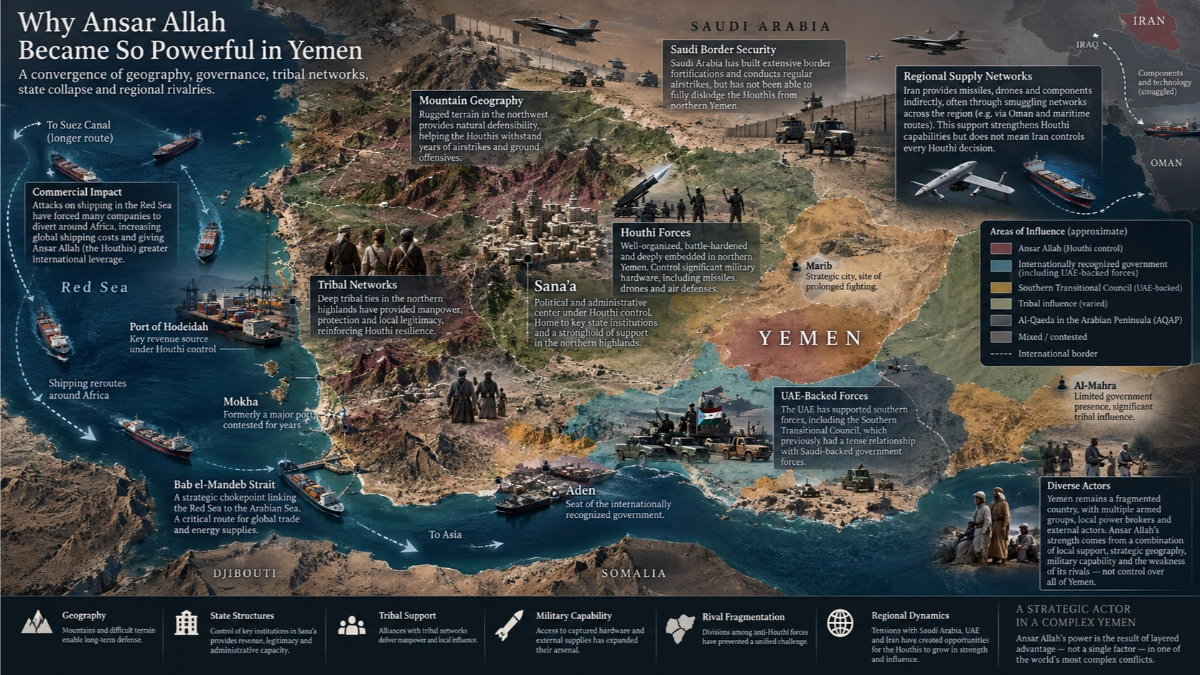
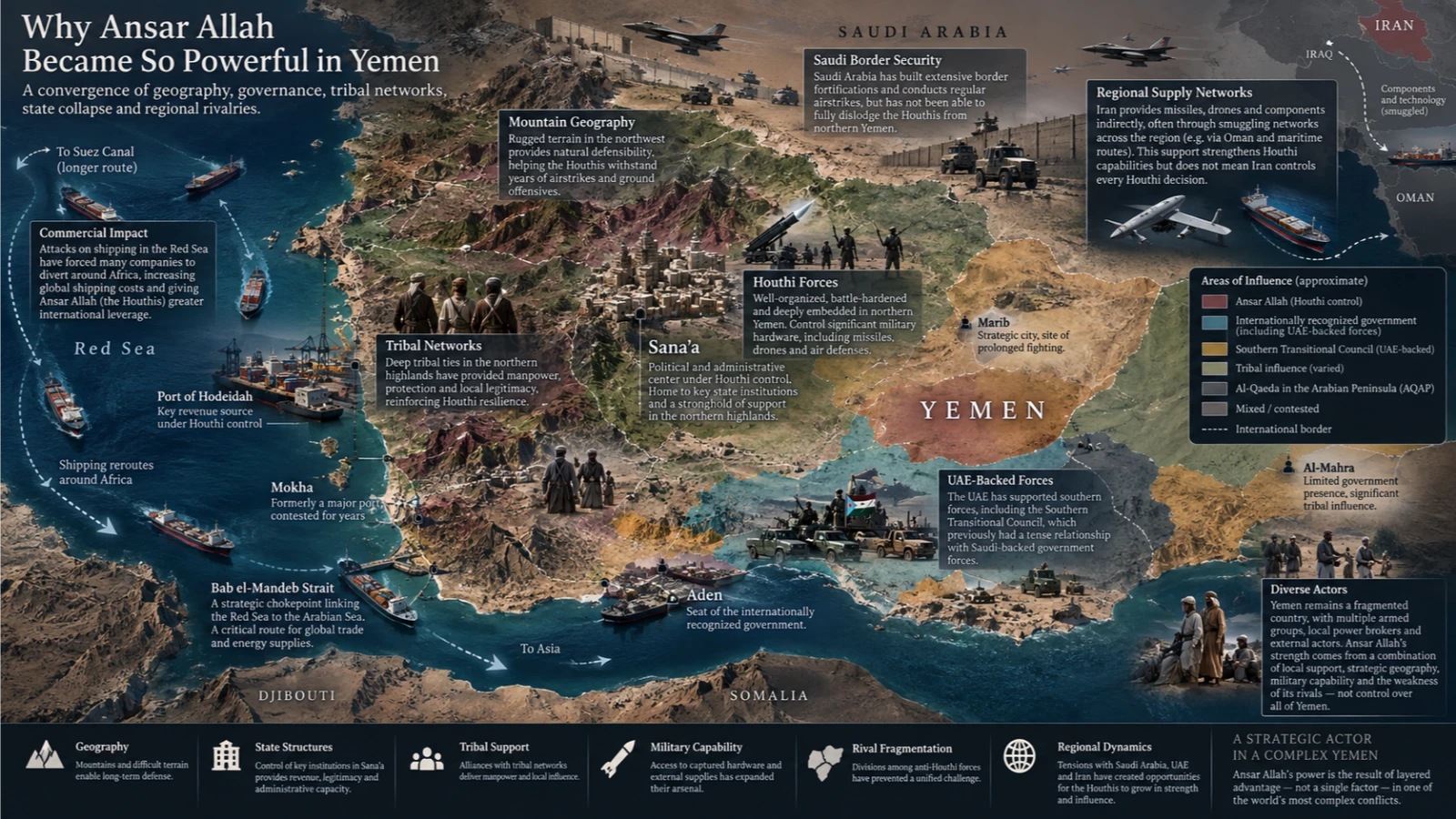
The Houthis are powerful because no single explanation accounts for their rise.
Ansar Allah is an indigenous Yemeni movement with genuine social, religious and political roots. It built a committed core of supporters, exploited the collapse of Yemen’s post-2011 political transition, allied temporarily with the former president it had once fought, captured state institutions and weapons, accommodated or coerced northern tribes, developed a centralized governing system, accumulated domestic revenue and received increasingly important military assistance from Iran.
Its opponents, meanwhile, spent much of the war divided among rival Yemeni factions sponsored by Saudi Arabia and the United Arab Emirates. The Saudi-led military intervention failed to dislodge the Houthis from Sana’a and, in some parts of Yemen, appears to have strengthened Ansar Allah’s nationalist claim that it was defending the country from foreign attack.[1]
None of this establishes that most Yemenis support Houthi rule.
There is no reliable current national approval rating for Ansar Allah. Limited recent polling actually suggests that supporting specific Houthi actions—particularly attacks connected to the Palestinian cause—can coexist with an unfavorable view of the movement itself.[2]
Nor does calling the Houthis an “Iranian proxy” adequately explain them. The movement predates substantial Iranian military support by years and developed from distinctly Yemeni conditions. At the same time, a United Nations panel concluded that Ansar Allah could not independently develop and produce the full range of advanced missiles, drones, maritime weapons and related systems it now operates without foreign support, with significant evidence pointing toward Iran and aligned armed groups.[3]
The most accurate picture is therefore complicated but coherent:
Ansar Allah is simultaneously a locally rooted Yemeni movement, an authoritarian de facto government, an Iranian-supported regional military actor, a beneficiary of its enemies’ failures, and a political organization whose actual level of nationwide popular support remains uncertain.
That distinction matters again because Yemen’s long-frozen front lines are moving. In September 2026, Ansar Allah launched a major offensive along the west coast and captured Mokha, its most consequential territorial gain since the 2022 truce. On September 10, UN Special Envoy Hans Grundberg told the Security Council that the risk of Yemen returning to large-scale war had become a “harsh reality.”[4]
Understanding why the Houthis became so difficult to defeat is therefore no longer merely a question about the last war. It is central to understanding the next phase of Yemen’s conflict.
Who are the Houthis?
The organization commonly called the Houthis formally calls itself Ansar Allah, or “Supporters of God.”
The popular name comes from the al-Houthi family, particularly Hussein Badreddin al-Houthi, the religious and political figure whose followers became the nucleus of the movement.
Its origins lie in Yemen’s far north, particularly Saada Governorate, and in a revival of Zaydi Islam, an indigenous Yemeni branch of Shia Islam with a history stretching back more than a thousand years.
That does not make the Houthis simply Yemen’s equivalent of Iran’s Twelver Shia establishment.
Zaydism differs substantially from the Twelver Shiism dominant in Iran. Historically, Zaydi jurisprudence has in some respects been closer to Sunni schools than to Iranian Twelver doctrine. Yemen’s sectarian divisions also never mapped neatly onto its political alliances: former president Ali Abdullah Saleh himself came from a Zaydi background, while some Zaydi tribes fought against the Houthis.[5]
Reducing Yemen’s war to Sunni Saudi Arabia versus Shia Iran therefore misses much of its internal history.
Where did Ansar Allah come from?
One important predecessor was the Believing Youth, a Zaydi religious and educational revival network established in the 1990s.
Northern Zaydi communities had experienced several decades of political and cultural pressure. Saudi-supported Salafist institutions had expanded in historically Zaydi areas, while residents of Saada also complained about economic neglect, political marginalization and the increasingly authoritarian government of President Ali Abdullah Saleh.
Hussein al-Houthi became one of the movement’s most influential figures.
His politics mixed Zaydi revivalism, opposition to Saleh, hostility toward American and Israeli policy, and themes later associated with Iran’s post-1979 revolutionary discourse.
Tensions with Saleh’s government eventually became armed conflict.
In 2004, government forces sought Hussein al-Houthi’s arrest. Fighting followed, and he was killed that September.
Rather than eliminating the movement, his death transformed him into a martyr for supporters.
Between 2004 and 2010, government forces and the Houthis fought six rounds of war in Saada. The campaigns hardened Ansar Allah militarily, deepened local grievances and created networks of fighters and supporters that would later prove far more consequential than Sana’a expected.
This history is important because it establishes a basic chronological fact:
The Houthi insurgency was already a significant Yemeni political and military phenomenon before Iranian assistance reached the level seen later in the civil war.
Iran matters enormously to the story. It does not explain the movement’s birth.
What happened after Yemen’s 2011 uprising?
The next major turning point was not Iran. It was the collapse of Yemen’s existing political order.
The Arab Spring reached Yemen in 2011. Mass protests, elite defections and violence eventually forced Saleh from the presidency under a Gulf Cooperation Council-backed transition.
Vice President Abdrabbuh Mansur Hadi took over and was confirmed in a 2012 election in which he was the sole presidential candidate.
A National Dialogue Conference attempted to construct a new political order.
It failed to create one strong enough to contain Yemen’s competing movements.
The country faced corruption, economic deterioration, separatism in the south, jihadist insurgency, tribal rivalries, military fragmentation and deep suspicion among political factions.
Ansar Allah used that environment to expand beyond Saada.
But another actor was indispensable to its rapid rise:
Ali Abdullah Saleh.
Why did the Houthis ally with the president who had fought them?
This is one of the strangest but most important parts of Yemen’s war.
Saleh had spent years trying to crush the Houthi movement.
After being forced from the presidency, he retained extensive influence inside Yemen’s military, bureaucracy, General People’s Congress political machine and tribal patronage networks.
He and the Houthis then formed a tactical alliance against common enemies.
The arrangement was ideologically unnatural but strategically useful.
Ansar Allah brought motivated fighters and expanding territorial control.
Saleh brought decades of relationships inside the state and armed forces.
Together, Houthi fighters and Saleh-aligned forces were dramatically more powerful than the northern insurgency would have been by itself.
This helps explain why the Houthi advance of 2014 should not be interpreted as either:
“Yemenis democratically chose the Houthis,”
or:
“Iran simply installed the Houthis in Sana’a.”
The actual mechanism was a convergence of state failure, armed expansion, elite alliances, military defections and political collapse.
How did the Houthis take Sana’a?
Ansar Allah forces entered the capital in September 2014.
A UN-brokered Peace and National Partnership Agreement was supposed to produce a new government while armed forces withdrew.
Instead, Houthi power continued expanding.
By early 2015, President Hadi and his government had been placed under severe pressure, Houthi forces controlled key institutions, and Hadi eventually fled Sana’a and then Yemen.
The UN Security Council responded with Resolution 2216 in April 2015, demanding that the Houthis withdraw from seized territory, relinquish weapons captured from state institutions and cease actions reserved to Yemen’s recognized government.[6]
But the resolution did not reverse events on the ground.
Ansar Allah had already crossed a crucial threshold.
It was no longer merely an insurgency fighting the Yemeni state.
It had captured much of the Yemeni state.
Why did Saudi Arabia intervene?
Saudi Arabia viewed the Houthi takeover as a major security threat.
The movement had taken Sana’a, advanced southward, seized Yemeni military weaponry and maintained increasingly visible ties with Iran.
Saudi Arabia also faced the possibility that an armed movement openly hostile toward Riyadh would dominate a neighboring country along a roughly 800-mile border.
In March 2015, Saudi Arabia formed a military coalition to intervene in Yemen.
The stated objectives included restoring the internationally recognized government and reversing Houthi territorial gains.
The UAE became another major coalition power.
The United States was not formally a belligerent in the same sense as Saudi Arabia, but Washington provided major military support to Saudi Arabia and the UAE, including weapons, services and other assistance. A later Government Accountability Office review found that the Pentagon administered at least $54.6 billion in military support to Saudi Arabia and the UAE between fiscal years 2015 and 2021, overwhelmingly through purchased defense articles and services. The GAO also found that the U.S. government had not fully determined the extent to which that support contributed to civilian harm in Yemen.[7]
Saudi Arabia had overwhelming advantages in aircraft, money and conventional military technology.
Yet the Houthis survived.
That failure is one of the central facts of the war.
Did Saudi Arabia’s intervention make the Houthis stronger?
In important ways, yes.
That does not mean Saudi intervention created Ansar Allah or that every Yemeni rallied behind the Houthis.
It means foreign intervention changed the political environment in which the movement operated.
Before 2015, Ansar Allah could be understood primarily through Yemen’s internal political, religious and regional conflicts.
After Saudi aircraft began bombing Yemen, the Houthis gained another identity:
defenders of Yemen against a foreign military campaign.
Research by Carnegie has documented Yemenis outside the traditional Houthi constituency—including some Sunni Yemenis—who came to support the movement because they regarded resistance to Saudi intervention as a national rather than sectarian cause.[1:1]
This is a recurring phenomenon in war.
A population does not have to approve of a government’s domestic rule to oppose the foreign power attacking it.
That difference between governing legitimacy and resistance legitimacy becomes essential to understanding the Houthis.
What did the Saudi-led war do to Yemen?
The humanitarian consequences were catastrophic.
Coalition airstrikes hit military targets but also repeatedly killed civilians. UN investigators documented strikes raising serious questions about distinction, proportionality and precautions in attack, while also documenting indiscriminate Houthi shelling, sniping, detention, torture and child recruitment.[8]
The coalition also imposed restrictions on Yemen’s airspace, territorial waters and ports.
UN investigators found that those restrictions severely disrupted imports into a country that depended heavily on imported food and fuel. After a Houthi missile was fired at Riyadh in November 2017, the coalition temporarily imposed a total blockade on Yemeni borders and ports. Although it was later eased, restrictions continued and contributed to higher prices, shortages and economic damage.[9]
This is where a frequently repeated statistic requires precision.
Save the Children estimated in 2018 that approximately 84,701 children under five may have died from severe acute malnutrition or related disease between April 2015 and October 2018.[10]
That estimate was not a body count, and it did not establish that exactly 85,000 children were individually killed by a Saudi blockade.
Yemen’s hunger crisis resulted from interacting causes: war, economic collapse, import restrictions, lost income, unpaid salaries, infrastructure damage, displacement, disease and obstacles to humanitarian access.
The coalition’s restrictions were an important part of that chain. They were not the only part.
The distinction does not make the humanitarian record less severe. It makes the causal claim more accurate.
Did the Houthis also obstruct aid and abuse civilians?
Yes.
A complete account cannot treat abuses committed by the Saudi-led coalition as evidence that abuses under Houthi rule were invented or irrelevant.
UN agencies have repeatedly reported Houthi interference with humanitarian operations.
Human Rights Watch has documented arbitrary detention, disappearance, torture and mistreatment by Houthi authorities, Yemeni government forces and UAE-backed forces.[11]
Beginning in 2024, Ansar Allah detained dozens of UN and civil-society personnel and accused humanitarian organizations of espionage. As of late 2025, dozens of UN staff remained detained.[11:1]
Houthi forces have also recruited children.
The former UN Group of Eminent Experts documented child recruitment by the Houthis as well as by government- and coalition-affiliated forces.[8:1]
Foreign interference in Yemen is real.
It does not follow that every act of domestic Houthi repression is simply a defensive response to American, Saudi, Emirati or Israeli activity.
An authoritarian government can face genuine foreign threats and still repress people who are not foreign agents.
Both propositions can be true.
Is Ansar Allah an Iranian proxy?
The word proxy is useful only if its meaning is specified.
If it means:
a movement created by Iran that primarily exists to execute orders from Tehran,
the history does not fit well.
Ansar Allah’s origins are Yemeni. Its grievances, leadership, social networks and early wars predate the mature Iran-Houthi military relationship.
If “Iranian proxy” simply means:
an armed actor that receives major Iranian support, belongs broadly to Iran’s regional alignment and sometimes advances overlapping strategic goals,
then there is substantial evidence for the description.
The problem is that those are very different claims.
The safest formulation is:
Ansar Allah is an Iran-backed Yemeni movement with substantial independent origins and interests.
How important is Iranian support?
Very important—particularly to the Houthis’ transition from a formidable Yemeni ground force into a regional missile, drone and maritime actor.
A UN Panel of Experts reported in 2024 that the Houthis lacked the indigenous capacity to develop and manufacture the complete range of sophisticated systems they were operating, including ballistic missiles, land-attack and anti-ship cruise missiles, anti-ship ballistic missiles, advanced UAVs, maritime radar and other systems.[3:1]
The panel documented similarities between Houthi equipment and systems produced or operated by Iran or other members of what Iran calls the Axis of Resistance.
It also described external training, technology and supply networks involving actors associated with Iran, Hezbollah and aligned armed groups.[3:2]
Iranian assistance therefore matters enormously.
But chronology still matters.
A more accurate causal sequence is:
A Yemeni movement arose locally → became militarily experienced → captured much of the Yemeni state → survived a Saudi-led intervention → deepened its relationship with Iran → acquired increasingly sophisticated regional strike capabilities.
That is very different from saying:
Iran created the Houthis and sent them to capture Yemen.
Does Iran control Houthi decisions?
Public evidence does not establish that Tehran exercises simple command-and-control authority over every major Ansar Allah decision.
The two actors share enemies and increasingly share military technology, strategic relationships and ideological language.
But their interests are not identical.
The Houthis have their own territorial, political and economic interests inside Yemen. Their Zaydi religious tradition is distinct from Iran’s Twelver establishment. They also have a domestic constituency and governing apparatus that Tehran does not directly administer.
A useful comparison is therefore not “independent or proxy.”
It is degrees of dependency and alignment.
Iran appears capable of strengthening Houthi options dramatically.
That does not prove it dictates all Houthi choices.
How did the Houthis turn military control into government?
Once Ansar Allah captured Sana’a, its source of power changed.
An insurgent movement mainly needs fighters, weapons, supply routes and sympathetic communities.
A governing authority can acquire considerably more:
- ministries;
- intelligence agencies;
- police;
- military depots;
- tax systems;
- customs;
- telecommunications infrastructure;
- judicial institutions;
- public records;
- ports;
- patronage networks;
- schools;
- religious institutions;
- businesses and regulated markets.
Ansar Allah did not simply destroy Yemen’s bureaucracy.
It frequently occupied and repurposed it.
Research by the Sana’a Center describes a parallel Houthi “supervisor” system placed throughout ministries, governorates, districts and villages. Formal officials could remain in office while trusted movement supervisors exercised the more consequential authority behind them.[12]
This is a critical reason why calling the Houthis simply a “rebel group” can now obscure as much as it explains.
They began as an insurgency.
They now also operate a de facto state.
Where does Houthi money come from?
Iranian support is only part of the answer.
Ansar Allah also extracts considerable resources from the territory it governs.
Revenue sources have included taxation, customs, fuel imports, zakat, telecommunications, commercial fees, seizures and other economic activity.
Because many prewar national institutions remained headquartered in Sana’a, control of the capital gave the movement leverage over systems whose economic reach extended beyond its immediate territory.
Telecommunications are one example.
Sana’a Center research estimates substantial Houthi income from Yemen’s telecom sector, including taxes and revenue from companies whose customers can live outside Houthi-controlled territory.[13]
U.S. Treasury sanctions actions have separately described networks involved in petroleum imports, smuggling, money laundering and international procurement, while estimating that Houthi-linked petroleum taxation can generate hundreds of millions of dollars annually.[14]
Treasury is an interested U.S. government actor in this conflict, so its characterization of the Houthis should not automatically be treated as neutral analysis.
But its sanctions cases provide useful documentation of specific companies, transactions, facilitators and commercial networks.
The larger point is independently plausible:
Ansar Allah is not financially sustained by Iran alone. It governs millions of people and has built a domestic extraction system capable of helping finance itself.
Why are the Houthis so hard to defeat?
The answer is cumulative.
They have a genuine committed constituency
Some Yemenis genuinely support Ansar Allah for religious, political, regional, tribal or nationalist reasons.
Without a meaningful domestic constituency, it would be difficult to explain the movement’s growth from a northern insurgency into an organization capable of governing Sana’a and sustaining years of high-intensity war.
But a committed minority can matter more militarily than a passive majority.
A movement does not need 51 percent approval to dominate a civil war.
They are unusually cohesive
Ansar Allah has developed a highly centralized leadership structure around Abdulmalik al-Houthi.
Its opponents have historically been much less unified.
A smaller but coordinated force can outperform a larger coalition whose members disagree about leadership, territorial control and the desired postwar political order.
They captured state institutions
The Houthis did not spend the entire war operating from mountain caves.
They took the capital, military bases, ministries, weapons and bureaucratic infrastructure.
That fundamentally increased their organizational capacity.
Yemen’s geography favors defenders
Northern Yemen contains rugged mountainous terrain in which the Houthis accumulated years of combat experience during the Saada wars.
Saudi air superiority could destroy infrastructure and inflict casualties, but air power alone could not easily replace the political and military authority controlling population centers on the ground.
They built relationships with tribes
Tribal politics are central to Yemen, but tribal participation should not be treated as a national opinion poll.
Some tribes and sheikhs support Ansar Allah sincerely.
Others have cooperated because of patronage, common enemies, local bargains, coercion or survival.
Sana’a Center research documents both voluntary tribal alliances and cases in which tribal leaders said they submitted because resistance threatened their communities.[15]
That distinction is essential.
A tribe fighting alongside Ansar Allah does not necessarily mean every member supports Houthi ideology or government.
They use coercion
Ansar Allah has not ruled only through persuasion.
Its security apparatus, detention practices, pressure on tribes, control of institutions and repression of dissent lower the ability of opponents to organize inside territory it governs.[11:2][12:1]
Political control can therefore reproduce itself even where enthusiasm is limited.
Iran dramatically increased their military reach
Foreign weapons, components, knowledge and training helped Ansar Allah threaten Saudi cities, Emirati infrastructure, Israel and commercial vessels far beyond the Yemeni battlefield.[3:3]
That capability raises the cost of attacking the movement.
Their enemies repeatedly fragmented
For much of the conflict, the anti-Houthi camp was not really one camp.
Saudi Arabia backed Yemen’s internationally recognized government and various aligned armed forces.
The UAE cultivated separate local partners, including southern forces that sometimes fought other groups nominally aligned against the Houthis.
The Southern Transitional Council sought the restoration of an independent South Yemen.
Other factions included Islah-aligned forces, tribal forces, Salafist formations, Tareq Saleh’s National Resistance forces and numerous local armed groups.
Some wanted a unified Yemen.
Some wanted southern independence.
Some opposed the Muslim Brotherhood-linked Islah party nearly as strongly as they opposed the Houthis.
This produced an enormous strategic asymmetry:
Ansar Allah generally knew what political order it was fighting to preserve. Many of its opponents agreed principally that Ansar Allah should not rule them.
Did the Saudi and UAE coalition use foreign fighters?
Yes, although the terminology requires care.
Sudanese forces participated in the Saudi-led coalition, including fighters recruited from Darfur.
Reporting in 2018 alleged that significant numbers of the Sudanese recruits were minors and were fighting primarily for pay. Saudi Arabia disputed allegations that it deployed child soldiers.
Separately, UN investigators verified child recruitment by multiple Yemeni parties, including the Houthis and government- or coalition-affiliated armed groups.[8:2]
Calling every Sudanese soldier a mercenary is therefore too broad.
Sudan was formally a coalition member, meaning some Sudanese personnel were state forces rather than privately hired mercenaries in the legal sense.
But the broader fact remains important:
The anti-Houthi war depended heavily on external military power, external money and foreign personnel.
That demonstrates dependence.
It does not mathematically prove that Yemen’s internationally recognized government had no domestic support.
If the recognized government was legitimate, why did it need foreign support?
Because international recognition and domestic power are different things.
The internationally recognized government inherited Yemen’s diplomatic representation, state sovereignty under international law and broad international recognition.
But on the ground it became heavily dependent on Saudi Arabia and other foreign sponsors.
That dependence is a legitimate reason to question how much independent governing capacity it possessed.
It does not make UN recognition imaginary.
Likewise, Houthi territorial control is real.
It does not automatically create a national democratic mandate.
To understand Yemen, “legitimacy” has to be separated into different categories.
What does “legitimate government” actually mean in Yemen?
At least five different concepts are often collapsed into that one word.
1. International legal legitimacy
The Presidential Leadership Council-led government is internationally recognized as representing the Yemeni state.
Ansar Allah is not internationally recognized as Yemen’s sovereign government.
2. De facto legitimacy or authority
Ansar Allah actually governs Sana’a and large population centers.
Whatever one’s political judgment of that rule, those institutions affect everyday life for millions of Yemenis.
3. Democratic legitimacy
Neither major governing camp holds a fresh nationwide electoral mandate for the political order it currently administers.
Yemen has not had a normal competitive national presidential election capable of resolving the present conflict.
4. Sociological legitimacy
This is the deeper question:
Do the people governed by an authority believe it has the right to govern them?
Current evidence is inadequate to assign Ansar Allah—or its opponents—a reliable nationwide percentage.
5. Resistance legitimacy
A population may regard an actor as justified in resisting a foreign adversary without wanting that actor to govern domestically.
This appears particularly important in Yemen.
It explains how people can disapprove of Houthi rule while approving of actions they see as resistance to Saudi Arabia, Israel or the United States.
Do most Yemenis support the Houthis?
We do not know—and current evidence does not justify claiming that they do.
Reliable nationwide polling in a divided authoritarian war zone is exceptionally difficult.
Respondents may fear giving politically dangerous answers. Researchers cannot necessarily sample every area normally. Millions have been displaced. Different authorities control different regions. Access changes. War alters opinions rapidly.
Arab Barometer conducted a major Yemeni survey in 2018, providing useful evidence about attitudes in government- and Houthi-controlled areas, but it is now too old to function as a 2026 approval rating.[16]
More recently, the Sana’a Center conducted a rapid survey of 414 respondents across 11 governorates between February 28 and March 20, 2024.
The Center explicitly cautioned that its results were not a comprehensive reflection of Yemen’s population.[2:1]
Yet the results revealed something important.
In Houthi-controlled areas, 35 percent viewed the Houthi Red Sea operations positively, while only 8 percent reported a positive view of the Houthi movement itself.
In government-controlled areas, 28 percent viewed the Red Sea operations positively, while only 3 percent expressed a positive view of Ansar Allah.[2:2]
That gap matters more than any attempt to extrapolate a national approval number from the survey.
How can Yemenis support Houthi attacks but dislike the Houthis?
Because those are different questions.
A Yemeni might simultaneously believe:
- Ansar Allah governs badly;
- political opponents are repressed;
- Houthi ideology is too authoritarian or religious;
- Saudi Arabia caused enormous suffering in Yemen;
- the United States enabled the Saudi war;
- Palestinians deserve military support;
- Israel should face pressure;
- Western attacks on Yemen are unacceptable.
There is no logical contradiction.
This is why the equation:
support for Red Sea attacks = support for Houthi government
does not work.
The reverse equation also fails:
opposition to Houthi government = support for Saudi Arabia, Israel or the internationally recognized government.
Yemenis have political positions of their own.
Is “80 percent of Yemenis live under Houthi rule” accurate?
Precise percentages should be treated cautiously.
The Houthis have long controlled less than half of Yemen’s territory but many of its most heavily populated regions, including Sana’a.
Carnegie estimated in 2022 that Houthi-held territory represented roughly 30 percent of Yemen’s land but around 65 percent of its population.[1:2]
Other analyses have used figures around two-thirds.
A separate UN statistic has sometimes caused confusion: approximately 80 percent of Yemen’s humanitarian needs have recently been concentrated in Houthi-controlled areas.[17]
That does not mean exactly 80 percent of Yemen’s population lives there.
And Yemen’s front lines are moving again in 2026, making static population-control estimates even less reliable.
The safest conclusion is:
Ansar Allah governs the capital and territory containing a majority of Yemen’s population, but no single precise percentage should be presented as permanently settled.
Are the Houthis an occupying force?
That depends heavily on what the word means.
They are not a foreign occupying army. The movement is Yemeni.
But Ansar Allah did seize state institutions and significant territory through armed force, and many Yemenis living under its authority did not consent to its takeover.
Both facts matter.
Calling the Houthis simply “foreign occupiers” obscures their indigenous origins.
Calling all territory under their control voluntarily “liberated” obscures coercion and the absence of a national mandate.
The neutral description is simpler:
Ansar Allah is an indigenous Yemeni movement that seized and now governs territory through a combination of military force, alliances, institutions, social support and coercion.
Are the Houthis terrorists?
This is partly a legal-designation question and partly a political-labeling question.
The United States designated Ansar Allah a Foreign Terrorist Organization in March 2025, after previously designating it a Specially Designated Global Terrorist entity.[18]
That is a U.S. legal designation.
It is not the same thing as saying there is a universal international legal classification under which every state treats the organization identically.
The movement has attacked civilian commercial shipping and launched missiles and drones against civilian infrastructure. The International Maritime Organization has condemned Houthi attacks against merchant vessels as illegal and unjustifiable.[19]
But simply using the word “terrorist” as a substitute for explaining Ansar Allah’s political origins, governing institutions or military power tells a reader very little about why the movement exists or why it has survived.
Legal classifications matter.
They are not complete geopolitical explanations.
What do the Houthis want?
There is no single answer because Ansar Allah’s objectives have expanded with its power.
At different stages, its goals have included:
- defending and reviving Zaydi religious and political identity;
- resisting Saleh-era state repression;
- defeating local rivals;
- controlling northern Yemen;
- reshaping the Yemeni state;
- preserving its governing apparatus;
- reducing Saudi leverage over Yemen;
- opposing U.S. and Israeli influence;
- participating in Iran’s broader “Axis of Resistance” alignment;
- establishing itself as an unavoidable party in any future Yemeni settlement.
Its ideological language also contains openly hostile rhetoric toward the United States, Israel and Jews.
That should not be sanitized.
Nor should rhetoric alone be treated as a complete description of the movement’s day-to-day strategic calculations.
Ansar Allah behaves simultaneously as an ideological movement and as a governing power concerned with territory, revenue, regime survival and bargaining leverage.
Why did the Houthis attack Red Sea shipping?
After the Gaza war began in 2023, Ansar Allah began attacking ships in the Red Sea and launching missiles and drones toward Israel, saying the campaign was intended to pressure Israel over Gaza.
The targeting criteria publicly claimed by the movement and the vessels actually exposed to danger were not always the same.
Attacks hit or threatened international commercial shipping, killed seafarers and led many shipping companies to avoid the Red Sea.
The economic effect was substantial.
Before the disruption, the Bab el-Mandeb was a major route for energy shipments between Asia, the Middle East and Europe. In 2023, roughly 9.3 million barrels per day of crude oil and petroleum products passed through the strait. By 2024, that volume had fallen to around 4.1 million barrels per day as ships diverted around Africa.[20]
The strategic lesson was unmistakable:
Ansar Allah had evolved from a Yemeni insurgency into an actor capable of altering global shipping behavior.
Does that make Ansar Allah more popular?
Not necessarily.
The limited 2024 polling suggests the Red Sea campaign improved or reflected support for specific external actions much more than it improved opinion of the movement as a domestic governing authority.[2:3]
That distinction is strategically useful to Ansar Allah.
An external confrontation can allow a government to shift public discussion away from:
- salaries;
- corruption;
- political repression;
- taxation;
- service provision;
- internal legitimacy;
and toward:
- national sovereignty;
- foreign enemies;
- Palestine;
- resistance;
- war.
That does not mean the foreign conflict is invented.
It means genuine external conflicts can also produce domestic political benefits.
Did the Houthis win Yemen’s civil war?
The most accurate answer is:
They defeated the original Saudi-led strategy more clearly than they won Yemen.
Saudi Arabia entered the war intending to reverse Houthi gains and restore the recognized government to Sana’a.
That did not happen.
After years of intervention, Ansar Allah remained entrenched in the capital, controlled most major northern population centers and possessed far more sophisticated military capabilities than it had in 2015.
By that measure, Saudi Arabia failed to achieve its central objectives.
But Ansar Allah did not conquer all of Yemen.
It did not eliminate competing political projects.
It did not receive a nationwide electoral mandate.
It did not achieve undisputed international recognition.
Yemen remained divided.
The phrase “the Houthis won” therefore captures an important strategic truth while overstating the political settlement.
A more precise description is:
Ansar Allah emerged from the first major phase of the war as Yemen’s strongest single political-military organization, while the Saudi-led coalition failed to restore the previous national order.
What happened to the anti-Houthi coalition?
For years, fragmentation was one of its deepest weaknesses.
Saudi Arabia and the UAE cooperated against the Houthis but supported different Yemeni political and military partners.
The UAE became closely associated with the Southern Transitional Council, which sought southern independence.
Saudi Arabia remained more committed to the internationally recognized government and a nominally unified Yemeni state.
The UAE also supplied weapons to armed Yemeni groups outside straightforward government command. Amnesty International documented Western-supplied arms being transferred to UAE-backed militias accused of serious violations.[21]
These competing patronage systems meant forces supposedly on the same side sometimes pursued fundamentally incompatible objectives.
That changed dramatically in late 2025 and early 2026.
What changed in Yemen in 2026?
The Southern Transitional Council attempted a major expansion into eastern Yemen in late 2025.
Saudi Arabia opposed the move.
Saudi-backed forces, local tribes and Saudi airpower pushed STC forces out of Hadramawt and Al-Mahra in early January 2026. STC leader Aiderous al-Zubaidi left Yemen, the organization was officially dissolved, Emirati military personnel withdrew and Riyadh began absorbing formerly UAE-backed formations into a new Saudi-dominated security structure.[22]
For the first time in years, Saudi Arabia became the overwhelmingly dominant external sponsor of the anti-Houthi camp.
It also began trying to address one of that camp’s chronic weaknesses: irregular salaries.
Saudi Arabia budgeted nearly $3 billion for 2026 public-sector salaries, including personnel previously supported by the UAE.[23]
This matters because an old explanation for Houthi success—“their enemies are too divided to fight effectively”—may now be becoming less complete.
Saudi Arabia is actively trying to consolidate those enemies.
Yet Ansar Allah has advanced anyway.
What happened at Mokha in September 2026?
In early September, Ansar Allah launched its most significant offensive since the relative calm that followed the 2022 truce.
Its forces advanced along the west coast and captured Mokha, the historic port near the Bab el-Mandeb.
The offensive also intensified fighting around Taiz and Hudaydah and produced fresh displacement.
On September 10, UN Special Envoy Hans Grundberg told the Security Council that Yemen’s return to large-scale conflict was no longer merely a risk but a reality.[4:1]
Mokha has strategic value far beyond the city itself.
It sits near one of the world’s most consequential maritime chokepoints.
Houthi territorial expansion toward the Bab el-Mandeb therefore increases pressure not only on the Yemeni government and Saudi Arabia but on global shipping and energy markets.
The renewed fighting also creates an important analytical test.
If Ansar Allah’s earlier success was mainly the product of a hopelessly divided anti-Houthi coalition, then a more consolidated Saudi-backed structure should reduce that advantage.
If Houthi advances continue despite consolidation, other explanations—military capability, organization, morale, intelligence, geography and operational competence—become even more important.
The 2026 war is still developing, so that conclusion cannot yet be settled.
Why hasn’t overwhelming foreign firepower defeated them?
Because wars are not engineering equations in which the side with the most expensive weapons automatically wins.
Airpower can:
- destroy infrastructure;
- kill commanders;
- destroy weapons;
- interrupt supply chains;
- impose economic costs.
It cannot by itself create a legitimate alternative government.
It also cannot guarantee that the population experiencing the bombing will blame only the authority being targeted.
Sometimes the opposite happens.
The Saudi-led coalition possessed vastly more sophisticated aircraft than Ansar Allah.
But the political problem was harder:
Who would govern Houthi-held Yemen if the Houthis disappeared, and could that authority actually hold the territory?
For much of the war, no unified answer existed.
That is one reason military superiority failed to produce political victory.
What is the strongest explanation for Houthi survival?
Think of Ansar Allah’s power as a stack rather than a single variable.
At the bottom is an authentic indigenous movement with a committed base.
On top of that came combat experience from the Saada wars.
Then state collapse.
Then the Saleh alliance and access to state military networks.
Then the capture of Sana’a and state institutions.
Then tribal accommodations and coercion.
Then Saudi intervention, which created additional nationalist mobilization.
Then Iranian military assistance, which expanded Houthi range and sophistication.
Then years of taxation, revenue extraction and institutional consolidation.
Meanwhile, the opposing side suffered from competing foreign sponsors and incompatible Yemeni political projects.
No one layer explains the movement.
Together, they explain why simply saying either:
“the Houthis are popular”
or:
“the Houthis are an Iranian proxy”
is inadequate.
What does Yemen’s humanitarian situation look like now?
It remains catastrophic.
The UN’s 2026 humanitarian plan estimates that more than 22 million people require humanitarian assistance or protection, including 5.2 million internally displaced people.
Approximately 18.3 million people are acutely food insecure.
More than 2.2 million children under five are acutely malnourished, including more than half a million projected to suffer severe acute malnutrition.
Only about 59 percent of health facilities are fully functional.[24]
These numbers also reveal why assigning the entire humanitarian disaster to one actor is analytically weak.
Yemen’s crisis now results from more than a decade of:
- civil war;
- airstrikes;
- missile and drone attacks;
- port restrictions;
- economic warfare;
- divided monetary systems;
- collapsed state revenue;
- blocked oil exports;
- displacement;
- declining foreign aid;
- political repression;
- infrastructure destruction;
- climate shocks;
- disease.
Responsibility is not necessarily equal.
But causation is undeniably cumulative.
So who is actually responsible for Yemen’s war?
There is no honest one-party answer.
Ansar Allah seized the capital by force, detained opponents, continued expanding militarily and constructed an authoritarian governing system.
Saleh helped dismantle the transition and empowered the same movement he had once fought.
The internationally recognized government failed to establish cohesive and broadly effective governance.
Saudi Arabia and the UAE internationalized the war through a military intervention that caused extensive civilian harm and failed to achieve its principal strategic objectives.
The UAE built and armed competing local forces.
Iran progressively expanded Houthi military capabilities.
The United States and other Western governments armed and supported Saudi Arabia and the UAE while knowing civilian harm was occurring.
Multiple Yemeni factions committed abuses.
Al-Qaeda and other jihadist groups exploited the breakdown.
That complexity should not be mistaken for “everyone is equally guilty.”
Different actors did different things at different stages.
The point is that Yemen cannot be explained through a morality play containing only one aggressor and one passive victim.
The simplest way to understand the Houthis
Ansar Allah began as a local Zaydi revivalist and opposition movement in northern Yemen.
The Saleh government turned its conflict with that movement into a series of wars.
Yemen’s political order then collapsed.
The Houthis became stronger, allied with former enemies, captured the capital and inherited parts of the state.
Saudi Arabia intervened to reverse that outcome and failed.
The intervention caused enormous civilian suffering and helped Ansar Allah portray itself as a national resistance force.
Iran took advantage of the war to deepen a comparatively cheap relationship with a movement capable of pressuring Saudi Arabia and, eventually, global shipping.
The Houthis became more technologically sophisticated while also becoming more entrenched and authoritarian at home.
Their opponents remained divided for years.
By 2026, Saudi Arabia was trying to consolidate those opponents into something more coherent.
Then the Houthis began advancing again.
That is why the movement remains so consequential.
Bottom line: are the Houthis popular, legitimate, Iranian-controlled, or simply authoritarian?
All four questions need separate answers.
Are they genuinely Yemeni? Yes. Ansar Allah is an indigenous movement with roots that cannot plausibly be explained as an Iranian creation.
Do they have real supporters? Yes. Their survival cannot reasonably be explained without acknowledging a committed domestic constituency.
Do most Yemenis support them? There is no reliable contemporary national evidence establishing that.
Does controlling most major northern population centers prove majority support? No. Territorial control and public approval are different measurements.
Did foreign intervention increase their legitimacy among some Yemenis? Evidence strongly suggests that it did, particularly by allowing Ansar Allah to present itself as a defender of Yemeni sovereignty.[1:3]
Are they authoritarian? Yes. Extensive evidence documents coercive governance, arbitrary detention, institutional control and repression.[11:3][12:2]
Does Iran matter? Enormously. Iranian assistance materially expanded the Houthis’ military capabilities.[3:4]
Does that make them merely an Iranian puppet? The movement’s history and independent interests make that description too simplistic.
Did Saudi Arabia lose the original war? It failed to accomplish the central objective of removing the Houthis from Sana’a and restoring the previous government there.
Did the Houthis completely win Yemen? No. Yemen remained politically and territorially divided, and large-scale war has resumed.
The deepest lesson is simpler.
Military survival is not a public-opinion poll.
A movement can be unpopular with many people and still be militarily dominant. It can obtain real legitimacy from resisting foreign attack while governing coercively at home. It can receive extensive foreign assistance without being invented by its patron. And an internationally recognized government can retain legal sovereignty while becoming profoundly dependent on foreign sponsors.
Yemen contains all of those apparent contradictions at once.
Once they are separated, the rise of Ansar Allah becomes considerably easier to understand.
References and Further Reading
Primary and United Nations Sources
UN Security Council Resolution 2216 (2015) — The central Security Council resolution concerning the Houthi takeover, withdrawal demands and targeted arms embargo.
UN Panel of Experts on Yemen — Final Report S/2024/731 — Detailed evidence on Houthi weapons, external support, procurement and regional military capabilities.
UN Special Envoy Hans Grundberg — September 10, 2026 Security Council Briefing — The most important official source for the renewed 2026 war and escalation around Mokha.
Yemen Humanitarian Needs and Response Plan 2026 — Current UN figures on humanitarian need, displacement, food insecurity and child malnutrition.
Houthi Origins, Governance and Tribal Politics
Carnegie — Yemen’s Houthis Used Multiple Identities to Advance — Useful history of the Believing Youth, political evolution, Saleh alliance and transformation into a national power.
Carnegie — The Pitfalls of Saudi Arabia’s Security-Centric Strategy in Yemen — Important analysis of how Saudi intervention altered Houthi appeal and failed to achieve Riyadh’s original objectives.
Sana’a Center — Entrenched Power: The Houthi System of Governance — Detailed examination of the Houthi supervisor system and the transformation of formal state institutions.
Sana’a Center — Tribes and the State in Yemen — Essential for distinguishing ideological support from tribal bargains, patronage, accommodation and coercion.
Public Opinion and Legitimacy
Sana’a Center — A Snapshot of Yemeni Public Sentiment on Red Sea Developments — Small, explicitly nonrepresentative survey, but particularly useful for showing the large gap between support for Houthi Red Sea operations and approval of the Houthi movement itself.
Arab Barometer — Yemen Country Report 2019 — The strongest older national public-opinion source, useful mainly as historical context rather than a current Houthi approval rating.
Human Rights and Humanitarian Impact
Human Rights Watch — World Report 2026: Yemen — Documents abuses by Houthis, Yemeni government forces and UAE-backed forces.
Save the Children — Original 85,000 Child Malnutrition Estimate — The original source needed to understand what the widely repeated “85,000 children” figure actually measured.
Amnesty International — UAE Arms Diversion to Yemeni Militias — Open-source investigation into Western weapons transferred by the UAE to local armed formations.
Economics, Regional Power and Maritime Security
World Bank — Economic Strain Deepens in Yemen as Regional Risks Intensify — Current overview of economic fragmentation, government revenue weakness and the continuing effect of conflict on Yemen’s economy.
U.S. Energy Information Administration — World Oil Transit Chokepoints — Quantifies the collapse in Bab el-Mandeb energy traffic after Houthi shipping attacks.
Sana’a Center — Yemen’s Saudi-Driven Security and Military Restructuring — Critical for understanding the collapse of the old Saudi-UAE division and Riyadh’s 2026 effort to unify anti-Houthi forces.
Editorial currency note: Yemen returned to rapidly moving warfare in September 2026. Territorial control, displacement numbers, Saudi military involvement, maritime conditions and negotiations can now change within days. The historical analysis above is comparatively stable, but sections describing current front lines and the 2026 offensive should be checked immediately before publication and updated as events develop.
Ahmed Nagi. “The Pitfalls of Saudi Arabia’s Security-Centric Strategy in Yemen.” Carnegie Endowment for International Peace, October 2022. Read the Carnegie analysis ↩︎ ↩︎ ↩︎ ↩︎
Lara Uhlenhaut, Yazeed Al-Jeddawy and Mona Ghaleb. “A Snapshot of Yemeni Public Sentiment on Red Sea Developments.” Sana’a Center for Strategic Studies, October 16, 2024. Read the survey analysis ↩︎ ↩︎ ↩︎ ↩︎
United Nations Security Council. “Final Report of the Panel of Experts on Yemen, S/2024/731.” 2024. Read the UN Panel of Experts report ↩︎ ↩︎ ↩︎ ↩︎ ↩︎
Hans Grundberg, UN Special Envoy for Yemen. “Briefing to the Security Council.” September 10, 2026. Read the UN briefing ↩︎ ↩︎
Carnegie Endowment for International Peace. “Yemen’s Sectarian Spring.” May 2012; and “Islamic Institutions in Arab States: Yemen’s War-torn Rivalries for Religious Education.” 2021. Read Yemen’s Sectarian Spring Read the Carnegie religious-institutions analysis ↩︎
United Nations Security Council. “Resolution 2216 (2015).” April 14, 2015. Read Resolution 2216 ↩︎
U.S. Government Accountability Office. “Yemen: State and DOD Need Better Information on Civilian Impacts of U.S. Military Support to Saudi Arabia and the United Arab Emirates.” June 2022. Read the GAO report ↩︎
UN Human Rights Council Group of Eminent Experts on Yemen. “Situation of Human Rights in Yemen, Including Violations and Abuses Since September 2014.” 2019. Read the UN human-rights report ↩︎ ↩︎ ↩︎
UN Human Rights Council Group of Eminent Experts on Yemen. Findings concerning coalition naval restrictions and the November 2017 blockade. Read the UN findings on naval restrictions ↩︎
Save the Children. “Yemen: 85,000 Children May Have Died From Starvation Since Start of War.” November 21, 2018. Read the original Save the Children estimate ↩︎
Human Rights Watch. “World Report 2026: Yemen”; and “Houthis Prosecute UN, Civil Society Staff in Yemen.” August 25, 2026. Read the 2026 Yemen chapter Read the August 2026 detention report ↩︎ ↩︎ ↩︎ ↩︎
Maysaa Shuja Al-Deen. “Entrenched Power: The Houthi System of Governance.” Sana’a Center for Strategic Studies, July 11, 2022. Read the Houthi governance study ↩︎ ↩︎ ↩︎
Sana’a Center for Strategic Studies. “The Economy — The Yemen Review, October-December 2025.” Read the economic analysis ↩︎
U.S. Department of the Treasury. “Treasury Sanctions Houthi-Linked Petroleum Smuggling and Sanctions Evasion Network.” July 22, 2025. Read the Treasury sanctions release ↩︎
Rim Mugahed. “Tribes and the State in Yemen.” Sana’a Center for Strategic Studies, January 21, 2022. Read the tribal-politics study ↩︎
Arab Barometer. “Yemen: Country Report — 2019.” Based on Wave V fieldwork. Read the Yemen public-opinion report ↩︎
United Nations in Yemen. “UN Yemen Country Results Report 2025.” June 15, 2026. Read the UN country results report ↩︎
U.S. Department of the Treasury, Office of Foreign Assets Control. FAQ 1219 on the 2025 Ansar Allah Foreign Terrorist Organization designation. Read the OFAC designation guidance ↩︎
International Maritime Organization. “IMO Condemns ‘Illegal, Unjustifiable’ Attacks on Ships in Red Sea.” May 24, 2024. Read the IMO resolution summary ↩︎
U.S. Energy Information Administration. “World Oil Transit Chokepoints.” Updated 2026. See EIA Bab el-Mandeb transit data ↩︎
Amnesty International. “Yemen: UAE Recklessly Supplying Militias With Windfall of Western Arms.” February 6, 2019. Read Amnesty’s investigation ↩︎
Sana’a Center for Strategic Studies. “The Yemen Review Quarterly: January-March 2026.” April 24, 2026. Read the January-March 2026 Yemen Review ↩︎
Eleonora Ardemagni. “Yemen’s Saudi-Driven Security and Military Restructuring: Trends and Key Factors.” Sana’a Center for Strategic Studies, July 31, 2026. Read the 2026 restructuring analysis ↩︎
UN Office for the Coordination of Humanitarian Affairs. “Yemen Humanitarian Needs and Response Plan 2026.” March 2026. Read the 2026 humanitarian plan ↩︎