
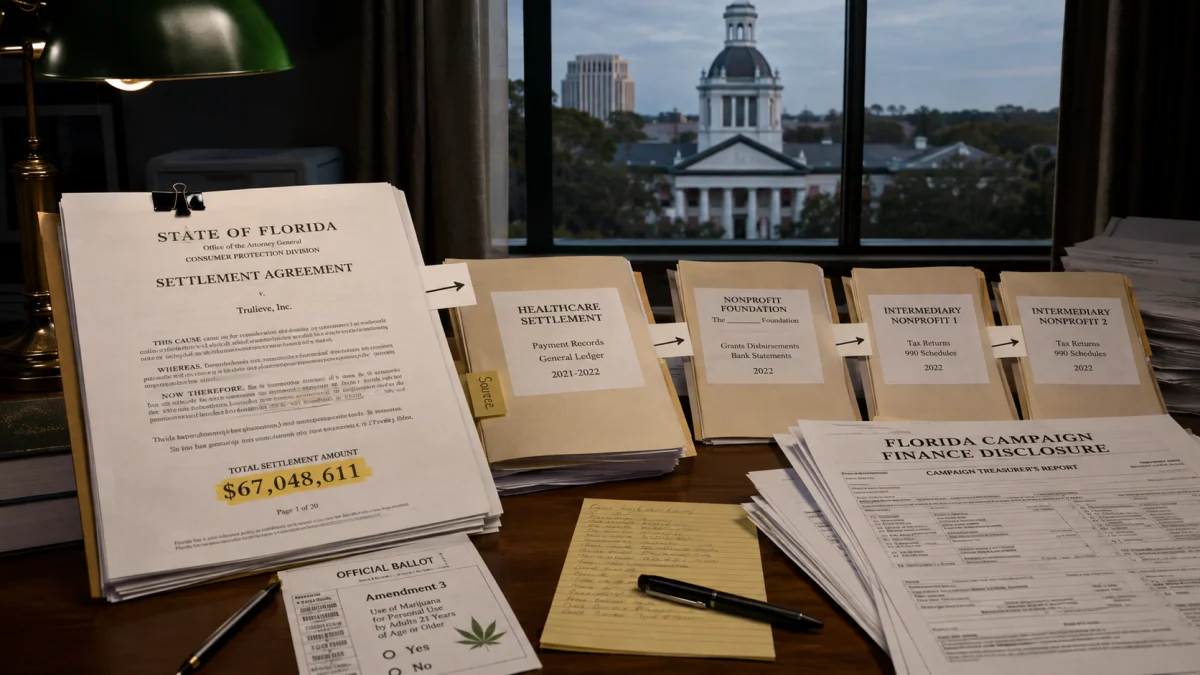
The basic money trail is now remarkably clear.
Florida negotiated a $67,048,611 settlement with Centene Corporation over potential claims connected to pharmacy-benefit overbilling. An earlier draft directed the entire roughly $67 million to the state.
The final agreement did something different.
It still defined the full $67,048,611 as the “Settlement Amount,” but directed Centene to send $10 million to the Hope Florida Foundation and the remaining roughly $57 million to Florida’s Agency for Health Care Administration.
Centene wired the $10 million to Hope Florida.
Hope Florida then awarded two extraordinary $5 million grants to Secure Florida’s Future and Save Our Society From Drugs.
Within weeks, millions from both organizations moved into Keep Florida Clean, a political committee chaired by Gov. Ron DeSantis’s then-chief of staff, James Uthmeier. Keep Florida Clean was heavily involved in defeating Florida’s 2024 recreational-marijuana amendment and later transferred millions to the Republican Party of Florida and another political committee associated with Uthmeier.
A Florida grand jury investigated the chain and reached an unusually blunt conclusion.
The $10 million had been “misappropriated,” it said, as part of what the grand jury described as a “sophisticated scheme to fund political activities.”
Yet nobody was indicted.
That is not because investigators concluded nothing improper happened.
The problem was almost the opposite: investigators said they could reconstruct what happened to the money, but could not establish who made the original decision to divert the $10 million into Hope Florida.
The report says no witness would take responsibility for that decision or identify the person who made it.
That distinction explains the apparent contradiction at the center of the Hope Florida scandal.
Where Did the Hope Florida $10 Million Actually Go?
The grand jury’s forensic accountant reconstructed the core money trail:
Centene Corporation ↓ $10 million
Hope Florida Foundation
↓ $5 million Secure Florida’s Future ↓ at least $3.75 million directly traced Keep Florida Clean
and
↓ $5 million Save Our Society From Drugs ↓ $4.75 million directly traced Keep Florida Clean
From there, the grand jury traced Keep Florida Clean sending:
- $7 million to the Republican Party of Florida during the relevant traced period, although the party later returned $2 million.
- Approximately $1.23 million to the Florida Freedom Fund, another political committee associated with Uthmeier, shortly before Keep Florida Clean was dissolved.
The grand jury’s own financial analysis therefore traced at least $8.5 million from the two organizations that received Hope Florida’s grants into Keep Florida Clean.
But there is an important accounting complication.
Public campaign-finance records show that Secure Florida’s Future gave Keep Florida Clean $4.85 million over the entire 2024 election cycle, rather than only the $3.75 million shown in one part of the forensic trace.
The grand-jury report itself contains both figures in different sections.
That does not necessarily mean $1.1 million is unaccounted for.
The forensic accountant explained that he could not obtain Secure Florida’s Future’s own bank records because its bank had not produced them. The $3.75 million figure represents what investigators could directly observe arriving in Keep Florida Clean’s bank records during the specific period they analyzed.
The broader campaign-finance filings cover additional transactions.
That distinction matters because Keep Florida Clean raised more than $26 million overall during the 2024 election cycle.
Once money from multiple contributors entered the same political account, individual dollars became fungible. It would therefore be misleading to claim that a particular later payment can be identified dollar-for-dollar as the original Centene money.
The narrower conclusion is already significant enough:
The grand jury traced at least $8.5 million from the two organizations that had just received Hope Florida’s $10 million into a political committee chaired by the governor’s chief of staff.
The Most Important Document Is the Settlement Itself
One of the administration’s central defenses has been that the $10 million was essentially a charitable contribution or “bonus” from Centene rather than money belonging to Florida.
The executed agreement makes that interpretation difficult to reconcile with the actual contract.
The agreement defines a single:
$67,048,611 “Settlement Amount.”
It then states that Centene will make payments totaling that amount as directed by AHCA.
AHCA directs Centene to send:
- $10 million to the Hope Florida Foundation
- approximately $57 million to AHCA
The contract further states that Centene has no authority to control how Florida allocates the settlement amount.
In other words, the agreement does not describe this transaction as:
$57 million settlement + unrelated $10 million charitable gift.
It describes:
$67 million settlement amount → Florida directs where the money goes.
That difference became central to the grand jury’s findings.
It becomes even more significant when the final agreement is compared with earlier drafts.
A July 2021 working draft contemplated approximately the same amount — $67,048,611.64 — going to Florida.
A September 5, 2024 draft, only weeks before the final agreement, likewise directed the entire $67,048,611 settlement to the state.
There was no Hope Florida carveout.
Hope Florida did not create an additional $10 million recovery.
It was inserted into an existing approximately $67 million recovery.
The grand jury ultimately rejected AHCA Secretary Jason Weida’s characterization of the Hope Florida payment as a separate “bonus.”
It concluded that the full settlement represented taxpayer reimbursement.
The report also noted that Florida calculated the federal government’s reimbursement share using the full settlement figure, another fact that sits uneasily beside the argument that the Hope Florida portion was unrelated private money.
Centene itself admitted no wrongdoing in the settlement.
That distinction matters.
The issue here is not whether Centene confessed to intentionally overbilling Florida. It did not.
The relevant question is what Florida did with money Centene agreed to pay in exchange for resolving the state’s potential claims.
Hope Florida Appeared in the Settlement Only at the End
The chronology may be the most important unresolved part of the entire case.
Centene and attorneys working with Florida had been trying for years to resolve the claims.
As late as September 5, 2024, the draft settlement sent the entire $67 million to Florida.
Records subsequently obtained by reporters show that AHCA officials were preparing to brief the Executive Office of the Governor about the settlement on September 10.
There is an important evidentiary limit here.
The available records do not establish that the planned meeting actually happened, who attended it or what was discussed.
What happened immediately afterward is better documented.
On September 11, AHCA General Counsel Andrew Sheeran circulated a version in which Hope Florida appeared.
By September 12, $5 million of the settlement was earmarked for Hope Florida.
By September 13, the proposed amount had doubled to $10 million.
The grand jury found no satisfactory explanation for why the amount doubled virtually overnight.
That makes the period around September 10 through September 13 one of the most important gaps in the entire chronology.
The evidence does not establish that Ron DeSantis personally ordered $10 million sent to his wife’s signature initiative.
But the timing does establish something worth investigating:
Hope Florida appeared in a settlement that had existed for years without it immediately around the time the settlement was moving through senior levels of state government.
And nobody questioned by the grand jury ultimately identified the person who made the decision.
Who Actually Decided to Send the Money to Hope Florida?
The testimony becomes almost circular.
Jason Weida, then secretary of AHCA, said he did not remember who suggested that Hope Florida receive part of the settlement.
He described the payment as an additional incentive or “bonus” from Centene and said he sought legal advice before proceeding.
Andrew Sheeran, AHCA’s general counsel, gave investigators a somewhat more specific account.
According to the grand-jury report, Sheeran said Weida initially wanted $5 million separated for charity, that the amount later became $10 million and that Weida directed him to draft the agreement accordingly.
Sheeran nevertheless maintained that the structure was legal.
That testimony gets investigators closer to the drafting instruction.
It does not necessarily answer where the policy decision originated.
Who first proposed Hope Florida?
Why $5 million?
Why did it become $10 million?
The public record still does not provide satisfactory answers.
Centene Wanted It Clear That Florida Chose Hope Florida
Centene’s attorneys also appear to have recognized that the arrangement was unusual.
According to records reviewed during the investigation, Centene’s lawyers wanted the agreement written so that it was clear the company itself was not selecting Hope Florida as the beneficiary.
The final agreement reflects that concern.
It expressly says AHCA directed the payment and that Centene had no authority to influence Florida’s allocation of the settlement amount.
That wording matters.
It undermines another possible explanation of the transaction: that Centene independently decided to donate $10 million to Casey DeSantis’s initiative and Florida simply accepted its generosity.
The contract assigns the allocation decision to the state.
Hope Florida’s Money Had to Be Paid Much Faster Than Florida’s
The payment deadlines are another unusual feature.
Under the executed agreement, Centene had only seven days to send the $10 million Hope Florida payment.
Florida’s remaining approximately $57 million was treated much less urgently.
Half could arrive within 45 days.
The second half could be paid as late as one year after the first installment.
Weida told the grand jury he did not know why the Hope Florida payment had such a dramatically shorter deadline.
The grand jury drew its own inference from the timing.
It concluded that the urgency was connected to the approaching November 2024 election.
That is the grand jury’s investigative conclusion, rather than independent proof of every participant’s motive.
But the underlying timeline is factual.
The settlement was executed on September 27.
Centene’s $10 million reached Hope Florida on October 4.
Florida’s election was November 5.
The $10 Million Was Enormous for Hope Florida
The Hope Florida Foundation describes itself as a direct-support organization created to raise private money supporting the state’s Hope Florida initiative.
Its current website says the fund operates through private donations and “not at taxpayer expense.”
That statement may describe the foundation’s intended funding model.
It does not determine what the specific Centene payment legally represented.
The scale of the payment was unprecedented for Hope Florida.
Former foundation chairman Joshua Hay told the grand jury that the largest donation Hope Florida had received before Centene was $100,000.
Then it received $10 million.
That was one hundred times larger.
IRS records provide additional context.
For the fiscal year ending June 2024, before the Centene transaction, Hope Florida Foundation reported approximately $850,000 in revenue and just $40,760 in expenses.
For the following fiscal year — encompassing the Centene transaction — revenue jumped to approximately $11.2 million, while expenses rose to approximately $10.4 million.
Almost all of the extraordinary new money moved through the foundation rapidly.
Hope Florida Then Approved Two $5 Million Grants
Hope Florida did not spend the $10 million directly on healthcare services, hurricane recovery, food assistance or support for Medicaid beneficiaries.
Instead, it awarded two $5 million grants.
The first went to Secure Florida’s Future, a 501(c)(4) organization associated with Florida Chamber of Commerce leadership.
Its grant proposal discussed promoting Hope Florida through activities such as:
- webinars,
- podcasts,
- meetings,
- surveys,
- business outreach,
- public-awareness efforts.
Critically, the application represented that Secure Florida’s Future would not use the Hope Florida grant for political activities and did not make independent expenditures or electioneering communications.
The second $5 million grant went to Save Our Society From Drugs, another 501(c)(4).
The circumstances surrounding that application are even more important.
Its executive director, Amy Ronshausen, told the grand jury that James Uthmeier contacted her on October 11 and suggested that her organization apply for a Hope Florida grant.
Uthmeier connected her with Hope Florida attorney Jeff Aaron.
Aaron helped with the process and recommended that she seek $5 million — the same amount Secure Florida’s Future had received.
Ronshausen submitted the application on October 18.
She learned that same day that it had been approved.
Hope Florida transferred the $5 million on October 22.
The application likewise represented that the organization would not use the grant for political activities or electioneering.
Within days, Save Our Society From Drugs sent $4.75 million to Keep Florida Clean.
Ronshausen testified that nobody told her how she had to spend the grant once she received it. She said she believed supporting Keep Florida Clean’s campaign against marijuana legalization furthered her organization’s anti-drug mission.
The grand jury was not persuaded that the grant applications accurately described what happened.
It concluded that both organizations mischaracterized their intended use of the money, pointing to their representations about political activity and the speed with which millions subsequently reached a political committee.
Hope Florida’s Chairman Said He Barely Vetted the Grants
Joshua Hay’s testimony adds another unusual layer.
According to the grand-jury report, Hay learned during a conversation with Hope Florida attorney Jeff Aaron both that the foundation was receiving a $10 million contribution and that a proposal was coming for half of it to leave again.
Hay said he assumed the extraordinary money was intended to help people during hurricane recovery and did not question the first unusually large grant.
When the second $5 million application arrived, Hay said he was unfamiliar with Save Our Society From Drugs.
So he conducted a Google search to see whether its mission appeared compatible with Hope Florida.
He then approved the grant using authority previously provided by the foundation board.
The grand jury found Hay’s testimony transparent and credible.
It nevertheless concluded that he exercised poor judgment by approving two extraordinary grants without substantially more scrutiny.
The grand jury separately described the foundation’s grant process as highly irregular.
There was also a notable contradiction between Hay and Aaron.
Hay said Aaron was the person who told him the $10 million was coming.
Aaron told the grand jury that he did not learn about the Centene payment until much later, after controversy surrounding Hope Florida had already emerged.
The grand jury specifically called that conflict “curious” and said it credited Hay’s account.
One Detail in the Grand-Jury Report Appears to Be Wrong
The leaked presentment should not be treated as infallible simply because it is a grand-jury document.
For example, it says former Florida Department of Health chief of staff Cassandra Pasley was working in the state’s Emergency Operations Center during Hurricane Milton when she was asked to sign the settlement.
But the settlement was executed on September 27, 2024.
Hurricane Helene had just struck Florida.
Hurricane Milton did not strike until October.
The hurricane name in the report therefore appears to be an error.
The underlying substance of Pasley’s testimony remains important.
She said she was pulled aside amid emergency operations, asked whether the settlement had been vetted, was assured that it had and signed the document on the same day she first learned about it.
She testified that she did not know the settlement money would ultimately reach a political committee.
She said she would not have signed had she known.
The mistake is nevertheless worth noting because it illustrates why the grand jury’s conclusions should be checked against contracts, financial records and independent documentation rather than treated as unquestionable.
What Does Florida Law Say About Settlement Money?
Florida law creates an obvious problem for the structure.
Florida Statute §216.216 says that when a state agency or officer settles an action in which Florida will receive money, those funds must generally be placed in the General Revenue Fund or the appropriate state trust fund.
Florida Statute §45.062 similarly addresses money obtained when an executive-branch agency settles claims in which Florida asserted a right to recover funds.
The administration’s lawyers had an answer.
Sheeran argued, among other things, that the Hope Florida money was never technically paid to the state.
He also argued that portions of §45.062 governing civil actions did not apply in the same manner because this settlement occurred before a lawsuit was filed.
And he maintained that only money actually directed into state accounts was governed by §216.216.
The grand jury rejected that reasoning.
It concluded that directing the $10 million “donation” to Hope Florida was intended to circumvent the clear purpose of §216.216.
It also concluded that the arrangement violated the spirit of §45.062.
That language should be interpreted carefully.
The grand jury did not find a particular person criminally guilty of violating either statute.
It concluded that state settlement money had been structured around laws designed to keep such money under state fiscal and legislative control.
Those are related findings, but they are not legally identical.
Why Was the Amount Exactly $10 Million?
The grand jury identified another potentially significant detail.
According to its findings, an underlying component of the Centene reimbursement calculation included approximately $10.8 million in additional potential damages.
The grand jury concluded that Weida’s decision to reduce that component from $10.8 million to exactly $10 million was made to avoid wording in §45.062 involving settlements with a refund or future loss of state revenue exceeding $10 million.
That is one of the strongest allegations of intent contained in the report.
It remains a grand-jury finding rather than a criminal conviction.
Weida maintained that he believed the settlement arrangement was legal and said he relied on advice from lawyers.
What Did Ashley Moody Know?
Ashley Moody was Florida’s attorney general when the settlement was executed.
Her chief deputy, John Guard, signed it.
Guard told the grand jury that he had not negotiated the settlement and had concerns about how state settlement proceeds were supposed to be handled.
He acknowledged that directing $10 million to Hope Florida could be viewed by legislators as interfering with their authority over state spending.
The agreement was subsequently restructured so that AHCA, rather than the attorney general’s office, became the principal state party receiving and directing the money.
Guard testified that this resolved his concern because responsibility for handling the funds then belonged to AHCA.
After consulting Moody, she authorized him to sign the final agreement.
The grand jury criticized Guard for insufficient due diligence and concluded that Moody knew about the Hope Florida allocation when she authorized the signature.
But there is an important distinction.
The presently public evidence does not establish that Moody knew, when she approved the settlement, that Hope Florida would later give $10 million to two nonprofits that would send most of it into Keep Florida Clean.
Moody, now a U.S. senator, has maintained that her office did not know how the money would subsequently be used.
Both things can be true:
Moody could have known and approved of the $10 million Hope Florida provision without knowing its eventual political destination.
What Did James Uthmeier Do?
Uthmeier’s documented role becomes considerably more important after the money reached Hope Florida.
The grand jury found that, as DeSantis’s chief of staff, Uthmeier occupied “a position of authority” over people involved with the Centene settlement.
It also obtained testimony directly connecting him to the downstream movement of the money.
Most importantly, Ronshausen testified that Uthmeier personally contacted her and suggested that Save Our Society From Drugs apply for a Hope Florida grant.
The political committee that subsequently received most of the traced funds, Keep Florida Clean, was chaired by Uthmeier.
Keep Florida Clean opposed Amendment 3, the 2024 proposal that would have legalized recreational marijuana for adults in Florida.
Amendment 3 ultimately received approximately 55.9% support.
That was a majority of voters, but Florida constitutional amendments require at least 60% approval.
The evidence therefore connects Uthmeier much more clearly to the downstream political use of the money than it does to the original decision to insert Hope Florida into the Centene settlement.
That distinction matters.
The grand-jury report does not establish that Uthmeier personally originated the $10 million carveout.
It does establish that he occupied a powerful position around officials handling the settlement, personally encouraged at least one organization to seek a Hope Florida grant and chaired the political committee that became the principal destination of the traced money.
Uthmeier, now Florida’s attorney general, denies wrongdoing.
Did Casey DeSantis Direct the Money?
There is no public evidence establishing that she did.
Casey DeSantis is inevitably associated with the controversy because Hope Florida was her signature initiative.
But political association with an organization is not the same thing as evidence that she directed its financial transactions.
The leaked grand-jury report does not establish that Casey DeSantis:
- ordered the Centene money sent to Hope Florida,
- approved either $5 million grant,
- instructed the nonprofits to transfer money,
- directed Keep Florida Clean’s spending.
Ron DeSantis has argued that the controversy was manufactured to damage his wife.
On this narrower point, the record matters: the grand jury did not accuse Casey DeSantis of personally orchestrating the transaction.
That does not erase what happened to the money.
It means the evidence points toward other officials when documenting operational responsibility.
Did Ron DeSantis Personally Order the Transfer?
There is currently no public evidence establishing that either.
DeSantis says he was not involved in negotiating the Centene settlement.
Records show senior officials in his administration handling the agreement and show that AHCA was preparing to brief the governor’s office shortly before Hope Florida appeared in the settlement.
But the available records do not establish whether that briefing occurred or what DeSantis personally said about the transaction.
The grand-jury report likewise does not identify DeSantis as the person who gave the original order.
That is not the same thing as saying his administration had no involvement.
The executed contract itself says AHCA directed the allocation, and the grand jury attributed the misappropriation to the administration’s handling of the settlement.
But evidence against an administration does not automatically establish personal criminal responsibility for the governor.
Why Was Nobody Charged If the Money Was “Misappropriated”?
This is the most important legal question in the entire story.
A grand jury can conclude that government money was mishandled without having sufficient evidence to indict an identifiable person for a crime.
Criminal charges are person-specific.
Prosecutors generally need evidence connecting a particular defendant to a prohibited act and, depending on the offense, evidence establishing the required criminal intent.
Here, the grand jury identified the original misappropriation as the decision to divert $10 million of the settlement into Hope Florida.
That is precisely the decision nobody would take responsibility for.
The report states:
“Nobody will take responsibility for deciding the $10 million of taxpayer money would go to Hope Florida.”
It also describes an environment populated heavily by government lawyers, with officials repeatedly relying on the legal advice or approval of other lawyers.
The grand jury acknowledged that this created a significant obstacle to establishing individual criminal liability.
So its conclusion was not:
We investigated the matter and found nothing wrong.
It was essentially:
We believe the money was misappropriated, but we cannot prove which identifiable person committed the legally critical act strongly enough to indict that person.
Those are very different outcomes.
Why Didn’t DeSantis, Moody or Uthmeier Testify?
That creates perhaps the largest remaining procedural question.
According to reporting based on the grand-jury presentment, Ron DeSantis, Ashley Moody and James Uthmeier were not called to testify before the grand jury.
The report does not explain why.
That omission is notable because the grand jury’s stated obstacle to criminal charges was its inability to determine who authorized the original diversion.
It would be speculation to claim that testimony from any of the three officials would have solved that mystery.
But it is reasonable to ask why investigators attempting to determine who authorized a politically sensitive $10 million transaction did not question three of the most powerful officials surrounding the administration, settlement and downstream political apparatus.
The leaked presentment does not answer that question.
DeSantis Calls the Investigation a “Hoax.” Does That Fit the Evidence?
After the grand-jury report became public on August 27, 2026, DeSantis again attacked the investigation.
He said:
“There was no diversion of any Medicaid funds.”
He characterized the Centene agreement as lawful and appropriate and argued that the apparent crime was the leaking of the confidential grand-jury report.
Parts of his broader defense are supported by the record.
Nobody was indicted.
The grand jury did not find Casey DeSantis personally responsible.
And government lawyers involved in the transaction did articulate legal arguments for why they believed its structure was permissible.
But describing the underlying controversy as a complete hoax is much harder to reconcile with the primary documents.
The September 5 settlement draft had the entire $67,048,611 going to the state.
The final agreement retained exactly the same settlement figure while redirecting $10 million to Hope Florida.
The agreement explicitly says AHCA directed that allocation.
Florida calculated the federal government’s reimbursement using the full settlement amount.
And the grand jury specifically rejected the argument that the $10 million represented some unrelated private Centene bonus.
Those facts exist regardless of whether prosecutors can prove criminal liability against a particular person.
Calling the investigation a hoax does not explain them.
What Happened to the Other $1.5 Million?
There is no responsible basis for saying that $1.5 million simply “disappeared.”
The grand jury’s specific forensic bank analysis traced:
- $3.75 million from Secure Florida’s Future to Keep Florida Clean.
- $4.75 million from Save Our Society From Drugs to Keep Florida Clean.
That totals $8.5 million.
But both organizations had other financial activity, and broader campaign-finance records show transactions outside the narrower period examined by the forensic accountant.
Secure Florida’s Future, for example, reported $4.85 million in total 2024 contributions to Keep Florida Clean.
Once the Hope Florida grants entered organizations with existing accounts and other revenue, the accounting becomes more complicated than simply subtracting $8.5 million from $10 million.
The most accurate answer is:
The grand jury directly traced $8.5 million of the two Hope Florida grants into Keep Florida Clean through the bank records its accountant examined. The presently public evidence does not provide a complete dollar-for-dollar ledger establishing the final destination of every remaining dollar once money was commingled.
That is an unresolved accounting question.
It is not evidence that $1.5 million vanished.
What the Hope Florida Grand Jury Did Not Prove
Several important lines should not be crossed based on the evidence currently available.
The grand jury did not:
- indict Ron DeSantis, Casey DeSantis, James Uthmeier, Ashley Moody or anyone else;
- establish that Casey DeSantis personally directed the settlement or grants;
- establish that Ron DeSantis personally ordered the $10 million carveout;
- identify the person who originally decided Hope Florida should receive the money;
- prove that every dollar subsequently spent by Keep Florida Clean or the Republican Party of Florida was literally a Centene dollar after funds were commingled;
- establish a federal criminal offense or issue a final federal tax determination concerning the nonprofits.
Those limitations are real.
They do not require pretending that investigators cleared everyone.
They expressly did not.
What the Grand Jury Actually Concluded
The grand jury’s findings are narrower than some partisan versions of the scandal.
They are also considerably more serious than the administration’s description.
The grand jury concluded that:
- the full Centene settlement represented taxpayer reimbursement;
- the $10 million was not merely an unrelated private “bonus”;
- the decision to send $10 million to Hope Florida was intended to circumvent the purpose of Florida’s settlement-fund law;
- the two organizations receiving Hope Florida’s grants mischaracterized how they intended to use the money;
- millions moved rapidly through those organizations into political activity;
- James Uthmeier occupied a position of authority and was involved in the downstream process after the money reached Hope Florida;
- the $10 million had ultimately been misappropriated.
What investigators could not establish was the identity of the person responsible for the critical first decision strongly enough to bring a criminal charge.
That is not exoneration.
It is an accountability failure.
The Grand Jury Wants Florida Law Changed
The report ends with recommendations intended to prevent another similar transaction.
First, the grand jury recommended that Florida lawmakers make unmistakably clear that money received by the state from any source must flow into General Revenue or an authorized state account, with meaningful consequences when those rules are violated.
Second, it recommended clearer rules governing direct-support organizations such as Hope Florida when they receive or control taxpayer-related money, including stronger tracking, monitoring and enforcement.
Those recommendations are revealing.
A grand jury that believed the controversy was simply invented would have little reason to recommend rewriting Florida law to prevent the same sequence from occurring again.
The Biggest Unanswered Hope Florida Questions
The leaked report largely solves the question of where much of the $10 million went.
It does not solve the more consequential question of who decided that it should begin moving in the first place.
Why did Hope Florida suddenly appear in a settlement that had existed for years without it?
Why did the proposed payment jump from $5 million to $10 million?
Why did Centene have only seven days to send Hope Florida’s money while Florida could wait as long as a year for part of its own payment?
Who made the original decision?
What happened during or around the planned September 10 briefing involving the governor’s office?
Why were DeSantis, Moody and Uthmeier not called before a grand jury whose principal obstacle was identifying the decision-maker?
And how should the broader campaign-finance totals be reconciled with the narrower bank trace contained in the grand-jury report?
Those are no longer speculative questions generated by political opponents.
They arise directly from settlement drafts, testimony, financial records and the grand jury’s own findings.
That is ultimately what makes the Hope Florida controversy more significant than another partisan fight involving Ron DeSantis.
Florida recovered money in exchange for settling claims against one of its major healthcare contractors.
The amount was defined.
The state changed where part of that money would go.
The money then passed rapidly through a state-connected foundation and two nonprofits into political machinery.
Investigators reconstructed that financial trail and concluded that taxpayer money had been misappropriated.
Yet when they reached the most basic accountability question —
Who decided to do it?
— nobody could or would give them an answer.
That is the part of the Hope Florida scandal that remains unresolved.
References and Further Reading
Primary Documents and Florida Law
-
Hope Florida Grand Jury Report — The leaked 19-page presentment containing testimony summaries, the forensic money-flow analysis, findings and legislative recommendations.
-
Executed Florida–Centene Settlement Agreement and Release — The September 2024 agreement defining the entire $67,048,611 as the settlement amount and directing $10 million to Hope Florida.
-
September 5, 2024 Centene Settlement Draft — Earlier draft showing the full approximately $67 million going to Florida before Hope Florida was added.
-
July 2021 Florida–Centene Working Draft — Shows that essentially the same $67.048 million settlement figure existed years before the Hope Florida provision.
-
Florida Statute §216.216 — Court Settlement Funds Negotiated by the State — Florida law governing the receipt and appropriation of money recovered through state settlements.
-
Florida Statute §45.062 — Settlements Involving Executive-Branch Agencies — Contains additional requirements governing executive-branch settlements and state-recovery funds.
-
Official Florida 2024 Amendment 3 Election Results — Florida Division of Elections results showing Amendment 3 received approximately 55.9% support, below the 60% required for adoption.
Financial and Nonprofit Records
-
Hope Florida Foundation — IRS Filings via ProPublica Nonprofit Explorer — Shows the dramatic increase in the foundation’s revenue and spending surrounding the Centene transaction.
-
Hope Florida Foundation — The foundation’s official website and description of its mission and funding model.
-
Keep Florida Clean — 2024 Expenditures and Payees — Campaign-finance records showing the committee’s broader activity during the 2024 election cycle.
-
Secure Florida’s Future — 2024 Political Contributions — Shows broader reported contributions to Keep Florida Clean beyond the grand jury accountant’s narrower direct bank trace.
Reporting and Investigative Chronology
-
CBS Miami — Grand Jury Finds $10 Million Was Misappropriated to Hope Florida — Detailed reporting based on the leaked grand-jury presentment and related records.
-
CBS Miami — DeSantis Calls Hope Florida Grand-Jury Findings a “Hoax” — Gov. Ron DeSantis’s August 27, 2026 response after the report became public.
-
Associated Press — Florida Grand Jury Finds Administration Misused $10 Million but Files No Charges — Independent reporting on the grand jury’s findings and responses from Florida officials.
-
Miami Herald — Records Shed New Light on How the Hope Florida Settlement Was Constructed — Reporting on the September 2024 settlement drafts, internal discussions and the planned governor’s-office briefing.
-
Florida Trident/WGCU — Sealed Grand-Jury Report Details the Hope Florida Money Trail — Detailed reporting on the grand-jury investigation, its sealed status and officials who were not called to testify.
Editorial currency note: This article reflects documents, financial records and reporting available through August 27, 2026. The grand-jury presentment remains officially sealed despite leaked copies becoming publicly available. New court proceedings, legislative action, federal inquiries or additional financial records could materially change parts of this account.