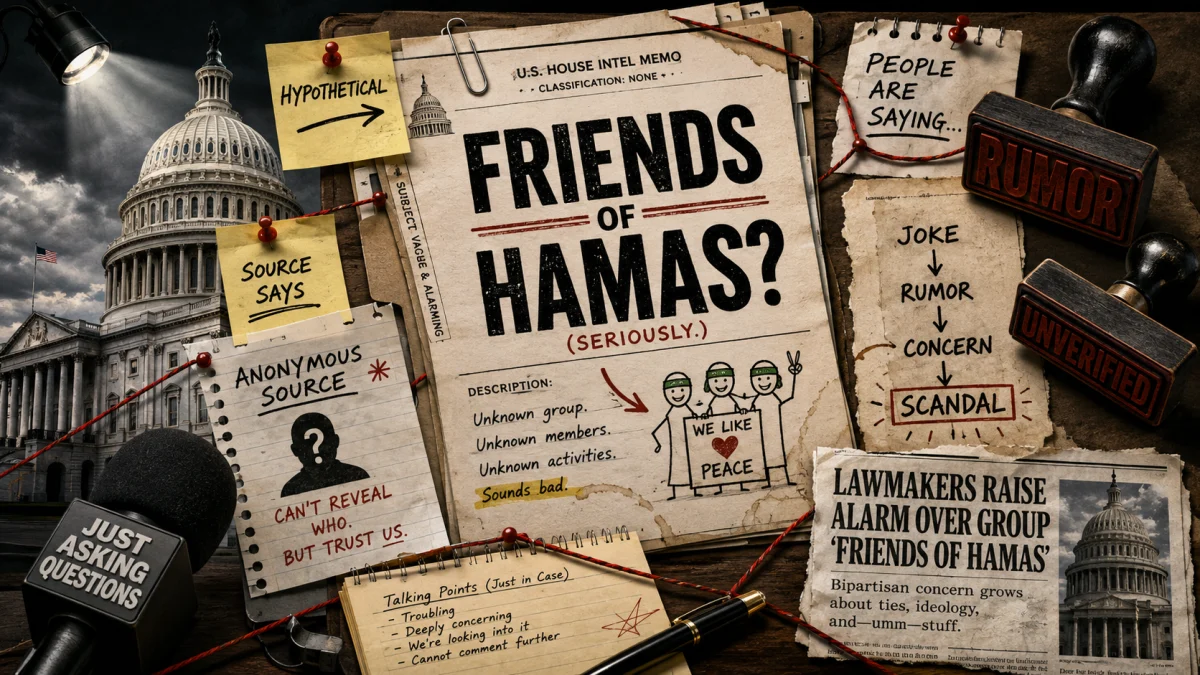
How an absurd hypothetical became a Senate-sourced allegation against Chuck Hagel—and what the episode reveals about rumor laundering, Islamophobia, anti-Palestinian political framing, and the manufacture of plausibility.
The Answer First
There was no verified organization called “Friends of Hamas” that paid Chuck Hagel a speaking fee.
The name was invented by reporter Dan Friedman as a deliberately absurd hypothetical while he was questioning a Republican Senate aide on February 6, 2013. Friedman says he also invented another group—the “Junior League of Hezbollah”—because he wanted examples so ridiculous that nobody could mistake them for actual organizations. He followed up by asking whether Hagel had received a $25,000 speaking fee from “Friends of Hamas.”
The following day, Breitbart News published a story by Ben Shapiro saying that Senate sources had been informed that one of the names connected to Hagel’s undisclosed foreign funding was a group “purportedly called ‘Friends of Hamas.’” Breitbart’s own editor’s note now says it subsequently found no confirmation that such a group existed or that Hagel received financial support from it.
The allegation nevertheless spread. RedState repeated it. National Review reported that “rumors abound” on Capitol Hill. Radio host Hugh Hewitt raised it with Senator Rand Paul. Mike Huckabee discussed it. It reached a Fox Business discussion involving National Review columnist Andrew McCarthy.
And that is the story worth examining.
Not merely that somebody published something false.
Not merely that partisan media can make mistakes.
The extraordinary part is that a name invented precisely because it was too ridiculous to be real was transformed, almost overnight, into something Washington treated as worthy of investigation.
The important question is not just:
Who invented Friends of Hamas?
It is:
What political and cultural conditions made “Friends of Hamas” sound plausible enough that almost nobody in the transmission chain stopped and established whether it existed?
That question leads somewhere much more uncomfortable.
Start With What Actually Happened
Barack Obama formally nominated former Republican Senator Chuck Hagel to become secretary of defense on January 7, 2013. Hagel’s nomination immediately became unusually contentious, particularly over his positions concerning Israel, Iran, sanctions, Hamas, Hezbollah and American Middle East policy. His January 31 confirmation hearing repeatedly returned to those subjects.
Those were not imaginary controversies.
Hagel had made statements that legitimately invited scrutiny. He had opposed some unilateral sanctions on Iran. He had criticized aspects of American policy toward Israel. He had used the phrase “Jewish lobby,” which he later said he regretted and should have described as the pro-Israel lobby. And he had supported exploring diplomatic engagement with Hamas under certain circumstances.
But there is an important distinction between those positions and the allegation that followed.
Hagel repeatedly stated during his confirmation process that he regarded Hamas and Hezbollah as terrorist organizations. The Senate transcript records him explicitly saying so. The State Department had formally designated Hamas a Foreign Terrorist Organization in 1997.
The controversy, then, was originally about policy:
Should the United States communicate with Hamas?
Was Hagel sufficiently supportive of Israel?
Was he too skeptical of sanctions?
Had he been too willing to negotiate with adversaries?
Those are legitimate political questions.
Then something happened to the argument.
Policy disagreement became insinuation of secret financial association.
That transformation is the heart of the story.
Before the Fiction Appeared, the Political Market for It Already Existed
By the time “Friends of Hamas” entered the conversation, a substantial campaign to defeat Hagel’s nomination was already underway.
The Emergency Committee for Israel had launched advertising and a website opposing Hagel. Other outside groups were spending against his confirmation. By February 6—the exact day Friedman says he invented “Friends of Hamas”—the nonpartisan Sunlight Foundation had identified at least $212,000 in television advertising aimed at defeating Hagel, while cautioning that its tracking almost certainly understated total spending.
Much of the opposition concentrated on Hagel’s views concerning Israel and Iran. FactCheck.org concluded that one Emergency Committee for Israel advertisement presented an overly simplified picture of Hagel’s more nuanced positions.
At the same time, Republican senators were escalating demands concerning Hagel’s financial history.
On February 6, Republican senators sent Hagel a letter demanding additional information about compensation and possible foreign funding connected with organizations with which he had been affiliated. Senate Armed Services Committee Chairman Carl Levin responded that portions of those demands went beyond what previous defense-secretary nominees had been required to disclose. The Congressional Record preserves both sides of the dispute.
This context matters enormously.
It does not prove that Republican senators conspired to fabricate a Hamas story.
It does not prove that the anonymous aide who spoke with Friedman deliberately transmitted his joke.
It does establish something much more defensible:
There was already intense political demand for information that could connect Chuck Hagel’s money, speaking engagements or institutional relationships to a politically toxic foreign source.
The tinder was already arranged.
“Friends of Hamas” was the spark.
February 6, 2013: A Reporter Makes Up an Organization
Dan Friedman was covering the financial-disclosure controversy.
He wanted to know whether Senate Republicans actually possessed examples of the supposedly problematic speaking engagements or funding relationships they were demanding Hagel disclose.
So Friedman contacted a Republican Senate aide.
To make clear what kind of explosive information he meant, Friedman says he invented intentionally absurd possibilities.
Had Hagel spoken to something like the “Junior League of Hezbollah”?
What about “Friends of Hamas”?
He later followed up by email with an even more specific hypothetical: had Hagel received a $25,000 speaking fee from Friends of Hamas?
Friedman’s reasoning was straightforward.
The examples were supposed to be ridiculous.
He wasn’t planting a sophisticated fake.
He was doing almost the opposite.
He chose names that he believed would announce their own fiction.
And then, as Friedman later told NPR:
“I made this up.”
He did not hear back from the aide.
February 7: The Joke Returns as a “Senate-Sourced” Allegation
The next day, Breitbart published Shapiro’s story.
Its opening attribution was carefully constructed.
It did not flatly say that Breitbart had independently established the existence of Friends of Hamas.
Instead, it said that Senate sources had told Breitbart that they had been informed that the group might appear among Hagel’s foreign funding sources.
Look closely at the informational distance.
Breitbart was not saying:
We found evidence that Friends of Hamas paid Chuck Hagel.
It was effectively saying:
Sources told us that somebody told them that this may have happened.
The underlying evidence had become invisible.
The provenance had been replaced by attribution.
And attribution looked enough like verification to move the story.
That is the first stage of what we can call recursive validation.
How Recursive Validation Manufactures a “Fact”
Imagine the chain abstractly.
Person A invents a hypothetical.
Person B hears it.
Person C hears from a source that people are discussing it.
Outlet D reports that Senate sources are discussing it.
Outlet E cites Outlet D.
Commentator F observes that the allegation is now circulating.
Politician G is asked whether the increasingly visible allegation concerns him.
Now return to Person B.
What Person B originally heard as an unsupported proposition has come back through several independent-looking institutions.
It feels corroborated.
But nothing new has necessarily been discovered.
The information has simply traveled.
This is not genuine confirmation.
It is recursive validation: the circulation of a claim becomes evidence for the claim’s credibility.
And the Friends of Hamas episode provides an unusually clean real-world example.
One Article Became “Rumors Abound on Capitol Hill”
On February 7, RedState reproduced the Breitbart allegation, arguing that Hagel could resolve the issue by disclosing his donors.
National Review subsequently reported that “rumors abound on Capitol Hill” concerning Hagel’s relationships with supposedly unsavory organizations, including Friends of Hamas.
Think about what had happened linguistically.
A hypothetical from one reporter had become an allegation attributed to unnamed Senate sources.
That allegation was repeated.
Then the existence of repeated discussion itself became describable as “rumors” circulating on Capitol Hill.
The rumor now had a social existence.
That social existence could then be offered as evidence that there was something worth investigating.
Nobody needed to discover Friends of Hamas.
They only needed to discover other people talking about Friends of Hamas.
Then Politicians Were Asked About It
Hugh Hewitt raised the report in an interview with Senator Rand Paul. Paul described the information as concerning. Mike Huckabee publicly discussed the allegation conditionally. It also surfaced during a Fox Business discussion involving Andrew McCarthy.
Notice another important transformation.
Once elected officials respond to an allegation, the allegation acquires a second layer of perceived legitimacy:
A United States senator is talking about it.
But the senator’s discussion is not independent evidence.
The senator may simply be responding to the same media report everyone else saw.
This is one of the easiest ways for misinformation to manufacture the appearance of corroboration.
A media report cites political sources.
Politicians react to the report.
Media outlets then report the politicians’ reactions.
The source and the confirmation begin orbiting each other.
The Most Revealing Part Came After the Story Fell Apart
Eventually, journalists began asking the most elementary question:
Does Friends of Hamas actually exist?
Slate’s Dave Weigel reported on February 14 that he could find no evidence of the organization. Other journalists searching major databases similarly came up empty.
Friedman then recognized the phrase.
He reconstructed the timeline.
He had used the invented name on February 6.
Breitbart published it on February 7.
Friedman concluded that his hypothetical had apparently entered the political information chain and emerged as a report.
There remains an important evidentiary limitation.
Shapiro said his source denied that Friedman was the origin of the information, and Shapiro maintained that he had multiple sourcing behind his report. Because the relevant sources remained anonymous, the public record does not conclusively establish the precise human chain between Friedman’s conversation and Breitbart’s source.
That limitation should not be hidden.
It should be emphasized.
Because the parts we can establish are already extraordinary enough.
Friedman says the phrase originated in his imagination.
He communicated it to a Republican Senate aide on February 6.
A strikingly similar allegation appeared the next day.
No evidence emerged that the supposed Hagel-linked organization existed.
And the allegation nevertheless circulated nationally.
That is already a devastating case study.
We do not need to manufacture certainty where the evidence stops.
Breitbart’s Defense Accidentally Explained the Entire Problem
Perhaps the most instructive part of the story is how Shapiro defended the report.
He emphasized that his article had accurately represented what his sources told him.
In one contemporaneous account, he put the distinction this way: the story as reported was correct; whether the information supplied by the source was correct was another question.
That defense exposes a profound loophole in political journalism.
Consider these two propositions:
Proposition 1
Chuck Hagel received money from Friends of Hamas.
Proposition 2
Someone told a reporter that Chuck Hagel may have received money from Friends of Hamas.
Those are radically different statements.
Proposition 1 requires evidence concerning Hagel and Friends of Hamas.
Proposition 2 requires only evidence that somebody said something.
Once journalism substitutes Proposition 2 for Proposition 1, almost any allegation can become technically publishable without the underlying allegation ever being verified.
The newspaper does not have to prove the accusation.
It merely proves the existence of an accuser.
And then other outlets can accurately report that an accusation has been reported.
This creates an epistemic loophole:
A false factual claim can generate an indefinitely expanding series of true statements about the fact that people are discussing the false claim.
That is rumor laundering.
Why “Friends of Hamas”?
This is where the story becomes larger than Breitbart, Shapiro or even Hagel.
Friedman could have invented almost anything.
He could have asked whether Hagel had taken money from:
“Foreign Defense Contractors for Hagel.”
“The Tehran Speakers Bureau.”
“Americans for Questionable Foreign Payments.”
But he didn’t.
He instinctively selected Hamas and Hezbollah because those names carried immediate political meaning.
And the people who subsequently encountered “Friends of Hamas” understood that meaning too.
That does not mean Hamas was an imaginary threat.
It wasn’t.
Hamas was a real organization designated by the United States as a Foreign Terrorist Organization. American law imposed serious consequences for providing material support to designated terrorist organizations.
That reality is precisely what gave the fictional association its power.
The smear did not require readers to learn anything about a mysterious new organization.
The words “Friends of Hamas” already contained the accusation.
The Name Was the Evidence
Think about how unusual that is.
No organizational history was necessary.
No officers needed to be identified.
No address.
No incorporation records.
No tax filings.
No website.
No event program.
No photograph of Hagel appearing before the organization.
No payment record.
The organization’s name itself performed most of the argumentative work.
“Friends.”
“Hamas.”
Chuck Hagel.
Put those three things beside each other and allow the audience to complete the moral syllogism.
If Hamas is bad,
and these people are friends of Hamas,
and Hagel takes money from them,
then Hagel must be compromised.
The accusation arrives preassembled.
Evidence feels almost redundant.
That is one reason guilt-by-association propaganda is so effective: the association substitutes for the argument.
The Obvious Common-Sense Problem Nobody Needed Expertise to Notice
There was another reason “Friends of Hamas” should have triggered immediate skepticism.
Hamas had been a formally designated Foreign Terrorist Organization in the United States since 1997, and American law criminalized knowingly providing material support or resources to designated organizations.
Now imagine the proposition Breitbart’s sources were implicitly asking readers to entertain:
A politically consequential organization secretly connected with Hamas was operating in the orbit of American elites.
It supposedly paid a former United States senator a large speaking fee.
The payment was politically explosive enough to threaten his confirmation as secretary of defense.
And the people running this covertly disastrous operation apparently called themselves:
Friends of Hamas.
Could an organization somewhere use such a name? Of course. Human beings are capable of almost anything.
But that possibility is not the relevant standard.
The question is whether the extraordinary claim should have triggered more verification rather than less.
A five-minute search that returned no meaningful institutional footprint should not have strengthened the allegation.
It should have stopped publication until someone produced evidence.
The absurdity was the warning.
Instead, the political environment converted the absurdity into plausibility.
This Is Where Islamophobia Enters the Analysis
There is an easy version of this argument that should be rejected.
It would be irresponsible to say:
“Criticizing Hamas is Islamophobic.”
That is not true.
Hamas is a political and armed organization. Its ideology, governance, violence, military activity and treatment of civilians are legitimate subjects of scrutiny.
Nor do we possess evidence establishing that the anonymous Senate aide, Shapiro, or every person who repeated the story consciously thought:
I will weaponize anti-Muslim prejudice against Chuck Hagel.
We cannot read their minds.
That is not the argument.
The stronger argument concerns the cultural machinery that determines which accusations feel believable before evidence arrives.
Academic research conducted around this same period documented recurring American media frames associating Muslims, Arabs and Islam with organized international terrorism and security threat. A 2011 study of U.S. terrorism coverage identified a pronounced pattern in which international terrorism was framed through associations among Muslims, Arabs and Islam, while domestic terrorism was more often individualized.
Other scholarship has examined the broader post-9/11 securitization of Muslim identity and the persistence of Orientalist and security-centered representations in American political discourse.
That matters here because “Hamas” did not enter an ideologically neutral information environment.
It entered an America more than a decade into the War on Terror.
The word arrived carrying years of accumulated associations:
terrorism,
Islamism,
Middle Eastern threat,
foreignness,
security,
Israel,
9/11-era political fear.
The Friends of Hamas allegation could therefore borrow credibility from a much larger reservoir of cultural suspicion.
Islamophobia Does Not Mean Pretending Hamas Is Harmless
This distinction is essential.
Calling out Islamophobic framing does not require pretending that Islamist terrorism does not exist.
In fact, the analytical point is almost the reverse.
A stereotype becomes politically powerful when it attaches itself to something real.
Hamas is real.
Terrorism is real.
Political violence is real.
American law really does prohibit material support for designated terrorist organizations.
The propaganda mechanism is to take the legitimate moral and security weight attached to those realities and transfer it to a person for whom the relevant evidence does not exist.
Chuck Hagel did not need to be proven a supporter of Hamas.
He merely needed to be placed close enough to the word.
That is how contamination by association works.
Anti-Palestinian Framing and Islamophobia Overlap—but They Are Not Identical
There is another distinction worth preserving.
Palestinian identity is not synonymous with Muslim identity.
Palestinians include Muslims, Christians and others. Hamas is not synonymous with Palestinians. And criticism of Israeli government policy is not synonymous with support for Hamas.
Those distinctions sound painfully obvious.
But political rhetoric frequently compresses them.
A position in favor of negotiating with Hamas can become “soft on Hamas.”
“Soft on Hamas” can become sympathetic to Hamas.
Sympathetic to Hamas can become financially connected to Hamas.
And once that final association has been planted, the original policy dispute can disappear completely.
That is not ordinary fact-finding.
It is semantic escalation.
Diplomacy becomes sympathy.
Sympathy becomes allegiance.
Allegiance becomes corruption.
The destination was never contained in the original evidence.
It was produced through a chain of associations.
The Pinkwashing Parallel
This is where the comparison with pinkwashing becomes useful—provided we are precise about what is being compared.
Scholar Jasbir Puar has described “pinkwashing” as a political discourse in which Israel’s relative recognition of gay and lesbian rights is presented as evidence of Western modernity and liberalism, while Palestinians or Muslim societies are positioned as backward, intolerant or uncivilized. Puar connects that discourse to her broader concept of homonationalism. Her interpretation is a scholarly and political argument, not a universally accepted neutral description, but it provides a useful analytical framework.
The Friends of Hamas episode is not itself an example of pinkwashing.
The parallel is structural.
Pinkwashing, as Puar analyzes it, can transform a complicated political conflict into a civilizational moral contrast:
liberal vs. backward
tolerant vs. intolerant
modern vs. primitive
The Friends of Hamas allegation performed a related simplification:
American vs. foreign
responsible vs. extremist
national-security professional vs. terrorist sympathizer
Once the target is placed on the morally contaminated side of the binary, evidence can become secondary.
The category does the work.
Call It Moral Laundering
There is a broader family of political techniques here.
Whitewashing cleans a damaging reality.
Pinkwashing, in the critical literature, uses progressive credentials to redirect moral judgment.
Greenwashing borrows environmental virtue.
What happened with “Friends of Hamas” worked in the opposite direction.
Instead of laundering innocence onto a questionable actor, it laundered guilt onto a target through association.
The sequence looked like this:
Hamas is a designated terrorist organization.
↓
Hagel supports exploring engagement with Hamas.
↓
Hagel is suspiciously sympathetic to Hamas.
↓
Hagel may have accepted money from people who support Hamas.
↓
There may be a group called Friends of Hamas.
↓
Senate sources are talking about Friends of Hamas.
↓
National political figures are discussing Friends of Hamas.
↓
Therefore there must be something behind Friends of Hamas.
At each step, the previous proposition lends emotional credibility to the next one even when the evidentiary bridge between them is missing.
That is not ordinary washing.
It is moral laundering through recursive association.
Repetition Then Does What Repetition Does
Once an allegation enters enough channels, psychology begins helping it.
Researchers have studied the illusory truth effect for decades: repeated exposure to a statement can increase the extent to which people perceive it as true.
A major 2026 systematic review and meta-analysis in Nature Communications synthesized 182 studies, 366 effect sizes and more than 31,000 participants. After adjusting for small-study effects, the researchers found a modest but robust increase in perceived truth caused by repetition.
That does not mean everyone who heard “Friends of Hamas” automatically believed it.
It means repetition has measurable cognitive consequences.
A claim encountered on Breitbart, then RedState, then National Review, then radio, then television and then in the mouth of an elected official no longer feels like one unsupported allegation.
It feels familiar.
And familiarity can masquerade as knowledge.
This Is Why “People Are Saying” Is Such a Powerful Political Technology
The most dangerous phrase in political communication may not be:
“This is true.”
It may be:
“People are saying.”
Because “people are saying” avoids responsibility for demonstrating truth while still depositing the allegation into public consciousness.
Once enough people repeat it, the sentence becomes self-validating:
People really are saying it.
The speaker can therefore make an entirely accurate statement about the circulation of an entirely inaccurate claim.
Friends of Hamas illustrates the mechanism almost perfectly.
The rumor became real as a rumor before anyone demonstrated that its subject was real.
So Why Did They Do It?
Here we need to separate evidence from inference.
What is verified
There was an active political campaign to defeat Hagel’s nomination before Friends of Hamas appeared.
His positions on Israel, Iran, Hamas and Hezbollah were already central to the opposition.
Republican senators were simultaneously demanding broader disclosure of his speaking income and organizations’ foreign funding.
Friedman invented “Friends of Hamas” while probing those allegations.
The phrase emerged in a Breitbart story the following day attributed to Senate sources.
No evidence subsequently established either a Hagel-linked organization by that name or a payment from it. Breitbart eventually acknowledged that it had found no confirmation of either proposition.
What is strongly suggested but not conclusively proven
Friedman’s conversation with the Republican aide appears to be the most obvious origin of the specific phrase that subsequently reached Breitbart. The one-day timeline is striking. Friedman believed that was what happened. Shapiro’s source denied it. Because the intermediary chain remains anonymous, this link cannot honestly be called proven.
What cannot responsibly be asserted as fact
We cannot establish that the aide deliberately decided to fabricate an anti-Hagel story.
We cannot establish that everyone who repeated it knew it was false.
We cannot prove that conscious Islamophobia motivated every participant.
And there is no evidence that the entire anti-Hagel campaign coordinated the fabrication.
Those would be stronger claims than the evidence permits.
But motive does not have to be centrally coordinated for an information system to behave predictably.
The political incentive was obvious:
Information linking Hagel to Hamas would damage Hagel.
The cultural mechanism was available:
Association with Islamist terrorism carried extraordinary political toxicity.
The media mechanism was available:
Anonymous sourcing allowed the allegation to move without exposing its evidentiary origin.
The psychological mechanism was available:
Repetition could make the allegation increasingly familiar.
No conspiracy is required.
The machinery can run on incentives.
The Most Damning Interpretation Requires the Fewest Assumptions
This is why the Friends of Hamas incident should not be reduced to a funny story about gullible political bloggers.
The deeper lesson is worse.
A journalist intentionally fabricated an example because he believed nobody could possibly mistake it for reality.
The surrounding political information system proved him wrong.
It took approximately one day.
The fictional name entered an anonymous-source pipeline.
The provenance disappeared.
The allegation acquired institutional language.
Other outlets repeated it.
Politicians responded to it.
Their responses produced additional coverage.
The additional coverage made the rumor more visible.
Visibility made the rumor look more consequential.
And when the underlying proposition collapsed, defenders could retreat to the narrower argument that they had accurately reported the existence of the allegation.
That is an astonishingly efficient misinformation machine.
The Real Scandal Wasn’t That Friends of Hamas Was Fake
The real scandal was that its existence barely mattered.
The allegation worked before the organization was verified.
It worked because “Friends of Hamas” sounded like the kind of thing a suspicious Chuck Hagel ought to be connected to within the political narrative already constructed around him.
That is the frightening part.
Evidence normally works like this:
Evidence → conclusion.
But identity-driven political narratives can reverse the sequence:
Conclusion → expectation → allegation → search for evidence.
Once Hagel had been coded as insufficiently supportive of Israel, too open to diplomacy with America’s adversaries and suspiciously resistant to certain orthodoxies of Middle East policy, a Hamas connection did not need to be proven before it sounded plausible.
It fit.
And sometimes fit is more politically powerful than fact.
“Friends of Hamas” Is a Warning From 2013 That Looks Even More Important Now
Chuck Hagel survived the campaign.
On February 26, 2013, the Senate confirmed him as secretary of defense by a vote of 58–41.
The Friends of Hamas story became an embarrassing footnote.
It should have become something more.
Because the episode provides a nearly controlled experiment in how political misinformation can be created without the traditional architecture of a conspiracy.
There was no sophisticated forgery.
No fake bank document.
No deepfake.
No Russian bot farm.
No generative AI.
No elaborate fabricated dossier.
There was just a phrase.
One person invented it.
Someone apparently repeated it.
A publication attributed it.
Other publications circulated it.
Politicians discussed it.
And an organization that had never been established as real became part of a national confirmation battle.
If you want to understand modern misinformation, start there.
The technology has changed.
Human epistemology has not.
The Question We Should Have Asked in 2013
When an allegation perfectly confirms everything a political audience already suspects about someone, that is not the moment to lower the evidentiary bar.
It is the moment to raise it.
When the accusation involves terrorism, Muslims, Palestinians, Israel, foreign money or national security, the emotional stakes make that discipline even more important—not less.
And when the source says that other people are saying something, the first question should not be:
How damaging would this be if true?
It should be:
Who knows this firsthand?
Then:
What evidence do they possess?
Then:
Can we independently establish the underlying fact?
Had someone applied that standard in February 2013, the entire scandal might have lasted five minutes.
Search for Friends of Hamas.
Find nothing.
Ask for the organization’s records.
Receive nothing.
Ask for evidence of the $25,000 payment.
Receive nothing.
Do not publish.
Instead, Washington performed the experiment in reverse.
It published first.
Then searched for reality.
The Bottom Line
“Friends of Hamas” was not merely a false story.
It demonstrated how political narratives manufacture their own evidence.
A reporter’s deliberately absurd hypothetical became an anonymous Senate rumor.
The rumor became a news report.
The news report became material for other news reports.
Those reports became questions for elected officials.
The politicians’ answers became news.
The resulting volume of discussion made the allegation appear independently corroborated.
And when the supposed organization itself evaporated, defenders could still say—technically—that sources really had made the allegation.
That is recursive validation.
It is how provenance disappears.
It is how repetition masquerades as corroboration.
It is how guilt by association replaces evidence.
And in this case, the mechanism operated inside an American political culture in which associations among Muslims, Palestinians, Middle Eastern politics and terrorism had already been made extraordinarily potent by more than a decade of post-9/11 security discourse.
The most important lesson is therefore not that somebody was gullible enough to believe in an organization called Friends of Hamas.
It is that the accusation told people a story they were already prepared to believe.
The group did not have to exist.
The narrative already did.
What Is Verified—and What Is Not
| Claim | Assessment |
|---|---|
| Dan Friedman says he invented the phrase “Friends of Hamas” | Verified as Friedman’s firsthand account; contemporaneous interviews document it. |
| Friedman used the phrase with a Republican Senate aide on February 6, 2013 | Verified as Friedman’s firsthand account. |
| Breitbart published the “Friends of Hamas” allegation February 7 | Verified. |
| Hagel received a $25,000 payment from Friends of Hamas | No supporting evidence was established. |
| The Hagel-linked “Friends of Hamas” organization was established to exist | No. Breitbart itself ultimately reported finding no confirmation. |
| Friedman’s specific aide was definitely Breitbart’s source | Unproven. Friedman considered the connection obvious; Shapiro’s source denied it. |
| The rumor circulated through conservative media and political interviews | Verified. |
| Hagel was already the target of organized opposition focused partly on Israel and Iran | Verified. |
| The participants consciously intended an Islamophobic smear | Not established by the available evidence. The argument here concerns the structure and cultural plausibility of the allegation, not unverifiable private intent. |
| Research supports the broader claim that Muslim/Arab identities were frequently securitized in post-9/11 U.S. media and political discourse | Supported by scholarly literature. |
Frequently Asked Questions
Was Friends of Hamas a real organization?
No evidence established the existence of the “Friends of Hamas” organization supposedly connected to Chuck Hagel. Breitbart later added an editor’s note stating that it had found no confirmation either that such a group existed or that Hagel received financial support from it.
Who invented the name “Friends of Hamas”?
Washington reporter Dan Friedman said he invented the phrase as a deliberately farcical example while questioning a Republican Senate aide about supposedly controversial organizations that might have paid Chuck Hagel for speeches. He says he also invented “Junior League of Hezbollah.”
Did a congressional aide make up the Friends of Hamas story?
Not exactly. The best available evidence indicates that Friedman invented the name and used it while speaking with a Republican Senate aide. What happened to the phrase after that remains partly unresolved because Breitbart’s sources were anonymous. Friedman believed his inquiry entered the rumor chain; Shapiro’s source denied being downstream from Friedman.
Did Chuck Hagel support Hamas?
Hagel advocated diplomatic engagement as a possible means of influencing Hamas, but he also repeatedly described Hamas as a terrorist organization. Supporting negotiation with an adversary is not equivalent to supporting that adversary.
Was the Friends of Hamas story Islamophobic?
There is insufficient evidence to establish Islamophobia as the conscious personal motive of each participant. A stronger and more defensible argument is that the allegation operated within a documented post-9/11 discourse that frequently associated Muslims, Arabs and Islam with terrorism and national-security threat. That environment helps explain why an intentionally absurd Hamas association could acquire plausibility so quickly.
References and Further Reading
Primary and Official Records
U.S. Senate Committee on Armed Services — “Nomination of Hon. Charles T. Hagel to Be Secretary of Defense,” January 31, 2013. Official confirmation-hearing record documenting the senators’ focus on Israel, Iran, Hamas and Hezbollah, as well as Hagel’s own statements that Hamas and Hezbollah were terrorist organizations.
Congressional Record — February 13, 2013: Hagel Financial-Disclosure Correspondence. Preserves Republican senators’ February 6 demands concerning compensation and foreign funding and Chairman Carl Levin’s argument that portions of those requests exceeded historical committee requirements.
U.S. Department of State — “List of Foreign Terrorist Organizations,” October 8, 1997. Official historical record of Hamas’s inclusion in the original group of organizations formally designated under the federal FTO regime.
U.S. Department of State — “Designation of Foreign Terrorist Organizations,” October 8, 1997. Explains the legal consequences of designation, including the prohibition on providing material support or resources to designated organizations.
U.S. Senate — Roll Call Vote on the Confirmation of Charles Timothy Hagel, February 26, 2013. Official Senate record showing Hagel’s confirmation as secretary of defense by a 58–41 vote.
Primary Evidence From the Media Controversy
Ben Shapiro, Breitbart — “Secret Hagel Donor?: White House Spox Ducks Question on ‘Friends of Hamas,’” February 7, 2013. The original report. The page now includes an editor’s note acknowledging that Breitbart later found no confirmation that Friends of Hamas existed or financially supported Hagel.
NPR, All Things Considered — “‘Friends of Hamas’: How a Joke Went Wrong,” February 21, 2013. Melissa Block’s interview with Dan Friedman provides one of the clearest firsthand reconstructions of how Friedman says he invented the name, when he used it and why.
WNYC / On the Media — “How to Accidentally Start a Rumor About a U.S. Senator,” February 22, 2013. Extended contemporaneous interview with Friedman tracing the hypothetical from his conversation with a Senate aide through its appearance in media and political discussion.
RedState — “Breitbart.com Told That Chuck Hagel Took Money From ‘Friends of Hamas,’” February 7, 2013. Useful as primary evidence of how quickly the Breitbart allegation was repeated within the conservative media ecosystem.
Political and Media Context
Sunlight Foundation — “Anti-Hagel Ad Spending Tops $200K,” February 6, 2013. Contemporary nonpartisan tracking of the outside advertising campaign seeking to defeat Hagel’s nomination.
FactCheck.org — “Haggling Over Hagel’s Record,” January 10, 2013. Detailed examination of claims made about Hagel’s positions on Israel and Iran, concluding that some campaign portrayals oversimplified his record.
The New Yorker — “‘Friends of Hamas’ and Andrew Breitbart’s Legacy,” February 20, 2013. Contemporary analysis of the difference between verifying an underlying allegation and merely reporting accurately that an unnamed source made the allegation.
David Weigel — “‘Friends of Hamas’: The Scary-Sounding Pro-Hagel Group That Doesn’t Actually Exist,” February 14, 2013. The early debunking that prompted broader examination of whether the purported organization existed and how the story had spread.
Islamophobia, Securitization and Political Framing
Kimberly A. Powell — “Framing Islam: An Analysis of U.S. Media Coverage of Terrorism Since 9/11,” Communication Studies 62(1), 2011. Empirical analysis identifying recurring differences in how international terrorism associated with Muslims and Arabs and domestic terrorism were framed in U.S. news coverage.
“Securitization, Normalization, and Representations of Islam in Senate Discourse,” Politics and Religion. Scholarly analysis of U.S. Senate discourse finding persistent themes involving securitization, Orientalism and divisions between “moderate” and “fundamentalist” Islam.
Jasbir Puar — “Citation and Censorship: The Politics of Talking About the Sexual Politics of Israel,” Feminist Legal Studies 19, 2011. Puar’s explanation of homonationalism and her critique of “pinkwashing,” useful here as a structural comparison rather than as a claim that the Friends of Hamas episode was itself pinkwashing.
Misinformation and Repetition
Steeven Ye et al. — “Systematic Review and Meta-Analysis of the Evidence for an Illusory Truth Effect and Its Determinants,” Nature Communications, 2026. Meta-analysis of 182 studies and more than 31,000 participants finding a small but robust tendency for repeated information to receive higher perceived-truth ratings.
Editorial note
This article distinguishes documented historical fact, disputed provenance and analytical inference. In particular, the available public record does not conclusively identify the full anonymous-source chain through which Dan Friedman’s invented phrase reached Breitbart, nor does it establish a specific private psychological motive for every person who repeated the allegation. Those uncertainties do not change the documented sequence: Friedman invented the phrase, used it with a Republican Senate aide on February 6, a “Friends of Hamas” allegation appeared the following day, no supporting evidence for the purported Hagel-linked organization emerged, and the claim nevertheless circulated through national political media.