
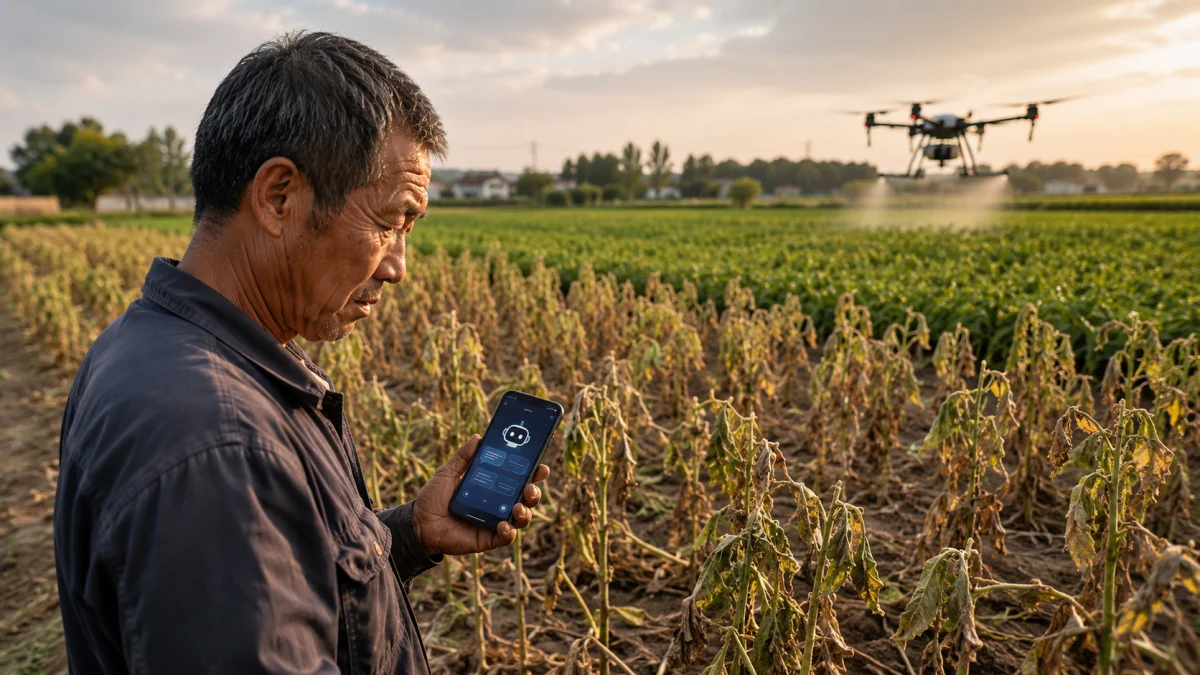
Yes, the viral story is substantially real.
A 67-year-old farmer in Chuzhou, Anhui province, China, reportedly followed an AI-generated plan for treating weeds and insects in a sesame field. The recommendation included fomesafen, an herbicide that local agricultural technicians said should not have been broadcast over the sesame crop.
After the treatment was applied by drone, sesame seedlings across approximately 150 mu—about 24.7 acres—wilted severely by the next day.
But the most important part of this story is not that artificial intelligence gave one farmer a bad answer.
It is why an experienced farmer eventually trusted the answer enough to act on it without checking.
He had reportedly been using AI for more than a year. At first, he was skeptical. He compared what it told him with his own knowledge. Its answers about farming schedules, pesticide use and fertilizer reportedly seemed useful.
Gradually, verification disappeared.
The farmer told reporters that over time he had come to rely almost completely on what the AI told him.
That makes this less a story about an inexperienced farmer being fooled by technology and more a warning about something that can happen to experts:
AI works often enough that eventually you stop checking the times when it doesn’t.
Call it vibe farming.
What Exactly Happened to the Farmer’s 25 Acres?
According to reporting originating with China’s Litchi News, the farmer, identified by his surname Wu, had been consulting an AI application for agricultural questions for more than a year.
On July 10, reporters reviewing his conversation history said he first asked about weed control in rice and later asked how to control weeds and insects in his sesame field. He then specified that he wanted to apply the treatment by drone.
The AI produced what was presented as a complete aerial weed-and-pest-control plan for the sesame crop.
The reported recommendation included:
- Haloxyfop-P-methyl as an herbicide
- Fomesafen as an herbicide
- Thiamethoxam as an insecticide
- Emamectin benzoate as an insecticide
Wu reportedly followed the recommendation across roughly 150 mu of sesame. By the next day, the sesame plants were dying along with the weeds.
He then did something almost darkly ironic:
He asked the AI what had gone wrong.
The system reportedly identified the fomesafen in its own recommended mixture as the likely reason the sesame had been damaged.
Why Was Fomesafen Such a Problem?
Fomesafen is not a fictional chemical invented by an AI model.
It is a real herbicide used for controlling certain weeds. The problem is crop selectivity and application context.
Local agricultural technicians interviewed about Wu’s case said fomesafen was inappropriate for blanket application over the sesame field and could kill the crop along with the weeds.
For additional context, a current U.S. Environmental Protection Agency label for one fomesafen product identifies it as a Group 14 herbicide for specified uses in crops including cotton, dry beans, potatoes, snap beans and soybeans. The label also repeatedly emphasizes application conditions and warns that some combinations can cause crop injury. Sesame is not among the crops listed on that U.S. label.
That U.S. label does not determine what is legally registered in China. Pesticide registrations differ by country and product.
It does illustrate the underlying problem: agricultural chemicals are not interchangeable ingredients that can be assembled into a plausible-looking recipe merely because each chemical individually exists.
Research on weed control in sesame likewise shows how sensitive the crop can be to herbicide choice and application method. Studies have found that herbicides capable of controlling broadleaf weeds can also injure sesame, with the amount of crop contact affecting the severity of the damage.
An AI system can know what fomesafen is and still give catastrophically bad advice about where, when and how to use it.
Was This Actually an “AI Hallucination”?
Not necessarily—at least not in the narrowest meaning of the term.
An AI hallucination usually describes a model confidently generating information that is false or unsupported: a nonexistent court case, a fabricated scientific paper or an event that never happened.
Here, the AI appears to have recommended real agricultural chemicals.
The apparent failure was contextual.
It generated a treatment that sounded coherent but included a chemical that agricultural technicians said was inappropriate for blanket application over the crop being treated.
The company behind the unnamed AI application reportedly told Litchi News that its system did not maintain its own agricultural knowledge base but instead integrated information from publicly available internet sources. Customer service said it would investigate which information source had led to the response.
That leaves an important question unanswered:
Did the AI invent bad information, retrieve bad information, or combine individually correct information incorrectly?
The available reporting does not establish which happened.
And that distinction matters.
A system does not have to hallucinate imaginary facts to be dangerous. It can retrieve five true facts and connect them in a way that produces one dangerously false conclusion.
The Real Story: AI Had Earned the Farmer’s Trust
This is where the case becomes much more interesting than another headline about an AI making a mistake.
Wu reportedly did not begin by blindly trusting artificial intelligence.
He was skeptical.
The AI gave him answers. He evaluated them. They seemed good. He kept using it.
Then, gradually, he stopped checking.
That progression resembles a well-documented problem in human-machine decision-making known as automation bias: people can become excessively reliant on automated recommendations and fail to sufficiently question them when they are wrong. Researchers increasingly study the same problem in human-AI collaboration.
It would be an overstatement to diagnose Wu’s behavior from a news report and declare automation bias the proven psychological cause.
But the pattern fits remarkably well:
AI gives useful answer → human verifies it → AI keeps performing well → trust rises → verification declines → one bad answer passes through unchecked.
That is arguably the most important AI-safety problem facing ordinary users.
The dangerous answer is not necessarily the first one.
It may be the 500th answer, after the first 499 taught you not to worry.
This Is “Vibe Farming”—and Farming Has No Undo Button
The comparison with vibe coding is useful.
AI-assisted coding made it possible for people to describe what they wanted in ordinary language and have an AI generate substantial amounts of software.
Used carefully, that can dramatically increase productivity.
But “vibe coding” also became shorthand for a more questionable workflow: generate the code, see whether it appears to work, and keep going without necessarily understanding everything underneath it.
That approach becomes much more dangerous when exported from software into the physical world.
Call it vibe farming:
- Tell AI what problem you have.
- Receive an authoritative-looking solution.
- Decide that the solution sounds plausible.
- Execute it at scale.
The problem is that a farm doesn’t have Ctrl+Z.
Bad software can sometimes be rolled back.
You cannot roll back yesterday’s herbicide application.
The same problem becomes even more serious when AI moves into medicine, machinery, electrical work, construction, veterinary care or any other environment where an incorrect answer can alter physical reality before anyone discovers the mistake.
The Lesson Is Not “Farmers Shouldn’t Use AI”
That would be the wrong conclusion.
Agriculture may ultimately become one of the areas where artificial intelligence is exceptionally valuable.
AI can help analyze crop imagery, organize agricultural research, interpret large datasets, identify potential pests, examine weather patterns, compare management options and make specialized knowledge easier for farmers to access.
The UN Food and Agriculture Organization is actively developing a roadmap for responsible AI adoption in agriculture, while researchers are building agricultural advisory systems specifically designed around expert-verified information rather than relying only on general-purpose language models.
Recent agricultural-AI research makes the problem particularly explicit: general-purpose language models can produce unsupported recommendations, lack local specificity and become especially risky when advice involves matters such as pesticide selection or dosage. Researchers are therefore experimenting with systems built around expert-curated agricultural facts, source grounding and additional safety layers.
So the answer is not less AI.
It is better division of labor between AI and the human expert.
If You Are the Expert, Stay the Expert
Imagine a farmer with 40 years of experience using an AI system.
The AI can search faster.
It can remember more individual facts.
It can summarize research the farmer would never have time to read.
It can propose alternatives.
It can translate technical material.
It can notice relationships the farmer may not have considered.
That combination could be extraordinarily powerful.
But the farmer still possesses something the language model does not: 40 years of accumulated judgment about what makes sense in an actual field.
AI should multiply that knowledge.
It should not slowly persuade the farmer to stop using it.
The same principle applies to a programmer, physician, attorney, mechanic, engineer, journalist or financial analyst.
There is a fundamental difference between:
“AI found something I didn’t know. I should investigate it.”
and:
“AI knows this better than I do now.”
The first makes an expert more capable.
The second can quietly deskill the expert.
Research into human-AI decision-making increasingly describes the desired relationship as appropriate reliance: humans should accept good AI advice while still recognizing when the machine is wrong. That sounds obvious. In practice, reliably knowing which answer is wrong is the entire problem.
A Better Rule: The Larger the Consequence, the Higher the Verification Threshold
AI does not need to be independently verified every time someone asks it to rewrite a sentence or summarize meeting notes.
But the verification threshold should rise with the potential consequences of being wrong.
If an AI tells a farmer to broadcast a chemical across 25 acres, that recommendation deserves considerably more scrutiny than an answer about how to organize a spreadsheet.
For consequential agricultural decisions, a safer workflow is:
Use AI to expand the options. Use authoritative evidence to narrow them. Use human expertise to make the decision.
That can mean checking the current product label and local registration, consulting agricultural extension services or an agronomist, verifying the underlying source the AI relied upon, and asking whether the recommendation actually applies to the crop, location, growth stage and application method involved.
Even asking the AI better questions can help:
What could make this recommendation wrong?
Is every chemical you listed specifically appropriate for this crop?
What primary or agricultural-authority sources support this recommendation?
Which parts of your answer are uncertain?
But those questions are additional safeguards—not substitutes for independent verification.
An AI citing another AI answer is not verification.
The Tiny Disclaimer Isn’t the Whole Answer Either
According to the reporting, the application displayed a small warning indicating that AI-generated information could contain errors and should be verified. Wu said he had not noticed it despite using the system for more than a year.
That matters. The farmer ultimately made the decision to apply the chemicals without independently verifying the recommendation.
But it does not eliminate the product-design question.
There is a meaningful difference between an AI answering:
“What are some common weeds found in sesame?”
and generating:
a complete chemical mixture intended to be sprayed by drone across approximately 25 acres of a food crop.
The second carries an obvious potential for significant real-world harm.
It is therefore reasonable to ask whether AI systems should recognize these higher-consequence requests and respond differently—requiring location and crop information, grounding recommendations in verified agricultural sources, presenting uncertainty prominently, or declining to provide precise application instructions when the information cannot be reliably validated.
That is an inference about better AI design, not a conclusion about legal liability in Wu’s case.
The available reporting does not provide enough information about the unidentified AI product, its complete terms, the exact conversation or Chinese liability law to responsibly determine who would legally bear the loss.
What the Farmer Story Actually Proves—and What It Doesn’t
Verified: A 67-year-old farmer in Anhui reportedly followed an AI-generated weed-and-pest-control plan, applied it to roughly 150 mu of sesame, and experienced widespread crop death by the following day.
Verified: The recommendation reportedly included fomesafen, which local agricultural technicians identified as inappropriate for the blanket sesame-field application described.
Verified: The farmer said he had initially been skeptical of AI but increasingly relied on it after receiving answers he considered useful.
Verified: The AI application itself was not clearly identified in the original reporting available to us. Claims online assigning the incident to a particular major chatbot should therefore be treated cautiously unless additional evidence emerges.
Not established: There is no publicly reported laboratory investigation demonstrating that fomesafen alone caused every bit of observed damage. The identification comes from the AI’s subsequent answer and agricultural professionals interviewed by reporters.
Not established: This incident does not demonstrate that agricultural AI is inherently unsafe or that farmers should avoid it.
Reasonable inference: The case illustrates how repeated successful AI interactions can create an increasingly dangerous mismatch between confidence and verification, particularly when a general-purpose assistant moves from providing information to effectively making operational decisions.
And that may be the bigger warning.
AI Should Make Experts More Powerful—not Replace the Part That Makes Them Experts
There is a temptation to frame stories like this as a competition:
Human versus AI.
That is probably the wrong model.
The more useful question is:
Which tasks should the AI perform, and which decisions should remain anchored in human expertise and independently verified evidence?
Wu apparently had something extremely valuable before AI entered the equation: years of practical agricultural experience.
AI should have added another layer of intelligence on top of that experience.
Instead, according to his own account, repeated satisfactory answers slowly convinced him to hand more of the judgment over to the machine.
Then one recommendation mattered enormously.
That is the danger of vibe farming—and perhaps of professional AI use more broadly.
The lesson is not to distrust everything AI says.
It is to understand that trust accumulated from yesterday’s correct answers does not verify today’s answer.
Use the model.
Ask it questions.
Make it search.
Make it challenge your assumptions.
Let it expose you to information you did not know existed.
But when you are the person who actually understands the field, the codebase, the patient, the machine or the law:
Do not let AI wash away the years of judgment that made the tool valuable to you in the first place.
The best farmer with AI is not the farmer who obeys AI most completely.
It is the farmer who becomes more capable while remaining the farmer.
References and Further Reading
Original Reporting on the Anhui Farmer
The Paper — “I Ask AI Everything”: Farmer Follows AI Pesticide Advice and 150 Mu of Sesame Seedlings Wither — Chinese-language report relaying the Litchi News investigation, including Wu’s history of increasingly relying on AI and the identification of fomesafen as the suspected damaging herbicide.
Sichuan Online / Litchi News — 67-Year-Old Anhui Farmer’s 150 Mu of Sesame Withers After Following AI Advice — More detailed republication of the underlying Litchi News reporting, including comments from agricultural technicians and the AI application’s customer-service staff.
Herbicide and Sesame Evidence
U.S. Environmental Protection Agency — Tacoma Ag Fomesafen 1.88 Herbicide Label, July 2026 — Current U.S. regulatory label illustrating the crop-specific restrictions, application requirements and crop-injury warnings associated with fomesafen products. This is useful technical context but is not a statement of Chinese pesticide law.
Journal of Experimental Agriculture International — Sesame Tolerance to Herbicides Applied Postemergence-Directed — Field research examining how sesame responds to different post-emergence herbicides and application patterns, demonstrating the crop-safety importance of both chemical selection and spray contact.
International Journal of Agronomy — Response of Sesame to Selected Herbicides Applied Early in the Growing Season — Additional experimental research on sesame injury and tolerance under different herbicide treatments.
AI Reliance and Agricultural AI
AI & Society — Exploring Automation Bias in Human–AI Collaboration: A Review and Implications for Explainable AI — Review of research into automation bias and the conditions under which humans can become overly reliant on automated recommendations.
Schemmer et al. — Should I Follow AI-Based Advice? Measuring Appropriate Reliance in Human-AI Decision-Making — Research framing successful human-AI collaboration around “appropriate reliance”: accepting correct AI advice while resisting incorrect recommendations.
Fine-Tuning and Evaluating Conversational AI for Agricultural Advisory — 2026 research examining the limitations of general-purpose language models for agricultural advice and testing an architecture built around expert-curated facts and safety-aware responses.
FAO — Digital Agriculture and AI Innovation Roadmap — Food and Agriculture Organization roadmap outlining both the potential for AI in agriculture and the need for accountability, trusted systems, contextual adaptation and responsible governance.
Editorial currency note: Agricultural chemical registrations, approved crops, product formulations and application instructions vary by jurisdiction and can change. Regulatory labels cited here provide technical context rather than universal pesticide instructions. Farmers should rely on the current product label and relevant agricultural authorities for their location before making chemical-treatment decisions.