Yes.
If the question is whether Israel materially helped cause the United States to enter the 2026 war with Iran, the public record supports that conclusion.
Not because Benjamin Netanyahu secretly controls the United States.
Not because every American politician who supports Israel is taking orders from Jerusalem.
And not because Iran presented no legitimate security concerns.
The case is much simpler—and much better documented.
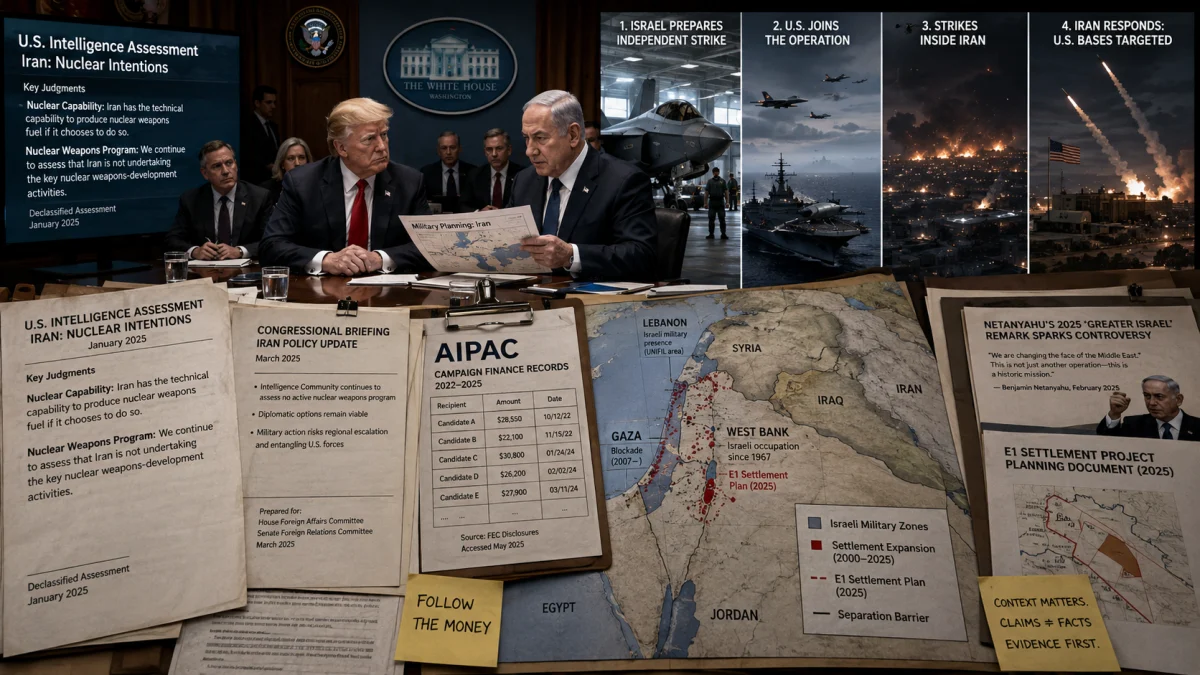
Netanyahu spent months pushing President Donald Trump toward an attack. Israel informed Washington that it was prepared to attack Iran with or without American participation. American officials concluded that an Israeli attack would trigger Iranian retaliation against U.S. forces. And then the United States attacked Iran first.
Secretary of State Marco Rubio subsequently explained the sequence almost explicitly: Washington knew Israeli military action was coming, knew it would probably trigger Iranian attacks on Americans, and decided to strike before that retaliation occurred. House Speaker Mike Johnson similarly said Israel was determined to act “with or without” U.S. support and that this left Trump with a “very difficult decision.”
That is not an allegation about some hidden conspiracy.
That is the administration describing the causal chain itself.
And once that is established, the next question becomes much more important:
Why did Israel want this war so badly?
The answer is broader than Iran’s nuclear program.
Iran was Israel’s principal remaining state-level regional rival. It financed and armed organizations capable of imposing military costs on Israel. Its influence constrained Israeli freedom of action from Lebanon and Syria to Gaza. Netanyahu had spent decades defining Iran as the overriding threat to Israel. By 2026, Iran was militarily weakened, its regional network had been battered, its Syrian ally had collapsed, and Israeli leaders saw an opportunity not merely to contain Tehran but to permanently reorder the regional balance of power.
The nuclear issue helped sell that project.
But the intelligence record makes it increasingly difficult to argue that an imminent Iranian nuclear bomb explains why America had to go to war on February 28, 2026.
The Most Damaging Evidence Came From the Trump Administration Itself
Strip away everything said by critics of Israel.
Forget activists.
Forget social media.
Forget speculation about AIPAC.
Start with Republican officials defending the war.
After a classified congressional briefing, Johnson described the administration’s logic this way: Israel was going to attack Iran with or without American support.
The administration believed Iran would then retaliate against American forces.
That left Trump deciding whether to wait for Israel to attack, allow Iran to retaliate against Americans and then respond—or have the United States attack Iran first alongside Israel.
Rubio was even more explicit:
“We knew that there was going to be an Israeli action.”
He said officials expected that action to produce attacks against American forces and therefore chose preemption.
Think about what that means.
The administration’s argument was not simply:
Iran is about to attack America, therefore America must attack Iran.
It was effectively:
Israel is about to attack Iran. Iran will probably retaliate against Americans after Israel attacks. Therefore America should attack Iran before Iran retaliates.
Those are radically different scenarios.
If Israel’s planned offensive was the event expected to produce the Iranian attack on Americans, then Israel’s decision to initiate hostilities was plainly part of the causal chain that brought America into the war.
That does not absolve Trump.
Quite the opposite.
Washington could have refused to join.
It could have told Israel that an independently initiated attack would not automatically become an American war.
Instead, the United States entered the attack itself.
Israel created the pressure. Trump chose to yield to it.
Netanyahu Had Been Pressuring Trump for Months
The February attack did not emerge spontaneously from intelligence delivered the night before.
Netanyahu had been trying to move Trump toward a much larger confrontation with Iran.
The Washington Post later described a months-long campaign by Netanyahu to convince Trump to attack. It also reported that Israeli pressure inside the new administration began remarkably early: two people familiar with the decision-making described Israeli officials pushing the issue within the first weeks after Trump returned to office, with Pentagon officials receiving strike-option briefings as early as January 2025. One source characterized the Israeli effort as an extreme pressure campaign.
The argument was familiar.
Iran was approaching a nuclear threshold.
Time was running out.
Israel would have to act.
America would eventually be dragged in anyway.
Netanyahu personally returned to Washington on February 11, 2026, as Trump was pursuing another round of negotiations with Iran.
Publicly, Trump said after the meeting that he had insisted negotiations continue.
Netanyahu, meanwhile, was pressing to broaden American demands beyond uranium enrichment to include Iran’s ballistic missiles and its support for Hezbollah, Hamas and other armed movements.
Seventeen days later, American and Israeli forces were bombing Iran together.
That sequence deserves considerably more attention than it normally receives.
Then Trump’s Own Counterterrorism Chief Resigned
Perhaps the most extraordinary internal accusation came several weeks into the war.
Joe Kent was not an antiwar protester standing outside the White House.
Trump had appointed him director of the National Counterterrorism Center.
Kent was a former Green Beret with 11 combat deployments and a former CIA officer. His own wife had been killed in a terrorist attack in Syria.
On March 17, he resigned.
His explanation was remarkable:
“Iran posed no imminent threat to our nation, and it is clear that we started this war due to pressure from Israel and its powerful American lobby.”
Kent further accused senior Israeli officials and influential American media figures of promoting a misinformation campaign designed to convince Trump that Iran represented an imminent danger and that victory would be swift.
Kent’s allegation is not itself proof of every component of that alleged campaign.
He was expressing his assessment, and the White House strongly rejected it.
But it matters enormously that the person making the accusation was the sitting head of America’s National Counterterrorism Center, who resigned because he believed the government had entered an unnecessary war.
And portions of Kent’s account overlap with independently reported facts.
Israeli officials really had conducted an extended campaign for American military action.
Israel really was preparing to attack regardless of whether America joined.
American officials really did use that impending Israeli action to explain why America acted.
And America’s own intelligence assessments really did undermine the public claim of an imminent Iranian nuclear bomb.
The Nuclear Justification Gets Worse the Closer You Examine It
Iran’s nuclear activities were not imaginary.
Before the 2025 war, Iran had accumulated roughly 441 kilograms of uranium enriched as high as 60%.
That is highly unusual for a country without nuclear weapons.
The IAEA called the accumulation a serious proliferation concern. It also determined that Iran had failed to properly declare nuclear material and activities connected to an undeclared structured program operating until the early 2000s. Iran repeatedly provided inadequate explanations about unresolved safeguards questions.
Those facts are important.
But so is the part that repeatedly disappears from political rhetoric.
The same comprehensive IAEA assessment stated:
“The Agency has no credible indications of an ongoing, undeclared structured nuclear programme” of the type Iran previously maintained.
And the U.S. intelligence community went further.
Its March 2025 threat assessment stated:
Iran was not building a nuclear weapon.
It also assessed that Supreme Leader Ali Khamenei had not reauthorized the weapons program suspended in 2003.
Iran had nuclear capability.
Iran created proliferation risk.
Iran could potentially have moved toward weapons production if its leadership made that decision.
Those are serious issues.
They still do not mean:
Iran was building a nuclear bomb.
And they definitely do not mean:
Iran was about to launch a nuclear attack requiring an American war immediately.
The 2026 Intelligence Assessment Makes the War Rationale Even Harder to Defend
Then came perhaps the strangest contradiction of all.
The United States and Israel had already attacked Iran’s nuclear facilities in June 2025.
Trump said those facilities had been “obliterated.”
His administration then went to war again eight months later while the White House described Iran as an “imminent nuclear threat.”
What did America’s intelligence community subsequently tell Congress?
Director of National Intelligence Tulsi Gabbard stated in March 2026 that the previous American strikes had indeed obliterated Iran’s enrichment program.
She added something even more consequential:
Iran had made no effort since those strikes to rebuild its enrichment capability.
Asked by Sen. Jon Ossoff whether that represented the intelligence community’s assessment, Gabbard repeatedly answered yes.
Ossoff then confronted her with the obvious contradiction.
If Iran’s enrichment program had been obliterated and Iran had not attempted to rebuild it, how did the White House simultaneously justify another war by citing an imminent nuclear threat?
Gabbard would not say that the intelligence community had reached that conclusion.
Instead, she said determining imminence was Trump’s responsibility.
That exchange should be central to any serious account of this war.
This is not hindsight.
This was the sitting Director of National Intelligence describing the intelligence community’s position weeks after the attack.
The intelligence community was certainly concerned that Iran intended eventually to recover its nuclear infrastructure, and the 2026 threat assessment said precisely that.
But “intends eventually to recover” is not the same statement as “imminent nuclear threat.”
Again, political rhetoric collapsed very different concepts into one frightening phrase.
U.S. Intelligence Also Did Not Show Iran Preparing to Attack America First
The nuclear issue was not the only problem.
Immediately after the war began, administration officials briefed congressional staff about the threat from Iran.
According to three people familiar with those briefings, U.S. intelligence did not indicate that Iran was preparing a preemptive attack against the United States before the American-Israeli assault.
Iran certainly possessed ballistic missiles, drones, proxy forces and the ability to attack Americans throughout the Middle East.
It had attacked Americans previously.
Its capabilities represented a genuine military threat.
But possessing the capability to retaliate is different from preparing to attack first.
And that distinction becomes especially important when Rubio acknowledges that officials expected Iran to attack Americans because Israel was about to attack Iran.
The supposed preemption was therefore, at least partly, preemption against a predicted retaliation.
That is a very unusual definition of defensive war.
Netanyahu Has Been Moving the Iranian Nuclear Deadline for More Than 30 Years
Extraordinary scrutiny of Netanyahu’s nuclear claims is also warranted for a simple historical reason.
He has been making versions of them for more than three decades.
In 1992, while serving in Israel’s parliament, Netanyahu warned that Iran could be only three to five years away from becoming independently capable of producing a nuclear bomb.
He repeated a similar timeline in his 1995 book Fighting Terrorism.
In a 1996 address to the U.S. Congress, he again described the nuclear deadline as rapidly approaching.
Then came 2012.
Netanyahu stood before the United Nations holding his famous cartoon bomb.
He argued that Iran would reach a critical enrichment threshold by spring or summer 2013.
Iran did not possess a nuclear weapon in summer 2013.
Nor the following summer.
Nor a decade later.
There are legitimate explanations for why nuclear timelines change.
Diplomacy matters.
Sabotage matters.
Sanctions matter.
The 2015 nuclear agreement mattered.
Iranian political decisions matter.
A prediction can fail because efforts to prevent the predicted outcome succeeded.
But that cannot become an unlimited logical escape hatch.
When one political leader repeatedly tells the world for three decades that the intolerable Iranian nuclear deadline is rapidly approaching, that history becomes relevant when the same leader again argues that war cannot wait.
You do not ignore the previous predictions.
You increase the scrutiny.
What Israel Actually Gained From Destroying Iranian Power
This is the part that disappears when the Iran war is reduced to a nuclear story.
Israel had enormous strategic reasons to want Iran weakened that had nothing to do with an Iranian bomb being completed next Tuesday.
Iran had spent decades developing what it called its Axis of Resistance.
That network gave Tehran influence through Hezbollah in Lebanon, armed Palestinian factions including Hamas, Iraqi Shiite militias, the Houthis in Yemen and Syria under Bashar Assad.
From Israel’s perspective, destroying that network changes the strategic map.
And that is largely what Israel spent the years following October 7 doing.
Hamas was devastated in Gaza.
Hezbollah’s leadership and military infrastructure suffered enormous damage.
Assad’s government collapsed, severing one of Iran’s most important geographical supply routes to Hezbollah.
Israel repeatedly attacked Syria.
Israel struck Yemen.
Israel struck Iran.
By June 2025, the Associated Press described Netanyahu as seeing the transformation as vindication of his promise to “change the Middle East,” with Iran’s regional network severely weakened.
Iran was therefore not merely a nuclear file.
It was the principal state power capable of financing, supplying and coordinating armed resistance to Israeli regional dominance.
Destroying Iranian capabilities gives Israel a freer hand throughout the region.
That is a strategic benefit whether Iran ever builds a nuclear weapon or not.
By 2026, Israel’s Goal in Iran Went Beyond Nuclear Sites
The conduct of the 2026 war makes this even clearer.
Israel did not restrict itself to uranium enrichment facilities.
It targeted Iranian command structures, political leadership, internal security forces and economic infrastructure.
Netanyahu openly addressed the Iranian population and military, telling them they had an opportunity to overthrow their government.
The Washington Post later reported significant divergence between Washington and Jerusalem over the war’s ultimate goals.
American officials described Israel as pursuing a broader campaign aimed at crippling Iran’s regime and economy.
Roughly 40% of Israel’s first several thousand strikes were reportedly directed against security forces and installations involved in suppressing domestic uprisings.
Israeli attacks killed senior political and security officials and expanded into energy infrastructure.
One senior U.S. official put the disagreement bluntly:
Israel was pursuing a “scorched-earth campaign of regime change.”
Whatever one thinks about Iran’s government—and there is plenty to condemn about it—that is plainly a broader objective than preventing uranium enrichment.
Israel saw an opportunity to eliminate its principal regional rival as an effective power.
That is the strategic prize.
Where AIPAC Fits Into This
This subject also cannot be discussed seriously while pretending the U.S.-Israel relationship operates like an ordinary alliance.
AIPAC does not “control America.”
That statement would be impossible to prove and would flatten a complicated political system into a conspiracy theory.
But the opposite claim—that organized pro-Israel political power has little meaningful influence over Congress—is equally unserious.
The scale is measurable.
According to Federal Election Commission statistics, the AIPAC Political Action Committee ranked No. 1 among all PACs in contributions to federal candidates and other committees during the 2023-2024 election cycle, with approximately $53.7 million.
AIPAC itself boasted after the election that:
- it endorsed 361 candidates;
- those endorsements covered roughly 75% of the House and 84% of senators up for election;
- 326 endorsed candidates had won by the time of its report;
- its members had directed more than $53 million toward pro-Israel candidates.
Its affiliated super PAC, United Democracy Project, spent $61.4 million during the 2024 cycle, according to FactCheck.org, including tens of millions in independent expenditures.
And AIPAC has demonstrated that this money is not merely ceremonial.
When members of Congress become prominent critics of Israeli policy, enormous amounts can suddenly appear in their primaries.
United Democracy Project spent roughly $14.5 million in the 2024 race that removed Rep. Jamaal Bowman and more than $5 million in the race against Rep. Cori Bush. Both were outspoken critics of Israel.
No politician needs to receive a phone call saying:
Vote this way or else.
Members of Congress can observe what happens.
That is how political incentive structures work.
AIPAC Was Not Neutral About the Iran War
AIPAC also did not sit on the sidelines when America entered the war.
On February 28, the organization issued a statement strongly supporting Trump’s attack.
It praised the operation, emphasized its coordination with Israel, repeated the claim that Iran had relentlessly pursued nuclear weapons, and called on the administration and Congress to ensure Israel received the protection and resources necessary to deal with Iranian retaliation.
After the first phase of fighting, AIPAC celebrated what it called a historic joint American-Israeli campaign and praised bipartisan congressional leaders who had spent years ensuring Israel possessed the resources necessary for such operations.
This does not prove AIPAC ordered Trump to invade Iran.
It does establish something less sensational and much more important:
An enormously well-funded American political organization exists specifically to maintain congressional support for Israel; it openly rewards politicians who support that relationship, spends heavily against some who challenge it, and strongly supported America’s entry into Israel’s war with Iran.
That is relevant evidence when analyzing the political environment in which the decision occurred.
And when Trump’s own counterterrorism director subsequently resigns and blames “Israel and its powerful American lobby,” the allegation should be investigated rather than dismissed reflexively.
This Is Political Leverage, Not a Jewish Conspiracy
The distinction matters.
AIPAC is an identifiable political organization.
The Israeli government is an identifiable foreign government.
Netanyahu is an identifiable political leader.
Their actions, spending and lobbying can be scrutinized like those of oil companies, pharmaceutical companies, defense contractors, Saudi Arabia, China, labor unions or any other concentrated interest.
None of that says anything about Jewish people collectively.
Millions of Jewish Americans disagree profoundly with Netanyahu.
Israeli citizens themselves disagree profoundly over their government.
Reducing state policy to ethnicity or religion would not merely be bigoted; it would make the analysis worse.
The issue here is political power and state interests.
And those are measurable.
The “Greater Israel” Question Cannot Simply Be Dismissed Anymore
This is where the broader regional context becomes uncomfortable.
There are wildly exaggerated versions of the “Greater Israel” claim online, including maps attributed to Israeli policy that cannot be substantiated.
Those should not be repeated.
But neither should the documented evidence be hidden simply because the subject attracts conspiracy theories.
Netanyahu himself created the problem.
During an August 2025 interview with Israel’s i24NEWS, the interviewer presented Netanyahu with an amulet representing what he called the “Promised Land.”
Asked whether he felt connected to the vision, Netanyahu answered:
“Very much.”
The interviewer clarified:
“It is Greater Israel.”
Netanyahu again affirmed the connection before describing himself as engaged in a historic and spiritual generational mission.
That alone does not establish a military blueprint to conquer Jordan, Egypt, Lebanon or Syria.
“Greater Israel” itself has been used to describe different territorial visions at different times.
But Netanyahu’s governing record makes it impossible to treat territorial maximalism as an irrelevant fringe subject.
See also: What Is Greater Israel—and Is It Actually Real? What Israeli Leaders Have Said and Done
Netanyahu’s Government Put Territorial Maximalism in Writing
When Netanyahu formed his current governing coalition in December 2022, its published guiding principles began with an extraordinary statement:
“The Jewish people have an exclusive and inalienable right to all parts of the Land of Israel.”
The government pledged to promote settlement throughout the land, specifically including Judea and Samaria—the occupied West Bank.
The same governing principles separately pledged to continue Israel’s struggle against Iran’s nuclear program.
Netanyahu’s coalition agreement with Religious Zionism went further, committing the prime minister to formulate policies for applying Israeli sovereignty to the West Bank, subject to his judgment about timing and international circumstances.
Then policy began catching up with ideology.
In August 2025, Israel approved the long-delayed E1 settlement project.
Finance Minister Bezalel Smotrich did not disguise its purpose.
He said the project would “bury” the idea of a Palestinian state and called for Israeli sovereignty over the West Bank.
When asked whether Netanyahu approved what he was doing, Smotrich said his actions in the West Bank were being undertaken with Netanyahu’s blessing.
That is not a meme about Greater Israel.
That is Israeli government policy.
And Israeli Territorial Control Was Expanding Elsewhere
Look at the physical map, not merely political rhetoric.
Gaza
By April 2025, Israel controlled more than half of Gaza after dramatically expanding military buffer zones and corridors.
Israeli forces had systematically razed homes, farmland and infrastructure in some of those areas.
Netanyahu said Israel would retain security control after Hamas was defeated and endorsed moving Palestinians out of Gaza under what his government called “voluntary emigration.”
Syria
After Bashar Assad’s government collapsed, Israel moved forces into a U.N.-patrolled buffer zone inside Syrian territory.
It did not quickly leave.
Netanyahu subsequently demanded the demilitarization of a huge portion of southern Syria.
Defense Minister Israel Katz said Israeli troops would remain on Mount Hermon and inside the buffer zone for an indefinite period.
As of August 2026, Israel continues occupying that buffer zone and continues conducting airstrikes inside Syria.
Just days ago, Israel struck the Abu Duhur air base in northern Syria in an effort to prevent a Turkish military presence there.
Lebanon
After the 2024 ceasefire required withdrawal from southern Lebanon, Israel withdrew from much of the territory but retained troops at five strategic positions inside Lebanon.
Lebanon called the continued presence an occupation and violation of the agreement.
Yemen
Israel also expanded its military reach into Yemen, including launching its first naval attack on Hodeida in June 2025 after repeated Houthi missile attacks.
None of these conflicts arose in a vacuum.
Hamas conducted the October 7 massacre.
Hezbollah fired rockets into Israel.
The Houthis repeatedly launched missiles and attacked shipping.
Iran armed hostile forces and attacked Israel directly.
Those facts belong in the record.
But so does the result:
Israel emerged from the post-October 7 period projecting military power across Gaza, Lebanon, Syria, Yemen and Iran while simultaneously expanding or maintaining physical control over Palestinian, Syrian and Lebanese territory.
That is a remarkable concentration of regional military power.
Did Israel Attack Iran Because of “Greater Israel”?
There is no credible public evidence proving that Netanyahu ordered the Iran war as a discrete step in a secret territorial blueprint called the Greater Israel project.
We should not claim that.
What can reasonably be inferred is more defensible.
An Israeli government openly committed to permanent control over strategically important territory has an obvious interest in eliminating the regional power most capable of financing and arming forces that resist Israeli policy.
Iran does not have to be physically annexed for its destruction to facilitate Israeli expansion elsewhere.
Weakening Iran means weakening Hezbollah.
It means weakening Palestinian armed factions.
It means reducing Iranian influence in Syria.
It means reducing the external military support available to actors opposing Israeli control of Palestinian territory.
It means eliminating the principal state capable of imposing significant regional costs on Israel.
Iran is therefore relevant to Israel’s territorial ambitions not because Israel intends to annex Tehran, but because Iranian power limits what Israel can do closer to home.
That is an inference.
But it is an inference grounded in observable strategic incentives.
This Is Why the War Was So Valuable to Netanyahu
The advantages of a devastated Iran are enormous from Netanyahu’s perspective.
A weakened or replaced Iranian government could:
- sharply reduce Hezbollah’s ability to rebuild;
- further isolate Hamas and Palestinian Islamic Jihad;
- diminish Houthi military support;
- reduce Iranian influence over Iraqi militias;
- eliminate a source of weapons and money for Israel’s regional adversaries;
- give Israel far greater military freedom in Syria and Lebanon;
- weaken resistance to Israeli control and annexation policies in Palestinian territory;
- establish Israel as the overwhelmingly dominant military power in the region.
And there is a personal political dimension.
Netanyahu has spent decades constructing his political identity around one claim:
He is the Israeli leader who understood the Iranian threat before everyone else and is uniquely capable of defeating it.
Destroying the Iranian regime would not merely represent a strategic victory.
It would become the defining achievement of Netanyahu’s political life.
The Associated Press noted before the February war that his relationship with Trump and his role in shaping Iran policy were already central to Netanyahu’s 2026 election positioning.
That does not prove he started a war to win an election.
It does demonstrate that the war produced obvious domestic political benefits alongside its geopolitical ones.
Saudi Arabia Was Also Accused of Pushing Trump—But the Evidence Is Weaker
For completeness: the Washington Post reported, based on anonymous sources, that Saudi Crown Prince Mohammed bin Salman also privately encouraged Trump to attack Iran; Saudi Arabia denied that account.
That disputed allegation does not have anything approaching the publicly documented evidentiary record establishing Israel’s role and is therefore not a comparable causal pillar of this story.
Trump Is Still Responsible
Saying Israel got America into the Iran war must not become a convenient way of absolving the American president who ordered American forces to fight it.
Netanyahu could lobby.
Israel could threaten unilateral action.
AIPAC could create political incentives.
None could order the U.S. military into combat.
Trump could say no.
Congress could assert its constitutional war powers.
American policymakers could distinguish Israeli security objectives from American ones.
They did not.
Trump ultimately made the decision.
His administration sent American pilots, sailors and soldiers into the conflict.
His government accepted the strategic logic that an anticipated Iranian response to an Israeli attack justified an American attack first.
So the most accurate formulation is not:
Israel forced America into war.
It is:
Israel deliberately created enormous pressure for an American war with Iran, and the United States chose to let Israeli strategic priorities become American military policy.
That is worse in some ways because it means the system worked exactly as designed.
Americans Are Now Paying for That Decision
On February 28, Americans were told they were entering a decisive military campaign.
Months later, the war had not disappeared.
As of August 21, the Pentagon’s casualty system showed 18 American service members killed and 756 wounded during the Iran conflict.
The fighting has stretched into its sixth month despite Trump’s early expectation that it would be over within weeks.
Many of the wounded have suffered traumatic brain injuries.
The Strait of Hormuz became a continuing flashpoint.
Regional infrastructure was attacked.
Energy markets were disrupted.
American military resources remained tied down in another Middle Eastern conflict.
And Iran’s government did not disappear.
The result makes the original causal question more important, not less.
Americans deserve to know why their country entered a war.
So, Did Israel Get America Into the Iran War?
Yes.
That is the best-supported conclusion from the currently available evidence.
Israel was not a passive ally that happened to join an independently necessary American war.
The chronology runs the other way.
Netanyahu spent months pushing Washington toward an attack.
Israeli officials conducted an intensive pressure campaign.
Israel was prepared to attack Iran whether the United States joined or not.
American officials believed that Israeli action would trigger Iranian retaliation against American forces.
Rubio publicly acknowledged that sequence.
The United States then chose to attack alongside Israel rather than refuse participation.
Trump’s own counterterrorism chief later resigned and said the war resulted from pressure by Israel and its American political lobby.
Meanwhile, the U.S. intelligence community had assessed in 2025 that Iran was not building a nuclear weapon.
After the 2025 attacks, the intelligence community assessed that Iran’s enrichment infrastructure had been obliterated and that Iran had not tried to rebuild it before the new war.
American intelligence also did not show Iran preparing a first strike against the United States immediately before the February attack.
And beyond the nuclear story sits the strategic reality that is too often omitted:
Destroying Iranian power profoundly benefits Israel.
It weakens every major Iranian-supported military actor confronting Israel.
It increases Israeli freedom of action in Lebanon and Syria.
It strengthens Israel’s position while its government simultaneously expands settlements, entrenches control in Palestinian territory and maintains new security zones beyond internationally recognized boundaries.
And it advances Netanyahu’s decades-long ambition to eliminate Iran as Israel’s principal strategic rival.
None of that proves that every Israeli action belongs to one secret master plan.
It does not need to.
The visible policy is consequential enough.
The mistake is treating Israeli interests as if they are automatically American interests—and treating questions about the political machinery that produces that alignment as somehow illegitimate.
They are not.
After six months of war, hundreds of wounded Americans and decades of repeatedly shifting predictions about Iran’s supposedly imminent nuclear bomb, those questions are overdue.
Evidence classification
Verified facts
- Netanyahu spent months pressing Trump for stronger action against Iran.
- Israel planned to strike Iran with or without direct American participation.
- Rubio acknowledged that U.S. officials expected an Israeli strike to produce Iranian retaliation against U.S. forces.
- The United States elected to attack Iran alongside Israel.
- Trump’s National Counterterrorism Center director resigned and blamed pressure from Israel and its U.S. lobby.
- The 2025 U.S. intelligence assessment said Iran was not building a nuclear weapon.
- The 2026 intelligence assessment said the 2025 strikes obliterated Iran’s enrichment capability and Iran had not attempted to rebuild it.
- U.S. intelligence did not indicate Iran was preparing a preemptive attack against America immediately before the war.
- AIPAC PAC was the largest PAC by candidate and committee contributions in the 2024 FEC table.
- AIPAC and its affiliated super PAC spent tens of millions influencing congressional elections.
- AIPAC publicly supported the February 2026 U.S. strikes.
- Netanyahu publicly expressed a strong connection to a “Greater Israel” vision.
- Netanyahu’s government formally committed itself to settlement throughout the West Bank and has supported applying Israeli sovereignty there.
- Israel has expanded or maintained military control in Gaza, Syria and parts of southern Lebanon.
Strong inference
Israel was the primary foreign driver pushing the United States into the February 2026 Iran war, and eliminating Iranian power served broader Israeli ambitions for regional military dominance and increased freedom of action in Palestinian territory, Lebanon and Syria.
Not established
- That AIPAC literally controls the U.S. government.
- That Netanyahu can order an American president to go to war.
- That the Iran war was secretly planned as one formal stage of a documented “Greater Israel” blueprint.
- That Iran posed no security or proliferation threat whatsoever.
- That Israel was the only influence on Trump’s decision.
Those limitations do not weaken the central conclusion.
They are what make it difficult to dismiss.
References and Further Reading
Primary U.S. intelligence and government records
2025 Annual Threat Assessment of the U.S. Intelligence Community — Office of the Director of National Intelligence — Primary intelligence-community assessment stating that Iran was not building a nuclear weapon and Khamenei had not reauthorized the weapons program suspended in 2003.
2026 Annual Threat Assessment of the U.S. Intelligence Community — Office of the Director of National Intelligence — Current threat assessment describing Iran’s post-2025 nuclear and military capabilities.
DNI Gabbard Releases 2026 Annual Threat Assessment — ODNI — Includes Gabbard’s statement that Iran’s enrichment program had been obliterated and that there had been no effort to rebuild it.
Sen. Ossoff Questions DNI Gabbard About the Claimed “Imminent” Iranian Nuclear Threat — Transcript exposing the tension between the White House’s imminent-nuclear-threat language and the intelligence community’s assessment.
President Trump’s March 2, 2026 War Powers Notification to Congress — The administration’s formal notification explaining the purposes asserted for the February 28 military action, including collective self-defense of regional allies such as Israel.
IAEA nuclear evidence
IAEA Comprehensive Safeguards Assessment of Iran — GOV/2025/25 — Documents serious safeguards violations and 60% enrichment while stating that the agency had no credible indication of a continuing undeclared structured weapons program.
IAEA Board Resolution on Iran — GOV/2025/38 — Primary record of Iran’s unresolved safeguards failures and historical undeclared nuclear activities.
IAEA Verification and Monitoring Report After the 2025 Attacks — GOV/2025/50 — Records Iran’s prewar 60%-enriched stockpile and the subsequent loss of IAEA continuity of knowledge after military strikes and suspended cooperation.
How Israel shaped the U.S. decision
Trump Officials Say Israel’s Plans Helped Lead the U.S. Into the Iran War — Associated Press — Reporting on the administration’s postwar explanation that Israel intended to act regardless of U.S. participation and that anticipated Iranian retaliation shaped Trump’s decision.
Push From Saudis, Israel Helped Move Trump to Attack Iran — The Washington Post — Details Netanyahu’s lobbying and Rubio’s classified briefing while also containing the separate, disputed Saudi allegation.
Senior Counterterrorism Official Joe Kent Resigns Over Iran War — The Washington Post — Reports Kent’s accusation that Israeli pressure and its U.S. lobby helped cause the conflict, along with additional reporting about Israel’s early pressure campaign.
What to Know About Joe Kent’s Resignation — Associated Press — Independent account of the resignation and the dispute surrounding Kent’s claims.
U.S.-Israeli Rift Widens Over the Endgame in Iran — The Washington Post — Reports divergent American and Israeli objectives and describes Israel’s broader attacks on Iranian security and economic infrastructure.
AIPAC and American political influence
FEC 2024 Top PACs by Contributions to Candidates and Committees — Federal Election Commission table placing AIPAC PAC first with approximately $53.7 million in contributions during the 2023-2024 cycle.
AIPAC: Keeping Congress Pro-Israel — AIPAC — AIPAC’s own description of its electoral strategy, candidate endorsements, win rate and political fundraising.
United Democracy Project — FactCheck.org — Current financial overview of AIPAC’s affiliated super PAC and its 2024 spending.
AIPAC Statement Supporting the February 2026 U.S. Strikes on Iran — AIPAC’s own public endorsement of America’s entry into the war and its request for continued U.S. support to Israel.
Greater Israel, settlements and territorial policy
Netanyahu Says He Feels Connected to the Vision of “Greater Israel” — Times of Israel — Israeli reporting of Netanyahu’s August 2025 remarks describing his connection to the concept.
Netanyahu Government’s Published Coalition Guidelines — Times of Israel — Full translated governing principles asserting exclusive Jewish rights throughout the Land of Israel and pledging expanded settlement.
Israel Approves E1 Settlement Project That Could Divide the West Bank — Associated Press — Documents final approval of the E1 project and Smotrich’s stated goal of preventing Palestinian statehood.
Smotrich Announces E1 Settlement Expansion — Reuters — Includes Smotrich’s statements about territorial, demographic and sovereignty goals and his assertion that the policy had Netanyahu’s backing.
Regional territorial and military expansion
Israel Controls More Than Half of Gaza After Expanding Buffer Zones — Associated Press — Detailed investigation into Israeli control, demolitions and long-term security plans inside Gaza.
Netanyahu Says Israeli Forces Will Remain in Southern Syria — Associated Press — Documents Israel’s occupation of the Syrian buffer zone and plans for an indefinite presence.
Israel Retains Five Military Positions in Southern Lebanon — Associated Press — Documents Israel’s decision to retain military positions beyond the ceasefire withdrawal deadline.
Netanyahu’s historical Iran warnings
Full Transcript of Netanyahu’s 2012 U.N. Iran Speech — European Parliament Archive — Primary transcript of Netanyahu’s famous red-line presentation and his spring/summer 2013 nuclear timetable.
Fighting Terrorism by Benjamin Netanyahu — U.S. Department of Justice Library Record — Government bibliographic record for Netanyahu’s 1995 book outlining his longstanding view of Iran as a nuclear and terrorism threat.
Current cost of the war
More Than 750 U.S. Service Members Wounded in Iran War — The Washington Post — August 21 Pentagon figures showing 18 dead and 756 wounded as the conflict approached six months.
Editorial currency note: This article reflects evidence available through August 24, 2026. The Iran conflict, negotiations, casualty accounting and intelligence disclosures remain active. Future declassification could materially strengthen, weaken or clarify portions of the causal analysis.