
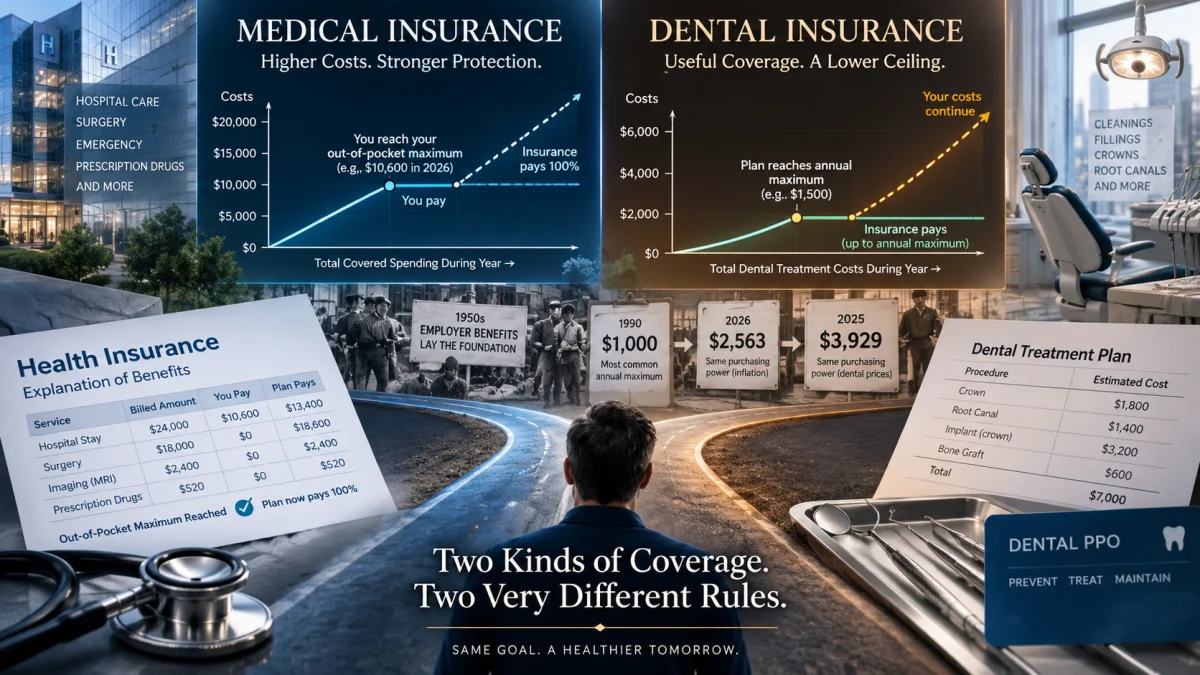
Dental insurance can stop paying after $1,500 because many plans have an annual benefit maximum: a limit on how much the plan will pay toward covered dental care during a benefit year.
That is almost the reverse of the protection people are accustomed to with major medical insurance.
With an ACA Marketplace medical plan, the out-of-pocket maximum limits the patient’s covered in-network spending. Once the patient reaches that limit, the plan generally pays 100% of additional covered in-network benefits for the rest of the year. Federal law also generally prohibits annual dollar limits on essential health benefits. HealthCare.gov’s explanation of out-of-pocket maximums HealthCare.gov’s annual- and lifetime-limit protections
A traditional adult dental PPO often works differently:
Dental spending rises → the plan reaches its annual maximum → the patient becomes responsible for additional costs.
The reason is not simply that dental insurers picked $1,500 and refused to pay more. Modern dental-plan design reflects several forces at once: dental coverage developed historically as a limited employment benefit, most members do not exhaust their annual maximum, employers and workers are sensitive to premiums, many dental treatments can be scheduled in ways that complicate insurance risk, and adult dental coverage does not receive the same federal essential-health-benefit protections as major medical coverage.
There is also an important correction to the familiar "$1,500 dental maximum" story: $1,500 is no longer a universal or even necessarily typical ceiling. The National Association of Dental Plans, the industry’s trade association, reported that 73% of dental PPO enrollees had annual maximums of at least $1,500 in 2024, up from 67% a year earlier. It also reported that 42% had some form of annual-maximum rollover. NADP’s 2025 dental plan-design summary
The more interesting question is therefore not simply why $1,500 exists.
It is why dental insurance still limits the insurer’s annual exposure to amounts that can be consumed quickly by major dental work, while medical insurance is generally designed to protect the patient from catastrophic covered spending.
A Dental Annual Maximum Is Not an Out-of-Pocket Maximum
These terms sound similar but describe opposite limits.
| Term | What is being limited? | What happens after the limit? |
|---|---|---|
| Dental annual benefit maximum | What the dental plan pays | Patient generally becomes responsible for additional covered treatment subject to the maximum |
| Deductible | Initial amount the patient pays before certain benefits begin | Plan begins applying its coverage formula after the deductible is satisfied |
| Coinsurance | Percentage of an allowed charge assigned to each side | Patient and plan split the cost according to the plan |
| Medical out-of-pocket maximum | Patient spending on covered in-network care | Plan generally pays 100% of additional covered in-network benefits |
For 2026, a Marketplace medical plan can have an out-of-pocket limit no higher than $10,600 for an individual or $21,200 for a family. Premiums, uncovered services, many out-of-network costs and charges above allowed amounts do not count toward that limit. HealthCare.gov’s 2026 out-of-pocket-limit guidance
A $1,500 dental annual maximum means something very different.
It generally means:
The plan will pay no more than $1,500 during the benefit year for services that count toward the maximum.
Some plans exclude preventive services from the maximum or provide rollover benefits, so the actual contract matters.
Why Can Health Insurance Work the Opposite Way?
The legal treatment is different.
Under the Affordable Care Act, insurers generally cannot impose annual dollar limits on essential health benefits. The federal list includes hospitalization, emergency services, prescription drugs, maternity care and other categories. Pediatric oral care is included, but routine adult dental coverage is not currently an essential health benefit. HealthCare.gov’s list of essential health benefits HealthCare.gov’s dental Marketplace guidance
That distinction has concrete consequences.
For stand-alone pediatric dental plans in the federally facilitated Marketplace, CMS set a 2026 annual cost-sharing limit of $450 for one covered child and $900 for two or more children. In other words, that structure limits the patient’s exposure rather than simply imposing a low ceiling on what the plan will spend. CMS’s 2026 stand-alone dental-plan guidance
A 2027 adult-dental change was proposed, then reversed
This is an area where older explanations are already outdated.
A previous federal rule would have allowed states to begin adding routine adult dental services to their essential-health-benefit benchmarks in 2027. But in May 2026, CMS reversed that policy.
The final 2027 rule, effective July 20, 2026, again prohibits issuers from treating routine non-pediatric dental services as essential health benefits. CMS’s final 2027 Marketplace rule
So, as of September 2026, the basic distinction remains: routine adult dental coverage is generally outside the federal EHB structure that protects major medical benefits from annual dollar limits.
That does not mean every dental-plan rule comes from federal law. Employer plans, state law, plan type and the contract itself can all matter. But the regulatory difference helps explain why the two products can legitimately have very different benefit architectures.
How Did $1,000 and $1,500 Dental Maximums Become So Common?
Dental insurance did not develop as a smaller version of modern comprehensive medical insurance.
A National Academies review of dental-care financing traces a major expansion of prepaid dental coverage to 1950s collective bargaining. One important predecessor of today’s Delta Dental system grew out of 1954 labor-management negotiations involving longshore workers on the West Coast. National Academies history of dental insurance and financing
Dental coverage expanded as an employee benefit during the following decades.
By 1977, federal health-insurance data reported that 21% of the population had dental coverage. Among people with dental insurance, 46% had comprehensive coverage involving deductibles or coinsurance and an annual benefit maximum of $1,000 or more. Federal historical review of private health insurance in 1977
By 1990, the structure was firmly established.
A Bureau of Labor Statistics survey found that annual maximums applied to slightly more than four-fifths of dental-plan participants in small private establishments, and:
The most common annual limit was $1,000.
The same report found that major procedures such as crowns and prosthetics were commonly covered at only 50% of the recognized charge. BLS Employee Benefits in Small Private Establishments, 1990
That history matters because today’s debate is not about a benefit limit invented last year. The basic design has existed for decades.
What Would a $1,000 Dental Maximum From 1990 Be Worth Today?
This is where the stagnation becomes easier to see.
The Bureau of Labor Statistics’ general Consumer Price Index averaged 130.7 in 1990. By August 2026, the CPI-U had reached 334.980. BLS historical CPI data BLS August 2026 CPI data
On general inflation alone:
$1,000 in 1990 ≈ $2,563 in August 2026 dollars.
But general inflation may actually understate what happened to dental prices.
The Bureau of Economic Analysis’ dental-services price index, available through the Federal Reserve Bank of St. Louis, increased from 33.159 in 1990 to 130.309 in 2025. BEA dental-services price index via FRED
Using that index:
$1,000 of dental services in 1990 ≈ $3,929 at 2025 dental-service prices.
That does not mean every $1,000 dental plan from 1990 should automatically have a $3,929 maximum today. Insurance prices depend on utilization, negotiated fees, benefit design, networks and other factors.
It does show why comparing the nominal dollar amounts is misleading.
A present-day $1,500 maximum is only about 38% of the dental-service purchasing power represented by $1,000 in 1990 under that broad price index.
That is the strongest evidence behind complaints that annual maximums failed to keep pace with the cost of care.
The American Dental Association, which represents dentists and therefore has a direct stakeholder interest in this debate, similarly argues that some longstanding maximums have remained essentially unchanged for decades. ADA discussion of annual dental maximums
So Why Didn’t Annual Maximums Simply Rise With Dental Costs?
There is no evidence that one single explanation accounts for the entire market.
The strongest evidence instead points to several reinforcing forces.
1. Most dental-plan members never reach the maximum
This is the dental industry’s strongest economic argument.
NADP’s 2024 plan data found that the percentage of group dental PPO enrollees reaching their annual maximum increased from 1.7% to 2.9%, but remained a small minority. NADP’s current plan-design data
An ADA Health Policy Institute analysis reached a similar result from a different dataset: the ADA reported that 3.4% of patients reached a typical annual maximum, while another 3.3% came within $100 of common limits such as $1,000 or $1,500. ADA’s annual-maximum analysis
The precise percentages differ because the populations and methods differ, but the broad finding is consistent:
Most people do not exhaust their dental benefit in a typical year.
That creates a difficult benefits-design question.
If an employer raises everyone’s annual maximum from $1,500 to $5,000, the plan takes on additional potential claims expense for a benefit that relatively few employees will fully use. Employers may instead prefer a cheaper dental benefit, especially when medical premiums and other compensation costs are competing for the same benefits budget.
That tradeoff is real even though it can be brutal for the minority of employees who suddenly need extensive dental work.
2. A higher maximum increases potential claims
A larger annual maximum is not merely a more generous number printed on the insurance card.
It increases the amount the plan may have to pay when members require substantial treatment.
That does not establish exactly how much premiums would rise if every $1,500 plan became a $5,000 plan. Pricing depends on the covered population, coinsurance, network reimbursement, utilization and plan design.
But the actuarial direction is straightforward: all else equal, expanding what a plan is obligated to pay increases expected claims.
That is one reason employer benefit budgets matter.
Interestingly, current industry data do not support the simplistic narrative that dental premiums have simply skyrocketed while maximums remained frozen. NADP reported in June 2026 that its average dental premium measure fell more than 6% in 2025 compared with 2024, following several years in which premium changes were at or below general inflation. NADP is an industry association, so its figures should be understood as industry-produced market data rather than independent consumer advocacy research. NADP’s 2026 premium report summary
3. Your insurance company may not actually be carrying the risk
This is one of the most important parts of the story that conventional explanations often miss.
NADP reports that 46% of group dental benefits were self-insured in 2024. NADP’s 2025 enrollment report summary
In a self-funded arrangement, the employer generally finances the claims while an insurance company or benefits administrator may handle the network, claims processing and administration.
That makes the popular explanation that "the insurer keeps everything once you hit $1,500" incomplete.
For a self-funded plan, reducing claims exposure primarily protects the employer’s benefit budget.
For a fully insured plan, the insurance carrier bears the claims risk and a lower maximum limits that risk. But whether that produces extra profit, lower premiums, greater administrative margins or some combination cannot be determined merely from the existence of the cap.
The identity of the economic beneficiary depends on how the particular plan is financed.
4. Dental care creates an unusual insurance-selection problem
Dental treatment also differs from many catastrophic medical events in an economically important way.
Some dental treatment can be moved forward or backward in time.
Economist Marika Cabral studied dental claims and found that approximately 40% of individuals in the dataset strategically delayed dental treatments when financial incentives encouraged them to do so. Her analysis concluded that flexibility in treatment timing can contribute to adverse selection in dental-insurance markets. Marika Cabral’s study in The Review of Economic Studies
The concept is easier to understand with an example.
Someone generally cannot schedule a heart attack for January because a new insurance year has begun.
Some nonurgent dental procedures, by contrast, may be clinically capable of being scheduled before or after a benefit reset. A person who already knows substantial dental work is coming also has a stronger incentive to purchase unusually rich dental coverage than a person expecting only two cleanings.
That creates adverse selection: the people most eager to buy unusually generous coverage are disproportionately likely to use it.
This does not mean patients should delay medically necessary dental treatment. Dental infections, severe pain and other urgent conditions can worsen when postponed. It means only that treatment timing is economically more flexible for some dental services than for many catastrophic medical events.
Waiting periods, annual enrollment rules, coinsurance and benefit maximums all help plans manage that risk.
Who Actually Benefits From a Low Annual Maximum?
There is no single answer.
A self-funded employer
A lower maximum can reduce the employer’s claims liability and make the dental benefit less expensive to provide.
A fully insured carrier
A lower maximum reduces the insurer’s maximum exposure to covered claims. That is economically valuable to the insurer, although competition and pricing can return some of that value through lower premiums.
An employee who rarely needs dental work
That worker might rationally prefer a cheaper plan with a modest maximum rather than paying more every month for coverage he or she is unlikely to use.
A patient who needs extensive treatment
This is where the structure performs worst.
The annual maximum can become binding exactly when the patient develops the largest financial need.
That does not make the product fraudulent. But it does mean traditional dental insurance provides much less protection against catastrophic spending than consumers may expect when they hear the word insurance.
If Only 3% to 5% Reach the Maximum, Is It Really a Problem?
The statistic needs more context.
The percentage of patients who actually hit the maximum is not the same as the percentage whose decisions are affected by it.
Imagine a patient who needs a procedure in November but has only $200 of annual benefits remaining.
If the patient postpones treatment until January, the person never technically reaches the old year’s maximum.
A dataset measuring only who exhausted the benefit would therefore miss that effect.
Dentists frequently report that patients postpone care near the end of the benefit year, but those reports alone do not establish how often this happens nationally.
There is stronger evidence that benefit design matters.
A 2025 study in JAMA Health Forum examined seniors with Medicare Advantage dental benefits and found that plans with lower annual benefit maximums were associated with greater unmet dental need due to cost and lower dental utilization. Enrollees in plans with maximums above $2,500 or with no annual maximum reported substantially less unmet need due to cost than those in plans capped at $500 or less. JAMA Health Forum study of Medicare Advantage dental benefits
The limits of that evidence matter.
This was an observational study of Medicare Advantage enrollees, not a randomized experiment covering the entire private dental market. It supports an association between richer benefits and better access, but it does not prove that raising every commercial dental maximum would produce the same effect.
Still, it undercuts the idea that annual maximums are irrelevant merely because relatively few patients formally exhaust them.
How Fast Can a $1,500 Maximum Disappear?
Consider a simplified hypothetical PPO.
Assume:
- $1,500 annual maximum
- $50 deductible
- preventive care covered at 100%
- major services covered at 50% after the deductible
- preventive benefits count toward the maximum
- all prices below are the plan’s negotiated allowed amounts
Actual plans differ.
| Treatment during year | Allowed charges | Plan pays | Patient pays | Maximum remaining |
|---|---|---|---|---|
| Preventive care only | $400 | $400 | $0 | $1,100 |
| Preventive + $2,800 major treatment | $3,200 total | $1,500 maximum | $1,700 | $0 |
| Preventive + $6,000 major treatment | $6,400 total | $1,500 maximum | $4,900 | $0 |
The second example shows why the annual maximum can surprise patients.
Without the annual cap, 50% coverage would suggest the plan pays roughly half of the eligible major-treatment expense after the deductible.
But once the plan reaches $1,500, the insurance percentage becomes largely academic for additional expenses subject to the maximum.
The patient pays the rest.
Some real plans make this less severe by excluding preventive services from the annual maximum, offering rollover balances or setting higher limits. Others classify particular services differently, so a root canal might be considered basic treatment under one plan and major treatment under another.
Always use the actual summary of benefits rather than assuming a standard "100/80/50" design.
Are $1,500 Dental Maximums Still Normal?
They exist, but the market is moving upward.
NADP’s newest publicly reported plan-design data show that in 2024:
- 73% of dental PPO enrollees had annual maximums of at least $1,500
- 42% had an annual-maximum rollover feature
- 88% of dental HMO enrollees had no annual maximum
NADP’s 2024 plan-design findings published in 2025
Dental HMOs typically use a different model involving contracted dentists and scheduled copayments, which is one reason they can operate without the same type of annual dollar ceiling.
The ADA also cites industry data showing a growing share of plans with limits above $1,500 and some plans with no maximum. ADA’s summary of annual-maximum trends
So the accurate description in 2026 is not:
"Dental insurance is still universally capped at $1,500."
It is:
Annual benefit maximums remain a defining feature of dental PPO coverage, but maximums have been moving upward and alternative structures increasingly exist.
What Happens After You Reach Your Dental Maximum?
For services subject to the maximum, the plan generally stops paying once it has paid the annual limit.
You may still:
- remain enrolled in the plan;
- continue seeing your dentist;
- receive services;
- have claims processed;
- receive any network pricing that remains applicable under the provider contract and state law;
- receive benefits that your particular plan excludes from the annual maximum.
But you become responsible for additional costs that the plan no longer pays.
Whether a network discount continues after the maximum is reached is not universal. Provider contracts and state laws governing fees for noncovered services can affect what the dentist is permitted to charge. The ADA notes that these rules vary by contract and state. ADA guidance on dental insurance contract and noncovered-service rules
The safest approach is to ask for a pre-treatment estimate or predetermination and verify:
- the insurer’s allowed amount;
- your remaining annual maximum;
- deductible remaining;
- coinsurance;
- whether the procedure counts toward the maximum;
- whether preventive services count;
- whether rollover funds exist;
- the date your benefit year resets.
Does the Maximum Always Reset January 1?
No.
Many dental plans operate on a calendar year, but a plan can use a different benefit year.
The relevant date is the reset date in your own plan documents.
This matters if a dentist proposes staging several nonurgent procedures across benefit years. Spreading treatment can sometimes allow benefits from two different annual maximums to apply.
But insurance optimization should never determine whether medically necessary or urgent treatment is postponed. That decision belongs with the patient and treating dentist.
Is Dental Insurance Really Insurance?
Legally, many dental products are insurance.
Economically, however, traditional dental coverage often behaves differently from the type of insurance people buy to protect themselves against catastrophic losses.
A conventional dental PPO commonly combines:
- negotiated provider prices;
- preventive benefits;
- deductibles;
- coinsurance;
- limited reimbursement for major services;
- an annual plan-payment ceiling.
That makes it resemble a limited cost-sharing benefit with an insurance component more than comprehensive catastrophic medical coverage.
This distinction explains much of the frustration.
A patient hears "50% coverage for major services" and may reasonably imagine that the plan will pay half of a large treatment bill.
The annual maximum can make that assumption false.
If a patient needs $8,000 in eligible dental work, a $1,500 annual maximum can matter much more than the nominal 50% coverage percentage.
Is a $1,500 Dental Plan Still Worth Having?
A low annual maximum does not automatically make a dental plan a bad financial deal.
The answer depends on the entire package.
A useful comparison should include:
Annual premium you personally pay
If an employer pays most of the premium, the economics can look very different from an individually purchased plan.
Preventive benefits
Two examinations, cleanings and X-rays can account for some of the value even in a year without major treatment.
Network discounts
A negotiated PPO price can have value independently of the insurer’s direct reimbursement, although the rules after benefits are exhausted can vary.
The annual maximum
Higher maximums become more valuable when significant treatment is expected.
Coinsurance
A $3,000 maximum is less generous than it appears if major procedures are covered at only 20% or 50%.
The deductible
Usually modest in dental insurance, but still relevant.
Waiting periods
Particularly important when buying coverage because major treatment is already expected.
Rollover provisions
Unused benefits may increase a future year’s effective maximum.
Employer contributions
These can make an employer dental plan economically attractive even when the benefits would look mediocre at the plan’s full premium.
The right question is therefore not simply:
"Will the insurer pay me more than I pay in premiums this year?"
Insurance also provides risk sharing and negotiated access.
But with dental insurance, the ceiling on that risk protection is unusually important, because the plan can stop contributing well before the patient’s dental costs stop.
The Bottom Line
Dental insurance stops paying after $1,500 when $1,500 is the plan’s annual benefit maximum.
That limit exists because traditional dental coverage evolved differently from comprehensive medical insurance. It developed largely as a limited employee benefit; employers and workers make tradeoffs between premiums and richer coverage; most members do not exhaust their benefit; some dental treatment can be timed in ways that make unusually generous coverage vulnerable to adverse selection; and routine adult dental care remains outside the ACA’s essential-health-benefit structure.
But the historical evidence also shows why consumers find the arrangement increasingly difficult to understand.
$1,000 was already the most common annual dental maximum among workers surveyed by the Bureau of Labor Statistics in 1990. General inflation alone would turn that into about $2,563 by August 2026. A dental-services-specific price index suggests the equivalent purchasing power was closer to $3,900 by 2025.
The market has begun adjusting. Higher maximums, rollover benefits and plans with no annual maximum are becoming more common.
Still, the fundamental design remains unusual:
Medical insurance generally becomes more protective after the patient’s covered spending becomes very high. Traditional dental insurance can become less protective after the plan’s spending becomes relatively modest.
That is why a person with a $4,000 or $8,000 treatment plan can discover that "having dental insurance" and being insured against a large dental bill are not the same thing.
Frequently Asked Questions
Is a $1,500 dental annual maximum legal?
Generally, yes for conventional adult dental coverage, subject to applicable state law and the terms of the plan. Routine adult dental services are not currently federally classified as essential health benefits, so they do not receive the ACA prohibition on annual dollar limits that applies to essential medical benefits.
Does my deductible count toward the $1,500 annual maximum?
Usually the annual maximum describes what the plan pays, while the deductible is money the patient pays. The deductible therefore generally does not consume the plan’s maximum in the same way an insurer payment does. Always verify the definition in your specific policy.
Do cleanings count toward the annual maximum?
Sometimes. Other plans exclude diagnostic and preventive care from the maximum. Check the summary of benefits rather than assuming.
Can I split dental work between two years?
Sometimes, if your dentist considers the timing clinically appropriate. Doing so can allow two annual benefit periods to contribute toward treatment. Necessary or urgent care should not be postponed simply to optimize insurance benefits.
Are there dental plans with no annual maximum?
Yes. Dental HMOs commonly operate without annual maximums, and some other products offer no maximum or provide rollover benefits. NADP reported that 88% of DHMO enrollees had no annual maximum in 2024.
Why does dental insurance often pay only 50% for crowns?
Major restorative work has historically been assigned higher patient coinsurance than preventive or basic care. BLS data show that this structure already existed decades ago. The exact classification and percentage vary by plan.
Is the orthodontic maximum the same thing?
Usually not. Orthodontic benefits commonly have a separate lifetime maximum, while the normal annual maximum resets each benefit year.
Does the PPO discount continue after I hit my annual maximum?
It may, but do not assume it. Provider contracts and state laws can determine what fees apply after a benefit becomes exhausted or a service is considered noncovered. Ask the insurer and dental office for the applicable allowed price before treatment.
References and Further Reading
Federal Rules and Government Data
HealthCare.gov: Ending Lifetime and Yearly Limits Explains the ACA prohibition on annual and lifetime dollar limits for essential health benefits and the exceptions to that rule.
HealthCare.gov: Out-of-Pocket Maximum/Limit Defines medical out-of-pocket maximums and provides the 2026 Marketplace limits.
HealthCare.gov: Dental Coverage in the Marketplace Explains the federal distinction between pediatric dental coverage and optional adult dental coverage.
CMS: HHS Notice of Benefit and Payment Parameters for 2027 Final Rule Current federal rule reversing the previously planned 2027 treatment of routine adult dental services as essential health benefits.
CMS: 2026 Guidance for Stand-Alone Dental Plans Establishes the 2026 $450/$900 pediatric stand-alone dental cost-sharing limits used in the article’s regulatory comparison.
Bureau of Labor Statistics: Employee Benefits in Small Private Establishments, 1990 Historical evidence showing that annual maximums covered more than four-fifths of dental-plan participants surveyed and that $1,000 was the most common annual maximum.
Private Health Insurance Plans in 1977: Coverage, Enrollment, and Financial Experience Historical federal health-financing data documenting the growth and structure of dental coverage during the 1970s.
BLS: August 2026 Consumer Price Index Provides the current CPI-U figure used for the general-inflation comparison.
Economics and Independent Research
Cabral: "Claim Timing and Ex Post Adverse Selection," The Review of Economic Studies Peer-reviewed economic research examining strategic timing of dental treatment and its implications for adverse selection.
Nasseh et al.: "Benefit Design and Access to Dental Care Among Seniors With Medicare Advantage Dental Benefits," JAMA Health Forum 2025 study finding associations between lower dental benefit maximums, greater unmet dental need due to cost and lower utilization among Medicare Advantage enrollees.
BEA Dental-Services Price Index via the Federal Reserve Bank of St. Louis Provides the long-run dental-services price index used to compare the purchasing power of a 1990 annual maximum with modern dental-service prices.
National Academies: Dental Care Expenditures and Insurance Historical review explaining how U.S. dental insurance developed, including the role of collective bargaining and prepaid dental plans.
Dental Industry and Provider Perspectives
National Association of Dental Plans: 2025 Plan Design Findings Industry data covering current annual maximums, rollover provisions, DHMO design and the percentage of PPO enrollees reaching their maximum. NADP represents dental benefit plans, so its policy interpretations should be understood in that context.
National Association of Dental Plans: 2025 Enrollment Findings Provides the estimate that 46% of group dental benefits were self-insured and other current market-structure information.
American Dental Association: Annual Maximums Presents the dentist-profession perspective on stagnant maximums and summarizes ADA Health Policy Institute and NADP data. The ADA represents dentists and advocates for changes to dental benefit design.
Editorial currency note: Dental-plan designs, Marketplace regulations, employer benefits and state insurance laws can change. Market statistics in this article reflect the newest public data located through September 18, 2026. Readers should verify the current summary of benefits, provider contract and applicable state rules for an individual plan.