Who Is Jennica Pounds?
Jennica Pounds is best known online as DataRepublican, a political researcher who became prominent by using public records and data analysis to map relationships among government agencies, nonprofits, contractors and political organizations.
The publicly established details most relevant to readers are:
- Online identity: Pounds is the researcher behind DataRepublican.
- Professional background: Her publisher describes her as a software engineer, data analyst and Utah small-business owner.
- Political influence: DataRepublican developed a large following through investigations of government and nonprofit networks.
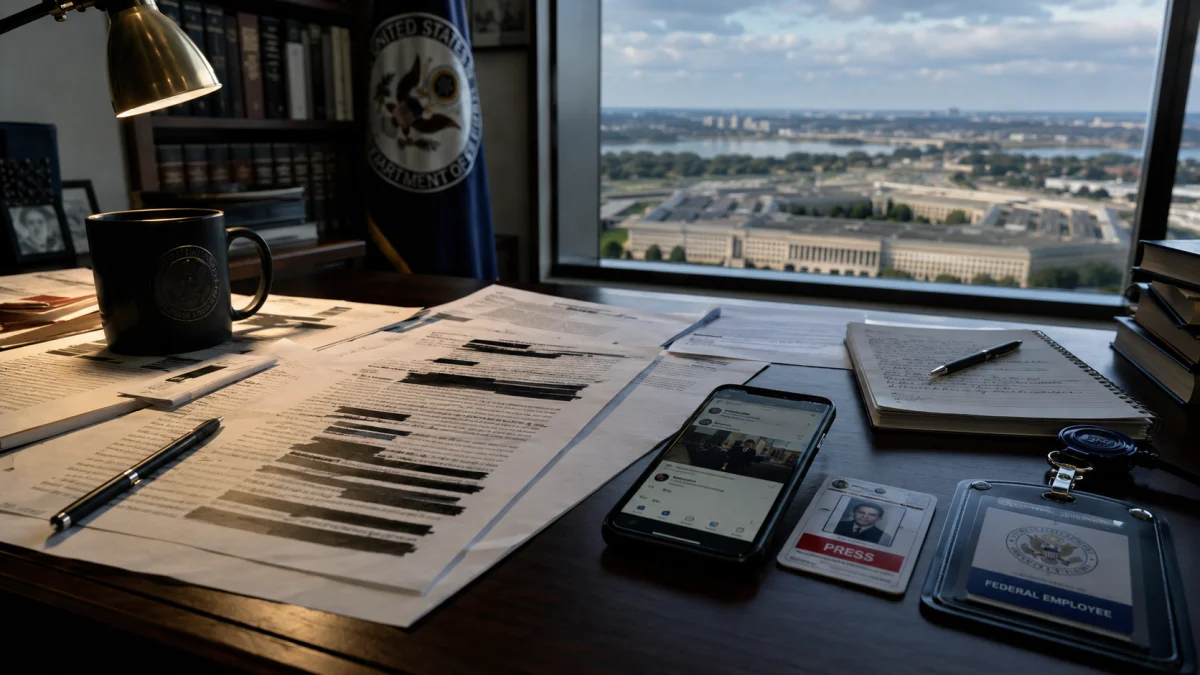
- Pentagon relationship: The Pentagon confirmed that Pounds became a Special Government Employee in July 2026.
- What remains unknown: The Pentagon has not publicly explained what duties she performs or which office employs her.
Jennica Pounds built the DataRepublican brand around a simple premise: hidden institutional relationships matter.
Who funds whom matters. Who employs whom matters. Who supplies the information matters. Who benefits when supposedly independent voices repeat the same narrative matters.
That standard has helped make Pounds one of the most influential political researchers on X. It is also the standard that now needs to be applied to her.
On August 21, 2026, Pounds publicly accused the “Deep State” of trying to entrap her into committing a crime after a government official handed her documents she believed she was expected to leak. She said she had entered the meeting in good faith, “ready to collaborate on Cuba,” only to discover troubling markings on the documents. She concluded that someone inside the government was trying to set her up.
The supposed Deep State operative quickly revealed herself.
She was Sarah B. Rogers, Donald Trump’s Senate-confirmed Under Secretary of State for Public Diplomacy—one of the senior officials responsible for the State Department’s communications and influence apparatus. Rogers said the documents were hers, rejected the idea that Pounds had been trapped, and released the records herself.
Then the story took a much more consequential turn.
The Pentagon confirmed that Pounds herself had been working for the federal government since July as a Special Government Employee.
Her roughly one million followers had not been told.
The Pentagon will confirm that Pounds works there. What it apparently will not tell the public is what she does there, which office employs her, whether her government duties intersect with her online research, or whether any of the information appearing on DataRepublican since July came from, was requested by, or was coordinated with the government. Reporter Will Sommer says the Pentagon confirmed Pounds’s employment to him and other journalists but refused to identify her job or departmental office.
That does not prove DataRepublican is a Pentagon propaganda operation.
It creates the question.
And until the Pentagon answers it, that question is entirely legitimate.
What actually happened in the “Deep State” incident
Pounds’s original account was dramatic.
“It’s not okay when the Deep State sets you up to commit a crime,” she wrote.
According to Pounds, she entered a meeting prepared to “collaborate on Cuba,” was handed hard-copy government documents to “leak,” later noticed markings that alarmed her, consulted other people, and concluded that a legitimate authorized disclosure would simply have been sent electronically. Therefore, she reasoned, someone had intentionally placed incriminating material in her hands.
There is currently little public evidence supporting that conclusion.
Rogers responded that she was the official involved and that the records were hers to disclose. She said the documents contained FOIA redactions and then published them herself.
There was one wrinkle worth preserving rather than smoothing over for the State Department: Rogers’s own thread shows that at least one screenshot had previously been supplied in another context with a “not for public release” notation. Rogers said that restriction applied to the previous disclosure and that she had discretion to release the material now.
So Pounds did not hallucinate the existence of a marking.
What the available evidence does not show is that the documents were classified, that Pounds was prohibited from possessing them, or that Rogers was attempting to manufacture a criminal case against her.
And Rogers voluntarily publishing the supposedly incriminating material under her own name is fairly devastating evidence against the theory that her objective was secretly to prosecute Pounds for publishing it.
The “Deep State entrapment” allegation therefore looks unsupported on the public record currently available.
But that should not turn Rogers into the hero of the story.
Because her response confirmed something else.
The State Department really was feeding material to an influencer
Strip away the accusations and the spectacle.
A senior State Department communications official had internal government records.
Pounds, a politically sympathetic influencer with an enormous following, came into contact with that official in connection with what Pounds described as collaboration involving Cuba. A conservative publication supportive of the Trump administration reported that she had attended an influencer outreach event on Cuba. Rogers provided Pounds with records that appeared intended to become a story or exclusive.
Those records were not principally a Cuba dossier. The documents Rogers subsequently released concerned the former State Department Global Engagement Center and allegations that it had crossed the line from countering foreign influence into monitoring or facilitating action against domestic political speech. Those allegations deserve their own evidentiary examination; Rogers is an interested party advancing the administration’s interpretation of the records, not a neutral auditor.
But the mechanics of the handoff matter independently of whether Rogers’s interpretation of the old GEC documents is correct.
The government had information it wanted publicized. Rather than simply publishing it, a senior official appears to have tried first to place it through a politically friendly outside voice.
That is not inherently illegal.
Government officials give exclusives, background briefings and selective disclosures to journalists constantly. Sometimes that is legitimate newsgathering. Sometimes it is strategic communication. Usually it is some combination of both.
But nobody should pretend the choice of messenger is meaningless.
When an administration gives a preferred intermediary information before everyone else, it gains some ability to influence how that information first enters public consciousness: which documents lead, which facts receive emphasis, which headline gets written and, importantly, whether the information initially appears to be an independent discovery rather than something the government wanted released.
And here the supposedly outside intermediary had another relationship the audience didn’t know about.
She already worked for the Pentagon.
Yes, DataRepublican really is a Pentagon employee
This part is no longer disputed.
After the controversy erupted, Associated Press Pentagon reporter Konstantin Toropin reported the Pentagon’s confirmation that Pounds serves as a Special Government Employee. CBS national-security producer Jim LaPorta obtained a more detailed Pentagon statement saying her Pentagon press credential expired in June, she did not seek renewal, and she began working for the department in July 2026. Pounds subsequently confirmed the same timeline herself.
That timeline also resolves one allegation we should not make.
There is presently no evidence that Pounds simultaneously held a Pentagon press credential and a Pentagon government job.
Her credential expired in June.
Her government employment began in July.
That distinction matters.
But it does not resolve the transparency problem.
Pounds continued operating one of the country’s largest political-research accounts after becoming a federal employee. The Pentagon employment was not disclosed to that audience when she took the position. After the relationship became public, Pounds said she joined the government “to serve the country in a more hands-on way” and then directed further questions to the Pentagon press office.
Even Glenn Greenwald—hardly an establishment-media defender—immediately identified the obvious problem: if someone works for the U.S. government while publicly commenting on administration policy, readers need that information to evaluate whether they are listening to an independent analyst.
Pounds had actually hinted much earlier that government employment might be in her future. In March 2025, she told the Deseret News that she believed “working within the system” could be the right path and said she was awaiting a federal background check. That is relevant context and deserves to be included.
But announcing an aspiration to work somewhere is not the same as telling your audience when you actually start working there.
And the public-facing image remained strikingly independent.
As of August 27, Pounds’s publisher still markets her upcoming book by describing her as a software engineer, data analyst and Utah small-business owner whose citizen-driven research allows ordinary Americans to hold government institutions accountable. The biography does not mention Pentagon employment. That may simply be an author biography that has not yet been updated, but it is nevertheless what a reader encountering her work today sees.
Meanwhile, the Oversight Project currently lists DataRepublican as one of its Visiting Fellows, a relationship the organization publicly announced in February.
None of these affiliations is automatically improper.
The problem is that the public needs to know which hat an influential source is wearing.
“Special Government Employee” does not mean fake government employee
There has been an effort in some online defenses of Pounds to make the title sound almost honorary.
It is not.
“Special Government Employee” is a real category of federal officer or employee created for people performing temporary government duties, generally expected to work no more than 130 days during a 365-day period.
Federal law expressly says an SGE may serve with or without compensation.
That last point is important because some critics are currently describing Pounds as a “paid Pentagon propagandist.”
We could not verify that.
The fact that she is a Pentagon SGE does not establish that she receives a federal salary. The law allows both paid and unpaid SGEs, and we found no reliable public disclosure establishing Pounds’s compensation.
It does establish something more basic:
Jennica Pounds is not merely an influencer who happens to know people at the Pentagon. She is a federal employee performing duties for the Pentagon.
What those duties are remains undisclosed.
And that is where this stops being Twitter drama and becomes a legitimate public-interest question.
The Pentagon could answer the most important question. So far, it hasn’t.
The Pentagon has been willing to tell reporters that Pounds works there.
According to Sommer’s reporting, it has refused to explain what job she performs or which office employs her.
That information is essential to evaluating almost everything else.
If Pounds was hired to perform an unrelated technical project, cybersecurity task, accessibility consultation or internal data-analysis assignment with no connection to public communications, political research or DataRepublican, that would substantially reduce the propaganda concern.
If she was hired to perform communications work, influence analysis, information operations, research on political networks, opposition research, media strategy, narrative analysis or anything that overlaps with the subjects she publishes to her audience, that would substantially increase it.
We currently do not know.
That uncertainty is not evidence of wrongdoing.
But neither is it a reason for journalists to shrug and move on.
Opacity is the story when the missing information is the information needed to determine whether a conflict exists.
DataRepublican’s own standard makes the disclosure problem difficult to dismiss
There is another reason this matters specifically in Pounds’s case.
Her entire analytical model treats undisclosed relationships as evidence worth examining.
In March, for example, Pounds attacked Punchbowl News by tracing its corporate sponsorships and questioning whether its financial relationships helped explain its political coverage. She explicitly examined the relationship among access, money, journalism and influence.
Her forthcoming book, Unelected, is marketed around an even broader thesis: powerful networks hide their relationships behind government departments, nonprofits, NGOs and foundations, and citizens need to map those connections to understand how power actually moves.
That premise is not suddenly invalid because the undisclosed institutional relationship belongs to her.
If a journalist’s corporate sponsorship matters, federal employment matters.
If an NGO’s government grant matters, federal employment matters.
If knowing who supplied a supposedly organic narrative matters, federal employment matters.
The standard cannot be “follow the network until the network reaches someone I like.”
Does this mean DataRepublican is Pentagon propaganda?
Not based on the evidence currently available.
That conclusion would require a connection we have not established.
Federal precedent provides an unusually useful way to understand the distinction.
In 2005, the Government Accountability Office found that the Department of Education engaged in prohibited covert propaganda after the government arranged for commentator Armstrong Williams to promote the No Child Left Behind law without ensuring that audiences knew the government was sponsoring his commentary.
The concealment mattered.
But GAO has also examined cases in which people working with the government independently made public statements favorable to government policy and found no propaganda violation because the government had not hired them to make those statements.
When HHS consultant Maggie Gallagher independently published articles supporting a Bush administration marriage initiative, GAO distinguished her case from Williams because the government had not contracted with her to write those favorable articles.
The Pentagon itself has been through a similar controversy.
Defense officials cultivated retired military officers who appeared as television analysts, gave them talking points, access and briefings, and clearly hoped favorable messages would reach the public. GAO nevertheless found insufficient evidence of prohibited covert propaganda because it did not find that the Pentagon had contracted with or paid those analysts for positive commentary.
That precedent gives us a much better question than “Is she a fed?”
We know she is.
The question is:
Did her federal job have anything to do with the supposedly independent information she was publishing?
If the answer is no, there may be a serious disclosure failure without a covert-propaganda operation.
If the answer is yes—if government officials were commissioning, directing, supplying or materially shaping ostensibly independent DataRepublican content without disclosure—then the issue becomes much more serious.
GAO has repeatedly said the critical element in covert propaganda is concealment of the government’s role in creating or sponsoring material presented to the target audience as independent.
We cannot determine whether that standard is implicated here because the Pentagon will not say what Pounds was hired to do.
No, “Smith-Mundt violation” is not the shortcut some people think it is
Several viral posts have already declared this an obvious violation of the Smith-Mundt Act.
That is too simple.
Federal law does contain restrictions on State Department funds being used through specified public-diplomacy programs to influence domestic U.S. public opinion. But the statute also expressly permits the State Department to provide information about its programs and policies to the media and public. And the provision applies to the State Department and U.S. international broadcasting—not as a blanket prohibition on everything the Pentagon communicates to Americans.
So the fact that a government employee has a large X account does not by itself prove an illegal domestic influence operation.
The more relevant legal and ethical question is whether taxpayer resources or official authority were used to create or sponsor communications whose government origin was concealed.
Again, that takes us directly back to the duties the Pentagon won’t describe.
The wider government-influencer machinery is not hypothetical
There is another reason not to dismiss these questions as conspiratorial.
The current administration openly uses influencers as instruments of public diplomacy abroad.
In March 2026, Reuters reviewed a worldwide directive from Secretary of State Marco Rubio instructing American diplomats to use X to counter what the administration calls foreign anti-American propaganda. The directive specifically told diplomats to coordinate, where appropriate, with the Pentagon’s Psychological Operations apparatus.
The Guardian’s reporting on the directive found that embassies were also instructed to cultivate local influencers and other influential voices capable of carrying pro-American messages into foreign information environments.
The State Department’s own manual is even more explicit about what public diplomacy is supposed to do: identify established and emerging influencers, engage them and develop strategies intended to persuade foreign audiences in support of U.S. policy objectives.
Rogers herself described her job in January as managing the relationship between the American government and foreign publics. She also said she oversees the State Department’s Global Public Affairs Press Office and is directly or indirectly involved when State communicates through social media.
None of this proves DataRepublican was recruited into a psychological operation.
The Rubio program described in the reporting is explicitly foreign-facing, and we found no evidence connecting Pounds to it.
But it establishes an important piece of context:
Government agencies deliberately identifying influencers, cultivating them, supplying messaging and using their reach to influence information environments is not a paranoid theory. It is an acknowledged tool of modern statecraft.
That makes disclosure more important, not less.
The Pentagon was already replacing hostile scrutiny with friendlier “new media”
Pounds’s transition also occurred during an extraordinary transformation in Pentagon press access.
In October 2025, most major news organizations refused to accept a new Pentagon press policy restricting journalists’ ability to solicit information the department had not authorized for release. Reporters surrendered their credentials, while the Pentagon assembled a new press corps populated heavily by conservative outlets, smaller organizations and influencers willing to accept the rules.
In March 2026, a federal judge ruled key portions of that policy unconstitutional, finding that it threatened ordinary newsgathering and gave the Pentagon extraordinary discretion over who could remain credentialed. Reuters reported that only one of the 56 outlets in the Pentagon Press Association had agreed to the challenged policy before the press exodus.
Pounds entered that environment as a credentialed member of the Pentagon press corps.
Then her credential expired.
Then she became a Pentagon employee.
That progression deserves scrutiny even though the dates do not overlap.
Independent investigator → Pentagon journalist → Pentagon employee is not an insignificant change in relationship to the institution being investigated.
And it becomes considerably more significant when the audience isn’t told about the final transition.
The State Department handoff becomes stranger once you know all of this
Return now to August 21.
A hugely influential online researcher walks into what she describes as a meeting about collaborating on Cuba.
A senior State Department official responsible for public diplomacy and government communications supplies her internal material apparently intended for publication.
The influencer panics and concludes that the government is attempting to use her.
She calls it the Deep State.
And then the public discovers that she already works for another arm of that government.
The comedy practically writes itself.
But the institutional question is better than the joke.
Why did State view DataRepublican as an outside influencer appropriate for receiving an exclusive if she was already a Pentagon employee?
Did Rogers know Pounds worked for the Pentagon?
Did the Pentagon know Pounds was attending the State Department meeting?
In what capacity did Pounds attend: Pentagon employee, Oversight Project fellow, former journalist, private citizen or influencer?
Did she receive the documents because of her government position or because of her supposedly independent audience?
Was the material being provided to her because officials believed she would analyze it independently, or because they expected a politically useful presentation?
Did any Pentagon official know about, approve or facilitate the relationship?
And most importantly:
What exactly did the Pentagon hire DataRepublican to do?
None of the public material reviewed for this article answers those questions.
They are the questions the story now demands.
There is an important difference between influence and control
Governments do not need to secretly dictate every sentence an influencer writes in order to benefit from influencers.
Influence can operate much more simply.
Provide access.
Provide information.
Provide exclusives.
Reward cooperative voices with proximity to power.
Restrict access for hostile reporters.
Hire people from the friendly information ecosystem.
Allow audiences to assume those people remain entirely external to government.
No central script is required for the resulting information environment to become more favorable to the institution.
That does not mean every participant is knowingly carrying propaganda.
It means structural incentives can produce propaganda-like outcomes even without a literal government handler approving each post.
And that is why transparency is the minimum requirement.
The Pentagon spent the past year arguing for greater control over journalists seeking unauthorized information while building relationships with a new media ecosystem more sympathetic to the administration. A federal court found significant portions of those restrictions unconstitutional.
Against that background, discovering that a major political influencer moved from covering the Pentagon to quietly working for it deserves more than an explanation that she wanted to serve her country.
She is perfectly entitled to serve her country.
The public is entitled to know who she is serving while she is speaking to them.
What we can prove—and what we cannot
As of August 27, 2026, the evidence supports several firm conclusions.
The Pentagon confirms Jennica Pounds is a Special Government Employee who began working there in July.
Her Pentagon press credential expired before that employment began, so there is no established simultaneous reporter-employee overlap.
Her federal employment was not publicly disclosed when she began the job.
She continued operating DataRepublican while employed by the Pentagon.
The Pentagon has not publicly explained her duties or office, according to reporters who asked.
Sarah Rogers did provide Pounds with government records and then publicly released those records after Pounds accused her of attempting a setup.
Pounds’s allegation that Rogers was trying to entrap her into a crime is not supported by the evidence currently available.
The State Department and Pentagon already participate in formal programs abroad involving influencers, strategic messaging and, in some cases, coordination with military psychological-operations capabilities.
But there is no evidence presently available proving that Pounds’s Pentagon assignment is part of those programs, that the Pentagon pays her to operate DataRepublican, that officials dictate her posts, or that her account constitutes an illegal covert-propaganda operation.
Those last claims should not be printed as facts unless evidence emerges.
We do not need them.
The verified facts are troubling enough.
The real scandal is that nobody outside the government can currently draw the boundary
Pounds became famous by teaching people to ask who sits behind an institution, who funds it, who connects to whom and what invisible relationships might explain the information they are seeing.
That is a useful instinct when applied carefully.
So apply it here.
A political influencer investigated government.
The government credentialed her.
The government then employed her.
She kept influencing.
Another government agency supplied her with material for dissemination.
The audience did not know about the employment relationship.
And now that the relationship is public, the Pentagon will confirm that she works there but apparently will not explain what she actually does.
Perhaps the answer is completely innocuous.
Perhaps her Pentagon duties have nothing whatsoever to do with DataRepublican.
If so, the government can provide enough information to establish that.
Until it does, skepticism is not conspiracy theory.
It is exactly the kind of institutional scrutiny DataRepublican built her career demanding from everyone else.
You cannot build your authority exposing hidden government networks, quietly join one of the most powerful institutions in that government, and then expect your own undisclosed relationship to be treated as irrelevant.
And you certainly cannot spend years warning people that powerful institutions use ostensibly independent voices to shape public opinion, then act betrayed when another government agency apparently starts treating you like a useful channel for information.
The irony is funny.
The unanswered question is not:
Was DataRepublican exposing the machine—or had she quietly become part of it?
References and Further Reading
Primary records and first-person sources
DataRepublican’s August 21 “Deep State” accusation, preserved by Thread Reader — Pounds’s own account of the documents, Cuba meeting and alleged entrapment.
Sarah B. Rogers’s response and release of the State Department records — Rogers identifies herself as the official involved, disputes the trap allegation and publicly releases the material.
State Department biography of Under Secretary Sarah B. Rogers — Official biography and confirmation of Rogers’s position.
State Department Foreign Affairs Manual: Public Diplomacy at Posts Abroad — Primary description of U.S. public diplomacy, including identifying and engaging influencers to support foreign-policy objectives.
18 U.S.C. §202 definition of Special Government Employee — Federal definition establishing that an SGE is an actual temporary federal officer or employee and may serve with or without compensation.
Pentagon employment and press-access reporting
Mediaite report compiling the Pentagon confirmation and Pounds’s response — Includes confirmations from AP Pentagon reporter Konstantin Toropin and CBS national-security producer Jim LaPorta.
Will Sommer’s reporting on the Pentagon’s undisclosed role for Pounds — Reports that the Pentagon confirmed Pounds’s employment but declined to identify her job or office.
Reuters: Federal judge rules Pentagon press restrictions unconstitutional — Important context on the Pentagon’s effort to restrict traditional newsgathering and the resulting transformation of its press corps.
Associated Press: Major outlets reject Pentagon press restrictions — Documents the exodus of established Pentagon reporters under the department’s new media policy.
Government propaganda and disclosure standards
GAO: Department of Education contract with Armstrong Williams — Key federal precedent finding covert propaganda when government-sponsored favorable commentary was presented without disclosure.
GAO: Pentagon retired military officers as media analysts — Useful contrasting case showing why government outreach, talking points and access do not automatically establish unlawful covert propaganda without evidence tying payment or sponsorship to public commentary.
GAO: HHS contract with Maggie Gallagher — Another important contrast: government employment or contracting alone did not convert independently written favorable articles into government propaganda.
GAO: Standard for identifying covert government propaganda — Explains that concealment of the government’s role in creating or sponsoring material is central to the analysis.
State Department influence strategy
Reuters: Rubio directs diplomats to use X and coordinate with Pentagon psychological operations — Reporting on the March 2026 foreign-facing counter-propaganda directive.
The Guardian: U.S. embassies directed to engage local influencers in global information campaigns — Additional reporting on the administration’s use of influencers abroad.
Semafor interview with Sarah Rogers on public diplomacy and State Department communications — Rogers explains her office, foreign-public mission and oversight of State’s Global Public Affairs operation in her own words.
Pounds’s public affiliations and background
Deseret News profile of Jennica Pounds and DataRepublican — Detailed 2025 profile documenting her rise, DOGE connections and earlier statement that she was considering working inside government.
Oversight Project announcement naming DataRepublican a Visiting Fellow — Primary record of another publicly disclosed institutional affiliation.
Current Oversight Project staff directory — Lists DataRepublican as a Visiting Fellow.
Passage Publishing page for Jennica Pounds and Unelected — Current public-facing author biography emphasizing her independent data-research and government-accountability work.
Legal context on Smith-Mundt
22 U.S.C. §1461-1a: Domestic distribution and public-opinion restrictions — Shows both the limits on certain State Department influence activities and the statute’s explicit exceptions for providing government information to the media and public.
USAGM explanation of Smith-Mundt modernization — Useful for understanding why claims that Smith-Mundt simply makes all domestic government “propaganda” illegal are inaccurate.
Editorial currency note: This is a developing story. The most consequential unanswered fact is the nature of Jennica Pounds’s Pentagon assignment. Any subsequent Pentagon disclosure regarding her office, duties, compensation or interaction between her government work and DataRepublican should be incorporated into this article.