

Updated October 26, 2026
Israel is widely assessed to possess approximately 90 nuclear warheads, giving it the capability to threaten Iran with nuclear weapons. But whether Israel would ever use them is a fundamentally different question.
The short answer is that there is no verified evidence that Prime Minister Benjamin Netanyahu ordered a nuclear strike against Iran, that Israel’s military refused such an order, or that China threatened nuclear retaliation.
What has emerged is a potentially serious confrontation over military preparations that Israeli security officials reportedly feared could provoke another war with Iran.
That distinction matters because the danger does not necessarily begin with an order to launch a nuclear weapon. It can begin much earlier, when military preparations convince an adversary that an attack is imminent, prompting action that neither government initially intended.
An October 26 investigation by Israel’s Channel 12 provides a particularly important detail: according to three sources familiar with the discussions, the disputed instruction concerned preparations resembling those made before previous confrontations with Iran, not the attack itself.
The confrontation also has a striking historical precedent. In 2010, Netanyahu and then-Defense Minister Ehud Barak reportedly tried to place Israel’s military on heightened readiness for an Iran strike. Senior security officials resisted, warning that the preparations themselves could create a chain of events leading to war.
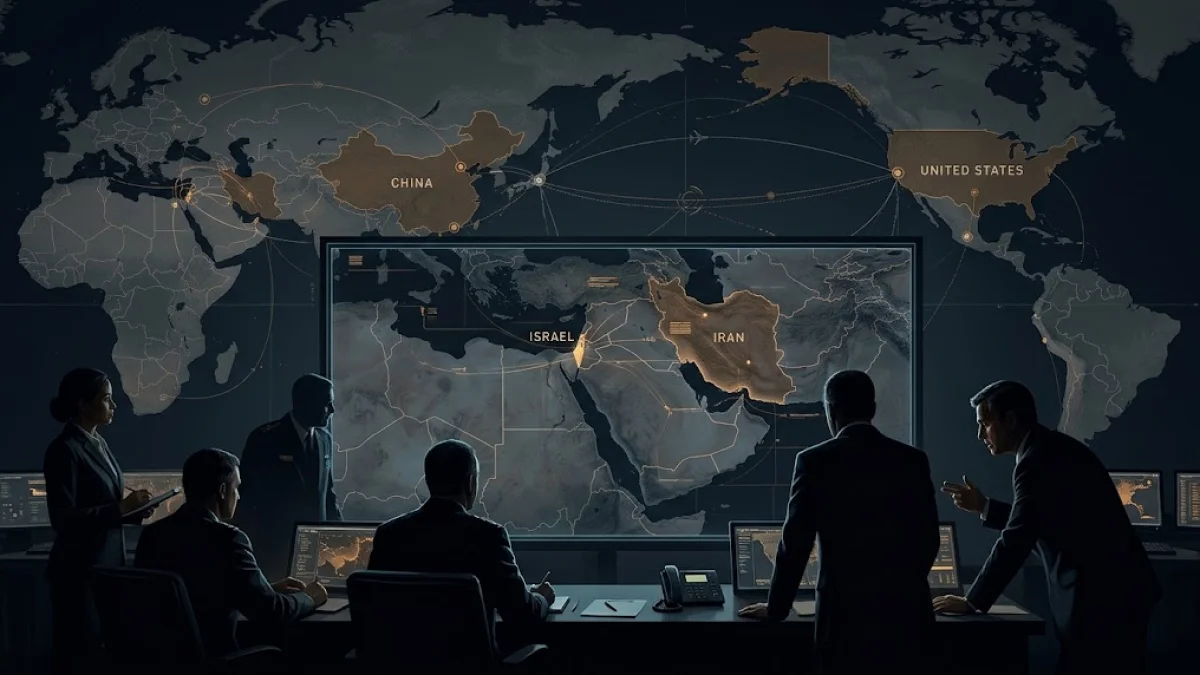
The larger question is therefore worth examining seriously: How close could a conventional confrontation bring Israel and Iran to a nuclear crisis, what could actually prevent nuclear use, and how would China respond if deterrence failed?
What Actually Happened Between Netanyahu and the IDF?
On October 25, 2026, Israeli broadcaster Channel 12 reported an unusual confrontation between Netanyahu and Israel Defense Forces Chief of Staff Lt. Gen. Eyal Zamir.
According to Channel 12’s original investigation, Zamir had received a directive from Israel’s political leadership concerning an operation that could trigger a rapid confrontation with Iran.
The military chief reportedly requested further deliberations and signed legal authorization before proceeding.
Sources familiar with the discussions described concerns that military action shortly before Israel’s October 27 election might serve political rather than operational purposes.
Netanyahu denied that a confrontation had occurred. Defense Minister Israel Katz also rejected suggestions that Israel intended to initiate an attack before the vote.
The IDF’s subsequent public statement emphasized that its operational decisions were based on professional and security considerations. It did not publicly disclose the disputed instruction.
The October 26 update changes the interpretation
The next day’s reporting supplied a critical distinction.
According to Channel 12, three sources said that the disagreement concerned unusual preparations comparable to those undertaken before earlier clashes with Iran. Zamir reportedly worried that initiating those preparations before the election could cause Tehran to miscalculate Israel’s intentions.
Channel 12 also reported that Mossad chief Roman Gofman, Defense Minister Katz and Shin Bet chief David Zini supported proceeding, while the positions of other senior officers were disputed.
These accounts remain reporting based on unnamed sources, not independently authenticated operational records.
Nevertheless, they substantially weaken the interpretation that the confrontation concerned an actual nuclear launch order.
A military preparation, a conventional strike, and a nuclear attack are three different decisions. Evidence of one does not establish the others.
A separate October 26 report summarized by The Times of Israel said the United States had asked Israel to delay potential strikes until Washington was prepared for coordinated operations. Netanyahu’s office rejected that reporting as false.
The strongest current explanation is therefore a dispute over escalation, timing, authorization and military readiness.
The specific possibility of nuclear use requires a separate strategic assessment.
Does Israel Actually Have Nuclear Weapons?
Yes, according to the overwhelming consensus of independent nuclear-weapons researchers, although Israel has never formally acknowledged possessing an arsenal.
The Federation of American Scientists’ 2026 nuclear inventory estimates that Israel possesses approximately 90 nuclear warheads.
The Stockholm International Peace Research Institute likewise includes Israel among the world’s nine nuclear-armed states.
Israel maintains a policy commonly known as nuclear ambiguity or nuclear opacity. It neither officially confirms nor denies possessing nuclear weapons.
This creates an unusual strategic arrangement. Israel benefits from adversaries believing it possesses a devastating retaliatory capability while avoiding the transparency normally associated with declared nuclear powers.
Because Israel does not publish an authoritative nuclear inventory or operational doctrine, important details remain unconfirmed.
Independent analyses identify possible aircraft-delivered and ballistic-missile nuclear capabilities, while sea-based options are also discussed. The exact operational status, readiness and deployment arrangements are not publicly established.
The UK House of Commons Library’s Israeli nuclear profile provides a useful assessment of these capabilities and their uncertainties.
Does Iran have nuclear weapons?
There is no publicly verified evidence that Iran possesses an assembled, operational nuclear weapon.
However, that does not mean the status of its nuclear program is fully understood.
According to the Congressional Research Service’s October 13, 2026 assessment, the effects of U.S. and Israeli strikes on Iran’s nuclear infrastructure remain uncertain, and international inspectors have been unable to verify important aspects of Iran’s nuclear activities and enriched-uranium stockpile.
Iran had previously accumulated uranium enriched to 60%, well above civilian power-reactor requirements, although possessing enriched uranium is not equivalent to possessing a functioning nuclear weapon.
This distinction is essential.
Israel is widely assessed to possess an existing nuclear arsenal. Iran has demonstrated substantial nuclear technical capability, but its weaponization status and current nuclear-material inventory remain uncertain.
The two countries do not occupy the same publicly established nuclear position.
Could Netanyahu Personally Order a Nuclear Strike?
Israel’s publicly documented constitutional framework does not give its prime minister unrestricted authority to start a war independently.
Under Basic Law: The Military, the armed forces are subject to the authority of the government. The defense minister supervises the military on the government’s behalf, and the chief of staff is subordinate to that civilian authority.
Section 40 of Basic Law: The Government establishes that starting a war, or initiating significant military action almost certain to lead to war, requires a government decision.
The government may delegate that authority to the designated security cabinet under specified conditions.
The law also preserves the ability to conduct other military actions necessary for national defense and public security.
A provision briefly adopted in 2018 that allowed extraordinary unilateral war decisions by the prime minister and defense minister was repealed later that year, as documented by the Knesset’s July 17, 2018 announcement.
But this legal framework does not answer every question about nuclear use.
Nuclear authorization is not the same as ordinary military authorization
A nuclear strike would have consequences far beyond those of an ordinary operation. It could provoke a major regional war, threaten civilian populations across borders and permanently alter Israel’s international relationships.
Yet the precise Israeli nuclear-release procedure remains classified or otherwise unavailable in authoritative public records.
That means we cannot responsibly identify the full chain of required nuclear authorizations, how approvals are authenticated, or which officials must participate.
There are three separate issues:
- Political authority: Who has the legal authority to approve the military action?
- Military execution: Who is responsible for implementing an authorized decision?
- Nuclear command and control: What classified procedures govern the release and use of nuclear weapons?
The first is partly addressed by Israeli law. The second follows the military command structure. The third cannot be reconstructed reliably from public information.
A prime minister’s political influence should not be confused with an unlimited personal ability to launch nuclear weapons.
Equally, a military chief’s objections should not be confused with an independent power to veto every decision of an elected government.
Could the IDF Refuse a Nuclear Order?
Potentially, but the reason for refusal would matter enormously.
A commander may object because an operation lacks adequate legal authorization, because it is operationally unsound, or because carrying it out would be unlawful.
These are not interchangeable objections.
A commander who demands clarification of an order’s legal basis is not necessarily refusing civilian authority. The commander may instead be requiring civilian leaders to exercise that authority formally and accept responsibility for the decision.
A commander who believes an operation is strategically disastrous may advise against it. That professional disagreement does not automatically create a legal veto.
Conversely, civilian authorization does not make every possible military act lawful.
Israeli military law recognizes the duty not to obey manifestly unlawful orders, a principle historically associated with the Kafr Qasim cases. International humanitarian law also imposes obligations that do not disappear because a senior political leader has approved an operation.
Whether a specific proposed nuclear attack would be unlawful would depend on its circumstances and applicable international law.
The crucial point is that the military’s role is neither unconditional obedience nor independent control over national policy.
This distinction becomes even more significant during an escalating conflict.
Military commanders may be among the few people capable of explaining to political leaders why an apparently limited preparatory measure could produce consequences that are neither limited nor reversible.
Israel has encountered precisely this problem before.
The 2010 Precedent: Netanyahu, Iran, and Generals Who Pushed Back
The October 2026 controversy has a remarkable parallel in Israeli military history.
In November 2012, Israeli investigative television program Uvda, hosted by Ilana Dayan, revealed details of a confrontation that occurred in 2010.
According to the original Uvda investigation, Netanyahu and then-Defense Minister Ehud Barak directed senior military and intelligence officials to raise the armed forces to a heightened readiness status known as P-Plus.
The preparations were connected to a possible attack on Iranian nuclear facilities.
Two senior officials objected:
- IDF Chief of Staff Gabi Ashkenazi.
- Mossad Director Meir Dagan.
Their objections centered on whether the instruction was lawful, whether the military was ready and whether the very act of preparing could make war more likely.
Dagan reportedly argued that the prime minister and defense minister were attempting to circumvent the proper political decision-making process.
Ashkenazi warned that preparations could create facts on the ground that would be difficult to reverse.
Barak disputed important elements of their accounts, arguing that preparations did not necessarily mean war and that military leaders were obligated to develop operational capabilities even when they opposed a proposed operation.
The disagreement did not result in the reported attack.
Why the historical comparison matters
The 2010 episode establishes something important: a confrontation between Netanyahu and senior security officials over preparations for an Iran strike is not unprecedented.
More importantly, the central strategic dispute was not necessarily whether to attack immediately.
It was whether moving military forces into a heightened state of readiness might begin an escalation process before the necessary political decision had been made.
The October 26, 2026 Channel 12 follow-up describes a similar concern.
That resemblance does not prove Netanyahu intended to initiate an unauthorized war in either case. Nor does it prove that the current preparations were identical to those in 2010.
But it supports a serious strategic inference:
Military preparations can become part of the escalation mechanism, rather than merely a precaution taken before a separate decision to fight.
This is a far more meaningful explanation for a command-level dispute than assuming that the military rejected a nuclear launch order.
Could Israel Actually Use Nuclear Weapons Against Iran?
As a matter of assessed capability, Israel possesses nuclear weapons and delivery options that could threaten Iran.
The more difficult question is under what circumstances Israeli leaders might consider using them.
Israel does not publish a comprehensive doctrine identifying the exact conditions for nuclear first use.
Consequently, claims that Israel would only use nuclear weapons in one specific scenario should be treated as interpretations, not verified official rules.
Historical research suggests that Israeli nuclear thinking has been closely associated with preventing national destruction and preserving a final deterrent against catastrophic military defeat.
This has sometimes been described through the concept of the Samson Option, an expression associated with the possibility of devastating retaliation in an existential crisis.
But the term should not be mistaken for a publicly authenticated operational doctrine.
The distinction between possessing a nuclear deterrent and being willing to use it is central to nuclear strategy.
Why a nuclear first strike would be strategically difficult to justify
Consider the likely consequences of Israel using nuclear weapons in an attempt to destroy Iranian military or nuclear infrastructure.
Such an attack would not simply be a more powerful version of a conventional airstrike.
It would cross the nuclear threshold, with consequences extending well beyond the immediate target.
Those consequences could include:
- Catastrophic civilian casualties, radioactive contamination and long-term environmental damage.
- Large-scale Iranian retaliation with surviving conventional forces.
- Severe diplomatic and economic consequences for Israel.
- A crisis in the United States’ relationship with Israel.
- Pressure on other states to develop nuclear deterrents.
- Increased risks of further nuclear escalation, including misinterpretation by other nuclear-armed governments.
A nuclear attack also would not guarantee the elimination of Iran’s nuclear capabilities. Iran’s infrastructure, technical expertise, materials and industrial capacity cannot be assumed to disappear because a particular facility is destroyed.
A strike intended to remove a future security threat could instead provide powerful incentives for surviving Iranian leadership to pursue nuclear weapons.
That is the central strategic contradiction.
A nuclear first strike intended to make Israel safer could produce a less predictable and more dangerous security environment.
There is another important consideration: Israel possesses extensive conventional military capabilities and has already demonstrated the ability to conduct major operations against Iran.
The existence of conventional alternatives weakens the military case for nuclear first use in a situation that does not threaten Israel’s survival.
None of this makes nuclear use impossible. Political leaders can miscalculate, and states under extreme pressure may accept costs they would ordinarily reject.
But available evidence does not support treating nuclear use as the expected next step in an ordinary dispute over the timing of a conventional operation.
The humanitarian and legal barriers
The International Court of Justice’s 1996 advisory opinion concluded that nuclear-weapons use would generally be contrary to the rules of international humanitarian law. The court did not reach a definitive conclusion for the exceptional situation of self-defense when a state’s very survival was at stake.
That narrow unresolved question is not a general legal authorization to use nuclear weapons.
The International Committee of the Red Cross emphasizes the extraordinary difficulty of using nuclear weapons consistently with the legal requirements of distinction, proportionality and protection of civilians.
The use of a nuclear weapon against a populated area would be especially difficult to reconcile with those obligations.
Whatever a government claims about military necessity, nuclear weapons do not create an exemption from the laws of war.
Would China Retaliate if Israel Used Nuclear Weapons Against Iran?
China would almost certainly regard an Israeli nuclear strike on Iran as a major international crisis.
However, there is no verified Chinese commitment to launch a nuclear or conventional military attack against Israel in response.
This is not a minor distinction.
A warning against military escalation is not equivalent to a guarantee of armed intervention. Condemning nuclear weapons is not the same as threatening nuclear retaliation.
China has repeatedly condemned attacks on Iran and called for respect for Iranian sovereignty.
In a February 28, 2026 Foreign Ministry statement, Beijing called for an end to U.S. and Israeli military operations and a return to negotiations.
In a September 22 statement to the International Atomic Energy Agency, China condemned attacks against nuclear facilities under safeguards and warned of nuclear-safety dangers.
Those statements concern military attacks and nuclear facilities. They do not announce an automatic Chinese military response to an Israeli nuclear detonation.
China has a strategic partnership with Iran, not a mutual-defense guarantee
China and Iran maintain substantial economic and political relations.
China is a major purchaser of Iranian oil, while Iran is a partner in China’s efforts to expand economic and diplomatic influence outside U.S.-dominated institutions.
The countries signed a long-term comprehensive strategic partnership in 2021.
But a strategic partnership is not necessarily a mutual-defense alliance.
A March 2026 U.S.-China Economic and Security Review Commission assessment specifically noted that Beijing had avoided formal defense commitments to Tehran.
China’s actual response to earlier U.S. and Israeli strikes was principally diplomatic, although economic relationships and concerns about dual-use technology transfers remained significant.
That historical behavior is evidence of Beijing’s preference for calibrated involvement. It is not proof that China would behave identically after the unprecedented use of a nuclear weapon.
A nuclear attack would create a much more serious decision for Beijing.
China’s no-first-use nuclear policy matters
China’s official nuclear doctrine includes a commitment not to be the first state to use nuclear weapons.
Its November 2025 arms-control white paper and April 2026 NPT implementation report reaffirm that position.
Under China’s declared policy, an Israeli nuclear attack on Iran would not automatically authorize China to initiate its own nuclear strike.
China could revise its posture under extraordinary circumstances, and declarations are not infallible guarantees of future behavior.
Nevertheless, a Chinese nuclear attack on Israel in response to an attack on Iran would represent a major departure from Beijing’s published doctrine.
It would also risk confrontation with the United States, potentially transforming a regional conflict into a direct crisis among nuclear powers.
The costs of such an escalation would be immense.
What could a Chinese response realistically look like?
The following scenarios are analytical judgments based on declared policy, strategic incentives and prior behavior. They are not forecasts based on undisclosed Chinese military plans.
| Possible Chinese response | Strategic assessment |
|---|---|
| Diplomatic condemnation and emergency UN action | Highly plausible and consistent with established behavior |
| Economic restrictions or sanctions-related measures | Plausible, depending on China’s political and commercial interests |
| Expanded political, economic or material support for Iran | Plausible, but the extent and military significance would depend on circumstances |
| Direct conventional military action against Israel | Possible in an extreme crisis, but not supported as an automatic or expected response |
| Chinese nuclear retaliation against Israel | Inconsistent with China’s declared no-first-use policy and unsupported by any verified commitment |
China would have powerful reasons to oppose a nuclear attack on Iran.
Beijing has invested in the principle that nuclear weapons should not become ordinary tools of coercion. It has economic interests in regional stability and would face pressure to respond to an event that fundamentally damaged the international nuclear order.
At the same time, China has reasons to avoid direct war with the United States and its partners.
Its nuclear arsenal is primarily intended to protect China’s own strategic security, not provide an openly declared nuclear umbrella over Iran.
The most defensible conclusion is that China would be likely to respond forcefully in diplomatic and political terms, while direct military retaliation would depend on additional decisions and circumstances that cannot currently be predicted.
Could China Stop Israel Before a Nuclear Strike?
Not through any publicly established legal veto or formal control over Israel’s military.
China could attempt deterrence through diplomatic warnings, international coordination, economic pressure and demonstrations of political resolve.
But effective deterrence depends on more than the existence of a warning.
A threat must be communicated, understood and considered credible by the decision-makers it is intended to influence.
An ambiguous statement that a country will respond is strategically different from a specific commitment identifying what action would trigger which consequences.
There is no publicly authenticated Chinese declaration establishing such a nuclear-response threshold for Israel.
That does not rule out private diplomatic communications. Those are inherently harder to verify.
But a claim about a secret Chinese ultimatum requires evidence. It cannot be inferred merely from China’s relationship with Iran or opposition to Israeli military operations.
The United States has more immediate leverage
Israel’s relationship with Washington creates a different set of constraints.
The United States provides Israel with major military assistance, intelligence cooperation, weapons systems and diplomatic support.
It also has direct interests at stake if Israeli actions produce a wider war with Iran.
According to reporting summarized on October 26, American officials had reportedly urged Israel to delay possible military operations until Washington was ready for coordinated action. Netanyahu’s office denied the account.
The important distinction is that American influence does not amount to a universal legal veto over Israeli military decisions.
Israel can make sovereign decisions, including decisions Washington opposes.
But military dependence and strategic cooperation can create practical limits on the range, timing and sustainability of operations.
In the current situation, that relationship is a more direct potential constraint on escalation than an unverified Chinese retaliation threat.
The Nuclear Risk That Washington Was Already Asking About
Concerns over Israel’s nuclear decision-making are not confined to internet speculation.
On May 4, 2026, a group of 30 members of the U.S. House of Representatives led by Joaquin Castro sent Secretary of State Marco Rubio a detailed letter requesting information about Israel’s nuclear arsenal and the risks of nuclear escalation during the Iran conflict.
The seven-page congressional letter asked several unusually direct questions.
Among them:
- Had Israel communicated nuclear-use doctrines, thresholds or red lines to U.S. officials?
- Had Washington received assurances that Israel would not use nuclear weapons?
- Had U.S. officials seen indications of Israeli preparations for nuclear deployment or use?
- What circumstances might cause Israel to consider nuclear weapons?
- What contingency planning had the administration conducted?
These questions are strategically significant.
They show that lawmakers were not merely asking whether Israel possessed nuclear weapons. They were asking whether the United States understood when Israel might use them, and what safeguards or assurances existed.
In a June 3 congressional hearing, Rubio acknowledged that most of the world assessed Israel possessed nuclear weapons, while maintaining the U.S. government’s longstanding reluctance to discuss the issue publicly. He suggested that more detailed discussion was appropriate in a classified setting.
The exchange did not establish a nuclear-use order.
Nor do the lawmakers’ questions prove that such an order was contemplated.
Their importance lies elsewhere: they reveal a serious oversight concern about the public’s inability to evaluate nuclear escalation risks involving a close U.S. military partner.
The uncertainty is real, even when particular viral allegations are unsupported.
The Most Dangerous Scenario May Begin Without a Nuclear Order
The central strategic danger in the current confrontation is miscalculation.
Military crises often involve adversaries acting under uncertainty about one another’s intentions.
A government may believe it is taking precautionary measures. Its opponent may interpret those same measures as preparations for an imminent attack.
The resulting response can reinforce the original government’s belief that its adversary was preparing aggression.
This is a classic security dilemma.
In the Israel-Iran context, the problem is amplified by repeated military confrontations, deep mutual distrust, the possibility of renewed U.S. involvement and uncertainty about nuclear intentions.
A simplified escalation sequence illustrates the danger:
- Israel undertakes military preparations it considers necessary for deterrence or a possible future operation.
- Iran interprets those preparations as a warning that an attack is imminent.
- Iran increases military readiness or takes action intended to prevent an Israeli attack.
- Israel interprets the Iranian response as confirmation of hostile intent.
- Military action begins or expands, creating further opportunities for miscalculation.
None of these steps requires an initial nuclear launch order.
Yet a prolonged conflict could eventually create circumstances in which nuclear threats enter political calculations.
What would make nuclear escalation more plausible?
The most consequential question is whether Israeli leaders begin to perceive a threat to the state’s survival rather than a serious but manageable military confrontation.
There is a substantial difference between losing military assets, suffering a conventional attack, and facing what leaders believe to be a catastrophic threat to national survival.
Analytically, nuclear danger would become more concerning if several conditions developed together:
- Israeli leaders assessed that conventional defense was failing against an overwhelming threat.
- A major attack threatened essential national command structures or produced catastrophic damage.
- Leaders feared that delaying a decision would eliminate their remaining deterrent options.
- Diplomatic channels and conventional methods of de-escalation had failed.
- Credible reporting indicated changes to nuclear readiness or explicit nuclear threats.
This is not a claim that Israel has formally adopted these conditions as nuclear-use thresholds.
It is an assessment of circumstances that could increase pressure on a nuclear-armed government during an extreme crisis.
Military analysts must distinguish an observable indicator of increased risk from evidence that a decision to use nuclear weapons has been made.
That distinction prevents legitimate concern about escalation from turning into unfounded certainty about an imminent strike.
Strategic Risk Assessment: Four Scenarios
Rather than assign unsupported numerical probabilities to classified decisions, the following matrix compares four broad developments.
| Scenario | Nuclear implications | Broader escalation risk |
|---|---|---|
| Military preparations without a strike | No evidence of nuclear intent from preparations alone | Misinterpretation and heightened readiness |
| Renewed conventional Israeli-Iranian strikes | Nuclear use is not an automatic consequence | Missile retaliation, regional infrastructure attacks and possible wider U.S. involvement |
| Severe military crisis perceived as existential by Israeli leaders | Nuclear considerations become more strategically relevant | Extremely dangerous decision-making under pressure |
| Actual Israeli nuclear use | The nuclear threshold has been crossed | Catastrophic human consequences and unpredictable regional and global responses |
The scenarios describe different levels and types of danger, not a forecast that events will progress from one row to the next.
The strongest immediate concern supported by the October 2026 reporting is the possibility that military preparations could trigger a confrontation neither side fully controls.
The most catastrophic possibility is that a subsequent crisis changes the political leadership’s assessment of what is necessary for survival.
A credible analysis must examine both without pretending that one proves the other.
What Evidence Would Establish That Netanyahu Ordered Nuclear Use?
An allegation this consequential requires evidence capable of distinguishing a nuclear-use decision from an ordinary military directive.
Relevant evidence could include:
- An authenticated decision or authorization specifically concerning nuclear weapons.
- Reliable, independently corroborated testimony from officials with direct knowledge of the nuclear decision-making process.
- Official acknowledgment by the Israeli government or military.
- Declassified records establishing the nature and timing of an instruction.
- Multiple credible investigations that independently substantiate the same specific allegation.
Anonymous reporting can be important, particularly in national-security investigations. But the strength of an anonymous-source report depends on what the sources actually establish.
The currently available Channel 12 reporting concerns military preparations and the possibility of escalation with Iran.
It does not identify a nuclear weapon, a nuclear target, an authenticated nuclear order or a refusal by the personnel responsible for executing nuclear operations.
Nor does the available Chinese official record contain a verified promise of nuclear retaliation against Israel.
It would therefore be inaccurate to present an Israeli nuclear strike order, an IDF nuclear refusal or a Chinese nuclear ultimatum as established events.
That conclusion is not a judgment that Israel’s nuclear arsenal is harmless or that a regional nuclear crisis is impossible.
It is simply the distinction between a substantiated strategic risk and an allegation lacking the evidence necessary to establish it.
What the Netanyahu-IDF Confrontation Really Reveals
The unusual significance of the October 2026 reports is not that a nuclear war has been prevented. There is no verified evidence that nuclear use was the subject of the disputed instruction.
The significance is that Israel’s civilian and military leadership reportedly disagreed over preparations that could provoke another confrontation with Iran.
The 2010 precedent demonstrates why such disagreements matter.
A military organization may be asked to prepare for an operation before a final political decision to execute it. But preparations are not always strategically neutral.
They can change an adversary’s intelligence assessment, alter military readiness on both sides and narrow the political options available to decision-makers.
This produces a difficult responsibility for military leaders.
They must remain subordinate to lawful civilian authority while communicating when an instruction may create an unacceptable or unintended risk of war.
Civilian leaders, in turn, must distinguish military advice from political resistance, establish the legal basis for consequential decisions and accept responsibility for the foreseeable effects of their instructions.
Nuclear weapons make the consequences of failure substantially more severe.
Israel’s deliberate nuclear ambiguity complicates the problem further, because foreign governments and the public cannot evaluate the full nuclear command structure or the precise conditions under which weapons might be used.
China’s relationship with Iran adds another major power to the strategic picture, but it does not establish an automatic Chinese military response.
And the United States, whose regional forces and security relationship with Israel are deeply implicated, faces its own questions about how effectively it understands and manages the risk of nuclear escalation.
The most important finding is therefore not a dramatic claim about a secret nuclear order.
It is a structural problem that exists whether or not the alleged confrontation occurred exactly as reported:
A conflict involving an undeclared nuclear arsenal can escalate through ordinary military decisions long before anyone publicly discusses nuclear weapons.
The central safeguard is not a mysterious last-minute refusal to launch.
It is a decision-making system capable of identifying when military preparations, political incentives, intelligence uncertainty and adversary reactions are combining to create a war that no participant can reliably control.
That is the risk the October 2026 reports make worth examining, and the question future reporting should continue to test.
References and Further Reading
Original Reporting and Historical Evidence
Channel 12: Netanyahu and Zamir Clash Over Iran-Related Military Action, October 25, 2026
Original Israeli reporting alleging a dispute over military instructions, escalation risks and signed legal authorization. Based on unnamed sources and disputed by political officials.
Channel 12: Further Details of the Confrontation, October 26, 2026
Critical follow-up identifying the disputed measures as military preparations rather than an actual strike, and providing competing accounts of senior security officials’ positions.
Uvda: The 2010 Netanyahu-Barak Iran Strike Preparations
The original Israeli television investigation describing objections by military and intelligence leaders to heightened readiness for a potential Iran attack.
Uvda: Netanyahu’s Response to the 2010 Iran Strike Controversy
Follow-up containing Netanyahu’s public defense of his responsibility to make national-security decisions and further details of the earlier dispute.
Israeli Military Law and Nuclear Capabilities
Basic Law: The Military, Knesset
Establishes the IDF’s subordination to civilian government, the defense minister’s supervisory role and the chief of staff’s position.
Basic Law: The Government, Section 40
Sets out Israel’s constitutional framework for decisions to initiate war or significant military operations likely to lead to war.
Federation of American Scientists: Status of World Nuclear Forces, 2026
Provides current independent estimates of national nuclear stockpiles, including Israel’s approximately 90 warheads.
UK House of Commons Library: Nuclear Weapons Profile, Israel
Explains Israel’s nuclear opacity and the limits of publicly available evidence concerning its arsenal and delivery capabilities.
Congressional Research Service: Iran and Nuclear Weapons Production, October 13, 2026
Assesses Iran’s nuclear capabilities, historical weapons-related research, inspection difficulties and unresolved uncertainties following military attacks.
China, Iran and Nuclear Deterrence
Chinese Foreign Ministry: Remarks on U.S. and Israeli Strikes Against Iran, February 28, 2026
Primary statement establishing China’s opposition to the strikes and its call for an end to military escalation.
China’s Statement to the IAEA General Conference, September 22, 2026
Documents Beijing’s position on attacks against safeguarded nuclear facilities and the resulting threats to nuclear safety and nonproliferation.
China’s NPT Implementation Report, April 2026
Primary documentation of China’s declared no-first-use nuclear policy and its official position on the Iranian nuclear issue.
U.S.-China Economic and Security Review Commission: China-Iran Fact Sheet, March 2026
Examines economic ties, political alignment, military cooperation and the absence of formal Chinese defense commitments to Iran.
U.S. Oversight and International Humanitarian Law
Congressional Letter to Secretary Marco Rubio on Israel’s Nuclear Capabilities, May 4, 2026
Primary congressional record requesting details of Israel’s nuclear weapons, potential-use thresholds, U.S. assurances and contingency planning.
International Court of Justice: Legality of the Threat or Use of Nuclear Weapons, 1996
Foundational advisory opinion addressing nuclear weapons under international law, including the rules governing armed conflict and the unresolved extreme-self-defense question.
International Committee of the Red Cross: Nuclear Weapons and Humanitarian Law
Explains the destructive consequences of nuclear weapons and the substantial barriers to their lawful use under international humanitarian law.
Editorial currency note: This article reflects publicly available reporting and official statements reviewed through October 26, 2026. Developments surrounding Israel’s October 27 election, further military disclosures, Chinese diplomatic statements or newly released U.S. records may change the assessment. Strategic scenarios are explicitly identified as analysis rather than verified operational intentions.