
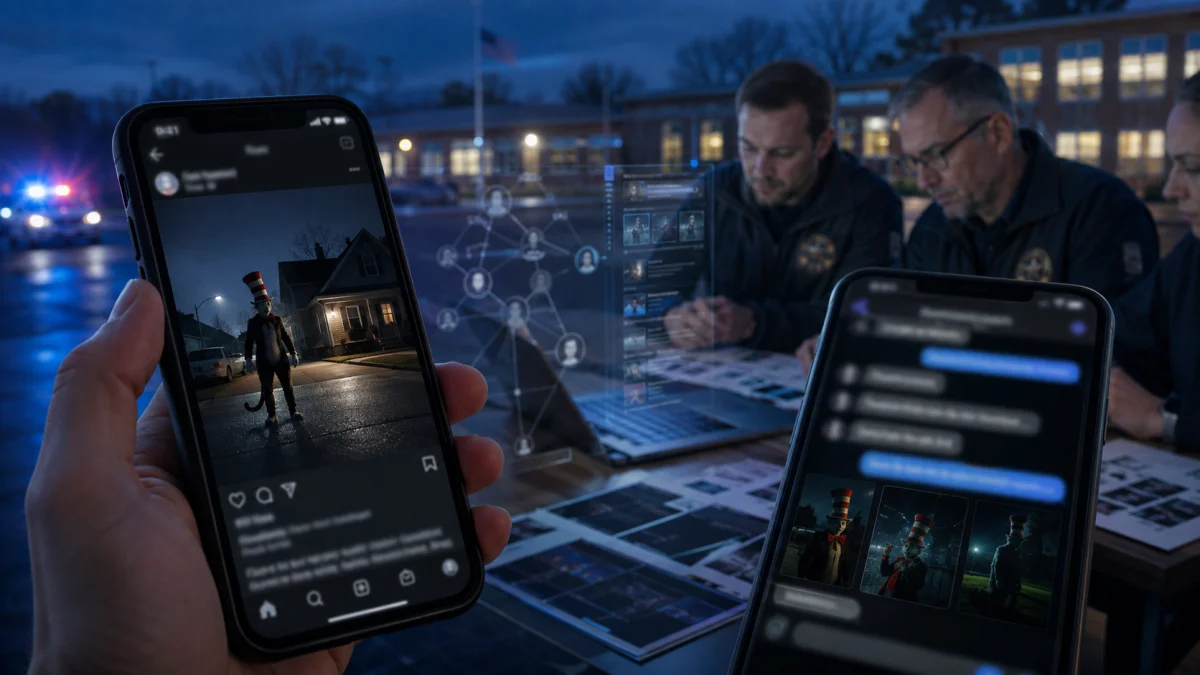
No, the original viral “Cat in the Hat stalker” was not a real roaming stalker or serial killer moving from Ireland and Britain to the United States.
But the hoax did produce something real.
People began copying it.
Update — September 21, 2026: Subsequent reporting clarified important details about the original Allen County, Kentucky, case. The juvenile was 14, was cited and released to a guardian, and authorities said he was responsible specifically for the TikTok account involved in the investigation. At that point, investigators were still awaiting records to determine who controlled a separate Snapchat account that had sent threatening messages. Since this article was first published, the same “Cat in the Hat” trend has also led to additional juvenile charges and arrests in Kentucky and several other states. None of those developments changes the central conclusion: the original viral story about a roaming Cat in the Hat stalker was fabricated, while real people subsequently began adopting the meme for threatening or disruptive conduct.
In Allen County, Kentucky, a juvenile tied to Cat-in-the-Hat-themed social-media activity was identified, surrendered to authorities and was cited. Since then, other young people around the United States have been arrested or charged over separate posts using the same recognizable character and format.
That does not mean the original Cat in the Hat stalker was real.
It means a fictional internet threat became recognizable enough for real people to start using it.
Those two facts can exist at the same time.
The original scare that spread across Ireland and the United Kingdom involved AI-generated or manipulated images portraying a sinister Cat in the Hat figure outside houses, on streets and in recognizable neighborhoods. Police investigated the claims and publicly said the supposed roaming character was not actually there.
By late August, however, the story had changed.
Police in Allen County were investigating Cat-in-the-Hat-themed social-media activity involving local students. A juvenile connected to part of that activity was identified and ultimately cited.
Other cases soon followed.
The simplest explanation remains the most accurate:
The original stalker was a hoax. The hoax then developed real-world copycats.
So, Is the Cat in the Hat Stalker Real?
Not in the way the original viral story claimed.
There remains no evidence of one mysterious Cat in the Hat serial killer or stalker traveling from Ireland to Britain and then across the United States.
There is also no evidence from the cases reviewed here that one person has been physically roaming those communities in costume and stalking residents.
What is real is the human participation behind parts of the trend.
Authorities around the United States have described young people creating Cat in the Hat accounts, using AI-generated or edited imagery and attaching threatening or ominous messages naming particular towns, schools, neighborhoods or individuals. By September, multiple agencies were explicitly describing it as a nationwide social-media trend.
That is fundamentally different from saying the viral stalker was real all along.
The evidence still does not support that.
The better description is:
The hoax became a template.
What happened in Allen County, Kentucky?
The Allen County-Scottsville Crime Task Force became involved on August 27 after multiple students reported threatening messages through Snapchat.
Police said the school itself had not been threatened, but individual students had received similar communications. Investigators contacted Snapchat through its law-enforcement process and obtained warrants seeking additional account information and evidence.
Reports continued the following day.
Authorities said someone communicating through social media was identifying themselves as the “Cat in the Hat,” and some messages contained AI-generated images. Police warned that conduct crossing into actual threats could carry serious criminal consequences.
By August 29, investigators announced that they had identified a juvenile responsible for a TikTok account involved in the investigation. The juvenile subsequently came forward.
Initial coverage correctly reported that the juvenile faced criminal consequences, but later reporting added useful detail.
The Kentucky Herald-Leader reported on August 31 that the juvenile was 14 years old, had been cited by the task force and was released to a guardian. Investigators said the teenager had been trying to scare friends, had admitted what he did and was not considered a threat to the school or wider community.
That clarification matters.
It makes the case more specific without making it more sensational.
Was the Allen County juvenile responsible for the threatening Snapchat account?
This is the most important correction to preserve.
The available evidence does not justify automatically merging the TikTok account and the separate Snapchat account into one actor.
Allen County officials specifically told the Herald-Leader that the 14-year-old was responsible for the “Tik Tok one.”
They separately said they were awaiting returns from Snapchat to determine who was behind the other account.
Earlier reporting had understandably described the juvenile within the larger investigation because the case began with threatening Snapchat messages and later expanded across multiple social platforms.
But later reporting drew a clearer line.
The safest conclusion is therefore:
Police identified and cited a juvenile responsible for a Cat in the Hat TikTok account in Allen County. Investigators separately sought to identify the operator of a Snapchat account accused of sending threatening messages.
The public reporting reviewed for this update does not establish that those two accounts belonged to the same person.
That distinction should remain intact unless authorities publicly say otherwise.
The Allen County case was not the end of the trend
What looked in late August like one unusual Kentucky case subsequently became part of a much larger pattern.
On September 1, police in Hutchinson, Kansas, said a 15-year-old student had been charged with two counts of criminal threat after investigators connected the student with a local Cat in the Hat account.
Police in Berwick, Louisiana, announced four juvenile arrests connected with local Cat in the Hat posts. Three juveniles faced terrorizing or menacing allegations and another was arrested on a cyberbullying allegation.
Then another Kentucky case emerged.
On September 7, Nicholasville police said that, with assistance from the FBI, they had charged a juvenile in connection with a Cat in the Hat post targeting Jessamine County schools.
The trend was still producing investigations weeks later.
On September 16, the Oxnard Police Department in California issued an official notice describing a nationwide “Cat in the Hat” social-media trend involving AI-generated or edited videos and references to violence at schools. Investigators said they had not identified a credible threat to Oxnard schools, but warned that threatening posts could still produce arrests and criminal charges even when intended as jokes.
One day later, authorities in nearby Ventura announced that three Buena High School students had been arrested in connection with threatening Cat in the Hat videos. A 14-year-old was subsequently charged with a felony conspiracy count involving a threat of death or great bodily injury at a school and a misdemeanor criminal-threat count.
That later history strengthens rather than overturns the original conclusion.
There was never good evidence of a single roaming Cat in the Hat stalker.
There is now abundant evidence that many different people have participated in a recognizable internet trend built around that fictional threat.
The timeline shows how a fake story became something real
| Date | What happened | What it establishes |
|---|---|---|
| Aug. 20 | Wexford Gardaí said circulating Cat in the Hat “sightings” were essentially AI-created images or videos placing the character into recognizable locations. | The original neighborhood-stalker imagery was fabricated. |
| Aug. 21–24 | Similar posts spread through Britain. South Yorkshire Police debunked a fake police warning and said it had received no reports of the supposed character. | The fictional story was spreading geographically and acquiring fake institutional confirmation. |
| Aug. 27–29 | Allen County students reported threatening social-media communications, including AI-generated Cat in the Hat imagery. | Real people were beginning to use the viral narrative in communications affecting identifiable students. |
| Aug. 29–31 | A 14-year-old tied to a Cat in the Hat TikTok account was identified, came forward, was cited and released to a guardian. Investigators said a separate Snapchat account still required attribution. | Part of the trend had crossed from fabricated imagery into real conduct with juvenile legal consequences. |
| Sept. 1–7 | Juvenile arrests or charges were reported in Kansas, Louisiana and another Kentucky case in Jessamine County. | Allen County was not an isolated imitation. |
| Sept. 16–18 | California authorities continued investigating school-related posts; three Ventura students were arrested and one 14-year-old was charged. | The trend remained active weeks later and continued producing real law-enforcement consequences. |
That chronology is why simply changing an old fact check from FALSE to TRUE would be wrong.
The proposition itself changed.
The original Cat in the Hat sightings were still fake
On August 20, Wexford Gardaí addressed images supposedly showing the character lurking around homes.
According to the Irish Examiner’s reporting on the Garda statement Irish Examiner: “‘Cat in the Hat’ stalking Wexford residents is AI-generated, gardaí say”, authorities described the supposed incidents as essentially an AI prompt placing the character into images and videos of familiar places.
The viral material included supposed scenes of the character peering through windows and even pursuing people with a knife.
Those images were not evidence of a real roaming attacker.
The scare then spread through Britain.
The Independent documented AI-generated and mocked-up imagery appearing in numerous towns and cities. Someone even circulated what looked like a police statement saying officers were investigating a suspicious Cat in the Hat figure near Meadowhall in Sheffield. The Independent: “Police issue warning over viral ‘Cat in the Hat’ social media trend”
That notice was fabricated.
South Yorkshire Police said it had received no reports of a Cat in the Hat in Meadowhall or elsewhere in the force’s area.
The later American arrests do not make those earlier images retroactively authentic.
What changed was the behavior, not the truth of the original videos
One weakness in ordinary fact checking is that internet claims are sometimes treated as static objects.
Real viral stories mutate.
At stage one, someone creates a fake image.
At stage two, other accounts repeat the story.
Then localized versions appear.
Eventually somebody may decide to participate in the story directly by creating an account, sending a threatening message, naming a school or individual, dressing like the character or otherwise acting within a mythology that an audience already recognizes.
At that point, real conduct can grow around a false narrative.
The original fiction does not have to become true for the consequences to become real.
Allen County officials themselves described the accounts as part of a viral trend extending well beyond their community. By mid-September, police departments elsewhere were using nearly identical language.
That is observable imitation.
Folklorists actually have a term for this
There is a useful concept in folklore research called ostension: broadly, the enactment of elements from an existing story or legend in real life.
A 2025 paper by folklorist Eda Kalmre examined ostension and criminal legends in online youth culture, including Slenderman stories and the “killer clown” phenomenon. The paper discusses the way narratives can move between online storytelling, participatory culture and real-world behavior. Yearbook of Balkan and Baltic Studies: “Ostension and Criminal Legends: Contemporary Horror Tales as Part of Online Youth Lore”
That does not mean that every person exposed to frightening viral material will imitate it.
Nor does it establish that a social-media post “caused” any particular offense.
Research on copycat offending is considerably more cautious than casual use of the term might suggest.
A major literature review by criminologist Jacqueline Helfgott found substantial anecdotal evidence for copycat behavior but emphasized that empirical research specifically measuring the phenomenon remained limited and that media influence interacts with individual, environmental and situational factors. Aggression and Violent Behavior: “Criminal behavior and the copycat effect”
We do not need a sweeping psychological theory, however, to recognize the narrower factual pattern here.
Different people in different communities began creating accounts and threats modeled on the same viral Cat in the Hat narrative.
That part is documented.
This resembles the 2016 “killer clown” panic
The closest modern comparison may be the 2016 killer-clown scare.
That phenomenon also blurred several categories people repeatedly treated as though they were one event:
rumors, staged videos, false threats, mistaken sightings and actual people deciding to dress as frightening clowns because frightening clowns had already become a recognizable cultural story.
PBS later described how viral clown imagery helped produce copycat appearances in more than 20 states. PBS Monstrum: “Creepy Clowns: The Horror Behind the Laughter”
The lesson was not that every early killer-clown rumor had secretly been true.
It was that once a scare becomes recognizable enough, the story itself can provide a script for the next participant.
By September 2026, the Cat in the Hat phenomenon had clearly reached that stage.
AI makes this cycle considerably easier
Internet hoaxes producing copycat behavior long predate generative AI.
What AI changes is the cost and speed of manufacturing convincing-looking local “evidence.”
A participant no longer necessarily needs a convincing costume, physical access to the location or sophisticated editing skills.
A recognizable location can be photographed.
A threatening fictional character can be inserted into it.
Text can imply that the character is nearby or targeting someone.
Another person can repeat the same trick in another town.
The content can therefore become intensely local without the depicted event ever having happened there.
That helps explain one of the strangest features of the original Cat in the Hat scare.
The same supposed figure could appear almost simultaneously in distant neighborhoods because there did not need to be a physical figure traveling between them.
Each community could generate its own version.
What the later criminal cases demonstrate is the next stage of that process.
The image may be synthetic.
The person sending it is not.
Does that mean every Cat in the Hat post should be treated as a real physical threat?
No.
That would recreate the same confusion that allowed the original hoax to spread.
An AI-generated picture claiming the character has arrived in a particular town is not automatically evidence that somebody wearing a costume is actually nearby.
At the same time, a synthetic picture attached to a message directed at a specific person or school can still be part of real conduct.
The important question is therefore not simply whether the image is fake.
It is:
What actually happened around the image?
Was an edited picture posted publicly as a joke?
Was somebody falsely reporting a sighting?
Was an identifiable student contacted directly?
Was a school named?
Was there threatening language?
Was there repeated unwanted contact?
Did somebody claim an attack would occur?
Did anyone physically appear at a location?
Those are different factual situations and potentially very different legal situations.
“AI-generated” describes how an image was produced.
It does not make every action surrounding the image imaginary.
Were the original debunks wrong?
No.
If the original question was whether a real Cat in the Hat serial killer or stalker was roaming through communities depicted in the viral images, the available evidence said no.
That remains the answer.
What changed is that real people began participating in the narrative.
The distinction is subtle but essential:
The original sightings can be fake while later threats, impersonation and copycat conduct are real.
Allen County became an early documented example.
The subsequent cases made clear that it was not the only one.
There is still no evidence of one supernatural-looking Cat in the Hat stalker moving from town to town.
There is something arguably more instructive instead:
An internet fabrication became recognizable enough that unrelated people in different communities started using the same fictional character and format to frighten real students, schools and communities.
That is not evidence that the hoax was secretly true.
It is evidence that a hoax can become a script.
References and Further Reading
Allen County and Kentucky investigations
Kentucky Herald-Leader: “Charges filed in 2 states. KY schools targeted in viral ‘Cat in the Hat’ threats” — The most important clarification of the original Allen County case. Reports that the juvenile was 14, was cited and released to a guardian, was responsible for the TikTok account, and that investigators were separately waiting for Snapchat records.
WSMV: “Police task force identifies juvenile behind threatening messages to Allen County students” — Documents the initial Thursday-to-Saturday chronology, Snapchat investigation and identification of the juvenile associated with a TikTok account.
WBKO: “Juvenile identified in ‘Cat in the Hat’ case” — Local reporting on the task force’s announcement that a juvenile had been identified and that charges would be filed.
WBKO: “Allen County-Scottsville task force investigating ‘Cat in the Hat’ account targeting students” — Describes the original threatening-message investigation, AI imagery and law-enforcement requests to social-media platforms.
WKYT: “AI expert says ‘Cat in the Hat’ school threat trend is ‘tip of the iceberg’” — Confirms that Nicholasville police, with FBI assistance, charged another juvenile in a separate Jessamine County case.
Later nationwide developments
Oxnard Police Department: “Cat in the Hat Social Media Trend” — September 16 official police notice describing the phenomenon as a nationwide trend and distinguishing alarming posts from a verified credible school threat.
News Channel 3-12: “Buena High Teen Facing Felony Charge Related to Threatening Cat in the Hat Video” — Reports the Ventura Police investigation, three juvenile arrests and felony and misdemeanor charges filed against a 14-year-old.
KWCH: “Hutchinson teenager charged in connection with ‘Cat in the Hat’ trend” — Documents a separate Kansas case in which a 15-year-old was charged with two counts of criminal threat.
WBRZ: “Four juveniles arrested in Berwick following investigation into Cat in the Hat trend” — Documents four juvenile arrests in Louisiana connected to local accounts participating in the trend.
Original AI-hoax reporting
Irish Examiner: “‘Cat in the Hat’ stalking Wexford residents is AI-generated, gardaí say” — Reports the August 20 Garda debunk identifying supposed neighborhood sightings as AI-generated rather than evidence of a roaming attacker.
The Independent: “Police issue warning over viral ‘Cat in the Hat’ social media trend” — Documents the spread across Britain, localized AI imagery and South Yorkshire Police’s debunking of a fabricated police warning.
Background on legends becoming behavior
Yearbook of Balkan and Baltic Studies: “Ostension and Criminal Legends: Contemporary Horror Tales as Part of Online Youth Lore” — Peer-reviewed discussion of ostension, digital legends, killer clowns, Slenderman and real-world enactment.
Aggression and Violent Behavior: “Criminal behavior and the copycat effect: Literature review and theoretical framework for empirical investigation” — Review explaining both the plausibility of media-related copycat behavior and the limitations of the empirical evidence.
PBS Monstrum: “Creepy Clowns: The Horror Behind the Laughter” — Useful historical comparison describing the spread of 2016 killer-clown copycats across more than 20 states.
Editorial currency note: Juvenile proceedings are often confidential, and this trend continues to generate new local investigations. The exact disposition of the Allen County citation, attribution of the separate Snapchat account and outcomes of later juvenile cases may not be publicly available. This article reflects publicly available information reviewed through September 21, 2026.