Originally published October 6, 2026. Substantively reviewed and updated October 23, 2026.
Update, October 23, 2026: Since this article was published, the World Medical Association (WMA) concluded its October 7–10 General Assembly in Rotterdam. On October 10, it adopted the Declaration of Rotterdam on the Protection of Medical Neutrality. The declaration calls on medical associations to publicly oppose violations of medical neutrality, including violations by their own governments, and to review their policies for consistency. It also calls for the unconditional release of medical personnel detained solely for providing healthcare, a narrower standard than an unconditional demand to release every detained health worker regardless of circumstances.
At the same assembly, the WMA adopted a resolution specifically addressing the deterioration of healthcare in the West Bank. It calls for safe medical access and urges Israeli authorities to address financial disruptions affecting Palestinian healthcare, including the transfer of Palestinian tax revenues allocated for public services. These are WMA decisions, not new AMA House of Delegates votes. They do not establish how individual AMA representatives voted.
On October 21, CIVICUS and Physicians for Human Rights–Israel renewed a campaign calling for the release of Dr. Hussam Abu Safiya and 13 other detained Gaza doctors. Their descriptions of detention conditions and legal status are attributed to the organizations, not treated here as independent court findings. The available record reviewed for this update does not establish a subsequent final AMA decision on Resolution 616 or authenticate the email attributed to physician Gary A. Delaney.
The viral claim that the American Medical Association (AMA) has been completely silent about Gaza is wrong. The AMA has spoken about Israel, Palestine, medical neutrality and protections for health workers.
The more consequential finding is documented in the AMA’s own proceedings: Gaza- and Palestine-specific proposals have repeatedly been broadened or referred, while Ukraine-specific humanitarian policy and an Israel-specific organizational policy remain in place. The decisions are not identical, and each has its own stated rationale. But they raise a question the AMA has yet to answer clearly: When does naming a particular conflict serve medical ethics, and when does the association consider it inappropriate political specificity?
The question is now sharper because the WMA, of which the AMA is a member, adopted additional protections in October 2026 and has itself published policies naming Gaza, the West Bank and the Israeli government.
A second issue involves a screenshot of an alleged email attributed to Dr. Gary A. Delaney, a South Carolina physician with a documented leadership role in organized medicine. That email has not been independently authenticated by sherafy.com. It is a separate allegation, not evidence of an official AMA response, and should never be confused with the verified policy record.
What the AMA’s own record shows
| Reader question | What the documentary record establishes |
|---|---|
| Has the AMA been completely silent on Gaza? | No. Its trustees spoke about medical neutrality in November 2023, and its House adopted language addressing peace in Israel and Palestine in 2024. |
| Did the AMA receive a Gaza-specific proposal in 2026? | Yes. Resolution 615 explicitly named Gaza and attacks on healthcare workers and facilities. |
| Did the adopted version retain that specificity? | No. The House adopted amended language about noncombatant healthcare workers in all conflict areas. |
| Why was the language changed? | The official committee report recorded concerns about political bias and singling out Gaza, alongside support for the underlying humanitarian principle. |
| What happened to the proposed Palestine humanitarian-aid policy? | Resolution 616 was referred, not rejected. Its final disposition following referral was not established by the records reviewed here. |
| Does the AMA have a Ukraine-specific humanitarian policy? | Yes. Policy D-65.984 specifically addresses humanitarian and medical support to Ukraine and Ukrainian refugees. |
| Does it retain an Israel-specific organizational policy? | Yes. D-250.990 opposes efforts to expel the Israeli Medical Association from the WMA. A 2026 proposal to rescind it was not adopted. |
| Has the AMA explicitly named a government in another war? | Yes. An AMA president’s 2022 commentary described Russia’s invasion of Ukraine in explicitly Russia-specific terms. |
| Has the WMA used conflict-specific language on Gaza? | Yes. Its October 2025 policy directly addressed the Israeli government; its October 2026 resolution specifically addressed the West Bank. |
| Has the WMA addressed Dr. Hussam Abu Safiya? | Yes. It issued appeals in 2025 and 2026 concerning his detention, due process and health. |
| Has the Gary Delaney email been proved authentic? | Not by the evidence independently established in this article. His leadership positions, by contrast, are documented by South Carolina medical organizations. |
The relevant records are the AMA’s annotated 2026 Reference Committee F report, its annotated 2024 report, the AMA’s Ukraine policy, and the WMA’s published policies. The AMA’s 2026 annotated report identifies itself as preliminary pending the official proceedings, but it expressly records the House actions discussed below.
The documentary question is not whether the AMA has universal humanitarian principles. It does. The question is how consistently it applies its approach to geographic and political specificity.
First, correct the viral claim: the AMA has spoken about Gaza
In a November 9, 2023 statement, the AMA Board of Trustees emphasized medical neutrality, the protection of healthcare workers and access to humanitarian assistance during the conflict involving Israel and Gaza.
At the 2024 Annual Meeting, the AMA House of Delegates adopted an alternate resolution supporting peace in Israel and Palestine to protect civilians and healthcare personnel. It also affirmed broader protections for healthcare and humanitarian workers in armed conflict. The 2024 House action is recorded in the annotated committee proceedings.
Those actions matter. Any article claiming the AMA never addressed Gaza would be wrong.
But there is a difference between issuing a broadly worded statement and adopting a proposed policy that names particular victims, governments, conflicts or requested interventions. That distinction is where the documentary record becomes significant.
Resolution 615: watch the word "Gaza" disappear
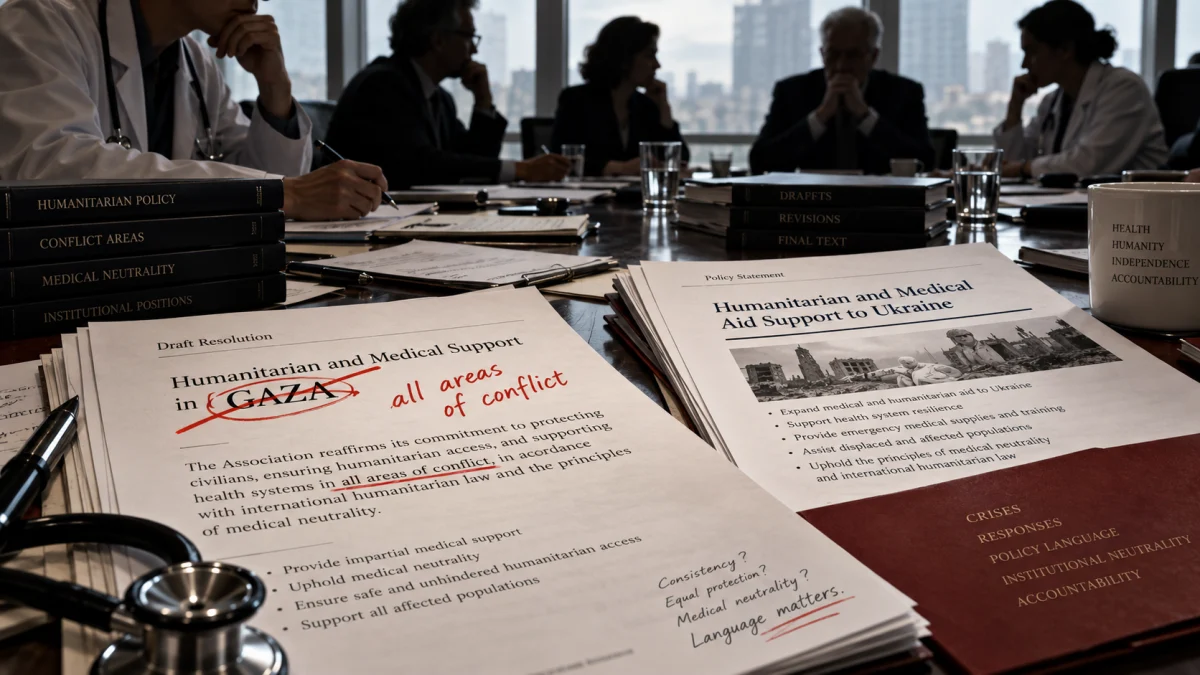
At the AMA’s 2026 Annual Meeting, Resolution 615 arrived with the title "Condemnation of Attacks on Healthcare Workers and Facilities in Gaza." Its sponsors proposed recognizing the deliberate targeting of healthcare workers, medical students and healthcare facilities in Gaza as a violation of medical neutrality and supporting efforts to protect, release and provide restitution to detained healthcare workers there.
The House adopted Resolution 615 as amended. The final policy broadened the geographic scope and specified noncombatant healthcare workers. According to the AMA’s official annotated report of the House action, the principal changes were:
| Element | Proposal submitted | Adopted House language |
|---|---|---|
| Geographic scope | Gaza | All areas of conflict |
| People specifically named | Healthcare workers and medical students, with facilities in Gaza | Noncombatant healthcare workers, medical students and facilities across conflict areas |
| Medical-neutrality concern | Deliberate targeting in Gaza | Deliberate targeting in conflict areas generally |
| Detention-related request | Protect, release and provide restitution to detained healthcare workers in Gaza | Support efforts to protect, release and provide restitution to detained noncombatant healthcare workers across conflict areas |
| Resolution title | Condemnation of Attacks on Healthcare Workers and Facilities in Gaza | Protection of Non-Combatant Healthcare Workers and Facilities in Conflict Areas |
The adopted measure is not meaningless. Its broad language can potentially cover physicians in Gaza as well as other wars. Universal medical protections are legitimate and necessary. The procedural record also contains an important distinction: although the reference committee initially recommended deleting the Gaza-specific detention clause, the House ultimately retained a geographically generalized version of the protection, release and restitution provision.
What makes this case noteworthy is the explanation of the amendment. The committee’s report recounts mixed testimony and explicitly refers to concerns about "political bias" and "singling out Gaza." The amendment responded by moving the operative language away from Gaza-specific references.
That raises a narrower and more useful question than simply accusing the AMA of silence: Was the objection to the underlying medical-neutrality principle, or to applying it explicitly to Gaza? The recorded testimony suggests the naming of Gaza was itself part of the dispute.
An additional qualification matters. A resolution’s proposed language is not a factual finding that every alleged attack was deliberate or unlawful. Allegations of particular violations require investigation and evidence. The point here is to compare what delegates were asked to adopt with the language they actually adopted.
Resolution 602: "Israel and Palestine" became "the world"
Resolution 602 produced another revealing comparison in the same 2026 proceedings.
The proposed revision to AMA Policy H-520.985 included support for peace in Israel and Palestine as a means of protecting civilian lives and healthcare personnel. The House-adopted text instead begins:
Our American Medical Association supports peace in the world in order to protect civilian lives and healthcare personnel.
That change removed the named geographic focus. But a fair reading must acknowledge the rest of the action: the amended policy also retained and reinforced protections for humanitarian personnel and condemned targeting, detention or attacks on noncombatant healthcare workers, while condemning the use of healthcare personnel or institutions for military purposes or as shields.
Therefore, the documented outcome is not simply that the AMA weakened healthcare protection. It strengthened or restated certain protections while choosing universal rather than Israel-Palestine-specific language.
The problem that remains is one of consistency. If the association is comfortable naming one place in its standing policy but considers naming another place politically inappropriate, it should be able to articulate a clear rule explaining the difference.
The pattern predates 2026
At the 2024 Annual Meeting, Resolution 603 addressed attacks on health and human rights in Israel and Palestine and sought ceasefire-related action. Resolution 610 proposed opposition to collective punishment, including restrictions on essentials such as food, water, electricity and healthcare in armed conflict.
Delegates did not adopt those proposals in their submitted form. They adopted an alternate resolution in lieu of Resolutions 603 and 610, supporting peace in Israel and Palestine, protecting healthcare and humanitarian workers in areas of armed conflict, and reaffirming existing policy against war crimes.
Again, the result was not silence. It was a move from more specific proposed commitments toward a narrower statement and broader protections.
The 2024 committee record also recounts competing views about whether the AMA should enter geopolitical disputes. That concern is not inherently illegitimate. A professional medical association has finite time, resources and authority. Members can reasonably disagree about whether an organization should call for a ceasefire, condemn a particular government or focus on universal rules of medical ethics.
Yet that rationale becomes less persuasive as a blanket prohibition on specificity when the AMA’s own record includes country-specific policies and statements elsewhere.
The Ukraine comparison is written into AMA policy
The central comparison is an existing AMA directive, D-65.984, "Humanitarian and Medical Aid Support to Ukraine."
The AMA Policy Finder entry specifically addresses continuing support for organizations providing humanitarian missions and medical care to Ukrainian refugees in Ukraine, neighboring countries and the United States. It also deals with war trauma and mental-health services for Ukrainian refugees. The policy was last modified in 2024 in the record reviewed.
By contrast, Resolution 616, "Humanitarian and Medical Aid Support to Palestine," proposed AMA support for funding to address the humanitarian crisis in Gaza, assistance for Palestinian refugees and mental-health services for people experiencing war-related trauma.
The 2026 Reference Committee F report records that Resolution 616 was referred. The committee described testimony favoring a universal approach to civilians affected by armed conflict and indicated that integrating the proposal with existing policy warranted a report back.
Its explanation also noted that the existing Ukraine directive was not under consideration at that time. That is a material limitation: the House was considering a Palestine proposal, not voting simultaneously on whether to retain the Ukraine policy. The two procedural outcomes therefore cannot be treated as a controlled vote on the same resolution.
Even with that distinction, the comparison raises a legitimate question. The AMA has already demonstrated that country-specific humanitarian advocacy is compatible with its mission in at least one case. What criteria make a comparable proposal appropriate for Ukraine but insufficiently general for Palestine?
Referral is not rejection. It is also not adoption. The evidence reviewed through October 23 does not establish the eventual outcome of the referred proposal, and the article should not imply that the upcoming November 2026 AMA meeting will necessarily resolve it.
The AMA has also shown it can name an aggressor
An April 2022 AMA presidential commentary on Russia’s invasion of Ukraine used Russia-specific language, describing the invasion as an unprovoked attack and condemning violence against civilians and healthcare.
A commentary by an AMA president is not the same kind of instrument as a standing House of Delegates policy. Nor does a statement about Russia automatically dictate the wording of every resolution concerning Israel and Palestine.
It does, however, answer one narrower question: Has AMA leadership ever decided that naming a particular state and conflict was appropriate in a public discussion of medical ethics? Yes.
That makes an explanation of the association’s standards more important, not less.
An Israel-specific AMA policy remains in force
The 2026 proceedings also considered Resolution 617, which proposed rescinding AMA Policy D-250.990. That existing directive opposes efforts to expel the Israeli Medical Association from the World Medical Association.
The proposed replacement would have favored evaluating WMA constituent-member applications, disciplinary issues and termination based on the evidence available at the time rather than maintaining the existing Israel-specific commitment.
The House did not adopt Resolution 617. Its committee report records opposition to rescission, including concern that withdrawing explicit support for the Israeli Medical Association could appear to endorse excluding a national medical organization because of its government’s conduct. That concern reflects a meaningful professional distinction between the actions of a government and the status of physicians or their representative association.
There is no reason to pretend that protecting a medical association from expulsion and advocating for detained Palestinian doctors are identical policy decisions. They are not.
But the example matters because it demonstrates that the AMA does not categorically refuse to name national or territorial actors in its policies. It can choose to retain geographically specific wording when it considers the circumstances sufficiently compelling.
An additional qualification: the committee said D-250.990 would remain in place and undergo the AMA’s ordinary policy sunset review at its 2027 Annual Meeting. Sunset review does not mean the policy has already expired, been repealed or been scheduled for automatic rescission.
The WMA has named Gaza, Israel and the West Bank directly
The distinction between the AMA and the WMA is central to this story. They are separate bodies. A WMA declaration does not become AMA House of Delegates policy just because the AMA participates in the global organization.
Still, the WMA’s record provides a useful comparison with claims that professional medical advocacy must avoid naming specific conflicts or governments.
In October 2025, the WMA adopted a resolution explicitly calling on the Israeli government to comply with the Geneva Conventions and other applicable humanitarian-law instruments. It urged protection of health workers and facilities, access to humanitarian assistance, the release of arbitrarily detained health personnel and accountability for violations. It also called on WMA constituent members to condemn attacks on healthcare workers and facilities in the conflict.
That document preceded this article’s original publication and deserves inclusion in the record. It demonstrates that the WMA had already taken a direct, named position concerning Israel and Gaza before its October 2026 assembly.
Then, at the October 2026 Rotterdam assembly, the WMA adopted two further texts with distinct but complementary implications:
- The Declaration of Rotterdam tells medical associations to publicly oppose violations of medical neutrality, including those involving their own countries, and to review their own policies for consistency.
- The resolution on the West Bank healthcare crisis names the territory and explicitly urges Israeli authorities to facilitate mechanisms for transferring Palestinian tax revenues that support essential public services, especially healthcare.
These positions do not establish which AMA delegates supported them or how the AMA would vote on an equivalent House resolution. They do establish that the world body can both articulate universal ethical obligations and apply them in named geographic cases.
There is a legal nuance worth preserving. The Declaration of Rotterdam recognizes that international humanitarian law provides stringent, limited circumstances in which healthcare may lose special protection because of misuse. It does not imply that medical personnel are exempt from lawful investigation. Its unconditional-release provision specifically concerns people detained solely because they provided healthcare, including to opposing combatants. Allegations of other conduct require independent evidence and due process.
Universal principles and case-specific accountability are not opposites. The WMA’s newer language makes that point unusually clearly.
Put the name back into the discussion: Dr. Hussam Abu Safiya
Dr. Hussam Abu Safiya, director of Kamal Adwan Hospital in northern Gaza, was taken into Israeli custody on December 27, 2024. He has become a prominent case in the debate over medical neutrality, detention and the treatment of Palestinian health workers.
The case must be described precisely rather than reduced to competing slogans.
Israel has said Abu Safiya was investigated on suspicion of cooperating with, or working for, Hamas. His colleagues and humanitarian organizations have disputed those allegations. Associated Press reporting in July 2026 documented that he had not been formally charged and reported concerns voiced by his lawyer and Physicians for Human Rights–Israel about his deteriorating health and alleged abuse. Israel’s Prison Service rejected allegations of mistreatment. An allegation of association with Hamas is not itself proof of the allegation, and an absence of formal charges is not equivalent to a judicial finding that no investigation can lawfully occur.
The WMA has not been silent about his individual case. In November 2025, it urged Israeli authorities to provide due process and fair-trial guarantees or release Abu Safiya and similarly situated health workers in the absence of charges and due process. In July 2026, it renewed its appeal and raised concerns about his condition, drawing on information from lawyers and advocates.
On October 21, CIVICUS and Physicians for Human Rights–Israel launched a new public campaign calling for the release of Abu Safiya and 13 other detained doctors. Its account of detention conditions, mistreatment and the detainees’ legal circumstances represents the organizations’ documented advocacy claims, not a substitute for detention records or independent judicial findings.
Abu Safiya’s case raises more than one question, and they should not be collapsed:
- Is his continued detention lawful and consistent with fair-trial and due-process protections?
- Has he been treated humanely and given adequate medical care and access to legal representation?
- Do the AMA’s adopted policies concerning noncombatant healthcare workers apply to his circumstances, and what facts would determine that application?
- What, if anything, has the AMA itself done in response to the WMA’s public appeals?
A medical association can ask these questions without prejudging contested facts or endorsing an armed organization. A demand for humane treatment, medical access, due process and an independently examined evidentiary basis for detention is not a verdict on criminal responsibility.
The AMA cannot simply outsource the question to the WMA
The AMA describes the WMA as its primary vehicle for participation in international medical issues. Representatives linked to the AMA have held senior positions in WMA governance, including Dr. Jack Resneck Jr. as chair of the WMA Council. The WMA’s published leadership roster is the appropriate source for current titles and membership.
Working through an international association can be sensible. Global medical ethics often require coordination across national institutions. The WMA’s 2025 and 2026 interventions also undermine any simplistic accusation that organized medicine has universally refused to speak about Gaza.
But the AMA remains responsible for explaining its own resolutions, its own votes and its own choices about specificity.
The Rotterdam meeting took place October 7–10, 2026. An accurate question after that meeting is not what position AMA representatives will take. It is what positions they took, whether those positions are documented, and what actions the AMA now intends in response to the WMA’s adopted policies.
Neither WMA membership nor a WMA declaration proves that an individual AMA delegate voted for a particular measure. Conversely, the existence of WMA action does not answer whether the AMA intends to apply its own 2026 Resolution 615 to named cases.
The alleged Gary Delaney email is not an AMA policy position
A screenshot presented in an Instagram video attributed to ENT surgeon Dr. Angela Tsai purports to show an exchange in which Dr. Gary A. Delaney responded to a physician’s appeal concerning Abu Safiya with the words:
"You are annoying. Get a life."
That screenshot has not been independently authenticated by sherafy.com. A circulated image does not, by itself, establish who sent a message, whether the quoted text is complete, whether an account was compromised, what correspondence preceded it or whether it represented anyone else’s views. No independently verified response from Delaney or the relevant organizations resolving the allegation was established in the record reviewed for this update.
The professional positions associated with his name are a different matter. The South Carolina Medical Association’s leadership page identifies Dr. Gary A. Delaney as a District 12 trustee and chair of its AMA delegation. The SCMA Members’ Insurance Trust biography describes him as its chief medical officer, a former SCMA president and an AMA delegate.
Those positions are verifiable; the email’s authenticity is not.
Even if the screenshot were authenticated, it would establish a response by the sender, not automatically a formal statement of the American Medical Association. That distinction is essential to responsible reporting.
If the email is authentic, representative leadership should be questioned
The following is an editorial judgment, conditional on authentication of the alleged communication.
If Delaney sent the quoted response to a colleague asking for assistance for a detained physician, sherafy.com believes he should step down from representative leadership positions in which he speaks on behalf of other physicians, unless a full and credible account materially changes the meaning of the exchange.
This is not a demand that all doctors agree about Israel, Palestine, Hamas, the conduct of the Israeli military or the disposition of an individual detention case. Reasonable people can disagree about evidence, legal standards and what a medical association should advocate.
Nor does discourtesy alone establish professional misconduct, warrant loss of a medical license or prove a breach of a particular disciplinary rule.
The concern is more specific: people chosen to represent other physicians should be capable of engaging serious requests concerning medical colleagues with professional respect, even when they reject the requested action. If the alleged words are genuine and materially complete, contemptuous dismissal would warrant scrutiny of the sender’s fitness for that representative role.
The first step is not punishment based on a screenshot. It is authentication, an opportunity to respond and a clear statement from the organizations involved about whether the message was sent in an official or personal capacity.
This is a private association with public influence
The AMA is a private professional association. It is not a government agency, and describing it as broadly taxpayer-funded would be misleading.
But its public influence is substantial. In the 2026 Board of Trustees report on 2025 grants and donations, the AMA disclosed $2.356 million in government funding received in 2025. The report lists projects associated mainly with the Centers for Disease Control and Prevention, plus a smaller Substance Abuse and Mental Health Services Administration-related subcontract. The published financial table reports amounts in thousands of dollars, so its entry of 2,356 represents $2.356 million, not $2,356.
The AMA also owns Current Procedural Terminology (CPT), a coding system used throughout healthcare administration. CMS’s published AMA licensing terms govern use of CPT in federal healthcare programs. The federal license is described as royalty-free, so it would be incorrect to imply that every CPT use by Medicare generates an AMA royalty payment.
Neither fact means the public owns the AMA. Both illustrate that the association has relationships with public health programs and an outsized role in the healthcare system.
An organization that exercises significant influence over medical standards, professional advocacy and public healthcare infrastructure should expect scrutiny of how it applies its stated ethical principles. Private governance does not eliminate the need for institutional accountability.
The real issue is not universalism. It is whether the AMA applies it consistently.
There is a defensible argument for universal policy. Medical neutrality should protect healthcare professionals and patients in Gaza, Ukraine, Sudan, Myanmar and every other conflict. Humanitarian law does not become less important because a victim is politically inconvenient.
There is also a defensible argument for case-specific action. If a particular hospital, detained physician or public-health collapse presents an identifiable medical emergency, naming it can make the policy operational rather than merely aspirational.
The AMA’s own record shows it uses both approaches. It has named Ukraine in an ongoing humanitarian directive; retained a policy naming the Israeli Medical Association; issued Russia-specific commentary; and adopted general medical-neutrality policies that cover all areas of conflict. Its committees also chose to generalize Gaza-specific proposals and refer a Palestine-specific humanitarian initiative.
Those outcomes do not, on their own, prove discriminatory motive. Resolutions have different sponsors, procedural histories, purposes and legal implications. The distinction between protecting a national medical association from expulsion and supporting refugees is real. The fact that an existing Ukraine policy was not on the agenda during the Palestine debate is also real.
But the resulting policy landscape still warrants explanation. Why did concerns about naming Gaza carry weight during the 2026 debate, while existing geographic specificity was accepted or left in place elsewhere? What test determines when a particular conflict merits an explicit AMA policy? Does the AMA have a consistent policy-selection framework, or is the answer being shaped by the controversy surrounding each case?
The phrase selective universalism describes that question about institutional consistency, not an established finding about the personal motives of individual delegates.
The October 2026 WMA declaration adds another test: medical associations are expressly urged to review their policies and speak publicly against violations of medical neutrality, even when doing so creates political difficulty. The AMA should explain what that instruction means in practice for its own advocacy.
What the evidence proves, and what it does not
Verified by primary records:
- The AMA made public statements addressing medical neutrality and Gaza-related humanitarian concerns before 2026.
- Resolution 615 was submitted with Gaza-specific language and adopted in an amended, geographically generalized form.
- Resolution 602 changed a proposed Israel-Palestine peace clause to language supporting peace worldwide while also maintaining protections for healthcare and humanitarian personnel.
- Resolution 616 was referred, not adopted or rejected at the 2026 Annual Meeting.
- The AMA maintains a Ukraine-specific humanitarian-aid policy and an Israel-specific policy concerning the Israeli Medical Association.
- Resolution 617, which would have rescinded the Israel-specific policy, was not adopted; its committee discussed ordinary sunset review in 2027.
- The WMA adopted new medical-neutrality and West Bank healthcare policies in October 2026 and previously issued appeals concerning Abu Safiya.
- South Carolina medical organizations identify Gary A. Delaney in senior or representative roles.
Supported but requiring careful attribution:
- Abu Safiya’s lawyers and medical-rights advocates allege mistreatment and deterioration in detention; Israel’s Prison Service has disputed mistreatment allegations.
- CIVICUS and Physicians for Human Rights–Israel report that Abu Safiya and other doctors remain detained under the circumstances described in their October 21 campaign.
- The proposal-and-amendment pattern raises a reasonable concern about consistency in how the AMA handles geographic specificity.
Not established by the evidence reviewed:
- That the AMA has never spoken about Gaza.
- That every delegate who favored universal language held discriminatory views.
- That Resolution 616 was finally rejected or has reached a documented post-referral disposition.
- That the October 2026 WMA policies were formal AMA House of Delegates decisions, or that specific AMA delegates cast particular votes on them.
- That the alleged Delaney screenshot is authentic, complete or an official AMA communication.
- That the accusations underlying Abu Safiya’s detention have been independently proved, or that every claim about his treatment has been judicially resolved.
These distinctions do not weaken the article’s criticism. They identify precisely what can be substantiated and what the AMA should explain.
Questions the American Medical Association should answer
- Resolution 615: Under what circumstances does the adopted policy apply to Dr. Hussam Abu Safiya and other detained Palestinian health workers? What facts does the AMA consider necessary to assess whether they qualify as noncombatant medical personnel?
- Actual advocacy: Has the AMA taken any action concerning Abu Safiya’s due process, medical care, detention or the WMA’s specific appeals? If so, what action and on what date?
- Resolution 616: What is the status of its referral, what report is anticipated, and will the AMA publish the resulting recommendation and disposition?
- Rotterdam: What positions did AMA representatives take at the October 7–10, 2026 WMA General Assembly, where can those positions be verified, and what follow-up will the AMA undertake after the Declaration of Rotterdam?
- Gaza wording: Why was Gaza-specific language in Resolution 615 removed following testimony raising concerns about singling out Gaza?
- Policy criteria: What written rule determines when the AMA should name a country, territory, government, association or particular conflict in a medical-policy statement?
- Ukraine comparison: Why does D-65.984 remain Ukraine-specific while Resolution 616 was referred for integration into more universal policy? What substantive differences justify the outcomes?
- Israeli Medical Association: How does the AMA distinguish its defense of that organization’s WMA membership from proposals that named Gaza or Palestine, and what will the 2027 sunset review examine?
- Alleged Delaney message: Did Delaney send the statement attributed to him? Have the SCMA or AMA obtained an authenticated record or requested his response?
- Representative capacity: If the exchange is verified, was Delaney speaking privately or in a representative role, and what standards do the relevant organizations expect of a delegation chair responding to concerns about detained colleagues?
The AMA’s 2026 Interim House of Delegates meeting is scheduled for November 6–10, 2026. That provides a near-term opportunity for clarification, not evidence that any specific referred resolution will be decided there.
Medical neutrality matters when institutions apply it to real cases
It is easy for a professional body to affirm that healthcare workers deserve protection everywhere. It is harder to explain why a particular physician’s name, a particular conflict or a particular government’s conduct does or does not appear in its official policy.
The AMA deserves credit for the medical-neutrality protections it has adopted. It also deserves scrutiny for how it chooses to translate those principles into named actions, whether in Ukraine, Gaza or elsewhere.
The World Medical Association’s October 2026 declaration presents that issue plainly: medical associations should not let political allegiance determine whether they oppose violations of medical neutrality, and they should test their own policies for consistency.
The AMA does not need to issue identical statements on every conflict. It does need to explain the principle that makes its differences principled. Until it does, the questions raised by its own records remain unanswered.
References and Further Reading
AMA primary records and policy
- AMA, Final Report of Reference Committee F, 2026 Annual Meeting, annotated House actions. Primary record for Resolutions 602, 615, 616 and 617, including proposed wording, testimony and recorded House outcomes. The AMA labels the annotated report preliminary pending the official proceedings.
- AMA, Final Report of Reference Committee F, 2024 Annual Meeting, annotated House actions. Documents the alternate resolution adopted in lieu of Resolutions 603 and 610, including debate over ceasefire language, collective punishment and the association’s remit.
- AMA, 2024 Annual Meeting resolutions. Original submitted 2024 resolution language for comparison with the House’s adopted text.
- AMA Policy D-65.984, Humanitarian and Medical Aid Support to Ukraine. Standing Ukraine-specific humanitarian and medical-aid directive, including refugee and mental-health support.
- AMA Board of Trustees statement, November 9, 2023. Confirms that the AMA publicly addressed medical neutrality and humanitarian protection involving the Gaza conflict before its 2026 resolutions.
- AMA presidential commentary, Targeting civilians and health care in war is unconscionable, April 2022. Example of AMA leadership explicitly naming Russia’s invasion of Ukraine.
- AMA, International involvement. Explains the AMA’s participation in and relationship with the World Medical Association.
- AMA, Principles of Medical Ethics. Professional ethical principles relevant to medical independence and treatment of colleagues; not, by itself, a disciplinary finding about the alleged email.
- AMA, 2026 Informational Reports, Board of Trustees Report 03 on 2025 Grants and Donations. Primary accounting source for the $2.356 million government-funding figure, reported in thousands of dollars.
- AMA, November 2026 Interim Meeting information. Identifies the scheduled November 6–10 House meeting; does not establish that Resolution 616 will receive a final disposition there.
World Medical Association primary policies and communications
- WMA, Declaration of Rotterdam on the Protection of Medical Neutrality, adopted October 2026. The new general declaration on impartial care, duties of authorities, medical associations’ public responsibilities and review of their own policies.
- WMA, Resolution on the Critical Deterioration of the Healthcare System in the West Bank, October 10, 2026. New territory-specific resolution addressing access, supplies, medical staffing and Palestinian public-service financing.
- WMA, Resolution Calling on the Israeli Government to Comply with the Geneva Conventions, October 11, 2025. Prior country-specific policy calling on the Israeli government to protect healthcare, allow humanitarian access and release arbitrarily detained medical personnel.
- WMA, Resolution on the Protection of Healthcare in Israel and Gaza. Earlier geographic-specific policy that helps establish the WMA’s record before the 2026 General Assembly.
- WMA, Call for fair-trial standards for detained Gaza physician, November 7, 2025. The WMA’s specific position on due process or release absent charges and adequate procedure for Dr. Abu Safiya.
- WMA, Renewed urgent appeal concerning detained Gaza physicians, July 13, 2026. Follow-up public appeal reporting serious health concerns and seeking medical access, humane treatment and fair procedures.
- WMA, Leadership roster. Official roster for verifying WMA governance and individuals serving in international medical leadership.
Independent reporting and attributed advocacy
- Associated Press, Lawyer warns detained Palestinian doctor Hussam Abu Safiya is in critical condition, July 2026. Independent reporting on detention, the Israeli allegations, the lawyer’s account and the prison service’s denial of mistreatment.
- CIVICUS and Physicians for Human Rights–Israel, Release Dr Hussam Abu Safiya and 13 other doctors held without charge, October 21, 2026. Documents the renewed campaign and the organizations’ allegations; it is advocacy, not a judicial finding.
- Doctors Without Borders (MSF), Appeal ahead of the WMA General Assembly, October 6, 2026. Documents pressure from a medical humanitarian organization before the Rotterdam meeting. Its demands are identified as advocacy.
Gary A. Delaney and public-system context
- South Carolina Medical Association, Leadership. Primary organizational listing for Gary A. Delaney’s trustee and AMA delegation chair positions.
- South Carolina Medical Association Members’ Insurance Trust, About and leadership. Additional organizational biography documenting his chief medical officer role, previous SCMA presidency and AMA delegate service.
- Centers for Medicare & Medicaid Services, AMA CPT licensing terms. Federal licensing terms governing CMS use of the AMA’s CPT system, including the royalty-free federal license.
Editorial currency note (October 23, 2026): This article reflects the published documents and independently reviewed reporting available through this date. AMA policy proceedings, the status of Resolution 616, WMA leadership, detained physicians’ legal and medical circumstances, and any authenticated evidence concerning the alleged Delaney communication may change. A future update should distinguish newly established facts from claims that remain disputed.