
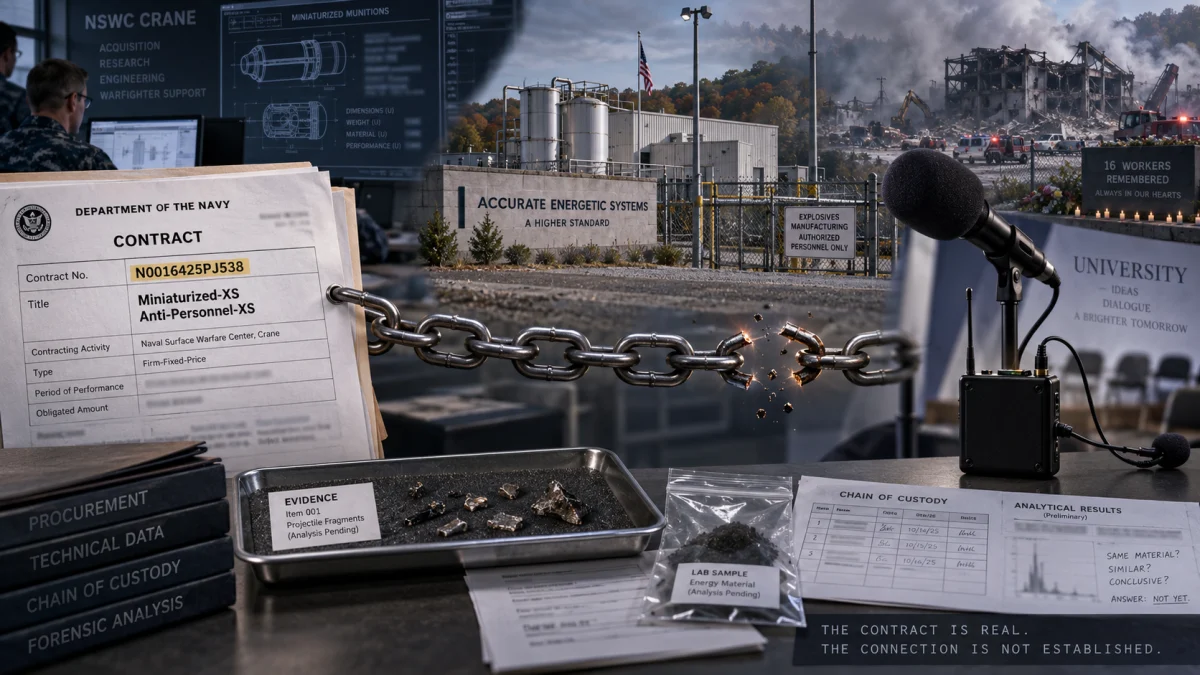
There is no publicly established evidence that Accurate Energetic Systems (AES) manufactured or supplied a device used to kill Charlie Kirk. But the question did not arise from a fabricated contract: the Navy awarded AES a purchase order for charges described as “MINIATURIZED-XS” and “ANTI PERSONNEL-XS” before Kirk was killed. The order’s listed performance period ended 16 days before the September 10, 2025 shooting. Exactly 30 days later, an explosion at AES’s Tennessee facility killed 16 workers.
We thank “Good Samaritan” for submitting an article challenge and choosing to be credited. Their feedback prompted us to review the article’s sourcing and clean up citation and presentation artifacts. We appreciate readers who take the time to help us improve our work.
Those are documented events. The evidence reviewed here does not show that they are connected. The gap is specific: no public record located identifies the Navy order’s units or lot, traces them from AES through government custody to Utah, or identifies AES material in evidence from the killing. The timeline is worth examining because the procurement is real; it cannot substitute for that missing chain.
| Claim | What the public record establishes | Status |
|---|---|---|
| AES received a Navy order for “MINIATURIZED-XS” and “ANTI PERSONNEL-XS” charges | Purchase order N0016425PJ538 appears in federal award data | Verified |
| The order ended shortly before Kirk was shot | The listed performance end date is August 25, 2025; that field does not prove delivery or acceptance on that date | Verified date; delivery not established |
| A unit from the order reached Utah or Kirk’s event | No public transfer, shipment or inventory record located in this review | Not established |
| Kirk’s microphone or other equipment contained an AES device | No publicly released forensic report located here establishes this | Not established |
| Building 602 made the Navy-ordered devices | The CSB identifies it as a cast-booster building; reviewed records do not identify it as PJ538’s production site | Not established |
| The October AES explosion was deliberate or tied to Kirk’s killing | The CSB’s cause investigation remains ongoing; no public evidence reviewed links it to the killing | Not established |
| The ATF matched the recovered bullet-jacket fragment to the rifle—or excluded it | The comparison was inconclusive: neither identification nor exclusion | Neither claim is supported |
What is the Accurate Energetic Systems theory?
The strongest version of the allegation joins several facts. AES is a manufacturer of military and commercial energetic products. The Navy placed an order with AES for miniaturized demolition charges, including an item described as anti-personnel. The performance period ended shortly before Kirk’s death. Online claims have suggested that an explosive device could have been concealed in or near his audio equipment. Then, one month after the killing, an explosion destroyed a building at AES and killed 16 workers.
That sequence can prompt legitimate questions about the contract, the equipment used at the Utah event and the cause of the Tennessee explosion. It does not, by itself, answer any of them. To establish a connection, the evidence would have to show what AES produced under the order, where those particular units went, whether a unit reached the event, and whether physical or documentary evidence connects it to Kirk’s death.
The article follows that chain rather than treating proximity in time as proof. It also separates the plant explosion’s cause from workplace-safety violations and from the pending criminal case in Utah. Those are related topics only if evidence links them.
The $440,494 Navy purchase order is real
The federal award record for purchase order N0016425PJ538 identifies Accurate Energetic Systems as the recipient and the Naval Surface Warfare Center Crane Division as the contracting office. The public summary records $440,494 in obligations and describes a requirement for “MINIATURIZED-XS DEMOLITION CHARGES” and “DEMOLITION CHARGES, ANTI PERSONNEL-XS TO SUPPORT SPM.” It lists an award date of April 22, 2025, and a period of performance from May 1 through August 25, 2025. A structured copy of the award data also reports a firm-fixed-price purchase order and one offer under simplified acquisition procedures.
The contract can be checked through USAspending’s award profile. Its public interface did not expose the full record in this review, so the listed fields were cross-checked against GovChime’s searchable award entry, which says it draws from federal award data. The structured summaries are not the signed order or a technical data package.
That distinction limits what can be inferred from the wording. The public summary does not give dimensions, explosive fill, drawings, lot or serial identifiers, a shipment date, an acceptance record, or an operational end user. It does not say that the device was disguised as electronics, intended to be placed on a person, or used against Kirk. “Miniaturized” is a product descriptor, not evidence that an item could fit inside a microphone. “Anti personnel” describes a category of charge; it does not identify a target or establish that a particular unit was used in a crime.
The $440,494 is reported as an obligation in the award summary. An obligation is a federal commitment recorded against an award; it is not proof that the full amount was paid. Similarly, August 25 is the listed end of the performance period. It is 16 days before Kirk was shot at Utah Valley University on September 10, but the field does not establish that the order shipped, arrived or was accepted on August 25.
The record shows one offer under simplified acquisition procedures. That deserves accurate reporting, but it does not establish that the procurement was covert or that AES was the only firm capable of supplying the products. The summary does not explain why one offer was recorded, what solicitation or market research occurred, or whether other suppliers were considered. Those questions would require the acquisition file.
What does “SPM” mean?
The award description says the charges were “to support SPM.” Public Naval Surface Warfare Center Crane material describes a Specialized Munitions capability and uses “SpM” as an abbreviation. That makes “Specialized Munitions” a plausible reading of the acronym in this award. The award summary itself does not define “SPM,” so the expansion should be treated as context, not as a confirmed contract term.
That context matters. Crane’s published mission includes work on specialized and expeditionary munitions. An order for demolition charges can fit that broad mission without being unusual in the sense of being clandestine. The public mission description does not, however, identify a specific program, device design or eventual user for PJ538.
Other AES-Navy orders provide context, not a link to Kirk
The PJ538 award was not the only Navy order to AES in 2025 whose description referred to demolition products or “SPM.” A searchable federal-award history lists several nearby contracts:
| Purchase order | Award date | Description in the award listing | Listed amount | Listed end date |
|---|---|---|---|---|
| N0016425PJ509 | Jan. 24, 2025 | “DEMOLITION CHARGES, AP, SMALL/LARGE” | $105,369 | Oct. 10, 2025 |
| N0016425PJ530 | Apr. 3, 2025 | “SPM FY25 BWC MPI PELLETS” | $22,530 | July 10, 2025 |
| N0016425PJ538 | Apr. 22, 2025 | “MINIATURIZED-XS” and “ANTI PERSONNEL-XS” demolition charges | $440,494 | Aug. 25, 2025 |
| N0016425PJ593 | Sept. 17, 2025 | “SPM ORDNANCE SYSTEMS MPI ASSEMBLIES” for an immediate demolition requirement | $156,721 | Aug. 5, 2026 |
These entries are visible in G2X’s AES federal-award listing; the award identifiers can also be searched in USAspending. The amounts and end dates are listing fields, not proof of payment, delivery or acceptance. The descriptions show that AES had recurring Navy business involving munitions and demolition products. They do not establish that the orders were for the same item, program, production line or lot.
One date merits particular care. PJ509’s listing ends on October 10, 2025—the day Building 602 exploded. That is a real coincidence in the date fields. But a performance-period end date is an administrative contract field; it does not say a shipment was due that morning, an inspector was at the plant, or PJ509 material was inside Building 602. The contract file, delivery schedule, invoices, acceptance records and production work orders could clarify whether the date reflected a real delivery milestone or only the end of the recorded period.
The September PJ593 award also cuts against reading PJ538 as an isolated, mysterious transaction: AES’s Navy relationship continued after Kirk’s death. Its description refers to an immediate warfighter requirement for demolition charges, but no public record reviewed here connects it—or the earlier orders—to Kirk. A procurement pattern is context for what AES made and whom it supplied. It is not a chain of custody.
AES’s capabilities establish capacity, not use in this case
AES describes itself as a manufacturer of energetic products for military, aerospace and commercial markets. Its company materials list demolition charges, bulk explosives, pelletized products, testing and load-assemble-pack work. Public federal awards also show AES supplying other military explosive products, including demolition materials and mines.
That evidence supports a limited point: AES had experience producing specialized energetic products. It does not reveal the design or dimensions of the items under PJ538. A company’s general capability cannot establish what a particular order contained, where each unit went, or whether one was used in Utah. The award record and company product catalogue do not fill in those missing links.
The question worth pursuing is therefore not whether AES could make energetic devices. The public record says it could. The unanswered questions concern the specific PJ538 units: how many were made, what identifiers they carried, who accepted them, and how they were stored, tested or transferred.
The alleged connection still has a missing middle
The documented part of the procurement chain is:
Navy → Naval Surface Warfare Center Crane → AES → charges described in the purchase order
The theory then needs a second chain:
AES or Crane custody → a specific transfer or release → Utah → evidence from Kirk’s event
No public record reviewed for this article identifies a PJ538 lot or serial number in Utah. No located shipping or transfer document sends a unit to an organization connected with the event. No publicly released forensic report identifies an AES-manufactured component or residue in Kirk’s clothing or audio equipment. No public production record ties a specific PJ538 unit to his death.
Those are not minor gaps. They are the evidence needed to connect the order to the killing. Without them, the purchase order demonstrates a real procurement and AES’s capacity to manufacture the described products. It does not demonstrate that an AES product reached Utah or caused Kirk’s death.
A complete record accounting for the units could move the question either way. If the units were accepted into Navy inventory, then tested, consumed, stored, destroyed or transferred under documented custody to unrelated users, that would weaken the allegation. If a lot number or transfer record led toward Utah, or if forensic evidence matched a device or residue to the order, that would materially strengthen it. Neither sort of evidence was found in the public sources reviewed.
Did an explosive device kill Kirk?
Some online versions of the allegation focus on a microphone or other audio equipment worn near Kirk’s upper body. The relevant question is not whether a compact energetic device can be imagined; it is whether the equipment involved in this event showed evidence of containing one and whether that evidence could be connected to AES.
The public record reviewed here includes no released forensic report finding an explosive device, AES component or AES-linked residue in Kirk’s clothing or equipment. That is a statement about what was publicly available in the sources checked—not proof that no examination occurred or that investigators hold no nonpublic evidence.
The public preliminary-hearing transcript describes the medical examiner’s conclusion that Kirk died from a gunshot wound to the neck. It also describes a recovered bullet fragment and a wound path. That physical evidence must be considered in any alternative account. The transcript is a record of evidence and arguments presented at a preliminary hearing, not a final verdict about every disputed fact. An explosive-device theory would need evidence that explains the medical and physical findings, not simply point to an unresolved procurement record.
What the ATF ballistics report does—and does not—say
The ATF comparison is often summarized too broadly. In a report quoted in a court filing and later made public, the examiner said a bullet-jacket fragment recovered from Kirk’s body could not be identified or excluded as having been fired from the rifle prosecutors attribute to Tyler Robinson. The result was inconclusive. KSL’s report reproduces the conclusion.
“Inconclusive” does not mean the rifle was ruled out. It also does not mean the fragment was conclusively matched to it. The comparison did not resolve whether the fragment came from that rifle.
The result is a limitation in one firearms comparison. It is not evidence that an explosive device was used, much less that AES supplied one. During the preliminary hearing, prosecutors also presented other evidence; the defense disputed aspects of the case. The judge’s later probable-cause ruling allowed the prosecution to proceed, but it did not decide guilt. The full criminal case—not one forensic result—remains to be tried.
What happened at AES exactly 30 days later?
At 7:47 a.m. on October 10, 2025, multiple explosions destroyed Building 602 at AES’s facility in McEwen, Tennessee. The U.S. Chemical Safety Board’s March 2026 investigation update says 16 employees died, one was seriously injured and six others reported injuries. About 24,600 pounds of explosives were in the building at the time; the CSB estimates that about 23,000 pounds were consumed in multiple detonations. Debris traveled more than 700 feet, and the blast was reportedly felt more than 20 miles away.
Kirk was killed on September 10. The AES explosion occurred 30 days later. The interval helps explain why people have asked whether the two events were related. It does not establish that the explosion was deliberate, that it destroyed evidence, or that it had anything to do with Kirk.
Building 602 was making cast boosters
The CSB says Building 602 was producing commercial cast boosters using a melt-pour process. Workers melted explosive mixtures in kettles and poured the material into tubes, where it cooled and solidified. The CSB says Building 602 was the only AES building manufacturing cast boosters.
That description is important because the public discussion sometimes treats “an AES building exploded” as if it establishes that the building was producing the Navy-ordered Miniaturized-XS charges. The CSB update does not identify Building 602 as the PJ538 production site. It documents the products and process underway there, but the reviewed procurement records do not say which AES building fulfilled the Navy order.
Could PJ538 work have taken place in Building 602, or could employees or equipment have been shared across product lines? The public records reviewed do not answer those questions. Production travelers, work orders, facility assignments or inventory records could. Possibility in either direction should not be stated as fact.
The plant had a separate, documented safety-enforcement history
The AES explosion is also being investigated as a workplace-safety event. In April 2026, Tennessee OSHA announced 100 citation items and $3,133,900 in assessed penalties following its six-month investigation. The state listed 59 willful, 32 serious, four repeat-serious and five other-than-serious violations. TOSHA explained that “willful” denotes an employer’s intentional disregard of safety requirements or plain indifference to worker safety; the term does not mean malicious intent.
TOSHA also drew a clear boundary around what its enforcement action determines: it evaluates compliance with workplace-safety standards, not what caused the accident or who was at fault. The state’s announcement says an employer may seek an informal conference or formally contest citations. The federal OSHA inspection entry shows contest activity; the public enforcement records reviewed do not present a final adjudication of every item.
TOSHA’s release lists 100 citation items, while the federal database has displayed a different number of current items. The records reviewed do not reconcile the difference, so neither figure should be presented as a final court-tested count. That discrepancy does not erase the state’s allegations, and the allegations do not establish the root cause.
The CSB is conducting a separate investigation into the explosion. Its current case page lists the investigation as ongoing. Until the CSB issues its findings, the initiating cause remains unresolved in the public record reviewed here. Safety violations can be important context for an industrial accident; they do not prove a particular cause, and an unfinished cause investigation does not prove sabotage.
Claims that go beyond the records
A few recurring claims turn limited records into conclusions they cannot support.
“One offer proves the Navy contract was covert”
The public award data report one offer under simplified acquisition procedures. That is a procurement fact. The record reviewed does not explain why one offer appears, show whether the acquisition was restricted, or disclose the underlying solicitation and market research. One offer alone does not establish secrecy, a covert purpose or a connection to Kirk.
“August 25 proves the charges were delivered right before the shooting”
August 25 is the period-of-performance end date, 16 days before Kirk was killed. It is not an acceptance or delivery record. A shipping manifest, inspection document or government receipt would be needed to establish when the Navy actually took possession.
“The explosion destroyed the Miniaturized-XS factory”
The CSB identifies Building 602 as a cast-booster production building. No public record reviewed identifies it as the production site for PJ538. It is inaccurate to call it the Miniaturized-XS factory without production records that establish that fact.
“The ballistics report ruled out the rifle”
The ATF examiner did not exclude the rifle; the comparison was inconclusive. The report also did not conclusively match the fragment to the rifle. Both stronger claims misstate the finding.
“The explosion’s timing proves it was intentional”
The blast occurred 30 days after Kirk’s death, and a different AES-Navy award’s listed end date also falls on October 10. Those coincidences warrant precise record-checking. They do not establish intent, a planned delivery that day, or a connection between the explosion and the killing.
Correcting these claims does not resolve every question about the procurement or the explosion. It keeps the remaining questions tied to evidence that could answer them.
What evidence would establish—or weaken—an AES connection?
A meaningful connection would require more than a contract description, a capability profile or dates on a timeline. Relevant evidence could include a PJ538 unit or lot number in an inventory connected with Utah; a Crane transfer or government-acceptance record leading to the event; manufacturing documents that match material recovered from the scene; authenticated laboratory findings identifying an AES component or residue in Kirk’s equipment; or authenticated communications that link the procurement to the crime.
Records accounting for all units would matter in the other direction. If the units remained in government custody, were used in documented testing, were transferred elsewhere, or were otherwise reconciled under a reliable chain of custody, the allegation would weaken. That record has not been made public in the material reviewed.
The key unanswered procurement question is where the PJ538 products went after manufacture and acceptance. The public award profile does not answer it. The full contract, specifications, delivery records, acceptance data, lot identifiers and any later transfers would be the next records to examine. Without them, the contract verifies a Navy purchase—not a trip to Utah.
What does the criminal case currently establish?
Tyler Robinson has pleaded not guilty to charges connected with Kirk’s killing. On September 1, 2026, a Utah judge found sufficient probable cause for the case to proceed to trial. The Associated Press report describes the ruling and the plea.
A probable-cause decision is not a verdict. The prosecution presented evidence at a preliminary hearing, the defense challenged parts of it, and the judge decided that the case could proceed. The court record therefore cannot be reduced to the inconclusive bullet-fragment comparison. Nor does the existence of a prosecution resolve the separate question of whether any AES product was involved; the public evidence reviewed here has not made that connection.
So, was Accurate Energetic Systems connected to Charlie Kirk?
The public record confirms a Navy purchase order to AES for miniaturized demolition charges, a cluster of other AES-Navy awards with related but not identical descriptions, and a catastrophic explosion at an AES building 30 days after Kirk was killed. It also shows that the contract’s end date does not prove delivery, that Building 602 was making cast boosters rather than a publicly identified PJ538 product, and that one ATF comparison was inconclusive.
What the record does not show is the movement of a PJ538 unit from AES or Crane into the events at Utah Valley University. No public lot, shipping, transfer or forensic record located in this review closes that gap. The October explosion is serious and still under investigation, but the CSB has not identified its root cause and the public evidence reviewed does not connect it to Kirk’s death.
The most useful next inquiry is a records question: How many units were produced, what identifiers did they carry, when were they accepted, which government organization received them, and were they later tested, stored, destroyed or transferred? A complete accounting could strengthen or weaken the alleged connection. Until such evidence appears, the Navy procurement is verified; the claimed connection to Kirk’s killing is not established by the public evidence reviewed here.
References and Further Reading
Navy procurement and AES capabilities
- USAspending award profile for N0016425PJ538 — Official federal award profile. Its interface loaded dynamically during this review; award-summary fields were cross-checked against structured data views. It is not the signed purchase order or technical specification.
- GovChime’s structured award entry for PJ538 — Searchable award fields, including amount, dates, description and one-offer field. A third-party view of government data, not an independent contract document.
- G2X federal award listing for AES — Searchable listing for the related 2025 Navy awards discussed above. The award descriptions show similarity at a broad category level; they do not establish common program, product or lot.
- NSWC Crane Expeditionary Warfare and Special Warfare and Expeditionary Systems Hardware — Official Crane mission and capability pages for the context around “SPM.” The purchase-order summary does not itself define the acronym.
- AES company overview — The company’s own description of its markets and energetic-product work; useful for its stated capabilities, not independent proof of the PJ538 design.
Explosion and workplace-safety records
- CSB March 2026 investigation update — Primary federal source on the October 10 explosion, Building 602’s cast-booster process, fatalities, explosive inventory and damage. It is an interim update, not a final cause finding.
- CSB investigation page — Current investigation status; lists the root-cause inquiry as ongoing.
- Tennessee OSHA statement — State agency’s citation totals and its explanation that enforcement findings do not determine accident cause or fault.
- Federal OSHA inspection detail — Federal enforcement-status entry for the AES inspection. TOSHA reported 100 citation items; the federal record displayed 66 current items in the view reviewed. The records do not reconcile these fields, and neither is a final adjudicated count.
Kirk case and forensic reporting
- KSL report on the unsealed ATF comparison — Quotes the examiner’s conclusion that the bullet-jacket fragment comparison was inconclusive, not a match or exclusion.
- Transcript of the public preliminary hearing — Third-party transcript of the hearing, including testimony about the medical examiner’s finding. It is a hearing record, not a verdict or a court-certified transcript.
- Associated Press report on the September 1, 2026 ruling — Reports the judge’s decision to send the case to trial and Robinson’s not-guilty plea.
Research current through October 12, 2026. The CSB investigation and the criminal case remain unresolved; the OSHA enforcement matter shows contest activity. This review covers the public records and reporting listed above. It did not inspect the full acquisition file, classified records, nonpublic criminal discovery or complete investigative files. Recheck the CSB, OSHA and court records before publication if new findings or rulings are issued.