
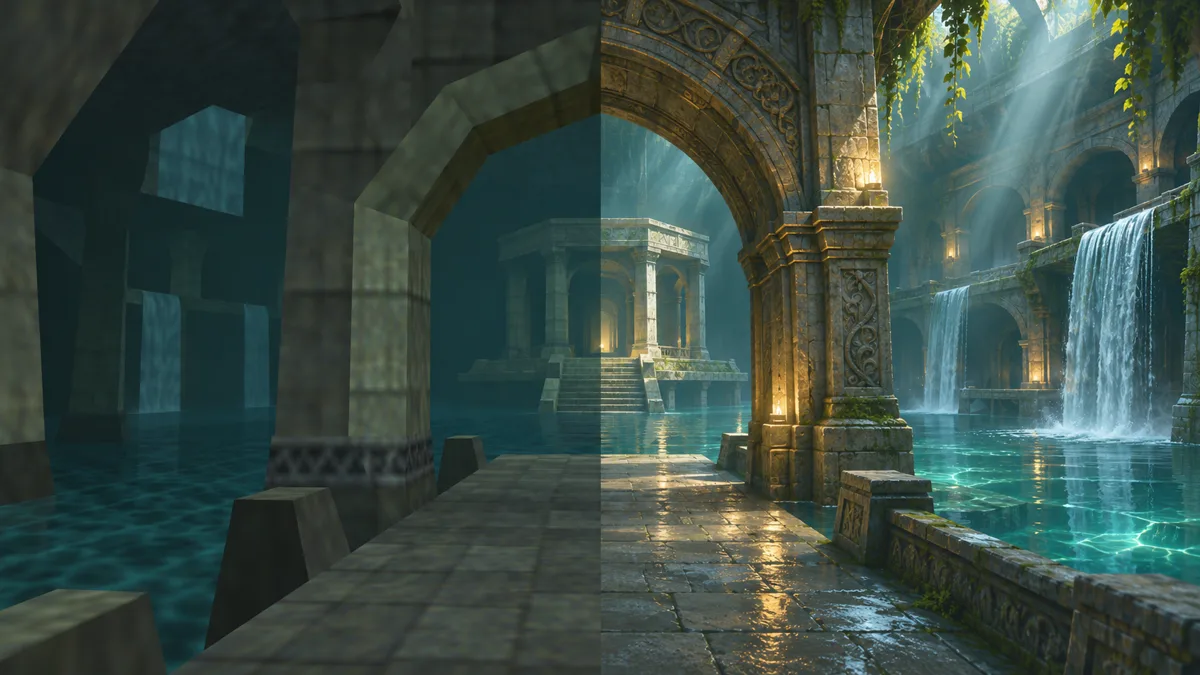
Nintendo's 2026 The Legend of Zelda: Ocarina of Time remake is more than a graphical upgrade. Released November 5 exclusively for Nintendo Switch 2, it rebuilds the 1998 adventure with modern movement, free camera control, voiced cutscenes, expanded dialogue and orchestral music. It also modifies certain dungeon layouts, makes clues easier to spot and changes how some encounters work. The remake is easier in some demonstrable ways, but not every convenience removes a meaningful challenge.
The distinction matters. Faster equipment switching reduces frustration. Removing a dungeon key or making a formerly hidden solution obvious changes the problem players must solve. Meanwhile, the remake launched without Master Quest, the more demanding alternative included in the 2011 Nintendo 3DS version. Newly reported references to that mode in the remake's files do not amount to an announcement of DLC, free or paid.
Here is what has actually changed, what remains disputed and which version makes sense for different players. This is a source-based comparison of Nintendo's disclosures and published hands-on reporting, not a claim of independent, room-by-room gameplay testing.
| At a glance | Answer |
|---|---|
| 2026 remake release date | November 5, 2026 |
| Platform | Nintendo Switch 2 only |
| U.S. price at launch | $59.99 digital; $69.99 listed for physical copies |
| Type of release | Full remake, not an enhanced port of the 1998 game |
| Core adventure | Same basic story, time-travel structure and principal dungeons |
| Biggest gameplay changes | Manual jumping, dashing, right-stick camera, quicker equipment changes, clearer navigation |
| Performance | Targets 60 frames per second, according to technical analysis |
| Master Quest at launch | Not included |
| Master Quest DLC | Possible according to reported file references; not announced by Nintendo |
| Original N64 version still available? | Yes, through Nintendo Switch Online + Expansion Pack on supported systems |
Sources: Nintendo's launch announcement, Nintendo's game page, Best Buy's U.S. listings, Nintendo Life's review and technical analysis summarized by Nintendo Everything.
What changed in the 2026 Ocarina of Time remake?
Nintendo rebuilt Ocarina of Time rather than simply raising the resolution of the Nintendo 64 release. In its November 2026 developer interview, the team describes recreating the game from scratch while repeatedly comparing the results with the original. Its stated objective was to preserve the familiar adventure without requiring newcomers to relearn limitations of a 1998 controller and camera.
The biggest changes fall into four groups:
- Movement and camera: Link can jump on command, dash by holding a button and freely move the camera with the right stick. These change how players move through the same spaces.
- Navigation and puzzles: Equipment is quicker to access, some dungeon geometry is revised and certain solutions are signposted more clearly.
- Presentation and storytelling: Environments are rebuilt, cutscenes feature voice acting, dialogue is expanded and the music has been newly arranged and recorded.
- New assistance and optional activities: A story-progress feature, improved hints, boss rematches, mobile-app functions and other additions sit alongside the main adventure.
Some alterations are surprisingly specific. Aonuma confirmed in a Game Informer interview that the remake now has five usable bottles instead of four, a change he said he had wanted even during development of the original. Published feature inventories also report larger wallets, different enemy patterns and new items.
Other distinctions are less obvious but more consequential: the player may encounter a clearer clue, a shorter route or fewer mandatory steps. Those are the changes that determine whether an older challenge was preserved.
Is the Ocarina of Time remake easier than the original?
In several identifiable respects, yes. But “easier” describes three different changes that should not be treated as interchangeable.
Control friction is the work required to operate the game: pausing repeatedly to equip boots, struggling with a fixed camera or fighting an old interface. Reducing it usually lets players spend more attention on the actual puzzle.
Discovery difficulty is the work of recognizing a clue, interpreting a room and deciding what to try. Adding an unmistakable target to a formerly ambiguous surface can make that puzzle easier, even if the movement and enemies are unchanged.
Failure consequences determine what happens after a mistake: how much damage Link takes, whether a fallen enemy returns, how far a failed jump sends him back or whether a timer forces another attempt. Changing these directly affects challenge.
That framework helps explain why reviewers disagree. Nintendo Life describes a mostly faithful experience with modest puzzle alterations. Game Informer identifies changes that reduce meaningful discovery, particularly in the Water Temple. Both observations can be true: preserving the overall dungeon does not mean preserving every decision needed to solve it.
The Water Temple: Fixing inconvenience and reducing the puzzle
The Water Temple provides the clearest example.
In 1998, changing water levels, remembering connections between floors and repeatedly equipping Iron Boots created a demanding sequence. Some of that difficulty came from spatial reasoning. Some came from pausing the game over and over.
The 2011 3DS remake already improved equipment access, including touchscreen-based Iron Boots switching, and introduced clearer visual indicators for water-level locations. It would therefore be wrong to credit the 2026 remake with inventing convenient Iron Boots controls. Nintendo Life's comparison documents that earlier history.
For Switch 2, Nintendo says it went further. Iron Boots are available through a quick input, the camera can move freely, and some walls have become lattice-like structures so players can see adjacent spaces. Producer Eiji Aonuma said the old layout and repeated menu use made it difficult to remember orientation; director HokWai Ng described the new architecture as a way to make routes easier to follow. Those explanations come directly from Nintendo's developer interview, Part 3.
There is also a more substantial gameplay change. Game Informer's hands-on review reports that the Water Temple now requires fewer small keys. Another IGN review excerpt published by Kotaku describes a previously easy-to-miss key room becoming optional to main progression.
That matters because a room you no longer need to discover is not merely a menu shortcut. It removes a requirement from the puzzle's critical path. Whether players welcome the change is subjective; the reduction in what must be found is not.
The Forest Temple: Not every change makes Link safer
The Forest Temple demonstrates why broad declarations of a universal difficulty reduction are unreliable.
In the original Stalfos encounter preceding the Fairy Bow, part of the arena was an opening in the floor. In the remake, reporting based on hands-on preview footage describes an acid-filled hazard in its place. That alteration can keep the hazard relevant throughout more of the fight rather than simply reproducing the original encounter. A Zelda Dungeon hands-on roundup discusses the encounter; TechRadar's completed-game review independently notes the changed Forest Temple hazard.
Other reported adjustments streamline movement through the temple, including a quicker route in the block-pushing area and a different location for the Dungeon Map. Those changes may reduce backtracking without necessarily making its most important puzzles trivial.
The correct conclusion is not that the Forest Temple is harder or easier overall. It is that individual encounters and navigation requirements have changed in different directions.
The Fire Temple: More dynamic combat, clearer routes
TechRadar's review describes revised platforms in a Fire Temple Lizalfos room, allowing enemies to move through a more dynamic environment. That is a meaningful alteration to how a familiar fight plays, not evidence that every enemy has been weakened.
Nintendo has also acknowledged rearranging certain objects and environmental details to make routes more intuitive. These improvements can shorten searching or backtracking, although the developer interview does not provide a complete room-by-room inventory.
Claims that the entire Fire Temple has been stripped of difficulty go further than the published evidence establishes.
Gohma and other bosses: The difference between clearer rules and weaker enemies
Nintendo has directly explained one redesigned boss cue. In the new Gohma encounter, the creature uses its arms to cover its vulnerable eye when it cannot be damaged. The intended effect is to help players understand when to attack. The developer describes this in Part 3 of Nintendo's interview.
That reduces uncertainty without necessarily changing the attack window itself. It is a useful illustration of the distinction between communicating a rule and rewriting that rule.
Elsewhere, player comparisons circulated after launch have alleged reduced Stalfos damage, changed revival behavior, more aggressive ReDeads and tougher King Dodongo patterns. Kotaku's November 9 report documents the discussion and its contradictions. Those are reported player findings, not an independently verified numerical balance sheet. Without matched testing, there is no sound basis for declaring that combat as a whole became easier by a specific percentage.
The change-by-change difficulty audit
The following matrix separates verified design statements, published hands-on findings and community reports. “Reduces discovery” means the player has less information to infer; it is not a judgment that the change is automatically bad.
| Location or system | What changed compared with 1998 | Likely effect | Evidence strength |
|---|---|---|---|
| Jumping | Automatic edge jumps replaced by a jump button | More freedom, but veterans must relearn timing | Nintendo confirmed |
| Camera | Free right-stick camera, including areas previously shown from fixed views | Easier to inspect surroundings and orient yourself | Nintendo confirmed |
| Dashing | Holding the roll input enables a sustained dash | Faster traversal; preserves rolling as an option | Nintendo confirmed |
| Water Temple: Iron Boots | Boots can be toggled quickly instead of repeatedly opening the original menu | Less interface friction; similar convenience existed on 3DS | Nintendo confirmed; historical 3DS comparison |
| Water Temple: visibility | Some walls replaced with see-through lattice structures | Easier spatial orientation | Nintendo confirmed |
| Water Temple: keys | Fewer small keys needed for progression | Reduces mandatory exploration and deduction | Hands-on reviews |
| Hookshot clues | Some previously subtle usable surfaces replaced with recognizable targets | More obvious item solutions | Hands-on review; specific examples reported |
| Forest Temple | Hazard and room arrangements altered, including an acid-filled arena | Changes risk and traversal; not simply a reduction | Hands-on reviews and previews |
| Fire Temple | Revised platforms in at least one Lizalfos encounter | Changes enemy movement and positioning | Hands-on review |
| Gohma | Arms visibly protect its eye outside damage windows | Makes timing rules easier to read | Nintendo confirmed |
| Stalfos / ReDeads | Players report adjusted damage and behavior in opposite directions | Potentially easier or harder depending on encounter | Community reports; needs controlled comparison |
| Saving | One manual file per profile, autosaves, and resuming nearer the saved location | More convenient continuation but fewer in-game file slots | Hands-on review |
Sources for the matrix: Nintendo's control and dungeon explanation, Game Informer, Nintendo Life, TechRadar and Kotaku's documented player debate.
The pattern is more precise than “Nintendo made Zelda easy.” The remake reduces interface friction, often clarifies environmental information and, in some places, changes what the player must actually discover. It also introduces or alters certain combat hazards. The most defensible criticism concerns specific removed or over-signposted challenges, not the existence of modern controls.
What Nintendo added beyond graphics
The most obvious upgrade is visual. Locations once represented by sparse geometry or pre-rendered backgrounds have been rebuilt so the camera can explore them. Nintendo's September announcement also confirms voiced cutscenes, expanded dialogue and reworked movement.
But several additions change the broader experience:
Threads of Time: A story recap that doubles as guidance
Threads of Time records story progress through illustrated passages that combine into a tapestry. It also helps players remember the next objective. Nintendo describes it as a way for newcomers and returning players to follow the adventure without losing track of the story. See Nintendo's explanation of Threads of Time.
This is useful for players who return to a save after a long break. It also changes how much uncertainty exists about where to go next. The mechanism is optional assistance, but its availability is part of why the remake can feel more guided.
Hall of Fallen Foes: Boss rematches, not Master Quest
The Hall of Fallen Foes lets players examine defeated enemies and revisit boss encounters. Nintendo Life's completed-game review reports rematches and multi-boss sequences. It adds replay value, but it does not substitute for a complete second campaign with redesigned dungeon puzzles.
Microphone ocarina and Zelda Notes
Instead of always entering musical notes with buttons, players can hum or play melodies into the Switch 2 microphone. Button controls remain available. Nintendo also supports ZELDA NOTES through the Nintendo Switch App, with activities including location challenges, music-score sharing and a quiz. The official game page and developer interview, Part 4 explain these functions.
The music itself received unusual attention. Nintendo says the remake includes more than 150 background music pieces, combining orchestral arrangements with carefully recreated sounds associated with the Nintendo 64 version. The result is not merely louder or more elaborate music in every scene; the developers describe keeping intimate areas restrained where appropriate.
Extra items, rewards and inventory changes
The fifth bottle is a confirmed addition. Published guides also document larger wallet capacities, a Business Scrub Seed that can summon a merchant, and an Echo Gem replacing the older rumble-oriented secret-finding reward. Those details matter because a walkthrough for the N64 or 3DS game may give the wrong inventory capacity, reward or route in the remake. Compare Nintendo Everything's feature inventory with Zelda Central's post-release changes guide.
Did Nintendo remove or soften anything from the original?
Yes, some details and interactions differ, although “Nintendo censored Ocarina of Time” is too broad a claim for the available evidence.
One documented example is a wounded soldier encountered in a Castle Town alley after Zelda's escape. In the N64 game, his dialogue and final on-screen description indicate he has died. In the remake, that concluding description is absent and the character can reportedly be spoken to again. Kotaku's November 9 comparison identifies the change. This is more than a graphics update: it alters the finality of a small story moment.
Players have also debated the appearance of stains in darker environments and a changed late-game depiction of blood. Some screenshots circulated without sufficient context, and darker coloring is not automatically evidence that a scene has been removed. The underlying comparisons must be distinguished from guesses about why Nintendo changed them.
Nintendo has given a relevant but general explanation of its approach. In a Game Informer interview, Eiji Aonuma said the team wanted the unsettling enemies and darker side of Hyrule to remain frightening without making the presentation so intense that younger or newer players would be discouraged.
That establishes a design consideration, not proof of the reason for each altered scene. Other reviewers, including VGC, argue that the remake retains the original's unsettling atmosphere.
There are also minor losses unrelated to darkness. Nintendo confirmed it removed the Nintendo character portraits formerly visible in Princess Zelda's courtyard. In Game Informer's interview, Aonuma explained that recognizing an unrelated character such as Yoshi could interrupt the player's immersion in Hyrule. Talon's Bowser emblem remains.
The broader lesson is that faithfulness is not binary. A remake can preserve the main story while changing individual lines, visual details, encounters and the tone of a particular moment.
Is Master Quest missing from the 2026 remake?
Yes. The Switch 2 game launched without Master Quest and without an equivalent full hard-mode campaign. That absence is confirmed in Nintendo Life's review.
The historical distinction matters:
- The 1998 N64 original did not launch with Master Quest.
- Master Quest appeared in 2003 as a separate GameCube-era version with remixed dungeons and puzzles.
- Ocarina of Time 3D (2011) included an unlockable Master Quest after finishing the main game. Its version mirrors the world and makes Link take double damage, as explained in Nintendo's original Iwata Asks developer interview.
- The 2026 remake has boss-rematch activities but no playable Master Quest at launch.
So the accurate statement is not that Nintendo removed Master Quest from the 1998 game. The 2026 remake lacks a mode players could access in the 2011 3DS version. For an experienced player seeking a more demanding second run, that is a substantial omission.
There is a potential source of confusion: the remake offers Normal, Pro and Master display settings, according to hands-on coverage. These are interface or HUD presentation options, not the separate Master Quest campaign. Hiding interface information is not the same as changing dungeon layouts or doubling damage.
Is Master Quest coming as paid DLC?
Nintendo has not announced Master Quest DLC, a price or a release date as of November 10, 2026. There is, however, more to the rumor than a fan wish list.
Following the November 5 launch, dataminer MrCheeze reported references to Master Quest-like content in the game's files. Strings cited in Nintendo Everything's November 7 report include HasMQ, IsMQModeExist, NewGameMQ and ReleaseMQ. The reported findings were subsequently supplemented by OatmealDome, who described DLC-ownership checks and apparently incomplete data for a mirrored world and modified dungeons. VGC covered those findings on November 9.
The evidence supports several different conclusions, and they must not be collapsed into one:
| Claim | What the evidence supports |
|---|---|
| Master Quest-related code references exist | Reported by named dataminers; independently reproducible validation has not been provided in this article |
| The files suggest a DLC unlock pathway | Reported from ownership checks, consistent with a possible separate content entitlement |
| Nintendo will release Master Quest | Not established. Unused or unfinished development code can remain in a shipped game |
| Nintendo will charge for Master Quest | Not established. A DLC entitlement check does not by itself prove a paid purchase |
| The mode has a release date | No official date announced |
When IGN asked producer Eiji Aonuma about the missing mode, he left open the possibility of future work but made no specific announcement, according to Nintendo Everything's report of the interview.
The responsible conclusion is straightforward: Master Quest appears to have been contemplated in the game's code, but its release, form and price are unresolved. Anyone buying the remake today should judge the content actually available, not a rumored addition.
Ocarina of Time on N64 vs. 3DS vs. Switch 2
The remake's improvements are easiest to understand across three generations, not merely by comparing 1998 with 2026. The 3DS release already addressed several problems associated with the original interface and included content missing from the newest version.
| Feature | N64 original (1998) | Ocarina of Time 3D (2011) | Switch 2 remake (2026) |
|---|---|---|---|
| Type of release | Original game | Updated remake | Newly rebuilt remake |
| Jumping | Automatic at designated edges | Automatic at designated edges | Manual jump button |
| Camera | Limited/fixed in many areas | Improved presentation, no modern free-camera system | Free right-stick camera |
| Iron Boots | Repeated pause-menu changes | Quick touchscreen access | Quick controller input |
| Water Temple guidance | Original layout and visual information | Added navigational cues | Additional geometry, visibility and key changes |
| Frame rate | Approximately 20 fps | Approximately 30 fps | Targets 60 fps |
| Story presentation | Mostly text and limited vocal sounds | Updated visuals and text | Expanded dialogue and voiced cutscenes |
| Master Quest | Not in the original launch | Unlockable after main story | Not available at launch |
| Extra guidance | Navi and ordinary map systems | Hint movies and revised interface | Threads of Time, revised hints and ZELDA NOTES |
| Boss rematches | No comparable dedicated hall | No comparable dedicated hall | Hall of Fallen Foes |
| Save arrangement | Multiple game files | Multiple game files | One manual save per system profile, plus autosaves |
| How to play now | Original hardware or N64 version through Switch Online + Expansion Pack | 3DS hardware and a copy of the game | Purchase standalone Switch 2 remake |
Sources: Nintendo's 2026 developer interview, Nintendo's historical 3DS development interview, Nintendo 64 – Nintendo Classics, Nintendo Life's review and Nintendo Everything's performance summary.
Why this comparison changes the answer: Against the N64 original, nearly every control improvement feels dramatic. Against Ocarina of Time 3D, the Switch 2 remake adds major visual and movement advances but does not introduce every convenience for the first time. The 3DS release also retains an alternative challenge mode the newer game does not currently offer.
Is the Ocarina of Time remake worth buying?
The answer depends less on whether the remake is universally “better” than on what a player wants from it.
For first-time players who already own Switch 2: The modern camera, manual jumping, clearer directions and updated presentation remove barriers that can make an older 3D adventure difficult to approach. The remake is designed as a complete introduction, not merely a nostalgia product. The standard U.S. digital price is $59.99.
For returning players who mainly want to revisit the story: The rebuilt world, expanded scenes, soundtrack and revised controls provide substantial reasons to revisit Hyrule. Expect a familiar quest, not a wholly new set of dungeons.
For players who want the original's more obscure puzzles and tougher second playthrough: The 3DS version remains important. It includes Master Quest and preserves an older approach to certain environmental discoveries. The 2026 remake's quality-of-life changes may be precisely what these players do not want from every puzzle.
For someone without Switch 2: There is no need to buy the new console simply to discover the original game. Nintendo still lists the N64 edition of Ocarina of Time in its Nintendo 64 – Nintendo Classics collection for Nintendo Switch Online + Expansion Pack subscribers. The new remake itself is exclusive to Switch 2.
There is no single correct version for every player. The decision comes down to presentation, controls, willingness to navigate older mechanics and the value of having Master Quest available now.
Frequently asked questions
Is the 2026 Ocarina of Time a remake or a remaster?
A full remake. Nintendo says the game was rebuilt from scratch for Switch 2 rather than simply updating the original N64 code and assets. It preserves the central adventure while changing presentation and mechanics. See Nintendo's developer explanation.
Does the Ocarina of Time remake have new dungeons?
It retains the original game's principal dungeon lineup rather than adding a wholly new story campaign. Individual rooms, puzzles and encounters have changed. The Hall of Fallen Foes adds repeatable battles, not a replacement sequence of new story dungeons. Nintendo Life's review details the additional mode.
Did Nintendo fix the Water Temple?
Nintendo substantially improved its usability through quicker Iron Boots controls, free camera movement and clearer sightlines. Hands-on reporting also describes fewer mandatory small keys. Whether that makes the dungeon better is a matter of preference; its navigation is easier and some discovery requirements have changed.
Does the remake include a hard mode or Master Quest?
Not at launch. The Master HUD preset changes information displayed on screen; it is not Master Quest. Nintendo has not announced a separate hard-mode campaign as of November 10, 2026.
Can you play the remake on the original Nintendo Switch?
No. The official Nintendo product page lists the 2026 remake as exclusive to Switch 2. The original N64 version remains accessible through a separate Nintendo Switch Online offering.
Can you play the new Ocarina of Time with button controls instead of humming?
Yes. Nintendo describes microphone input for ocarina melodies as an alternative to normal button-based song entry, not a requirement. See the official game's feature description.
Is Master Quest DLC confirmed, and would it be free?
No. Dataminers have reported related code and DLC-ownership checks, but Nintendo has announced neither a release nor a price. Both free and paid interpretations remain unconfirmed; the code could also reflect incomplete development work.
What the remake ultimately changes
Nintendo's achievement is not simply that Hyrule looks more detailed in 2026. It has made a 1998 design operate in ways a modern player expects, while leaving much of the original adventure recognizable.
The trade-off is that some obstacles were never just technical inconveniences. A difficult-to-read room might be poor communication; discovering how that room works can also be the heart of the puzzle. Faster boots do not remove that discovery. Fewer mandatory keys and more explicit solutions sometimes do.
The most accurate verdict is therefore neither “Nintendo ruined Ocarina of Time” nor “everything was improved.” The remake preserves the journey, improves access to it and changes some of the work required to complete it. Players deciding which version to buy deserve to know the difference.
References and Further Reading
Primary Nintendo documentation
- Nintendo: Ocarina of Time launch announcement, November 5, 2026. Confirms release date, platform, central features and official U.S. digital price.
- Nintendo: Ask the Developer, Part 3, Adapting the Game for a Modern Era. Primary explanation of manual jumping, movement, the camera, Water Temple changes, Gohma and Threads of Time.
- Nintendo: Ask the Developer, Part 4, A World Bursting with Life. Details orchestral music, ambient sound, humming controls, voice acting and the intended balance between challenge and accessibility.
- Nintendo: Ocarina of Time game page. Confirms Switch 2 exclusivity, new systems and compatibility information.
- Nintendo: Iwata Asks, Ocarina of Time 3D development interview. Explains the 3DS version's Master Quest, mirrored world, greater damage and hints.
- Nintendo: Nintendo 64 – Nintendo Classics. Establishes how the original N64 game remains available through Nintendo Switch Online + Expansion Pack.
Independent reporting, gameplay reviews and current developments
- Game Informer: Ocarina of Time review, Exceptionally Familiar. Firsthand review discussing streamlined dungeon design and reduced Water Temple key requirements.
- Game Informer: Interview with Eiji Aonuma and Hidemaro Fujibayashi. Primary interview on the remake's design philosophy, fifth bottle, dialogue revisions, darker enemies and removed Nintendo portraits.
- Nintendo Life: Ocarina of Time review (Switch 2). Firsthand assessment of controls, saving, boss rematches and absent Master Quest.
- TechRadar: Ocarina of Time remake review. Firsthand descriptions of revised dungeon hazards and encounters, audio, performance and narrative additions.
- Kotaku: Has the Ocarina of Time Remake Changed Too Much?. Collects concrete player comparisons, including changed encounter difficulty and altered story details; community claims require separate verification.
- VGC: Ocarina of Time Switch 2 Could Be Getting Master Quest DLC. Reports named dataminers' findings and distinguishes the possibility of DLC from Nintendo confirmation.
- Nintendo Everything: Master Quest References Potentially Found in Remake Files. Records the reported code strings and later DLC-ownership observations.
- Zelda Central: Changes from the Original. Specialist reference for item, collectible and version differences; use with primary or firsthand confirmation for disputed details.
Editorial currency note: Release information, prices and Master Quest status were reviewed November 10, 2026. Pricing and available features can change. This article synthesizes Nintendo documentation and attributed third-party reporting; it does not claim that sherafy.com independently measured combat damage or completed controlled gameplay comparisons across all three versions.