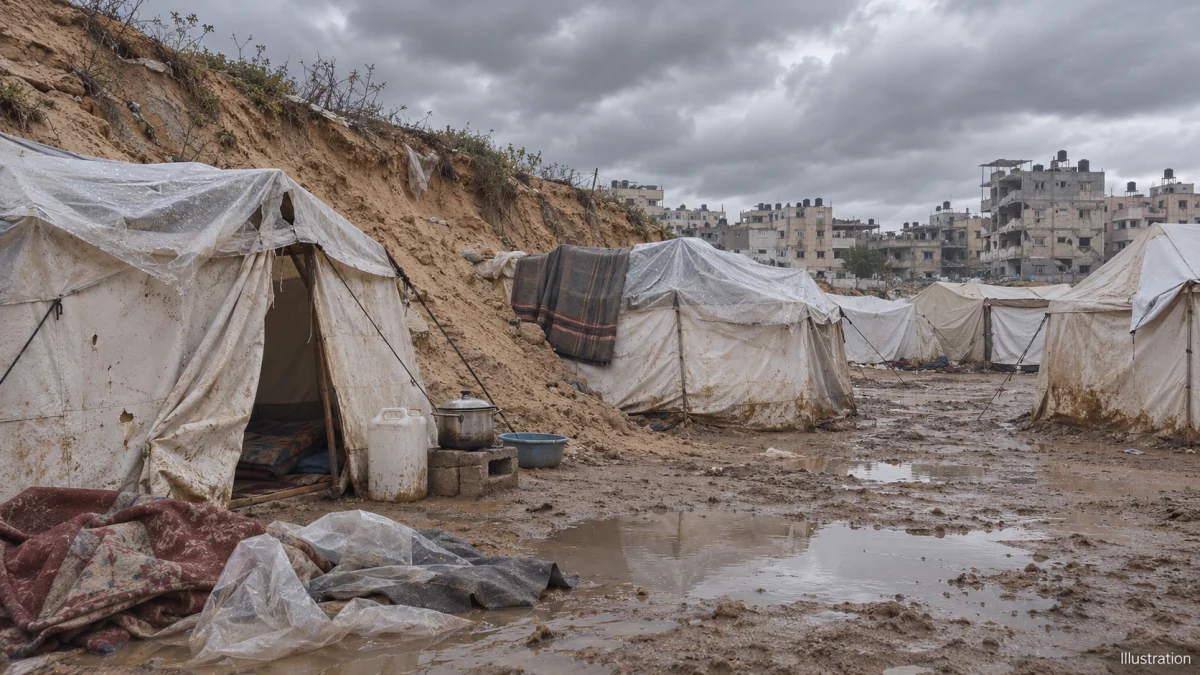
On November 8, 2026, heavy rain brought down a sandy embankment onto tents sheltering displaced Palestinian families near Deir al-Balah in central Gaza. According to Gaza Civil Defense figures cited by the United Nations Office for the Coordination of Humanitarian Affairs (OCHA), five people were killed, including three children and two women. Other early reports gave different counts.
The rain triggered the collapse. It did not explain why families were sleeping beneath the embankment.
They were there after years of war, widespread destruction of housing, repeated displacement, and a shelter response constrained by Israeli restrictions, inaccessible land, inadequate equipment, and funding shortages. The danger of winter flooding was not discovered afterward. Humanitarian agencies had documented it weeks before the storm.
This was not an inexplicable accident in an otherwise functioning society. It happened within a shelter crisis produced by war, displacement, and policy decisions. Israeli military operations destroyed or damaged much of Gaza’s housing, Israeli authorities maintained restrictions that humanitarian agencies say obstructed safer alternatives, and Washington continued military support while warnings mounted. To understand what the storm exposed, begin with the people buried beneath the sand.
The families beneath the embankment
Aisha Al-Zain heard people shouting that a tent had fallen on her niece, Tahrir, and her children. She ran toward the camp. Where the tents had stood, she found a mound of sand.
In firsthand reporting for Arab News, relatives identified Tahrir, also known as Umm Salah, her daughter Mariam Nabhan, and another young girl, Habiba, as among those killed. Habiba was the daughter of Reem, another woman caught in the collapse. Relatives said Reem and her son Ibrahim were in intensive care. Aisha also said Tahrir was four or five months pregnant.
These are relatives’ accounts, not an independently completed list of all five fatalities. The reporting should not be stretched to assign every casualty a name or relationship that has not been confirmed.
The families had come from Jabalia in northern Gaza. According to Aisha, they had been displaced eight times in three years. They eventually settled among other families in tents near Deir al-Balah, in a place that offered somewhere to stay but not meaningful protection from the hillside above them.
The story is not that these families failed to recognize the danger. It is that years of displacement had narrowed the choices available to them.
In a separate eyewitness report by The Guardian, a father survived the collapse because he was outside his tent when the embankment fell. That account should not be confused with the family relationships reported by Arab News. Together, the reports describe people digging through sand and debris to reach those trapped beneath.
There is a legitimate uncertainty about the earliest death toll. Reuters initially reported four deaths, including three children; UNICEF described three children and their mother; the November 9 OCHA situation report gave five deaths, including three children and two women. The article uses OCHA’s five-person figure as the latest UN situation-report count available at publication, while acknowledging that the early reports are not fully reconciled.
A casualty discrepancy is worth correcting. It does not change the more consequential finding: displaced civilians were killed in tents after the humanitarian system had already identified dangerous shelter conditions on a vast scale.
Why were Palestinian families still living in tents?
For many people outside Gaza, the immediate question is deceptively simple: why had the family not gone home or moved to a safer building?
Because a safe, accessible home was often no longer available.
The April 2026 Gaza Rapid Damage and Needs Assessment, produced jointly by the United Nations, European Union, and World Bank, recorded 371,888 housing units destroyed or damaged, equivalent to about 76.6% of Gaza’s housing stock in that assessment. It estimated that 1.9 million people had been displaced, often repeatedly.
A separate satellite-based measure found damage to approximately 82% of all structures by June 16, 2026, as reported in an OCHA summary of the UN Satellite Centre’s assessment. These are different measurements: one counts housing units; the other counts structures of all kinds. They should not be presented as competing estimates of the same thing.
Nor does every damaged house become permanently uninhabitable. But destroyed buildings, unstable walls, unexploded ordnance, damaged roads, broken water networks, and restrictions on access make a simple return impossible for many families.
Displacement also continued after the October 2025 ceasefire. The UN Commission of Inquiry’s October 2026 report described Israel’s expanding territorial control and the increasingly consequential demarcation known as the Yellow Line. It found that Israeli-controlled areas had expanded to at least 60% of Gaza by September 2026. The commission’s finding is about territorial control, not a precise measure of every accessible shelter site, but it helps explain why a smaller area has had to absorb much of the displaced population.
In its October 19 humanitarian report, OCHA was explicit: Israeli restrictions on access to suitable land, alongside shortages of materials and machinery and a lack of viable relocation options, were obstructing preparations for winter.
That is the answer to the question "Why didn’t they move?" A family can be physically capable of moving while still having no realistic, adequately protected place to go. Each relocation costs transport, money, supplies, access to water, and a location where a tent can be pitched. After eight displacements, telling a family to move again is not an answer to the conditions that made relocation necessary.
The warnings came before the rain
The disaster was not the first indication that Gaza’s displacement camps were unsafe. The documentary timeline is unusually clear.
| Date | What was documented before and during the storm |
|---|---|
| September 11, 2026 | OCHA reported that Israeli authorities had rejected nearly 37,000 timber pieces and 660 emergency shelter kits at the Kerem Shalom crossing on August 26 and September 2, then denied a renewed coordination request, reportedly on security grounds. |
| October 19 | OCHA reported approximately 950,000 displaced people at medium-to-high flood risk, including more than 400,000 at high risk. Available supplies could partially assist only 18% of 294,250 families needing rainy-season shelter assistance. |
| November 6 | OCHA’s report covering November 5 estimated a need for 121,000 tents and 57,000 emergency shelter kits, with about 2,800 tents and no emergency shelter kits in the Shelter Cluster’s stocks inside Gaza as of November 1. |
| November 6 | The Israeli military said Gaza’s humanitarian situation was the best since the war began and reported that more than 85,000 tents had entered under its winter-preparation program. |
| November 8 | Rain brought down the sand embankment near Deir al-Balah, killing displaced civilians. |
| November 9 | OCHA documented more than 26,000 households reporting storm damage to shelters or belongings, alongside severe shortages of emergency supplies and equipment. |
These warnings were about widespread flooding, unsafe buildings, exposed camps, and inadequate materials. They do not establish that engineers had specifically predicted the failure of this particular embankment. Relatives suspect that earlier bombardment weakened the hillside, but a site-specific geotechnical assessment is not available in the sources reviewed. That explanation cannot be treated as proven.
What the records do establish is enough to demand an accounting. Humanitarian agencies identified a population exposed to foreseeable winter hazards, warned of inadequate shelter stocks, documented barriers to obtaining materials, and then reported widespread damage when the first major rains arrived.
The relevant question is not whether authorities knew the exact minute a sandbank would collapse. It is what they knew about the exposure of civilians, what means of protection were available, and why those means were still inadequate.
The difference between a tent approved, a tent delivered, and a family protected
Israel’s military says substantial humanitarian assistance entered Gaza. That claim deserves examination, not automatic acceptance or automatic rejection.
In a November 6 statement, the Israel Defense Forces and COGAT said more than 85,000 tents and over 8,000 trucks of winter supplies had entered under a winterization program. The statement said more than 820 requests had been approved, but that roughly half of the approved equipment had not yet entered, partly because of logistical and budgetary problems the military attributed to organizations rather than to Israel. Israeli authorities also cite security concerns about materials that could be diverted to armed groups.
These are Israel’s reported figures and explanations. They do not answer the question the families faced on November 8: was safe shelter available to them?
To test a delivery claim, several distinct stages have to be separated:
- Requested: An aid organization identifies a need and seeks permission or coordination.
- Approved: An authority allows a specified shipment or operation.
- Admitted: Goods physically cross into Gaza.
- Available: Supplies reach a stockpile that humanitarian teams can access.
- Distributed and usable: The intended family receives an adequate shelter in a place that is reasonably safe.
Success at one stage is not evidence of success at the next. A cumulative tally of tents admitted cannot tell us how many are intact, how many remain in stock, how many families require replacement, whether drainage works, or whether the intended location is safe.
The UN’s figures expose the stakes of that distinction. On November 6, OCHA reported just 2,800 tents in the Shelter Cluster’s in-Gaza inventory and a severe unmet need for tents, repair kits, tarpaulins, and mattresses. It recorded a $186.5 million funding gap against estimated winterization requirements of $267.9 million. Funding and procurement delays mattered; Israeli restrictions were not the only obstacle.
Then, on November 9, OCHA reported that more than 150,000 tents purchased by humanitarian partners and member states were outside Gaza ready for dispatch, including approximately 117,000 from the Egyptian Relief Committee in Al-Arish. Those figures describe a wider set of purchasers and stocks than the November 6 Shelter Cluster inventory. They cannot be directly subtracted from or added to the earlier stock count.
But the underlying humanitarian problem is unmistakable: substantial shelter resources existed or were planned, while families in Gaza remained exposed and stocks inside the territory were depleted. OCHA explicitly called for more Israeli approvals, funding, supplies, and machinery to close the gap.
Some restrictions are not merely a matter of interpreting competing totals. In September, OCHA identified actual rejected shipments of timber and emergency shelter kits, followed by a denied request to coordinate their entry. The Israeli authorities reportedly cited security grounds. A security justification is a claim that must be examined against the humanitarian need and the applicable law; it does not erase the fact that the materials were refused.
The appropriate accountability measure is not how many supplies a government says it allowed in. It is whether the civilian population can obtain the conditions necessary to survive.
What the storm revealed about rescue, sanitation, and the next preventable deaths
The collapsing embankment was one emergency within a much larger breakdown.
According to OCHA’s November 9 assessment, Gaza Civil Defense received 2,166 distress calls on November 7 and was able to respond on-site to 218 of them. Most other callers received guidance because responders could not reach everyone. The same report described destroyed or damaged family shelters, flooded sites, and shortages of vacuum trucks, mobile pumps, engine oil, hoses, and heavy machinery.
Those numbers do not measure the fate of every caller. They measure the size of the emergency relative to the capacity available to respond.
Just before the storm, OCHA documented another death involving collapsing sand: a person in Gaza City was killed while digging a cesspit by hand, a task undertaken amid shortages of modular cesspit systems and materials needed to connect toilets to sewer networks. This was not the Deir al-Balah landslide, and the two sites should not be treated as geologically identical. The incidents nonetheless reveal the risks that appear when essential infrastructure is destroyed and safe substitutes are not available.
UNICEF’s November 9 statement described the broader health danger. No wastewater-treatment plant in Gaza was operational. At Gaza City’s Sheikh Radwan stormwater basin, only two of six pumps were working. UNICEF said it had sought Israeli approval for more than a year to bring in equipment needed to repair the facility.
The basin is in Gaza City, not the site of the Deir al-Balah collapse. It is evidence of a system-wide infrastructure and access problem, not proof of the mechanism at that particular hillside.
UNICEF also reported that 11 children had died of hypothermia during the previous winter. Exposure, sanitation failures, contaminated water, respiratory illness, and inadequate medical services are not abstractions when children are living in torn tents and damaged buildings. They are pathways through which civilians can die without being struck directly by a weapon.
A peer-reviewed 2026 study in The Lancet Global Health estimated 8,540 excess nonviolent deaths in Gaza between October 7, 2023, and January 5, 2025, above projected prewar mortality. Researchers surveyed 2,000 households and reported substantial uncertainty around the estimate. The study measures an earlier period and cannot tell us how many subsequent weather-related deaths were caused by the war. Its contribution is to establish, independently, that deaths beyond direct violence are a substantial part of a conflict’s human toll.
An individual death certificate may name drowning, infection, cold exposure, or a crushed chest. That is the immediate mechanism. Understanding preventability also requires asking why the person was exposed to the danger and why protection was unavailable.
The legal question is not limited to who fired a weapon
There is a reason international humanitarian law does not define civilian protection solely as refraining from shooting civilians.
The Genocide Convention includes, in Article II(c), the deliberate infliction of conditions of life calculated to bring about the physical destruction of a protected group, in whole or in part. That provision is not a declaration that every avoidable death is genocide. Genocide requires the specified destructive intent, and individual incidents must be assessed within the wider evidence.
The wider evidence has been examined by international investigators.
In September 2025, the UN Independent International Commission of Inquiry concluded on a reasonable-grounds standard that Israeli authorities and security forces had committed genocide in Gaza. Its analysis included killings, serious bodily and mental harm, and the deliberate imposition of destructive conditions of life. The Commission also concluded that the evidence supported genocidal intent. In its October 2026 report, it found that genocidal acts continued. Those are the Commission’s substantive findings, not a final judgment by an international court.
Separately, the International Criminal Court issued arrest warrants in November 2024 for Israeli Prime Minister Benjamin Netanyahu and former Defense Minister Yoav Gallant. Its pretrial judges found reasonable grounds to believe they bore criminal responsibility for the war crime of starvation as a method of warfare and crimes against humanity during the period examined. The ICC said it found no clear military justification for the humanitarian-relief restrictions addressed in that proceeding. Arrest warrants are not convictions, and they do not themselves adjudicate the November 2026 landslide.
The International Court of Justice, in the separate case brought by South Africa, issued binding provisional measures requiring Israel to prevent acts falling within the Genocide Convention and facilitate humanitarian assistance. It has not yet issued a final merits judgment on whether Israel committed genocide. In May 2026, the Court set further written-pleading deadlines extending into 2029.
Israel rejects the genocide allegations. Its rejection does not nullify the Commission’s findings, the ICC’s judicial determinations at the arrest-warrant stage, or the ICJ’s binding provisional measures. Nor does an ongoing court case require the public to suspend consideration of documented harm until the final judgment arrives.
The legal distinction is straightforward: the landslide is not itself a judicial finding of genocide; the documented conditions in which it occurred are relevant to an already substantial body of international findings about Israel’s conduct in Gaza.
The United States is part of the accountability record
American involvement is not conjecture. It is written into U.S. law and official filings.
The enacted Consolidated Appropriations Act, 2026 (Public Law 119-75) made not less than $3.3 billion available in Foreign Military Financing grants for Israel in fiscal year 2026. That is military financing, not humanitarian shelter funding. It should not be described as money directly spent on the Deir al-Balah site. It does, however, document a continuing U.S. role in sustaining Israel’s military capacity during a period of severe civilian harm and international scrutiny.
U.S. support extended beyond that appropriation. A Congressional Research Service account of arms-sale procedures describes the administration’s use of emergency authorities in March and May 2026 to expedite certain arms sales to Israel. An arms-sale authorization is not proof that a particular weapon was delivered or used in a particular strike. It is evidence of continued U.S. decisions to facilitate military supply.
Washington also took a clear position in the genocide proceedings. In its March 12, 2026 declaration of intervention at the ICJ, the United States said the allegations of genocide against Israel were false and submitted arguments concerning how the Genocide Convention should be interpreted. This was an official legal position, not a judicial determination that the allegations were false.
The Genocide Convention’s Article I binds states parties to prevent and punish genocide. The UN Commission of Inquiry has urged states to use the means reasonably available to them to prevent genocide, and to examine assistance and arms transfers in light of their obligations.
There are therefore several questions the United States cannot evade merely by describing itself as a mediator or ally. What information about civilian destruction and shelter restrictions was available to American officials? What military and diplomatic support continued after those warnings? What leverage did Washington have over an ally receiving substantial American assistance? How was that leverage used?
A legal finding of U.S. complicity in genocide would require its own analysis of the applicable standards and evidence; it has not been established by the records cited here. But political responsibility for continued support and the legal duty to prevent genocide are questions that arise long before a court rules on complicity. They warrant direct examination, not a footnote.
What prevention would have looked like
The humanitarian response did not lack a list of needed measures. It lacked sufficient access, material, financing, and implementation capacity to deliver them at scale.
The documented priorities included safe relocation areas, usable tents and more durable shelter, timber and repair kits, drainage maintenance, mobile pumps, sewage equipment, fuel and engine oil, rescue machinery, and repair of damaged buildings. Eventually, these measures must give way to meaningful rebuilding of homes and infrastructure. Tents are emergency shelter, not a substitute for civilian housing.
The responsibility for delivering those protections is distributed, but it is not anonymous. Israeli authorities controlled consequential approval processes and restricted access to land; aid organizations and donors faced funding and procurement limits; armed conflict and damaged infrastructure complicated delivery. Those categories should be investigated together without pretending they had identical powers or made identical decisions.
This is why the exact location of one family’s tent matters. Safe shelter is not a box marked "delivered" on an aid spreadsheet. It is a place where a child can sleep without a damaged wall falling, sewage flooding the ground, or an unstable bank burying the family during a storm.
Questions readers are asking
Was the November 8 Gaza landslide caused by an Israeli airstrike?
The immediate reported trigger was heavy rain that destabilized a sandy embankment beside a displacement camp. A relative suggested earlier bombardment had weakened the hillside, but no independently verified site-specific engineering evidence reviewed for this article establishes that claim. The broader housing destruction, displacement, and shelter crisis are documented separately.
How many children died in the Deir al-Balah tent collapse?
The November 9 OCHA situation report cited Civil Defense figures of five people killed, including three children and two women. UNICEF described three children and their mother; some early reports counted four total fatalities. Those accounts were not fully reconciled at publication.
Why can’t people in Gaza just return to their homes?
Many homes have been destroyed or damaged, essential services are broken, and access to some land remains restricted. The April 2026 joint UN-EU-World Bank assessment documented damage or destruction to more than 371,000 housing units. A ceasefire does not automatically make damaged buildings safe or reopen restricted areas.
Did Israel allow tents into Gaza before the storm?
Israel’s military said more than 85,000 tents had entered under its winterization program by November 6. OCHA simultaneously documented large unmet shelter needs, depleted in-Gaza stocks, denied materials, restricted access, and major funding gaps. Entry totals and actual family protection measure different things.
Were the risks known before the children died?
Yes, at the population level. OCHA documented approximately 950,000 people living in flood-exposed displacement sites in October. The reviewed sources do not establish that anyone had predicted this exact embankment would fail.
Does the landslide prove genocide or U.S. complicity?
No single weather-triggered collapse proves those legal conclusions. The UN Commission of Inquiry has separately found that Israel committed genocide in Gaza; ICC arrest warrants allege serious international crimes; the ICJ genocide case remains pending. The United States’ military and diplomatic support is documented, while a legal finding of U.S. complicity requires additional elements not established by this incident alone.
An emergency that did not begin with the weather
The children who died near Deir al-Balah did not choose the war, the destruction of their homes, or the repeated displacement that brought their families to the edge of a sand embankment. Their relatives’ accounts describe people moving again and again in search of somewhere they could remain alive.
There is a temptation, after every new death, to argue over whether its immediate cause was a bomb, a disease, the cold, a flood, or a collapse. The causes matter. They must be documented accurately. But treating each death as disconnected from the conditions surrounding it conceals how civilian life becomes steadily less survivable.
By October, the flood exposure was documented. By early November, the shelter and equipment shortages were documented. The damage to housing and the constraints on access were already documented. Then the storm arrived.
The warnings came before the rain. The families were still sleeping in danger when it came.
References and Further Reading
Humanitarian records, shelter, and infrastructure
- OCHA, Humanitarian Situation Report: Heavy Rains in the Gaza Strip, 8 November 2026. Published November 9. The primary UN emergency account, including the Civil Defense fatality figures, damaged shelters, relief stocks, distress calls, and equipment constraints.
- UNICEF, Three Children Killed as Heavy Rains Batter Displaced Families in Gaza. November 9. Documents child deaths, flood exposure, winter hazards, wastewater breakdowns, and the stalled pump-repair equipment request.
- OCHA, Humanitarian Situation Report, 15 October 2026. Published October 19. Records advance flood-risk estimates, the shortfall in winter shelter assistance, access constraints, and conditions at displacement sites.
- OCHA, Humanitarian Situation Report, 5 November 2026. Published November 6. Documents immediately pre-storm shelter inventories, unmet needs, funding and procurement gaps, equipment restrictions, and a separate fatal sand collapse.
- OCHA, Humanitarian Situation Report, 11 September 2026. Published September 12. Records Israeli rejection of timber and emergency shelter kits and the subsequent denied coordination request.
- UN, European Union, and World Bank, Final Gaza Rapid Damage and Needs Assessment. April 20. Provides the housing-damage and displacement baseline, along with estimates of reconstruction needs.
- Israel Defense Forces, How Is the IDF Preparing Humanitarian Efforts for Winter in Gaza?. November 6. Israel’s own claims about tent entry, aid approvals, the humanitarian situation, and reasons given for delays. Included as an interested-party record to be assessed against humanitarian outcomes.
Firsthand accounts and mortality research
- Razan Salman, Arab News, Death Follows Us in Every Form: In Gaza, Even the Sand Now Kills. November 9. Interviews relatives of families caught in the collapse, including accounts of victims, survivors, and repeated displacement.
- The Guardian, Witnesses Recount Struggle to Save People Buried in Horrifying Gaza Landslide. November 9. Separate eyewitness reporting on rescue efforts and the damage to tents.
- Spagat and colleagues, Violent and Non-Violent Death Tolls for the Gaza Conflict: New Primary Evidence from a Population-Representative Field Survey. The Lancet Global Health, 2026. Original household survey estimating violent deaths and excess nonviolent mortality for October 2023 through early January 2025.
International law and United States policy
- United Nations, Convention on the Prevention and Punishment of the Crime of Genocide. Treaty text, particularly Articles I and II, establishing the duty to prevent and the legal definition of genocide.
- UN Independent International Commission of Inquiry, Legal Analysis of the Conduct of Israel in Gaza (A/HRC/60/CRP.3). September 2025. The Commission’s substantive evidence and legal reasoning for its genocide determination.
- UN Independent International Commission of Inquiry, Report A/81/430. October 2026. Updated findings concerning civilian harm, territorial control, and continuing genocidal acts.
- International Criminal Court, Warrants for Benjamin Netanyahu and Yoav Gallant. November 2024. Explains the reasonable-grounds findings concerning alleged starvation and crimes against humanity; these are not convictions.
- International Court of Justice, Order of 24 May 2024, South Africa v. Israel. Binding provisional measures, including humanitarian-access requirements, rather than a final genocide judgment.
- International Court of Justice, Procedural Order of 21 May 2026. Sets further written-pleading deadlines, confirming the case remains pending.
- U.S. Consolidated Appropriations Act, 2026, Public Law 119-75. Enacted U.S. law providing at least $3.3 billion in FY2026 Foreign Military Financing grants for Israel.
- Congressional Research Service, Arms Sales: Congressional Review Process. Describes U.S. emergency arms-sale procedures and 2026 notifications involving Israel.
- United States, Declaration of Intervention at the ICJ, 12 March 2026. Washington’s actual legal submission rejecting the genocide allegations and arguing its interpretation of the Genocide Convention.
Editorial currency note (November 9, 2026): Fatality counts, the identities and conditions of survivors, humanitarian stocks, access rules, and court proceedings can change. The casualty figure in this article follows OCHA’s November 9 situation report; the conflicting early counts are disclosed. The article distinguishes the physical trigger of the Deir al-Balah collapse from broader documented conditions and does not claim a site-specific engineering finding that has not been made.