
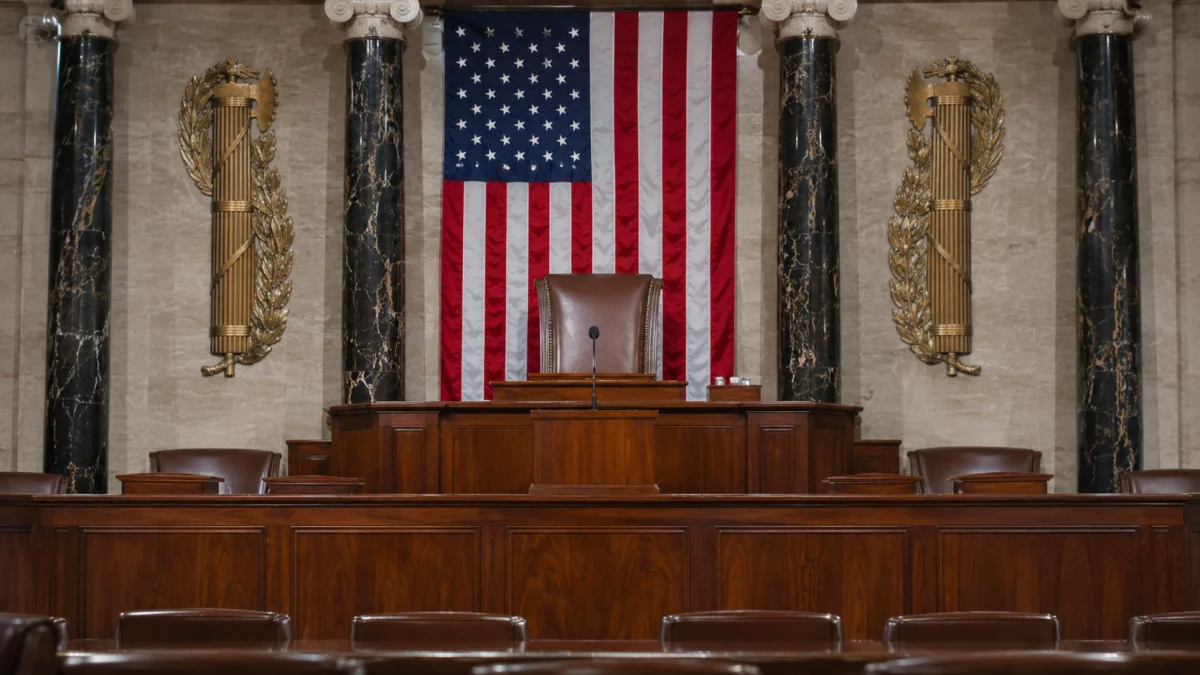
No, not under the U.S. House of Representatives’ longstanding interpretation. The Constitution tells the House to choose its Speaker but never expressly says the person must be a member of Congress. The Congressional Research Service’s April 2026 explanation says members may vote for any individual, and official House records confirm that representatives have cast Speaker votes for senators, former presidents and other people outside the House.
There is an important catch: no person who was not a sitting House member has ever actually served as Speaker. Constitutional scholars disagree over whether the office is legally open to outsiders in the first place. And if the House did elect one, further questions would arise about voting rights, the oath of office and presidential succession.
This is not a proposal to abolish elections or install a national leader by popular petition. Representatives would still elect the Speaker. The unresolved question is whether they can choose somebody voters did not elect to a House seat.
The essential distinctions:
| Question | What the evidence supports |
|---|---|
| Does the Constitution expressly require House membership? | No. Article I does not state that requirement. |
| Does the House treat nonmembers as permissible Speaker choices? | Yes, in its established institutional interpretation. Members have voted for outsiders in actual elections. |
| Has a nonmember ever become Speaker? | No. Every Speaker has been a House member. |
| Must a Speaker candidate be formally nominated? | No. Members can vote for someone who was not nominated. |
| Must a winner always receive 218 votes? | No. Ordinarily, a majority of votes cast for named people is required. |
| Has a court conclusively resolved nonmember eligibility? | No decisive test has occurred through an actual nonmember speakership. Scholars disagree on the constitutional interpretation. |
The difference between those answers is the story. A rule can be widely repeated, administratively accepted and still never have faced the circumstances that would test its limits.
Why the question is back in 2026
The issue is gaining a fresh audience because people are debating who should lead the House in the next Congress.
On November 6, 2026, Axios reported that House Democrats and members-elect were receiving calls urging them to consider alternatives to Hakeem Jeffries. Some callers suggested Rep. Jamie Raskin, an existing House member. Axios also reported that an online petition opposing Jeffries’ selection had nearly 900,000 signatures as of November 6. These are reports of public pressure, not proof that an alternative candidate had secured congressional support.
As sherafy.com examined separately in its article about Jeffries and the speakership, the choice of Speaker determines more than who holds the gavel. The office influences how legislation reaches the floor, how the House organizes its work and how its majority exercises power.
But a debate over a particular candidate produces a broader question: If House members are dissatisfied with their party’s established leaders, are they legally restricted to choosing another representative? Under the House’s present interpretation, they are not. Understanding that answer requires separating the Constitution, election procedure and real historical practice.
There are also two different elections people routinely conflate. A party caucus can choose its preferred leader or Speaker nominee, but the entire House elects the Speaker in a floor vote. Neither a caucus endorsement nor a public petition appoints someone to the office.
What does the Constitution actually say about the Speaker?
Article I, Section 2, Clause 5 contains the operative language:
The House of Representatives shall chuse their Speaker and other Officers;
That is the text’s instruction concerning the choice of Speaker. It says who chooses the officer, not expressly who qualifies to hold the job. The House Historian’s account of the speakership accordingly describes an office that has always been held by a House member even though, under the House’s interpretation, membership is not required.
For comparison, the Constitution is specific about the qualifications to be a representative. Article I, Section 2 requires an elected House member to be at least 25 years old, to have been a U.S. citizen for at least seven years and to be an inhabitant of the state in which elected. Those requirements apply to membership in the House. The Speaker Clause does not independently list a minimum age, citizenship period or prior public-office requirement. The constitutional text and House Manual make the distinction visible.
But one point cannot be skipped: the absence of an explicit requirement does not automatically settle whether an implicit one exists. In constitutional law, the historical meaning of an office and the structure of government can matter alongside the literal wording.
It is therefore more accurate to say that the House interprets the Constitution as allowing a nonmember Speaker than to claim the Constitution indisputably authorizes any person to take the job.
Why the House’s other officers matter
The Speaker is not the only officer chosen by the House. The Clerk, Sergeant-at-Arms, Chief Administrative Officer and Chaplain are elected House officers, and they are not ordinarily members of Congress. Article I itself groups the Speaker with the House’s "other Officers."
Supporters of broad eligibility see that wording as a reason not to import the qualifications for representatives into a separate office. Critics respond that the historical term Speaker may have carried an understood connection to membership, even though other House officers did not.
That is a real interpretive dispute, not a disagreement over whether the constitutional sentence exists.
Has anyone outside Congress ever received votes for Speaker?
Yes, repeatedly. And unlike hypothetical social-media scenarios, these cases are documented in official House election results.
The following is a selection of verified examples, not an exhaustive list of every outsider vote:
| Speaker election | Person outside the House who received votes | Position at the time | Votes on the cited ballot | Official record |
|---|---|---|---|---|
| January 3, 2013 | Colin Powell | Former secretary of state | 1 | House roll call 2 |
| January 3, 2013 | David Walker | Former U.S. comptroller general | 1 | House roll call 2 |
| January 6, 2015 | Rand Paul | Sitting U.S. senator | 1 | House roll call 2 |
| January 6, 2015 | Jeff Sessions | Sitting U.S. senator | 1 | House roll call 2 |
| January 3, 2019 | Tammy Duckworth | Sitting U.S. senator | 2 | House roll call 2 |
| January 3, 2019 | Joe Biden | Former vice president | 1 | House roll call 2 |
| January 3, 2019 | Stacey Abrams | Former Georgia state legislator | 1 | House roll call 2 |
| January 3, 2021 | Tammy Duckworth | Sitting U.S. senator | 1 | House roll call 2 |
| January 3, 2023 | Lee Zeldin | Former U.S. representative | 1 | House roll call 2 |
| January 5, 2023 | Donald Trump | Former president at the time | 1 | House roll call 13 |
| October 17, 2023 | Lee Zeldin | Former U.S. representative | 3 | House roll call 521 |
The Congressional Research Service’s historical study of Speaker elections from 1913 through 2025 identifies outsider votes in multiple elections beginning in 1997, including votes for former representatives and sitting senators.
These records establish three things:
- An outsider’s name can be spoken during the Speaker roll call. This is not merely a theoretical suggestion.
- Those votes have been counted and published. The official results do not erase them simply because the recipient was not a representative.
- Counting a vote is not the same as electing the candidate. None of these outsiders secured a majority or actually assumed the office.
That third point is crucial. An institution’s willingness to count isolated votes is meaningful evidence of its practice. It is not a definitive adjudication of the constitutional qualifications of someone who actually wins.
Did Donald Trump really receive a Speaker vote?
Yes. On January 5, 2023, when he was a former president, Donald Trump received one recorded Speaker vote. The official roll call lists him by name. He did not become Speaker, and the vote did not establish whether he could legally have served if a majority had selected him.
The historical record also demonstrates that outsider votes are not confined to one political party or one type of candidate. Members have cast votes for senators, former elected officials and individuals whose prominent government service came through appointment rather than a House election.
How is the Speaker of the House elected?
The Speaker is selected by the House of Representatives, not by a nationwide popular vote, the president, the Senate or a party’s donors.
At the beginning of a new Congress, the Clerk calls the House to order and presides while representatives-elect choose a Speaker. The House follows a roll-call procedure. By established practice, each major party’s nominee is placed in nomination, and members state aloud the surname of the person they support. Additional names may be nominated. Under the 2026 Congressional Research Service election guide, members may also vote for somebody who was never formally nominated.
Usually the process works as follows:
- The newly elected House convenes, and the Clerk presides over the Speaker election.
- Party nominees are announced; other nominations may be offered.
- Representatives-elect cast votes for named individuals or answer "present."
- The tellers count the votes cast for people by name.
- A candidate with a majority of those named votes is elected under the ordinary rule.
- If no one gets that majority, the House conducts another ballot. The process can repeat until somebody wins.
- The Speaker-elect is sworn in and then administers the oath to the other House members.
A new Speaker can also be elected during a congressional term if the office becomes vacant through resignation, death or removal. The process is not restricted to the first day of a new Congress.
Does the Speaker need 218 votes? Not always.
The common shorthand is that a Speaker needs 218 votes because the House ordinarily has 435 voting seats. But the actual rule is more precise: a majority of votes cast for named candidates, with a quorum present.
If 435 representatives vote for named people, the majority is 218. If some members answer "present" or do not vote, the majority needed to win can fall.
| Named candidate votes cast | Votes needed to win under the ordinary majority rule |
|---|---|
| 435 | 218 |
| 430 | 216 |
| 428 | 215 |
| 420 | 211 |
These are illustrations of the arithmetic, not predictions of a particular House election. A quorum must still exist, and the House has historically used special procedures in rare circumstances. The general rule is documented by CRS and the House’s own procedural manual.
The real example: Kevin McCarthy won with 216 votes
The decisive fifteenth Speaker ballot in January 2023 demonstrates why "218 votes required" is not universally true:
| January 7, 2023, final ballot | Votes |
|---|---|
| Kevin McCarthy | 216 |
| Hakeem Jeffries | 212 |
| Answered "present" | 6 |
| Votes cast for named candidates | 428 |
| Majority of named votes required | 215 |
McCarthy received 216 votes, enough to exceed the 215-vote threshold. The official Clerk’s roll call 20 records the outcome.
There is another subtlety. Voting for another named person is different from voting present. A vote for a third candidate still counts in the denominator used to calculate the majority. A "present" response ordinarily does not. In a closely divided House, that distinction can affect whether someone wins.
Could House members choose someone outside their own party, or outside Congress altogether?
A party’s leadership vote and the constitutional House election are different events. A representative does not have to follow the preferred nominee of their party when voting for Speaker. The recorded history includes votes for people outside the party’s official nominations, and CRS documents even a cross-party Speaker vote in 2001.
In theory, under the House’s interpretation, representatives from different parties could combine their votes behind a person who does not currently hold a House seat. But that person would still have to win the ordinary Speaker election, and the eligibility dispute discussed below would remain.
A public petition cannot elect the Speaker. Neither can a viral poll, a political endorsement or a presidential announcement. Those things may influence representatives, but only House members’ votes determine the Speaker election.
A person also does not need to run for a congressional district or appear on a general-election ballot merely to receive Speaker votes. And being proposed in an online discussion is not proof that the person has agreed to serve.
As of November 9, 2026, discussion of alternatives to established House leaders should be distinguished from an actual coalition of representatives committed to electing an outsider. The relevant test would be recorded support on the House floor, not the size of an online campaign.
Is it definitely constitutional to elect a nonmember Speaker? This is the real catch.
The House’s official interpretation says yes, but a nonmember speakership has never been tested. It is misleading to describe the issue as if every constitutional scholar agrees.
A useful way to understand the dispute is to separate three different kinds of evidence.
Argument 1: The text gives the House broad discretion
In his 2019 University of Illinois Law Review essay, Anybody’s Gavel: Why Congress Can Choose a Speaker from Outside Its Ranks, Russell Spivak argues that the Speaker Clause does not impose a membership restriction. The Constitution states explicit qualifications for representatives but does not repeat them for Speaker. The House elects other officers who are not members, and votes for outsiders have been counted without objection.
That position aligns with the institutional interpretation stated by the House Historian and CRS. It is an established and substantial argument, not a fringe theory.
Argument 2: The word "Speaker" may have implied membership
In a 2023 analysis, Cornell law professor Michael Dorf argued that constitutional silence is not the same thing as unlimited eligibility. The term "Speaker" carried historical meaning, and every actual Speaker has been a member of the chamber they led. That continuity may be evidence of an understood qualification.
Dorf did not claim that this proves nonmember service unconstitutional. His point was that the conventional answer is less secure than it sounds. A constitutional interpretation has to confront history and function, not just the lack of an explicit prohibition.
Argument 3: A 2024 law review article makes the affirmative case against outsiders
A 2024 University of Pennsylvania Journal of Constitutional Law article, Salvaging the Speaker Clause: The Constitutional Case Against Nonmember Speakers of the House, takes a stronger position. Authors Tanner Wadsworth, Kade Allred and Adam Moore argue that the founding-era understanding of a "Speaker" was an elected member of the House and that historical evidence supports a membership requirement.
That is a scholarly constitutional argument, not a Supreme Court holding. The article also addresses the possibility that a court might consider disputes over the House’s choice of Speaker unsuitable for judicial resolution.
The House Manual adds another wrinkle
The 119th Congress’s House Manual, section 26, describes the Speaker as an officer who has always been a member and says the Speaker’s term as such must expire with the person’s term as a member.
That passage describes the precedents that actually exist: every Speaker has had a congressional term. It should not be turned into an invented judicial ruling that outsiders are forbidden. But it shows how deeply the office’s customary administration assumes that its holder also occupies a House seat.
The evidence therefore supports two simultaneous conclusions: the House accepts nonmember candidacies in its present practice, and an actual nonmember election would require it to navigate constitutional questions that existing votes for outsiders have never resolved.
What would happen if someone outside Congress actually won?
Suppose a person who was not a representative received a majority of named votes in a Speaker election. That would be unprecedented. No reliable source can honestly cite a previous nonmember Speaker as proof of exactly what would happen next.
A few things are clear. Others would need to be determined.
| Practical question | Established rule or unresolved consequence |
|---|---|
| Who selects the Speaker? | The House, through its election process. |
| Does a majority vote automatically make the person a House representative? | No. The speakership is an office, not a new congressional district or seat. |
| Could the outsider cast a legislative floor vote? | Not simply by being Speaker. The legislative vote belongs to elected House members; a nonmember would not acquire a representative’s vote. |
| Could the outsider preside and carry out Speaker functions? | That is the premise of electing the person, but adapting the existing practices and resolving any eligibility challenge would be unprecedented. |
| Would the person take an oath? | The Speaker takes an oath under 2 U.S.C. section 25. How every existing member-based practice would be applied to an outsider is untested. |
| Would the outsider represent a congressional district? | No. They would not have constituents in the separate legal sense that a House representative does. |
| Could the election be challenged? | Legal objections are possible, but whether a court would decide the constitutional merits is uncertain. |
The distinction between an officer of the House and a member of the House matters here. The two roles have always overlapped for Speakers, but they are not identical concepts.
Could an outsider Speaker vote on bills?
There is no basis to give a nonmember a 436th House vote. Representatives are elected from congressional districts and possess the floor votes allocated to those seats. Traditionally, a Speaker who is also a representative can vote in that person’s capacity as a member. The Congressional Research Service’s account of the Speaker’s parliamentary and representative roles makes that distinction explicit.
If an outsider occupied the chair, they would not become a district representative just by taking the Speaker’s oath. They could help administer proceedings without holding an individual representative’s floor vote. The precise application of every House rule to such an unprecedented officer could still prompt procedural questions.
Would the outsider have actual power, or just a ceremonial title?
The Speaker is much more than a person who announces vote totals. Under the House rules, the office involves recognizing members to speak, referring measures, presiding over proceedings, signing House documents and making specified appointments. In modern practice, the Speaker also has substantial political influence over the majority party’s legislative agenda.
Not every power is unilateral. The House can change its rules, committees have responsibilities of their own and representatives still cast the votes that enact legislation. But it would be wrong to assume an outsider Speaker would be irrelevant merely because that person lacked an individual floor vote.
This is the democratic tradeoff hidden beneath the constitutional trivia: the House could, under its own interpretation, select a powerful presiding officer whom voters had never elected to a congressional seat. The officer would still be chosen by representatives elected by voters, and those representatives would remain politically accountable for their choice.
Could a nonmember Speaker become president? The succession law has a problem.
The Speaker’s place in presidential succession is often described too casually. The Constitution does not by itself make the Speaker the automatic next president. Instead, federal statute puts the Speaker after the vice president in the order of succession when neither the president nor vice president can discharge the office’s duties.
The current presidential succession law, 3 U.S.C. section 19, says the Speaker must resign as Speaker and as a Representative in Congress before acting as president. Its eligibility clause also limits succession to officers constitutionally eligible for the presidency.
Now imagine a Speaker who was never a representative. That person could resign as Speaker. But there would be no House seat to resign from. The statute’s wording plainly assumes the ordinary arrangement in which the Speaker is also a member of Congress.
That mismatch does not automatically prove a nonmember Speaker could never act as president. It means the succession question is unresolved, not something to wave away with "second in line." Any such case could require a contested interpretation of the statute and the Constitution.
There is also a separate eligibility test for the presidency: the Constitution imposes requirements including a minimum age of 35, natural-born citizenship and 14 years of U.S. residence. Someone who could conceivably hold the speakership would not necessarily qualify to act as president.
What about a former two-term president such as Barack Obama?
The Constitution’s Twenty-Second Amendment bars a person from being elected president more than twice. It does not expressly prohibit that person from being chosen as Speaker.
But that is not the same question as whether a two-term former president could subsequently act as president through the succession law. The Constitution Annotated explains that the interaction of presidential term limits, other eligibility provisions and succession is disputed, and the amendments do not directly settle the Speaker scenario.
Thus a former president’s name may be a legitimate subject of speculation about Speaker eligibility, but it would be misleading to promise a straightforward route around presidential term limits. No such route has been established.
Does a Speaker have to be 25, a U.S. citizen or a former elected official?
The qualifications are easy to conflate, so keep three separate questions in view:
| Requirement | Elected House representative | Speaker under the House’s established reading |
|---|---|---|
| At least 25 years old | Expressly required | No separate age threshold is expressly stated in the Speaker Clause. |
| U.S. citizen for seven years | Expressly required | No separate citizenship-duration threshold is expressly stated in the Speaker Clause. |
| Resident of the state represented | Expressly required | An outside Speaker would not represent a state district by virtue of the speakership. |
| Previously elected to public office | Not required for first-time representatives | Not stated as a Speaker qualification. |
| Elected by voters to a current House seat | Required to be a voting representative | Not required under the House’s institutional interpretation, but disputed as a constitutional question. |
The text of Article I and the competing legal analyses support these distinctions. They do not prove that literally anyone, regardless of identity or circumstances, could lawfully be Speaker. Claims about a child, a foreign national or a person entirely unable to serve would require additional constitutional interpretation, not merely pointing to the absence of a numbered requirement.
Nor should eligibility for Speaker be confused with eligibility to succeed to the presidency, which is governed by separate constitutional and statutory rules.
Frequently asked questions
Is the Speaker of the House elected by the public?
Not directly. Voters elect House representatives, and representatives elect the Speaker. Under House practice, the Speaker does not necessarily have to be a representative, but no nonmember has ever actually won the election.
Can an ordinary citizen be Speaker of the House?
Under the House’s established interpretation, membership in Congress is not an express prerequisite, so someone who has never held federal elected office is not ruled out merely on that basis. Whether every such candidacy would withstand a constitutional challenge is an untested question.
Can a U.S. senator become Speaker of the House?
House members have cast Speaker votes for sitting senators, including Rand Paul, Jeff Sessions and Tammy Duckworth. That establishes that senators can receive votes. It does not settle every question that would arise if a sitting senator won, including whether and how that person could simultaneously retain Senate responsibilities.
Can the president appoint the Speaker?
No. The president does not appoint the Speaker. Only the House selects its Speaker, through the House’s election procedure.
Does a Speaker candidate have to be nominated by a party?
No. Party nominations are customary, but the Congressional Research Service confirms that members can vote for a person who was never nominated.
Can a Speaker be chosen with fewer than 218 votes?
Yes. The usual requirement is a majority of votes cast for named individuals, with a quorum present. Kevin McCarthy won with 216 in January 2023 because six members voted "present," leaving 428 named votes and a winning threshold of 215.
Can the House remove a Speaker after electing one?
Yes. The House can declare the office vacant under its procedures. On October 3, 2023, the House removed Kevin McCarthy through a resolution declaring the speakership vacant, the first successful such removal in U.S. history. The precise procedure for initiating a removal motion can change with House rules; it should not be confused with a nationwide recall election. See the CRS explanation of mid-Congress Speaker elections.
Has a nonmember Speaker ever served in U.S. history?
No. Every actual Speaker, beginning with Frederick Muhlenberg in 1789, has been a House member. Outsiders have received votes but have never won. The House Historian documents the office’s history.
Who will vote for Speaker after the 2026 midterms?
The members-elect of the incoming House will select a Speaker when the new Congress organizes. Political parties may settle on nominees in advance, but their internal decisions do not replace the House floor vote. At the time of this article’s publication in November 2026, the next Speaker vote has not yet occurred.
The bottom line: The House can count outsider votes, but an outsider has never held the gavel
The popular claim contains a genuine constitutional surprise. Unlike membership in the House of Representatives, the speakership has no express constitutional clause requiring election to a congressional district. The House and its research service interpret that silence as allowing members to choose somebody from outside their ranks. Official congressional records prove that outsider votes have been cast and counted.
The popular claim also leaves out the important part. No nonmember has ever been elected Speaker, constitutional scholars disagree about the office’s implicit qualifications, and a successful outsider election would encounter parliamentary and presidential-succession questions no earlier Speaker has faced.
The voters do not directly choose the Speaker. Their representatives do. That makes the legal distinction worth understanding and the representatives’ choice worth scrutinizing.
A person can receive votes for Speaker without being elected to Congress. Whether that person could successfully hold the office remains the question American history has never tested.
References and Further Reading
Constitutional text, law and House procedure
- Constitution, Jefferson’s Manual, and Rules of the House, 119th Congress: Article I – Government Publishing Office. Contains the Speaker Clause, representative qualifications and the House Manual’s account of Speaker precedent.
- Electing the Speaker of the House of Representatives: Frequently Asked Questions – Congressional Research Service, updated April 21, 2026. Direct authority for nomination rules, roll-call procedure, named-vote majorities and repeat ballots.
- Speakers of the House: Elections, 1913-2025 – Congressional Research Service, updated April 13, 2026. Historical study documenting outsider votes and elections decided with fewer than 218 votes.
- Speaker of the House – U.S. House History, Art & Archives. Institutional history and the longstanding understanding that no nonmember has served.
- Rules of the House of Representatives, 119th Congress – Government Publishing Office. Governing text for the Speaker’s authority during the 2025-2026 House; rules may change in a new Congress.
- 2 U.S.C. section 25: Oath of Speaker, Members, and Delegates – Office of the Law Revision Counsel. Governs administration of the Speaker’s oath.
- 3 U.S.C. section 19: Presidential succession – Office of the Law Revision Counsel. The statutory succession order, resignation language and constitutional eligibility requirement.
- Twenty-Second Amendment: Presidential term limits – Constitution Annotated, hosted by Cornell Law School. Explains why term limits do not by themselves resolve every succession scenario involving a former two-term president.
Official Speaker vote records
- January 3, 2013, Speaker election – House Clerk’s original record of votes for Colin Powell and David Walker, among other candidates.
- January 6, 2015, Speaker election – Official record including sitting senators Rand Paul and Jeff Sessions.
- January 3, 2019, Speaker election – Official record including Tammy Duckworth, Joe Biden and Stacey Abrams.
- January 3, 2021, Speaker election – Official record of a vote for Senator Duckworth.
- January 3, 2023, Speaker election – Official record of a vote for former representative Lee Zeldin.
- January 5, 2023, Speaker election – Official record of one vote for Donald Trump, then a former president.
- January 7, 2023, final McCarthy ballot – Primary proof of the 216-212 result with six members voting present.
- October 17, 2023, Speaker election – Official record of three votes for former representative Lee Zeldin.
Constitutional scholarship and background
- Anybody’s Gavel: Why Congress Can Choose a Speaker from Outside Its Ranks – Russell Spivak, University of Illinois Law Review (2019). A developed argument for nonmember eligibility.
- Maybe the Speaker of the House Must Be a Member of Congress – Michael C. Dorf, Verdict (2023). Explains why constitutional silence alone does not settle the issue.
- Salvaging the Speaker Clause: The Constitutional Case Against Nonmember Speakers of the House – Tanner Wadsworth, Kade Allred and Adam Moore, University of Pennsylvania Journal of Constitutional Law (2024). Historical and original-meaning argument that House membership is required.
- The Speaker of the House: House Officer, Party Leader, and Representative – Congressional Research Service (2017). A foundational explanation of the separate institutional and representative functions of the office; current procedures should be checked against the 2026 CRS reports and House rules.
November 2026 public discussion
- House Democrats ‘inundated’ with anti-Jeffries calls – Axios, November 6, 2026. Original reporting on the current push for leadership alternatives; this is evidence of public activity, not a legal authority or a forecast of the floor vote.
- Why Hakeem Jeffries Should Not Be Speaker of the House – sherafy.com, November 4, 2026. Related editorial analysis of the political leadership debate, separate from this constitutional and procedural explainer.
Editorial currency note: Researched through November 9, 2026. Constitutional text and historical House roll calls are stable; House rules, party leadership arrangements, statutes and the status of the next Speaker election may change. The article distinguishes official institutional interpretations from contested legal scholarship and does not claim that a court has decided the eligibility of a successfully elected nonmember Speaker.