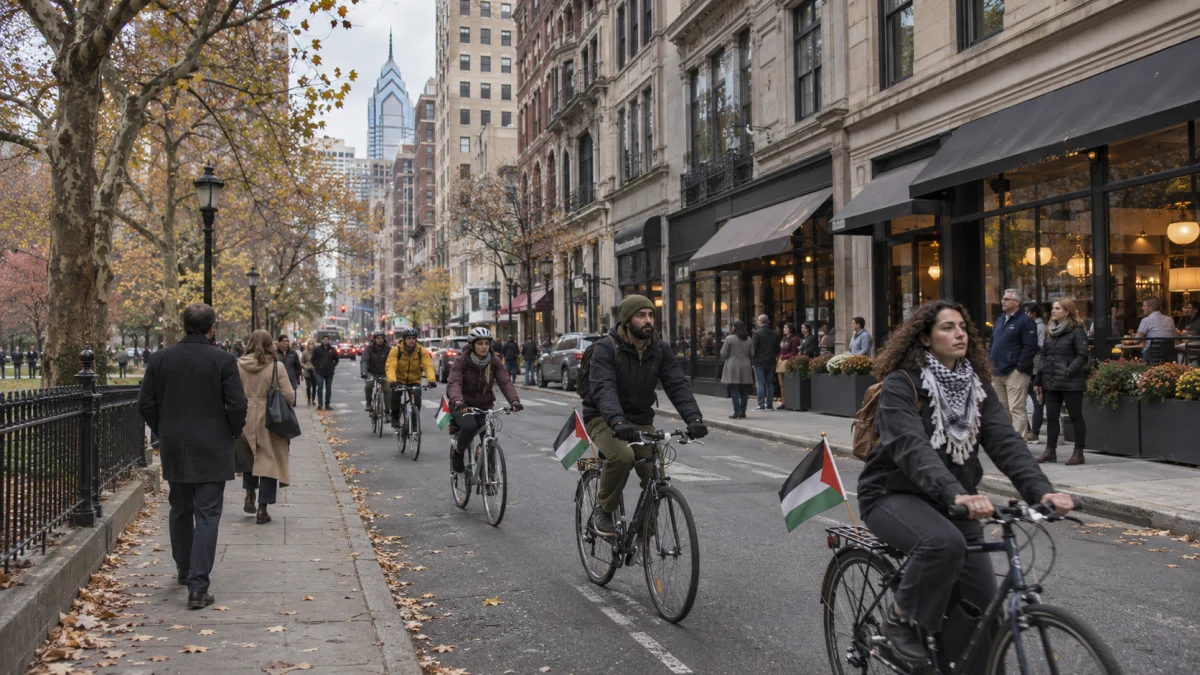
On November 8, 2026, a pro-Palestinian cycling group organized a boycott ride through Philadelphia’s Rittenhouse Square area, calling on people to stop patronizing six restaurants whose owners it accused of supporting Israel. The event became a national controversy after a flyer called for the businesses to leave the city. Pennsylvania Governor Josh Shapiro, Philadelphia Mayor Cherelle Parker, advocacy groups, and other officials condemned the protest as antisemitic. Hundreds of people gathered to support the restaurants, and police separated demonstrators from counterprotesters.
The organizers, a collective called Philly Bike On Your Left, said the boycott was directed at political and financial support for Israel, not at Jewish identity. That claim is neither automatically vindicated nor automatically disproved by the fact that the six businesses are Jewish-owned.
The evidence is more complicated than the national argument suggested. Several restaurants have documented connections to Israel-related fundraising dating to 2023. Some funds went to emergency medical or civilian relief efforts; at least one recipient fund also disclosed grants benefiting the Israeli military. Other businesses have substantially weaker documented connections. The six cannot responsibly be treated as interchangeable.
Nor can the original wording simply be dismissed. Saying that businesses "must go" can reasonably be understood as a demand for exclusion, even when the intended action is a consumer boycott. But criticizing a flyer does not answer why people organized the boycott, what they were protesting, or whether their claims were true.
That larger context matters. The United Nations Independent International Commission of Inquiry concluded in September 2025 that Israeli authorities and forces had committed genocide in Gaza. In its October 2026 findings, the Commission said genocidal acts continued. The International Court of Justice case remains separate and has not yet reached a final judgment on the merits.
The central question, then, is not whether every word used by the cyclists was appropriate. It is how to investigate a political boycott fairly without allowing a dispute about its language to eclipse the catastrophic suffering that motivated it.
What happened at the Philadelphia Boycott Ride?
A flyer circulated as early as October 30, 2026, promoting a November 8 bicycle ride around Rittenhouse Square, a commercial and residential area in Center City Philadelphia. It identified six restaurants:
- Goldie, a falafel shop;
- K’Far Café, a café and bakery;
- Dizengoff, a hummus restaurant;
- Huda, a sandwich restaurant;
- Schlesinger’s Restaurant and Delicatessen; and
- Mac Mart, a macaroni-and-cheese business.
The original promotional material, documented by The Philadelphia Inquirer, used the phrases "No business for Zionists" and "These Zionist establishments must go." The organizers’ accompanying October 30 Instagram caption called the owners "disgusting humans." The National Jewish Advocacy Center later alleged that the caption had been edited, including a change from "zio" to "zionist"; an independently authenticated edit history was not available for this review. The original wording became the focal point of the controversy.
The cyclists said their purpose was to show solidarity with Palestinians and encourage a boycott of businesses they considered complicit in Israeli policies or military activity. On November 7, the group clarified that its criterion was support for Israel rather than religion and denied choosing the date because of Kristallnacht, the Nazi pogrom commemorated on November 9–10.
Local and national coverage followed, along with a large show of support for the restaurants. The November 8 reporting by The Inquirer described long lines of customers at targeted establishments, Israeli and Palestinian flags, confrontations, and extensive police deployment.
Police estimated approximately 300 pro-Palestinian demonstrators, including 200 people with bicycles, and 200 counterprotesters. Those are official crowd estimates, not a count of the organizing club’s members. A City & State Pennsylvania reporter observed roughly 40 cyclists at one stage, illustrating why a count at one point on the route need not equal the overall police estimate or the size of the organizing club. The updated CBS Philadelphia report provides the police estimate.
Police reported three arrests, minor injuries to two officers, and no property damage. Early news accounts differed in how they described one adult’s alleged offense; the precise final charges should be checked against court records rather than inferred from early headlines. An arrest also does not establish guilt or collective responsibility for everyone at the event.
This was a real, heated demonstration. It was not, on the reported evidence, an attempt that succeeded in expelling restaurants or destroying their property.
Who is Philly Bike On Your Left, and who organized the event?
Philly Bike On Your Left uses the Instagram handle @phillybike.onyourleft and publicly describes itself as an anti-fascist, anti-Zionist social cycling collective. Its posts promote riding with Palestinian flags and participating in local solidarity activities. It also advertised a separate November 15 "Great Ride of Return", which had not yet taken place at the time of this article.
The reference to return is not merely a slogan. The United Nations’ explanation of the Nakba describes the mass displacement and dispossession of Palestinians during the 1948 war and the continuing dispute over refugees’ rights to return and receive restitution or compensation. The November 15 ride invokes that history.
There is no verified public membership count establishing that Philly Bike On Your Left comprises exactly 20 people, or any other precise number. The collective was relatively obscure before the controversy, but a small organizing account can attract a much larger crowd after an event receives national publicity.
That distinction also applies to the organizations named alongside the event. Boycott CookNSolo is an existing campaign against the restaurant group that owns three of the named businesses. Writers Against the War on Gaza and other local pro-Palestinian groups promoted or defended the ride. The November 6 solidarity statement hosted by Boycott CookNSolo carried signatures from numerous organizations.
A signature in support is not proof that an organization planned the route or authored the flyer. Reporting that treats every supporter as an organizer exaggerates the organizational structure of the protest. Conversely, the organizers’ own statements and language remain their responsibility regardless of the collective’s size.
Why were people protesting restaurants over Gaza?
A boycott asks consumers to withhold spending in order to exert economic or reputational pressure. The tactic is familiar from civil-rights campaigns, labor movements, and international campaigns against apartheid. It can target businesses because of their ownership structures, partnerships, investments, fundraising activities, public endorsements, or other conduct.
People can reasonably disagree about whether a particular target is persuasive or fair. What they cannot do is settle the question by saying all restaurant boycotts are inherently illegitimate.
The Philadelphia campaign emerged from a longer local dispute about Israeli state policy and businesses believed to support it. Organizers argue that purchases at certain restaurants generate revenue, political legitimacy, or charitable support connected to Israel. Critics argue that local Jewish owners were being held responsible for a foreign government’s actions. The crucial issue is what each targeted business actually did.
That is why it matters that the October 2023 financial transactions were reported well before the 2026 flyer existed. They are not an explanation invented after the backlash. But they also do not establish that every business on the later list funded the Israeli military, or that its owners bear legal responsibility for Israeli war crimes.
The scale of the suffering behind the protest
The UN Office for the Coordination of Humanitarian Affairs’ November 4, 2026, Gaza impact snapshot reported the following:
| Measure | Reported figure | Qualification |
|---|---|---|
| Palestinians killed since October 2023 | 74,618 | Gaza Ministry of Health figure reproduced by OCHA, as of November 4, 2026 |
| Palestinians injured | 175,920 | Same cumulative reporting date and attribution |
| Children among identified fatalities | 21,976 | From 74,237 fatalities fully identified as of October 7, 2026; not a separate November 4 count |
| Structures damaged or destroyed | 82% | UNOSAT assessment as of June 16, 2026 |
| People estimated to require shelter assistance | 1.98 million | OCHA shelter estimate in the November 4 snapshot |
The reported fatalities are not a definitive count of every direct and indirect death. OCHA expressly distinguishes reported figures from numbers individually verified by the United Nations. The breakdown of identified children also refers to an earlier cutoff than the overall death toll.
The crisis was not simply a historical event ending with the October 2025 ceasefire agreement. The UN’s November 6 humanitarian situation report documented continuing strikes, injuries, supply restrictions, and serious shortages. It reported, on the Gaza Health Ministry’s figures, 1,593 fatalities since the ceasefire agreement as of November 2, 2026.
And while Philadelphia argued over a boycott ride, a new disaster was unfolding in Gaza. The UN’s November 9 report on heavy rainfall said that, by November 8, aid organizations had received appeals from more than 26,000 households affected by flooded or damaged shelters and belongings. Approximately 1.4 million people were living in tents or makeshift shelters. The report said aid supplies inside Gaza were nearly exhausted and that Israeli restrictions and funding shortfalls continued to impede deliveries.
These are not rhetorical comparisons. They are contemporaneous, source-attributed facts. They explain why a protester might regard diplomatic pressure, economic boycotts, and solidarity organizing as urgent, even when the protester’s local action is imperfect.
Israel denies that its military campaign constitutes genocide and has maintained that its operations respond to attacks by Hamas. The UN Commission of Inquiry has nevertheless made a reasoned finding of genocide based on its investigations. The International Court of Justice’s January 2024 provisional-measures order imposed binding obligations concerning the prevention of genocidal acts; it did not decide final state responsibility. Those legal distinctions are important, but they do not erase the casualty, displacement, and destruction figures.
Why these six restaurants? A business-by-business evidence audit
The controversy has often been reduced to an all-or-nothing proposition: either every business was targeted solely because it was Jewish-owned, or every business directly financed the Israeli military. Neither proposition is established by the public evidence.
The following table separates documented conduct from claims that remain unproven.
| Restaurant | Documented connection | What the evidence does not establish |
|---|---|---|
| Goldie | Participated in a CookNSolo fundraiser that reported $100,565 raised across four restaurants for United Hatzalah in October 2023. | That Goldie’s specific share went to military operations, weapons, or a particular IDF project. |
| K’Far Café | Participated in the same four-restaurant fundraiser. | Its separate dollar contribution, or its individual allocation within the recipient charity. |
| Dizengoff | Part of CookNSolo, sharing ownership with Goldie and K’Far and the restaurant group’s publicly documented Israel-related activities. | That Dizengoff was one of the four restaurants contributing to the specific October 12, 2023 fundraiser. |
| Huda | Owner Yehuda Sichel held a fundraiser that generated $3,000 for Sderot, Israel, after the October 7 attack. He has publicly described himself as supportive of Israel. | That the fundraiser supported the Israeli military. Sichel says it supported affected children and the local municipality. |
| Schlesinger’s Deli | Owner Allan Domb donated $5,323.25, representing one day’s receipts, to a fundraiser identified by CBS as benefiting the Philly Stands With Israel Fund. | Which exact recipient projects the deli’s particular dollars ultimately financed. |
| Mac Mart | The owner, Marti Lieberman, has disputed the political characterization of the business. | A comparable donation to Israel, IDF support program, or other individualized selection rationale has not been substantiated in the reviewed public record. |
The donation amounts and dates were reported in The Inquirer’s October 18, 2023, restaurant newsletter, long before the November 2026 controversy. CBS Philadelphia’s October 16, 2023, coverage identifies the intended recipient of Schlesinger’s fundraiser. The businesses’ individual positions and responses appear in The Inquirer’s November 8 reporting.
Goldie, K’Far, and Dizengoff: the CookNSolo connection
Goldie, K’Far, and Dizengoff are part of CookNSolo, the Philadelphia restaurant group co-owned by chef Michael Solomonov and Steve Cook. The owners’ connection to Israel is not merely assumed from their religious background or a restaurant menu. Solomonov, who was born in Israel, has spoken publicly about his personal connections, and his businesses have conducted Israel-focused fundraising.
Following the October 7, 2023, Hamas-led attacks, CookNSolo reported raising $100,565 for United Hatzalah through sales at Zahav, Laser Wolf, K’Far, and Goldie. Dizengoff was not named among the four restaurants in that contemporary fundraising report. It was nevertheless part of the same restaurant group and the subject of the existing Boycott CookNSolo campaign.
United Hatzalah is a nonprofit emergency medical service. It treats emergencies and is not simply an arm of the Israeli army. That should be stated plainly. But calling it exclusively unrelated to the military would also be misleading: The Guardian’s December 2023 investigation documented the charity’s support for soldiers with protective and medical equipment and quoted its acknowledgment of training and emergency-response cooperation with the Israel Defense Forces.
Separately, the Jewish Federation of Greater Philadelphia’s 2024 annual report describes its own emergency funding for United Hatzalah as supporting emergency vehicles and critical assistance to the IDF. That is a disclosure about the Federation’s grants, not a transaction record proving how CookNSolo’s donation was spent. A recipient organization’s activities and a specific donor’s intended use must not be conflated.
CookNSolo has rejected the assertion that it supported military combat activity through the fundraiser. Solomonov has also expressed support for Palestinian self-determination and criticism of decisions by Israeli governments, according to his comments documented by The Inquirer in 2023. Those comments complicate a picture in which any support for Israel automatically equals support for every policy of its government.
There is another distinction: activists also object to Israeli cultural branding and what they regard as the erasure of Palestinian contributions to Levantine cuisine. Solomonov has acknowledged Palestinian influences while disputing the claim that his restaurants appropriated an entire cuisine. That is a separate cultural argument; it should not be presented as evidence of military financing.
What this establishes: The CookNSolo boycott has a documented political and financial history. What it does not establish: That each restaurant’s transactions personally financed war crimes.
Huda: support for Israeli children is not the same as funding an army
Huda’s owner, Yehuda Sichel, raised $3,000 in October 2023 for the Israeli town of Sderot, which was affected by the Hamas-led attack. In December 2023 reporting, the purpose was described as therapy for children. In an October 2024 WHYY interview, Sichel described helping rebuild a playground. The available accounts do not settle whether these were separate parts of one community effort or different descriptions of its purpose.
On November 8, 2026, Sichel told The Inquirer that the money went to the municipality and not to the military. He also described himself as a proud supporter of the Israeli cause, while rejecting responsibility for the government’s decisions.
That public political affiliation can be a reason activists choose to criticize or withhold patronage. It is not proof that the $3,000 funded Israeli military operations. Aid for traumatized children should not be relabeled as a weapons donation simply to make a boycott argument more forceful.
This does not require readers to endorse Sichel’s politics. It requires them to describe his actions accurately.
Schlesinger’s Deli: an actual fund connection, with a crucial limitation
Schlesinger’s owner, Allan Domb, a former Philadelphia city councilmember, donated the restaurant’s $5,323.25 in October 16, 2023, receipts to an Israel-related effort. CBS Philadelphia reported at the time that the day’s sales would support the Philly Stands With Israel Fund.
This is important because the fund’s activities can be examined through its own disclosures rather than through slogans from either side.
The Jewish Federation of Greater Philadelphia’s 2024 annual report says its Philly Stands With Israel Emergency Campaign raised $16 million, more than $12 million of which had been allocated at the time of publication. The report describes grants for civilian needs, mental-health support, and community recovery. It also lists military-associated assistance, including:
- Sar-El, an organization affiliated with the IDF that organizes volunteer logistical support;
- Yashar LaChayal, which received funds for winter gear for IDF soldiers;
- The Association for the Wellbeing of Israel’s Soldiers, supported for a medical-training simulator; and
- United Hatzalah, whose Federation-funded activities included critical assistance to the IDF as well as emergency response vehicles.
Those descriptions come from the Federation’s own reporting. They disprove the assertion that every use of the campaign’s money was unrelated to military personnel.
They do not prove that any specified amount of Schlesinger’s $5,323.25 reached Sar-El, Yashar LaChayal, the IDF, or any other particular project. The reviewed records do not provide the necessary donor-to-grant accounting. Pooled funds can support different categories of assistance, and no individual donor’s dollars should be assigned to a particular line item without evidence.
The defensible conclusion is therefore narrow but meaningful: Schlesinger’s publicly supported a fund that later disclosed civilian and military-associated assistance. The destination of the deli’s particular donation remains unverified.
That is neither "no connection whatsoever" nor "this deli bought weapons." The difference matters.
Mac Mart: the unresolved question the boycott must answer
Mac Mart is where the evidentiary problem is sharpest. Its owner, Marti Lieberman, has rejected the characterization of the business as a place of hatred or exclusion. The Inquirer reported her response, and she publicly thanked customers for the large show of support after the demonstration.
Among the reviewed records, no comparable Israel-related fundraiser, direct military-support transaction, or documented policy endorsement was established for Mac Mart. That is not proof that no such evidence exists. It means a public allegation against the business cannot currently be substantiated at the same level as the historical CookNSolo fundraising.
The National Jewish Advocacy Center’s November 6 statement pointed to an Instagram exchange suggesting that proximity to Rittenhouse Square influenced which restaurants appeared on the flyer. That statement comes from an advocacy organization opposed to the ride, not an independently authenticated transcript of the organizers’ complete selection process. Geographic convenience and political criteria could both play a role, but neither resolves why Mac Mart specifically was selected.
If the organizers believe Mac Mart has an identifiable political or material connection to Israel’s actions, the strongest response would be to document it. If the only basis was an assumption about a Jewish owner’s identity or beliefs, the inclusion would be indefensible.
A legitimate Palestinian-solidarity cause does not transform an unsubstantiated accusation into a fact. That is a reason to correct the target list, not to pretend the catastrophe in Gaza is less real.
Did the restaurants fund the Israeli military?
There is no single yes-or-no answer that accurately covers all six.
A useful way to avoid misleading readers is to separate four categories often treated as if they were the same thing:
| Category | Example in this story | What can responsibly be concluded |
|---|---|---|
| Public political support | An owner publicly identifying as supportive of Israel | Establishes a stated view, not support for every government act |
| Civilian relief | Assistance to children, displaced families, emergency medical care | May be politically controversial; does not by itself establish military financing |
| Support to an organization that also assists soldiers | CookNSolo’s donation to United Hatzalah | Shows a connection to that organization’s activities, not the final use of a specific donor’s dollars |
| Donation to a pooled fund with military-associated grantees | Schlesinger’s stated support for the Philly Stands With Israel Fund | Shows a funding relationship; individual grant attribution remains unproven |
These distinctions are not designed to protect a business from scrutiny. They make the scrutiny meaningful. If the claim is direct military support, identify the direct transfer. If the claim is political normalization, explain the public conduct. If the claim is pooled funding, describe what the fund disclosed and what cannot be traced.
Every one of those can be debated on its merits. They are not interchangeable accusations.
This was not Philadelphia’s first Goldie controversy
The November 2026 Boycott Ride did not arise in a vacuum. Nearly three years earlier, a December 3, 2023, march calling for a Gaza ceasefire made a brief stop outside Goldie, where demonstrators chanted an accusation connecting the restaurant to genocide.
A short clip circulated widely, drawing condemnation from President Joe Biden’s administration and Governor Josh Shapiro. The December 2023 Inquirer reconstruction reported that protesters did not enter Goldie and did not vandalize the premises. The stop lasted only a few minutes during a much longer march. Organizers said the target was the restaurant group’s fundraising and political connections, not the owner’s religious identity.
The subsequent Guardian investigation interviewed former Goldie employees who alleged that they lost their jobs after wearing Palestinian flag pins or supporting the demonstration. CookNSolo rejected the suggestion that employees were dismissed because of their political views and pointed to workplace policies. The allegations and denial should be reported together because the precise reasons for individual employment decisions remain contested.
The 2023 episode matters for a specific reason: the fundraising, boycott calls, short protest stop, political condemnation, and argument over the owners’ identities all preceded the 2026 ride. This was a recurring controversy over identifiable conduct and how that conduct should be characterized, not an entirely new dispute generated by a single flyer.
That does not establish that every renewed boycott target was justified. It establishes that reporting the 2026 ride without the 2023 history omits crucial information.
How did a small cycling event become a national controversy?
The sequence helps explain the amplification without requiring a conspiracy theory.
| Date | Development | Why it matters |
|---|---|---|
| Oct. 12–18, 2023 | CookNSolo, Huda, and Schlesinger’s report Israel-related fundraising. | Establishes earlier transactions and political context. |
| Dec. 3–4, 2023 | Protesters briefly stop at Goldie; national officials condemn the incident. | A precedent for rapid escalation of a local restaurant protest. |
| Oct. 30–31, 2026 | Philly Bike On Your Left promotes the November 8 ride and circulates its six-business flyer. | Introduces the provocative wording and target list. |
| Nov. 5–6 | Officials condemn the plan; police prepare; NJAC announces requests to law enforcement and a preservation notice to organizers. | The dispute becomes institutional and legal before the ride occurs. |
| Nov. 6 | Pro-Palestinian organizations issue a solidarity statement. | Shows that support broadened beyond the original cycling collective. |
| Nov. 7–8 | JewBelong installs billboards urging a counter-boycott; restaurant supporters mobilize. | Demonstrates the organizational capacity of those opposing the ride. |
| Nov. 8 | Demonstration, counterprotest, long restaurant lines, police intervention, and three reported arrests. | Establishes what actually occurred, beyond predictions of violence. |
| Nov. 9 | Updated local reports and UN assessments describe the event’s aftermath and Gaza’s worsening shelter emergency. | Places the controversy beside the humanitarian conditions motivating it. |
The NBC10 report on JewBelong’s campaign documented billboards at 14 locations urging Philadelphians to oppose the boycott. City officials made statements, national outlets carried the story, and community supporters organized an alternative restaurant crawl. People choosing to patronize the businesses were exercising their rights, just as nonviolent boycotters were.
But the resources and platforms involved were not equal. A modest social account can publish a flyer; a governor’s office, major advocacy groups, national media organizations, and paid citywide advertising can expose that flyer to an audience its creators could never reach directly.
This is amplification, not proof of a coordinated secret operation. The reviewed evidence does not establish a single command center, the total advertising spend, or the oft-repeated claim that a billion-dollar campaign was mobilized specifically against these cyclists. It is entirely possible for politicians, nonprofits, journalists, restaurant owners, and activists to act independently according to their own priorities and still produce a reinforcing national narrative.
An amplification process can also have multiple effects at once. The boycott may have drawn new attention to Palestinian solidarity. The backlash generated enormous support for the targeted restaurants. The original organizers faced scrutiny far beyond their initial audience. Meanwhile, the central factual question of why each individual restaurant was on the list often received less space than the controversy over the flyer itself.
That last imbalance is the information gap this investigation addresses.
Was the Boycott Ride antisemitic?
A boycott of a business for documented political actions or financial relationships with Israel is not inherently antisemitic. Targeting people because they are Jewish, or assuming Jewish people collectively answer for Israel’s actions, is. The relevant question is what motivated the targeting and how the organizers acted.
That distinction is reflected in the Jerusalem Declaration on Antisemitism, a scholarly framework that treats boycotts of Israel as political activity that is not antisemitic in itself, while identifying collective blame and stereotypes about Jews as antisemitic. The declaration is an interpretive guide, not a court judgment or a blanket endorsement of every boycott.
Applied here, the evidence supports several conclusions without requiring an extended definitional debate:
- The organizers stated a political rationale. They said they were responding to support for Israel and its actions in Gaza, not Jewish identity.
- Some targets had identifiable public connections to Israel-related fundraising and advocacy. Those facts deserve investigation rather than dismissal.
- The flyer was genuinely inflammatory. Its language could be understood as demanding that establishments be driven out, not merely asking consumers to spend elsewhere.
- The basis for at least one target, Mac Mart, remains unsubstantiated. A political explanation cannot be accepted as proven when its factual basis has not been supplied.
Business owners and Jewish residents who felt threatened by the flyer should not be dismissed as inventing their reaction. Neither should their reaction be treated as proof that all criticism of Israel, or all consumer boycotts connected to Israel, are anti-Jewish hatred.
This is the specific factual dispute. Recasting it as a demand that every Palestinian-solidarity activist repeatedly prove they are not antisemitic only pushes the actual evidence further out of view.
What about the Kristallnacht comparison?
The ride took place November 8, immediately before the November 9–10 anniversary of Kristallnacht, the Nazi-organized attacks on Jewish communities in 1938. The United States Holocaust Memorial Museum documents the destruction of synagogues, businesses, homes, and lives, as well as mass arrests of Jewish men.
The proximity was understandably painful for some people. Huda’s owner, whose grandfather survived the Holocaust, described that impact in The Inquirer’s November 8 reporting.
The organizers denied intentional scheduling, saying that the ride was planned around participants’ availability. There is no independently verified evidence in the reviewed record establishing that they chose November 8 to invoke Kristallnacht. Historical resonance is not proof of intent.
Nor are the events equivalent. Kristallnacht was a violent, state-organized pogrom directed at Jews because they were Jews. A nonviolent consumer boycott, even one advertised irresponsibly, does not become the same event by occurring a day before its anniversary. If actual threats or violence occur, those acts can be condemned and investigated on their own evidence.
Was the boycott legal? Could police stop it?
Nonviolent political boycotts generally receive First Amendment protection in the United States. In NAACP v. Claiborne Hardware Co. (1982), the U.S. Supreme Court held that the nonviolent elements of a politically motivated consumer boycott were constitutionally protected. Participants could encourage others not to patronize merchants as part of a campaign for political and civil rights.
That protection does not authorize assault, property destruction, true threats, or other independently unlawful conduct. Police can maintain public safety and respond to criminal activity while remaining bound by constitutional protections for peaceful speech, assembly, and association.
The National Jewish Advocacy Center’s November 6 statement requested police documentation, evidence preservation, and legal preparedness for potential offenses. Crucially, it also said it was not asking police to prohibit the ride, remove cyclists from public streets, or treat the boycott itself as a crime. Describing that specific request as a blanket demand to outlaw Palestinian protest would misstate its contents.
It is reasonable to question whether aggressive legal notices or a large police presence can chill grassroots organizing. It is also reasonable to plan for safety at a contentious event. Whether any particular policing decision was discriminatory or disproportionate requires evidence about police conduct, not an assumption drawn solely from who called for their involvement.
What happened to the organizers, restaurant owners, and counterprotesters?
The organizers reported being doxxed and sent death threats. The Inquirer reported those allegations, and the person communicating with the newspaper through the cycling account declined to identify themself, citing safety. The allegations are serious, but the reviewed reporting does not independently establish the number of threats, the perpetrators, or any completed attack against the organizers.
The restaurant owners reported fear, anger, and, later, gratitude for unusually large crowds of supporters. Several businesses had lines extending along the block. CBS Philadelphia’s updated account reported that police separated the groups and that the event ended without property damage. The same account describes arrests and reported minor injuries; it does not justify labeling the whole body of cyclists or counterprotesters violent.
Claims that a pogrom was about to occur against the restaurants, or that a pogrom was about to occur against the cyclists, are predictions for which the reviewed evidence is insufficient. Real threats, wherever directed, should be investigated. Inflated predictions do not help identify them.
The larger issue: when a protest’s wording replaces the reason for the protest
One can criticize the Philadelphia flyer without losing sight of scale.
A business owner may be wrongly accused. A political boycott can choose a weak target. A slogan may sound threatening to its audience. Those are questions that deserve evidence, correction, and, when warranted, accountability.
None is remotely comparable in scale or consequence to tens of thousands of reported deaths, mass displacement, large-scale destruction, and the ongoing deprivation described by UN investigators and humanitarian agencies in Gaza.
The pattern here is less mysterious than it first appears. The original post supplied a provocative phrase. Officials and advocacy organizations reacted to the possible targeting of Jewish businesses. Headlines emphasized that conflict. Counterprotesters mobilized to defend the restaurants. Each development generated additional coverage. The more the controversy became a referendum on whether the cyclists were antisemitic, the less room remained for the public to examine the humanitarian emergency, the historical boycott campaign, or the actual financial records.
This does not prove that everyone involved intended to divert attention from Gaza. There is no need to invent a conspiracy when the observable incentives and outcome already deserve scrutiny.
It does reveal an asymmetry in expectations. A small grassroots collective may have to choose every word as though it has a professional communications team, legal counsel, and an advertising budget. Public officials and prominent organizations can characterize its motives before investigating all the underlying transactions. The collective’s error is immediately available for national judgment; the factual basis for the boycott is harder to reconstruct and therefore easier to neglect.
There is a practical way out of that trap: do the reporting.
Ask what the organizers meant. Check the original text, including edits and clarifications. Examine each business separately. Document the fundraisers and the recipient organizations. Give the owners’ responses. Verify arrests and alleged threats. Then return to the violence and deprivation in Gaza with the same commitment to evidence.
The standard should not be that Palestinian solidarity must be articulated perfectly before the Palestinian catastrophe can be discussed. That would give any poorly chosen phrase the power to displace the underlying facts. Nor should the importance of Gaza excuse careless accusations against local people who may have no documented connection to the conduct being condemned.
The seriousness of the cause does not make every tactic correct. The imperfection of a tactic does not make the cause less serious. Those are different judgments, and responsible journalism should keep them separate.
What is verified, disputed, and still unknown?
| Question or claim | Evidence status | What readers should understand |
|---|---|---|
| The November 8 ride targeted six named restaurants | Verified | Original promotional material and multiple local accounts identify them. |
| Philly Bike On Your Left was the principal cycling organizer | Verified | Other organizations also promoted or defended the event. |
| Exactly 20 people belong to the collective | Unknown | No reliable membership roster was established. |
| Police estimated 300 pro-Palestinian participants and 200 counterprotesters | Officially reported estimate | Not equivalent to the cycling club’s membership. |
| CookNSolo raised $100,565 for United Hatzalah in 2023 | Documented | The fundraiser involved Goldie and K’Far, but not Dizengoff in the named four locations. |
| Huda raised $3,000 for Sderot | Documented | Available reporting describes civilian or community assistance, not military procurement. |
| Schlesinger’s generated $5,323.25 in receipts for an Israel-related fund | Documented | The broader fund later reported military-associated grants; the deli’s individual allocation is unknown. |
| Mac Mart had a comparable documented funding tie | Not established | Its inclusion demands an individualized explanation. |
| Organizers deliberately chose Kristallnacht’s anniversary | Unproven and denied | Temporal proximity alone cannot establish intent. |
| The flyers’ language was inflammatory | Directly observable | The impact and intent of that language remain open to reasoned criticism. |
| Organizers faced doxxing and death threats | Reported allegation | Serious, but not independently verified in the reviewed record. |
| The backlash was centrally orchestrated by a billion-dollar operation | Not established | Advocacy, political statements, billboards, and national amplification are documented; centralized control is not. |
| The UN Commission of Inquiry found genocide in Gaza | Verified institutional finding | Distinct from a final ICJ judgment on state responsibility. |
Frequently asked questions
Which Philadelphia restaurants were targeted by the boycott bike ride?
The six named businesses were Goldie, K’Far Café, Dizengoff, Huda, Schlesinger’s Deli, and Mac Mart. Three are owned by CookNSolo. The remaining businesses have separate owners and should not be treated as sharing the same fundraising history.
Who organized the Philadelphia Boycott Ride on November 8, 2026?
The principal organizing group was Philly Bike On Your Left, a local anti-fascist, anti-Zionist cycling collective. Other organizations promoted or defended the protest, including the existing Boycott CookNSolo campaign. The exact number of people who belong to the cycling collective has not been independently established.
Why did the organizers say they targeted Jewish-owned restaurants?
The organizers said their selection was motivated by the owners’ support for Israel, not their religion. Some businesses have documented Israel-related fundraisers or public statements. The quality of the evidence differs by business, however, and the record reviewed here does not establish a comparable political or financial connection for Mac Mart.
Did Goldie or Michael Solomonov donate money to the IDF?
CookNSolo reported raising $100,565 for United Hatzalah across four restaurants in October 2023. United Hatzalah is an emergency medical nonprofit with documented assistance to and cooperation with the IDF. That does not establish that CookNSolo transferred the money directly to the IDF or that the specific donation purchased military equipment. Those are separate claims requiring additional documentation.
What happened with Schlesinger’s Deli and the Philly Stands With Israel Fund?
Schlesinger’s donated a day’s receipts of $5,323.25 to an effort CBS identified as the Philly Stands With Israel Fund. The Jewish Federation’s later annual report documents civilian and soldier-related grants made through its emergency campaign. The reviewed public records do not trace Schlesinger’s individual donation to a particular grant or recipient.
Was the Philadelphia bicycle boycott antisemitic?
A political boycott over verified conduct is not automatically antisemitic; targeting people for being Jewish or making assumptions about their political allegiance because they are Jewish is antisemitic. The organizers expressly cited political support for Israel, but their flyer used inflammatory language, and the factual basis for including some businesses remains unresolved. The responsible answer requires examining each target and the actual conduct, rather than issuing a single verdict based on identity alone.
Was the event deliberately held on Kristallnacht?
The November 8 protest took place the day before the anniversary of the November 9–10, 1938, Nazi pogrom. The organizers said the date was selected for scheduling reasons and denied any intended connection. No independent evidence establishing a deliberate anniversary reference was found in the reviewed record.
Is it legal to boycott a restaurant over Israel or Palestine?
Peaceful, politically motivated consumer boycotts generally have First Amendment protection, as recognized in NAACP v. Claiborne Hardware Co. The right to boycott does not include an entitlement to commit assault, make true threats, vandalize property, or otherwise break the law.
Were people arrested or injured at the November 8 protest?
Philadelphia police reported three arrests, minor injuries to two officers, and no property damage. Initial reports varied on the exact allegation against one adult. The police crowd estimate was roughly 300 pro-Palestinian participants, including 200 with bicycles, and 200 counterprotesters. Those figures should not be confused with the size of the group that originally promoted the ride.
What is the Great Ride of Return planned for November 15?
The cycling collective advertised a separate November 15 event called the Great Ride of Return, referencing Palestinian displacement and the right-of-return campaign. As of November 9, it remained a future event. It should not be confused with the completed November 8 restaurant boycott ride.
Why does this story matter beyond Philadelphia?
Because it tests whether public debate can distinguish political conduct from religious identity, documented fundraising from speculative accusations, peaceful protest from violence, and a controversy about words from the humanitarian disaster those words were meant to address. Those distinctions matter to anyone trying to understand Gaza, boycotts, protest rights, or how media narratives develop.
The conclusion that the evidence supports
The Philadelphia Boycott Ride did not deserve a free pass on its wording or target selection. Its organizers could have explained their claims more precisely, and Mac Mart’s inclusion in particular needs a publicly documented rationale. People who were alarmed by the flyer were entitled to say so. Restaurant owners were entitled to speak, organize, and receive support.
But the reverse standard also applies. Political leaders and news organizations should not erase a documented boycott history by describing the entire dispute as inexplicable hatred of Jewish businesses. They should not ignore published fundraising records simply because those records complicate an easier headline. And a small activist collective should not have to win a national public-relations contest before the humanitarian emergency motivating its protest is treated as worthy of attention.
On November 8, cyclists and counterprotesters faced one another on Philadelphia streets. On the same date, thousands of displaced Palestinians were dealing with flooded shelters, little protection from the weather, and shortages of basic supplies, according to UN humanitarian reporting. Those two events were not equal in human consequence, and no dispute over the first should be allowed to erase the second.
The wording of a protest can deserve scrutiny. The human suffering that prompted it deserves considerably more.
References and Further Reading
Original statements, legal documents, and institutional records
- Philly Bike On Your Left, official Instagram account. Primary organizing account for event posts, flyers, clarifications, and later announcements. Individual Instagram posts may be edited or become unavailable; descriptions in this article were cross-checked against dated reporting.
- Boycott CookNSolo and Writers Against the War on Gaza, November 6 joint solidarity statement. Names supporting organizations and explains their stated political justification. An advocacy source, not independent verification of every allegation.
- Boycott CookNSolo, campaign statement. Establishes the existing boycott’s public goals and the restaurants targeted by that campaign, distinct from the November 8 flyer.
- Jewish Federation of Greater Philadelphia, 2024 Annual Report. Primary organizational disclosure of the Philly Stands With Israel Emergency Campaign and civilian and military-associated grantees. Does not provide a donor-specific allocation ledger for the restaurants discussed here.
- National Jewish Advocacy Center, November 6 law-enforcement and preservation statement. Documents the group’s requests, its allegations about the flyer, and its explicit acknowledgment that peaceful boycotts and marches should not be criminalized.
- U.S. Supreme Court, NAACP v. Claiborne Hardware Co. (1982). Governing precedent on constitutional protection for nonviolent political boycotts.
- Jerusalem Declaration on Antisemitism. A scholarly interpretive framework distinguishing criticism and boycotts of Israel from hostility toward Jews as Jews.
- United States Holocaust Memorial Museum, Kristallnacht. Historical account of the November 1938 Nazi-led pogrom, necessary to assess the anniversary comparison accurately.
- United Nations, About the Nakba. Historical background on Palestinian displacement and the right-of-return question invoked by the cycling collective’s separate November 15 event.
Gaza and international investigations
- UN Independent International Commission of Inquiry, September 2025 genocide analysis. The Commission’s substantive legal and factual analysis concluding that Israeli authorities and forces committed genocide in Gaza.
- UN Commission of Inquiry, October 26, 2026 findings. Reports the Commission’s finding of continuing genocidal acts and its assessment of conduct in the occupied Palestinian territory.
- UN OCHA, Gaza Reported Impact Snapshot, November 4, 2026. Source-attributed figures for deaths, injuries, building damage, displacement, and humanitarian needs. Breakdown dates differ from the headline totals.
- UN OCHA, Humanitarian Situation Report, November 5, 2026. Reporting on continued casualties, aid restrictions, and shortages after the October 2025 ceasefire agreement.
- UN OCHA, Heavy Rains in Gaza, November 8, 2026 situation report, issued November 9. Documents flooding, shelter damage, unmet assistance requests from more than 26,000 households, and obstacles to humanitarian deliveries.
- International Court of Justice, January 26, 2024 provisional-measures order in South Africa v. Israel. Primary order establishing provisional obligations; not a final merits decision on genocide.
Independent reporting on Philadelphia and the financial record
- The Philadelphia Inquirer, November 8, 2026: Boycott Ride, counterprotest, and business-owner responses. Detailed on-scene reporting, police estimates, organizers’ comments, and accounts from Huda and Mac Mart.
- CBS Philadelphia, November 8–9, 2026: Arrests and police crowd estimates. Updated local reporting on participation, arrests, injuries, and property damage.
- The Philadelphia Inquirer, November 6, 2026: The planned boycott and competing statements. Preserves the flyer language, named businesses, and early responses.
- NBC10 Philadelphia, November 7, 2026: JewBelong’s 14 billboard locations. Documents a concrete, paid public amplification effort in response to the ride.
- The Philadelphia Inquirer, October 18, 2023: Restaurant fundraisers and reported amounts. Contemporary financial reporting on CookNSolo, Huda, and Schlesinger’s, published years before the 2026 controversy.
- CBS Philadelphia, October 16, 2023: Schlesinger’s fundraiser recipient. Identifies the Philly Stands With Israel Fund as the announced beneficiary of the deli’s fundraising day.
- The Philadelphia Inquirer, December 4, 2023: The Goldie protest and boycott’s origins. Establishes the earlier boycott’s rationale, the brief stop, lack of vandalism, and Solomonov’s response.
- The Guardian, December 8, 2023: CookNSolo, United Hatzalah, and employee allegations. Original interviews and reporting on the medical charity’s military cooperation and contested employee dismissals.
- WHYY, October 8, 2024: Huda owner’s account of his Sderot fundraiser. Documents Sichel’s later description of the $3,000 project, allowing comparison with his 2023 account.
Editorial currency note: This report reflects sources available through November 9, 2026. Police charges, new organizer statements, fundraiser accounting, court proceedings, and humanitarian casualty totals may change. Financial connections are reported at the level the documents support; no individual donation is assigned to an ultimate recipient without transaction-level evidence.