
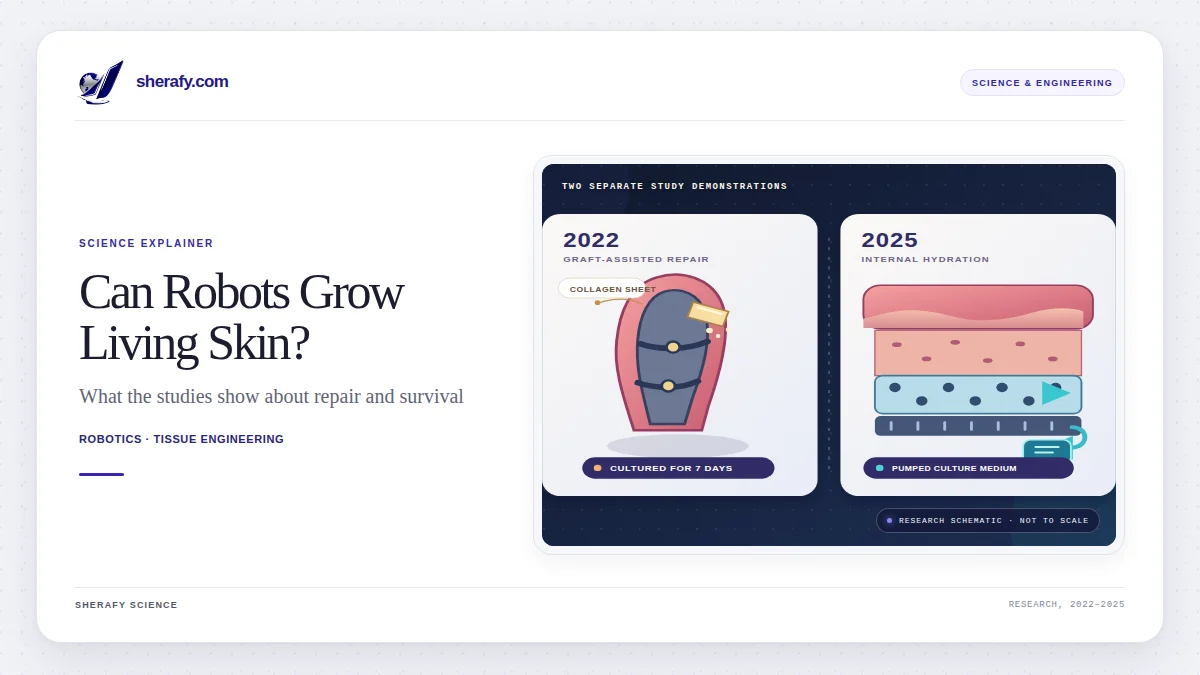
Yes, researchers have grown living, human-cell-derived skin equivalents over moving robotic parts, and one experiment showed a cut tissue layer repairing with help from a collagen sheet. That is a real biological repair result, but it was performed in a lab and cultured for seven days. It did not show a robot closing an injury on its own during ordinary operation, as the 2022 study and its authors’ methods account make clear.
Later work addressed two different challenges: keeping tissue attached as a robot moves, and supplying it with fluid. The 2025 hydration design improved a short-term tissue-thickness measurement after one day of air exposure. It did not establish long-term cell viability or a self-sustaining skin system. The studies mark progress across separate engineering problems, not one finished robot skin.
What researchers mean by “living skin”
The 2022 robotic finger was covered with a skin equivalent made from human cells. Its dermis-like layer was a collagen gel containing fibroblasts, cells that help produce and organize connective tissue. Researchers grew an epidermis-like outer layer from keratinocytes on top. The three-jointed finger could bend while covered.
This is engineered tissue, not a complete human skin organ. It does not reproduce all the structures and functions of natural skin. The distinction matters because “a robot with human skin” can suggest a more complete biological system than the experiments built.
The original research and the authors’ account of how they built the tissue describe this two-layer construction.
What the 2022 wound test actually showed
When researchers cut the finger’s dermis-equivalent, they covered the wound with a collagen sheet and cultured it for seven days. The researchers described the result as self-healing because cells participated in repairing the tissue. The collagen graft and controlled culture conditions were part of the process.
After the culture period, the finger flexed its joints as before, and the graft appeared integrated with the surrounding tissue. The group also examined separate, flat tissue samples. In those tests, dermal cells migrated into the collagen graft, and the repaired samples had greater adhesive strength than comparison samples. Those measurements help explain the repair mechanism; they were not measurements of the moving finger’s full skin function. The original study and the authors’ detailed account of the methods describe these as related but distinct demonstrations.
So “self-healing” is fair if it means that living cells helped repair a wound. It overstates the result if it means the robot autonomously detected damage, closed the wound without a graft, restored normal skin function and returned to work without support.
Later studies tackled attachment and hydration
The 2022 tissue had no built-in channels to deliver culture medium and could not be maintained in air for long periods, according to the authors’ account. Follow-up studies addressed specific parts of that problem, but they did not repeat the same wound-repair test.
| Study | What researchers changed | What the result supports | What it does not establish |
|---|---|---|---|
| 2022 robotic finger | Put a collagen sheet over a cut dermis-equivalent and cultured it for seven days | Graft-assisted, cell-mediated tissue repair in a lab demonstration | Unassisted wound closure or long-term operation without culture support |
| 2024 robotic face | Used perforation-type anchors inspired by skin ligaments to attach a dermis-equivalent to a face-shaped mold | Attachment and movement sufficient to form a smile when actuated | Wound repair in the anchored tissue or a complete living face |
| 2025 hydrated finger | Added a porous support and pumped culture medium beneath the tissue | Better preservation of measured dermis thickness after one day of air exposure | Long-term viability, a biological blood supply or independent nutrient delivery |
2024: holding tissue to a moving face
In the 2024 study, researchers used small perforations in the support, inspired by the ligaments that anchor skin to underlying tissue. The anchors helped hold a dermis-equivalent on a three-dimensional facial mold. Actuating the anchors moved the covering enough to make the face smile.
That was an attachment and motion advance, not another healing result. The paper says the researchers did not test wound repair in the anchored robotic skin. The study therefore cannot be used as evidence that a smiling robot face also repairs cuts.
2025: feeding fluid through a porous support
The 2025 design combined a perforated robotic skeleton with a permeable, sponge-like support made from polyvinyl alcohol hydrogel. Researchers pumped culture medium through the support beneath the tissue. This is engineered fluid delivery; it is not a network of living blood vessels or an independent source of nutrients.
In a separate demonstration, the skin-covered finger could move after seven days of perfusion culture. That shows the tissue was supported while the robot moved in laboratory conditions; it does not mean the finger spent a week in air without active fluid supply.
After one day of air exposure, the authors reported a mean dermis thickness of 774 ± 58 micrometers with the permeable support, compared with 181 ± 6 micrometers around a solid skeleton. The values are mean ± standard deviation from three tissue samples. It is evidence that the fluid-fed support helped limit tissue thinning over that short period. Thickness alone does not show whether cells across the full three-dimensional tissue remained viable.
The authors said longer-term effects and direct cell-viability assessment still needed study. They also described the finger’s epidermal layer as thin and not sufficiently differentiated. Those limits do not erase the engineering advance: the support offers a way to deliver fluid within a skin-covered structure. They do mean the result should be described as short-term hydration progress, not proof of durable living skin. The 2025 paper reports both the measurement and these qualifications.
Living tissue is not the only kind of self-healing robot material
Some soft robots use synthetic materials designed to repair damage. For example, a 2024 study reported that a maltose polyborosiloxane polymer healed after cuts under specified conditions, including about 10 seconds at room temperature, and integrated it into soft-robot components. This is a material-level result, not a direct comparison with living tissue.
As a review of soft robotics explains, “self-healing” can describe only one step in a larger system: detecting and cleaning damage, bringing the damaged parts together, repairing the material and checking whether performance has returned. A material that rejoins does not automatically make the whole robot autonomous. Living tissue may offer biological functions that a polymer does not, while synthetic systems can avoid the need to keep cells alive. The polymer study and soft-robotics review address different systems; neither is a head-to-head test of which approach is better.
What would count as self-sustaining robot skin?
The research has demonstrated several pieces of the idea: human-cell-derived tissue on moving parts, graft-assisted repair, attachment to a face-shaped structure, and a pumped support that preserved thickness over a one-day test. Those results come from the same University of Tokyo research program, so they show a developing line of work rather than independent replications of one integrated system.
The remaining evidence would need to connect those pieces: direct measurements of cell viability over longer periods, a better-developed outer layer, reliable tissue attachment during movement, and repeated injury-and-repair tests that show what intervention the repair requires. The fluid supply would also need to be treated as part of the system rather than mistaken for autonomous tissue maintenance.
The careful answer is therefore: robots can carry living human-cell-derived skin equivalents, and researchers have demonstrated a narrow, assisted form of tissue repair. The evidence does not yet show a robot with skin that heals itself unattended and remains viable long term. For more reporting on related research, see Sherafy’s Science, Engineering & Environment section.
References and Further Reading
Primary research
- Kawai et al., “Living skin on a robot” (Matter, 2022). Reports the three-jointed robotic finger and graft-assisted dermis-equivalent repair.
- Kawai et al., “Perforation-type anchors inspired by skin ligament for robotic face covered with living skin” (Cell Reports Physical Science, 2024). Tests a method for attaching a dermis-equivalent to a facial mold and actuating a smile.
- Ohta et al., “Skin-Covered Biohybrid Robotic Finger with Bilayered Permeable Subcutaneous Support for Internal Hydration Supplement” (Advanced Intelligent Systems, 2025). Measures a one-day air-exposure result with a permeable, fluid-fed support and describes the remaining viability questions.
Methods and context
- Takeuchi Laboratory, “Living skin on a robot”. Author-authored explanation of the tissue layers, collagen-sheet repair, separate flat-sample tests and air-maintenance limitation.
- Kuo et al., “Autonomous self-healing and highly stretchable polymer maltose polyborosiloxane for improving soft electronics and soft robots” (Journal of Materials Chemistry A, 2024). A synthetic-material example with specific healing conditions and soft-robot components.
- Tabrizian, Terryn and Vanderborght, “Toward Autonomous Self-Healing in Soft Robotics” (Advanced Intelligent Systems, 2025). Reviews why material repair and autonomous recovery of a whole robot are different claims.
Research reviewed October 25, 2026. The 2022, 2024 and 2025 living-skin studies discussed here are from one research program; they are not independent replications.