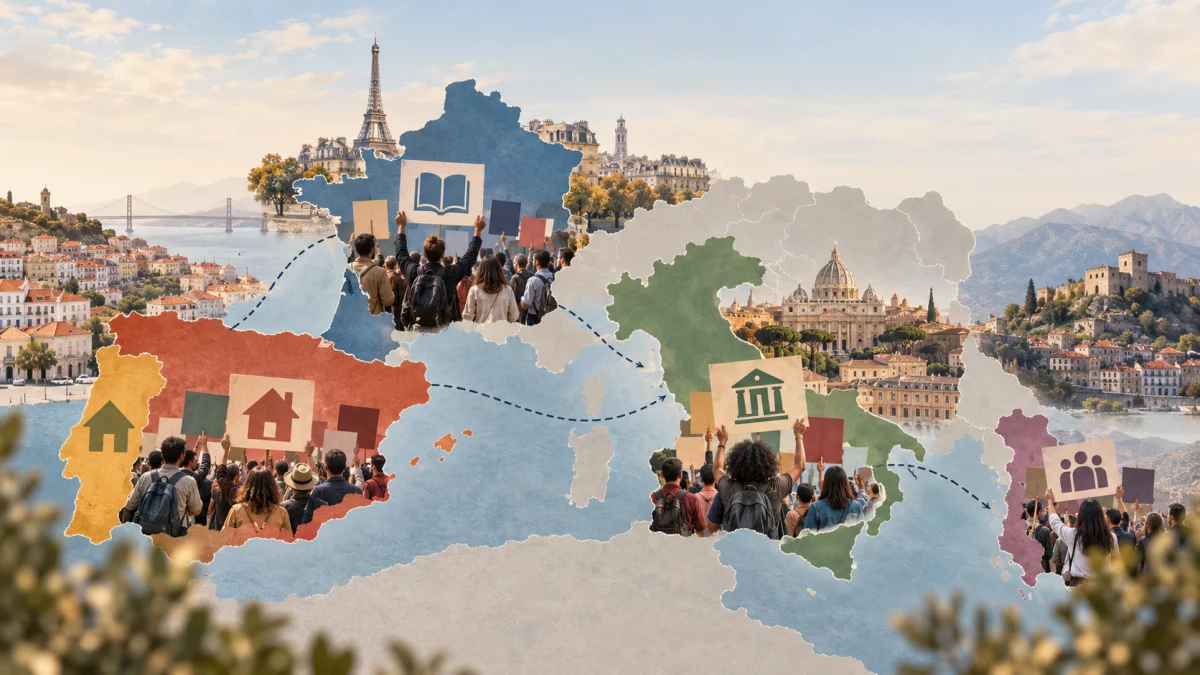
Some protests unfolding across Europe are connected through public expressions of solidarity and specific organizing proposals. Evidence available by October 21, 2026, does not show one organization directing protests in France, Italy, Spain, Portugal and Albania as a single movement. The clearest cross-border link is Iberian: Spanish unions registered a national housing and labor strike for November 11, while a Portuguese housing assembly proposed asking unions to organize a matching “Iberian” action. That was a proposal in Portugal, not confirmation that Portuguese unions had joined.
The five countries also have different immediate triggers. French demonstrations combine student complaints about schools with rising living costs and fuel prices. Italian students have called for school investment and challenged other government policies. Housing is central to protests in Spain and Portugal. Albania’s Flamingo movement began around a proposed coastal tourism development and broadened into anti-corruption and anti-government demands; students have since raised tuition and education concerns.
This comparison covers five selected cases, not all European protests. The evidence supports shared pressures, some influence between organizers and plans to coordinate particular actions. Similar timing, slogans, camps or social-media visibility alone do not prove a common command structure.
What are the protests in each country about?
| Country | Main grievances | Status reported by October 21 |
|---|---|---|
| France | School funding and conditions, fuel and living costs, public services. | October 17 saw large peaceful marches as well as looting and clashes. AP reported a Paris ban on a planned October 22 protest and another large action planned for October 24. |
| Italy | Student demands over schools, defense spending and education policy; separate labor and cost-of-living actions. | ANSA reported distinct Italian strike dates on October 30 and November 20, plus a planned European student action on November 20. |
| Spain | Housing affordability and security; the eviction of Maricarmen Abascal became a catalyst. Union demands also include wages and labor rights. | Unions including UGT and CCOO registered a 24-hour national strike for November 11. |
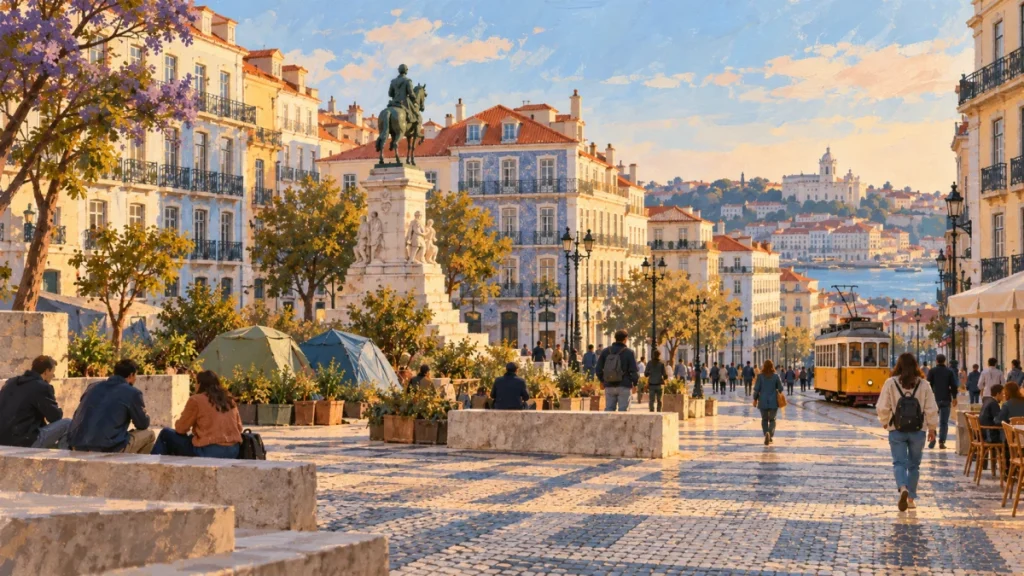
| Portugal | Housing costs, rents and proposed rental-law changes. | Police cleared Lisbon and Porto camps on October 20. Protests resumed that evening; Lisbon organizers planned to return to Rossio Square. |
| Albania | The Flamingo movement began over a proposed coastal tourism project and expanded into corruption and accountability demands. Students added tuition and education grievances. | AP reported an eighth consecutive day of clashes in Tirana on October 20, with students joining a broader campaign calling for Prime Minister Edi Rama to resign. |
These summaries do not mean every participant shares the same reason for attending. Nor should violence by some people be attributed to everyone at a demonstration. In Portugal, police and protesters gave conflicting accounts of parts of the camp clearances.
France and Italy: solidarity is real, but bounded
French students raised concerns about school funding, facilities, teacher shortages and admissions. Their October 17 mobilization joined those grievances with rising fuel and living costs and broader objections to public services. AP reported both peaceful mass participation and violent incidents in several cities. At the October 21 cutoff, Paris police had banned a planned October 22 protest, while another large demonstration was planned for October 24. These measures address the immediate security situation; they do not resolve the underlying grievances. For the country-level timeline, read Sherafy’s explainer on France’s October 2026 protests over fuel prices, school conditions and riots.
On October 16, Italian student groups held a “No Meloni Day” in dozens of cities. ANSA reported calls for better school facilities, more education investment, opposition to defense-industry funding and objections to a proposed cap on foreign students in classrooms. Organizer Angela Verdecchia expressed solidarity with French students and said Italian students were acting after those in France and Spain. This is evidence that some Italian organizers saw their action in relation to protests abroad. It does not establish that all Italian protesters shared that view or that the countries jointly planned the event.
Italy’s other mobilizations have separate organizers and dates. ANSA’s October 19 report described student groups joining actions around labor strikes on October 30 and November 20 and reported a planned European student strike on November 20. The sources reviewed did not establish a complete country list or shared steering body for that future action. These dates are separate from Spain’s November 11 housing strike. Sherafy’s explainer on Italy’s Blocchiamo tutto strikes over wages, war spending and public services covers a different strike sequence and should not be used to merge earlier events with this October’s student mobilization.
Spain and Portugal: an Iberian strike has been proposed
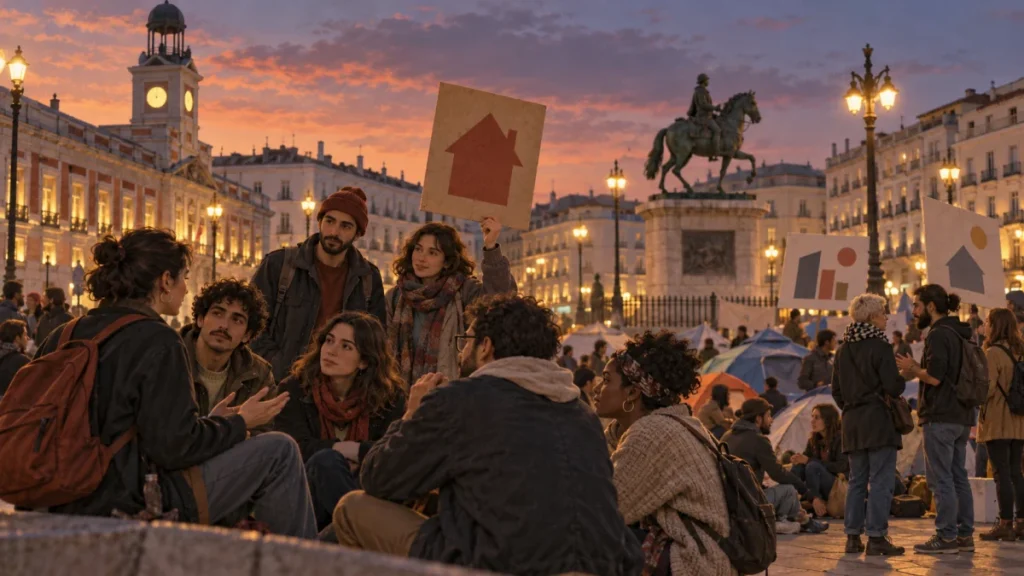
Spain’s housing protests grew around a wider affordability and tenant-security crisis. The eviction became a catalyst for tent camps at Madrid’s Puerta del Sol, while the campaign’s demands extend beyond her case, as AP’s October 19 overview reports. Sherafy’s explainer on Spain’s housing protests and Maricarmen’s eviction traces the national timeline and the legal limits of what is established about her case. EL PAÍS reported that UGT, CCOO and other unions and tenant organizations registered a 24-hour strike for November 11, framed around housing access, wages and labor rights.
Portugal’s protests developed on their own national timeline. Camps in Lisbon and Porto focused on rents, housing costs and proposed rental-law changes. Police cleared the camps before dawn on October 20. Thousands protested again that evening. RTP’s October 21 report said a Lisbon assembly voted to remain overnight in Rossio Square without tents after police warnings; Porto organizers planned a later return. For the country-level data and legal distinctions, see Sherafy’s explainer on Portugal’s housing protests, rents and the rental-reform dispute.
Authorities reported 55 arrests and two minor injuries in Lisbon. Protesters alleged excessive force and reported injuries. Those are competing accounts, not an independent legal finding. The encampment was cleared, but the protests continued.
The specific cross-border link is a proposal to act on the same date. RTP reported on October 19 that a Portuguese assembly participant wanted to appeal to unions to organize an Iberian strike on November 11, alongside the Spanish action. That statement establishes an organizing proposal. The sources checked by October 21 did not confirm that Portuguese unions had formally registered or called a matching strike. Spain’s strike, by contrast, had been registered.
This is stronger evidence than a visual resemblance between camps, but it remains a proposed link, not a completed joint action. It does not mean every Portuguese or Spanish housing protester belongs to the same organization.
Albania: a different political and environmental starting point
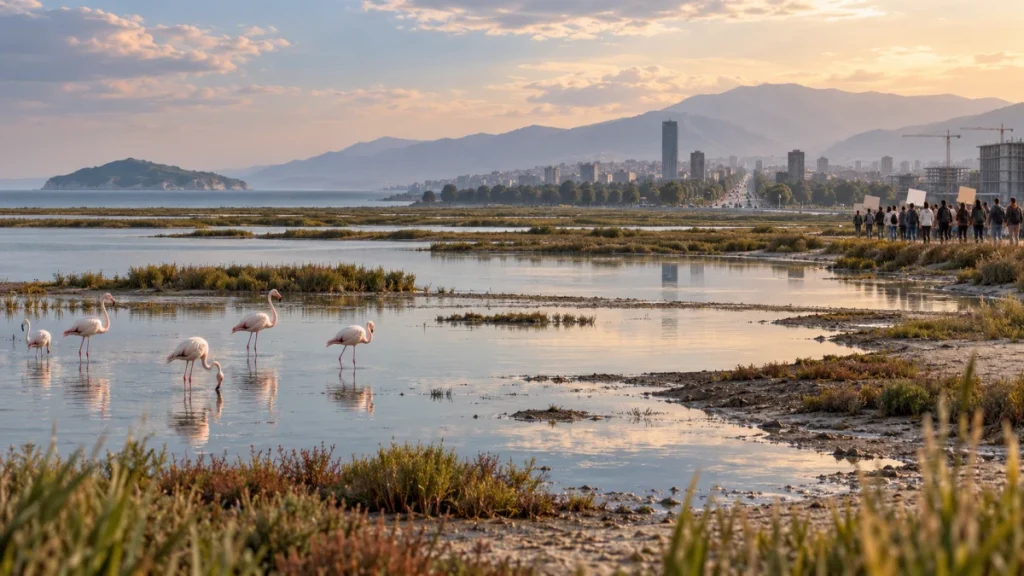
Albania’s protests should not be folded into the Iberian housing story. The Flamingo movement began months earlier in opposition to a planned luxury tourism development on Albania’s southern coast, including a project associated with an investment firm founded by Jared Kushner. The movement later broadened into anti-corruption and government-accountability demands. Its permits and environmental status remain separate factual questions; protest claims alone do not resolve them.
AP reported that students added demands for lower tuition, more education investment and action over corruption in the education system. They joined a broader campaign calling for Rama’s resignation. Sherafy’s explainer on Albania’s Flamingo Revolution, student demands and the resort dispute follows that separate national story. On October 20, police used tear gas and water cannons during clashes in Tirana; Rama said legitimate concerns were being hijacked by people committing violence. The sources reviewed establish no direct organizational link between these protests and the Iberian strike proposal or Italian student calls. That is a limit of the reviewed public record, not proof that no participants ever communicated.
Do the economic figures point to one common cause?
Eurostat’s October house-price release and September inflation release show different national patterns. These figures provide context; they do not measure who protested or why an individual joined.
| Country | House-price change, year over year, Q2 2026 | Consumer-price inflation, year over year, September 2026 |
|---|---|---|
| France | −0.8% | 3.4% |
| Italy | 4.0% | 4.2% |
| Spain | 12.1% | 5.0% |
| Portugal | 16.5% | 3.6% |
| Albania | Not included in these comparable Eurostat tables | Not included in these comparable Eurostat tables |
House-price changes track national transaction-price indices, not rent growth or affordability. HICP measures a broad consumer basket; it does not show the burden on a particular income group or identify a protest’s cause. France’s negative national house-price change does not rule out high rents, fuel costs or poor school conditions in protest locations. Faster purchase-price growth in Spain and Portugal does not show that housing alone explains every protest there.
Eurostat reports 12.1% for Spain’s Q2 house-price change; Spain’s national statistics institute reports 12.2%. This table uses one Eurostat release across the four EU countries rather than mixing national releases. The small difference does not indicate a meaningful change in trend. Albania’s absence is missing comparative coverage, not zero growth. See the Eurostat house-price release, September HICP release and Spain’s INE release.
How strong is the evidence that the protests are connected?
It helps to distinguish four kinds of evidence:
- Shared conditions: Housing, fuel prices and public services affect people in multiple countries. Similar pressures can produce parallel protests but do not prove coordination.
- Inspiration and solidarity: Some Italian student organizers expressly referred to French and Spanish students. Portuguese activists proposed an Iberian action. These are real but limited links among specific organizers.
- Coordination of a specific action: Spain registered its November 11 strike. Portuguese activists proposed asking unions to join the date. Italy’s labor and student calendars list separate actions on October 30 and November 20. These records do not establish one European strike.
- Common direction or foreign control: The sources reviewed do not establish that a government, party, donor or umbrella organization directed all five movements. On October 21, Macron said foreign leaders were exploiting France’s unrest through post-event messaging; AP reported he did not identify the AI images or explain how he verified them. That is evidence about narratives around protests, not who organized them.
There are competing explanations for the apparent wave. Participants may borrow tactics from visible demonstrations abroad; economic and public-service pressures can also produce similar demands independently. Domestic events matter: a court-enforced eviction in Spain, rental policy in Portugal, school conditions in France and Italy, and a coastal development dispute in Albania are not interchangeable causes.
The strongest evidence against calling this one movement is the mismatch in timing, organizers and demands. The strongest evidence against calling the cases wholly unrelated is the public solidarity and the Iberian proposal. The best-supported answer is that some groups influence or try to coordinate with others, but no single movement directing all five has been demonstrated.
Is there one European general strike?
No single Europe-wide strike had been established in the records checked by October 21. Spain’s November 11 action was registered as a national strike. Portuguese housing activists proposed appealing to unions for a parallel Iberian action, with Portuguese union participation unconfirmed in the reviewed record. Italian unions and student groups announced separate dates, including a planned European student action for November 20. All were future actions at the cutoff.
A call, proposal, union registration and completed strike are different stages. After each date, an update should verify which groups participated, whose turnout estimates were reported, what was disrupted, how governments responded and whether demands were implemented.
Are these all youth or “Gen Z” protests?
No. Students and young people are prominent in France, Italy and Albania, and younger tenants are visible in Spain and Portugal. Unions, tenant organizations, workers, environmentalists and other residents also appear in reporting. No comparable demographic survey across all five countries was found, so “youth-led” should describe only specific organizing and not every participant.
Questions readers ask about Europe’s protests
Why are people protesting across Europe in 2026?
The grievances differ. Living costs and public services appear in several cases; housing is central in Spain and Portugal; schools and education policy are prominent in France, Italy and Albania. Albania’s movement also grew from a coastal development dispute and anti-corruption demands.
Did protests in France inspire protests in Italy?
Some Italian student organizers said their action expressed solidarity with French students and referred to Spain. That supports a limited claim of inspiration, not proof that France directed Italy’s protests.
Are Spain and Portugal planning the same strike?
Spanish unions registered a November 11 strike. A Portuguese assembly participant said organizers would appeal to unions for an Iberian action on that date. As of October 21, the reviewed sources confirmed the proposal but not Portuguese union participation.
Is foreign involvement behind the protests?
The reviewed sources do not establish one outside actor directing all five movements. Claims about foreign leaders amplifying information about France concern post-event narratives; they do not identify who organized the underlying protests.
References and further reading
- AP: France’s protests and October 17 unrest — reports school grievances, living costs, peaceful marches and violent incidents; figures are tied to its date and event scope.
- AP: protests from France to Albania, October 19 — provides a cross-country overview and reports the Madrid camps followed Maricarmen Abascal’s eviction; it does not establish a common organization.
- AP: Macron’s response to foreign claims — reports his October 21 comments and AP’s qualification about the images he referenced.
- ANSA: Italian student demonstrations, October 16 — records “No Meloni Day,” stated grievances and organizer references to France and Spain.
- ANSA: Italian action dates, October 19 — summarizes separate planned Italian union and student actions; future participation was not verified.
- EL PAÍS: Spanish unions register the November 11 strike — identifies participating unions and tenant groups and their stated aims.
- RTP: Portuguese activists propose an Iberian strike — records a participant’s appeal to unions, not a union authorization.
- RTP: Portuguese protests after camp clearances — October 21 update on assemblies, arrests and planned returns; police and protester accounts differ.
- AP: Albania protests on October 20 — reports student demands, the broader resignation call and police response; does not resolve project permits.
- Eurostat: Q2 2026 house-price indices — supplies the common-source transaction-price figures, not rent or affordability.
- Eurostat: September 2026 HICP — supplies annual consumer-price changes, not household burdens or protest causes.
- Spain’s INE: Q2 2026 house-price index — reports 12.2%, slightly different from Eurostat’s 12.1%.
- AP: Greek student and teacher protests, October 21 — shows activity outside this five-country sample; it does not establish a common organization.
Research currency and limits: Sources and event status were checked through October 21, 2026. Protest plans, strike calls, police measures and legislative positions can change quickly. This is a five-country comparison using selected official statistics. No Search Console or keyword-volume data were accessed, and no ranking outcome is promised. No comparable participant survey, complete joint-planning archive, organizer finance audit or proof of outside direction was located. Limited links among some organizers are supported; a single coordinated five-country movement remains unproven.