Albania’s 2026 protests began with opposition to a proposed tourism development near the Vjosa–Narta wetlands and expanded into a wider challenge over government accountability, public services and young people’s prospects. In October, high-school and university students joined the demonstrations with demands about education, dormitories, tuition and opportunity. On October 21, the ninth day of student demonstrations, a march began peacefully and later escalated, with stones and Molotov cocktails thrown at the prime minister’s office and security forces, Anadolu Agency reported. Police had used tear gas and water cannons during the previous day’s clashes, according to the Associated Press. The protests overlap, but they do not represent one uniform group or a single set of demands. Citizens.al’s movement chronology, Anadolu Agency’s October 21 report and the Associated Press’s October 20 report describe these phases.
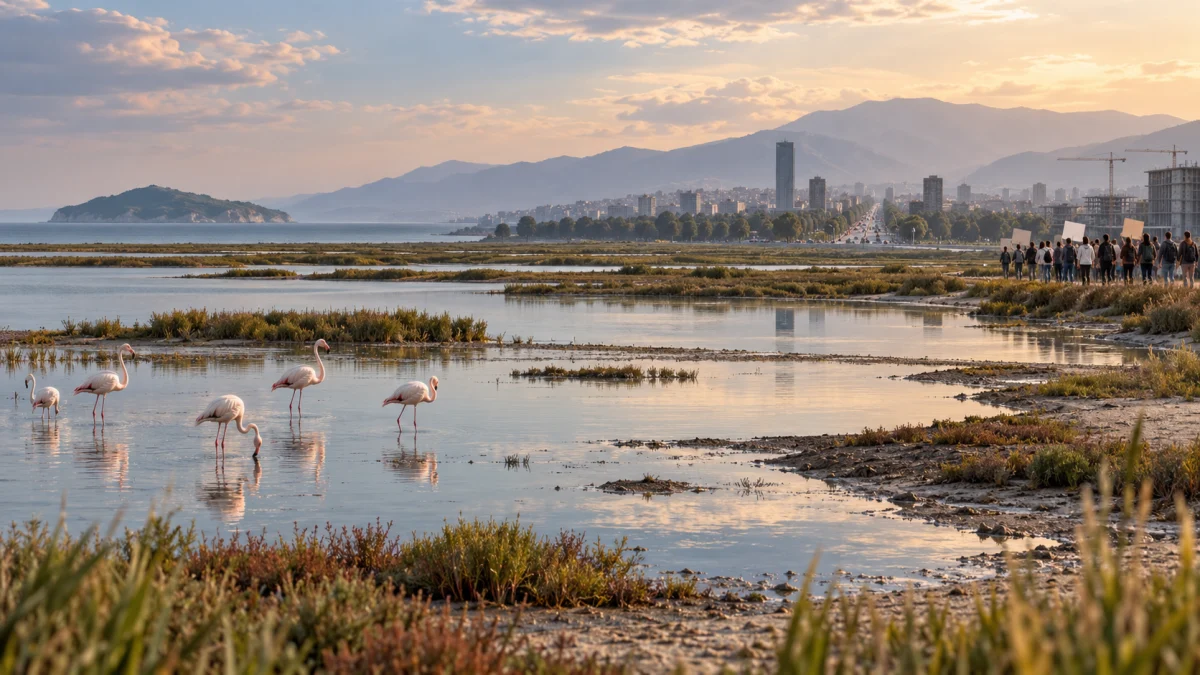
The movement is commonly called the “Flamingo Revolution,” after the birdlife associated with the Narta lagoon and the campaign’s environmental symbolism. The label covers a loose coalition and a changing list of grievances: coastal habitat protection, transparency around tourism projects, land rights, allegations of corruption, education and calls for Prime Minister Edi Rama to resign. Organizers and participants do not speak with one voice. Neither the government’s claims that violence is organized by outside or opposition forces nor every protester’s claims about project illegality have been independently established by the records reviewed here.
What happened most recently?
The latest event verified for this article is the October 21 demonstration in Tirana. Anadolu Agency reported that university students, high-school students, citizens and faculty members took part. The march began peacefully outside the prime minister’s office, moved to the Education Ministry, and later returned to the prime minister’s office. The agency reported that stones and Molotov cocktails were thrown at the building and security forces. It also reported that Rama again called for dialogue and that the University Academic Staff Union announced a boycott at universities nationwide. This is a report about that day, not a count of all participants or a finding about who coordinated the violence. Anadolu Agency, October 21.
The student phase began on October 13, when students and other demonstrators gathered outside the Ministry of Education. Reported demands included better teaching and university conditions, improved dormitories, lower tuition fees, greater public investment in education and fairer access to study and employment opportunities. Some participants also called for Rama’s resignation. The same day, stones were thrown at the ministry and police used tear gas, batons and pepper spray, according to Citizens.al. Its named interviews document individual views; they do not establish a representative national student platform. Citizens.al, October 13 and the Associated Press, October 20.
The Office of the Ombudsman has separately reported preliminary findings from monitoring detention and police conduct. In an October 16 statement, it said monitors had spoken with 214 people deprived of liberty over four days; documented complaints and visible signs of violence among 26 people held in the Security Unit; and observed minors questioned without a parent, guardian or psychologist. It also described detention facilities operating beyond capacity and poor conditions. These are preliminary oversight findings and recorded complaints, not final court determinations about each incident. In a later statement about October 20 monitoring, the Ombudsman reported that one facility held 118 people despite a stated capacity of 67, including six minors. That figure describes a facility snapshot, not the cumulative number arrested. Ombudsman, October 16, in English and Ombudsman, October 21 statement in Albanian.
The European Commission condemned violence, arson and attacks on public institutions, while saying any state response must remain lawful and proportionate and responsibility must be determined through due process. That statement establishes the Commission’s position; it does not resolve whether a specific use of force or detention was lawful. European Commission, October 18.
What sparked the Flamingo Revolution?
The immediate trigger was a local dispute at Zvërnec, on Albania’s southern Adriatic coast near the Narta lagoon. Residents and activists protested preparatory work and fencing associated with a proposed tourism development. On May 30, a private security guard dragged a protester during a demonstration near the site. Reports of the incident helped draw wider attention; the next day, protesters rallied in Tirana. Citizens.al’s month-one account says daily demonstrations broadened from opposition to interventions around Pishë Poro–Nartë and Zvërnec into disputes over protected-area laws, strategic-investment rules and the national government. DW’s June backgrounder and Citizens.al’s June 29 chronology describe the trigger and expansion.
The flamingo symbol refers to the wetlands and birdlife of the Narta area, rather than to Sazan Island. An ecological study hosted by Albania’s protected-area agency describes the wider Vjosa–Narta wetland as an important wintering habitat for birds including greater flamingos. That establishes the ecological significance of the area; it does not by itself measure the effects of a particular project. National Agency of Protected Areas ecological study, p. 42.
As the movement grew, conservation concerns joined wider criticism of government decision-making, property disputes, health and education services, economic opportunity and alleged corruption. Calls for Rama to resign became part of some demonstrations. These changes help explain why protests grew beyond a single development site, but they do not show that every person attending supports every demand.
What are the Sazan and Zvërnec projects?
The protests often refer to a Kushner-linked resort, but the public debate covers two geographically and legally distinct proposals. They should not be treated as one project or as if both are at the same approval stage.
| Site | What is proposed and what the record says |
|---|---|
| Zvërnec Peninsula, beside the Pishë Poro–Nartë protected landscape | A tourism development on land the government describes as privately owned, with reporting describing a mixed-use destination with hotels, apartments and a port. The government said in June that the National Territorial Council approved a development permit on March 30, 2026, but that it was not a construction permit. It said a fencing authorization issued April 29 was for preliminary measurements, environmental monitoring and technical preparation, and that an in-depth environmental impact assessment was required before a construction-permit application could be reviewed. It also said there were competing property claims in court. These are dated government statements; the underlying operative permits and later decisions were not independently inspected here. |
| Sazan Island | A separate state-owned island proposed as a tourism destination. The government said negotiations over state participation were ongoing in June, no final agreement had been reached, and the investors had not submitted an architectural project or environmental assessment. The island is not the Narta lagoon or the Vjosa–Narta wetland. |
The government’s June 15 account is detailed but comes from a party defending the project and its handling. It says the protected landscape remains designated and that development can proceed only through specified planning and environmental reviews. Conservation groups contest whether the rules and consultation process provide adequate protection. A coalition statement by environmental organizations called for repeal of Law 21/2024 and opposed development in Pishë Poro–Nartë; those are the coalition’s legal and policy claims, not a court ruling. Government account, June 15 and PPNEA coalition statement, June 12.
There is a consequential document dispute. The government announced a public “Flamingo Mirror” disclosure file on October 3. Citizens.al says its October 9 review compared the file with agency responses and found a January 2025 construction-permit approval for three residential blocks, followed by an investor withdrawal of an application on March 27; the report does not make the effect of that withdrawal clear. It also reported differences in how the March 2026 development decision was dated and described. The outlet said the public file listed major technical documents by title without the documents themselves. The Mirror’s answer was that there was no current building permit, according to Citizens.al, but the live file did not open in our review and we did not inspect the underlying permit, withdrawal or agency records. Those reports therefore raise a real status question without allowing us to resolve it. This article does not treat a development permit, prior approval or public-file entry as proof of current construction authorization. Government disclosure announcement, October 3 and Citizens.al’s document review, October 9.
Kushner’s public response says his partnership bought Zvërnec land from a private party for €230 million, estimates the project could represent about €4 billion in investment if successful, and describes him as a minority partner without day-to-day management. These are the investor’s claims, not audited proof of the purchase price, total project cost, financing, jobs or public benefit. He says the project remains subject to Albanian approvals. Citizens.al has reported on company records and a preliminary investigation concerning alleged irregularities in land transfers; that investigation is not a finding of wrongdoing by Kushner, the government or any other named party. Kushner’s response, Albania section, Citizens.al, October 9 and BIRN/Reporter.al, June 1.
Why are students protesting?
The student demonstrations added a distinct set of concerns to the coastal-development movement. Students interviewed by Citizens.al on October 13 described poor dormitory conditions, concerns about teaching quality, a desire for more merit-based study and employment opportunities, and frustration that young people see emigration as their best prospect. One interviewee discussed paying a higher fee for a second master’s degree and called for free public education. That personal account should not be generalized into a claim that tuition doubled for all students. Citizens.al’s October 13 interviews.
High-school pupils and adults have also joined or supported demonstrations. Some participants have called for the government’s resignation; others focus on education or environmental protection. Rama has argued that the demonstrations are not primarily about education and that some people involved in violence are not students. Named student interviews and October 21 reporting establish that students participated and voiced education concerns; they cannot determine the motives of everyone in a crowd. No representative student-wide platform was located.
Why the resort proposals are controversial
Rama has recognized the right to peaceful protest while condemning attacks on police, businesses and public buildings. He has called for dialogue with students and described some demonstrators as violent groups disconnected from the student movement. He has also alleged that opposition figures or outside actors are exploiting unrest to destabilize Albania or damage its European Union path. Those are the prime minister’s claims; the sources reviewed for this article do not independently establish who organized or funded the October violence. Rama’s October 18 remarks and October 20 meeting with school leaders.
The government’s strongest case is that Albania can pursue tourism investment and jobs while retaining protected-area status, and that a project should be judged through planning permissions and an in-depth environmental review. It says Sazan would remain state property and Zvërnec is privately owned, subject to court claims. Investors say they intend a lawful development and that Kushner is not managing it day to day. These arguments matter: tourism can support employment and public revenue, a protected-landscape designation does not itself prove every development is prohibited, and violence against police or public property is a real harm. A promise of future review, however, cannot substitute for the operative documents, environmental findings, transparent consultation or final title decisions.
Protesters’ central concern is that development in a sensitive wetland region could impose lasting costs on local residents, ecosystems and public access, while project documents and ownership arrangements have been difficult for the public to assess. Environmental coalitions want stronger protection; some residents raise land rights and consultation; students describe immediate educational and economic insecurity. These cases carry different evidence and do not merge into proof that the proposals are illegal, corruption occurred or all students support a change of government.
What could happen next with the projects and student demands?
Without the protests, the projects would still be subject to the planning, land and environmental processes described by the government. Its June account said Zvërnec had a development-permit decision but not a construction permit, with a more detailed environmental assessment still required; it described Sazan negotiations as unfinished. Because the October disclosure file could not be inspected, this is a dated baseline rather than a certified statement of current permits.
Authorities could complete and publish the environmental review, require redesign or reduced development, pause a project while land claims are resolved, or reject proposals that fail legal or environmental requirements. The projects could also proceed if the required approvals support them. None of the paths has a measured job, revenue or habitat outcome in the material reviewed here. Education demands are a separate policy track: the government could meet with students and faculty, publish plans for dormitory conditions and teaching quality, and address fee and access concerns through university and budget processes. A resignation demand is a political position, not a remedy with a quantified education effect.
What is established—and what remains disputed?
| Claim | What can be said from the records reviewed |
|---|---|
| “Albania is protesting because students oppose the government.” | Incomplete. The movement began around coastal development and later included students, political opposition and other grievances. |
| “Every student wants Rama to resign.” | Not established. Some participants called for resignation; others emphasized education and opportunity. No representative student-wide platform was verified. |
| “Kushner owns the land or controls both projects.” | Not established from complete corporate records. Kushner publicly describes himself as a minority partner with no day-to-day management role. |
| “Sazan Island has been sold.” | The government’s June account says it is state property and negotiations for state participation were unfinished. The current agreement file was not reviewed. |
| “Zvërnec has final construction approval.” | The government said in June the March 2026 decision was a development permit, not a construction permit. Citizens.al later reported a separate three-block construction-permit approval in January 2025, followed by an investor withdrawal of an application in March; it said the public file declared no current building permit but had gaps. We did not inspect the underlying records, so current status remains unresolved. |
| “The projects have been proven illegal or corrupt.” | Not established. Environmental groups and land claimants have raised objections; reporting describes a preliminary investigation. No final court finding was reviewed. |
| “Foreign or opposition groups organized the October violence.” | Rama has alleged outside or opposition involvement. The independent reporting and oversight records reviewed do not establish who coordinated or funded the violence. |
| “The October 20 detention-center figure is the number arrested.” | Incorrect. The Ombudsman described 118 people held at a facility with capacity 67 at a point in time; it is an occupancy snapshot, not an arrest total. |
Who is involved, and what do they say?
The interested parties include the Albanian government, developers and investors, local landowners and people contesting property claims, conservation groups, residents, students, university staff, police and demonstrators. The government has a stake in defending its investment policy and its response to the protests. Environmental groups advocate stronger protection and limits on development. Student groups and interviewees have education and political demands. These interests do not invalidate their claims, but they matter when weighing them.
The government describes Zvërnec as private development and Sazan as a proposed state-investor partnership. Kushner says his partnership paid €230 million for Zvërnec land and estimates that the completed project could represent about €4 billion in investment if successful. Those figures are investor representations, not audited costs or guaranteed economic gains. The public records reviewed do not provide a complete ownership map, beneficial-ownership reconciliation, financing terms, state valuation, job forecast or expected public revenue. No funding source for protest activity or evidence of paid participation was established here.
What is still unclear?
The complete operative permits, agreements, current environmental assessment and October disclosure file were not available for direct review. The exact current stage of each project, legal status of disputed land titles, and economic and ecological effects remain unresolved. A complete independent account of who was injured, detained or responsible for specific October acts was unavailable. Student accounts are documented, but the scale and representativeness of each demand are not known. Search Console data and search-volume metrics were not available, so the phrases in this package are editorial search-intent targets rather than measured keyword opportunities.
What should readers watch for next?
A current set of operative permits, agreements and environmental assessments would clarify the two projects’ status and likely effects. Court rulings and complete company records could resolve material land-title and ownership questions. For the protest story, updates from the Ombudsman, court records and university representatives could clarify detention complaints, individual cases and which education demands receive a response. Until those records are available, the permit dispute and the representativeness of the movements’ demands remain open questions.
Questions readers ask about Albania’s protests
Why are the protests called the Flamingo Revolution?
The name refers to flamingos and other birdlife associated with the Narta lagoon and nearby wetlands. It is a movement label, not the name of a single registered organization or a complete list of everyone’s demands.
Are the Sazan and Zvërnec resort proposals the same project?
No. Zvërnec is a privately owned coastal site near the Pishë Poro–Nartë protected landscape; Sazan is a separate state-owned island where the government said negotiations were unfinished. Their ownership, location and approval histories differ.
Has the Zvërnec project received permission to build?
The current status could not be confirmed from the records reviewed. The government described a development permit rather than a construction permit, while later reporting identified a separate earlier approval and an application withdrawal, then reported that a public disclosure file said no current building permit existed. The operative documents were not available for independent comparison.
Are all the protests about the resort?
No. Environmental protection and project transparency were central to the original movement, while student demonstrations brought additional demands about education and future opportunity. Some protesters called for Rama’s resignation; the sources reviewed do not establish that this is the position of every participant.
Were the October demonstrations peaceful?
Some marches began peacefully, but reports also describe stones, Molotov cocktails and other attacks, alongside police use of tear gas, batons and water cannons. The Ombudsman’s monitoring raised preliminary concerns about detention conditions and safeguards. Those separate facts do not determine the lawfulness of a particular person’s conduct or any specific police response.
Sources and further reading
- Anadolu Agency, “Protests in Albania continue as students demand improved education conditions,” October 21, 2026. Same-day account of the latest student demonstration and university staff boycott.
- Associated Press, “Albanian police clash with anti-government protesters for an 8th day,” October 20, 2026. Reports police use of tear gas and water cannons, clashes and the student demands; one event report, not an independent incident investigation.
- Citizens.al, “Students reawaken protest, police respond with violence,” October 13, 2026. Named student interviews and a one-day account; interviewees do not represent all students.
- Citizens.al, “Flamingo Revolution: 30 days of civic resistance,” June 29, 2026. Activist accounts, stated demands and movement chronology.
- DW, “Albania’s ‘Flamingo Revolution’: What’s behind the protests?”, June 27, 2026. Background reporting on the May 30 confrontation as a turning point; not proof of a single unanimous movement platform.
- Office of the Ombudsman, preliminary findings, October 16, 2026. Full English statement read; observations and complaints are preliminary.
- Office of the Ombudsman, October 21 statement on October 20 monitoring. Albanian original read; facility occupancy is not an arrest total.
- European Commission, statement on protests in Albania, October 18, 2026. Institutional position on violence, proportionality, assembly and due process; not an incident investigation.
- Albanian Council of Ministers, Sazan and Zvërnec account, June 15, 2026. Government’s two-site account, read in full; not an independent title or permit audit.
- Albanian Council of Ministers, “Flamingo Mirror” disclosure announcement, October 3, 2026. Announcement read; underlying disclosure file did not open in this review.
- Citizens.al, review of “Flamingo Mirror,” October 9, 2026. Full article read; it reports on the public file and agency responses, but its underlying permits were not independently inspected here.
- PPNEA coalition public-hearing statement, June 12, 2026. Environmental organizations’ demands and legal position; advocacy source, not an adjudication.
- National Agency of Protected Areas, ecological study, p. 42. Identifies regional wetland bird habitat; not a project-specific impact assessment.
- Jared Kushner, response on Albania, section 9. Direct account of his stated role; not independent ownership verification.
- Citizens.al, “Jared Kushner talks about the Zvërnec project,” October 9, 2026. Reports his position and company/investigation questions; secondary reporting, not a court finding.
- BIRN/Reporter.al, report on the SPAK investigation, June 1, 2026. Reports a preliminary investigation; investigation does not establish guilt.
- Prime Minister Edi Rama’s October 18 remarks and October 20 meeting with school leaders. Primary records of the prime minister’s position and allegations; claims about organization and foreign influence were not independently substantiated in the reviewed sources.
- Reuters reporting via ThePrint, October 15, 2026. Additional event and political context; syndicated reports are not independent corroboration.
Research currency: Checked through October 21, 2026. Event coverage includes the October 21 Anadolu Agency account. The current Zvërnec permit status remains unresolved because the underlying disclosure file and operative documents could not be independently reconciled; refresh protest developments and project records before publication.