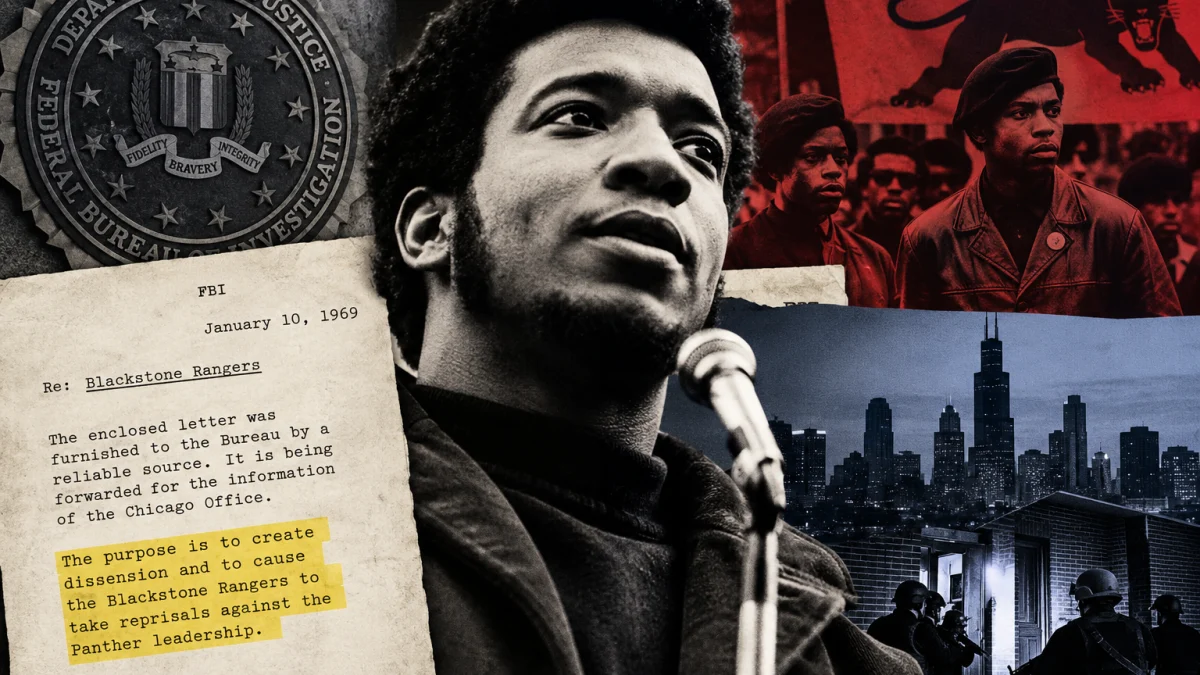
Yes. The FBI tried to provoke retaliation against Fred Hampton’s Black Panther Party by sending a fabricated warning to a rival Chicago street-gang leader. On January 30, 1969, FBI Director J. Edgar Hoover authorized an anonymous letter falsely claiming the Panthers were plotting to kill Jeff Fort, a leader of the Blackstone Rangers. An FBI memorandum anticipated that the deception could push Fort to retaliate against Panther leadership. A federal appeals court subsequently described the letter as having been sent.
This is documented in the U.S. Senate Church Committee’s 1976 investigation of FBI operations against the Black Panthers and the federal appellate decision in Hampton v. Hanrahan. The underlying evidence is considerably stronger than an unverified social-media allegation.
But the distinction between trying to provoke violence and proving that a particular act of violence resulted is essential. The Panthers and Rangers were already in conflict. Senate investigators could not establish that the forged letter caused subsequent clashes, much less Hampton’s death. On December 4, 1969, Chicago police killed Hampton, 21, and fellow Panther Mark Clark during a separate predawn raid. That raid did involve important FBI assistance, including intelligence supplied by paid informant William O’Neal. The letter and the raid are both documented; a direct causal chain from one to the other is not.
Contributor credit: This investigation was prompted by a video from Ashley B (@ashleytheebarroness), which brought the FBI’s interference with Hampton and the Blackstone Rangers to our attention. sherafy.com independently reviewed congressional records, federal court decisions, historical archives, and the broader claims discussed in the video.
What did the FBI’s fake letter to Jeff Fort say?
Fred Hampton and Bobby Rush were organizing the Illinois Black Panther Party in Chicago. Jeff Fort led the Blackstone Rangers, whose broader organization was known as the Black P. Stone Nation. By late 1968, the Panthers had approached Fort about cooperation, but the two organizations also had armed confrontations and competing demands over territory and membership.
The FBI’s Chicago office proposed exploiting these tensions. Its draft impersonated an anonymous Black community member who claimed to know Panther insiders. It falsely suggested Fort was in danger: "there’s supposed to be a hit out for you." The purported writer implied that Fort should protect himself by taking action. The claim was part of an FBI deception, not evidence of an actual Panther assassination order.
The bureau’s accompanying explanation revealed the objective. Agents believed the message could intensify hostility and lead to "reprisals against its leadership." They also considered a similar warning to the Panthers, but reasoned that the Rangers were more likely to engage in shooting or comparable violence. These words appear in the Church Committee report, printed page 197.
This is the decisive evidence. The letter was not a neutral intelligence warning, an ordinary criminal investigation, or a genuine effort to keep the peace. It was fabricated by a law-enforcement agency to encourage distrust and possible retaliation against a political organization.
Did the FBI specifically instruct Fort to murder Fred Hampton? No surviving wording in this particular letter names Hampton as a proposed victim or orders Fort to kill him. Yet Hampton was a leading Panther in Chicago, and the FBI explicitly contemplated reprisals against Panther leadership. Reasonable inference: The agents knowingly created a risk of violent consequences for Hampton and other leaders. A documented order, through this letter, to assassinate Hampton personally has not been established.
One more limitation matters: the Senate report documents the proposed letter and Hoover’s approval; the 1979 appellate opinion describes the letter as sent. Neither source, in the passages examined, proves that Fort personally read it or acted on it.
The Panthers and Blackstone Rangers were already in conflict
The FBI did not invent the organizations’ rivalry from nothing. Its strategy was to worsen tensions that already existed, according to the Church Committee’s reconstruction, printed pages 195-198.
On December 16, 1968, Chicago agents proposed an anonymous warning designed to increase resentment against Panther leaders. A memorandum reported that Fort was resisting Panther requests for support and had threatened to respond to insults directed at him. Around December 18, Panthers and Rangers were involved in a serious confrontation; FBI-collected information described a Ranger shooting a Panther and arrests of members from both groups.
That evening, Hampton and Rush went to Ranger headquarters to meet Fort. An FBI informant described an intimidating show of weapons by the Rangers, followed by discussion of joining forces. According to the informant, Fort wanted the Panthers to join the Rangers, while Hampton wanted the reverse. The meeting account is an informant report, not an independently confirmed verbatim transcript.
Hampton and Fort met again on December 26, but negotiations broke down in argument. A December 27 exchange also failed. Chicago agents then renewed their proposal for a letter, observing that cooperation had not materialized and mistrust was growing.
On January 13, 1969, Hampton and Rush discussed the Rangers on a Chicago radio show, and Fort phoned in to dispute Hampton’s description of their relationship. On January 16, according to an FBI report cited by the Senate, Hampton publicly said Fort had threatened him. Hoover approved the anonymous warning on January 30.
The causal lesson is simple: an agency can deliberately inflame a dangerous conflict even when it did not originally create that conflict. The documented misconduct is the decision to introduce a fabricated assassination threat into an already volatile relationship.
Timeline: the forged letter, the coalition, and Hampton’s death
| Date | What the record shows | What can be concluded |
|---|---|---|
| December 16-27, 1968 | The FBI proposes aggravating Panther-Ranger tensions; the groups clash and hold unsuccessful negotiations. | The conflict predated the letter’s January approval. |
| January 13-16, 1969 | Hampton and Fort publicly dispute their relationship; Hampton reports a threat. | Agents knew the dispute was volatile. |
| January 30, 1969 | J. Edgar Hoover authorizes an anonymous warning to Fort. | Approval came from the FBI’s director. |
| Spring 1969 | The Panthers, Young Lords, and Young Patriots establish the original Rainbow Coalition. | Those partners were distinct from the Blackstone Rangers. |
| March 24-April 8, 1969 | Agents propose another anonymous warning addressed to Hampton; headquarters approves it. | The records establish a related deceptive plan, not proven delivery. |
| November 19, 1969 | FBI agent Roy Mitchell prepares an apartment floor plan with informant William O’Neal’s assistance. | Federal intelligence becomes directly relevant to the later raid. |
| December 4, 1969 | Officers assigned to the Cook County State’s Attorney’s Office raid the apartment, killing Hampton and Mark Clark. | The killing is documented, but the Senate did not trace it to the January letter. |
| 1976-1983 | Senate findings, withheld FBI files, appellate review, and a civil settlement make more evidence public. | The record of state actions is broader than the forged letter alone. |
Sources: Church Committee, printed pages 195-199; Newberry Library’s Rainbow Coalition history; Hampton v. Hanrahan; UPI’s contemporaneous account of the 1983 settlement.
Why was the FBI targeting the Black Panthers?
COINTELPRO was the FBI’s covert counterintelligence effort against domestic political organizations. In August 1967, the bureau began a program aimed at organizations it classified as Black nationalist threats. The Black Panther Party was not an original target of that particular initiative, but by 1968 it had become a major focus. The Church Committee reported that the Panthers ultimately accounted for 233 of 293 authorized actions in the bureau’s Black-nationalist COINTELPRO category.
The program’s stated objectives included preventing coalitions among targeted groups, discrediting leaders, obstructing the emergence of a unifying figure, and limiting organizations’ long-term growth among young people. The directive also listed prevention of violence as an objective.
That creates a documented contradiction. The FBI claimed a preventive security purpose while approving tactics whose anticipated consequence was retaliation and possible bloodshed. The Church Committee found that senior officials wanted to promote violent confrontations between Panthers and rival organizations, even though it could not reliably trace individual shootings to specific covert actions. Its conclusions are explicit.
The evidence supports more than the idea that an individual agent went too far. The proposed Fort letter moved through an approval process ending with Hoover himself. Reasonable inference: The bureau regarded the Panthers’ organizational influence and potential alliances as threats to be weakened, not simply as subjects of case-by-case criminal investigation. That is supported by the written objectives and authorized tactics, without guessing at anyone’s private beliefs.
A necessary qualification: the coalition-prevention directive referred specifically to alliances among organizations categorized as militant Black nationalist groups. It was not itself a written order to dismantle Hampton’s later multiracial Rainbow Coalition. The Chicago letter nonetheless demonstrates the bureau’s willingness to interfere with potential Panther alliances in practice.
Did the FBI prepare a second false warning addressed to Hampton?
Yes. The Senate report describes another anonymous letter designed to aggravate suspicion. In March 1969, Chicago agents learned that a Panther member feared an internal faction wanted to remove him. Agents drafted a warning to Hampton that mixed an allegation about internal rivals with a suggestion that Jeff Fort might be involved. The proposal was recorded in a March 24 memorandum; headquarters approved it on April 8.
The Church Committee report, printed pages 198-199, documents the preparation and authorization. It does not establish, in that passage, that Hampton received or believed the warning. Unlike the first letter, the documentary evidence discussed here should not be treated as proof of delivery.
A footnote to the same Senate discussion records Bobby Rush’s account that informant O’Neal falsely reported a Panther had been shot by Rangers and encouraged retaliation. The committee explicitly said that account was unconfirmed. It is a possible line of inquiry, not a verified consequence of the forged-letter program.
Taken together, the approved proposals reveal a recurring method: plant uncertainty about who intended harm, then rely on the recipients’ existing fears and rivalries. Inference: The tactic was designed to make cooperation harder and retaliatory confrontation more plausible. Actual effects in either recipient’s behavior remain unproven by these documents.
Was Jeff Fort part of Fred Hampton’s Rainbow Coalition?
Not as one of its founding partners. The Blackstone Ranger negotiations were an unsuccessful attempt to develop a relationship with a powerful street organization. The original Rainbow Coalition that emerged in 1969 was a different, documented alliance.
The founding partners were the Illinois Black Panther Party, the Young Lords, and the Young Patriots. The Young Lords were a predominantly Puerto Rican organization that had evolved from an earlier Chicago street gang into a political movement. The Young Patriots drew heavily from poor white Southern and Appalachian migrant communities. Panther organizer Bob Lee helped build relationships among the groups, alongside Hampton, Young Lords leader José “Cha Cha” Jiménez, and Young Patriots leader William “Preacherman” Fesperman.
The Newberry Library’s August 2026 archival history describes their cooperation on poverty, housing, policing, education, and community services. Its Rainbow Coalition collection preserves photographs, flyers, and other materials documenting the alliance.
The coalition matters because it demonstrates that cross-community political cooperation was real, not just a plan Hampton talked about. But it also corrects a common conflation: Fort’s Rangers were not interchangeable with the Young Lords or Young Patriots, and a failed Panther-Ranger negotiation did not mean the Rainbow Coalition itself never formed. The January letter cannot be credited with destroying a coalition that took shape with other partners afterward.
What was the FBI’s role in the raid that killed Fred Hampton?
The FBI’s role in the December raid is separate from the forged Fort letter and more directly tied to the fatal operation.
William O’Neal was a paid FBI informant inside the Chicago Panthers. The Seventh Circuit’s 1979 opinion in Hampton v. Hanrahan recounts evidence that FBI agent Roy Mitchell met O’Neal on November 19, 1969, and constructed a detailed floor plan of the apartment at 2337 West Monroe Street. The plan identified rooms, furnishings, occupants, and the bedroom shared by Hampton and Deborah Johnson.
The court described Mitchell passing information from the plan and reports about weapons to Chicago police. It also recounted evidence that he later showed the floor plan to officials preparing a search. Officers assigned to the Cook County State’s Attorney’s Office obtained a warrant and entered the apartment before dawn on December 4. Hampton and Mark Clark were killed, and other occupants were wounded. These events and the relevant evidence are laid out in the appellate opinion’s factual account.
The first police account presented the operation as a gun battle in which officers faced heavy Panther fire. Subsequent physical evidence undermined key elements of that narrative. An FBI ballistics examiner found no evidence supporting shots supposedly fired from Hampton’s bedroom and concluded that only one recovered cartridge case was attributable to a Panther weapon. The appellate court also described serious problems with the handling of evidence and with officials’ subsequent explanations.
The FBI’s own reaction is especially significant. The court recounted a December 11 memorandum requesting a bonus for O’Neal because his intelligence had enabled the raid. A $300 bonus was approved. It also identified an FBI memorandum that praised the raid as a counterintelligence achievement. These documents show that FBI involvement was not simply incidental background surveillance.
There is another important distinction between a well-supported inference and a final legal finding. In 1979, the Seventh Circuit concluded that the plaintiffs had presented sufficient evidence for civil conspiracy claims involving federal and local officials to go to a jury. It criticized the withholding of relevant FBI files, including material on the Fort letter and the raid. This was a substantial judicial determination about the evidence, not a final jury verdict that every allegation against every official was true.
A disputed detail concerns whether O’Neal drugged Hampton before the raid. A National Archives biographical summary states the drugging allegation categorically, but a PolitiFact review notes conflicting toxicology evidence and O’Neal’s denial. The floor plan, intelligence-sharing, and bonus evidence do not depend on resolving that dispute.
Officials were prosecuted for an alleged cover-up: the appellate opinion records that state defendants were acquitted of conspiracy to obstruct justice in 1972. The federal civil-rights case ended in a $1.85 million settlement in 1983, funded by the federal government, Cook County, and Chicago. A settlement is not a criminal conviction or a formal admission of liability. UPI reported the final court order contemporaneously.
What can reasonably be concluded? Federal intelligence materially assisted the police operation, and FBI records treated its outcome as a counterintelligence success. What the available documents do not establish is that the January letter to Fort directly led to the December raid, or that the FBI issued an explicit, separately documented order through that letter to kill Hampton.
Were Chicago street gangs actually trying to become community organizations?
Some were. But the groups, the funding streams, and the outcomes must be kept distinct.
On Chicago’s West Side, members of the Vice Lords established Conservative Vice Lords, Inc. and pursued neighborhood initiatives. Their Art & Soul community arts center in North Lawndale was developed with the Museum of Contemporary Art Chicago. The museum’s own institutional history confirms the partnership, while the Newberry Library’s Art & Soul archives and the Black Metropolis Research Consortium’s archival account document the workshops, education efforts, and contemporary reports by participants.
Separately, the federal Office of Economic Opportunity funded a $927,431 job-training project through The Woodlawn Organization. The project was designed to involve members of Chicago youth gangs, including the Black P. Stone Nation associated with Fort. The sum and the fact that the grant went to The Woodlawn Organization are recorded in United States v. Fort, 443 F.2d 670. It is misleading to portray this as a check simply handed to Fort personally.
Nor was the experiment free of criminal misconduct. In United States v. Cogwell, 486 F.2d 823 (1973), the Seventh Circuit upheld the fraud-conspiracy convictions of Fort and other program participants. The court described falsified attendance records, misappropriated trainee funds, and a kickback scheme.
These cases establish two truths that should be held together. Street organizations could participate in genuine community work, including education, arts, and job training. Some programs also suffered serious criminal exploitation. Federal antipoverty grants, nonprofit partnerships, local policing, congressional scrutiny, and FBI counterintelligence were different responses by different institutions, not evidence that the government followed a single uniform policy toward every gang.
The strongest historical question is therefore not whether every attempted transformation succeeded. It is what opportunities existed for changing an organization’s role in the neighborhood, what obstructed them, and why some authorities actively tried to produce antagonism rather than reduce it.
Did the FBI try similar tactics against Panthers in California?
Yes. The Church Committee documented attempts to intensify an existing conflict in Southern California between Black Panthers and the rival US Organization, associated with Ron Karenga. The FBI used anonymous correspondence and caricatures designed to appear as insults sent by one group to the other. Officials described taking advantage of the organizations’ hostility to weaken the Panthers.
Two Panther leaders, Alprentice “Bunchy” Carter and John Huggins, were killed by US members at UCLA on January 17, 1969. The chronology is crucial: the particular series of inflammatory cartoons discussed in the Senate report began circulating after those January killings. Other FBI efforts to exploit the rivalry were already underway, but investigators could not attribute Carter’s and Huggins’s deaths directly to an identified FBI action. The Church Committee’s California findings, printed pages 189-194, document both the bureau’s strategy and the limits of causal proof.
Chicago was not an isolated case of an agent writing one reckless letter. The official record reveals a wider practice of intensifying dangerous rivalries. It does not establish that every subsequent shooting was caused by those operations.
Did COINTELPRO cause the creation of the Crips and Bloods?
That claim has not been demonstrated. The Crips began emerging in Los Angeles around the end of the 1960s and early 1970s, with Raymond Washington central to accounts of the group’s origins. The Bloods developed later as an alliance among groups resisting Crips expansion. In a 1993 Los Angeles Times interview, Stanley “Tookie” Williams described joining forces with Washington in 1971. His account is firsthand testimony, not a conclusive record of every stage of gang formation.
It is reasonable to ask whether the weakening of political organizations, employment decline, discrimination, and neighborhood disinvestment reduced alternative structures for young people. These are possible social mechanisms worthy of historical research. But two developments occurring around the same time do not prove that one caused the other, let alone that federal officials intended the second outcome.
Reasonable inference: Repression of community organizations can undermine institutions that might otherwise provide leadership, services, and nonviolent opportunities. Unproven leap: The FBI therefore created the Crips, created the Bloods, or deliberately preserved drug-dealing gangs as a preferred replacement for political organizing. No document reviewed for this investigation establishes that plan.
Do community-led violence-prevention programs work today?
The modern evidence is relevant to the question of whether people with street-group connections can help prevent violence. It is not retrospective proof of what motivated an FBI official in 1969.
Programs such as Cure Violence and Baltimore’s Safe Streets use trusted neighborhood workers, including some former gang members, to mediate disputes and interrupt cycles of retaliation. The evidence is mixed. A National Institute of Justice review of Chicago’s Cure Violence program found statistically significant reductions in actual shootings in three of seven evaluated areas; four areas did not show such reductions. The same review found significant declines in all gun-related shots in four of seven areas, a different outcome measure.
A 2023 Johns Hopkins evaluation of Baltimore’s Safe Streets program reported that homicides were, on average, 32% lower during the first four years of the five longest-running sites, but the six newer sites did not show a statistically significant homicide reduction. The findings were observational and varied by neighborhood.
More recently, a 2026 peer-reviewed study of youth violence in 11 Baltimore Safe Streets areas estimated 42% lower homicides and 21% fewer nonfatal shootings among people ages 15-24. Neither overall estimate was statistically significant, and the researchers cautioned that outcomes were rare and sensitive to modeling decisions. Those percentages should not be cited as conclusive proof of a program effect.
A 2025 review of Cure Violence implementation research identified funding stability, community trust, staffing, and program design as important considerations. The appropriate conclusion is not that every intervention works, but that community-led prevention can produce measurable benefits and should be judged by reliable evidence, including unsuccessful results.
What do the records prove, and what remains uncertain?
| Reader question | Evidence-based answer |
|---|---|
| Did the FBI write a fake warning to Jeff Fort? | Yes. The Senate reproduced the letter and approved plan; a federal appellate opinion described the letter as sent. |
| Was the intended result retaliation against Panther leaders? | Yes. That anticipated outcome appears in the FBI’s own explanation. |
| Did the FBI invent the Panther-Ranger rivalry? | No. Tensions and violent incidents predated final authorization of the letter. |
| Did Fort receive it and then order a killing? | Not established. Approval and dispatch are documented more clearly than receipt or resulting conduct. |
| Did the fake letter cause Hampton’s death? | Not established. The Church Committee could not link it to subsequent clashes; the fatal raid was a separate operation. |
| Did the FBI help the authorities who carried out the fatal raid? | Yes. Court records describe informant intelligence, a floor plan, information-sharing, and an FBI bonus after the raid. |
| Did the courts convict officials of Hampton’s murder? | No. The obstruction-related defendants were acquitted, and the major civil case ended in a settlement. |
| Did the FBI create the Crips or Bloods? | No credible causal chain has been established by the records reviewed. |
The most consequential finding does not depend on an unproven assassination order. The FBI knowingly introduced a false threat of murder into a volatile dispute in the hope of provoking reprisals against a political movement. Senior officials approved that tactic while the bureau’s stated objectives included preventing violence.
That conclusion is established by the agency’s own paperwork. The later history, including Hampton’s killing, raises additional questions about institutional power, police conduct, and accountability. Those questions deserve direct evidence, not a narrative that assumes every related event was caused by the same letter.
Frequently asked questions
How old was Fred Hampton when the FBI approved the letter?
He was 20 on January 30, 1969, and 21 when police killed him on December 4, 1969. The National Archives records his birth date as August 30, 1948.
Who was Jeff Fort?
Jeff Fort was a leader of the Blackstone Rangers and Black P. Stone Nation. He was the intended recipient of the FBI’s forged warning. Court records also document his involvement in federally funded gang-related job training and his later fraud-conspiracy conviction. See United States v. Fort and United States v. Cogwell.
Who made the FBI letter public?
The operation entered the public historical record through disclosures of COINTELPRO files, congressional investigations, and civil-rights litigation. The 1976 Church Committee report reproduces the proposed wording and the FBI’s stated purpose, while Hampton v. Hanrahan describes the letter in the litigation record.
Was the Rainbow Coalition real?
Yes. The Newberry Library documents the coalition among Black, Puerto Rican, and poor white Chicago organizers beginning in 1969. The Panthers’ unsuccessful negotiations with Fort were distinct from the alliance’s founding relationships.
References and Further Reading
Congressional and court records
- U.S. Senate Church Committee, The FBI’s Covert Action Program to Destroy the Black Panther Party (1976). Principal original record. Printed pages 187-189 explain the bureau’s objectives and the committee’s findings; pages 195-199 reconstruct Panther-Ranger friction, reproduce the Fort letter, record Hoover’s authorization, and describe the second proposed warning. The link is a reproduction of the original Senate report.
- Hampton v. Hanrahan, 600 F.2d 600 (7th Cir. 1979). Appellate decision recounting evidence about O’Neal, the Fort letter, the floor plan, ballistics, federal-local cooperation, withheld documents, and the sufficiency of civil conspiracy claims. This procedural ruling is not a final verdict on every disputed allegation.
- United States v. Fort, 443 F.2d 670 (D.C. Cir., decided 1970; reported 1971). Documents the $927,431 federal grant to The Woodlawn Organization, Fort’s position in the training program, and congressional scrutiny.
- United States v. Cogwell, 486 F.2d 823 (7th Cir. 1973). Upholds fraud-conspiracy convictions, including Fort’s, arising from falsified attendance records and misuse of Woodlawn training funds.
- National Archives, Fred Hampton (August 30, 1948 – December 4, 1969). Biographical dates and links to archival record groups. Its account states disputed details of drugging more categorically than some other analyses; compare the court record and PolitiFact.
Historical archives and contemporary reporting
- Newberry Library, The Forming of Chicago’s First Rainbow Coalition (August 2026). Archival synthesis of the coalition’s origins, membership, programs, and multiracial relationships.
- Newberry Library, Rainbow Coalition Collection. Finding aid describing contemporary flyers, buttons, and press photographs. Reproduction permissions are not automatically granted by online visibility.
- Museum of Contemporary Art Chicago, Our Story. Confirms the museum’s work with Conservative Vice Lords, Inc. on the Art & Soul neighborhood center.
- Newberry Library, Art & Soul Records. Finding aid for contemporaneous project materials, funding plans, photographs, and interviews.
- Black Metropolis Research Consortium, Black Creative Genius in Chicago: Art & Soul. Archive-based history including the Conservative Vice Lords’ own reporting and photographs.
- PolitiFact, Fact-checking Judas and the Black Messiah (2021). Independent comparison of dramatic portrayals with available evidence, including the disputed drugging claim.
- Celeste Fremon, Los Angeles Times, interview with Stanley “Tookie” Williams (1993). A participant’s retrospective account of the early Crips, offered as firsthand testimony rather than a complete origin record.
- United Press International, report on the Hampton-Clark civil settlement (February 28, 1983). Contemporary report confirming the court-approved $1.85 million settlement and the three government payers.
Violence-prevention evaluations
- National Institute of Justice, Cure Violence (Chicago, Illinois). Federal evidence summary reporting different outcomes across seven program areas and distinguishing all shots from actual shootings.
- Johns Hopkins Bloomberg School of Public Health, Safe Streets Baltimore Evaluation (2023). Research summary documenting positive findings at some long-running sites and insignificant or adverse results at others.
- Tilchin and colleagues, Impacts of Safe Streets, a Community Violence Intervention, on Youth Violence in Baltimore City (2026). Peer-reviewed analysis of 11 sites; its overall estimates for young people aged 15-24 did not achieve statistical significance.
- Solomon and colleagues, Community-Based Efforts to Reduce Violence: A Scoping Review on the Implementation of Cure Violence (2025). Peer-reviewed review of implementation factors, including staffing, community trust, funding, and variation in program outcomes.
Editorial currency note: Historical conclusions are based on the cited records; new archival releases could change the evidence available. The modern program evaluations reflect the research reviewed as of October 19, 2026. This is an independently researched historical fact-check, not a representation that the FBI or any other institution has endorsed its conclusions.