Yes, extraordinarily pure water can contribute to metal dissolution or corrosion under certain conditions. No, that does not mean it automatically eats through metal, strips minerals from your skin, or kills bacteria. Those are different claims governed by different chemistry.
Deionized water has had many dissolved mineral ions removed. That can make it useful for laboratories, electronics, and residue-free rinsing, but deionized water is not, by itself, a reliable kitchen disinfectant. Electrolyzed water is something else: certain formulations contain antimicrobial chemicals such as hypochlorous acid, produced through an electrochemical process.
The distinction matters because one of the most memorable stories about pure water comes from a particle-physics laboratory in Japan. Scientists reportedly recovered a hammer from an enormous water detector years after it was dropped in. Its internal metal had deteriorated, leaving what was described as a chromium shell. Yet the detector itself is a massive stainless-steel vessel designed to hold the water for years.
If extremely pure water indiscriminately dissolved metal, how could the tank survive? And if purity makes water unusually reactive, why would removing impurities not make it an effective disinfectant?
The answers are in the experiments, not the mythology.
The short answer: Which claims about pure water are true?
| Claim | What the evidence supports |
|---|---|
| Ultrapure water can corrode metal. | Conditionally true. Material, oxygen, surface condition, temperature, and operating environment matter. |
| Pure water dissolves every metal because it is "hungry for minerals." | Misleading. Dissolution and corrosion require specific chemical and physical conditions; some controlled tests find almost no sustained corrosion. |
| Ultrapure water strips minerals from skin and causes dryness. | Not established as a general rule. Prolonged water exposure can impair the skin barrier, but unusually low mineral content has not been shown to make brief contact inherently damaging. |
| Deionized water disinfects countertops and cutting boards. | Not reliably. Washing can remove microbes without killing them. Deionization is not a validated disinfecting treatment. |
| Deionized water is sterile. | False. Ion removal does not guarantee removal of bacteria or bacterial endotoxins. |
| Electrolyzed water can kill germs. | True for appropriately formulated and validated products. The active chemistry and correct contact time, not water purity, produce the effect. |
| Any laboratory ultrapure water is safe to drink. | False. Chemical purity and drinking-water safety are different specifications. |
What is ultrapure water, and how is it different from deionized water?
Water can contain much more than dissolved salts. Depending on its source and handling, it may contain suspended particles, organic compounds, dissolved gases, bacteria, and substances released by pipes or storage containers. Different purification technologies remove different categories of contamination.
Deionization uses ion-exchange materials or related technologies to remove charged substances, such as calcium, magnesium, sodium, and chloride ions. It does not, by itself, establish that neutral organic molecules, microorganisms, or endotoxins have been removed.
Distillation evaporates water and condenses the vapor, separating it from many nonvolatile impurities. Reverse osmosis pushes water through a selective membrane, removing many dissolved and particulate contaminants. Ultrapure-water systems typically combine several treatment and polishing stages to meet demanding specifications for a particular scientific or industrial use.
These categories describe different processes or quality targets. They are not interchangeable guarantees.
| Water type | Defining characteristic | Automatically sterile? | Automatically a surface disinfectant? |
|---|---|---|---|
| Ordinary tap water | Treated for drinking; generally contains dissolved minerals and may have a disinfectant residual | No | No; a drinking-water chlorine residual does not make it a validated surface disinfectant |
| Distilled water | Produced through evaporation and condensation | No; subsequent handling can contaminate it | No |
| Deionized (DI) water | Most dissolved charged ions removed | No | No |
| Ultrapure (UPW) water | Multiple contaminants reduced to stringent, application-specific limits | Not solely on the basis of an electrical purity reading | No |
| Electrolyzed water | An electrochemically treated solution; properties depend on the electrolyte and process | Not necessarily | Some formulations can sanitize or disinfect when their performance and use are validated |
The distinction is recognized in ASTM D1193-24, the current standard specification for reagent water. It defines multiple reagent-water types and separately addresses microbiological contaminants. In other words, even a technical water standard does not assume that low mineral content guarantees microbiological purity.
Just how pure is ultrapure water?
For extremely low-ion water, laboratories commonly discuss an electrical resistivity of approximately 18.2 megaohm-centimeters at 25 degrees Celsius. This corresponds to a conductivity of approximately 0.055 microsiemens per centimeter. The remaining conductivity is largely attributable to water’s own minute self-ionization into hydrogen and hydroxide ions. Merck’s technical explanation of ultrapure-water conductivity describes this theoretical limit.
High resistivity tells us that very few conducting ions are present. It does not measure every possible contaminant. Nor does it mean the water has stopped being chemically reactive.
Freshly dispensed ultrapure water also begins changing as soon as it meets the outside world. It absorbs carbon dioxide from air and can pick up substances from glass, plastic, or metal containers. Merck’s overview of laboratory-water contaminants explains why storage conditions can quickly change the measured quality.
Why do particle physicists need such extraordinarily pure water?
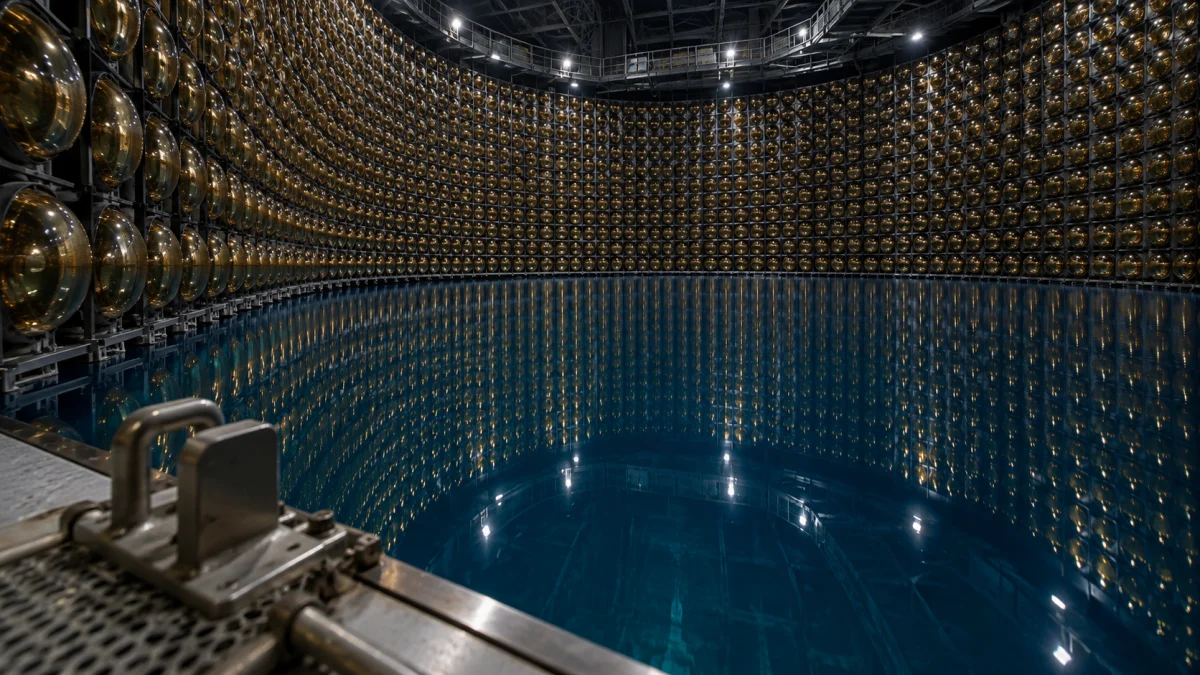
The Super-Kamiokande detector sits underground in Japan. It uses approximately 50,000 metric tons of water inside a cylindrical stainless-steel tank, surrounded by thousands of light-sensitive photomultiplier tubes.
Neutrinos rarely interact with matter. When one interacts inside the detector, it can produce a charged particle that travels fast enough through water to emit faint Cherenkov light. The detector measures that light to reconstruct the event.
This makes water cleanliness an instrument-performance issue. Particles and dissolved substances can interfere with light transmission; radioactive contaminants can create unwanted background signals. The observatory says its continuously circulating purification system removes dust, ions, bacteria, and radon.
But the most revealing detail is that Super-Kamiokande does not always try to remove everything from its water.
Beginning in 2020, researchers deliberately added gadolinium sulfate so that neutrons produced in certain interactions would be easier to detect. A 2021 collaboration paper documents the first loading, while a 2024 paper describes the second loading in 2022, which increased the dissolved gadolinium concentration to roughly 0.03% by mass. The purification system was adapted to remove unwanted impurities while retaining the useful gadolinium.
That is an important correction to the idea that water purity is simply a contest to approach chemically perfect H2O. The target is water with the properties the experiment requires, not water stripped indiscriminately of every useful substance.
Can ultrapure water really dissolve metal? The hammer story versus the experiments
In a 2019 ABC News report from Super-Kamiokande, physicist Mark Vagins described a hammer that had been dropped into the detector and recovered years later. He said the metal inside had deteriorated, leaving a chrome shell.
It is a striking account from a named scientist at the facility. But it is not a controlled corrosion experiment. The report does not establish the hammer’s complete alloy composition, surface condition, exact length of immersion, or the chemical conditions surrounding it. Those missing details matter if we want to know why the hammer changed.
The words dissolution, leaching, and corrosion are also not synonyms:
- Dissolution means a substance enters a liquid as dissolved species. Many salts dissolve readily; an intact piece of metallic copper or stainless steel does not simply behave like table salt.
- Leaching describes constituents moving from a material into contacting water. Trace amounts can be measurable without major structural damage.
- Corrosion is a chemical or electrochemical deterioration process. For metals, it commonly involves oxidation, with rates determined by the surrounding environment and the metal’s protective surface layers.
A low concentration of dissolved ions can favor the release of some constituents from materials, and ultrapure water is especially susceptible to contamination from what touches it. But that observation cannot by itself explain a hollowed-out hammer. For metallic corrosion, we must examine what reactions are possible and what could sustain them.
The controlled copper experiment: 29 months without detected sustained corrosion
In a 2017 study in Corrosion Science, researchers exposed exceptionally pure copper samples to ultrapure, oxygen-free water for as long as 29 months. The copper surfaces were carefully prepared and the samples, water, and containers were analyzed to minimize background contamination.
The investigators measured approximately 6 micrograms of copper per liter in the water but found no detectable copper oxide on the sample surfaces. They reported no evidence of sustained corrosion at the sensitivity of their methods.
That distinction is essential: they did not prove that exactly zero copper atoms entered the water. Their data showed that measurable trace copper was not evidence of the substantial, continuing corrosion proposed in competing explanations.
A 2018 follow-up paper tested related claims with attention to hydrogen evolution and experimental background signals. It likewise found no evidence of sustained copper corrosion above the study’s detection limits in pure, oxygen-free conditions. The literature included conflicting interpretations, which is precisely why the carefully controlled conditions and limits of detection mattered.
The 2026 stainless-steel experiment: corrosion under very different conditions
A September 2026 study in Corrosion Science examined 316L stainless steel partially immersed in ultrapure water under vacuum, in an arrangement relevant to heat pipes.
Here, researchers did observe corrosion, particularly around the liquid-vapor boundary. Their evidence indicated that bubble-related cavitation and cyclic mechanical stress damaged the steel’s normally protective passive film. The authors proposed that subsequent electrochemical reactions, including hydrogen evolution, drove localized metal dissolution. Their reported corrosion products eventually formed a layer that hindered further progression.
That is not a contradiction of the copper result. It is a different metal, a different surface condition, a different operating environment, and a different proposed mechanism. Nor does it show that an ordinary stainless-steel sink will be destroyed by a splash of deionized water.
| Evidence | Conditions | What was observed | What the evidence does not prove |
|---|---|---|---|
| Super-Kamiokande hammer, reported 2019 | Metal tool immersed in detector water for years; detailed material data unavailable | Scientist reported a deteriorated interior and surviving chrome shell | That purity alone caused the deterioration or that all metals behave the same way |
| Copper experiment, 2017 | Carefully prepared copper; ultrapure, oxygen-free water; up to 29 months | About 6 micrograms/L dissolved copper; no detectable surface copper oxide | That absolutely no dissolution occurred, or that copper never corrodes in other water |
| Copper experiments and review, 2018 | Controlled oxygen-free conditions; hydrogen and corrosion-product measurements | No sustained corrosion detected above experimental limits | That other metals or oxygenated environments behave identically |
| Stainless-steel experiment, 2026 | 316L steel; vacuum; liquid-vapor boundary; phase-change and mechanical stresses | Localized corrosion following passive-film damage | That ordinary room-temperature ultrapure water universally attacks stainless steel |
So why does the stainless-steel detector tank survive?
Reasonable inference: If extreme water purity alone caused rapid, indiscriminate destruction of metal, a large stainless-steel detector vessel would present an obvious design problem. Its continued use is consistent with engineers being able to select appropriate materials and control the relevant conditions.
But tank survival by itself is not a corrosion-rate measurement, and we should not claim the tank experiences zero corrosion. The stronger conclusion comes from the experiments: metal identity, dissolved gases, chemistry, surface protection, mechanical stress, temperature, and exposure duration can change the outcome dramatically.
"Pure water is hungry for minerals" is a catchy analogy. It is not a sufficient corrosion mechanism.
Does ultrapure or deionized water dry out your skin?
There is no good basis for claiming that brief contact with deionized or ultrapure water automatically strips minerals from your skin and makes it drier than ordinary water. Skin can become irritated by water exposure, but the conditions and mechanism matter.
The outermost skin barrier, called the stratum corneum, helps retain moisture and resist environmental irritants. Repeated washing, long periods of wet work, detergents, and conditions that disturb that barrier can contribute to dryness and irritation. A 2012 human volunteer experiment found that water exposure exceeding three hours daily increased transepidermal water loss, a measure used to assess barrier disruption.
That study concerned prolonged water contact, not proof that ion-free water is inherently harsher.
Two more direct comparisons are especially instructive:
A 2022 randomized crossover study assigned 43 neonatal intensive-care nurses to alternating periods of conventional tap water and a treatment the authors called ultra-pure soft water. The published results found improved stratum corneum hydration and self-rated skin condition with the treated water, without a statistically significant difference in transepidermal water loss. This was a particular soft-water treatment, not necessarily the same thing as laboratory water at the 18.2 megaohm-centimeter limit.
A 2025 experiment compared saline with deionized water on isolated human outer-skin tissue. In the study published in the Journal of the Mechanical Behavior of Biomedical Materials, saline-treated samples developed substantially greater drying stress than the deionized-water comparison: approximately 209 versus 91 kilopascals, respectively. However, the samples came from a single 96-year-old donor and were examined outside the living body. Those results cannot be generalized into a universal skincare recommendation.
Here is the evidence-based inference: if mineral-free water were intrinsically and unusually damaging to skin, we would expect controlled comparisons to consistently demonstrate that effect. These studies do not. They instead point toward a more complicated relationship involving exposure time, dissolved substances, washing practices, and skin condition.
That does not mean unlimited water exposure is harmless. It means "ultrapure water pulls minerals out of your skin" is an explanation in search of convincing direct evidence.
Does deionized water kill bacteria or disinfect kitchen surfaces?
No, deionized water is not a dependable stand-alone disinfectant. It may help rinse away contaminants, especially when used with physical washing, but removing dissolved mineral ions does not establish reliable antimicrobial activity.
The CDC’s guidance on water in healthcare settings specifically identifies deionizers and ion-exchange softeners as potential bacterial reservoirs and notes that they do not remove endotoxins. A treatment intended to reduce dissolved ions must not be confused with one designed and validated to control microorganisms.
It is fair to ask whether extremely low-mineral water can affect bacteria through osmotic stress. Under some conditions it can affect particular organisms. But microbes differ in their resistance, and a possible biological effect is not the same as consistent surface disinfection. There is also direct experimental evidence of the difference.
A cutting-board experiment provides the clearest answer
In 1999, researchers tested contaminated plastic cutting boards using either electrolyzed oxidizing water or sterile deionized water. The experiment included E. coli O157:H7 and Listeria monocytogenes, with soaking conditions ranging from 5 to 20 minutes at different temperatures.
For E. coli O157:H7 on the smooth plastic boards:
| Treatment | Reduction in recoverable bacteria on the board | What happened in the soaking water? |
|---|---|---|
| Sterile deionized water | Approximately 1.0-1.5 log, equivalent to about 90%-96.8% fewer recoverable bacteria on the board | Pathogens survived in the soaking water |
| Electrolyzed oxidizing water | At least 5.0 log, equivalent to at least 99.999% fewer recoverable bacteria on the board | The tested pathogens were not detected in the soaking water |
A log reduction describes the decrease in organisms recovered under the test conditions. It is not automatically a measure of organisms killed, especially when washing can dislodge them. "Not detected" also means below the method’s detection limit, not guaranteed absolute sterility.
This is the decisive distinction. Deionized water reduced the number of organisms left on the board, but viable pathogens remained in the wash water. Electrolyzed oxidizing water achieved a much larger reduction under the study’s laboratory conditions.
A cleaner-looking or lower-count surface is not the same as a disinfected surface. Some organisms may have been transferred rather than inactivated. Nor should a reader assume the laboratory’s extended immersion results apply to a quick spray or wipe at home.
Why electrolyzed water can disinfect when deionized water cannot
The names are similar, but the underlying processes are almost opposites.
Deionization removes ions from water. Electrolysis uses electrical energy to produce chemical changes in a suitable solution. When a system electrolyzes a chloride-containing solution, it can generate reactive chlorine species, including hypochlorous acid (HOCl). Hypochlorous acid is an antimicrobial oxidant: it can damage essential components of microbial cells.
Not every product marketed as "electrolyzed water" has the same chemistry. Acidic, near-neutral, and alkaline products can have substantially different properties and applications. A 2025 review of food-contact-surface disinfection technologies identifies available chlorine concentration, pH, oxidation-reduction potential, surface type, and organic contamination among the factors affecting antimicrobial performance.
For a legitimate efficacy claim, the questions are concrete: What active antimicrobial species is present? At what concentration? Against which microorganisms? On which surface? For how long? Under what test conditions?
A 2016 experimental evaluation of electrolyzed hypochlorous acid illustrates why those questions matter. Researchers achieved large reductions when directly exposing microbial suspensions to an adequately concentrated solution, yet some applications to contaminated meats produced little or no improvement over controls. A result in a test tube or on one surface does not guarantee the same outcome on every other surface.
There is another irony: some acidic, chemically active electrolyzed-water formulations can corrode equipment under unsuitable conditions. That risk comes from their chemistry and use conditions, not from being exceptionally pure.
Are home electrolyzed-water generators EPA approved?
Not necessarily, and labels are easy to misread.
The EPA’s consumer guide to pesticidal devices explains that hypochlorous-acid generators are generally regulated as devices, which ordinarily do not receive the same premarket EPA registration and efficacy review required for registered antimicrobial pesticide products. Depending on how a generator and its inputs are sold or distributed, however, it may instead be regulated as part of a pesticide product. The regulatory category cannot be determined just from a product calling itself a generator.
An EPA Establishment Number identifies a production establishment. It does not mean the agency approved the device’s safety or verified its antimicrobial performance. An EPA Registration Number identifies a registered pesticide product, whose registration involves product-specific review.
For household use, look for clear, applicable performance claims and directions rather than assuming the terms "natural," "pure," or "electrolyzed" prove anything. Where a disinfectant product is EPA-registered, follow its label for the target surface, organism, wet-contact time, and food-contact rinsing instructions.
EPA also advises not to ingest or apply the output of electrolyzed-water generators to the human body. A surface-treatment product should not be repurposed as drinking water or skincare simply because its main ingredient started as water.
What should you actually use to clean or sanitize a kitchen?
For ordinary household cleaning, the practical answer is much less exotic than the laboratory chemistry.
The CDC’s household cleaning guidance distinguishes three tasks:
- Cleaning uses water, soap or detergent, and physical action to remove dirt and many microorganisms.
- Sanitizing reduces the remaining germs to levels considered safe under applicable public-health standards.
- Disinfecting uses a treatment intended to kill or inactivate specified microorganisms that remain after cleaning.
For most routine household situations, cleaning is sufficient. The CDC recommends washing kitchen counters with hot, soapy water and then sanitizing surfaces contaminated by raw meat, poultry, or their juices. When illness is present, additional targeted disinfection may be appropriate.
| Situation | Evidence-based approach |
|---|---|
| Everyday crumbs, fingerprints, or food residue | Clean with appropriate soap or detergent and water. |
| Cutting board or counter contacted by raw meat or poultry | Clean first, then sanitize using a method appropriate for food-contact surfaces. |
| Hard surface needs disinfection because of illness | Clean first; use a product with relevant validated claims and follow its contact-time directions. |
| You want a spot-free final rinse on compatible equipment | DI water may help avoid mineral spots; it does not replace necessary cleaning or sanitizing. |
| A gadget promises to sanitize with "electrolyzed water" | Check its actual chemistry, supporting tests, intended surfaces, directions, and regulatory status; do not assume the name establishes efficacy. |
The safest default is to use a suitable, clearly labeled sanitizing or disinfecting product rather than improvising chemical concentrations. Never mix cleaning chemicals. For food-contact surfaces, follow any stated rinse requirements and keep chemical treatments away from food unless explicitly authorized for that use.
Is ultrapure or deionized water safe to drink?
Properly manufactured water intended for drinking can be safe even when it contains very few minerals. Distilled water is not inherently poisonous, and the claim that a single glass will pull essential minerals out of the body is not supported by a credible physiological mechanism.
But laboratory or industrial water should never be assumed potable. A supplier may control conductivity for an experiment without establishing food-grade production, microbiological quality, or suitability of its storage equipment. A container labeled "deionized water" is a description of treatment, not permission to drink it.
Long-term mineral intake is a separate question. Drinking water can contribute calcium and magnesium to a person’s overall diet. In its 2005 report Nutrients in Drinking Water, the World Health Organization examined potential consequences of long-term consumption of demineralized water and the rationale for remineralization. That discussion should not be distorted into a claim that every low-mineral drink is acutely harmful.
The practical distinction is between drinking-grade water and technical-grade water, not between water that contains minerals and water that allegedly steals them.
Frequently asked questions
Is ultrapure water acidic?
Ideally pure water is approximately neutral at 25 degrees Celsius. Once dispensed, it readily absorbs atmospheric carbon dioxide, which can lower its pH. Its very low ion content also makes conventional pH measurement difficult and unstable. A low pH reading after air exposure is not evidence that the freshly produced water was secretly a powerful acid. See the technical discussion of ultrapure-water pH.
Does pure water conduct electricity?
Yes, slightly. Water naturally contains minute concentrations of hydrogen and hydroxide ions even with no added salts. Ultrapure water has extremely low conductivity, but not literally zero conductivity.
Why does ultrapure water stop being ultrapure when left in a glass?
It can absorb carbon dioxide and airborne contaminants and extract trace substances from the container itself. This is why demanding laboratories monitor water quality near the point of use rather than assuming an open beaker will retain its initial purity.
Is deionized water the same as distilled water?
No. Deionization removes charged dissolved species, while distillation separates many impurities through evaporation and condensation. Either process may be combined with additional purification steps, but neither name alone certifies sterility.
Can deionized water kill germs through osmosis?
Exposure to low-solute water can stress certain cells, but organisms differ greatly in their response. Bacteria may remain viable, as the controlled cutting-board experiment demonstrated. Osmotic stress is not a substitute for a validated disinfection process.
Is hypochlorous acid the same as pure water?
No. Hypochlorous acid is a chemically active chlorine-containing species that can be present in appropriately produced electrolyzed water. Its antimicrobial properties come from that reactive chemistry, not from exceptional water purity.
What the full evidence tells us
The most useful way to test the dramatic claims is to follow their implications.
If extraordinary purity alone destroyed metal, controlled exposure of different metals should produce broadly similar, substantial damage. It does not. Some experiments detect little or no sustained corrosion; others find corrosion when particular materials and physical conditions permit it. This rules out purity as a sufficient explanation, though it does not rule out material-specific corrosion.
If removing ions reliably disinfected water, deionized-water systems should not harbor bacteria and viable pathogens should not survive in DI wash water. Both observations occur. The missing factor is a demonstrated antimicrobial mechanism, not another round of mineral removal.
If mineral-free water automatically stripped and dried skin, direct comparisons should consistently show greater damage from treated low-mineral water. The available studies do not demonstrate that pattern. They are limited, but they undermine the universal claim.
The broader conclusion is straightforward: purity describes what a water sample contains. Corrosion depends on chemical reactions and the materials involved. Skin effects depend on exposure and biology. Disinfection depends on validated antimicrobial action. Treating those as the same property is what makes the stories sound more mysterious than the underlying science.
References and Further Reading
Particle physics and water-quality standards
- Super-Kamiokande: Detector — Kamioka Observatory, University of Tokyo. Primary description of the 50,000-tonne detector, its stainless-steel tank, water purification, and gadolinium upgrade.
- Inside the ‘secret underground lair’ where scientists are searching the galaxies — ABC News, 2019. Original reporting attributing the recovered-hammer account to physicist Mark Vagins; an anecdote rather than a controlled corrosion study.
- First Gadolinium Loading to Super-Kamiokande — Super-Kamiokande Collaboration, 2021. Documents the 2020 gadolinium addition and selective recirculation process.
- Second Gadolinium Loading to Super-Kamiokande — Super-Kamiokande Collaboration, 2024. Reports the 2022 increase in gadolinium concentration.
- ASTM D1193-24: Standard Specification for Reagent Water — ASTM International. Current standard separating reagent-water types and microbiological requirements.
- Water Quality Monitoring — Merck. Technical account of ultrapure-water conductivity and resistivity.
- Water Contaminants: Types, Sources and Impacts in the Lab — Merck. Explains contamination from air, containers, and storage.
Controlled corrosion research
- Copper in ultrapure water, a scientific issue under debate — Ottosson and colleagues, Corrosion Science, 2017. Copper exposure up to 29 months, including measurements of trace dissolved copper and surface oxidation products.
- Corrosion of copper in pure O2-free water? — Hedin and colleagues, Corrosion Science, 2018. Controlled tests and interpretation of competing copper-corrosion claims.
- Corrosion behavior of 316L stainless steel partially immersed in ultrapure water under vacuum conditions — Corrosion Science, September 2026. Identifies localized corrosion in a specialized vacuum/phase-change environment.
Skin and drinking-water research
- Evidence of increased skin irritation after wet work: Impact of water exposure and occlusion — Human study, 2012. Measures barrier effects of repeated, prolonged water exposure.
- Effects of ultra-pure soft water on the hands of nurses in a neonatal intensive care unit: A randomized crossover study — Contact Dermatitis, 2022. Compares skin hydration and barrier measures under two washing-water conditions.
- Quantification of the mechanical effects of saline on human ex vivo stratum corneum — Journal of the Mechanical Behavior of Biomedical Materials, 2025. A limited laboratory comparison of saline- and DI-water-treated outer-skin tissue.
- Nutrients in Drinking Water — World Health Organization, 2005. Reviews possible nutritional implications of long-term consumption of demineralized drinking water.
Microbiology, sanitization, and regulation
- Inactivation of Escherichia coli O157:H7 and Listeria monocytogenes on plastic kitchen cutting boards by electrolyzed oxidizing water — Venkitanarayanan and colleagues, Journal of Food Protection, 1999. Direct experimental comparison of electrolyzed oxidizing water and sterile deionized water.
- D. Water: Infection Control — CDC. Notes bacterial reservoirs and endotoxin limitations in deionization systems.
- Process Technologies for Disinfection of Food-Contact Surfaces in the Dry Food Industry: A Review — Microorganisms, 2025. Reviews electrolyzed-water chemistry and factors that affect its effectiveness.
- Evaluation of Electrolytically-Generated Hypochlorous Acid (‘Electrolyzed Water’) for Sanitation of Meat and Meat-Contact Surfaces — Foods, 2016. Experimental evidence showing effectiveness varies significantly with the material and application.
- Pesticide Devices: A Guide for Consumers — U.S. Environmental Protection Agency. Explains device versus pesticide-product regulation, label numbers, and hypochlorous-acid generator considerations.
- When and How to Clean and Disinfect Your Home — CDC. Guidance for routine cleaning, food-contact surface sanitizing, and targeted disinfection.
Editorial currency note (October 14, 2026): Scientific mechanisms are generally durable, but reagent-water standards, disinfectant labels, EPA regulatory guidance, and product-specific claims can change. Follow the current label and governing guidance for any product used to sanitize or disinfect food-contact surfaces.