
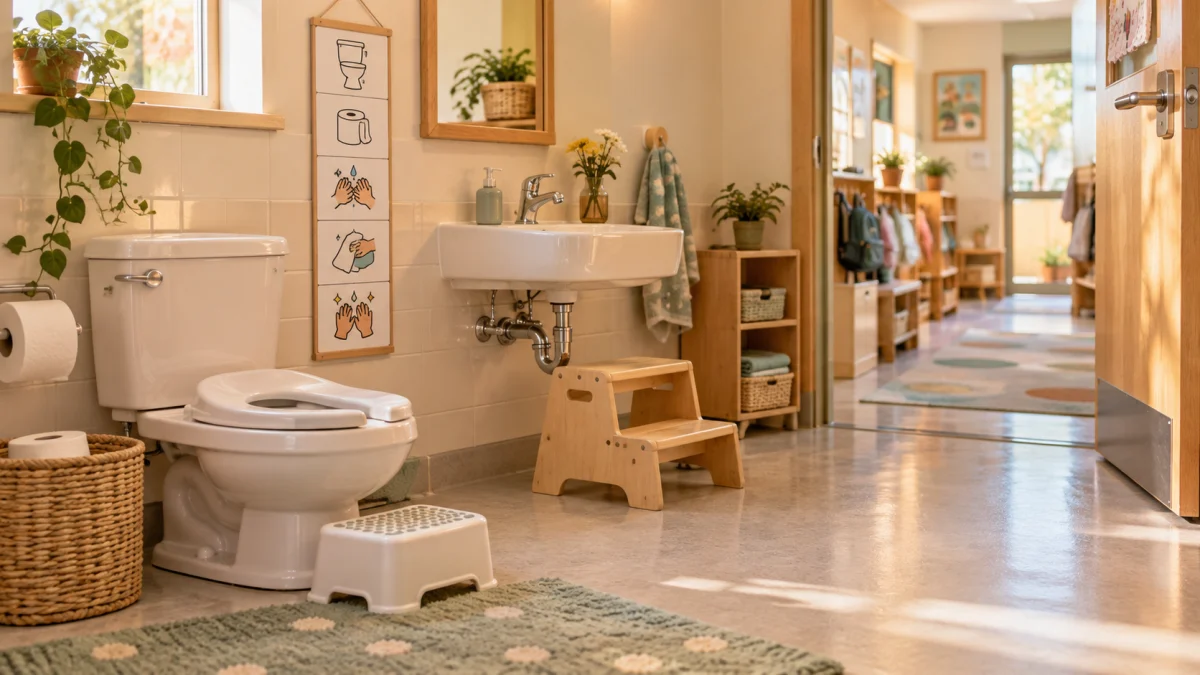
An autistic child can use the toilet successfully at home and still struggle to urinate at preschool. That does not necessarily mean toilet training has failed. Home and school may require different skills: recognizing the need to go, communicating with a less familiar adult, interrupting an activity, tolerating a different bathroom, sitting comfortably, and relaxing enough to urinate.
The practical response is to check for medical contributors, identify what changes between home and school, and agree on a small, consistent support plan. Repeatedly taking the child to the same toilet in the same way is unlikely to help if the obstacle remains unidentified.
Consider a four-year-old who uses the bathroom at home when a parent asks and accompanies him. At preschool, a teacher brings him to the restroom, sometimes separately from the group. He sits, gets up without peeing, and later wets his clothes. The school may describe this as refusing to go. The parent may reasonably suspect discomfort in public bathrooms.
Either explanation might be partly right, but neither is established. An accident later in the day does not prove his bladder was full during the earlier attempt. Nor does sitting on a toilet prove he was comfortable enough to release urine. The first task is to determine what is happening, not to assign intent.
For families seeing this pattern, three steps are worth taking together:
- Tell the pediatrician about repeated apparent holding and daytime accidents, especially if the pattern is persistent or changing. Ask about constipation, urinary symptoms, and whether further evaluation is warranted.
- Compare successful home visits with school attempts, including the last time the child actually urinated, the physical setup, the adult’s cues, privacy, noise, and distress.
- Ask the school for a written, feasible routine with a predictable opportunity, a clear communication cue, an assigned adult and backup, an agreed response when no urine is passed, and a brief record of results.
The goal is comfortable, regular urination at school, not merely a dry pair of pants at pickup.
What being potty trained at home does—and does not—tell us
A child who sits and pees reliably at home has learned something important. But it helps to distinguish supported toilet use from independent toileting across settings.
At home, a parent may notice the likely time, ask a familiar question, walk with the child, help with clothing, use a familiar seat, wait without pressure, and recognize when he is finished. All of those supports may be part of the successful routine. A school may unintentionally remove several of them at once.
Toileting is not one indivisible skill. It includes:
- Noticing bladder sensations or responding to a routine before urgency becomes overwhelming.
- Communicating the need for the toilet, help, privacy, or a break.
- Stopping play and moving to another room.
- Managing clothes and positioning safely on a toilet.
- Feeling secure enough to relax and urinate.
- Getting cleaned up and returning to the activity.
A child may manage some steps independently and need help with others. This is also why difficulty using an unfamiliar bathroom is not automatically regression. Regression would involve losing a skill that was previously established in that same context or across contexts, rather than not yet using it successfully in a new one.
The distinction matters for expectations. If a child still usually needs an adult prompt at home, expecting him to notice, request, transition, and urinate independently at school may skip several intermediate steps. The immediate school goal may simply be a comfortable, confirmed urination with predictable support. Independence can be built from there.
Why might an autistic child sit on the school toilet but not pee?
There is no single autism-specific explanation. Several possibilities can produce the same outward behavior, and more than one can apply at once.
| Possible obstacle | What adults might notice | What to investigate |
|---|---|---|
| The timing is wrong | A child sits calmly, does not pee, then has an accident much later. | When was the last confirmed urination? How long is the school day? When are drinks offered? |
| The bathroom feels different | The child hesitates near the doorway, tenses, covers ears, or rushes to finish. | Flushing, hand dryers, lighting, smells, crowding, toilet size, seat stability, and privacy. |
| The school routine adds demands | Difficulty increases when children queue, are hurried, or leave a preferred activity. | Could the child go before or after the group, using a predictable transition? |
| The support is different | The child pees with a parent or particular adult, but not with other staff. | Exact words, gesture, pacing, position, help with clothes, and adult proximity at home. |
| The child cannot easily communicate | The child seems distressed, leads someone by the hand, or has no reliable way to request a bathroom break. | Is a familiar gesture, picture, word, or AAC option available and understood by staff? |
| There is physical discomfort or a bladder/bowel problem | Straining, pain, frequent small amounts, unusually long gaps, bowel symptoms, or repeated accidents. | Pediatric assessment, including constipation and urinary symptoms. |
This table is a troubleshooting framework, not a diagnostic test. A child who appears calm could still be uncomfortable; a child who resists could be experiencing pain rather than an ordinary transition difficulty.
The child may be managing the visit, but not the urination
A school can count a bathroom visit as completed because the child entered, sat, stood up, washed hands, and returned to class. From a staffing perspective, the routine happened. From a bladder-health perspective, the essential outcome may not have happened at all.
The distinction is particularly important when the child is not able to describe whether he felt an urge, was frightened, or tried to urinate but could not begin. Record a toilet sit and an actual pee as different events.
Sensory and privacy differences may matter
Bathrooms differ in ways adults often overlook. A child accustomed to a small, quiet home bathroom may encounter unpredictable flushing, children waiting nearby, echoing sounds, strong smells, a cold or unstable seat, or dangling feet at preschool.
These are possibilities, not proof that sensory sensitivity is the cause. The UK children’s bladder-and-bowel charity ERIC describes ways to adapt the bathroom environment to individual sensory needs. That advice is best used experimentally: observe the child, change one relevant feature, and see whether comfort or successful urination improves.
A child who needs a quieter bathroom visit is not necessarily asking for a permanent private attendant. A different point in the classroom schedule, a stable footstool, or staff avoiding an unexpected flush during the attempt might be sufficient. Other children will need more substantial support.
Body signals may be difficult to interpret—but do not assume this
Interoception refers to sensing and interpreting internal bodily signals. It is sometimes discussed in connection with autism and toileting. However, noticing a full bladder, recognizing its meaning, communicating about it, and voluntarily beginning urination are different processes.
A child who relies on prompts might benefit from a predictable routine even if he senses his bladder normally. Conversely, a child who understands the question "Do you need to pee?" may not be able to answer it reliably at every moment. The useful question is not whether autism explains the problem in general, but which cue or support helps this child use the toilet comfortably.
Check for medical contributors before calling it a behavior problem
Repeated school accidents are worth raising with a pediatrician. That does not mean every four-year-old with occasional wet underwear has a medical disorder. The National Institute of Diabetes and Digestive and Kidney Diseases (NIDDK) notes that occasional daytime wetting can still occur at ages four to six. But an established pattern of apparent withholding, difficulty starting, or newly frequent accidents deserves more than a disciplinary explanation.
A clinician may ask about:
- Constipation, including painful or unusually large stools, withholding, or stool accidents. A child can have bowel movements regularly and still retain stool that contributes to urinary symptoms. The American Academy of Pediatrics’ guide to voiding dysfunction in children with neurocognitive disorders explains this connection.
- Urinary infection symptoms, including burning, fever, urgency, frequent small voids, abdominal or back pain, and unusual urine appearance.
- Infrequent urination or postponement, where a child goes long periods without emptying the bladder.
- Incomplete emptying or difficulty starting, especially with straining, a weak or interrupted stream, or leaking afterward.
- Other changes, including unusual thirst, large urine volumes, weight loss, new medications, or a loss of previously reliable continence.
The NIDDK’s guidance on symptoms and causes describes how holding, constipation, urinary tract infections, and bladder-coordination problems can contribute to daytime wetting. Diagnosis begins with the history and examination; a clinician may use a urine test or other testing when indicated, rather than automatically ordering specialized studies for every child.
For a broader bowel-health explanation, see sherafy.com‘s autism and constipation guide.
When to seek care sooner
Get emergency care if a child appears unable to urinate and has significant lower-abdominal pain, swelling, or distress. Acute urinary retention can require urgent treatment, as explained by Great Ormond Street Hospital. Do not respond to suspected painful retention by prolonging a toilet-training session.
Contact a healthcare professional promptly for painful urination, fever with urinary symptoms, blood in urine, a weak stream, marked changes in urination, or an unusually long interval without a confirmed pee—especially if the child is uncomfortable or seems unwell. NIDDK recommends assessment within 24 hours for symptoms suggestive of a bladder or kidney infection or an unexplained fever. Do not use a fixed number of hours as a universal definition of safety; hydration, recent urination, illness, and symptoms change the assessment.
A pediatric appointment is also appropriate for persistent accidents or apparent holding without urgent symptoms. Bring a brief home–school record and ask whether constipation, urine testing, or a continence referral needs consideration. The Royal Children’s Hospital’s daytime-wetting guideline describes the role of symptom history, a bladder diary, posture, and treatment of associated constipation.
The most useful first investigation: when did the child actually pee?
Before changing everything about the bathroom routine, establish a basic timeline. A common communication problem is that adults record "bathroom at 10:30" even though no urine was passed.
The NIDDK recommends a bladder and fluid diary when evaluating wetting. Families can simplify that idea for a busy preschool. For an initial three to five school days, ask staff to record just the essential events while parents note relevant home information. This is a practical trial period, not a medically validated deadline and not a reason to postpone care.
| Time or event | What to record |
|---|---|
| Before school | Last confirmed pee at home; relevant bowel symptoms; unusual morning changes. |
| Offered bathroom | Time; solo or group; whether the child sat; urinated yes / no / unknown. |
| Child’s response | Calm, rushed, hesitant, distressed, straining, or no clear concern. |
| Accident | Time wet clothing was noticed; actual time of wetting if known; changing assistance needed. |
| Drinks and breaks | Ordinary drink opportunities and any child-initiated bathroom requests or cues. |
| Handover | Last confirmed pee and anything important for the next caregiver to know. |
No one needs to watch the child continuously, estimate urine volume from clothing, or photograph private toileting. If staff cannot verify whether urination occurred, "unknown" is a valid entry.
The record may reveal different problems:
- No confirmed urination during a long school day: ask the pediatrician about the pattern while examining timing, communication, and comfort at school.
- Accidents consistently after an unsuccessful sit: review when the child last peed, whether a later opportunity is needed, and whether urgency or discomfort is visible.
- Success with one adult but not others: compare the adult’s cues and level of support before assuming the child prefers or rejects a particular person.
- More difficulty around a crowded group visit: trial a quieter, shorter transition.
- New pain, straining, or other urinary symptoms: prioritize medical assessment rather than increasing demands.
One important limitation: an accident discovered after lunch may have happened earlier. Record when it was noticed unless the timing is actually known. False precision makes the diary less useful.
What parents can practice at home without starting toilet training over
Preserve the home routine that works. The aim is to make that success portable, not to remove every helpful prompt at once.
Start by writing down the sequence in plain language. For example: the parent asks a familiar question, waits, walks beside the child, helps with clothing if needed, uses a stable seat, stays nearby, and offers quiet reassurance. Include the child’s own gestures or words. Then compare that sequence with school.
Choose one manageable difference at a time:
- Have another trusted adult use the same successful cue and setup at home.
- Practice the usual steps in another quiet, familiar bathroom when the child is comfortable and there is a natural opportunity to go.
- Use the same small picture or communication cue that school can use. Include messages such as bathroom, help, hurt, too loud, wait, and all done, as appropriate for the child.
- If a particular school-bathroom feature appears difficult, introduce it gradually and without pressure. Simply entering, standing near, or sitting comfortably may be useful practice before urination becomes the goal in that setting.
- If permitted, consider one brief parent-assisted familiarization visit at preschool, followed by a planned handoff to staff. This should be a bridge, not a permanent expectation that parents come to school for each toilet visit.
ERIC provides visual schedules and simple social scripts for toileting. These can make the sequence clearer, but a visual schedule will not correct constipation, urinary pain, or a physical difficulty emptying the bladder.
For a child who does not consistently speak to unfamiliar adults, gestures, pictures, and other augmentative and alternative communication (AAC) methods are legitimate ways to request help. The American Speech-Language-Hearing Association’s AAC practice guidance describes communication methods ranging from gestures to picture boards and speech-generating devices. sherafy.com‘s AAC guide for autistic children explains how to make a system usable across home and school.
Do not deliberately withhold water, make the child postpone urination to create a learning opportunity, or push large amounts of fluid without medical guidance. The NIDDK’s bladder-health advice supports regular bathroom opportunities and age-appropriate fluid intake, individualized to the child.
What preschool can realistically do when staff cannot provide one-to-one care all day
A useful plan should distinguish brief, predictable support at specific moments from a dedicated aide who follows a child throughout the day. The former may be workable in a busy classroom; the latter is a different staffing decision and is not automatically necessary.
The starting question should be: What is the smallest reliable change that could address the barrier we have observed?
| School support | A feasible starting version | What must be agreed on |
|---|---|---|
| Timing | Choose a predictable bathroom opportunity based on the child’s actual urination pattern, perhaps before or after the group. | When it occurs and how to respond if the child asks at another time. |
| Adult responsibility | One staff role handles the usual prompt, with a designated backup. | Who assists, what help is needed, and what happens during absences. |
| Communication | Use the same short phrase, gesture, picture, or AAC option as home. | Where the cue is kept and how the child can ask outside scheduled visits. |
| Physical comfort | Stable sitting position, feet supported where needed, manageable clothing, and a quieter moment if possible. | Which accommodations are available and safe for that bathroom. |
| Unsuccessful attempt | End calmly, record "sat, no pee," and follow an agreed re-offer or health-escalation plan. | How staff decide on the next opportunity and whom to inform. |
| Accident care | Spare clothing, prompt help, privacy, and a matter-of-fact response. | Who helps, where supplies are kept, and how parents are notified. |
| Review | A brief check-in after roughly one or two weeks of consistent implementation. | What changed, whether staff could deliver the plan, and what still needs adjustment. |
These are practical suggestions drawn from pediatric guidance and the logic of individualized support. They are not a single research-validated protocol for every autistic preschooler.
Make the timing reasonable, not relentless
For children with daytime bladder problems, NIDDK describes timed voiding every two to three hours as one common component of bladder training. That is general clinical guidance, not a rule that a child must urinate on command every two hours or that every preschooler needs an identical schedule.
If a child peed shortly before arriving and attends a short preschool session, there may be little urine to pass at the first group bathroom trip. If the day is longer and there is no confirmed urination, the next opportunity matters more. Ask the pediatrician for individualized guidance if unusually long gaps or other urinary symptoms are part of the pattern.
For a school with limited resources, one well-chosen, calm opportunity may provide better information than several poorly timed attempts. A second opportunity can be added according to the child’s observed pattern and the school’s staffing reality. Bathroom access should still be available when the child requests it; a schedule is a backup, not permission to ignore a request.
Don’t assume "go alone" fixes the problem
A teacher may already be separating the child from the group but getting the same result. That is useful information: crowding may not be the only obstacle. The next test should look at the remaining differences—who prompts, whether the child has foot support, how long after the last pee the attempt occurs, whether the bathroom feels predictable, and whether the adult stays nearby in the way the child expects.
Staff should not be asked to invent a new intervention on the spot each day. A written sequence can be as simple as:
"Show the familiar bathroom picture. Give the usual verbal cue. Walk with him. Help with clothing if needed. Offer a secure, comfortable sit without pressure. If he urinates, note it. If he does not, end calmly and mark ‘no pee.’ Follow the agreed next-opportunity plan."
The precise words, degree of help, and timing should be individualized, and the child’s discomfort or refusal to continue should be respected. A clinician’s advice takes priority when there are symptoms of abnormal bladder emptying.
A workable plan must also have a backup
An arrangement that works only when one particular teacher is present is fragile. Agree on who takes over when that person is absent and how substitute staff learn the routine. If the school says it cannot provide a proposed accommodation safely without leaving other children unsupervised, ask what it can do consistently and whether a formal team meeting is needed to address additional services or staffing.
A vague promise to "try harder" is not measurable. A modest plan with clear responsibilities is.
What should staff do when the child sits but does not pee?
Do not treat the sit as a successful bladder-emptying event. Do not force the child to remain seated until urine appears.
A reasonable response is:
- Finish calmly. Do not scold, interrogate, or make the child feel that leaving the toilet without peeing is a failure.
- Record the outcome accurately: bathroom visit, no confirmed urination.
- Look at the context: time since the last confirmed pee, whether the child seemed uncomfortable, and whether the setup was different from home.
- Use the agreed next opportunity. This may mean offering again later, rather than repeating the same request immediately; the plan should account for health symptoms and the child’s usual pattern.
- Escalate concerning patterns. Pain, straining, a weak stream, prolonged inability to urinate, or other red flags call for medical input—not longer sitting.
Short, predictable attempts can be more manageable than open-ended demands. A small 2012 school-based toilet-training study by Cocchiola and colleagues included sits capped at three minutes. That is an example from a specific intervention, not a universal prescription. The children in that study were not already reliably using the toilet at home, so its protocol should not simply be copied into this different situation.
The crucial distinction is between a child who did not need to pee yet and a child who needed to pee but could not comfortably or effectively do so. A teacher cannot always tell the difference; the diary, the child’s signals, and medical assessment help narrow it down.
What does the research on autism and toilet training actually show?
Research supports individualized instruction and coordination, but the evidence is less definitive than many online potty-training programs imply.
A 2022 systematic review by Simon and colleagues identified 26 autism toilet-training intervention studies. The authors found that conclusions were limited by small samples, relatively weak study designs, and inconsistent outcome reporting. They called for more attention to developmental skills, communication, and family needs.
School-based reports offer more specific lessons. In Cocchiola and colleagues’ study, five young children with autism or developmental delays learned toileting skills through a structured school program. But those participants had not previously succeeded at home or school. That is different from a child who can already urinate reliably at home.
In a 2021 classroom study by Cagliani, Snyder, and White, four elementary-age autistic students ultimately met the study’s toileting criteria. The intervention included scheduling, reinforcement, communication supports, and other components. Crucially, the classroom had at least five staff present daily, and the program took place in a specialized setting. Those results do not establish that a standard preschool with fewer available adults can deliver the same intensive intervention.
A 2024 published review by Donnelly and Karsten focused on barriers that can complicate toilet training for children with developmental disabilities, including excessive urine retention, recurring accidents, and difficulties initiating bathroom trips. Its practical lesson is that barriers may require changes to the intervention, rather than simply more of the same intervention.
What is supported: Assess the child’s specific difficulty, consider health and comfort, teach or preserve communication, use predictable routines, and coordinate among caregivers. What is not established: One best schedule, reward system, sit length, or sensory strategy for every autistic child who urinates at home but not at school. Nor do these small studies establish how quickly any one child should improve.
How to tell whether the plan is working
A dry school day is not the same as successful school toileting. A child who stays dry only because he avoids urinating until pickup may still be struggling.
Track outcomes that matter:
- Confirmed urination at school: Did the child actually pee, not just sit?
- Comfort: Is there less hesitation, strain, fear, or distress?
- Access: Can the child request help and get a reasonable bathroom opportunity?
- Accidents: Are they less frequent, without the child having to hold urine longer?
- Feasibility: Did the agreed routine actually happen on ordinary school days, including when staff were busy?
- Independence over time: Can the child eventually initiate, transition, or complete more steps with less help without sacrificing comfort?
Early progress may mean simply entering the bathroom calmly or having the first comfortable pee there. Later progress may mean reliable urination with more than one adult. No evidence supports imposing an arbitrary deadline by which an individual child must accomplish these steps.
If there is no meaningful improvement despite consistent support, or the child continues to have distress or long periods without confirmed urination, revisit the pediatric assessment and ask whether school supports need to change. Depending on what is found, the relevant professionals might include a pediatrician, pediatric urology or continence service, speech-language pathologist, occupational therapist, or the school special-education team. A specialist’s role should follow the identified problem, not merely the autism diagnosis.
How much toileting help is a school required to provide?
In the United States, the answer depends on whether the child attends a public preschool, receives special-education services, or is enrolled in private childcare. A school having limited staffing is a real operational concern, but it is not the end of the inquiry. The question is what individualized assistance is needed, who is responsible for providing it, and which legal framework applies.
Public preschool: raise functional toileting needs with the IEP team
For an eligible child receiving services under the Individuals with Disabilities Education Act (IDEA), the individualized education program (IEP) covers more than academic instruction. Federal IEP regulations at 34 C.F.R. § 300.320 address a preschool child’s participation in appropriate activities, functional needs, measurable goals, special education, related services, supplementary aids, and supports for school personnel. The IEP also identifies the frequency, location, and duration of listed services.
Federal related-services regulations at 34 C.F.R. § 300.34 include school health and nursing services when required for the child to benefit from special education. Whether a particular toileting-related service is needed is an individualized determination.
This does not mean every autistic preschooler has a right to a full-time one-to-one aide. It does mean that when toileting difficulty affects participation, parents can ask the team to consider and document practical supports rather than relying on informal assurances.
Useful questions for the IEP meeting include:
- Does the plan identify toileting as a functional participation need?
- What exact prompts, accommodations, personal assistance, or health-related supports are needed?
- Who implements them, and what training or backup is required?
- How will staff record whether the child actually urinates?
- What will trigger a review if the current support is ineffective?
Children without an IDEA IEP may have different protections under Section 504 in covered programs. For the broader distinctions, see sherafy.com‘s guide to autism at school, IEPs, and 504 plans. Families can request a formal evaluation or meeting rather than assuming the only options are full independence or full-time aide support.
Private preschool or daycare: reasonable modifications depend on the program
The U.S. Department of Justice’s ADA guidance for childcare centers states that covered centers generally must make reasonable policy and practice modifications for children with disabilities, with an individualized assessment rather than stereotypes. For toileting assistance, relevant considerations include whether staff already help other children after accidents, whether the requested help would leave other children unattended, and whether the change would fundamentally alter the program.
The same guidance says the ADA generally does not require a private childcare center to hire additional staff or provide constant one-to-one supervision. It also does not permit a center to reject a child solely on assumptions about disability or to avoid evaluating reasonable options. Religious-entity exemptions and state laws may affect coverage; operating inside a religious building is not necessarily the same as being run by a religious organization.
There is another important distinction: a child who is eligible for public special education may attend a parent-chosen private preschool, but the services available at that private site are not automatically identical to what an IEP requires in a public placement. The school district still has obligations to make a free appropriate public education available to eligible preschoolers; exactly where and how services are offered requires clarification with the district. The U.S. Department of Education addresses this distinction in its guidance on parentally placed children with disabilities in private schools.
For a practical conversation, ask the center what assistance it routinely provides, what modest modifications are feasible, and what further evaluation or coordination may be needed. Parents do not have to begin by demanding an aide; schools should not end the conversation by saying only that staff are busy.
A short script parents can use
"Our child uses the toilet at home with a familiar prompt and adult support. At school, he often sits without urinating and later has an accident. We want to figure out what is different, check for medical contributors, and agree on a written plan that staff can realistically follow. Could we review the timing, bathroom setup, communication cue, who will help and cover absences, what happens after a no-pee visit, and how we will measure whether it is working?"
For a public-school IEP meeting, add: "If these supports are needed for him to participate, how will we document them and the responsible services or staff supports in his IEP?"
A one-page home–school toileting plan to copy and share
The following is a working template, not a prescribed treatment protocol. Complete it with the family, school, and relevant clinician. Keep only information the staff actually need and follow the child’s privacy and health-information rules.
| Plan item | Agreed information |
|---|---|
| Child’s familiar toilet cue | ______________________________ |
| How the child requests bathroom / help / stop / pain | ______________________________ |
| What works at home (adult, phrase, positioning, clothing help) | ______________________________ |
| Last confirmed pee before arrival: who reports it? | ______________________________ |
| Preferred school bathroom and useful changes | ______________________________ |
| Planned opportunities (adjusted for school day and medical guidance) | ______________________________ |
| Staff role responsible / backup role | ______________________________ |
| If child sits but does not pee | ______________________________ |
| When parents or healthcare staff should be contacted | ______________________________ |
| Accident care, clean clothes, and privacy arrangements | ______________________________ |
| How actual urination / accidents / comfort are recorded | ______________________________ |
| Date to review the plan and person coordinating | ______________________________ |
Small daily record: Date | Last confirmed pee | School toilet offer(s) | Actual pee: yes/no/unknown | Accident noticed | Comfort/concern | Staff initials
Review questions: Did he urinate at school? Was he comfortable? Was the plan consistently delivered? Are medical concerns emerging? What one change is worth testing next?
If a child is distressed, appears unable to urinate, or has clinician-specific instructions, that takes priority over completing the log or following the ordinary schedule.
Common questions parents ask
Is my child still potty trained if he only pees at home?
He has established toileting skills in a familiar setting. He may still need support transferring those skills to school and developing greater independence with prompts, requests, and unfamiliar bathrooms. Calling him simply trained or untrained can obscure the practical problem.
Does wetting later prove he was deliberately holding it earlier?
No. The accident shows that the day’s arrangement did not reliably prevent wetting. It does not establish how full the bladder was at the earlier attempt or whether the child was deliberately withholding. A timeline and medical history are more informative than a judgment about intent.
Should the teacher make him stay on the toilet until he pees?
No. Prolonged or forced sitting can increase distress and does not resolve an underlying medical or environmental obstacle. Agree on a brief, comfortable attempt and a plan for the next appropriate opportunity. A clinician should evaluate difficulty starting urine, straining, or painful withholding.
What if he is comfortable at school but simply will not go?
Comfort at the doorway or while sitting does not prove that urination feels comfortable or is physiologically easy. Check when he last peed and whether the seat, support, cue, and opportunity are appropriate. If the pattern persists, ask the pediatrician to assess possible bladder or bowel contributors.
Can constipation cause pee accidents even if a child poops most days?
Yes. The American Academy of Pediatrics’ voiding-dysfunction guidance explains that retained hard or large stool may contribute even when bowel movements appear regular. Parents should describe stool consistency, pain, size, withholding, and soiling to the clinician rather than assuming frequency alone rules it out.
Does my child need to ask verbally before staff will take him?
No. He may communicate using speech, a gesture, a picture, or AAC, and caregivers should respond to meaningful communication. The communication method needs to be available at school and familiar to adults, including substitutes.
Does the school have to give him a one-to-one aide?
Not automatically. Public-school supports are individually determined through the applicable educational process, including the IEP when a child is eligible. Covered private childcare programs have reasonable-modification obligations, but the ADA generally does not require additional hiring or continuous individual supervision. Start by defining the actual task and staffing need, then escalate if a workable plan cannot be delivered.
How long should we keep trying before changing the plan?
There is no evidence-based deadline that applies to every child. A short initial log and a review after approximately one or two weeks are practical coordination steps, not a promise of continence by that date. Seek medical assessment earlier for symptoms, concerning withholding, or distress. If the same school routine repeatedly fails, change the hypothesis or the support rather than continuing indefinitely without review.
The decision that matters
If a child pees at home but not at preschool, the useful question is not whether the school or child is trying hard enough. It is what makes the home routine work, what changes at school, and whether a health issue is contributing.
A workable plan protects three things at once: the child’s physical comfort, access to ordinary school activities, and the staff’s ability to deliver the agreed support. For some children, that may mean a different bathroom time and a familiar cue. Others will need clinical evaluation, communication support, or formal educational accommodations. No one should have to guess which it is indefinitely.
References and Further Reading
Pediatric bladder and bowel health
- NIDDK — Symptoms and Causes of Bladder Control Problems and Bedwetting in Children. U.S. National Institutes of Health. Explains daytime wetting, urine holding, constipation, urinary symptoms, and signs that warrant medical attention.
- NIDDK — Diagnosis of Bladder Control Problems and Bedwetting in Children. Describes medical evaluation and the value of a bladder-and-fluid diary.
- NIDDK — Treatment of Bladder Control Problems and Bedwetting in Children. Outlines individualized management, timed voiding, treating constipation, and reinforcement of participation rather than punishment for wetting.
- Cornwell, L. — Bladder Control Issues (Voiding Dysfunction) in Children With Neurocognitive Disorders. American Academy of Pediatrics, HealthyChildren.org, 2024. Discusses bladder emptying, posture, constipation even with regular stools, and when specialist evaluation may be needed.
- Royal Children’s Hospital Melbourne — Clinical Practice Guideline: Urinary Incontinence, Daytime Wetting. Clinical guidance on history, red flags, bladder diaries, positioning, bowel symptoms, and assessment.
- Great Ormond Street Hospital — Urinary Retention. Explains the distinction between difficulty emptying the bladder and acute retention requiring emergency care.
Autism and school-based toileting research
- Simon, M., et al. — Toilet Training Interventions for Children With Autism Spectrum Disorder: A Systematic Review. Research in Autism Spectrum Disorders, 2022. Reviews 26 studies and highlights limitations in study size, design, outcomes, and attention to individual skills and family needs.
- Cocchiola, M. A., et al. — Toilet Training Children With Autism and Developmental Delays: An Effective Program for School Settings. Behavior Analysis in Practice, 2012. Five-child school study using structured scheduled visits and short sits; participants had not already achieved home continence.
- Cagliani, R. R., Snyder, S. K., and White, E. N. — Classroom Based Intensive Toilet Training for Children With Autism Spectrum Disorder. Journal of Autism and Developmental Disorders, 2021. Four-child elementary classroom study with encouraging outcomes but intensive components and substantial staffing.
- Donnelly, M. G., and Karsten, A. M. — Resolving Barriers to Continence for Children With Disabilities: Steps Toward Evidence-Based Practice. Behavior Analysis in Practice, published online 2023 and in a 2024 volume. Reviews barriers such as urine retention, accidents, and initiation difficulties, and how interventions may need to be modified.
Communication and practical bathroom supports
- ASHA — Augmentative and Alternative Communication: Practice Portal. Professional guidance on gestures, pictures, communication boards, speech-generating devices, and functional communication access.
- ERIC — Sensory Needs and Toileting. Specialist practical guidance on identifying sensory barriers and adapting bathroom conditions; not proof that sensory differences explain a particular child’s difficulty.
- ERIC — Help With Toileting. Social scripts and visual-sequence resources that families and schools can tailor.
U.S. school and childcare obligations
- U.S. Department of Education — 34 C.F.R. § 300.320: Definition of an IEP. Governs the inclusion of functional needs, goals, services, supplementary aids, personnel supports, and the details of implementation.
- U.S. Department of Education — 34 C.F.R. § 300.34: Related Services. Defines related services, including qualifying school health and nursing services.
- U.S. Department of Justice — Commonly Asked Questions About Child Care Centers and the Americans With Disabilities Act. Federal guidance on individualized assessment, reasonable modifications, toileting help, staffing limitations, and religious-provider exceptions.
- U.S. Department of Education — Questions and Answers on Serving Children With Disabilities Placed by Their Parents in Private Schools. Clarifies the important distinction between private preschool enrollment and the school district’s responsibility to make appropriate public special-education services available.
Editorial scope and currency: This article is an evidence-informed parent guide, not an individualized diagnosis, treatment protocol, or legal opinion. The research and federal guidance linked above were checked on October 12, 2026. Individual medical recommendations, school procedures, state law, and program obligations may differ. The suggested home–school template and review intervals are practical editorial tools, not interventions proven effective for every child. Clinical review by a qualified pediatric professional is recommended before publication and whenever the advice is applied to a child with ongoing symptoms.